
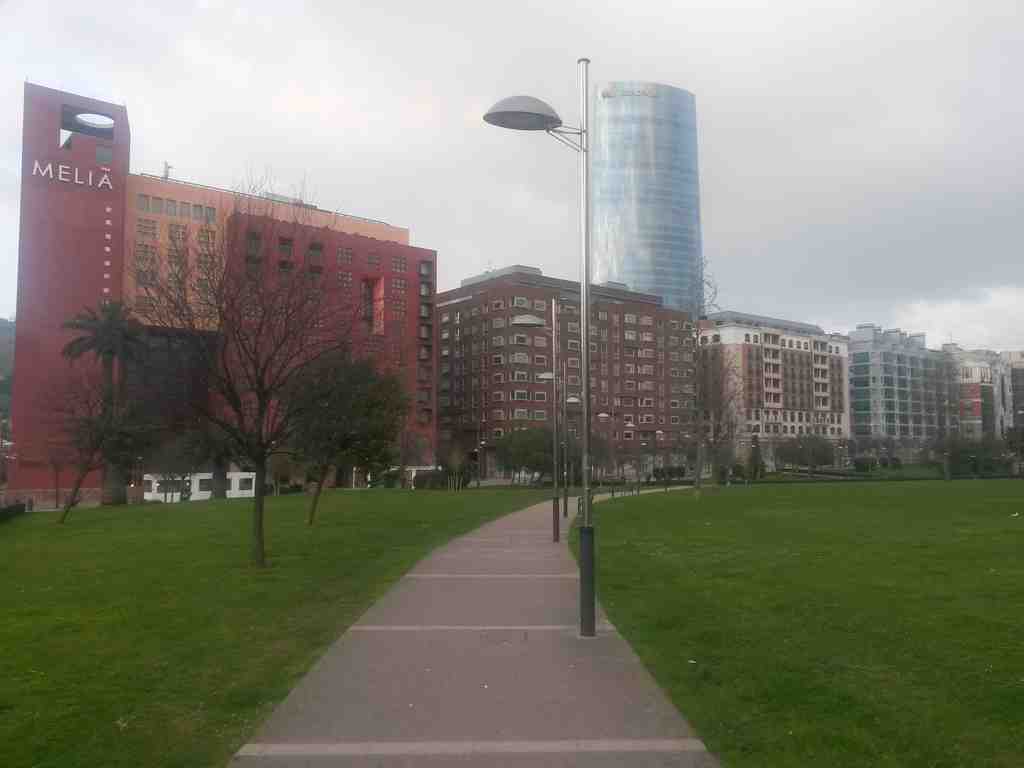
Notice the paved, gently curving pathway ahead, framed by the blocky, reddish-brown facade of the hotel on your left and the sleek, cylindrical glass skyscraper rising in the distance. We just left the quiet halls of the Fine Arts Museum behind us, but out here on the pavement, a distinctly different kind of cultural battle played out. When we walk down a city street, we rarely pause to think about the name written on the metal signs above us. But those plaques are very real battlegrounds where history is actively rewritten and erased in the modern era. A street name dictates who a society chooses to remember, and perhaps more importantly, who it deliberately decides to forget, burying their legacy beneath the quiet footsteps of everyday pedestrians.
This path, Paseo Eduardo Victoria de Lecea, looks incredibly peaceful now. Yet the name it carries is the direct result of a fierce legal fight over memory itself. Originally, this very walkway was named after Rafael Sánchez Mazas. He was a recognized writer, but he was also a founding member of the Falange, the Spanish fascist political party, and a minister during Francisco Franco's regime.
The Falange was an extremist organization that supported the military uprising leading to the Spanish Civil War, promoting severe authoritarian rule... a system of government demanding absolute obedience to the state. When Spain passed laws to remove public honors for those who aided the dictatorship, the Bilbao city council initially resisted changing this street's name. They argued that the plaque honored Sánchez Mazas strictly for his literary and cultural contributions, entirely separate from his political career. In essence, the city wanted to separate the art from the artist.
But a local memorial association called Lau Haizetara Gogoan refused to let that stand. They took the city to court. In October of two thousand fourteen, a judge delivered a definitive and forceful ruling against the city council. The court stated that the man's artistic facet, which actually included co-writing the official fascist anthem, was a minor footnote compared to his major role in establishing a brutal dictatorship. Following that ruling, the mayor finally signed the order, and the old plaques were officially stripped from the walls.
In their place came Eduardo Victoria de Lecea. He was a liberal, nineteenth-century mayor of Bilbao from a deeply rooted political family. He served two terms long before the civil war, in the eighteen sixties and eighties. During his tenure, he was deeply involved in the civic expansion of Bilbao, even initiating the construction of the current City Hall building over the ancient ruins of a convent. He was also a man who opened the grand salons of his home for literary evenings and amateur theater, promoting culture without the dark shadow of oppression.
By walking this path today, you are stepping over a conquered legacy. You are experiencing the silent, ongoing struggle over civic space, where a fascist shadow was legally erased to honor a mayor who actually helped build the modern city.
The struggle over who gets a pedestal and who gets forgotten does not end here. Let us walk further down the pathway and step under the welcoming canopy of the trees ahead, where another complex piece of history waits for us inside Casilda Iturrizar Park.




