
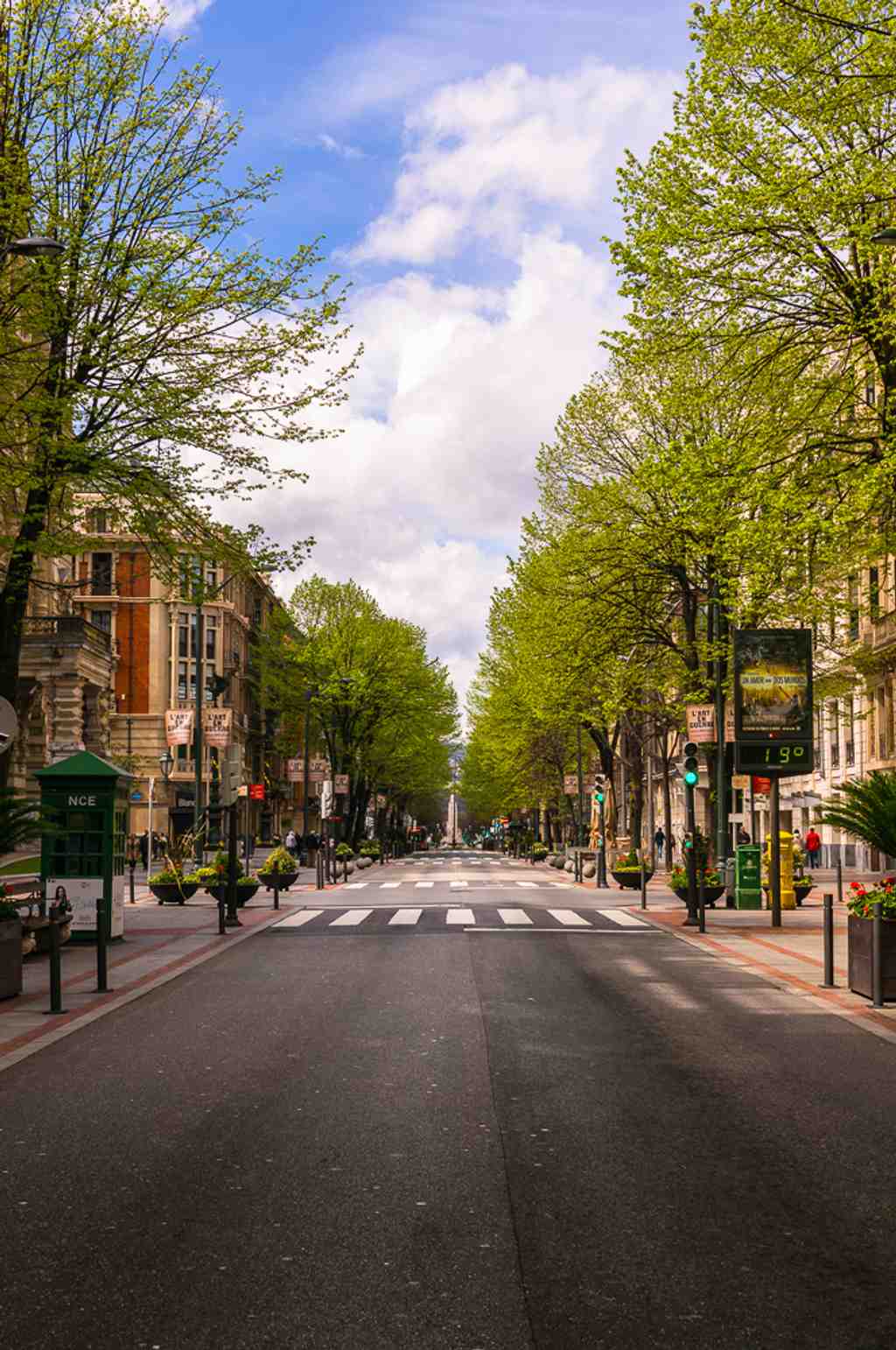
Turn your attention to the Gran Vía, which stretches out as a wide ribbon of smooth asphalt, framed by towering, ornate stone facades and a perfectly straight line of leafy shade trees. We just left the quieter charm of Calle Iparraguirre, and now you are standing on the edge of Bilbao's most commanding artery. This is the Gran Vía de Don Diego López de Haro.
The creation of this avenue is a story of immense ambition, revealing how a city's very shape is dictated by those who hold power. In the late nineteenth century, a new and fiercely competitive bourgeoisie was rising, fueled by the explosive industrial wealth of local iron mines and sprawling shipyards. They were amassing fortunes on a scale this region had never seen, and they desperately needed a grand, sweeping stage to display their newfound dominance. The cramped, medieval streets of the old town could no longer contain their massive aspirations, so they demanded the construction of an entirely new city district. This avenue was built to be their ultimate, unapologetic showcase.
To anchor this massive display of modern power in deep history, the city named the thoroughfare after Diego López the Fifth of Haro. He was the formidable Lord of Biscay who originally founded the town of Bilbao back in the year thirteen hundred.
This magnificent street became the centerpiece of the Ensanche plan. Ensanche is a Spanish urban planning term that simply means expansion or widening. Presented in eighteen seventy six, this successful plan adopted modern European urban solutions, mimicking cities like Barcelona by utilizing gridded streets with chamfered, angled corners to open up intersections.
But this triumph of design was born from a hidden struggle for space. Fourteen years earlier, in eighteen sixty two, an engineer named Amado de Lázaro proposed the very first expansion plan for Bilbao. He envisioned a city of wide open public spaces, prioritizing parks and breathing room for the everyday residents.
The ruling elite immediately and aggressively rejected his proposal.
They publicly dismissed his design as utopian and disproportionate. What they really meant was that his vision did not carve out enough profitable land for their railways, their heavy industry, and their palatial residential blocks.
Space in Bilbao was a battleground, and the industrialists won. The city handed the reins to a trio of pragmatic designers: Severino Achúcarro, Pablo de Alzola, and Ernesto de Hoffmeyer. This trio gave the elite exactly what they wanted, laying down a boulevard fifty meters wide and a kilometer and a half long.
As you look down its length, you can imagine the grand buildings that quickly rose here, like the Provincial Council Palace. Inaugurated in nineteen hundred, it is a staggering example of Alfonsine eclecticism, an architectural style characterized by heavy, highly decorated classical elements. Critics at the time argued the facade was far too excessive and flashy. The wealthy owners brushed off the criticism, declaring that such extreme lavishness was absolutely necessary to prove the region's prosperity to the world.
This immense industrial wealth did not just reshape the physical streets of Bilbao, it also profoundly shaped its culture. Let us follow the lingering echoes of that fortune




