
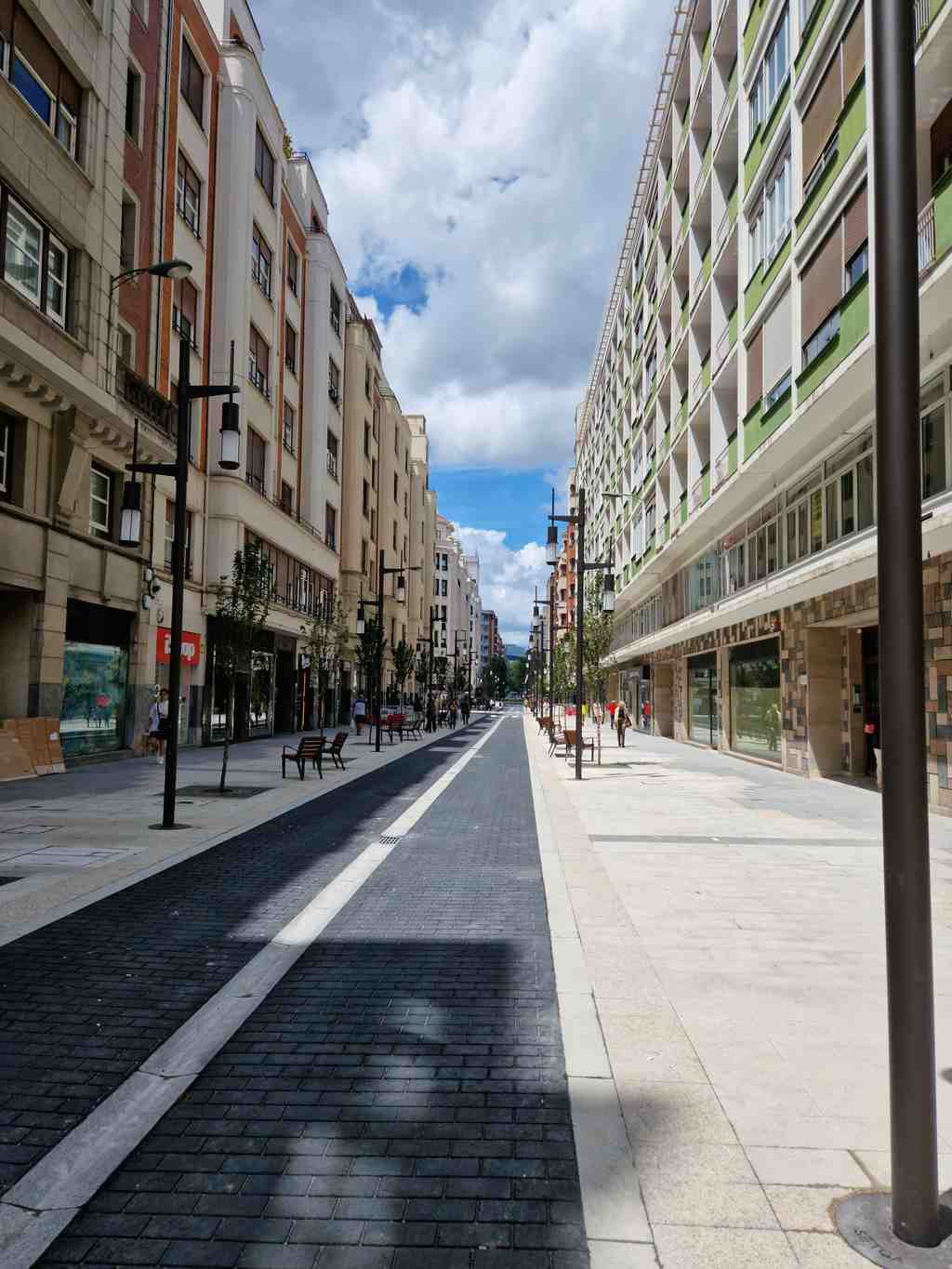
To your right at the roundabout, you will find the entrance to Rodriguez Arias Street, marked by a curved stone facade, an ornate blue metal street sign, and a stretch of smooth gray paving slabs leading into the distance.
This wide avenue feels incredibly polished today. But the gritty reality is that Bilbao's soaring elegance was funded largely by heavy maritime industry, smoke, and massive naval contracts. This street is a perfect example of how money shapes a city's memory. It is named after Rafael Rodriguez Arias, a nineteenth-century Spanish Minister of the Navy. He was not from Bilbao, nor was he a local hero. The city honored him for a purely economic reason. During his tenure, he awarded Bilbao the contracts to build three cruisers for the Spanish Navy. This massive injection of capital fueled the local shipyards and enriched the city's industrial tycoons.
That decision left a complicated legacy. Today, local anti-military groups regularly protest the street's name. They argue that public spaces should not glorify a man whose legacy is tied to warships and destruction, suggesting instead that the street honor figures of non-violence. It is a quiet but persistent struggle over who gets to be remembered in the very fabric of the city.
As you look down the street, notice the distinct architecture from the 1930s. This area is famous for Art Deco buildings. You will find portals designed in Zigzag Moderne, a style defined by sharp, geometric angles and stepped facades. Right alongside them are examples of Streamline Moderne. This is an architectural style that mimics the aerodynamic curves of ships and airplanes, featuring smooth, rounded corners and horizontal lines. It gives the block a cinematic elegance. In fact, the first iteration of the Bilbao Fine Arts Museum, which we visited earlier, was quietly housed right on this street before moving to the park.
But beneath this refined surface, tension over how this space is controlled never really stops. Recently, a major bank headquarters at the start of the street was demolished to make way for a luxury complex called Residencial Acrux. The demolition quickly became an engineering nightmare. Workers realized the bank's structure physically overlapped with the historic residential building next door. To avoid collapsing the neighboring apartments, heavy machinery was banned. Workers had to dismantle concrete pillars completely by hand, stretching the demolition into seven grueling months.
The friction here is not just structural. Just down the block, residents recently launched a fierce campaign against the city over a nightclub. Locals documented massive crowds taking over the street at dawn with flares and fireworks, demanding their right to sleep. Decades earlier, the stakes were much higher. During the violent political upheavals of the 1970s, an apartment at number 56 was the home of a student militant for the separatist group ETA. He later fled the country, and police eventually identified him as one of the men who assassinated a local mayor in 1976.
From naval warships and political violence to luxury apartments and neighborhood noise disputes, this street holds the heavy, often unseen weight of the city's evolution. Now, we are going to follow that trail of industrial wealth a bit further. Let us head deeper into Indautxu, about a five-minute walk away, where this maritime money eventually built an entire neighborhood of sprawling elite villas.




