
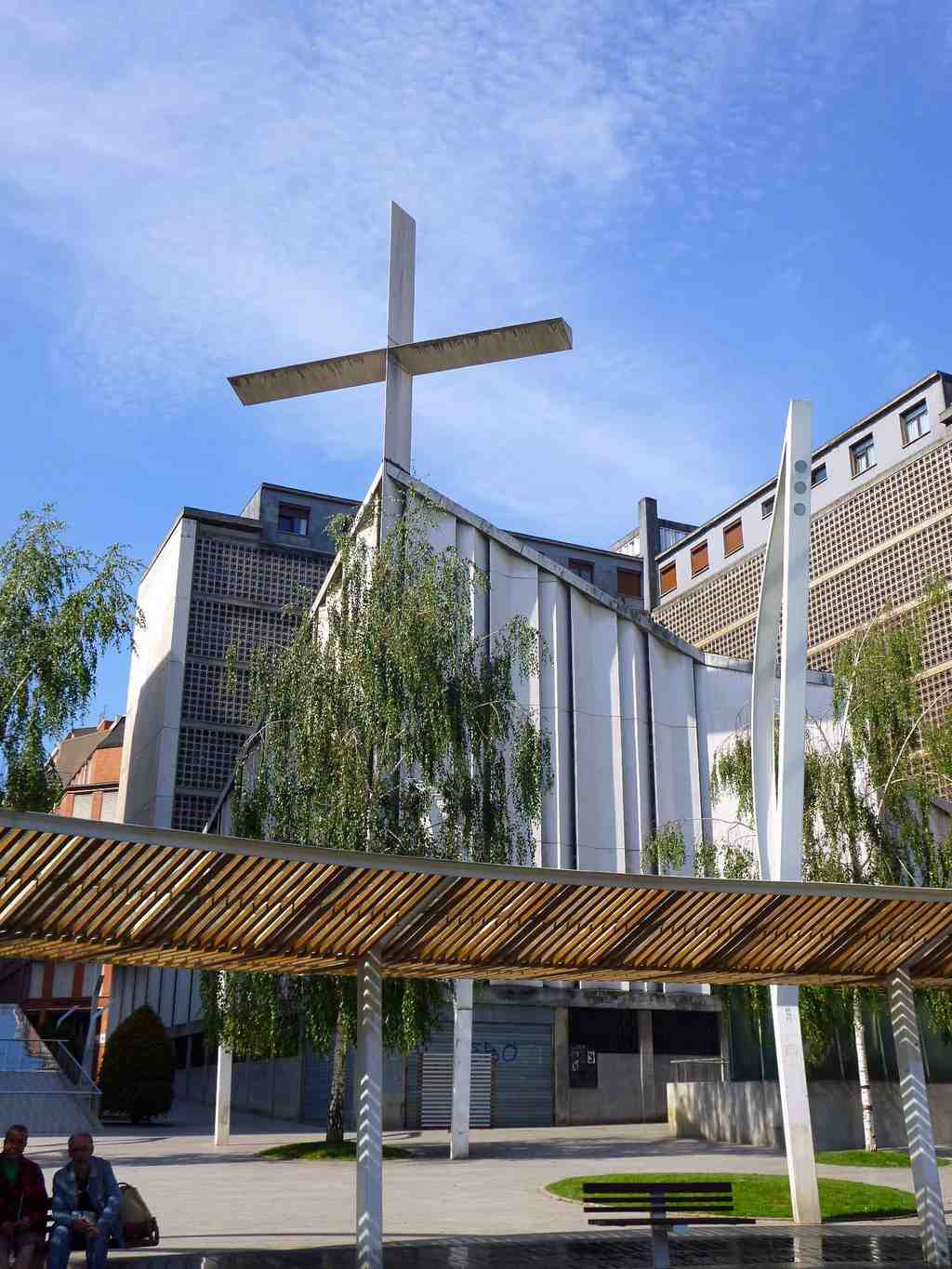
To your right stands the Church of Nuestra Señora del Carmen, easily recognizable by its vertically ribbed white concrete walls that form a sharp pyramidal shape, all crowned by a massive, unadorned cross.
Just steps from the bustling heart of Indautxu where we stood a few minutes ago, this bold, aggressively modern structure holds a deeply buried history of ambition, erased legacies, and the fierce battle for urban space. The story begins back in nineteen zero seven, when two highly influential brothers, Plácido and José Allende-Plágaro, donated this land to build a new church. The brothers were wealthy power players in Bilbao. Plácido, for instance, was a prominent mining engineer and one of the original founders of the Banco de Vizcaya. In a tragic twist of fate, Plácido died the very month the church was finally inaugurated in nineteen eleven, never living to see the finished result of his grand religious donation.
That original church was designed by Leonardo Rucabado, a young architect for whom this project was a profound professional turning point. With this building, he definitively abandoned his early modernism and fully embraced historicism. Historicism was an architectural movement dedicated to reviving romantic, medieval European building styles in an attempt to forge a unified national identity. His design featured classic gothic vaults and romantic arches. Thanks to his close ties to the wealthy Allende-Plágaro family, Rucabado effectively monopolized the grand architectural projects of this rapidly growing neighborhood.
But as the city swelled, the elegant little church became hopelessly overcrowded. Long before the current modern structure was ever conceived, an astonishing, pharaonic plan nearly changed the face of this neighborhood forever. In nineteen forty four, another famed architect named Ricardo Bastida proposed demolishing Rucabado's delicate work entirely to build the absolute largest temple in all of Bilbao. His design was a colossal concrete basilica featuring massive parabolic arches. These are steep, mathematically curved vaults designed to carry immense weight without the need for inner columns. It was designed to hold four thousand people. The proposed budget was a staggering six point seven million pesetas, an astronomical sum that translates to tens of millions of dollars in today's money.
Bastida's colossal design included two massive, asymmetrical brick towers meant to visually overpower the surrounding plaza. But this raw display of architectural dominance collided hard with the city's meticulous urban planners. Municipal architects Hilario Imaz and Estanislao Segurola were completely alarmed by the sheer scale of the looming monument. They argued the brick design lacked the architectural dignity required for the neighborhood and would utterly ruin the public aesthetic. The dispute grew so bitter that the initiative was permanently paralyzed. The ambitious blueprints were shoved into a drawer forever, and the original chapel was temporarily saved from the wrecking ball.
Yet, the reprieve did not last. By nineteen sixty seven, the congregation had grown so large that Rucabado's original historicist church was demolished without any hesitation. The physical legacy of the founding brothers was wiped from the map entirely to make way for the stark, pyramidal structure of concrete you see today. The city's face shifted once again, burying its past to accommodate the present.
Our journey through the shifting layers of this city continues. We are now heading to a street named after a formidable woman who fiercely defended her own birthright against immense opposition. It is just a four minute walk away, leading us to María Díaz de Haro Street.




