
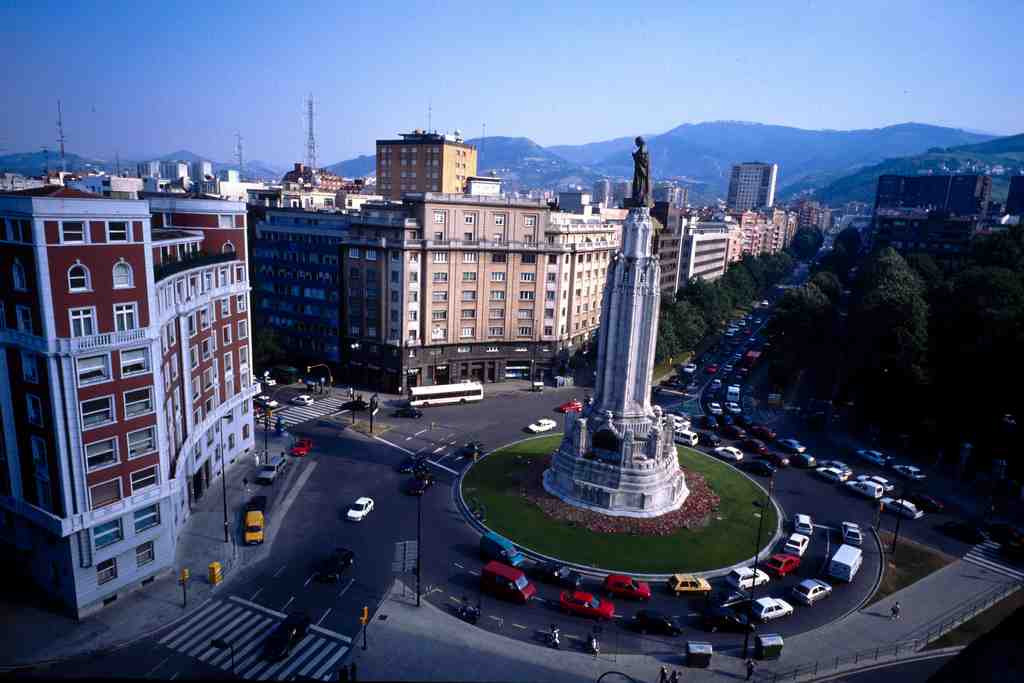
Directly in front of you stands a massive limestone obelisk soaring into the sky, crowned by a ten-meter bronze statue of Jesus with his arms wide open. This towering structure acts as the grand, concluding punctuation mark to the Ensanche expansion, the meticulously planned urban grid we walked through earlier.
Back in 1920, an anonymous local proposed erecting a monument right here. The sheer scale of the idea demanded a massive international contest, launched in 1923. It drew over seventy proposals from top architects and sculptors across Europe... from Germany to Italy to Belgium. The jury ultimately chose a staggering design by Pedro Muguruza and Lorenzo Coullaut Valera. At forty meters tall, it was so ostentatious that locals called it a bilbainada... a term used for the wonderfully exaggerated, over-the-top undertakings typical of Bilbao.
But after its inauguration in 1927, this quiet monument became the epicenter of a fierce political war. During the Second Republic in 1933, Spain embraced a new constitution establishing laicism, the strict separation of church and state. Citing this new secular law, republican leaders pushed to demolish the towering religious symbol. A republican councilman attacked the work as a provocation. Conversely, Basque nationalist politicians fiercely defended it, arguing the law should not crush the beliefs of the people.
The tension culminated in a razor-thin council vote... twenty-three votes in favor of demolition, and twenty-one against. The statue was doomed. Yet, when citizens heard the news, they formed resistance pickets around this very base, physically blocking the assault guards. The chaos was so intense that the civil governor publicly criticized the political manipulation of the statue, famously asking... who assures us that Jesus Christ hasn't become a republican?
The monument survived, but its meaning was soon hijacked. When fascist troops captured Bilbao in 1937 during the Spanish Civil War, the new dictatorship carved the names of their fallen soldiers into the limestone base. They appropriated a purely religious piece to exalt an authoritarian regime.
Even recently, the fight over this space continued. During a 2004 restoration, the city removed a large bronze inscription at the feet of the statue that read Reinaré en España, meaning I will reign in Spain. This sparked bitter accusations. Conservative factions accused the city of ideologically censoring the word Spain. However, defenders of the removal pointed out that the inscription was never part of the original design... it was an addition forced upon the monument by the dictatorship in 1940.
Every inch of this statue represents a century of factions fighting to claim the physical and historical landscape of Bilbao. Now, let us turn toward the river, where the polished city gives way to its heavy industrial roots, as we head toward the Euskalduna Conference Centre just a short walk away.




