
To your right is a dark blue enameled street plaque with crisp white lettering, mounted directly onto the smooth stone corner of the building. You are standing at the edge of María Díaz de Haro Street. This long avenue cuts straight through the heart of the city, but its very placement is a permanent, defiant piece of urban irony.
You see, María Díaz de Haro was known as the Good, the legitimate tenth Lady of Biscay. But in the year twelve ninety-five, her uncle, Diego López the Fifth of Haro, usurped her title with the backing of local nobles. María spent years fighting against being erased from the line of succession, battling medieval intrigue to reclaim her birthright. She finally succeeded in thirteen ten when her uncle died. In a twist of fate, it was María who officially confirmed Bilbao's founding charter that same year, taking ownership of a decree her usurping uncle had issued a decade prior. Today, her street directly and perpetually intersects the Gran Vía of Don Diego López de Haro, forcing her rival uncle to cross her path forever.
The defiant spirit of this street did not end in the Middle Ages. In the late nineteenth century, city ordinances strictly classified this entire area as the outskirts. That meant building residential apartments was illegal, with land reserved exclusively for factories or farmhouses. But several rebellious landowners simply ignored the law. They began constructing their own unauthorized mini-ensanches. These developers, however, were essentially building rogue, miniature city blocks right under the council's nose. They engaged in a fierce legal tug-of-war, forcing the city to adapt to their chaotic development until it was finally formalized in nineteen o six.
In more recent times, this asphalt witnessed struggles of a much darker nature. In the nineteen eighties, the street hosted the very first traffic headquarters of the newly formed Basque police. But on an April night in twenty twelve, following a football match, the police launched a controversial charge into a crowded alleyway perpendicular to this street. They fired rubber bullets to disperse the fans. Twenty-eight-year-old Iñigo Cabacas was struck in the head and died days later. The loss of the young fan was a profound shock.
The tragedy fractured the relationship between the city and its police. That small alley transformed into a grieving sanctuary of flowers, candles, and photographs demanding answers. His parents led an agonizing legal battle against an incredibly flawed investigation, eventually securing a conviction for a commanding officer and forcing a total overhaul of police riot protocols.
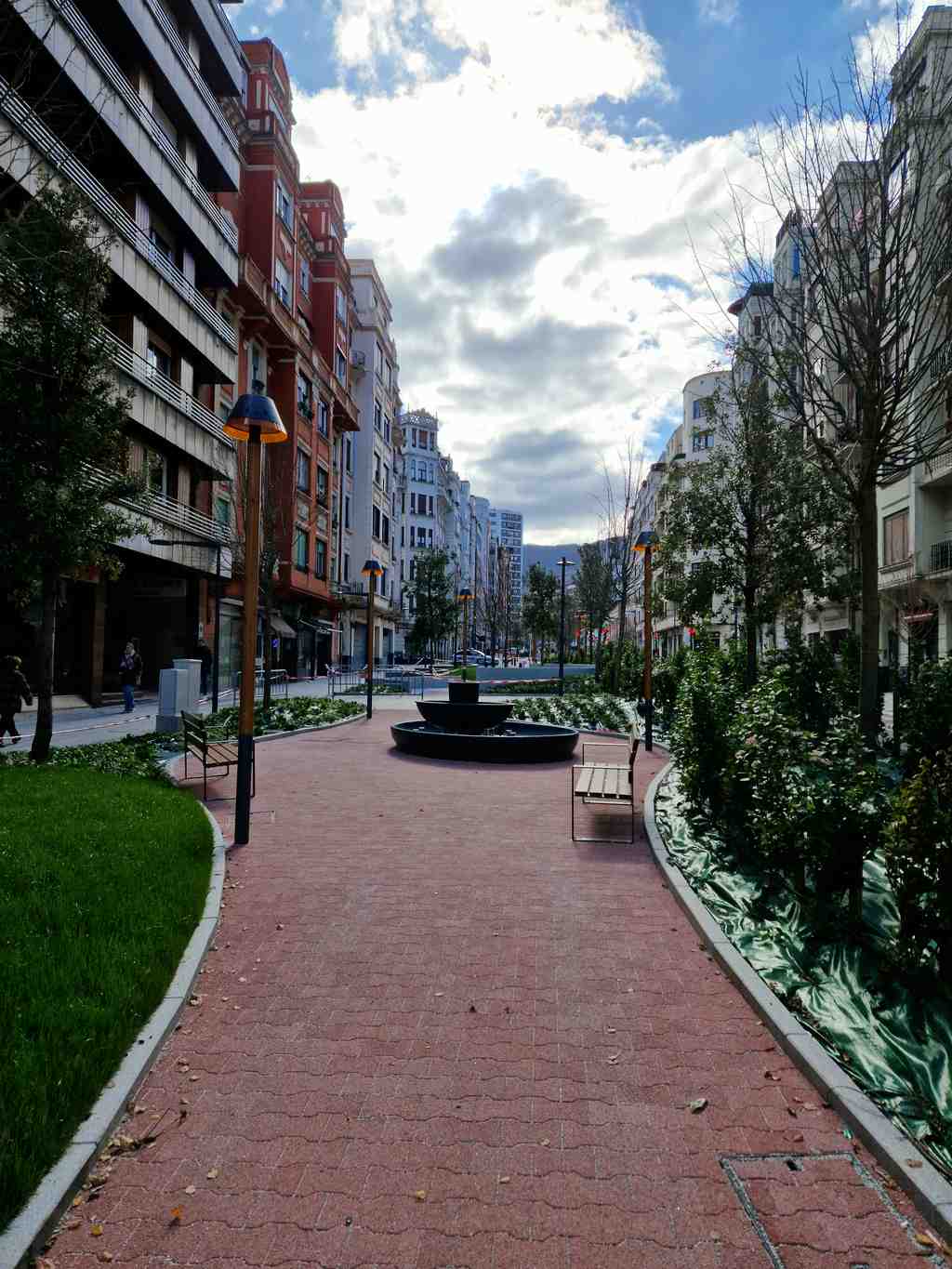
Now, this battle-scarred street is finding peace. Through a massive, multi-year urban project, it is being reborn as a green corridor. The lanes of traffic have been drastically reduced, making way for wide pedestrian spaces, new trees, and an innovative central median filled with vegetation. Neighbors who endured years of disruptive construction trenches finally have a quiet, pacified space to sit and breathe.
It is a fitting evolution for a street born from defiance, now claiming its own serene space. Let us continue to the end of the Gran Vía, where a massive monument awaits us. Our next stop, Plaza del Sagrado Corazón de Jesús, is about an eight minute walk away.




