
Trieste Audio Tour: Echoes of Empires and Hidden Wonders
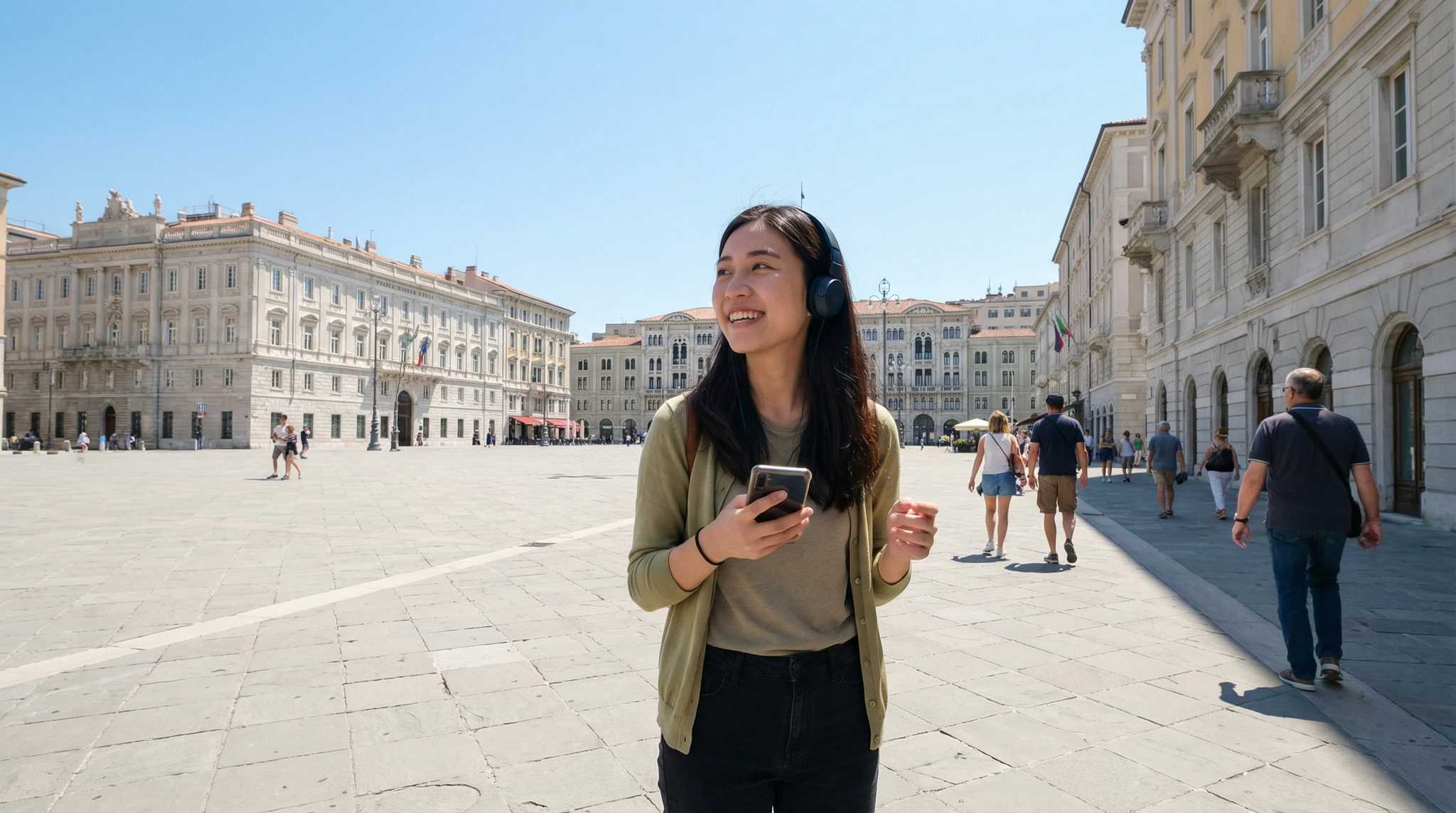
Moonlight once revealed secret messages across Piazza Unità d'Italia as spies and revolutionaries played a deadly game beneath its grand facades. Trieste is no ordinary port city—its polished palaces and public squares are stitched with intrigue, rivalry, and traces of lost empires. This self-guided audio tour leads you through its heart, unlocking stories and corners that slip past hurried visitors. Each stop uncovers a chilling, exhilarating, or delightfully odd moment buried in the city’s stones. Who risked everything in Narodni dom’s fiery hours of revolt? What shadowy deal echoed through the halls of Carciotti Palace? And why was a certain lamppost in the piazza once at the center of a Viennese scandal? Move along noble promenades and hidden alleyways. Feel the rise and fall of power and passion with every step. This is Trieste unmasked—dramatic, layered, and utterly new from every angle. Press play and let the city’s secrets call you into the light.
Tour preview
About this tour
- scheduleDuration 70–90 minsGo at your own pace
- straighten2.0 km walking routeFollow the guided path
- location_on
- wifi_offWorks offlineDownload once, use anywhere
- all_inclusiveLifetime accessReplay anytime, forever
- location_onStarts at Postal and Telegraphic Museum of Central Europe
Stops on this tour
lock_open 3 free previews · 11 unlock with purchase
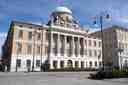
Look for the colossal yellow neo-Renaissance palace dominated by a central clock tower and grounded by a heavy, grey rusticated stone base. This isn't just a museum; this is the…Read moreShow less
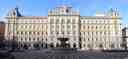
Look for the colossal yellow neo-Renaissance palace dominated by a central clock tower and grounded by a heavy, grey rusticated stone base. This isn't just a museum; this is the Palazzo delle Poste, the Post Office Palace. And honestly, it is a miracle that it is standing here at all. When they started building this in 1894, this land was unstable marshland, sitting right on top of old salt flats. To keep this seven-thousand-square-meter beast from sinking into the mud, the engineers had to drive five thousand wooden piles deep into the subsoil. It is a massive engineering triumph disguised as a government building. The architect, Friedrich Setz, was the master of imperial communication; he designed twenty-six post offices across the Austro-Hungarian Empire. But if you look closely at the details, you realize Setz had a sense of humor. On the side facades, there are sculptures of cherubs. But they aren't playing harps. They are little postmen! One is blowing a postal horn while holding a whip, and another is carrying a delivery bag. It is this wonderful, human touch on a building meant to project serious imperial power. Inside, the museum preserves the history of how Central Europe stayed connected. One of the most heartbreaking exhibits is a piece of the hull from the Elettra. This was the laboratory ship of Guglielmo Marconi, the inventor of radio. This ship sailed the world conducting experiments that defined modern communication. But during World War II, it was seized, turned into a warship, and eventually sunk by Allied planes. It sat underwater for eighteen years. When they finally raised it, instead of restoring it, they cut it into pieces. It is tragic, but seeing that slice of the hull here is a powerful reminder of how fragile history can be. There is also an item here that looks like something from a horror movie. It is an eighteenth-century metal "rake." Back when plagues and cholera were ravaging Europe, people were terrified that letters from the East carried disease. So, postal workers wouldn't touch the mail. They grabbed letters with tongs, slashed them open with this sharp rake, and fumigated them in vinegar and chlorine vapor before delivery. Just imagine being that afraid of an envelope. The museum also captures the sheer political chaos of 1945. In just a few months, Trieste was ruled by the Germans, then the Yugoslavs, and finally the Allied Military Government. There was no time to print new stamps. So, the postmasters just grabbed whatever was in the drawers-Italian stamps, German stamps-and hand-stamped new initials over them. You can see these rare stamps here, proof that in 1945, even mailing a letter was a confused political act. Finally, look for the military field post office. It looks like a stack of simple wooden crates. But these were the "Transformers" of the Habsburg army. You open the box, and it unfolds into a desk, a chair, and sorting pigeonholes. It allowed the empire to set up a fully functioning bureaucracy in the middle of a muddy battlefield in minutes. It is a fascinating collection that shows how we have always desperately tried to keep in touch, no matter the obstacles. Take a moment to admire the scale of the building, and when you are ready, we will head toward the next stop.
Open dedicated page →Look for the massive cream-colored building on your right, anchored by rough stone arches at the bottom and dominated by tall white semi-columns stretching up the center of the…Read moreShow less
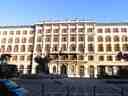
Look for the massive cream-colored building on your right, anchored by rough stone arches at the bottom and dominated by tall white semi-columns stretching up the center of the façade. This is the State Railways Building, or Palazzo delle Ferrovie dello Stato. It is grand, isn't it? Back in 1895, architect Raimondo Sagors didn't want to build a boring bureaucratic box. He wanted a palace. Look at the sheer verticality of it. See those massive columns in the center? Architects call this the "giant order," meaning the columns don't just sit on one floor-they soar past multiple levels, tying the whole building together. If you crane your neck and look all the way to the top, right under that roof railing, you might spot something watching you. The stone brackets, or corbels, holding up the balcony are carved with human heads. But the real magic happened behind these walls. It wasn't just railway clerks stamping tickets. In the Fascist era, the back of this building housed the Teatro del Dopolavoro Ferroviario. That’s a fancy way of saying the "Railway Workers' After-Work Theater." Imagine finishing a long shift on the tracks and coming here for a live show. By 1949, it had transformed into the Cinema Vittorio Veneto. For decades, flickering projectors brought Hollywood glamour to this very block. Today, however, the reels have stopped spinning. The building has been largely silent, stuck in a tug-of-war of sales and renovations since 2008, waiting for its next act. Take a second to admire those details near the roofline. When you are ready to move on, our next stop is just a minute away.
Open dedicated page →
Show 11 more stopsShow fewer stopsexpand_moreexpand_less
Look for the imposing stone structure defined by five distinctive blue hemispherical domes and shimmering gold mosaics set into the arched facade. Isn't this spectacular? This is…Read moreShow less
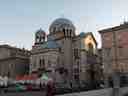
Look for the imposing stone structure defined by five distinctive blue hemispherical domes and shimmering gold mosaics set into the arched facade. Isn't this spectacular? This is the Serbian Orthodox Temple of the Holy Trinity and St. Spyridon. It feels like a piece of Byzantium dropped right into the city, doesn't it? Architect Carlo Maciachini designed this in 1869 to replace an older church on this very spot, giving it that soaring central dome that towers over the four bell towers. But look closer. Those nine statues on the facade were sculpted by Emilio Bisi to stand guard over the entrance. The curiosity continues inside. The walls are covered in what looks like intricate mosaics, but... they are actually oil paintings designed to trick the eye! The real treasure, however, is the iconostasis-that is the ornate wall of religious imagery that separates the holy sanctuary from the rest of the church. It holds four precious icons covered in gold and silver, crafted in Russia back in the early 1800s. There is even a massive silver lamp hanging near the entrance, a personal gift from the man who would become Tsar Paul I of Russia. It is a stunning example of how Trieste draws influence from every corner of the map. Whenever you are ready to move on, we can head toward the Police Headquarters.
Open dedicated page →Look to your left for the massive building defined by six soaring stone columns, a rooftop lined with white statues, and a high green copper dome rising from the center. Welcome…Read moreShow less
Look to your left for the massive building defined by six soaring stone columns, a rooftop lined with white statues, and a high green copper dome rising from the center. Welcome to the Palazzo Carciotti! This isn't just a house; it is a monument to pure, unadulterated ambition. Standing here, it looks solid as a rock, doesn't it? But get this... before 1800, this entire area was nothing but salt pans. That’s right. Muddy, salty, drying pools. The man who transformed that mud into this magnificence was Demetrio Carciotti. He was a Greek merchant who arrived in Trieste in 1775 and made an absolute fortune trading cloth from Bohemia. By the end of the century, he had enough cash to buy up five small houses right here at the mouth of the Grand Canal, tear them all down, and build this palace. Look up at the inscription on the facade, right above those six massive columns. It reads DEMETRIO CARCIOTTI MDCCC. That MDCCC is the Roman numeral for 1800, the year the facade was finished. It’s basically him signing his name on the skyline in giant bronze letters. The architect, Matteo Pertsch, didn't hold back. He designed those six columns in the Ionic style-that means they have those scroll-like swirls at the top-and placed a balustrade, that railing along the roof, teeming with statues. These aren't just random decorations. They are branding. Since Carciotti was a merchant, the statues represent things like Portenus, the guardian of the harbor, and Thyke, the protector of businesses. There’s even a statue of Athena, the goddess of weaving, which is a clever nod to the cloth trade that made Carciotti rich. Now, here is something fascinating about how this building worked. It was designed to be a machine for commerce. The ground floor was full of stables, warehouses for Carciotti’s goods, and even a printing press! It would have smelled of horses, ink, and spices. But upstairs? Pure luxury. The "piano nobile," or noble floor, had a magnificent round hall with sixteen columns and frescoes depicting scenes from the Iliad, celebrating Carciotti’s Greek heritage. Over the centuries, this place has seen everything. The famous Austrian diplomat Metternich stayed here in 1816. Later, in 1831, it became the very first headquarters of Assicurazioni Generali, the massive insurance company that is still a giant in Trieste today. But history hasn't always been kind to the architecture. See that green dome? In 1918, during the desperate final days of World War I, the Austrian government stripped the original copper off the roof to melt it down for the war effort. They needed the metal for bullets. And more recently, in 2012, the ferocious Bora wind-that legendary triestine gale-actually ripped part of the roof cover right off! But the story has a happy ending. For years, people argued about what to do with this empty giant. A hotel? A museum? Well, in December 2024, Assicurazioni Generali actually bought the building back for over 13 million Euros! They are turning it into a high-tech hub for Data Science and Artificial Intelligence, designed by the architect Carlo Ratti. So, a building that started on salt pans is going to end up hosting the technology of the future. Take a moment to admire that eagle perched on top of the dome. When you are ready to move on, we can head toward the next stop.
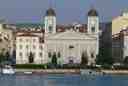
Open dedicated page →Look to your right at the elegant pale stone building defined by its large triangular roof pediment and framed by two matching towers with dark, bell-shaped domes. Now, this…Read moreShow less
Look to your right at the elegant pale stone building defined by its large triangular roof pediment and framed by two matching towers with dark, bell-shaped domes. Now, this isn't just a church; it is a monument to a community finding its own voice! This is the Church of San Nicolò dei Greci, the spiritual heart of the Greek Orthodox community here in Trieste. But the story of how it got here involves a bit of... let's call it, neighborly drama. You might remember the Serbian Orthodox church we passed earlier? Well, in the mid-1700s, the Greek and Serbian communities were actually roommates, spiritually speaking. They shared that same church. It made sense at the time. Both communities were Orthodox, and both were flourishing under the Austrian Empire's free port laws. But there was a catch. The liturgy. The religious service itself. The Serbian congregation was growing rapidly, and they insisted on holding services in their own language. The Greeks, proud of their own ancient heritage, naturally wanted the same. Tension simmered over whose language would be spoken at the altar. Finally, in 1781, the community decided to split. It was a divorce, plain and simple. The Serbs kept the original church, and the Greeks moved out. They didn't just move; they innovated! For a while, they held services in private homes, but by 1784, they began building this structure right here on the waterfront. They dedicated it to San Nicolò, or Saint Nicholas. And that is no coincidence. Saint Nicholas is the patron saint of sailors and merchants. For a community whose wealth came from the sea, there was no better protector to watch over their ships in the harbor just a few steps away. The facade you see now was actually a later addition, finished around 1820. The community hired Matteo Pertsch, a German architect who was an absolute superstar in Trieste. He designed the Opera House and the Carciotti Palace, which we just saw. He gave this church its crisp, Neoclassical look. Notice the clean lines and the symmetry. It feels rational, ordered, and incredibly dignified. But if you could walk through those doors, the rational exterior gives way to something far more mystical. The interior is dominated by a breathtaking feature called an iconostasis. In Eastern Orthodox traditions, this is a high, solid screen of icons that separates the sanctuary-where the altar is-from the nave, the central part of the church where the people stand. This particular iconostasis is a wall of shimmering gold and silver, built in the Empire style. It is covered in masterpieces painted by Greek artists, depicting scenes from the life of Jesus and the saints. Above it all, painted directly onto the ceiling, is a massive image of "Christ in Gloria," watching over the congregation. It is a space designed to overwhelm the senses with beauty. This church stands as a glittering testament to the independence and resilience of the Greek merchants who helped build this city. Take a moment to admire the symmetry of those twin towers. When you are ready, we can head to the next stop.
Open dedicated page →Look for the imposing beige block to your left, grounded by a long series of arched entryways and topped with a dramatic group of stone figures silhouetted against the sky. This…Read moreShow less
Look for the imposing beige block to your left, grounded by a long series of arched entryways and topped with a dramatic group of stone figures silhouetted against the sky. This is the Palazzo Tergesteo. It is a massive machine for business and culture, built with absolute determination. In 1838, a group of investors decided Trieste needed a multifunctional palace, a headquarters for its soaring ambition. They sold fifteen hundred shares to finance it, and by 1840, construction began. It was a race against the clock. The architect, Francesco Bruyn, had to fuse different visions into one cohesive structure, and incredibly, they finished the entire building in just two years. The layout inside is fascinating. It was designed as a "Greek cross," which is an architectural term for a floor plan shaped like a plus sign with arms of equal length. This wasn't random. The goal was to physically connect the financial heart of the city, the Stock Exchange, with its cultural heart, the Verdi Theater. Look up at the roofline. That sculpture isn't just decoration. It is a billboard. You see Thetis, the goddess of the sea, driving a chariot shaped like a shell. She is telling the world that Trieste’s fortune arrives from the waves. For over a century, the ground floor was the social engine of the city. The Caffè Tergesteo opened here in 1863. It was where stockbrokers screamed over prices by day, and where the intellectual elite whispered about art by night. The poet Umberto Saba wrote verses at its white tables. But for the novelist Italo Svevo, this building was a sophisticated prison. He worked on the first floor at the Unionbank. He called it his "cage," spending years managing commercial correspondence. But he was clever. He used that vantage point to study the businessmen coming and going, harvesting their mannerisms for his masterpiece, Zeno’s Conscience. The twentieth century brought wild changes here. During the Second World War, German forces seized the building. Then, when the Allied Military Government took over in 1945, the vibe shifted dramatically. The ground floor was requisitioned and turned into a ballroom for British troops. Where German officers once marched, British soldiers and local Triestine women danced to swing music. However, the building faced its biggest threat in 1957, during peacetime. An architect decided the original nineteenth-century iron and glass ceiling was obsolete. They tore it down and replaced it with a vault made of vetrocemento. This is a heavy construction material made of thick glass bricks set in concrete. It blocked the sun and cast the gallery into gloom for fifty years. Thankfully, a restoration in 2011 admitted that was a mistake. They ripped out the concrete and rebuilt the steel and glass, finally letting the light back in. It is a resilient survivor of war, commerce, and bad renovations. Take a moment to admire the details of the facade. When you are ready, we can walk toward the water for the next stop.
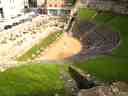
Open dedicated page →Look to your right at that sweeping semicircle of ancient stone steps carved directly into the hill, framed by weathered brick walls and broken marble columns at the base. Now...…Read moreShow less
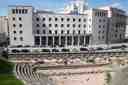
Look to your right at that sweeping semicircle of ancient stone steps carved directly into the hill, framed by weathered brick walls and broken marble columns at the base. Now... I want you to do something for me. Block out the traffic noise. Imagine the sound of waves crashing right at your feet. Because two thousand years ago, the Adriatic Sea didn't stop at the docks; it came all the way up to where we are standing. This theater wasn't just in the city; it was on the waterfront, so close that spectators could likely hear the surf during the plays. It was built around the first century thanks to a local power player named Quintus Petronius Modestus. This guy wasn't just rich; he was a primopilus, a high-ranking centurion who had climbed the military ladder all the way to Spain. When he came home to Trieste, he practiced something the Romans called evergetism. That is a fancy way of saying he spent a fortune on public buildings to buy social status. Basically, he wanted everyone to know exactly how important he was. But here is the wild part. For centuries, this massive structure... vanished. It didn't crumble away; it was swallowed by the city. A dense medieval neighborhood called the "Rena" grew right on top of it. People were literally living in apartments that used these ancient Roman seats as foundations for their kitchens and bedrooms! In the early 1800s, an architect named Pietro Nobile started playing detective. He noticed that the houses in this neighborhood didn't sit in straight lines; they curved. The buildings were tracing the ghost of the theater underneath. Even the name of the neighborhood, "Rena," was just a local dialect corruption of the word "Arena." The memory was hiding in plain sight. It stayed buried until 1938, when the Fascist regime decided to dig it up to celebrate the Roman Emperor Augustus. But this wasn't a gentle archaeological brush-off. It was a demolition. They tore down the entire medieval district, destroying centuries of history to get to the Roman layer. They called the old houses "slums" to justify wrecking them, but they wiped out a living, breathing community. The grand opening was held on September 18, 1938. Benito Mussolini himself came to admire these "liberated" stones. But this date lives in infamy for a much darker reason. On that very same day, just a few hundred yards from here in the main square, Mussolini announced the Racial Laws, stripping Jewish citizens of their rights. This theater became the backdrop for one of the darkest moments in Italian history. Recent excavations in 2024 have even found more traces of that ancient shoreline I mentioned, proving just how close the water really was. It is a stunning window into the past, even if the view came at a heavy price. Take a moment to take in the scale of it, and when you are ready, we can start walking to the next stop.
Open dedicated page →Look up at the massive structure looming over the ruins-it is the stark white building defined by two blocky corner towers and a long row of square windows set into a facade that…Read moreShow less
Look up at the massive structure looming over the ruins-it is the stark white building defined by two blocky corner towers and a long row of square windows set into a facade that gently curves to match the shape of the ancient theater below. We just explored the ancient Roman Theatre, but now I want you to look at the giant that watches over it. This is the Police Headquarters, or Questura. But originally? It was the Casa del Fascio, the local headquarters for the Fascist party. To build this white limestone fortress in the 1940s, the regime tore down the medieval Jewish quarter, erasing centuries of history to make room for their own new order. Look at those heavy towers on the corners. The architects, Raffaello Battigelli and Ferruccio Spangaro, designed them to look like quadriburgium. That is a fancy term for the fortified outposts that guarded the borders of the Roman Empire. The message was clear. This was not just an office; it was a stronghold. And honestly... people hated it. A famous sculptor at the time called it "very ugly," and locals thought it looked more like a bunker than a house for the people. The tension here did not end with the war. From 1945 to 1954, when Trieste was under Allied military control, this building was a nest of spies and suspicion. The "political squad" working here secretly created files on their own colleagues, tracking anyone who was too eager for Trieste to return to Italy. When Italian officers finally took over in '54, they walked into these offices looking over their shoulders, unsure if the person at the next desk was a friend or an informant. But here is the wildest part. Inside this severe block of authority, there is an auditorium. For years, it hosted the city's experimental theater. The acoustics were terrible-so bad that a director once strung metal wires across the ceiling trying to fix the echo. Even stranger? The actors’ dressing rooms were located in the crypt underground. That space was originally built to hold the tombs of fascist leaders, but instead, it became a place for actors to put on their makeup. History here is not just about the distant past, though. On October 4th, 2019, a tragedy happened right inside these walls that stopped the city cold. A man named Alejandro Meran, who had been arrested, asked to use the restroom. In a sudden, violent outburst, he managed to take the service pistols from the two agents escorting him, Pierluigi Rotta and Matteo Demenego. In what is now known as the "seven minutes of terror," he killed both officers and began shooting wildly through the atrium. Security cameras captured him firing until his magazines were empty, even trying to break into a police car outside. He was only stopped when another agent shot him in the leg. The courts later ruled that Meran suffered from schizophrenia and could not be held criminally responsible, a decision that left the city and the families of the fallen officers furious and heartbroken. It is a heavy place. But inside the memorial hall, there is a light in the darkness. They honor Giovanni Palatucci here. He was a police official who saved thousands of Jewish lives during the Holocaust before dying in a concentration camp. It feels like a powerful irony that his name is enshrined in a building constructed by the very regime that persecuted the people he saved. This building stands as a complex monument to authority, tragedy, and the resilience of those who serve. Take a moment to process the weight of this site. When you are ready, we can head to the next stop.
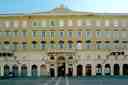
Open dedicated page →Look to your left for the five-story building with a warm apricot-colored facade, distinguished by rows of tall arched windows and a line of stone statues just beneath the…Read moreShow less
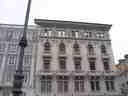
Look to your left for the five-story building with a warm apricot-colored facade, distinguished by rows of tall arched windows and a line of stone statues just beneath the roofline. This is Palazzo Modello, or the Model Palace. And the name isn't just a compliment; it is literal. When the city of Trieste decided to revamp this square in the 1870s, they wanted a unified, elegant look. So, they commissioned this building first to serve as the aesthetic blueprint-the literal model-that all future buildings in the square would have to follow. Before this elegant structure rose up, this spot was occupied by two old, crumbling churches dedicated to Saint Peter and Saint Rocco. By 1869, the land was up for grabs. The massive insurance giant Assicurazioni Generali tried to buy the lot to build their own headquarters, but the city council refused. They wanted to keep control of the urban design themselves. They handed the project to an architect named Giuseppe Bruni. This was a huge gamble for Bruni. He hadn't built any major public works yet. This building was his audition. If he succeeded here, he would secure the commission for the massive Town Hall right next door. Spoiler alert... he nailed it. The design was so successful that it defined the eclectic style of the entire Piazza Unità d'Italia. When construction finished in 1872, the building opened as the Hotel Delòrme. It was named after its owner, Antonio Delòrme, a Frenchman with a fascinating résumé. Before running this hotel, he had been the personal chef for Baron Revoltella, one of the wealthiest and most influential men in the city. Delòrme knew how to cater to the elite. His hotel was famous for being affordable yet incredibly modern. Rumor has it, this was one of the very first hotels to feature toilets on every single floor. That was absolute cutting-edge technology at the time. But there is a secret hidden in plain sight on this facade. Look all the way up to the top floor, just under the roof. Do you see the sculpted male figures standing in place of columns? In architecture, a male figure used as a pillar is called a telamon. Usually, they look strong and stoic, holding up the weight of the building. But Bruni’s telamoni are doing something... strange. Look closely at their hands. While a polite interpretation says they are just clutching their robes, the locals know better. They are clutching their groins in a very specific, superstitious gesture meant to ward off bad luck. Because of this, the locals have nicknamed this the "Palazzo degli Scongiuri," or the Palace of Warding Off Bad Luck. Was the architect superstitious about his big debut? Or was he just playing a prank on the city? We will never know for sure. In modern times, the building has seen its share of drama. After a fire damaged it in the early 2000s, it was sold to the utility company Acegas for over sixteen million euros. That purchase sparked a fierce debate in the local papers about public spending, proving that even a "Model" palace isn't immune to controversy. Take a minute to check out those superstitious statues near the roof. When you are ready, we can walk toward the water for the next stop.
Open dedicated page →Look for the vast, rectangular open space paved with light sandstone blocks, flanked by grand white palaces and opening directly onto the gray-blue waters of the Gulf. Can you…Read moreShow less
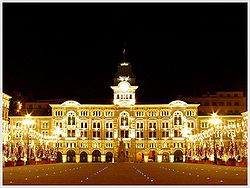
Look for the vast, rectangular open space paved with light sandstone blocks, flanked by grand white palaces and opening directly onto the gray-blue waters of the Gulf. Can you feel the sheer scale of this place? This is Piazza Unità d'Italia, the largest square in Europe that opens directly onto the sea. It is the beating heart of Trieste, a stage where the city has celebrated its triumphs and mourned its tragedies. If you look down at the ground, you might notice small blue LED lights embedded in the sandstone pavement. Locals have some strong opinions about these, calling them "cemetery lights" or even an airport runway. But they serve a poetic purpose. They mark the shoreline of the ancient mandracchio, the old internal harbor that was buried centuries ago to create this massive open space. The water used to come right up to where you are standing. This square has witnessed the death of one empire and the birth of a new era. In July 1914, a silent, devastated crowd gathered here to watch the coffins of Archduke Franz Ferdinand and his wife Sofia being carried from the waterfront to the train station after their assassination in Sarajevo. That solemn procession effectively marked the beginning of World War I. Just four years later, in November 1918, the scene was completely reversed. A destroyer called the Audace docked right here at the pier, bringing the first Italian general to step ashore, signaling the end of the war and the annexation of Trieste to Italy. But the square holds many layers of memory. Look at the large building opposite the sea: the Town Hall. It stands like a grand stage backdrop, waiting for us to uncover its full story in just a moment. Now, let’s find something a bit older. Look for the large fountain in the center, the Fountain of the Four Continents. It was carved in the 1750s. You will see four figures representing the known world at the time: Europe, Asia, America, and Africa. Take a close look at the figure representing the Nile. You will notice its face is covered by a veil. This isn’t about modesty; it is actually a confession of ignorance! When this was carved, geographers still didn’t know where the source of the Nile River was, so the sculptor simply hid the face. To the right of the fountain, you will see a column topped by a statue of Emperor Charles VI. He is pointing his finger out toward the horizon. There is a funny story about this. The city rushed to get this statue ready for the Emperor’s visit in 1728, so the first version was actually made of wood and hastily painted gold. It took them another twenty-eight years to replace it with stone! And while he seems to be pointing at the sea, legend says he was actually trying to tell the Triestines, "Don't look at the water, look at the commerce!" He was the one who established the Free Port that made this city rich. Finally, glance at the Grand Hotel Duchi d'Aosta on the side of the square. In the 18th century, this was the site of a brutal crime. Johann Winckelmann, the father of modern archaeology, was stabbed to death in a room there by a cook who wanted to steal his gold medals. This square is a beautiful, complicated mosaic of history, art, and a little bit of mystery. When you are done taking in the view, we can walk over to the Town Hall for a closer look.
Open dedicated page →
Frequently asked questions
How do I start the tour?
After purchase, download the AudaTours app and enter your redemption code. The tour will be ready to start immediately - just tap play and follow the GPS-guided route.
Do I need internet during the tour?
No! Download the tour before you start and enjoy it fully offline. Only the chat feature requires internet. We recommend downloading on WiFi to save mobile data.
Is this a guided group tour?
No - this is a self-guided audio tour. You explore independently at your own pace, with audio narration playing through your phone. No tour guide, no group, no schedule.
How long does the tour take?
Most tours take 60–90 minutes to complete, but you control the pace entirely. Pause, skip stops, or take breaks whenever you want.
What if I can't finish the tour today?
No problem! Tours have lifetime access. Pause and resume whenever you like - tomorrow, next week, or next year. Your progress is saved.
What languages are available?
All tours are available in 50+ languages. Select your preferred language when redeeming your code. Note: language cannot be changed after tour generation.
Where do I access the tour after purchase?
Download the free AudaTours app from the App Store or Google Play. Enter your redemption code (sent via email) and the tour will appear in your library, ready to download and start.
If you don't enjoy the tour, we'll refund your purchase. Contact us at [email protected]
Checkout securely with 




