
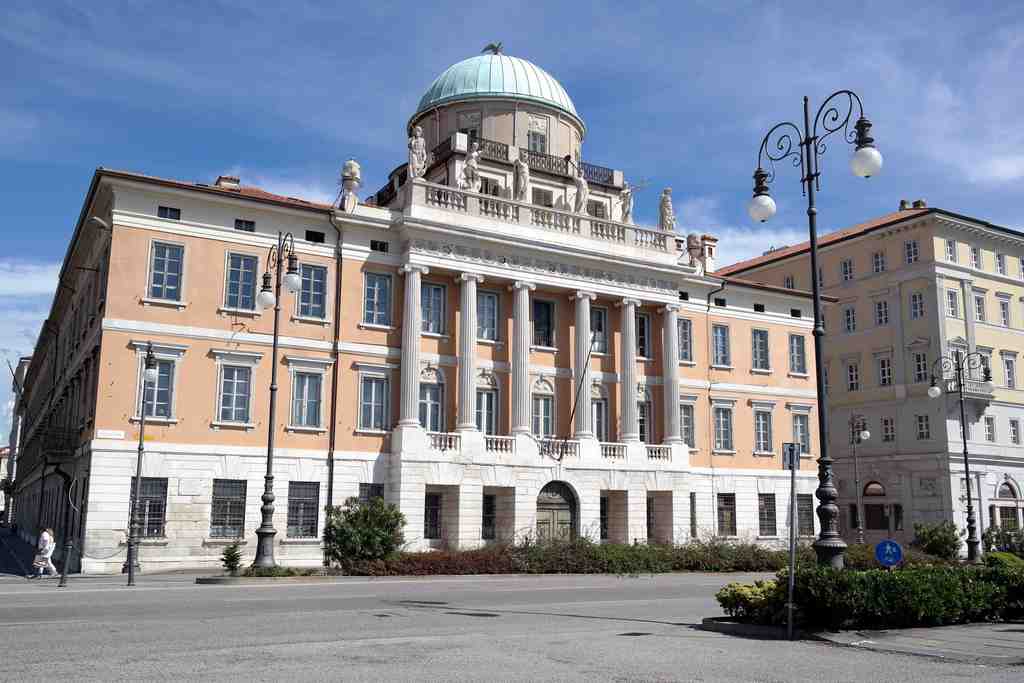
Look to your left for the massive building defined by six soaring stone columns, a rooftop lined with white statues, and a high green copper dome rising from the center.
Welcome to the Palazzo Carciotti! This isn't just a house; it is a monument to pure, unadulterated ambition. Standing here, it looks solid as a rock, doesn't it? But get this... before 1800, this entire area was nothing but salt pans. That’s right. Muddy, salty, drying pools.
The man who transformed that mud into this magnificence was Demetrio Carciotti. He was a Greek merchant who arrived in Trieste in 1775 and made an absolute fortune trading cloth from Bohemia. By the end of the century, he had enough cash to buy up five small houses right here at the mouth of the Grand Canal, tear them all down, and build this palace.
Look up at the inscription on the facade, right above those six massive columns. It reads DEMETRIO CARCIOTTI MDCCC. That MDCCC is the Roman numeral for 1800, the year the facade was finished. It’s basically him signing his name on the skyline in giant bronze letters.
The architect, Matteo Pertsch, didn't hold back. He designed those six columns in the Ionic style-that means they have those scroll-like swirls at the top-and placed a balustrade, that railing along the roof, teeming with statues. These aren't just random decorations. They are branding. Since Carciotti was a merchant, the statues represent things like Portenus, the guardian of the harbor, and Thyke, the protector of businesses. There’s even a statue of Athena, the goddess of weaving, which is a clever nod to the cloth trade that made Carciotti rich.
Now, here is something fascinating about how this building worked. It was designed to be a machine for commerce. The ground floor was full of stables, warehouses for Carciotti’s goods, and even a printing press! It would have smelled of horses, ink, and spices. But upstairs? Pure luxury. The "piano nobile," or noble floor, had a magnificent round hall with sixteen columns and frescoes depicting scenes from the Iliad, celebrating Carciotti’s Greek heritage.
Over the centuries, this place has seen everything. The famous Austrian diplomat Metternich stayed here in 1816. Later, in 1831, it became the very first headquarters of Assicurazioni Generali, the massive insurance company that is still a giant in Trieste today.
But history hasn't always been kind to the architecture. See that green dome? In 1918, during the desperate final days of World War I, the Austrian government stripped the original copper off the roof to melt it down for the war effort. They needed the metal for bullets. And more recently, in 2012, the ferocious Bora wind-that legendary triestine gale-actually ripped part of the roof cover right off!
But the story has a happy ending. For years, people argued about what to do with this empty giant. A hotel? A museum? Well, in December 2024, Assicurazioni Generali actually bought the building back for over 13 million Euros! They are turning it into a high-tech hub for Data Science and Artificial Intelligence, designed by the architect Carlo Ratti. So, a building that started on salt pans is going to end up hosting the technology of the future.
Take a moment to admire that eagle perched on top of the dome. When you are ready to move on, we can head toward the next stop.




