
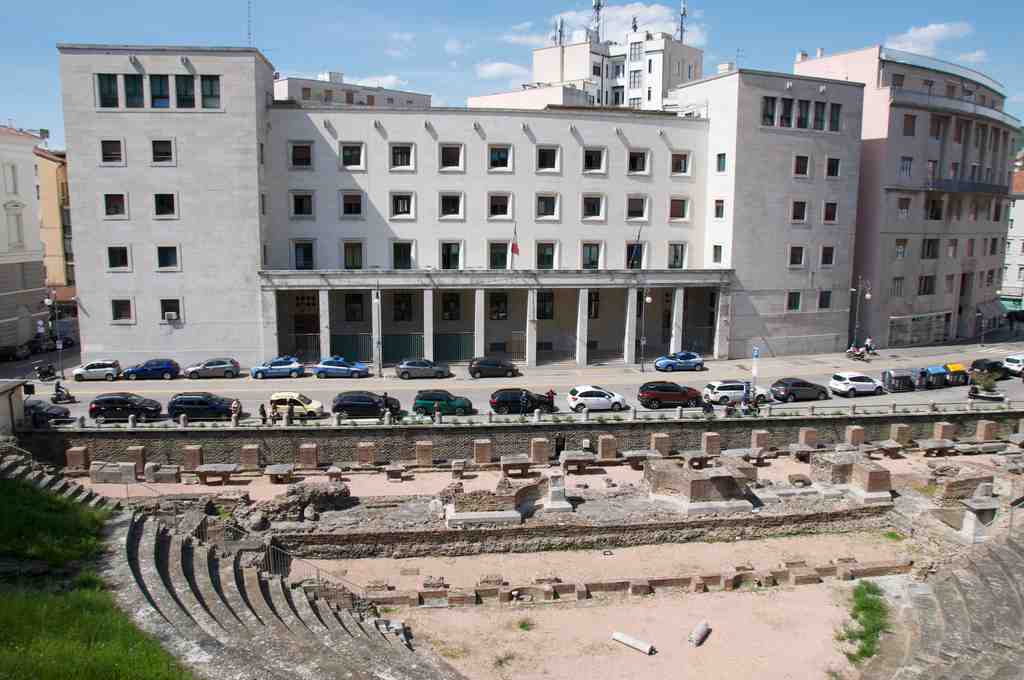
Look up at the massive structure looming over the ruins-it is the stark white building defined by two blocky corner towers and a long row of square windows set into a facade that gently curves to match the shape of the ancient theater below.
We just explored the ancient Roman Theatre, but now I want you to look at the giant that watches over it. This is the Police Headquarters, or Questura. But originally? It was the Casa del Fascio, the local headquarters for the Fascist party. To build this white limestone fortress in the 1940s, the regime tore down the medieval Jewish quarter, erasing centuries of history to make room for their own new order.
Look at those heavy towers on the corners. The architects, Raffaello Battigelli and Ferruccio Spangaro, designed them to look like quadriburgium. That is a fancy term for the fortified outposts that guarded the borders of the Roman Empire. The message was clear. This was not just an office; it was a stronghold. And honestly... people hated it. A famous sculptor at the time called it "very ugly," and locals thought it looked more like a bunker than a house for the people.
The tension here did not end with the war. From 1945 to 1954, when Trieste was under Allied military control, this building was a nest of spies and suspicion. The "political squad" working here secretly created files on their own colleagues, tracking anyone who was too eager for Trieste to return to Italy. When Italian officers finally took over in '54, they walked into these offices looking over their shoulders, unsure if the person at the next desk was a friend or an informant.
But here is the wildest part. Inside this severe block of authority, there is an auditorium. For years, it hosted the city's experimental theater. The acoustics were terrible-so bad that a director once strung metal wires across the ceiling trying to fix the echo. Even stranger? The actors’ dressing rooms were located in the crypt underground. That space was originally built to hold the tombs of fascist leaders, but instead, it became a place for actors to put on their makeup.
History here is not just about the distant past, though. On October 4th, 2019, a tragedy happened right inside these walls that stopped the city cold. A man named Alejandro Meran, who had been arrested, asked to use the restroom. In a sudden, violent outburst, he managed to take the service pistols from the two agents escorting him, Pierluigi Rotta and Matteo Demenego.
In what is now known as the "seven minutes of terror," he killed both officers and began shooting wildly through the atrium. Security cameras captured him firing until his magazines were empty, even trying to break into a police car outside. He was only stopped when another agent shot him in the leg. The courts later ruled that Meran suffered from schizophrenia and could not be held criminally responsible, a decision that left the city and the families of the fallen officers furious and heartbroken.
It is a heavy place. But inside the memorial hall, there is a light in the darkness. They honor Giovanni Palatucci here. He was a police official who saved thousands of Jewish lives during the Holocaust before dying in a concentration camp. It feels like a powerful irony that his name is enshrined in a building constructed by the very regime that persecuted the people he saved.
This building stands as a complex monument to authority, tragedy, and the resilience of those who serve. Take a moment to process the weight of this site. When you are ready, we can head to the next stop.




