
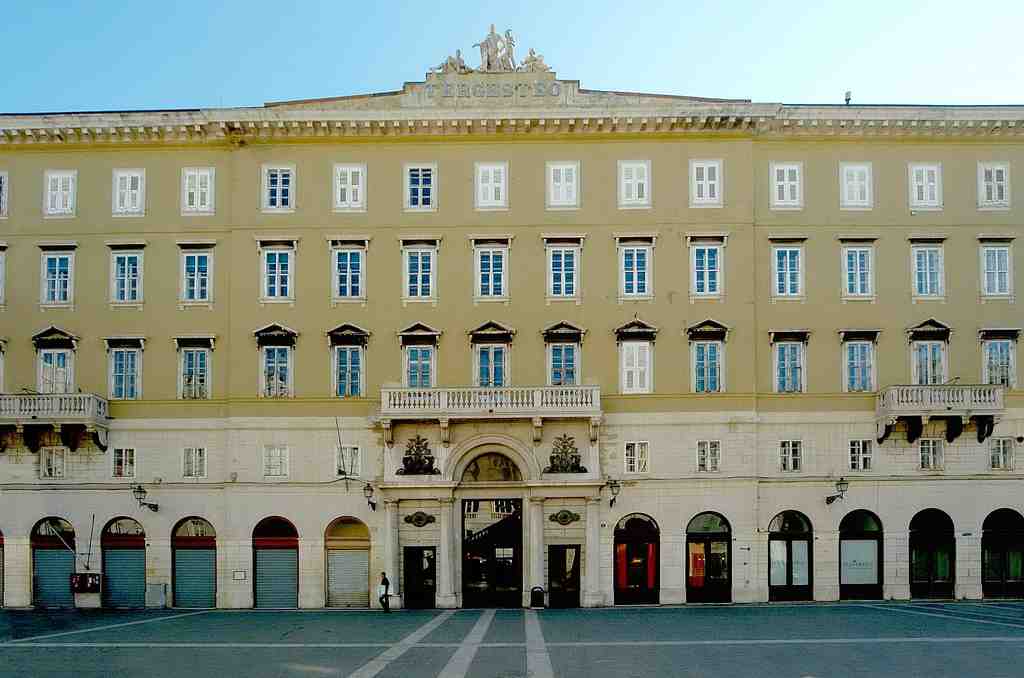
Look for the imposing beige block to your left, grounded by a long series of arched entryways and topped with a dramatic group of stone figures silhouetted against the sky.
This is the Palazzo Tergesteo. It is a massive machine for business and culture, built with absolute determination. In 1838, a group of investors decided Trieste needed a multifunctional palace, a headquarters for its soaring ambition. They sold fifteen hundred shares to finance it, and by 1840, construction began. It was a race against the clock. The architect, Francesco Bruyn, had to fuse different visions into one cohesive structure, and incredibly, they finished the entire building in just two years.
The layout inside is fascinating. It was designed as a "Greek cross," which is an architectural term for a floor plan shaped like a plus sign with arms of equal length. This wasn't random. The goal was to physically connect the financial heart of the city, the Stock Exchange, with its cultural heart, the Verdi Theater.
Look up at the roofline. That sculpture isn't just decoration. It is a billboard. You see Thetis, the goddess of the sea, driving a chariot shaped like a shell. She is telling the world that Trieste’s fortune arrives from the waves.
For over a century, the ground floor was the social engine of the city. The Caffè Tergesteo opened here in 1863. It was where stockbrokers screamed over prices by day, and where the intellectual elite whispered about art by night. The poet Umberto Saba wrote verses at its white tables.
But for the novelist Italo Svevo, this building was a sophisticated prison. He worked on the first floor at the Unionbank. He called it his "cage," spending years managing commercial correspondence. But he was clever. He used that vantage point to study the businessmen coming and going, harvesting their mannerisms for his masterpiece, Zeno’s Conscience.
The twentieth century brought wild changes here. During the Second World War, German forces seized the building. Then, when the Allied Military Government took over in 1945, the vibe shifted dramatically. The ground floor was requisitioned and turned into a ballroom for British troops. Where German officers once marched, British soldiers and local Triestine women danced to swing music.
However, the building faced its biggest threat in 1957, during peacetime. An architect decided the original nineteenth-century iron and glass ceiling was obsolete. They tore it down and replaced it with a vault made of vetrocemento. This is a heavy construction material made of thick glass bricks set in concrete. It blocked the sun and cast the gallery into gloom for fifty years. Thankfully, a restoration in 2011 admitted that was a mistake. They ripped out the concrete and rebuilt the steel and glass, finally letting the light back in.
It is a resilient survivor of war, commerce, and bad renovations.
Take a moment to admire the details of the facade. When you are ready, we can walk toward the water for the next stop.




