
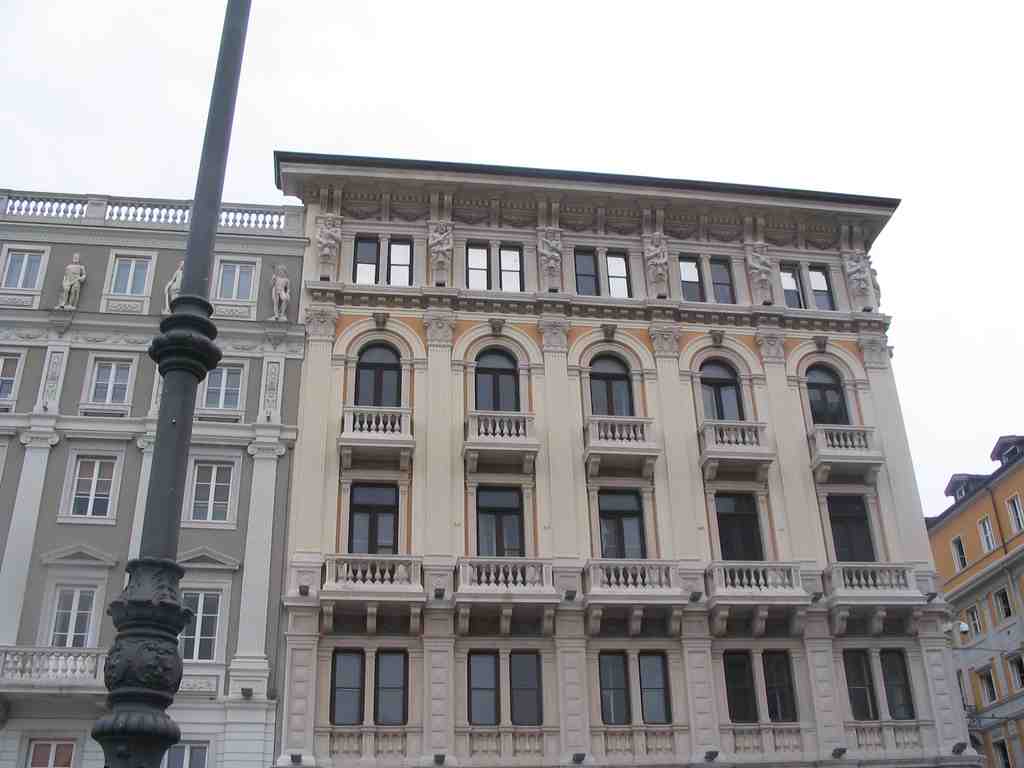
Look to your left for the five-story building with a warm apricot-colored facade, distinguished by rows of tall arched windows and a line of stone statues just beneath the roofline.
This is Palazzo Modello, or the Model Palace. And the name isn't just a compliment; it is literal. When the city of Trieste decided to revamp this square in the 1870s, they wanted a unified, elegant look. So, they commissioned this building first to serve as the aesthetic blueprint-the literal model-that all future buildings in the square would have to follow.
Before this elegant structure rose up, this spot was occupied by two old, crumbling churches dedicated to Saint Peter and Saint Rocco. By 1869, the land was up for grabs. The massive insurance giant Assicurazioni Generali tried to buy the lot to build their own headquarters, but the city council refused. They wanted to keep control of the urban design themselves. They handed the project to an architect named Giuseppe Bruni.
This was a huge gamble for Bruni. He hadn't built any major public works yet. This building was his audition. If he succeeded here, he would secure the commission for the massive Town Hall right next door. Spoiler alert... he nailed it. The design was so successful that it defined the eclectic style of the entire Piazza Unità d'Italia.
When construction finished in 1872, the building opened as the Hotel Delòrme. It was named after its owner, Antonio Delòrme, a Frenchman with a fascinating résumé. Before running this hotel, he had been the personal chef for Baron Revoltella, one of the wealthiest and most influential men in the city. Delòrme knew how to cater to the elite. His hotel was famous for being affordable yet incredibly modern. Rumor has it, this was one of the very first hotels to feature toilets on every single floor. That was absolute cutting-edge technology at the time.
But there is a secret hidden in plain sight on this facade. Look all the way up to the top floor, just under the roof. Do you see the sculpted male figures standing in place of columns? In architecture, a male figure used as a pillar is called a telamon. Usually, they look strong and stoic, holding up the weight of the building. But Bruni’s telamoni are doing something... strange.
Look closely at their hands. While a polite interpretation says they are just clutching their robes, the locals know better. They are clutching their groins in a very specific, superstitious gesture meant to ward off bad luck. Because of this, the locals have nicknamed this the "Palazzo degli Scongiuri," or the Palace of Warding Off Bad Luck. Was the architect superstitious about his big debut? Or was he just playing a prank on the city? We will never know for sure.
In modern times, the building has seen its share of drama. After a fire damaged it in the early 2000s, it was sold to the utility company Acegas for over sixteen million euros. That purchase sparked a fierce debate in the local papers about public spending, proving that even a "Model" palace isn't immune to controversy.
Take a minute to check out those superstitious statues near the roof. When you are ready, we can walk toward the water for the next stop.




