
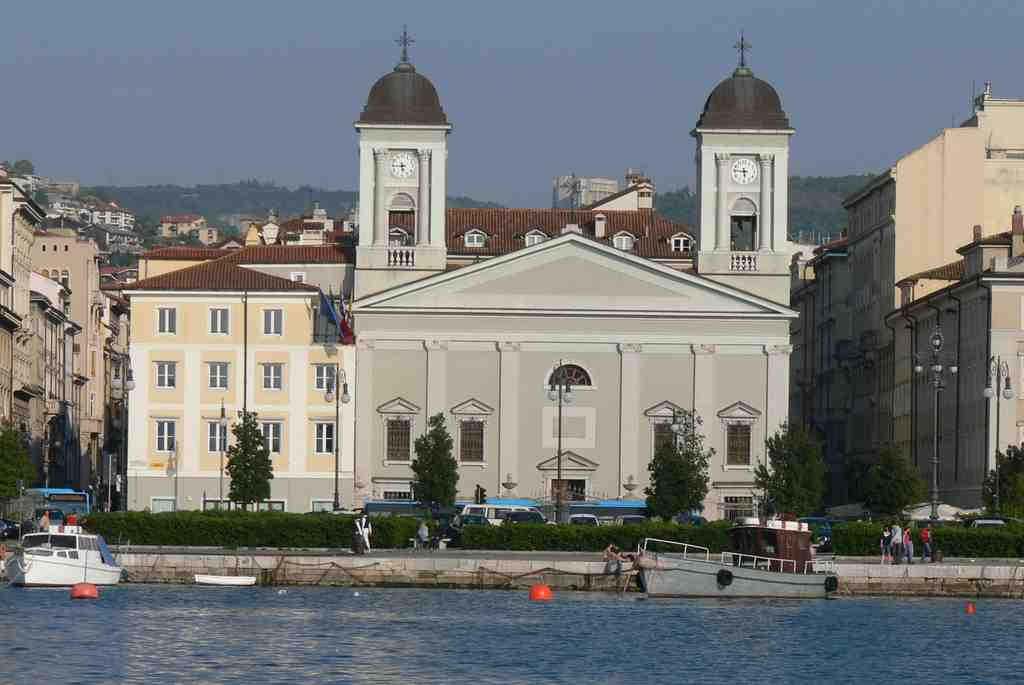
Look to your right at the elegant pale stone building defined by its large triangular roof pediment and framed by two matching towers with dark, bell-shaped domes.
Now, this isn't just a church; it is a monument to a community finding its own voice! This is the Church of San Nicolò dei Greci, the spiritual heart of the Greek Orthodox community here in Trieste. But the story of how it got here involves a bit of... let's call it, neighborly drama.
You might remember the Serbian Orthodox church we passed earlier? Well, in the mid-1700s, the Greek and Serbian communities were actually roommates, spiritually speaking. They shared that same church. It made sense at the time. Both communities were Orthodox, and both were flourishing under the Austrian Empire's free port laws. But there was a catch.
The liturgy. The religious service itself.
The Serbian congregation was growing rapidly, and they insisted on holding services in their own language. The Greeks, proud of their own ancient heritage, naturally wanted the same. Tension simmered over whose language would be spoken at the altar. Finally, in 1781, the community decided to split. It was a divorce, plain and simple. The Serbs kept the original church, and the Greeks moved out.
They didn't just move; they innovated! For a while, they held services in private homes, but by 1784, they began building this structure right here on the waterfront. They dedicated it to San Nicolò, or Saint Nicholas. And that is no coincidence. Saint Nicholas is the patron saint of sailors and merchants. For a community whose wealth came from the sea, there was no better protector to watch over their ships in the harbor just a few steps away.
The facade you see now was actually a later addition, finished around 1820. The community hired Matteo Pertsch, a German architect who was an absolute superstar in Trieste. He designed the Opera House and the Carciotti Palace, which we just saw. He gave this church its crisp, Neoclassical look. Notice the clean lines and the symmetry. It feels rational, ordered, and incredibly dignified.
But if you could walk through those doors, the rational exterior gives way to something far more mystical.
The interior is dominated by a breathtaking feature called an iconostasis. In Eastern Orthodox traditions, this is a high, solid screen of icons that separates the sanctuary-where the altar is-from the nave, the central part of the church where the people stand. This particular iconostasis is a wall of shimmering gold and silver, built in the Empire style. It is covered in masterpieces painted by Greek artists, depicting scenes from the life of Jesus and the saints.
Above it all, painted directly onto the ceiling, is a massive image of "Christ in Gloria," watching over the congregation. It is a space designed to overwhelm the senses with beauty.
This church stands as a glittering testament to the independence and resilience of the Greek merchants who helped build this city.
Take a moment to admire the symmetry of those twin towers. When you are ready, we can head to the next stop.




