
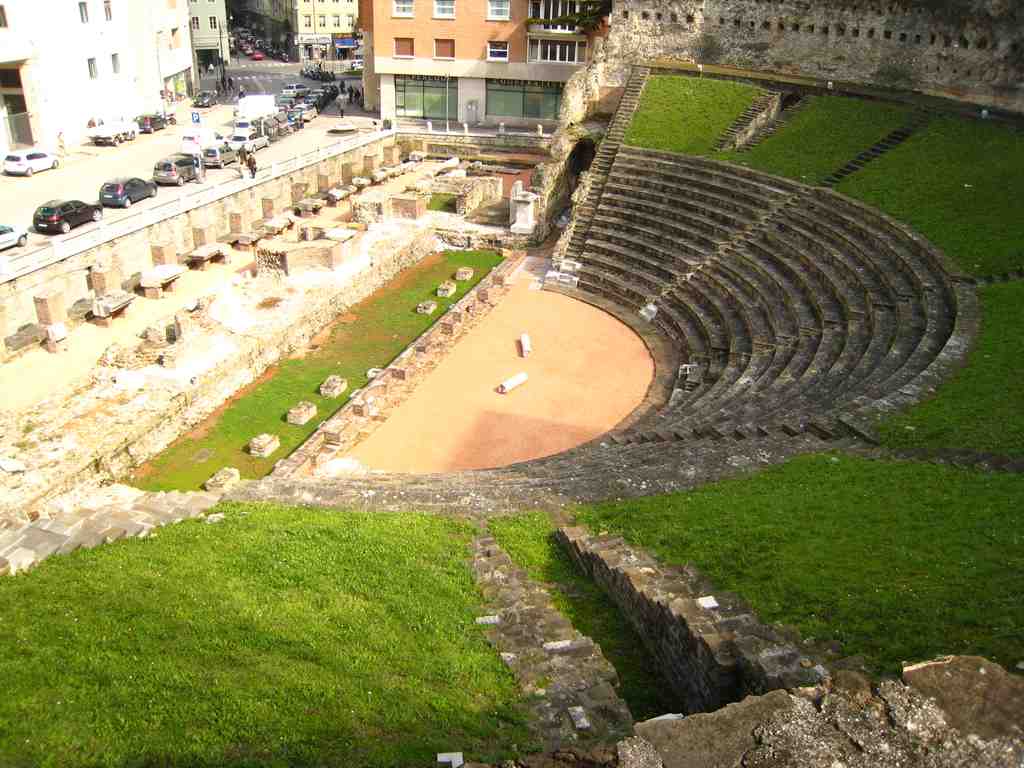
Look to your right at that sweeping semicircle of ancient stone steps carved directly into the hill, framed by weathered brick walls and broken marble columns at the base.
Now... I want you to do something for me. Block out the traffic noise. Imagine the sound of waves crashing right at your feet. Because two thousand years ago, the Adriatic Sea didn't stop at the docks; it came all the way up to where we are standing. This theater wasn't just in the city; it was on the waterfront, so close that spectators could likely hear the surf during the plays.
It was built around the first century thanks to a local power player named Quintus Petronius Modestus. This guy wasn't just rich; he was a primopilus, a high-ranking centurion who had climbed the military ladder all the way to Spain. When he came home to Trieste, he practiced something the Romans called evergetism. That is a fancy way of saying he spent a fortune on public buildings to buy social status. Basically, he wanted everyone to know exactly how important he was.
But here is the wild part. For centuries, this massive structure... vanished. It didn't crumble away; it was swallowed by the city. A dense medieval neighborhood called the "Rena" grew right on top of it. People were literally living in apartments that used these ancient Roman seats as foundations for their kitchens and bedrooms!
In the early 1800s, an architect named Pietro Nobile started playing detective. He noticed that the houses in this neighborhood didn't sit in straight lines; they curved. The buildings were tracing the ghost of the theater underneath. Even the name of the neighborhood, "Rena," was just a local dialect corruption of the word "Arena." The memory was hiding in plain sight.
It stayed buried until 1938, when the Fascist regime decided to dig it up to celebrate the Roman Emperor Augustus. But this wasn't a gentle archaeological brush-off. It was a demolition. They tore down the entire medieval district, destroying centuries of history to get to the Roman layer. They called the old houses "slums" to justify wrecking them, but they wiped out a living, breathing community.
The grand opening was held on September 18, 1938. Benito Mussolini himself came to admire these "liberated" stones. But this date lives in infamy for a much darker reason. On that very same day, just a few hundred yards from here in the main square, Mussolini announced the Racial Laws, stripping Jewish citizens of their rights. This theater became the backdrop for one of the darkest moments in Italian history.
Recent excavations in 2024 have even found more traces of that ancient shoreline I mentioned, proving just how close the water really was.
It is a stunning window into the past, even if the view came at a heavy price. Take a moment to take in the scale of it, and when you are ready, we can start walking to the next stop.




