
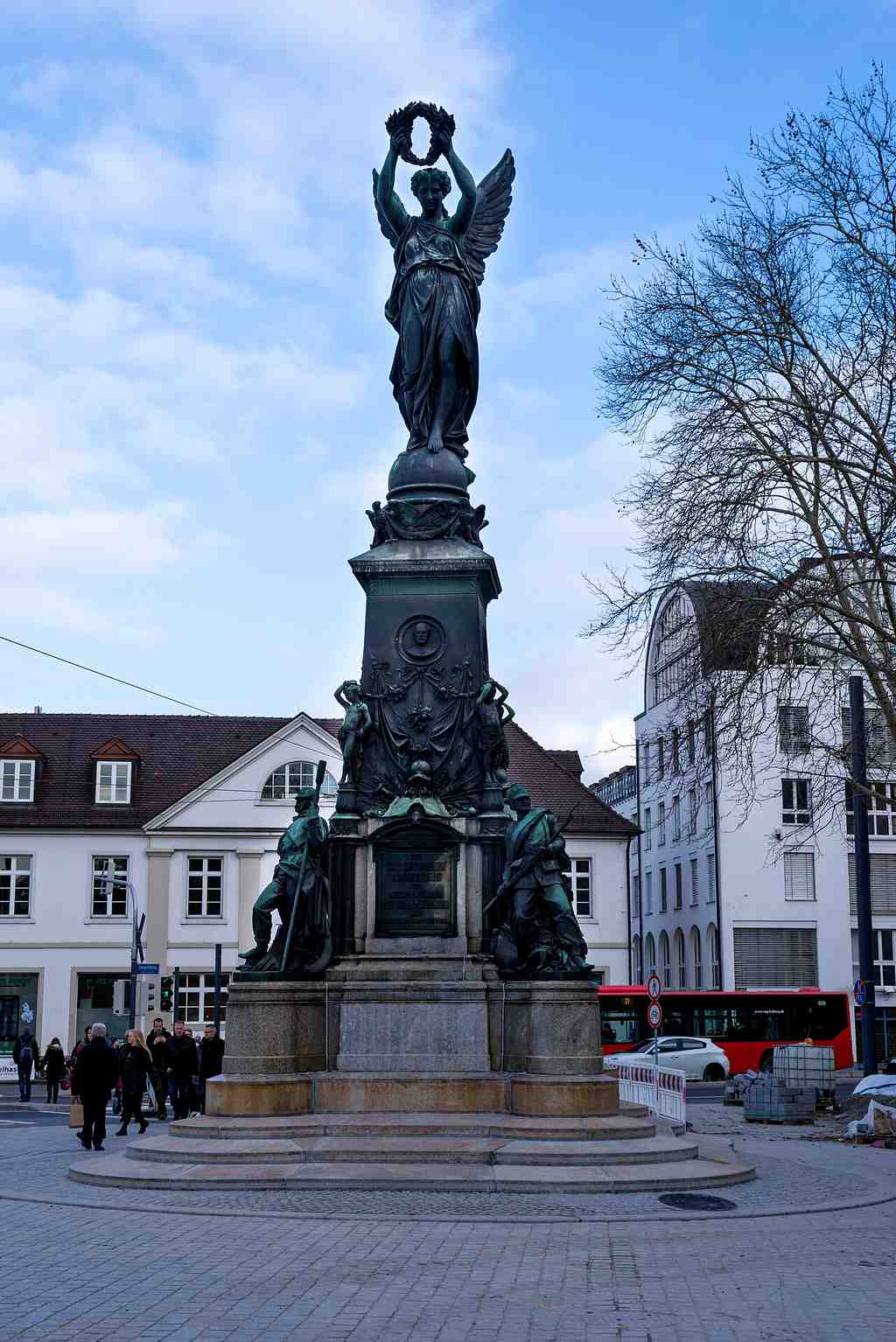
On your left rises a dark granite monument with rounded corner plinths, topped by a bronze Victory goddess standing on a half-globe and lifting a laurel wreath.
This is Freiburg’s Siegesdenkmal, the Victory Monument... and it shows how public memory rarely sits still, even when the bronze does. It began as a celebration of war, then became an argument about war, and now stands in a square with a newer, more careful voice around it.
The monument honors the fourteenth German Army Corps, made up largely of soldiers from Baden, under General August von Werder in the Franco-Prussian War of eighteen seventy-one. A wave of victory fever swept through the region, and donors from Lörrach to Karlsruhe paid for this monument to stand here in the middle of Baden. The sculptor Karl Friedrich Moest won a national design competition, judged by some very serious artistic heavyweights, including Gottfried Semper. Moest gave Freiburg not just a goddess on top, but four soldiers below: three still fighting, and one artilleryman collapsing in death. That last figure keeps the triumph from becoming too neat. Bronze has a way of bragging... but it also remembers the bill.
If you glance at the image in the app, you can see the monument after its recent return near its original setting. It first went up in eighteen seventy-six, with Kaiser Wilhelm the First, Otto von Bismarck, and General von Werder all present for the unveiling. The whole project cost eighty-five thousand marks, roughly the value of several hundred thousand euros today, and some of the bronze came from captured cannon barrels. Victories, apparently, like recycling.
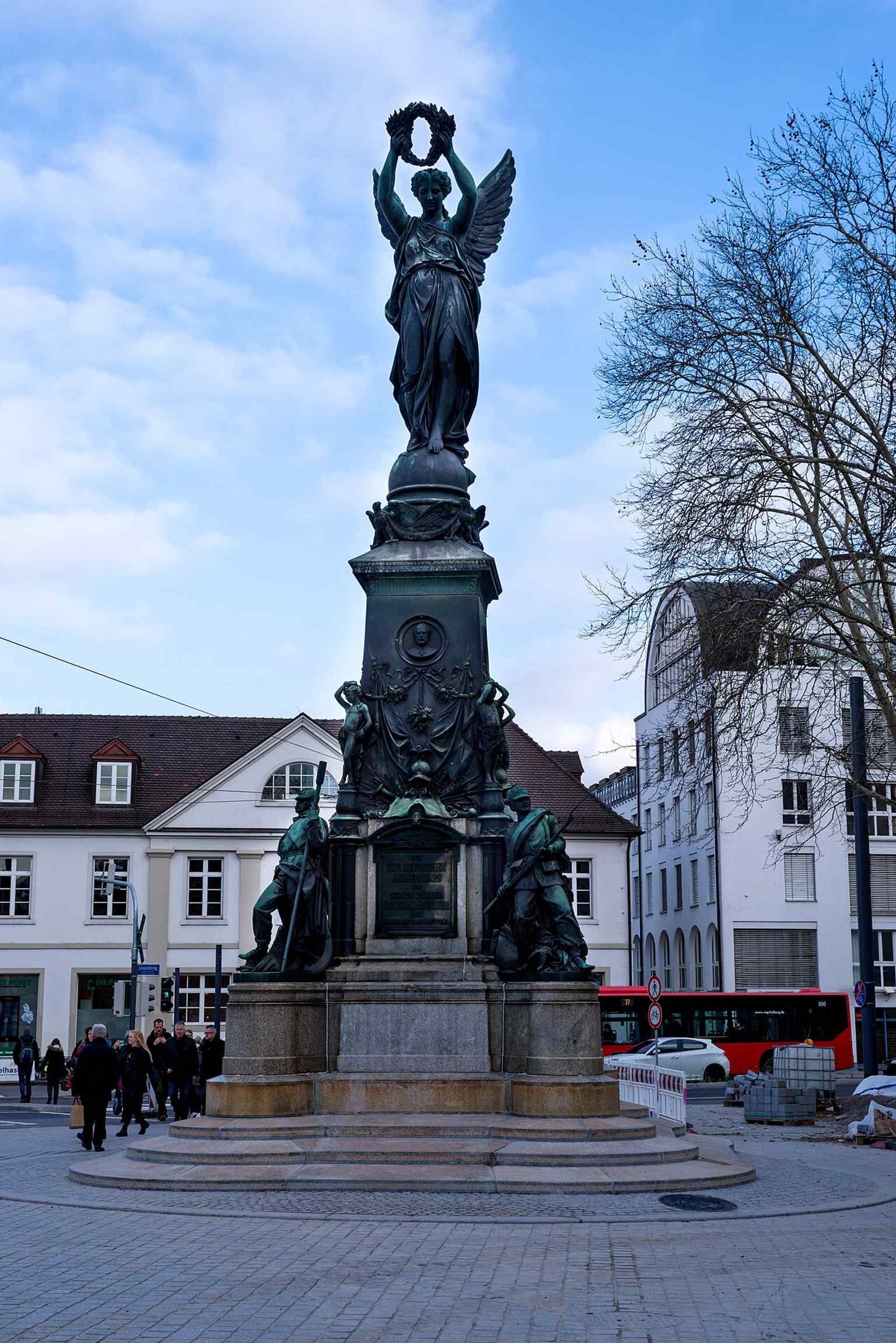
Here’s the part most visitors miss: official place names around this square kept changing. Wilhelmplatz, Kaiser-Wilhelm-Platz, then eventually Europaplatz. But locals mostly ignored the paperwork and just kept calling the place Siegesdenkmal. Public memory quietly overruled the city register.
The monument also survived the twentieth century by argument as much as by stone. In nineteen forty, the Nazi Gauleiter, the regional party leader, Robert Wagner, pushed to have it melted down as a birthday gift for Hitler. City figures including Franz Kerber resisted, and the monument stayed. Then in the bombing of November nineteenth forty-four, the nearby Karlskaserne was destroyed, while the monument remained standing, almost indecently intact. In nineteen sixty-two, traffic engineers shoved it about one hundred meters west because it was in the way. Then, during the rebuilding of the tram line, the city moved it back in twenty seventeen, nearly to where it had begun.
So this monument keeps changing without changing: same Victoria, same granite, new surroundings, new explanations, and more skeptical eyes. At Bertoldsbrunnen, civic symbolism felt confident; here it puts on a uniform.
Next, the story narrows from armies to one remarkable house and one famous scholar in exile: the House of the Whale is about a three-minute walk away.
And, in practical terms, this stop is always accessible, day and night.





%20jm59159.jpg)