
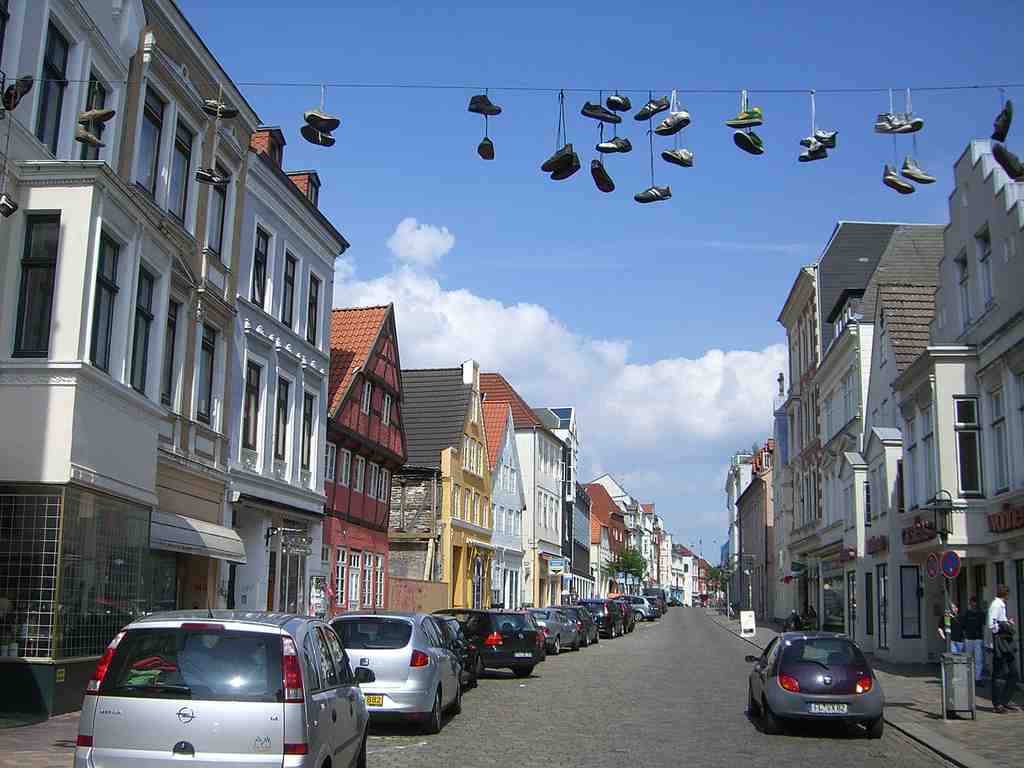
Look for a long stone-paved street framed by modest two-story brick-and-plaster houses, with narrow gables and simple shopfronts stretching in a straight run through the old town.
Norderstraße is Flensburg with its coat off. It is less polished than the grander shopping streets to the south, and that is exactly the point. This is the city’s long northern spine, about seven hundred meters from the edge of Nordermarkt up toward Nordertor, with side lanes slipping toward the harbor and stairs climbing uphill. Trade, gossip, errands, arguments, languages... they all passed through here.
Long before this became Norderstraße, this area belonged to a medieval settlement called Ramsharde, outside the old town walls, the settlement under the castle. Later, around fifteen ninety-five, the city pushed the northern gate farther out, and the street stretched with it. Even the name changed slowly. For centuries it formed part of the old Herrschaftsstraße, the ruler’s road. Only in the nineteenth century did people begin separating it into Holm, Große Straße, and Norderstraße, and the house numbering in eighteen eighty-one made the name official.
You can see that layered growth in the buildings. They do not march in neat formation. Many are low, simple gable houses or eave houses, meaning some show their pointed end to the street while others show their long roofline. Later buildings from the late nineteenth and early twentieth centuries added a more urban face. So the whole street feels mixed, practical, and lived-in... more work shirt than parade uniform.
That mix carries into daily life. Along this one street you find institutions of the Danish minority, including the Danish Central Library for South Schleswig, Flensborghus, and the House of Minorities. You also find international food, artist studios, bookshops, workshops, a Buddhist center, and a mosque. Flensburg has been telling you all tour long that identity here is rarely just one thing. Norderstraße says it in shop signs, meeting places, and lunch menus.
One of the street’s great local characters was Peter, known as Pit Liebmann. He rolled into Flensburg in nineteen seventy-two with a tattoo trailer and later turned numbers one hundred seven through one hundred nine into Villa Bunterhund, his wonderfully eccentric “Ministry for Finicky Affairs.” That is a title only a man with style and nerve would choose. Over his lifetime, Pit tattooed more than seventy thousand people. On this street, even self-invention got an address.
But Norderstraße also keeps harder memory in plain view. At number one hundred four, a memorial plaque recalls the Weiß family and the Flensburg Sinti who lived here until demolition in nineteen thirty-five. Authorities forced them first into a camp near Valentinerallee and later deported them through Hamburg to labor and extermination camps in Poland. This street does not let the city forget who belonged here, and who was torn away.
Then there is the playful side. Since two thousand and five, hanging shoes on wires, a bit of subcultural street art known as shoefiti, has helped turn Norderstraße into an unofficial landmark. Some travel writing has even singled it out as one of the city’s strangest streets. Fair enough. Flensburg has always had a taste for the respectable and the slightly unruly sharing the same block.
Take a slow look along the streetline now. The buildings are less uniform, less grand. Does that make the street feel ordinary... or does it make it feel more honest?
In a moment, we’ll head toward the Church of the Holy Spirit, where this city’s story narrows from street life to care, language, and memory held in an institution. It’s about a seven-minute walk from here.




