
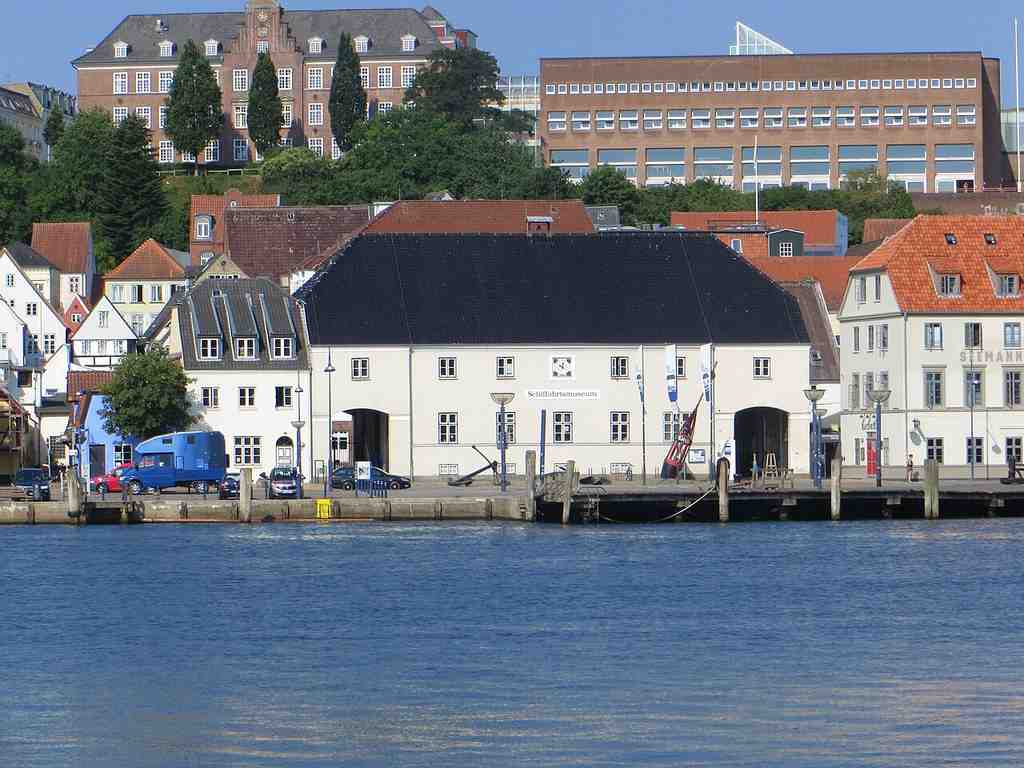
On your left stands a long red-brick warehouse with a broad gabled roof and a central arched passage cut through its middle.
If you want a clear example of citizen-led preservation, you’re looking at it. Maritime history did not simply drift into a museum like a bottle washing ashore... people in Flensburg argued over it, raised money for it, restored it, and decided what stories this harbor should keep.
This building began life in eighteen forty-two and eighteen forty-three, when the royal Danish building inspector Meyer designed it as a customs warehouse, a place where imported goods sat under seal until merchants paid the tax. Until nineteen seventy-two, Flensburg merchants stored goods here, and rum ranked among the big ones. That alone tells you plenty about this town: church towers on one side, trade ledgers on the other, and a harbor tying both together.
But turning it into a museum took a fight. In nineteen seventy-nine, the state of Schleswig-Holstein handed the old warehouse to the city. Even then, nothing was settled. A public meeting did not give a clear yes. Museum director Doctor Rudolf Zöllner still thought the city might simply enlarge its older museum instead. Then local supporters stepped in. They urged the city to accept the gift and remake this harbor warehouse as a home for Flensburg’s seafaring past. City president Ingrid Groß did not blink at the bill: about two point three million Deutsche Marks. That is what you call civic courage with a calculator in hand.
And then came Doctor Jutta Glüsing, the art historian who got the official task of creating the museum. She did not just arrange old objects in glass cases. She helped build the whole memory machine. Supporters sold hundreds of symbolic ship shares to fund a model ship, and collection tins appeared in banks, pharmacies, offices, and shops. From nineteen eighty to nineteen eighty-three, workers restored the listed building, added accessibility, and opened the museum in nineteen eighty-four as part of Flensburg’s seven hundredth anniversary. By the next year, it had already welcomed its fiftieth-thousand visitor.
Inside, the old world of Flensburg’s shippers survives in layers: ship portraits, models, nautical instruments, a city model showing the boom years around sixteen hundred, and the “treasure of the Schiffergelag,” the old shippers’ guild collection linked to medieval harbor management. There is even a two-cylinder ship steam engine from around eighteen seventy. Beneath one of the storage floors, cast-iron columns still hold the building up; Georg Dittmann’s first Flensburg iron foundry made them in eighteen forty-two. Solid stuff... history with muscles.
But here comes the turn. This museum no longer tells a cozy harbor tale and leaves it there. Its rum exhibits and later exhibitions, especially “Rum, Sweat and Tears,” confronted the darker side of Flensburg’s wealth: West Indies trade in sugar, rum, coffee, and dyewoods depended on enslavement, human trafficking, and brutal plantation labor in the Caribbean. So this place preserves pride, yes... but it also preserves accountability.
In a moment, head on toward Oluf-Samson Gang, where harbor life leaves the official record and slips into a narrower, more intimate lane, where reputation and survival rubbed shoulders. If you want to come back inside later, the museum is open Tuesday through Sunday from ten to five, and closed on Mondays.




