
Colmar Audio Tour: Saints, Altarpieces & Hidden Centre Centre Tales
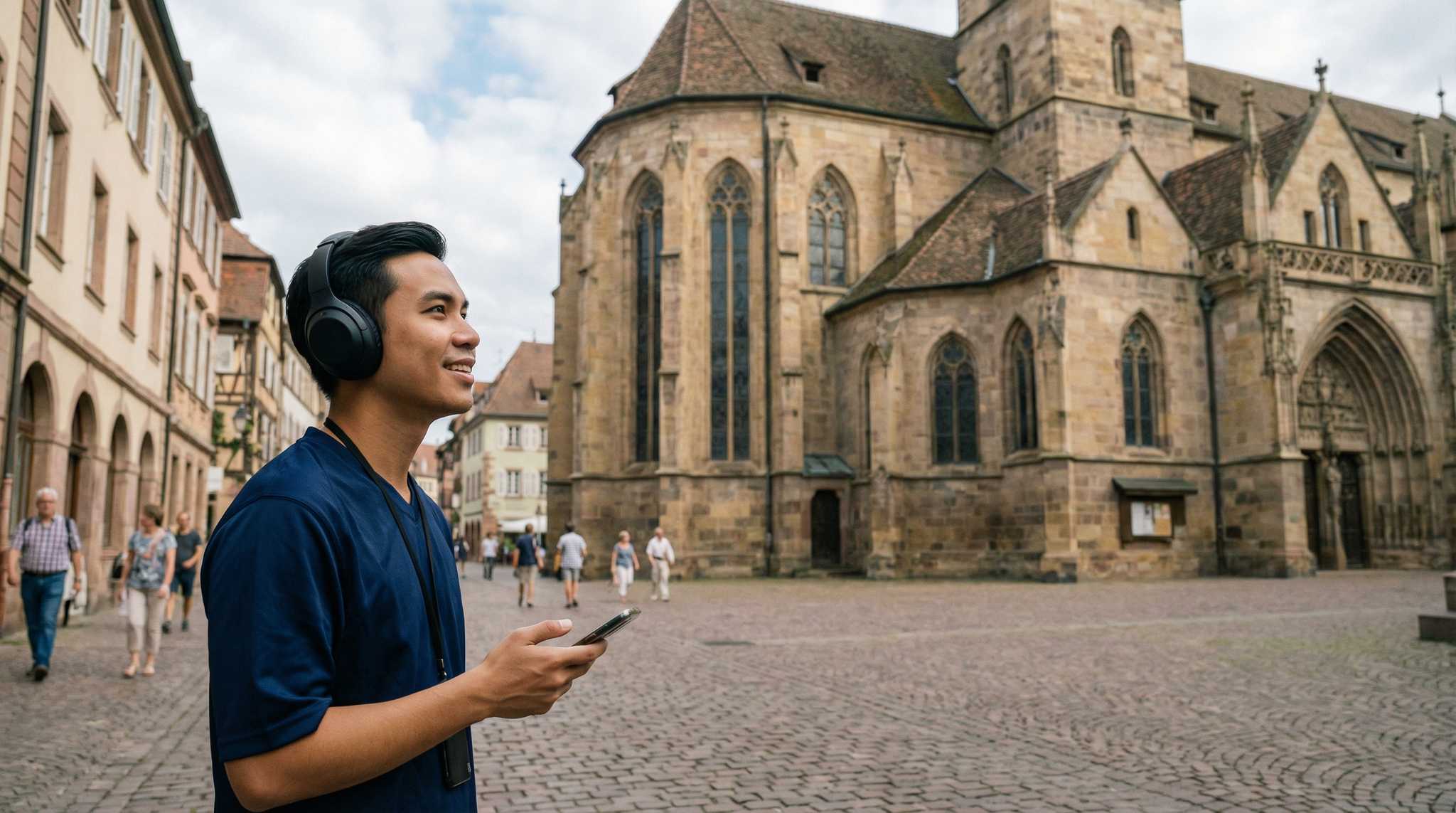
Half timbered façades and flowered canals make Colmar look harmless, yet Centre Centre has seen power plays, whispered scandals, and faith tested in stone. This self guided audio tour threads through the old streets to Collegiate Saint Martin de Colmar, The Virgin at the bush of roses, the Unterlinden Museum, and more. Listen as corners and courtyards reveal stories most visitors walk past. When the city shook with political battles and rebellion, which bell or banner tried to rally the crowd at Saint Martin? What quiet mystery still clings to The Virgin at the bush of roses when no one is watching? Why does a single haunting detail inside the Unterlinden Museum stop people mid step and refuse to be forgotten? Move from sunlit squares to shadowed chapels, following clues in carvings, pigments, and street names. Expect drama, discovery, and a changed view of Colmar. Press play and let the pretty streets show their teeth.
Tour preview
About this tour
- scheduleDuration 80–100 minsGo at your own pace
- straighten2.9 km walking routeFollow the guided path
- location_on
- wifi_offWorks offlineDownload once, use anywhere
- all_inclusiveLifetime accessReplay anytime, forever
- location_onStarts at Monument to General Rapp
Stops on this tour
lock_open 3 free previews · 12 unlock with purchase
Look up at the towering bronze figure striking a dynamic, mid-stride pose atop a stepped, light-colored granite pedestal adorned with a carved sword and wreath. You are looking at…Read moreShow less
Open dedicated page →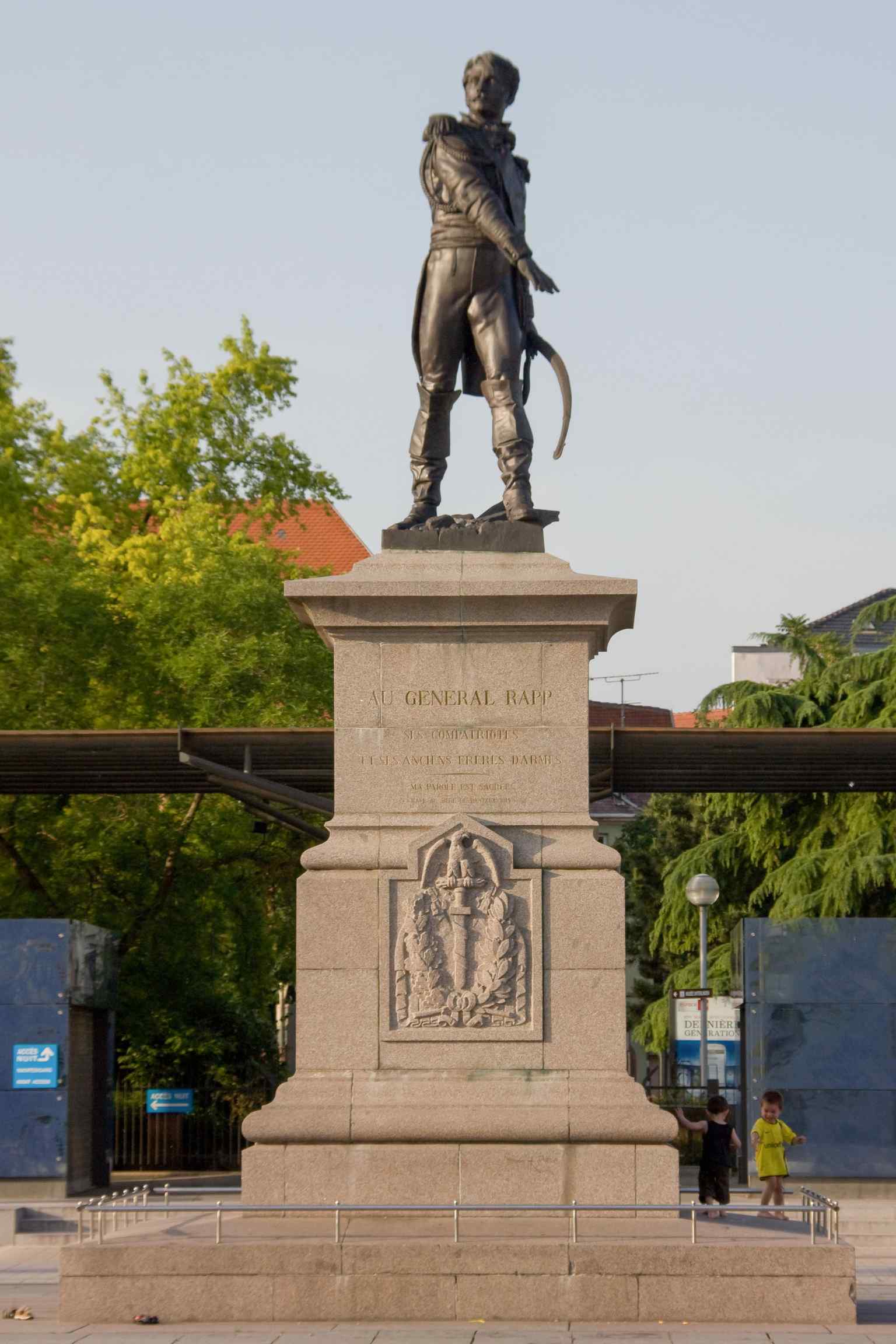
The towering Monument to General Rapp in Colmar, famously the first major public work by a young Auguste Bartholdi (2009).Photo: Poudou99, Wikimedia Commons, CC BY-SA 3.0. Cropped & resized. Look up at the towering bronze figure striking a dynamic, mid-stride pose atop a stepped, light-colored granite pedestal adorned with a carved sword and wreath. You are looking at the Monument to General Rapp, and it is actually the very first major public work by Auguste Bartholdi, the man who would later design the Statue of Liberty. Back in 1854, Bartholdi was just twenty years old when he landed this commission to sculpt Jean Rapp, a famous local general. The town council quickly got cold feet about the cost and tried to shrink the proposed statue by half. Fortunately for art history, Bartholdi had a very supportive and wealthy mother. She stepped in, using her influence and her own money to ensure her son's colossal vision survived. Because of her, we get this unusually energetic pose, a complete departure from the stiff, static statues of the era.
General Rapp himself was quite a character, known for surviving twenty-four combat wounds and for his legendary bluntness. On the front of the granite base, you will see an inscription in French that translates to, My word is sacred. This goes back to the Siege of Dantzig in 1813. Rapp and his men had held out against Russian forces for nearly a year, battling starvation and disease. When he finally agreed to surrender if no reinforcements arrived, the Russian general demanded a written guarantee. Insulted that anyone would doubt his honor, Rapp fired back with that single phrase. He kept his promise, earning the deep respect of his enemies. Rapp was also fiercely loyal, famously saving Napoleon Bonaparte from a young assassin wielding a kitchen knife in 1809.
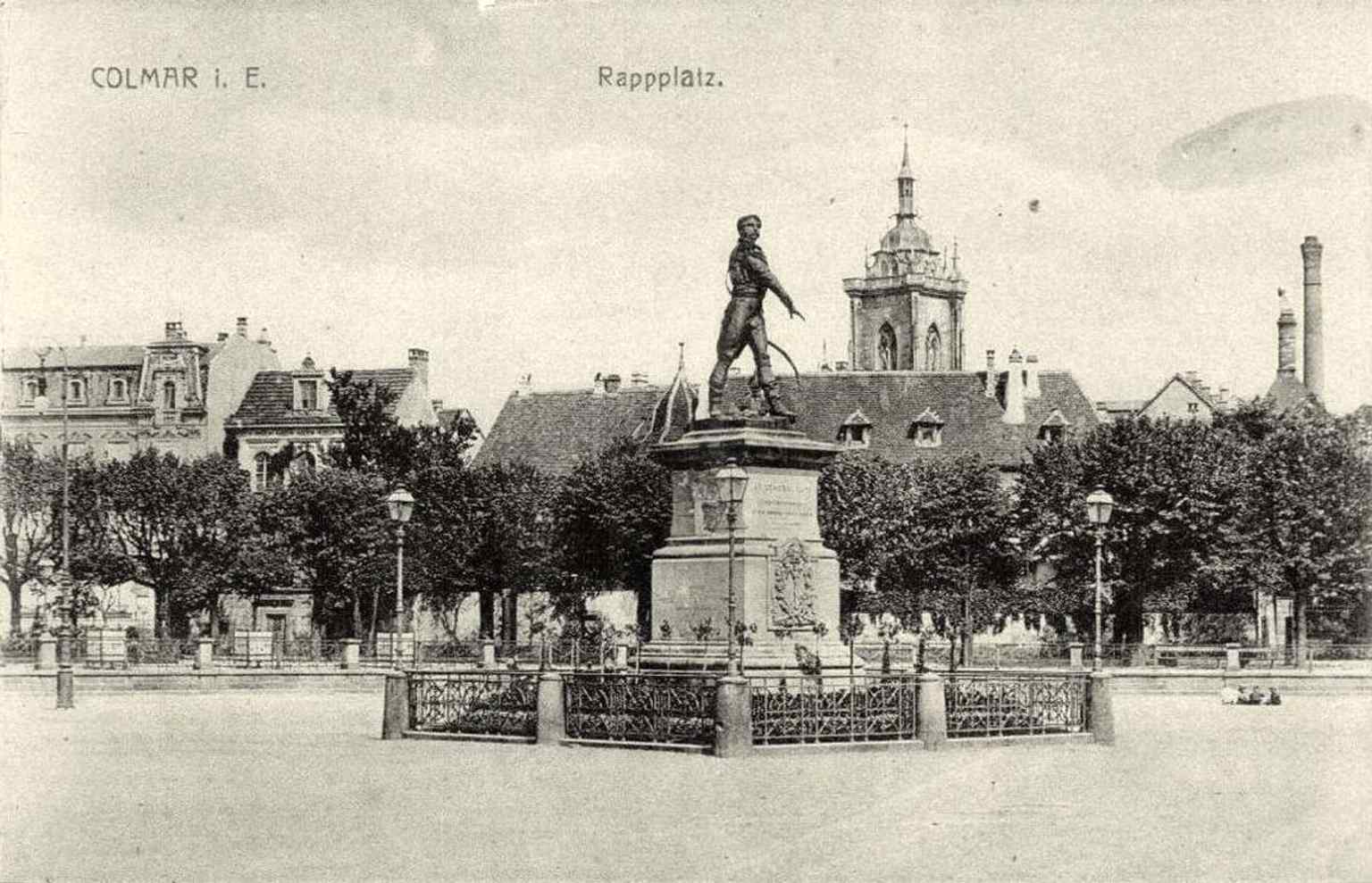
A historic view of Place Rapp from 1900, showing how the public square looked over a century ago.Photo: AnonymousUnknown author, Wikimedia Commons, Public domain. Cropped & resized. By the way, the app has a neat side-by-side image showing what this public square looked like back in 1900 compared to today. The monument itself has seen its share of conflict. During the Second World War, occupying Nazi forces tore the statue down, hoping to erase this symbol of French patriotism. Luckily, the bronze pieces were secretly preserved rather than melted down for munitions. After the war, the battered bronze was sent to Paris for repairs and triumphantly returned to this pedestal in 1948.
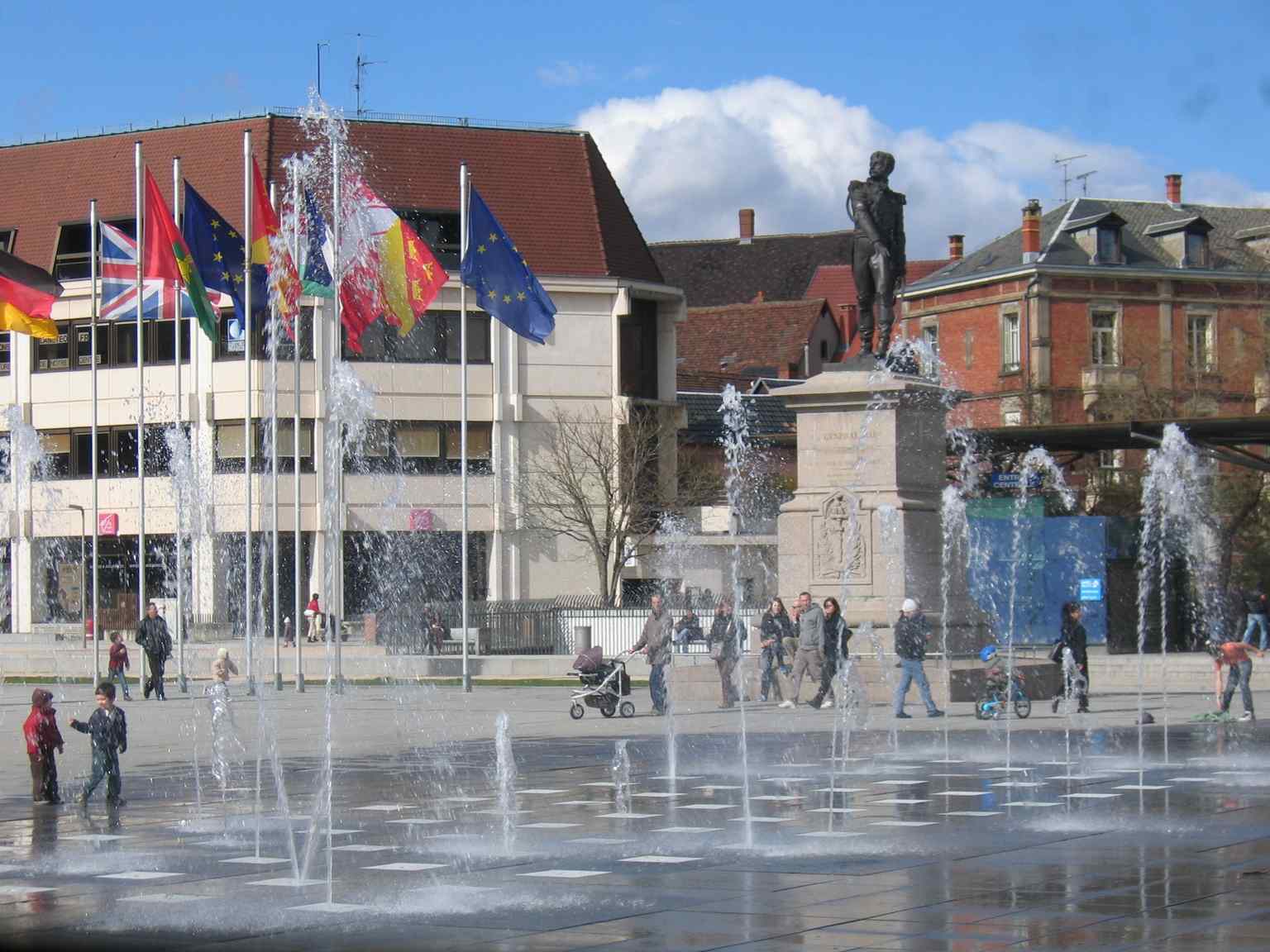
The vibrant Place Rapp as it stands today, a welcoming public square surrounding the historic monument (2010).Photo: Sanseiya, Wikimedia Commons, CC BY-SA 3.0. Cropped & resized. Since it stands right in the middle of a public square, you can visit this monument twenty-four hours a day, any day of the week. Take a moment to admire the details of Bartholdi's early triumph. When you are ready, we can take a short walk over to the Battle of Argentovaria.
On your right, look for the life-sized pink sandstone statue of a man in heavy, draped robes looking intently down at a book in his hands, resting on a simple square base. We have…Read moreShow less
Open dedicated page →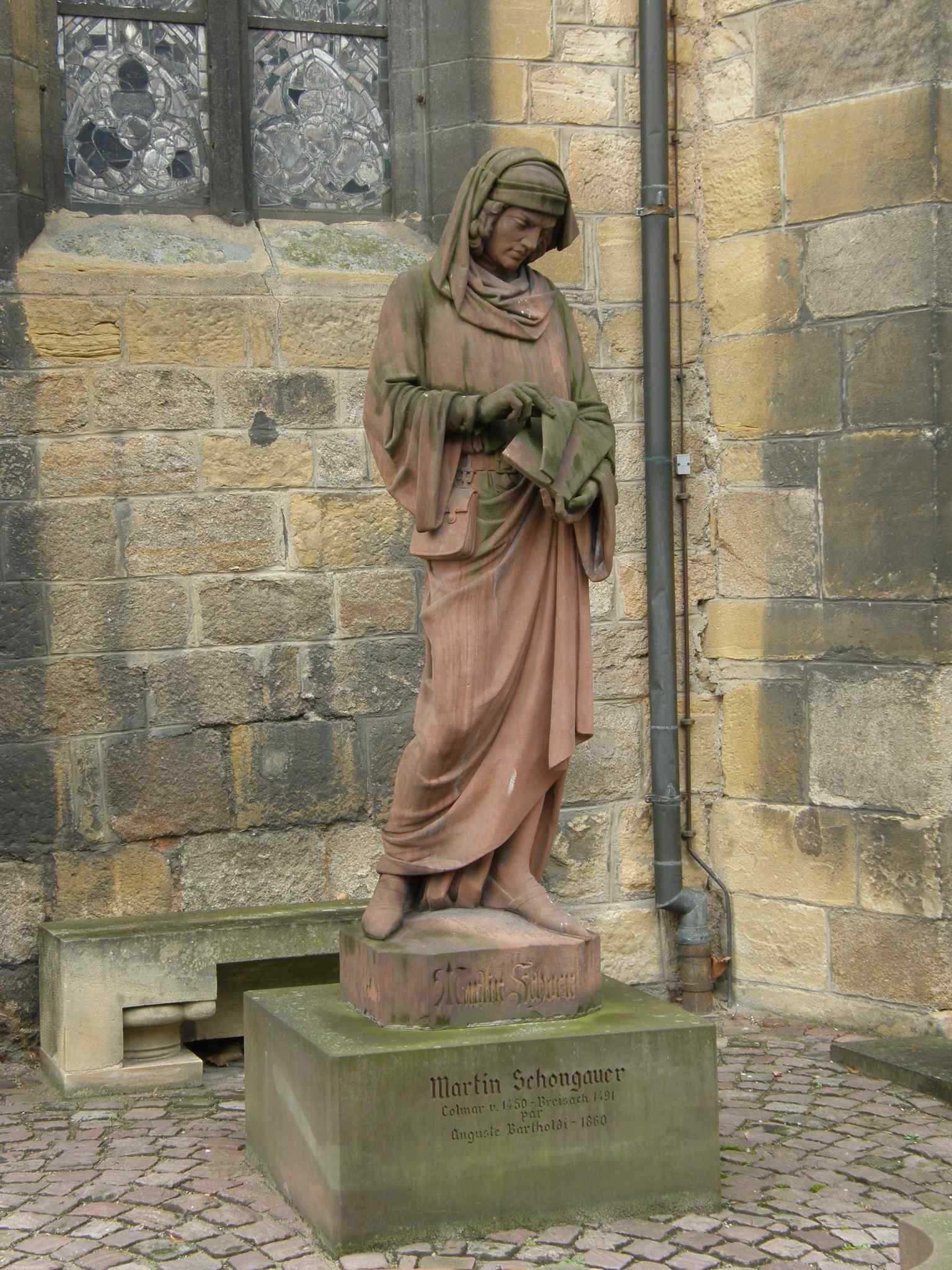
The pink sandstone statue of Martin Schongauer outside the Unterlinden Museum, standing as a quiet testament to medieval art, captured in 2008.Photo: Bourrichon, Wikimedia Commons, CC BY-SA 4.0. Cropped & resized. On your right, look for the life-sized pink sandstone statue of a man in heavy, draped robes looking intently down at a book in his hands, resting on a simple square base. We have traded the ancient clashes of the Battle of Argentovaria for the quiet focus of medieval art, though this monument has seen its own kind of drama. This is Martin Schongauer, a brilliant fifteenth-century painter and engraver from Colmar. If the statue looks a bit lonely on that modern block, it is because you are only looking at the top piece of a much grander puzzle. In 1863, the famous French sculptor Auguste Bartholdi created a massive fountain to honor Schongauer. To build it, Bartholdi carved through eleven cubic meters of this beautiful pink sandstone.
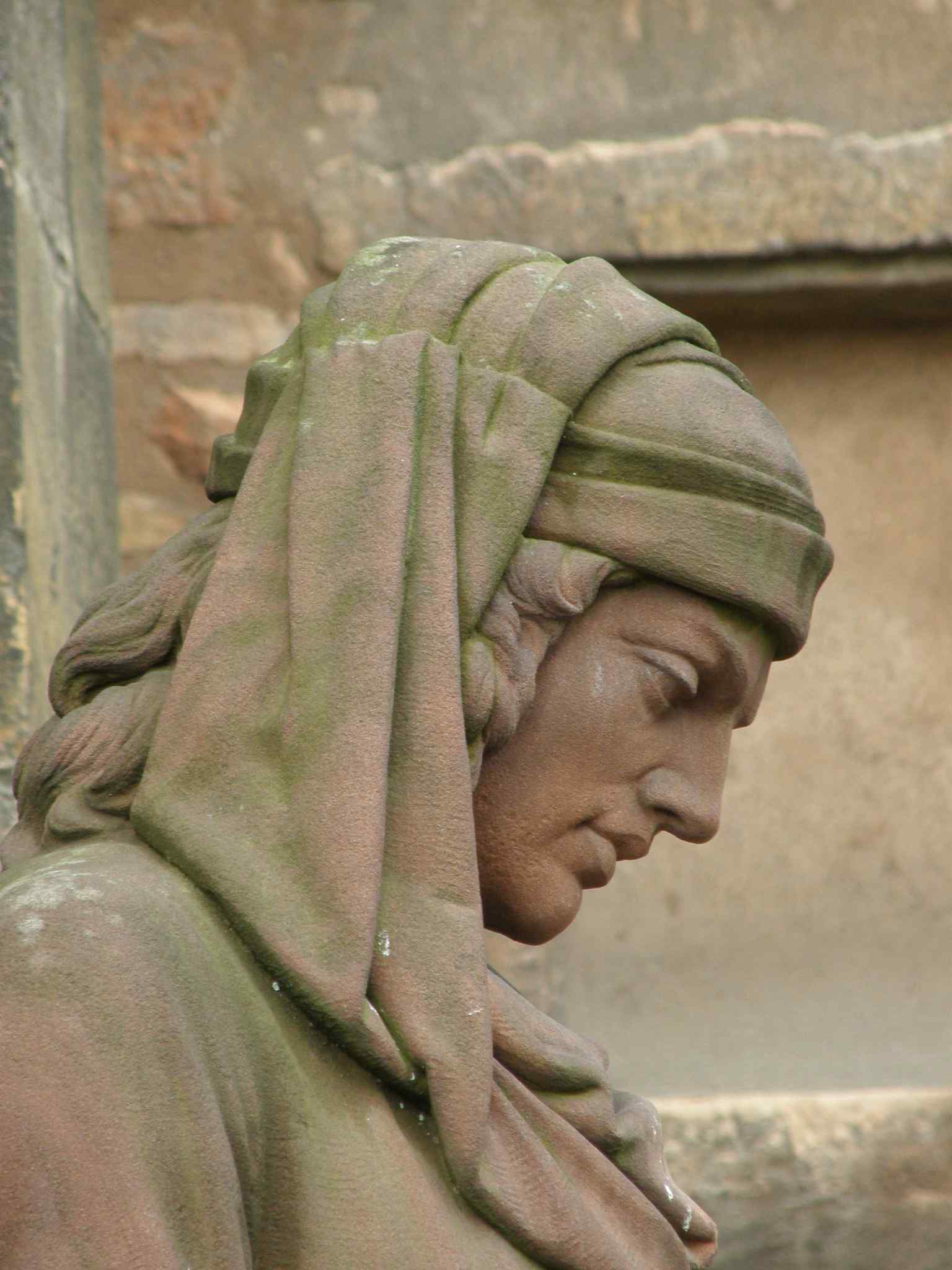
A closer profile view from 2008 showing the intricate details of Schongauer's draped robes and book, carved by Auguste Bartholdi.Photo: Bourrichon, Wikimedia Commons, CC BY-SA 4.0. Cropped & resized. Originally, this statue crowned a towering neo-gothic pedestal. Neo-gothic is an architectural style from the nineteenth century that revived the pointed arches and dramatic details of medieval churches. Clustered below Schongauer were four smaller statues known as allegorical figures, which are simply human forms used to symbolize abstract concepts. Here, they represented Schongauer's fields of expertise: Goldsmithing, Engraving, Study, and Painting. Bartholdi had a playful side, so he gave three of those statues the faces of the friends who helped promote the project, and he cheekily modeled the Goldsmithing figure after himself.
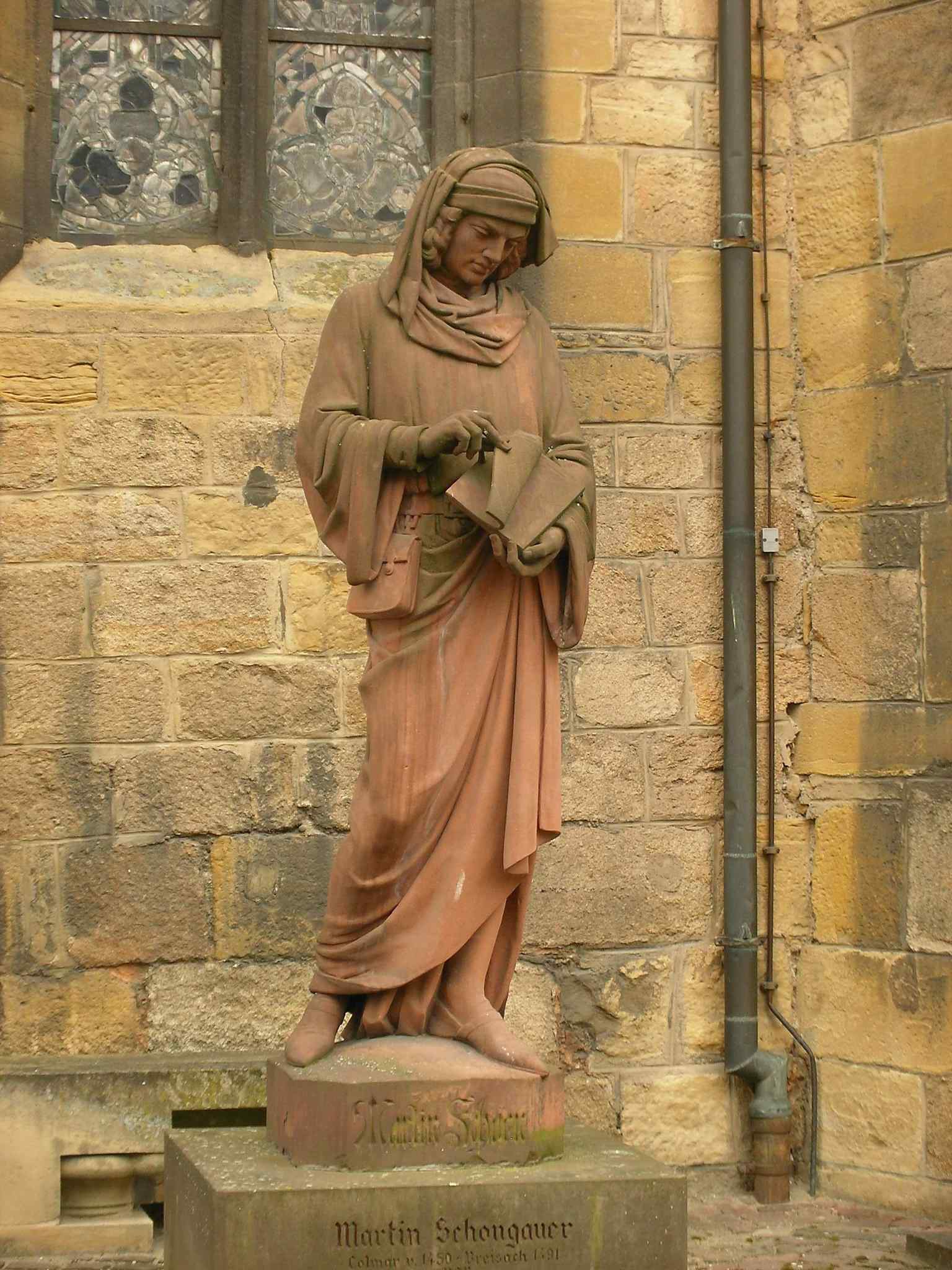
The lonely sandstone figure resting on its modern base in Colmar, seen in 2012 before its final relocation back to its original spot.Photo: Gzen92, Wikimedia Commons, CC BY-SA 4.0. Cropped & resized. The grand monument did not stay together forever. In 1958, the fountain was completely dismantled and the pieces were scattered across Colmar. The water basins were moved to a local church, and those four figures with his friends' faces were sent to the Bartholdi Museum. Meanwhile, Schongauer was shuffled around the city, spending years near a chapel and locked in museum storage. Finally, in 2015, this sandstone figure was brought right back here to his original location. He may have lost his magnificent fountain, but the artist is finally back home. It has been quite the journey for a single block of stone. When you are ready to continue, we will take a short stroll to see the famous Issenheim altarpiece.
Show 12 more stopsShow fewer stopsexpand_moreexpand_less
Coming off our last stop at the monument to Martin Schongauer, we arrive at something truly extraordinary on your right. This is the Issenheim Altarpiece, and it is widely…Read moreShow less
Open dedicated page →Coming off our last stop at the monument to Martin Schongauer, we arrive at something truly extraordinary on your right. This is the Issenheim Altarpiece, and it is widely considered one of the most hauntingly powerful works of art in Western history.
Created between 1512 and 1516 by the German painter Matthias Grunewald and sculptor Nicolas de Haguenau, this massive work is a polyptych. That is a multi-paneled altarpiece with hinged wings that can be opened and closed like an enormous, intricately carved book, revealing different scenes depending on the religious calendar.
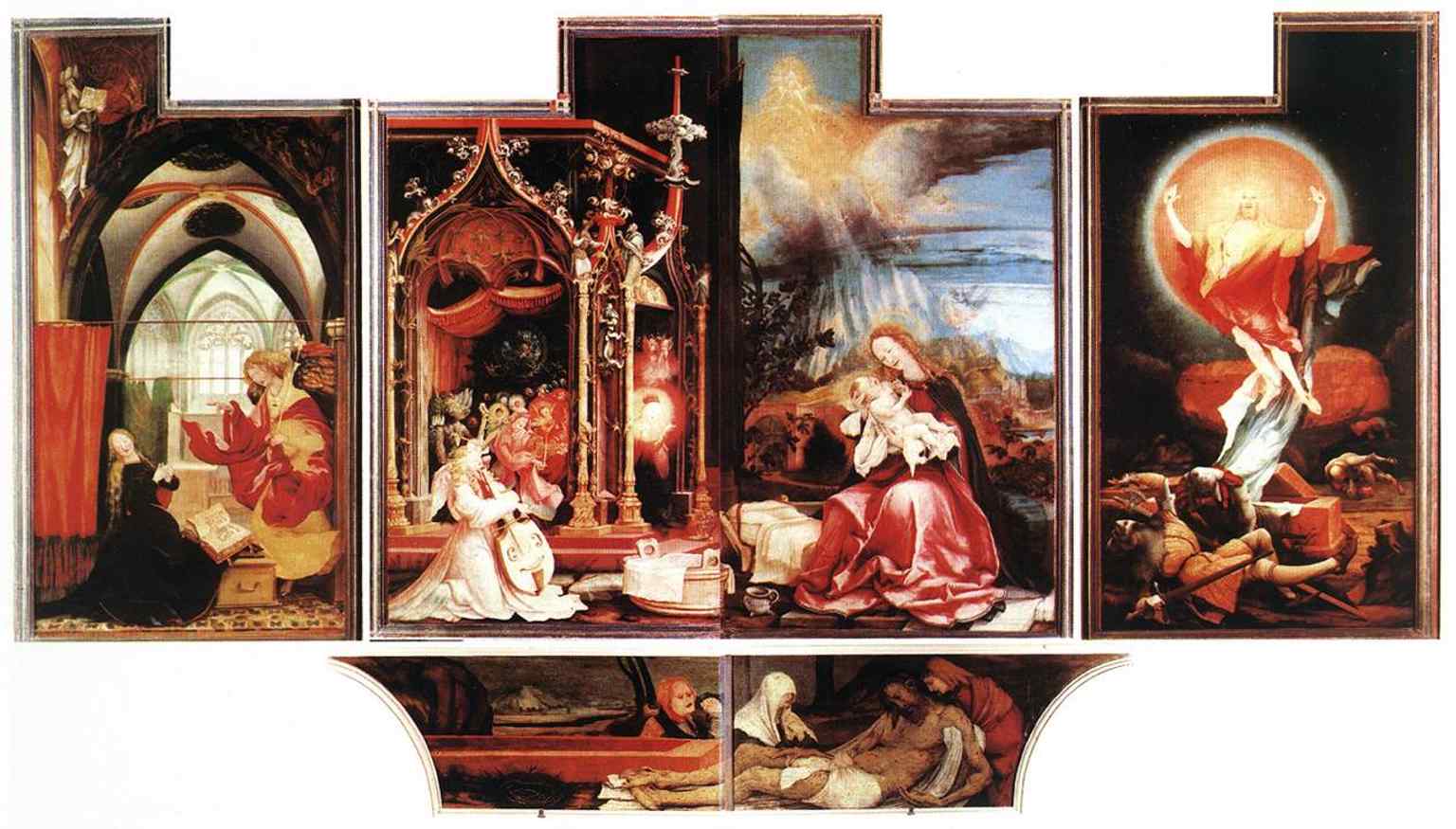
Grunewald's relentlessly dark depiction of the Crucifixion, where the visceral suffering of Christ offered strange solace to dying patients (1515).Photo: Matthias Grünewald, Wikimedia Commons, Public domain. Cropped & resized. To really understand the intensity of this piece, you have to know who it was made for. It was originally commissioned for the hospital of the Antonin monks in the nearby village of Issenheim. Throughout the Middle Ages, these monks specialized in treating a terrifying affliction known as Saint Anthony's fire. Today, we know this disease as ergotism, a severe poisoning caused by eating bread made from rye infected with a toxic fungus. But back then, it seemed like a demonic curse. Patients suffered from terrible hallucinations, muscle spasms, and a gangrenous, agonizing burning sensation in their limbs.
When patients first arrived at the hospital, they were brought before this very altarpiece. With the panels closed, they would see Grunewald's Crucifixion. It is a relentlessly dark, visceral painting. Christ is depicted not as a serene, glowing figure, but with twisted hands, blue lips, and a body completely covered in horrific, festering wounds. To modern eyes, it is almost shocking, but to the dying patients of the sixteenth century, it offered a strange kind of comfort. They looked at the altarpiece and saw a savior who actually understood their physical agony.
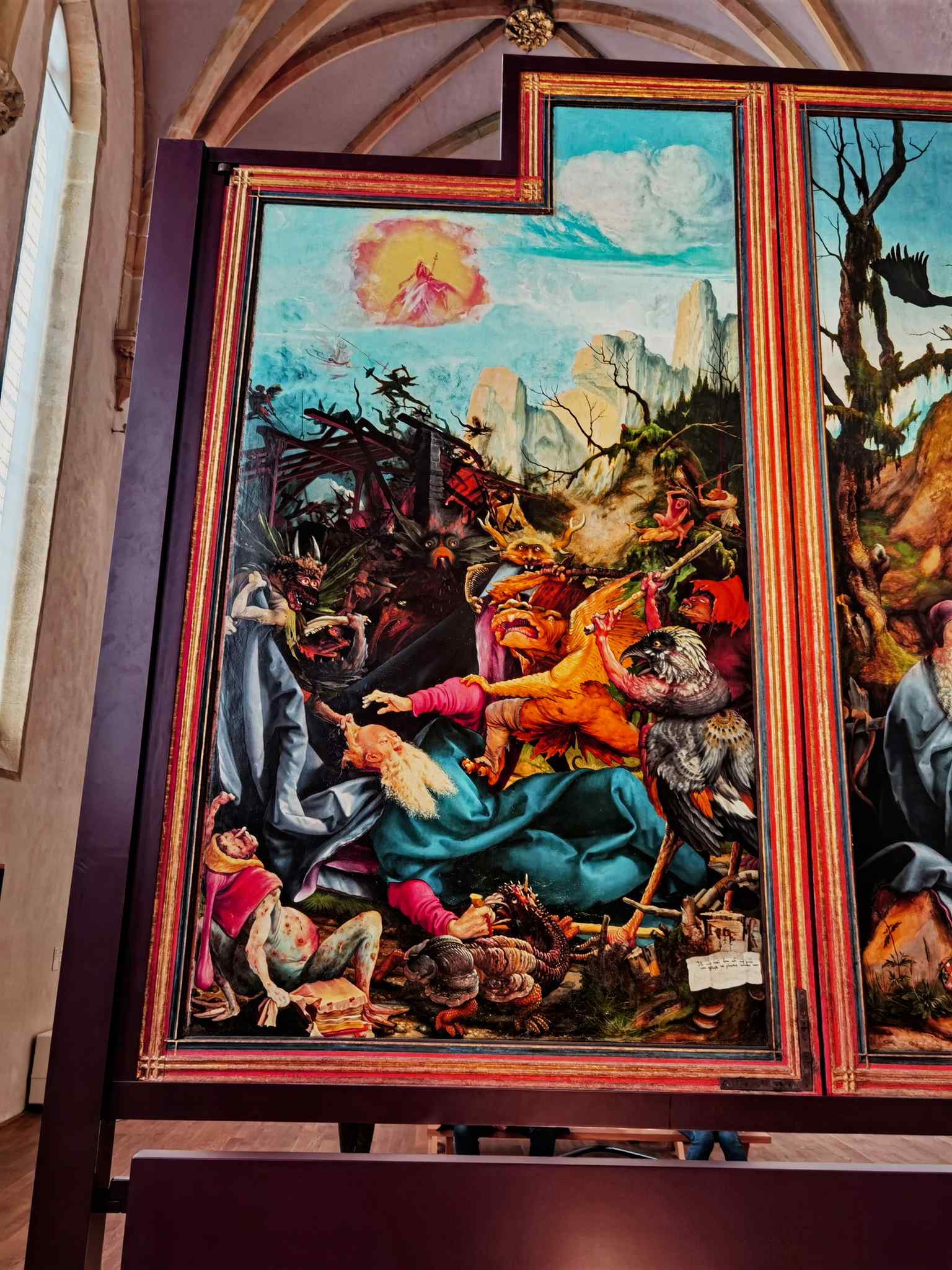
A vivid and terrifying panel showing Saint Anthony attacked by bizarre demons, whose diseased limbs mirror the exact symptoms of ergotism (2023).Photo: Txllxt TxllxT, Wikimedia Commons, CC BY-SA 4.0. Cropped & resized. When the panels were opened on special feast days, the artwork revealed vibrant paintings and wood sculptures, including a terrifying scene of Saint Anthony being attacked by bizarre, monstrous demons. In the corner of that panel, one of the grotesque creatures has webbed feet, a swollen belly, and diseased limbs, directly mirroring the exact symptoms of the patients lying in the hospital beds.
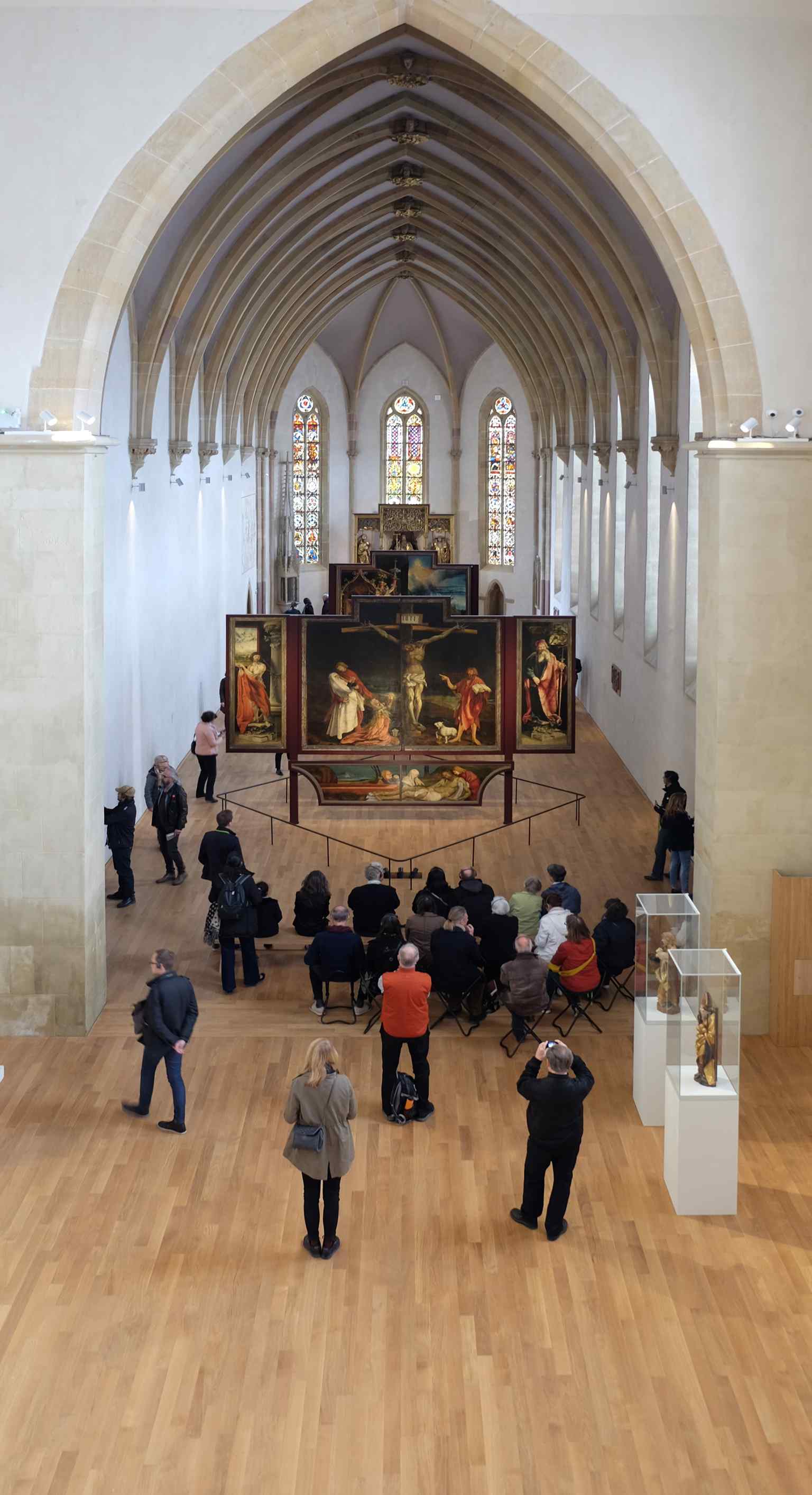
The safely preserved altarpiece on display within the sleek, modernized gallery of the Unterlinden Museum today (2017).Photo: Michael Lenz, Wikimedia Commons, CC BY-SA 4.0. Cropped & resized. The altarpiece has survived an incredible journey over the centuries. During the French Revolution, it was dismantled and moved to Colmar to save it from destruction. In World War Two, it was secretly hidden away in various rural castles to protect it from looting, eventually being recovered by the American army in 1944.
Now it rests safely right here inside the Unterlinden Museum. The app has a neat side-by-side showing what this place looked like back in 2014 before massive renovations, compared to its sleek modern gallery today.
It is a masterpiece born entirely from human suffering, yet it offered an entire community a sense of profound peace. Take a moment to soak this in, and when you are ready, we can head over to our next stop just steps away.
So here we are, just a minute's walk from the monument to Martin Schongauer, and right in front of you is where many of his finest works actually live. If you look to your right…Read moreShow less
Open dedicated page →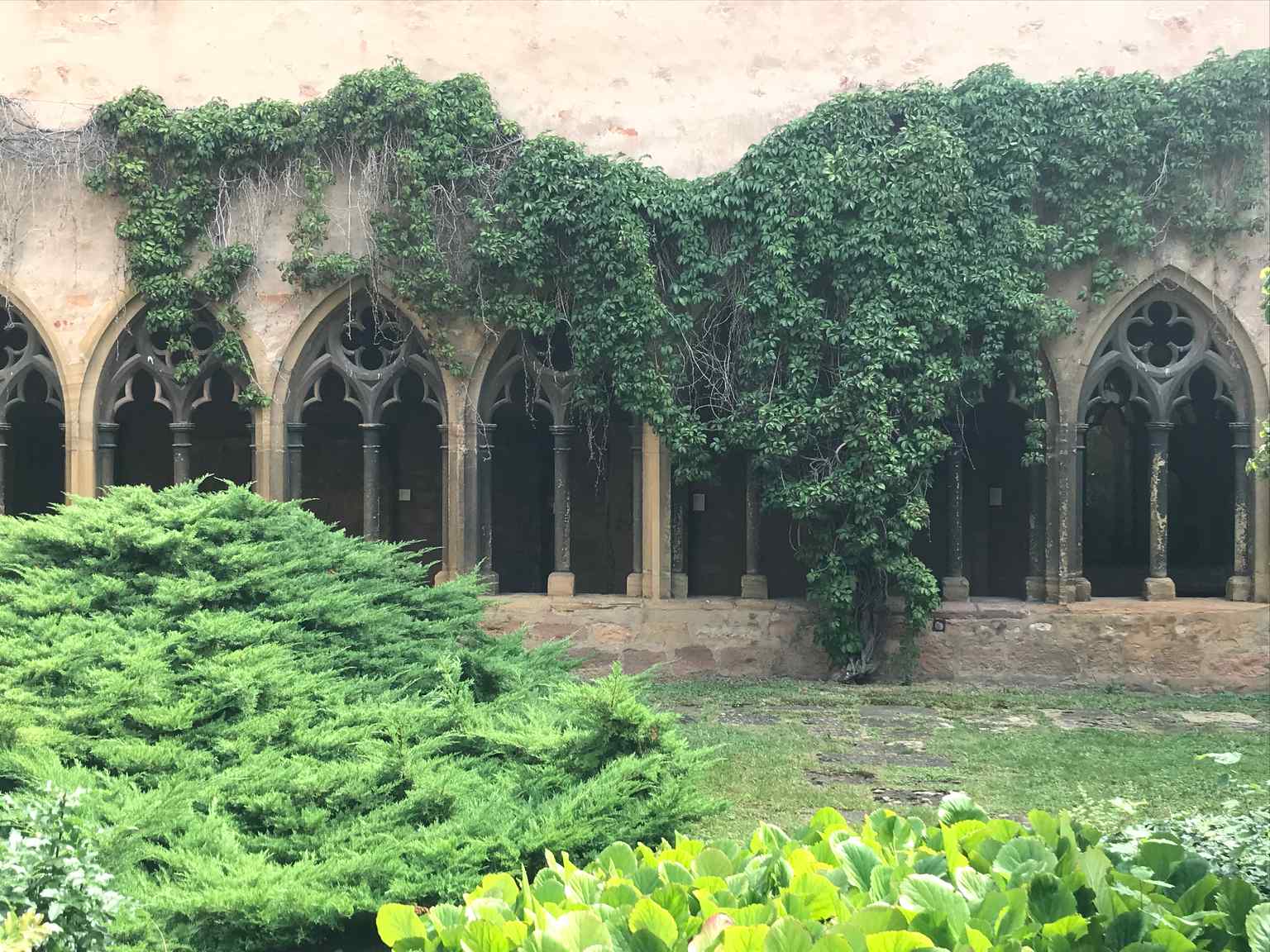
Cloître du Musée UnterlindenPhoto: Lou1923, Wikimedia Commons, CC BY 4.0. Cropped & resized. So here we are, just a minute's walk from the monument to Martin Schongauer, and right in front of you is where many of his finest works actually live. If you look to your right from where you are standing to the front left of the main facade, you will see the Unterlinden Museum.
The name Unterlinden translates quite simply to under the linden trees. Long before it was a world renowned museum, this beautiful stone complex was a convent for Dominican nuns, a Catholic religious order focused on preaching and study. The sisters lived here peacefully for centuries until the French Revolution in 1789 forced them out. After their departure, the buildings were left to decay and were eventually repurposed as a rather gloomy military barracks. The entire convent was slowly falling apart and was very nearly demolished to make way for new development.
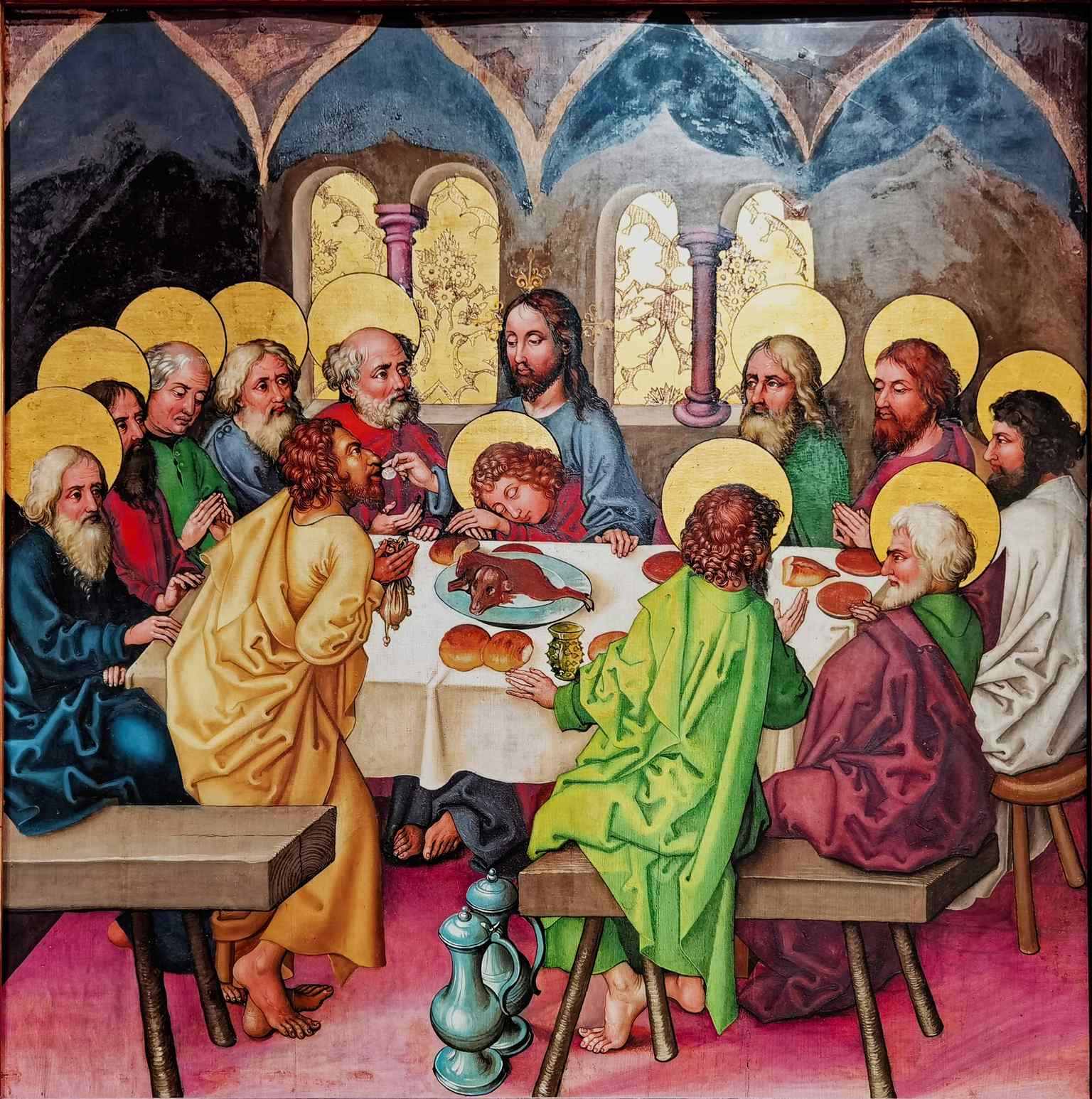
Colmar - Unterlinden Museum - Altarpiece of the Dominicans, Childhood and Passion of Christ - Martin Schongauer (ca 1445-1491) & Atelier, ca 1480 - Oil on wood panel - The Last SupperPhoto: Txllxt TxllxT, Wikimedia Commons, CC BY-SA 4.0. Cropped & resized. Fortunately, the site was saved in the mid-nineteenth century by a local heritage group called the Schongauer Society. In 1852, they had the clever idea to gather up the massive amounts of art that had been confiscated from local churches and monasteries during the Revolution and store it all in the old convent. By turning these crumbling halls into a sanctuary for regional art, they rescued the medieval architecture from the wrecking ball, and the museum officially opened its doors in 1853.
Today, the museum is best known for its incredible collection of Rhenish art, meaning pieces produced in the upper Rhine river region during its golden age. The absolute crown jewel of the collection is housed right inside the former convent church. That is the Issenheim Altarpiece we just discussed, drawing visitors from all over the world to experience its intense emotion and vivid color. You will also find a stunning array of pieces by local master Martin Schongauer, whose engravings, made by carving into copper plates with a sharp steel tool called a burin, were so masterful they were even admired by a young Albrecht Durer.
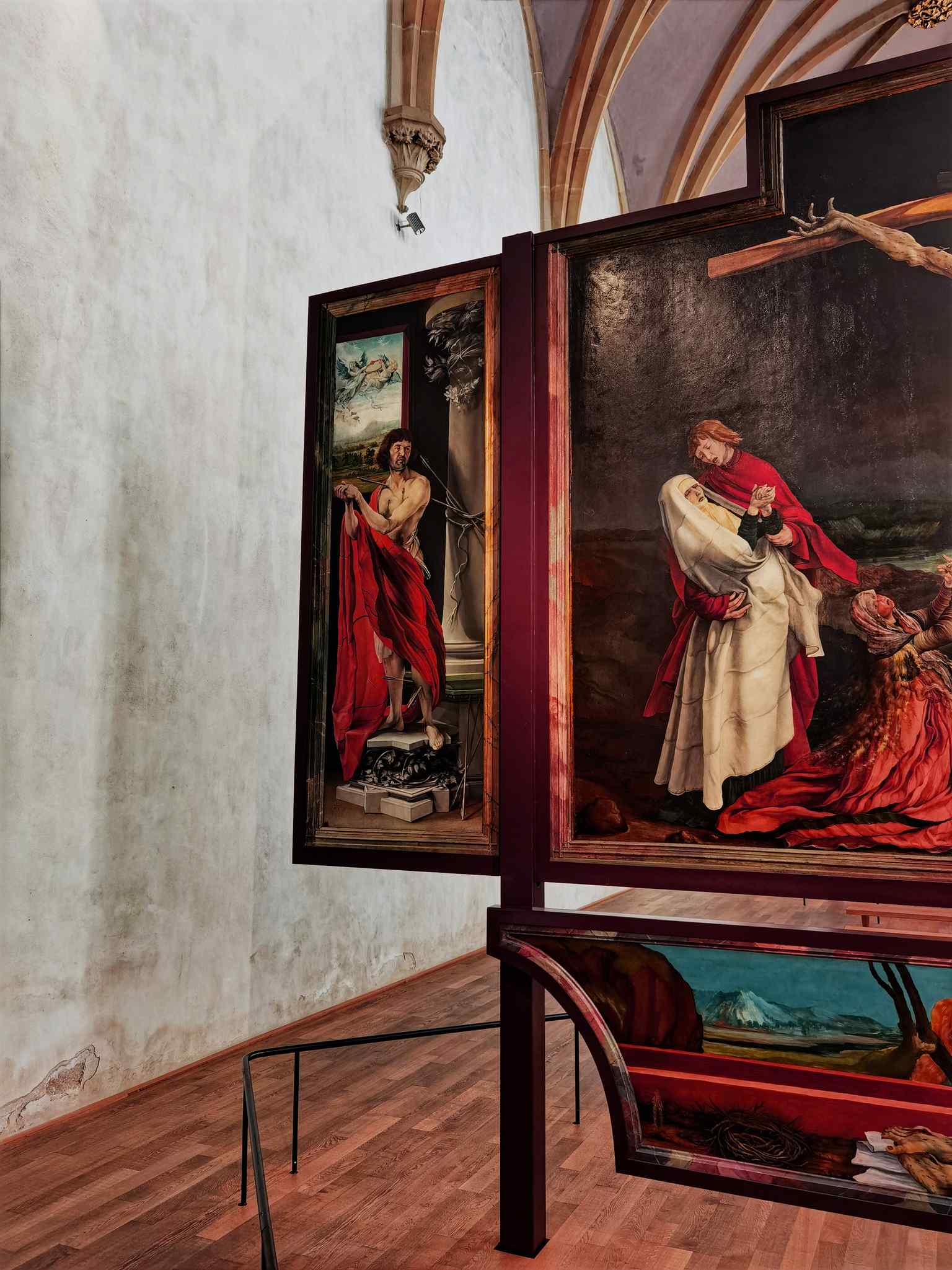
Colmar - Unterlinden Museum - The Isenheim Altarpiece 1512-16 by Matthias Grünewald (ca 1470-1528) - Crucifixion 02Photo: Txllxt TxllxT, Wikimedia Commons, CC BY-SA 4.0. Cropped & resized. But the museum is not entirely anchored in the past. It also houses modern pieces by Monet, Renoir, and Picasso, as well as a fascinating collection of Japanese sword guards and ancient Chinese ceramics donated by an art dealer named Florine Langweil. In 2015, the museum expanded massively with a forty-four million euro renovation by the famous Swiss architectural firm Herzog and de Meuron, linking the medieval cloister to the town's old municipal baths through an underground gallery.
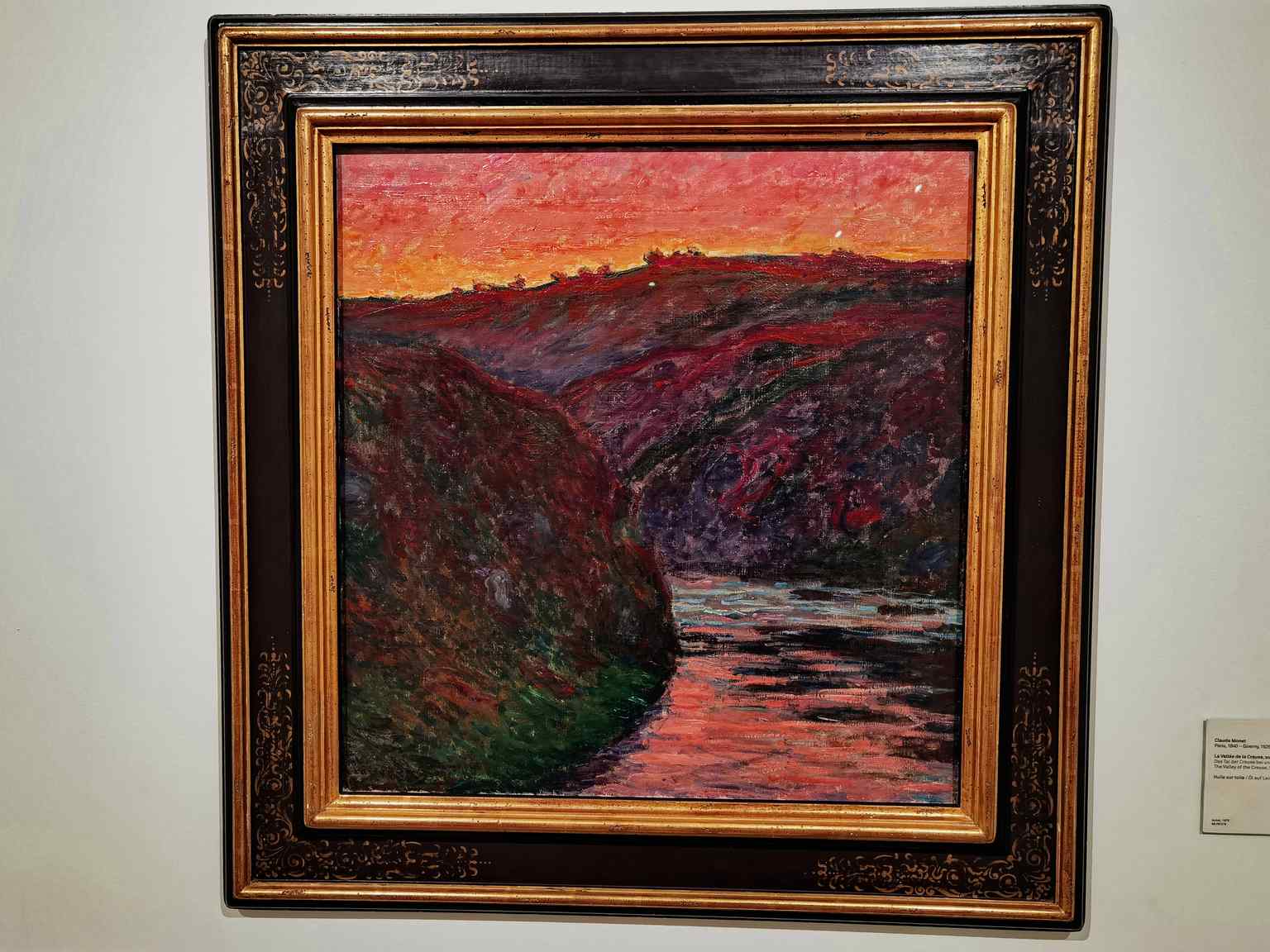
Colmar - Unterlinden Museum - La Vallée de la Creuse, soleil couchant (The Creuse Valley, setting sun) 1889 by Claude Monet (1840-1926) - Oil on Canvas 01Photo: Txllxt TxllxT, Wikimedia Commons, CC BY-SA 4.0. Cropped & resized. If you want to step inside to see the altarpiece yourself, the museum is open from nine in the morning to six in the evening every day of the week except Tuesdays. It truly is a remarkable collision of medieval devotion and modern vision. Take a moment to soak this in, and when you are ready, we can head just down the street to our next stop at the Colmar head house.
Look to your right to spot a towering, golden-yellow stone building featuring a highly decorated, wavy triangular roofline and a prominent, protruding central window. Just a short…Read moreShow less
Open dedicated page →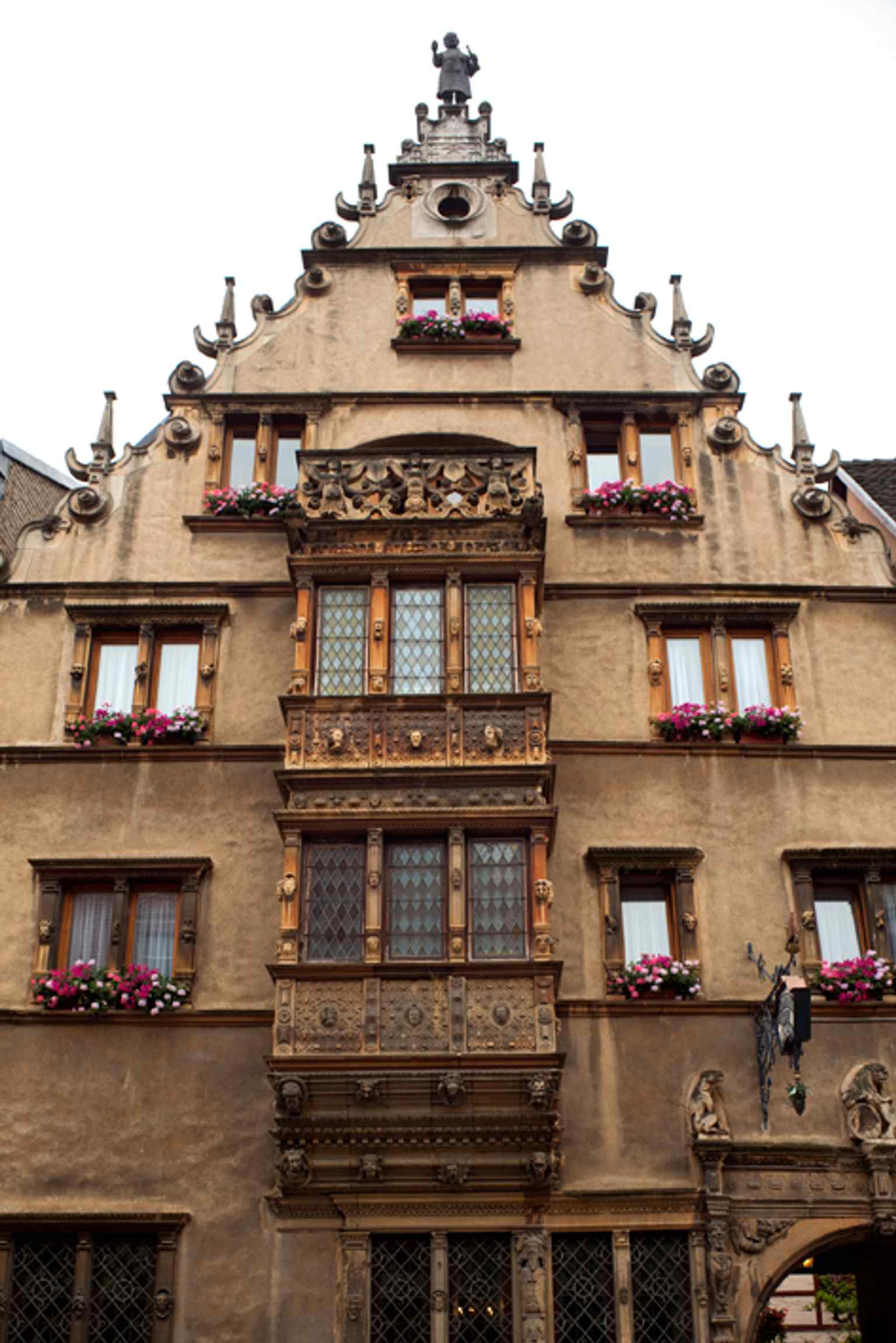
The striking Renaissance facade of the House of Heads, capturing the grand architectural vision of Anton Burger in 2010.Photo: PMRMaeyaert, Wikimedia Commons, CC BY-SA 3.0. Cropped & resized. Look to your right to spot a towering, golden-yellow stone building featuring a highly decorated, wavy triangular roofline and a prominent, protruding central window. Just a short walk from the Unterlinden Museum, you are now standing in front of the famous House of Heads. Built in 1609, this Renaissance masterpiece was the passion project of a wealthy merchant named Anton Burger. Anton actually demolished his own father's house to clear the space for this grand statement piece. He clearly wanted everyone to know who lived here, placing his family coat of arms right on the facade.
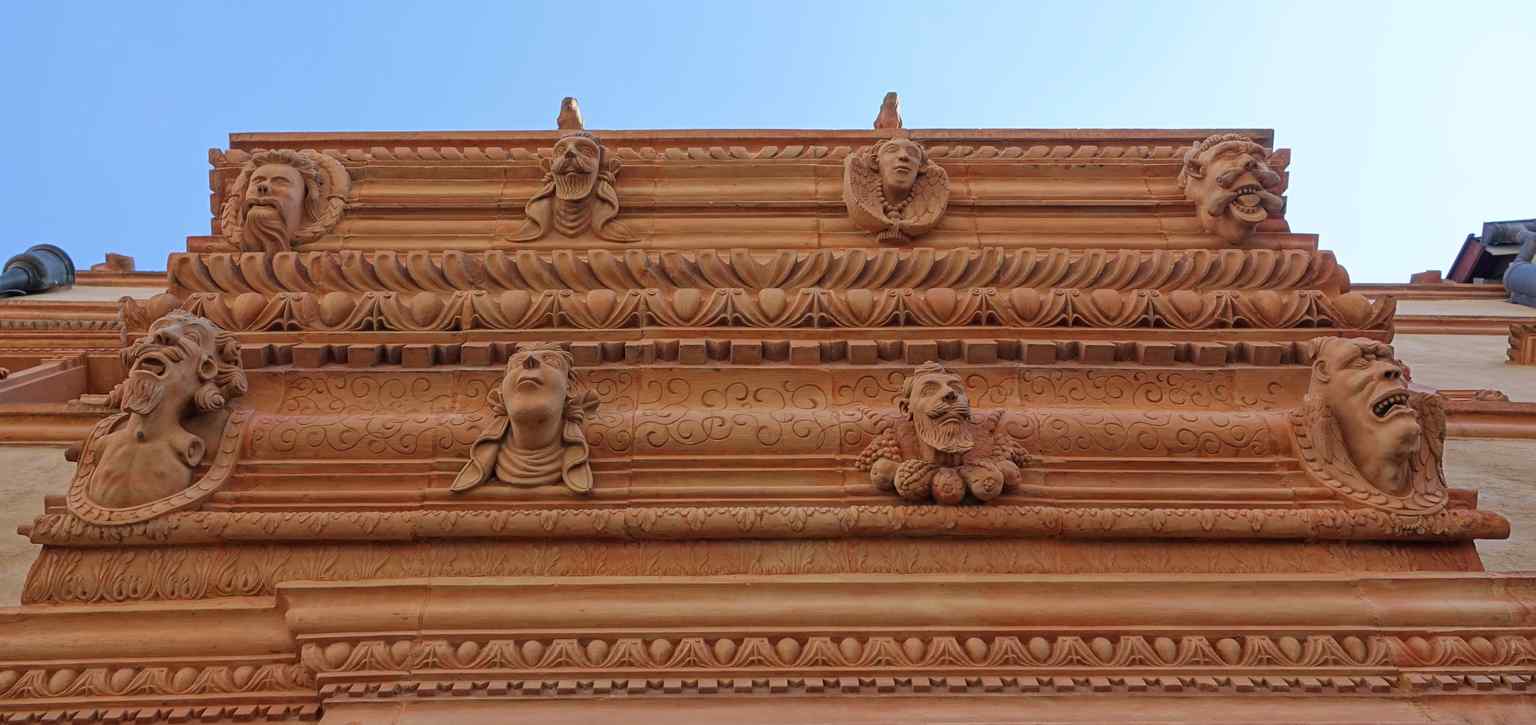
A close-up view from 2019 detailing some of the intricate and bizarre stone mascarons that give the house its iconic name.Photo: Gzen92, Wikimedia Commons, CC BY-SA 4.0. Cropped & resized. But the building's true fame comes from its bizarre decoration. Take a close look at the facade, especially around the oriel, which is that projecting bay window in the center. Clustered along the stone framework and the vertical dividers between the glass panes are exactly one hundred and six carved faces. These grotesque masks are called mascarons, an architectural feature originally meant to scare away evil spirits. You might also notice that the windows themselves are surprisingly asymmetrical, with different widths and irregular placements, adding to the slightly chaotic charm of the design.
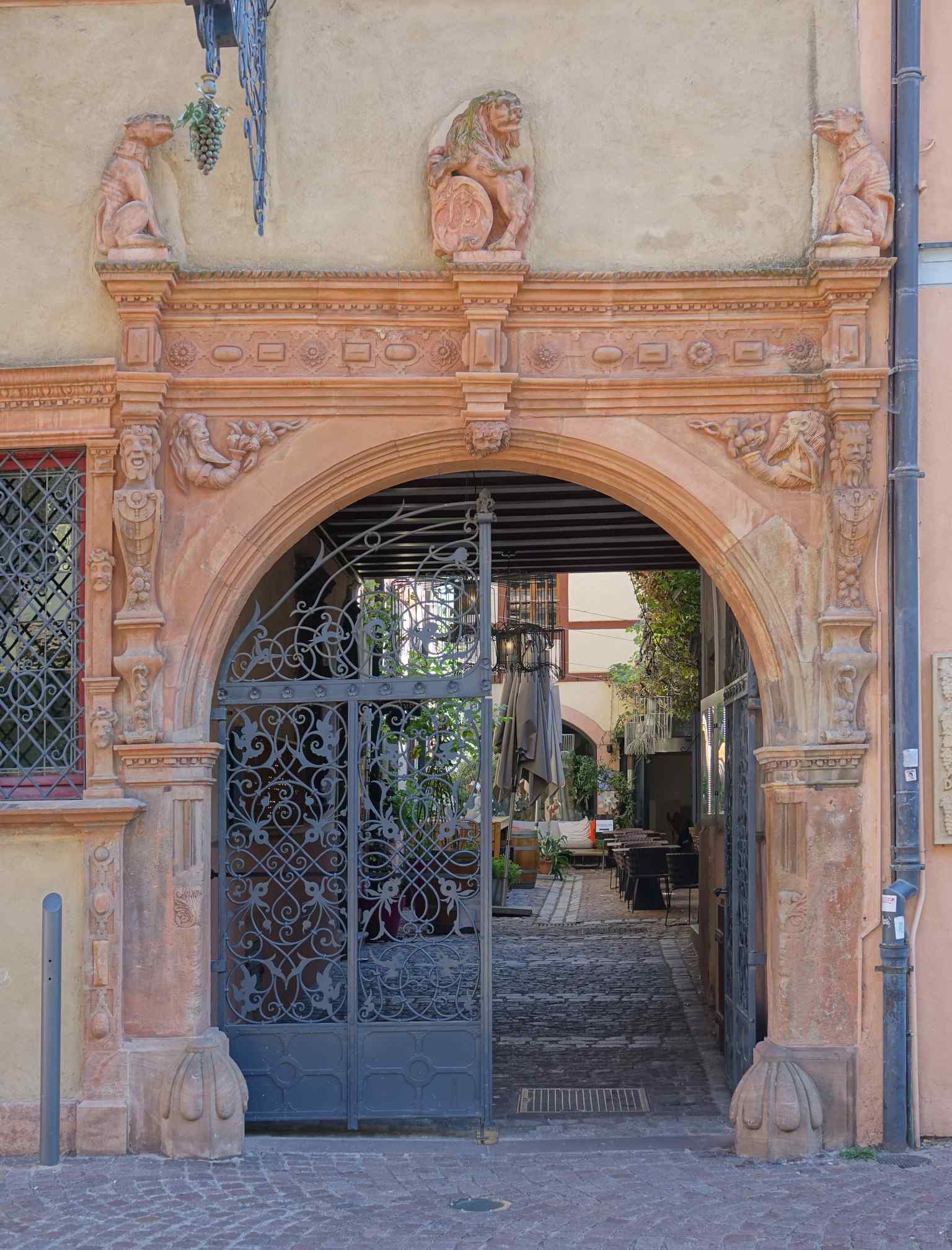
The ornate ground-floor portal, photographed in 2019, which witnessed centuries of changing ownership as the property passed to new hands.Photo: Gzen92, Wikimedia Commons, CC BY-SA 4.0. Cropped & resized. Sadly, Anton's time in his dream home was cut short. The Counter-Reformation, a fierce movement to restore Catholic dominance in the region, forced him to flee to Switzerland. In 1698, his heirs sold the property for fifteen hundred Thalers. A Thaler was a heavy silver coin, and that sum was a substantial fortune, roughly equivalent to about fifty thousand dollars today. The building eventually became the headquarters for the city's Wine Exchange. If you look all the way up to the very top peak of the roof, you will spot a small pewter statue of a cooper, or barrel maker. That little guy was added in 1902 and was actually sculpted by Auguste Bartholdi, one of Colmar's most famous citizens.
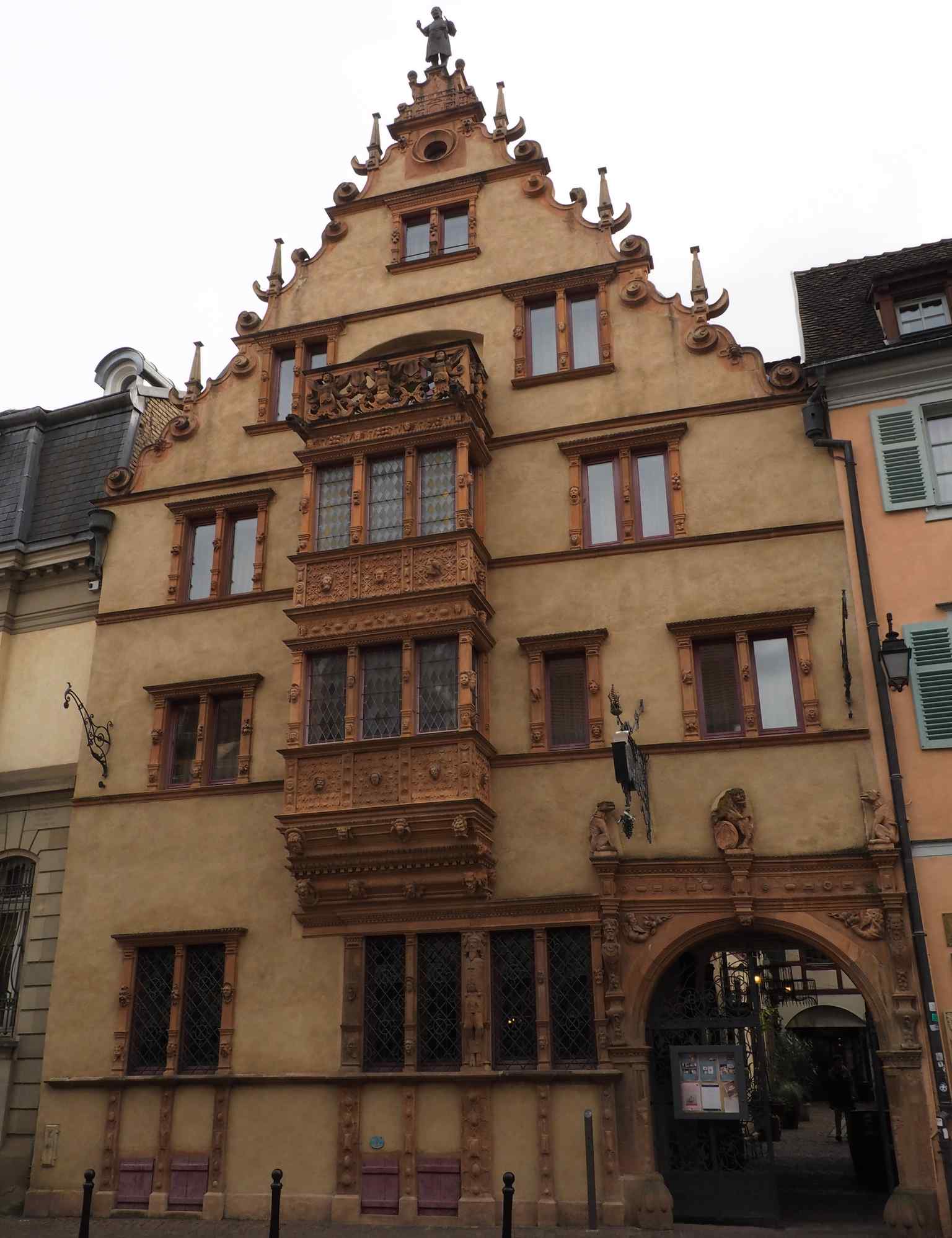
A recent look at the historic building in 2024, showing how meticulously the exterior has been preserved for modern visitors.Photo: BelPatty86, Wikimedia Commons, CC BY-SA 4.0. Cropped & resized. Today, this beautiful, quirky building survives as a luxury hotel and a Michelin-starred restaurant, keeping the grand merchant's legacy very much alive. Take a moment to see how many of those stone faces you can count. When you are ready, we can head to the next stop.
Look for the stunning painting set within an intricately carved arched golden frame, featuring a woman in a voluminous red robe seated before a wooden trellis of vibrant roses.…Read moreShow less
Open dedicated page →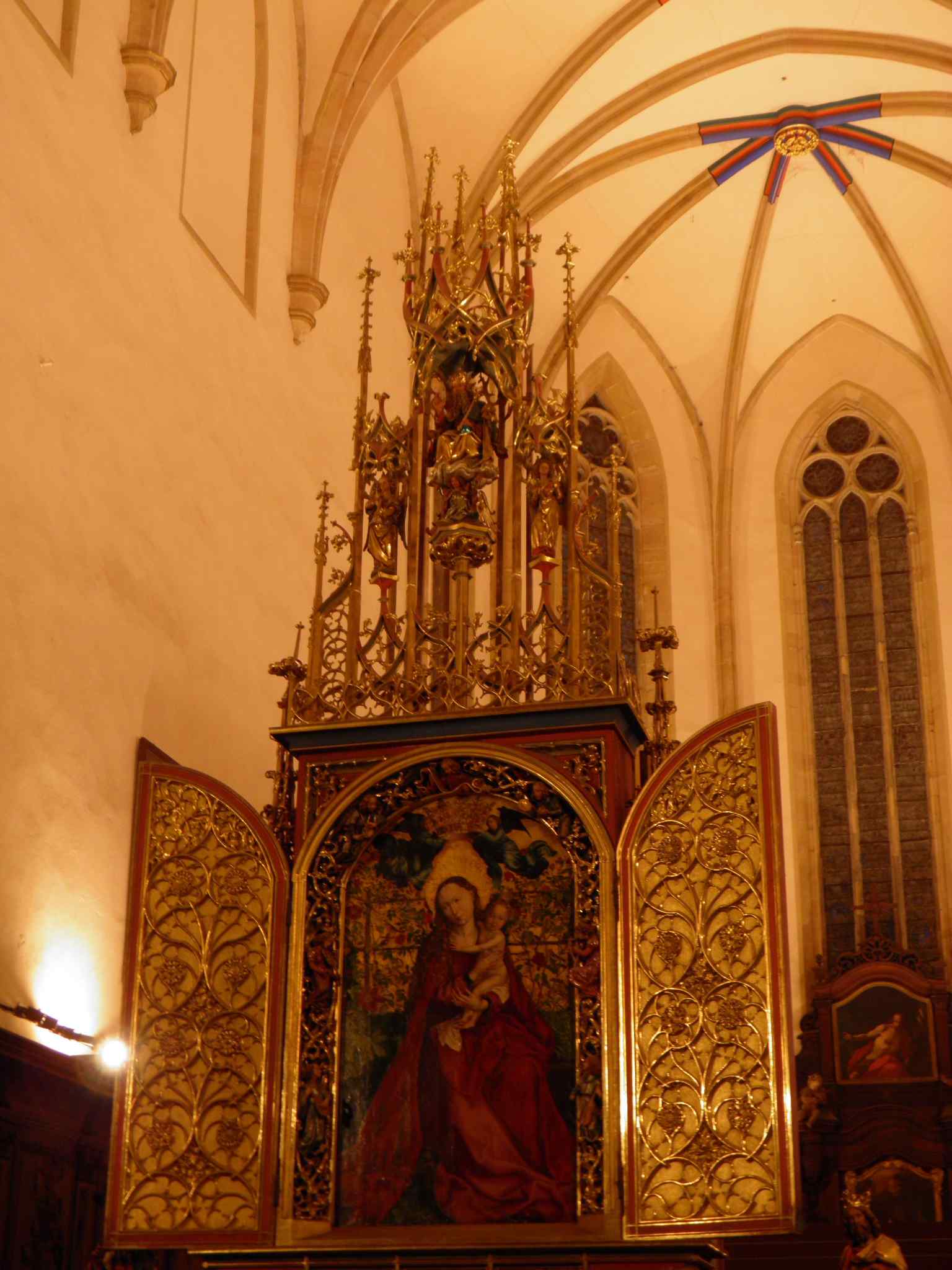
Église des Dominicains - La Vierge au buisson de rosesPhoto: Gzen92, Wikimedia Commons, CC BY-SA 4.0. Cropped & resized. Look for the stunning painting set within an intricately carved arched golden frame, featuring a woman in a voluminous red robe seated before a wooden trellis of vibrant roses. You are looking at The Virgin in the Rose Bower, a masterpiece completed in 1473 by Martin Schongauer, whose monument we passed just a few minutes ago.
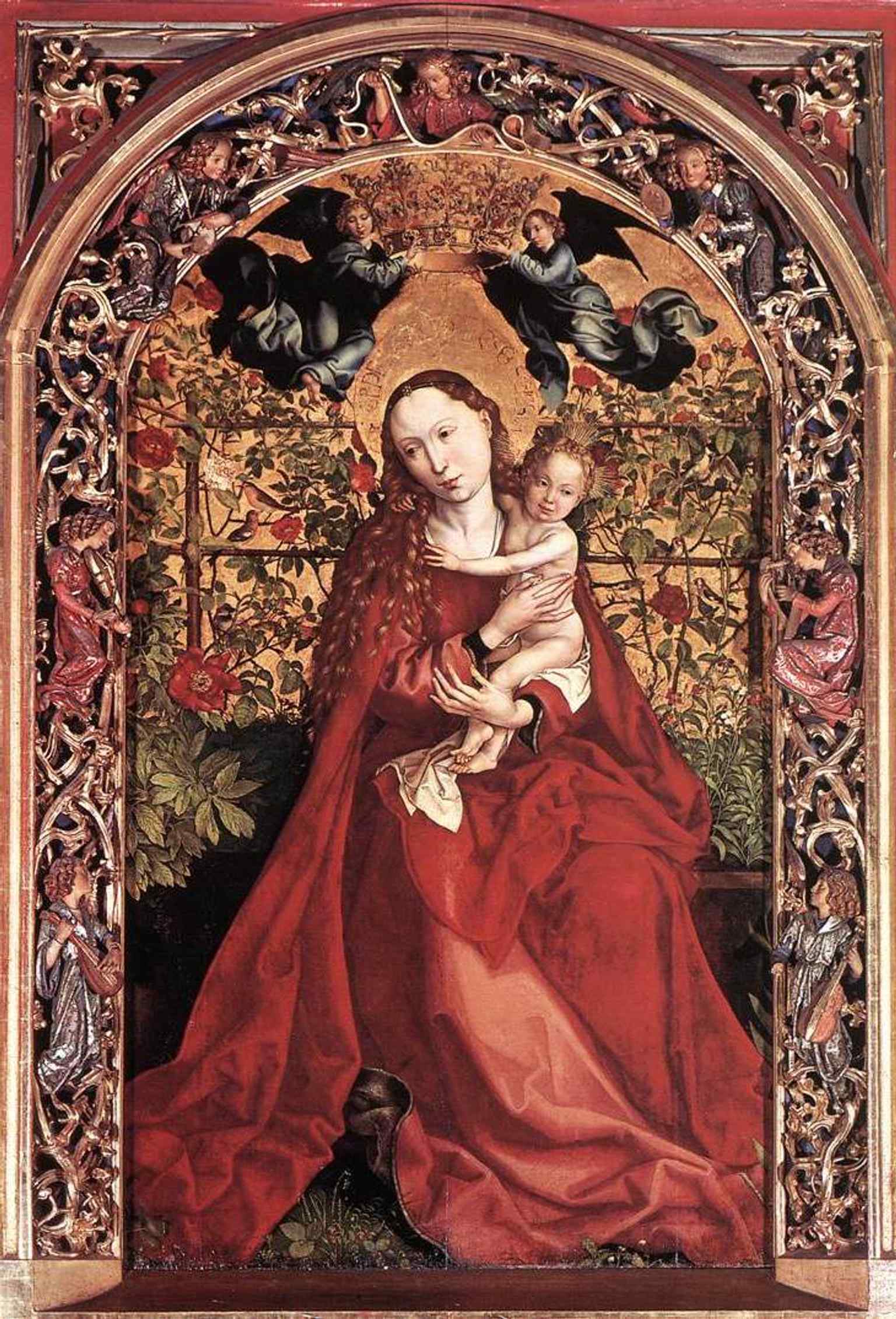
Martin Schongauer - Madonna of the Rose Bush - WGA21043Photo: Martin Schongauer, Wikimedia Commons, Public domain. Cropped & resized. This piece is a retable, which is simply a large devotional painting or sculpture designed to sit behind a church altar. While it currently rests securely here in the Dominican Church, it spent much of its life at the Collegiate Saint-Martin. As pristine as it looks now, this artwork has survived quite a bit of drama. First, you are not actually seeing the full picture. At some point in its history, the heavy wooden panel likely took a nasty fall. To hide the severe damage, the painting was cropped on all four sides. Originally, it featured God the Father at the top and a sprawling garden of white lilies at the bottom, all lost to the saw.
Then came the modern era's contribution to its stressful existence. In the dead of night in January 1972, thieves broke in and stole the masterpiece. For over a year, the painting vanished, sparking a massive hunt. It was eventually discovered wrapped up and stashed inside a random private garage in a suburb of Lyon. Following its dramatic rescue, it was brought to this church for tighter security.
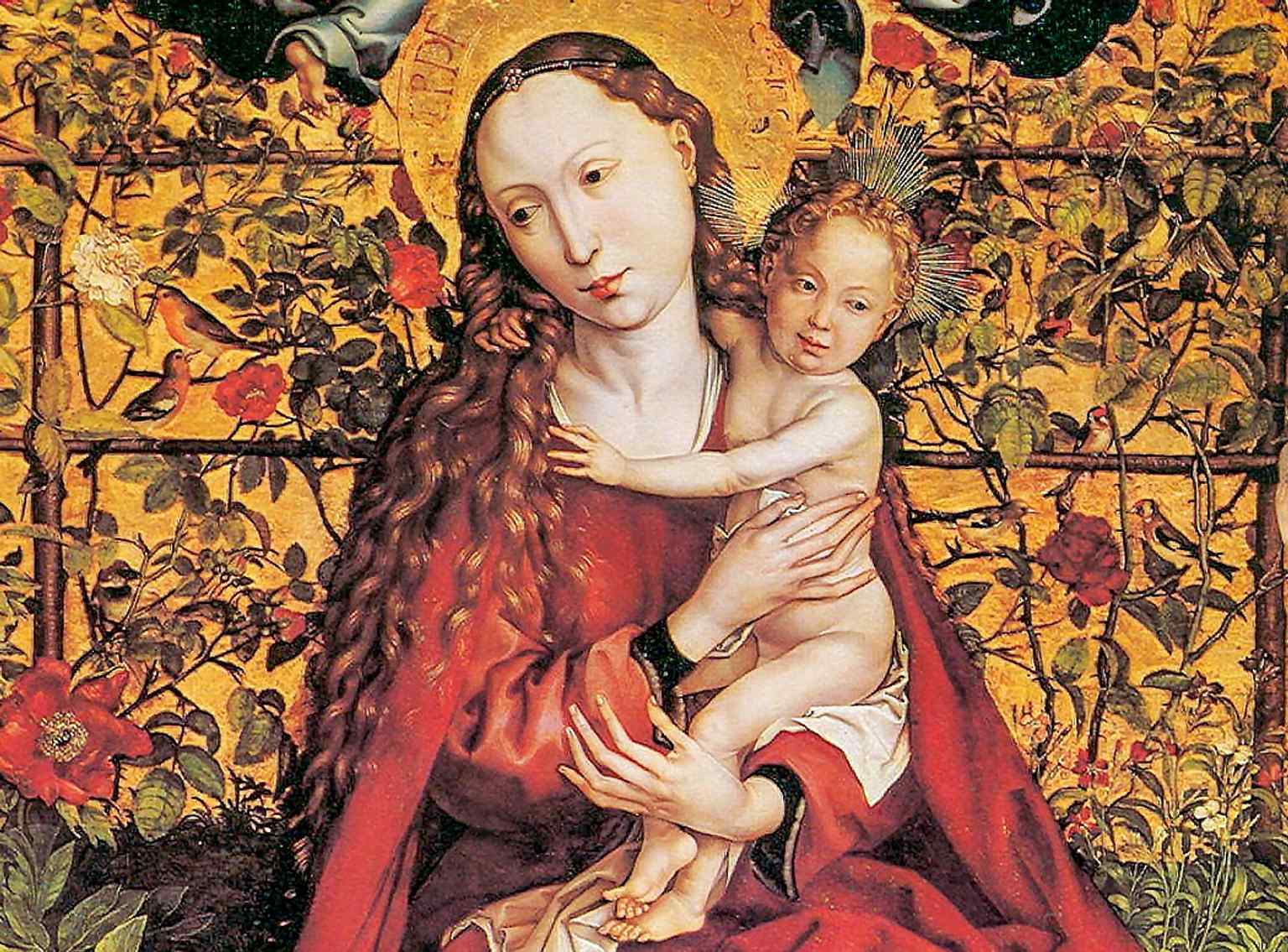
Martin Schongauer Madonna in Rose Garden with birds (detail)Photo: Martin Schongauer, Wikimedia Commons, Public domain. Cropped & resized. When you look closely at the details, Schongauer's genius really comes alive through his deep use of symbolism. Notice Mary's dress. Traditionally, the Virgin Mary is painted wearing blue, but here she wears a striking, cascading red. In Christian art, red is the color of the Passion, subtly foreshadowing the suffering her son would eventually endure. The birds perched on the trellis echo this same theme. Among them is a goldfinch, a small bird whose distinctive red face was historically said to symbolize the blood of Christ.
The plants are equally deliberate. Mary sits in an enclosed garden, symbolizing her purity. She is often referred to in religious texts as a rose without thorns. If you look closely at the blooming red rosebushes climbing the trellis, you will spot exactly one white rose tucked into the upper left, reinforcing her unique purity among mortals. Down at the very bottom, near the folds of her dress, you can spot tiny wild strawberries. Their delicate leaves are trilobed, meaning they grow in groups of three, a quiet natural nod to the Holy Trinity of the Father, the Son, and the Holy Spirit.
Schongauer managed to weave immense theological weight into a scene that otherwise looks like a peaceful moment in a lush garden. Take a moment to soak this in, and when you are ready, we can head to the next stop.
Coming up on your left is a massive, multi-toned sandstone church characterized by its large Gothic windows and a single, prominent square tower capped with a unique, bulb-shaped…Read moreShow less
Open dedicated page →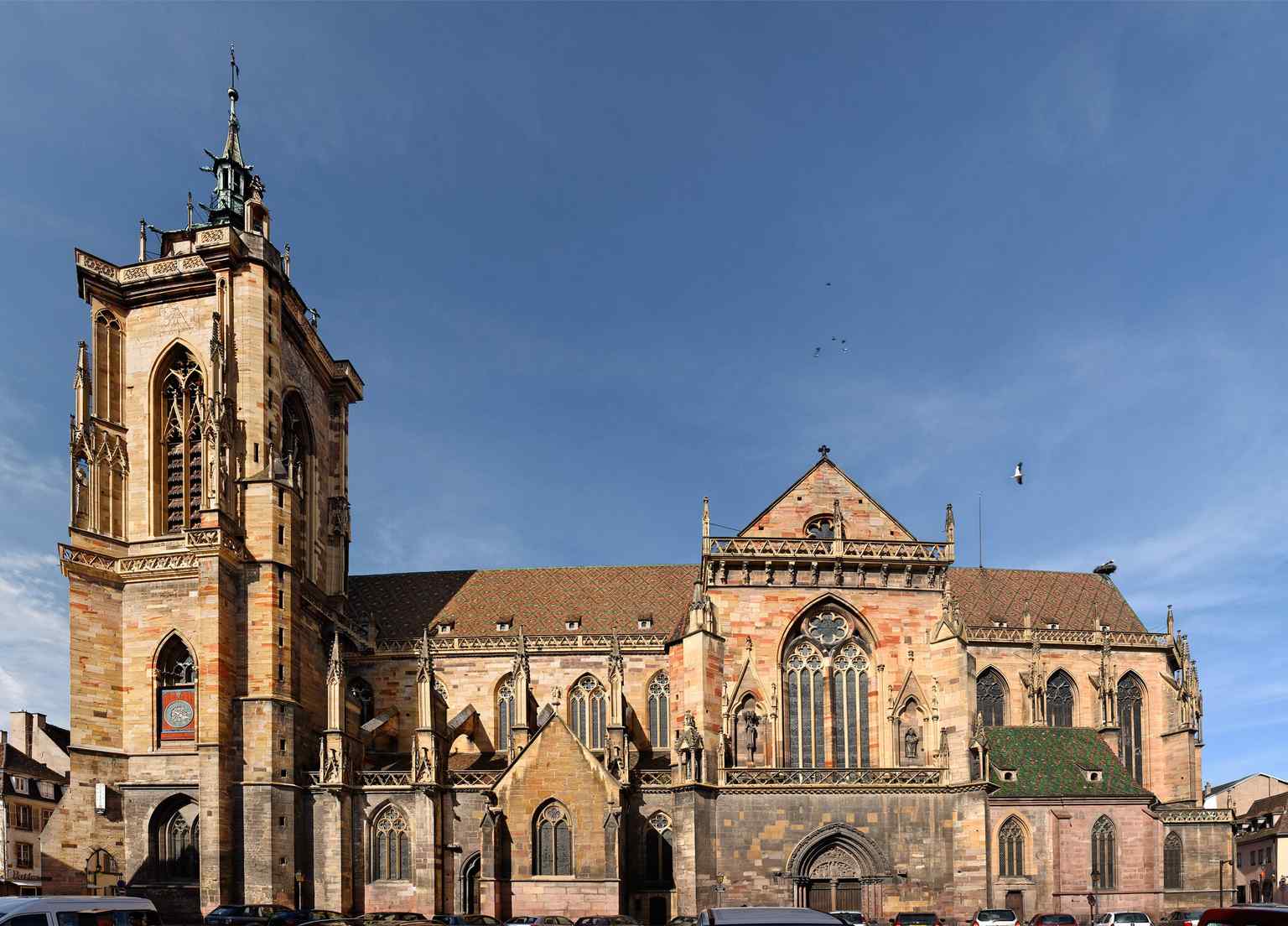
The massive Saint-Martin collegiate church stands out in Colmar's skyline, showcasing its Gothic architecture and distinctive tower. (2011)Photo: Sting, Wikimedia Commons, CC BY-SA 3.0. Cropped & resized. Coming up on your left is a massive, multi-toned sandstone church characterized by its large Gothic windows and a single, prominent square tower capped with a unique, bulb-shaped copper lantern.
Locals frequently call this Saint-Martin Cathedral, though technically, it is a collegiate church. That simply means it was historically run by a chapter of canons, a community of priests, rather than a single bishop. It is the most important religious building in Colmar and the second largest Catholic structure in all of Alsace, surpassed only by the grand cathedral in Strasbourg. Just a couple of minutes ago we were talking about Martin Schongauer's famous painting, the Virgin at the bush of roses, and for many centuries, this very church is where that masterpiece originally hung.
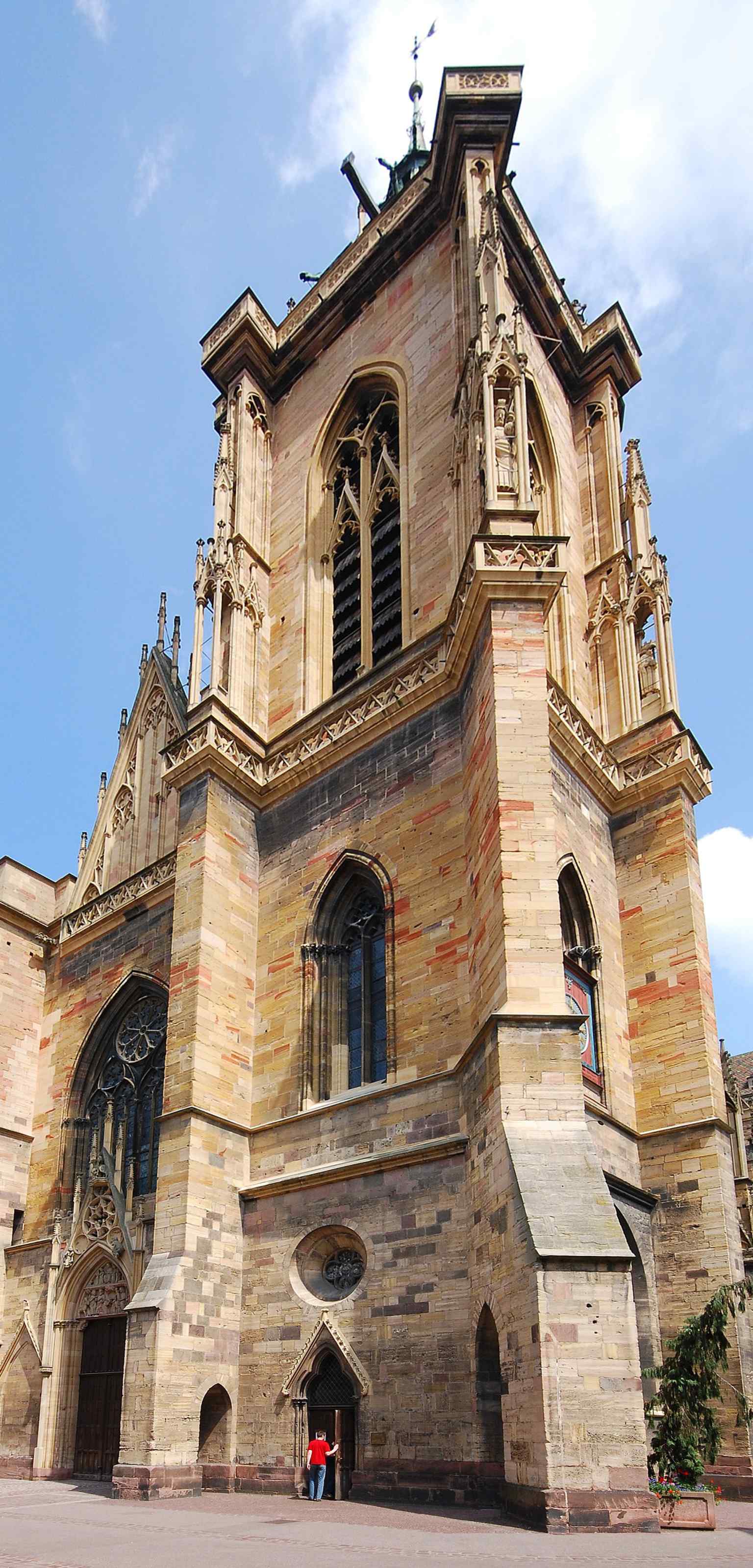
The west facade reveals the church's unique asymmetry, where a second north spire was planned but never completed. (2007)Photo: Wladyslaw, Wikimedia Commons, CC BY-SA 3.0. Cropped & resized. Construction on this Gothic giant kicked off in 1234 and dragged on for over a century, wrapping up around 1365. I say wrapping up, but it was never actually finished. If you look up, you will notice the building is decidedly asymmetrical. The original blueprints called for a towering north spire to match the south one, but the builders just never quite got around to it.
The building is constructed from sandstone hauled in from the nearby Vosges mountains. The beautiful patchwork of yellow, pink, and reddish-brown stone you see on the exterior exists because the builders had to source materials from several different quarries over those many decades of construction. Up top, the colorful roof is layered with traditional flat tiles known locally as beaver tails due to their gently rounded edges.
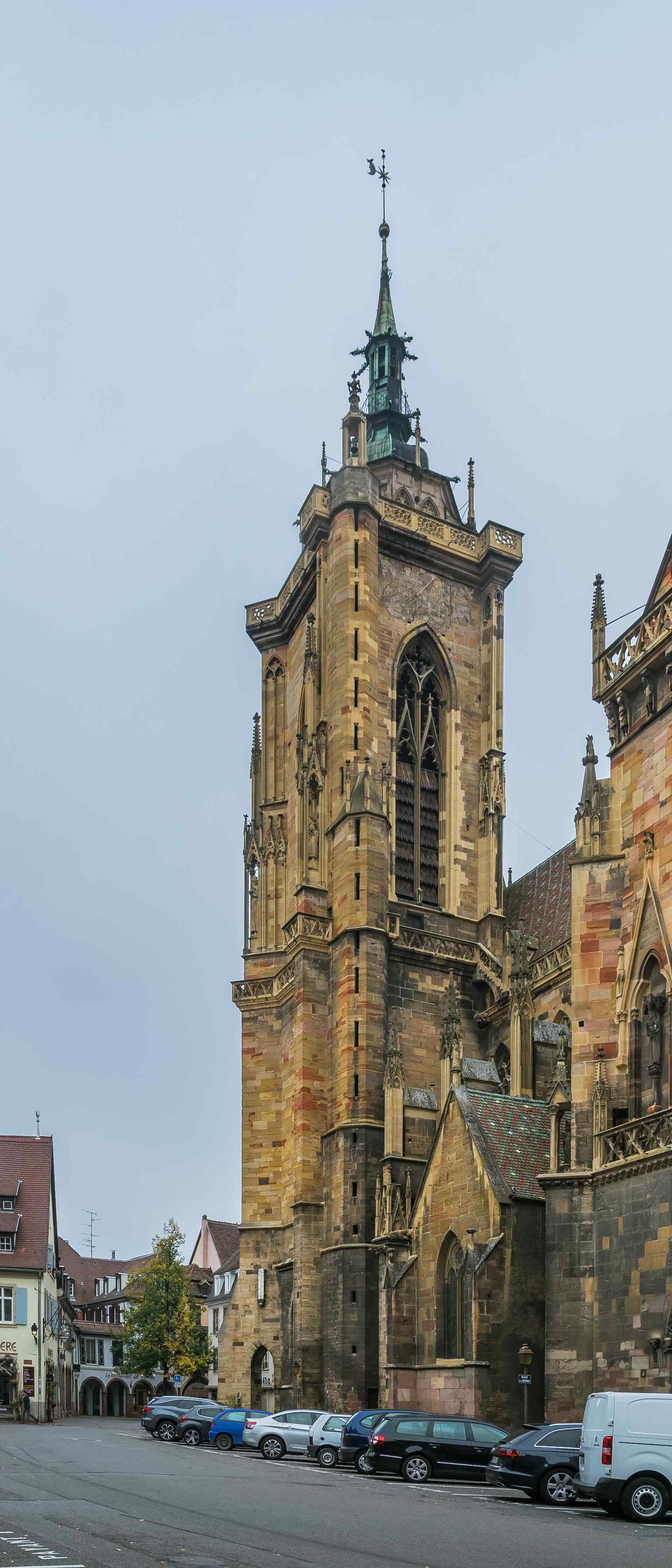
The prominent south tower features the unusual, onion-shaped copper lantern added after a devastating 16th-century fire. (2018)Photo: Krzysztof Golik, Wikimedia Commons, CC BY-SA 4.0. Cropped & resized. That single tower on the south side has a dramatic past. In 1572, a violent fire ripped through the upper levels, completely destroying the wooden roof and the top of the tower. Rather than rebuilding it to match the original Gothic design, the city opted for a trendy replacement three years later. They added the unusual, onion-shaped lantern you see today, forever changing the skyline of Colmar.
The church survived the centuries, but the French Revolution certainly left its mark. The revolutionary government abolished the community of priests and actually stripped the tower of its impressive bells. In 1793, the heavy bronze bells were lowered down, loaded onto boats, and shipped off to Strasbourg to be melted into cannons for the war effort. Today, a newer set of bells rings out from the tower, widely considered by acoustic experts to be some of the most harmonious in France.
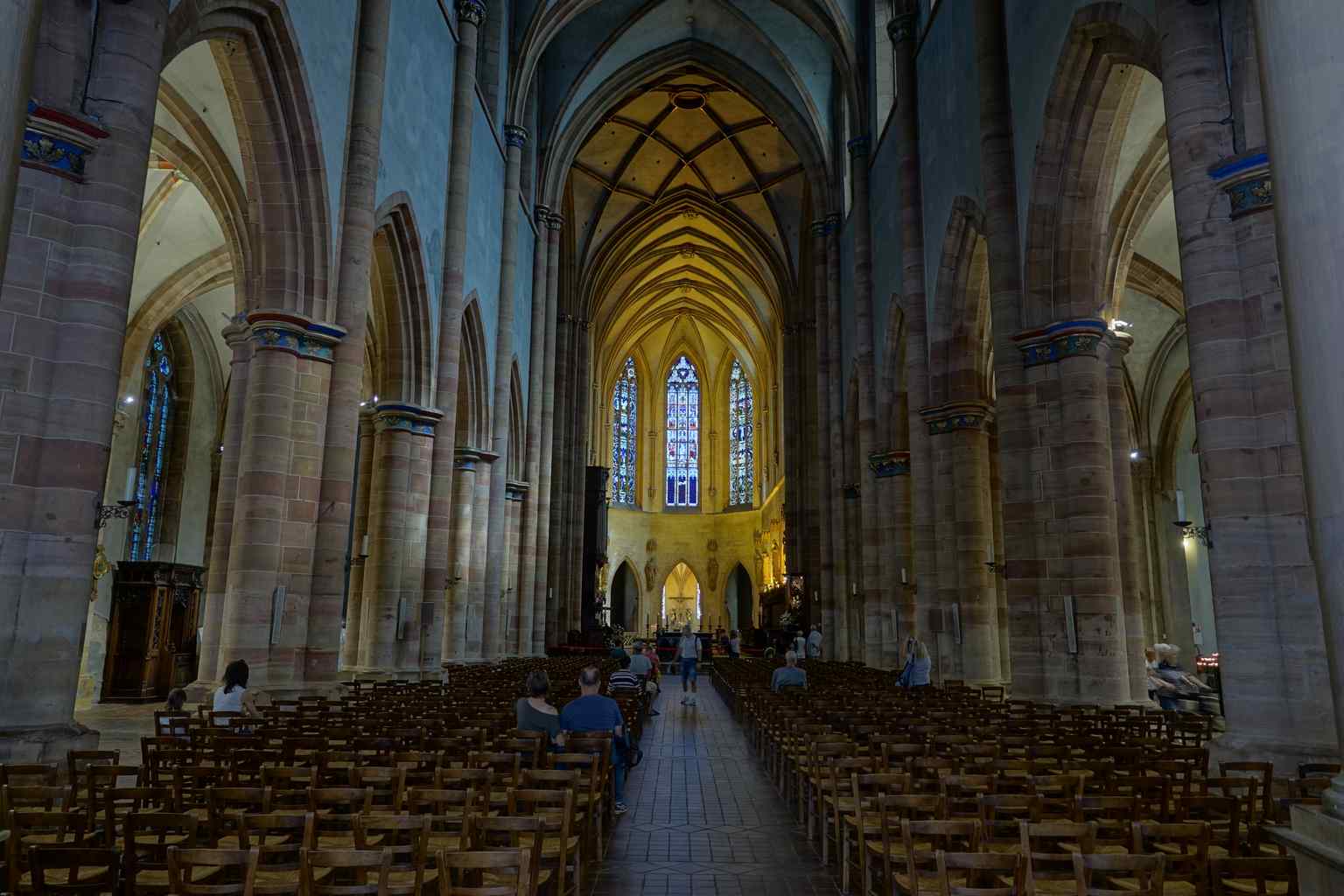
The soaring nave of Saint-Martin offers a quiet space to reflect on the immense scale of medieval ambition. (2019)Photo: Gzen92, Wikimedia Commons, CC BY-SA 4.0. Cropped & resized. If you want to step inside to see the nave, the soaring central hall where the congregation gathers, the doors are open most days from eight in the morning until nearly seven in the evening, opening a bit later at ten on Sundays.
It is quite a profound space to just stand and take in the sheer scale of medieval ambition. Whenever you are ready to continue, we can make our way down the street to the next stop.
Look for the pale yellow, U-shaped stone building with a dark slate roof and a striking bronze sculpture of figures holding a globe right in the center of the courtyard. You are…Read moreShow less
Open dedicated page →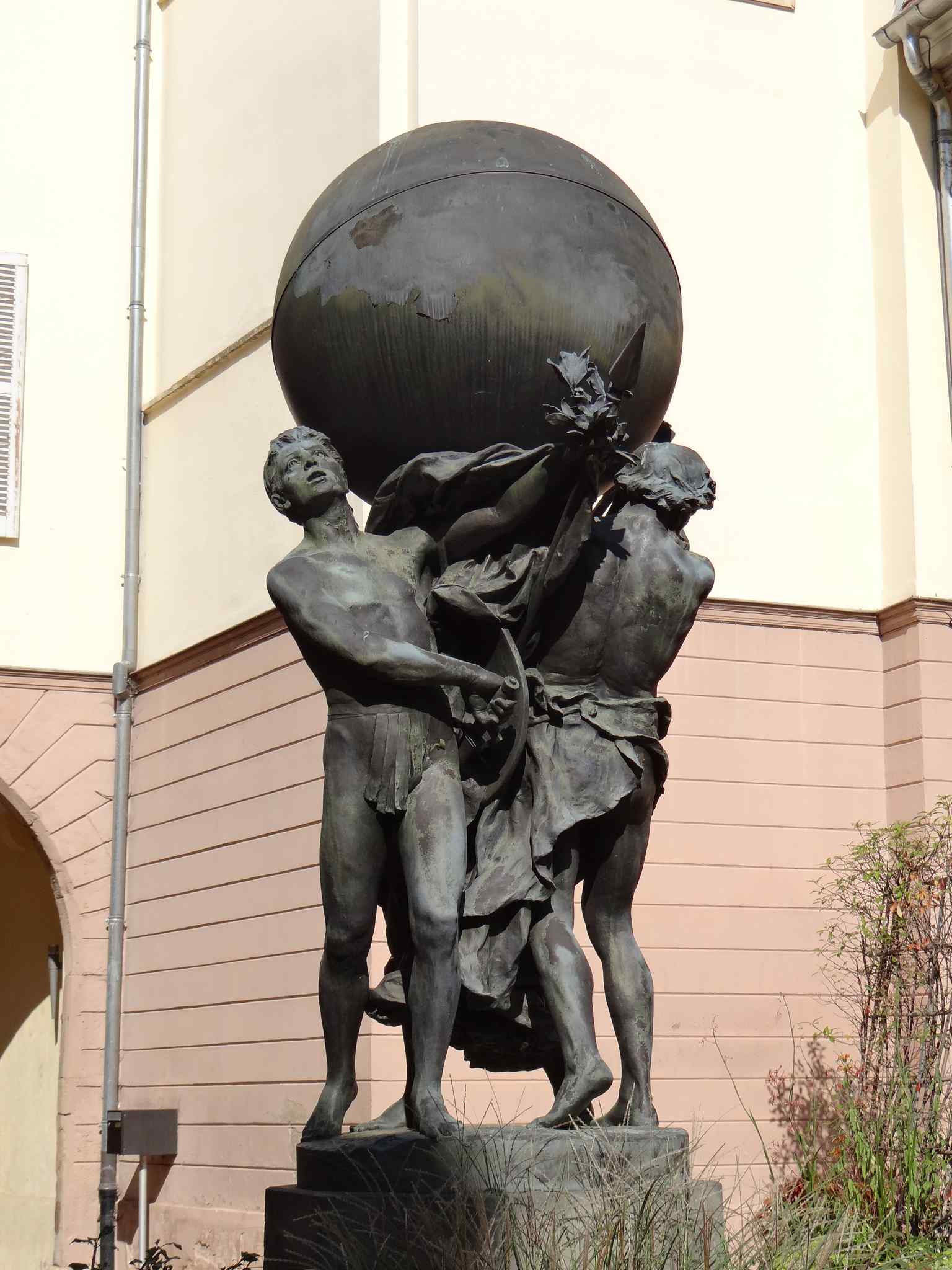
Les grands soutiens du monde - Colmar été 2021 01Photo: Anne Jea., Wikimedia Commons, CC BY-SA 4.0. Cropped & resized. 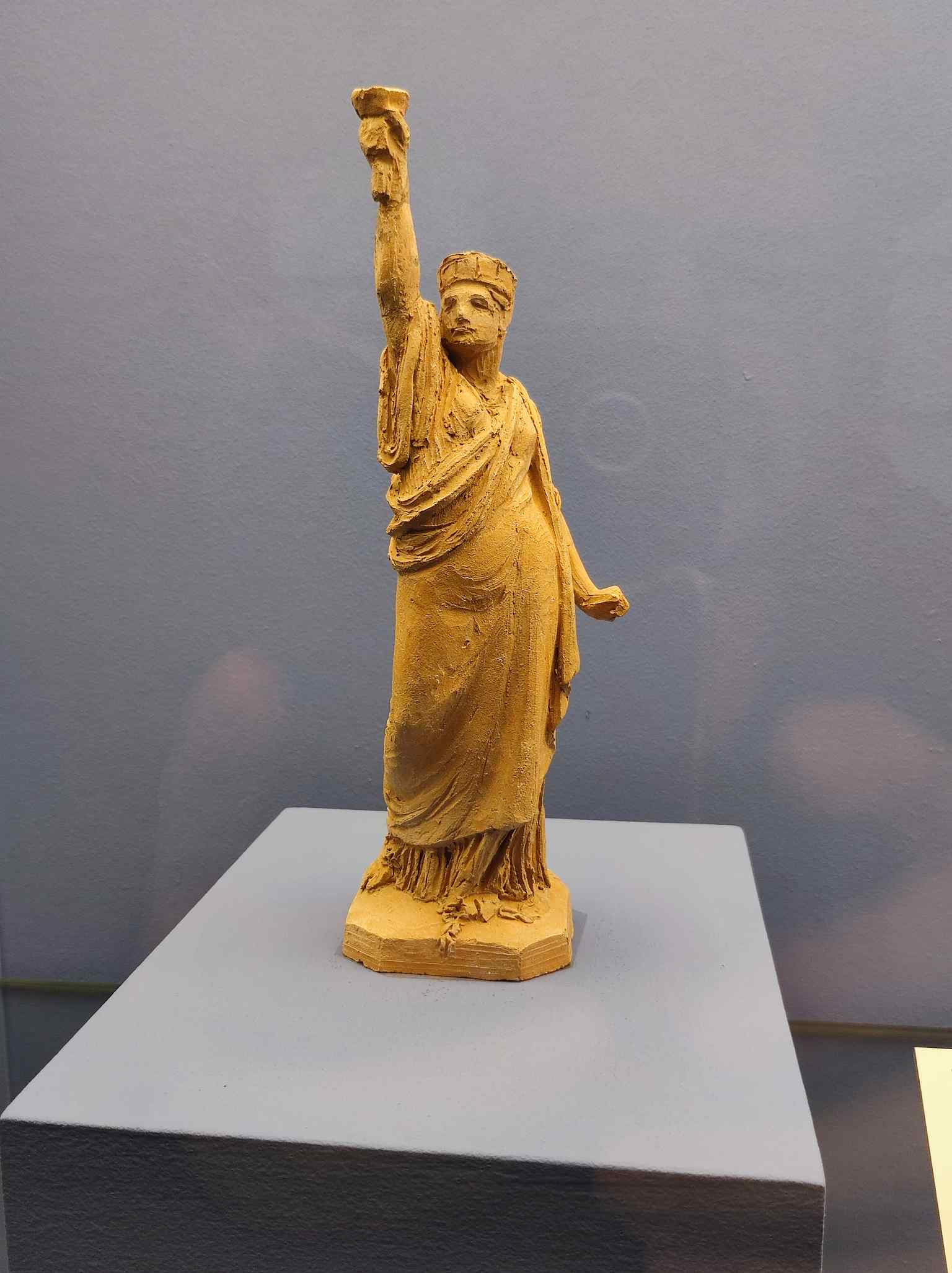
Maquette de la Statue de la Liberté -- Musée Bartholdi - ColmarPhoto: Adoc, Wikimedia Commons, CC0. Cropped & resized. 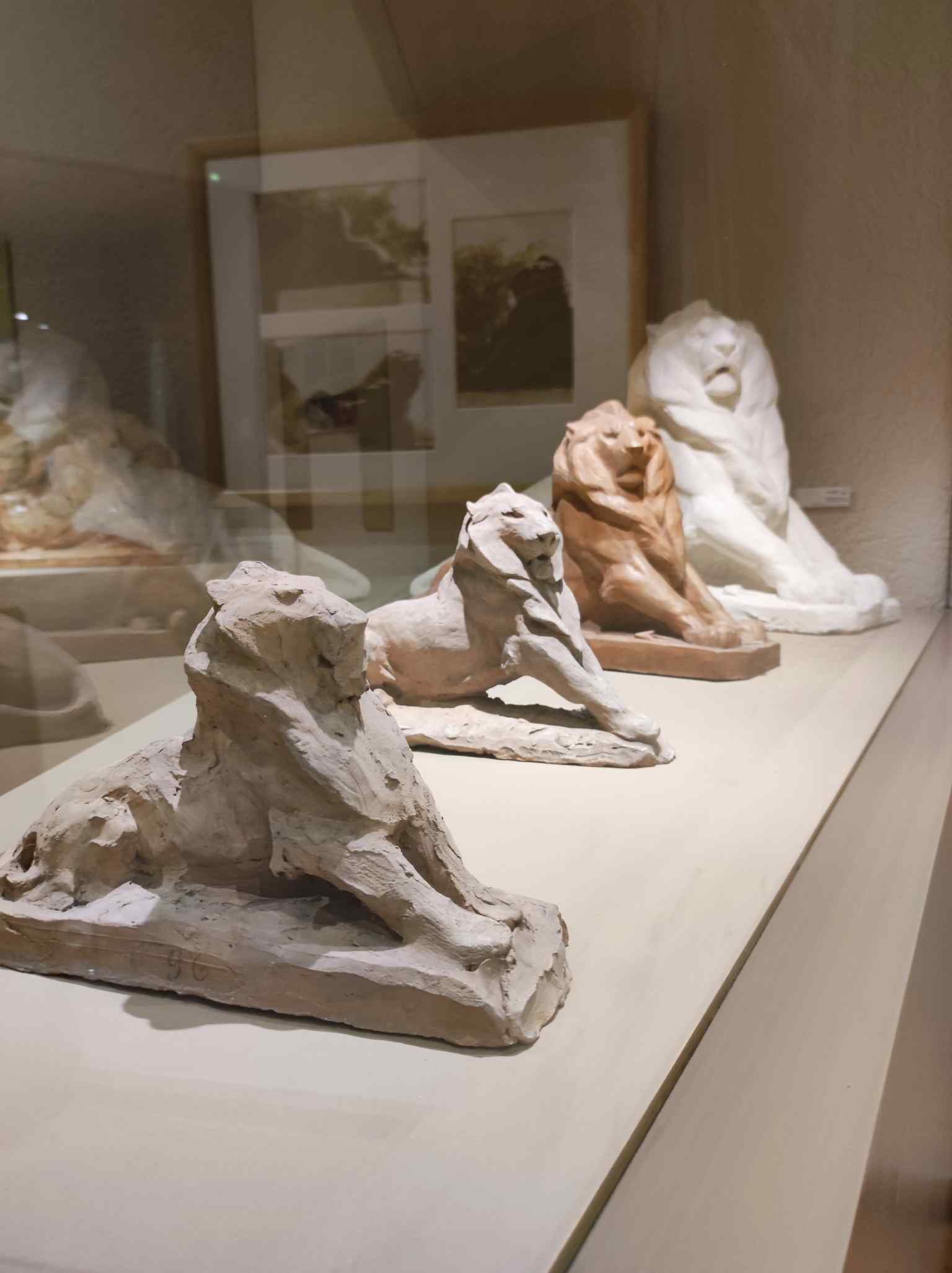
Maquette Auguste Bartholdi Lion de BerlfortPhoto: Adoc, Wikimedia Commons, CC0. Cropped & resized. 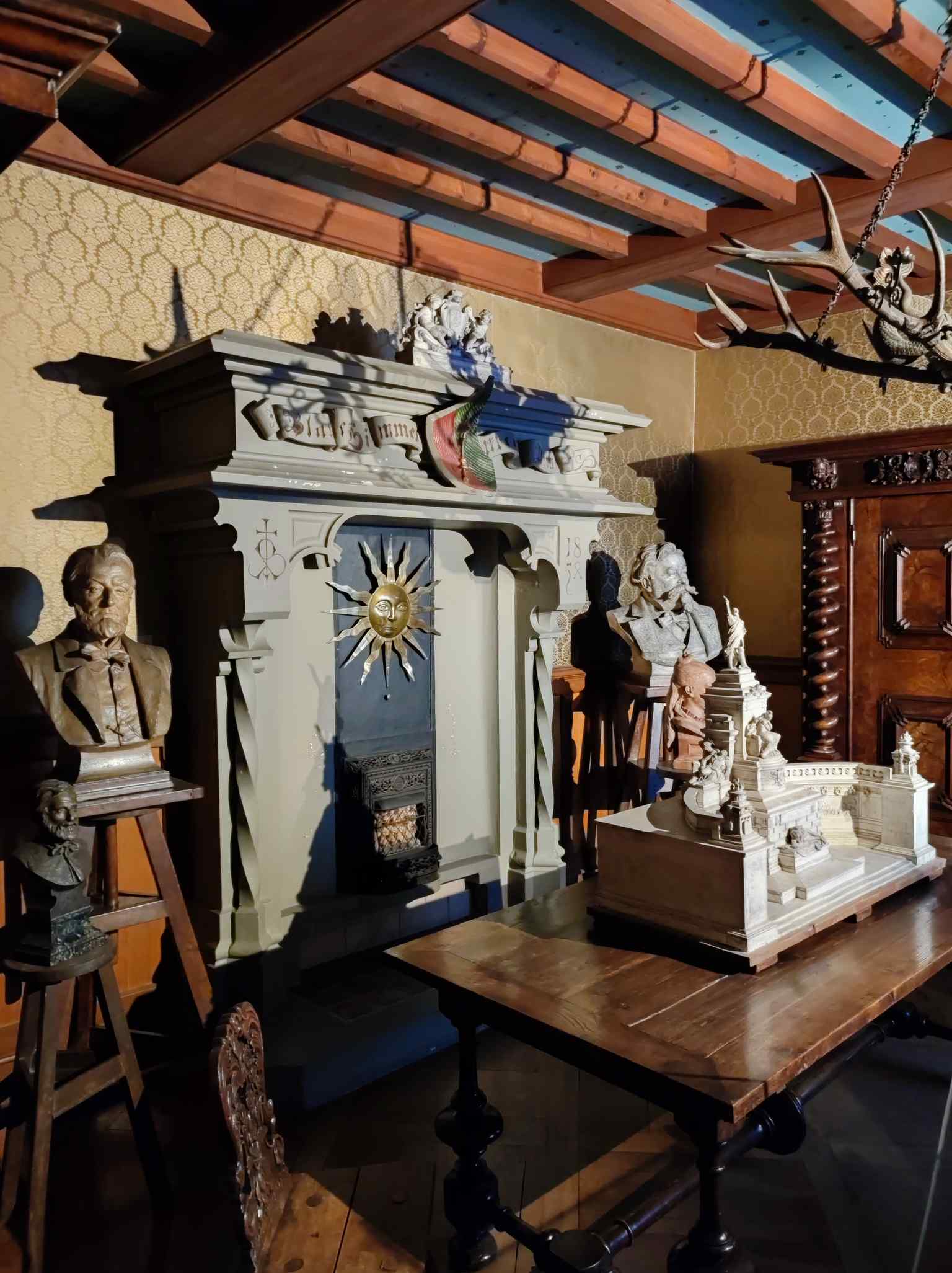
Bureau d'Auguste Bartholdi - Musée ColmarPhoto: Adoc, Wikimedia Commons, CC0. Cropped & resized. Just a short walk from the bustle of Main Street, you are now standing in front of the Sovereign Council of Alsace. If walls could talk, these would likely speak in dense…Read moreShow less
Open dedicated page →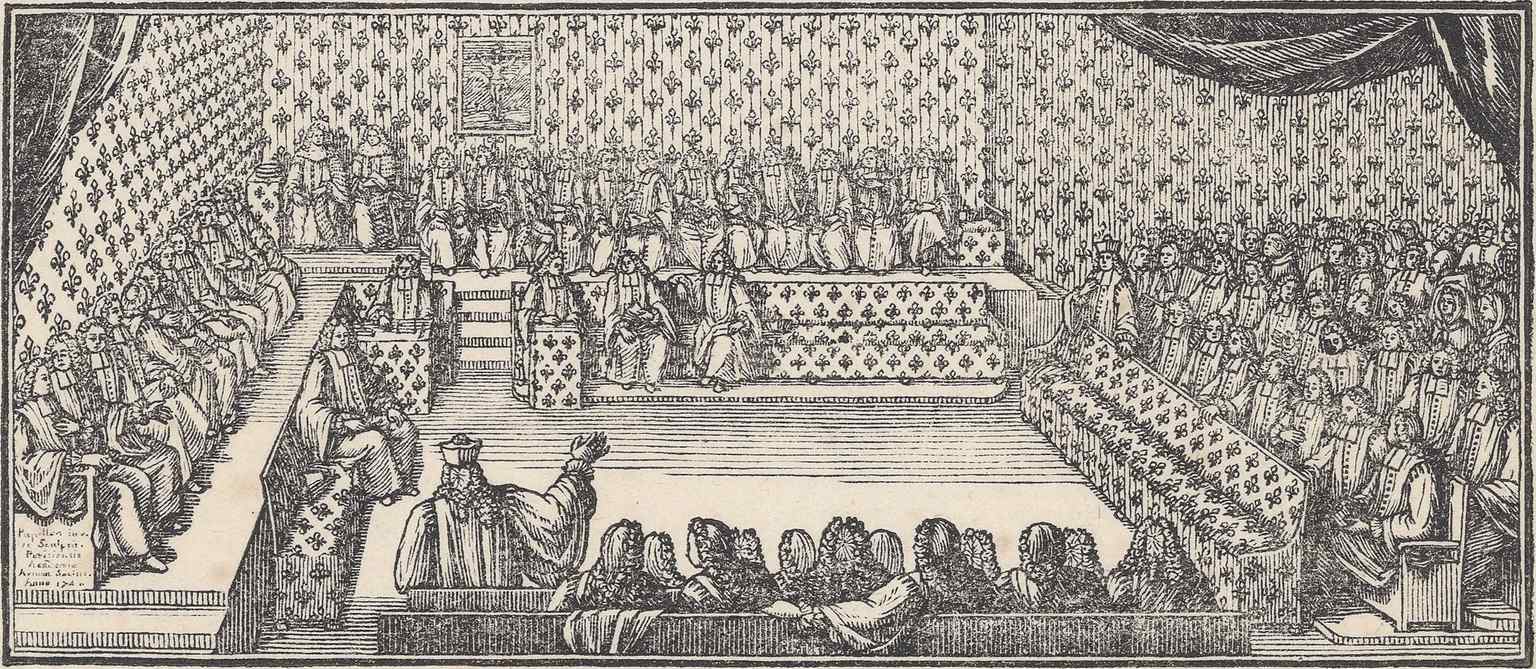
Conseil souverain d'Alsace (détail)Photo: Jean Michel Papillon, Wikimedia Commons, Licence Ouverte. Cropped & resized. Just a short walk from the bustle of Main Street, you are now standing in front of the Sovereign Council of Alsace. If walls could talk, these would likely speak in dense seventeenth century legal jargon, but the stories they hold are far from dry. Created by King Louis XIV, this council was the ultimate judicial authority in the region. Before settling permanently in Colmar and becoming a full parliament in 1711, the court bounced around a few other towns. It was essentially the king's tool for legal conquest. In 1680, the council combed through old medieval charters just to declare that entire territories legally belonged to France, which smoothly justified the military annexation of Strasbourg the very next year. It is a classic case of sending in the lawyers to justify sending in the troops. But this court was deeply out of touch with the people it judged. The council was made up of twenty four judges, plus a whole flock of prosecutors, clerks, and interpreters. They were all strict Catholics, mostly imported from central France, and they ran the court exclusively in French. Meanwhile, the vast majority of locals spoke only a Germanic dialect. Imagine being on trial for your life and not understanding a single word the judge is saying. This disconnect occasionally led to tragedy. The darkest stain on this institution is the 1754 case of Hirtzel Levy, a Jewish merchant accused of robbing a widow. Levy had a rock solid alibi backed by a local lord, but the council chose to completely ignore it. He was sentenced to be broken on the wheel, a brutal execution method where the victim's limbs were shattered in the public square. He maintained his innocence to his dying breath. The local Jewish community was so outraged they took the incredibly rare step of appealing directly to the King's Privy Council in Versailles. The high royal council actually overturned the verdict and cleared Levy's name posthumously, delivering a stinging, humiliating rebuke to the Colmar judges. The council did fare a bit better when ordered to end local witch hunts. When a 1682 royal edict officially downgraded witchcraft to mere pretended magic, the court had the difficult job of forcing paranoid locals to stop bringing women like Ursule Semler to trial for sorcery. Before we move on, take a look at the building itself, completed in 1771. Up on the main triangular pediment, you will see a stern statue of Justice. But if you glance at the side wall on Augustins Street, there is a surprising little detail. You will find a replica of the Manneken Pis, the famous Belgian statue of a little boy urinating. It was a gift from Brussels in 1922 to commemorate the suffering both cities shared under German occupation. It is quite the contrast to see such cheeky humor attached to a monument of strict royal law. Take a moment to soak this in. When you are ready, we can head to our next stop, the Museum of Natural History and Ethnography.
You will spot the Saint-Matthew Church of Colmar on your left, a massive stone building with tall, arched Gothic windows and a long tiled roof topped by a distinctive, small domed…Read moreShow less
Open dedicated page →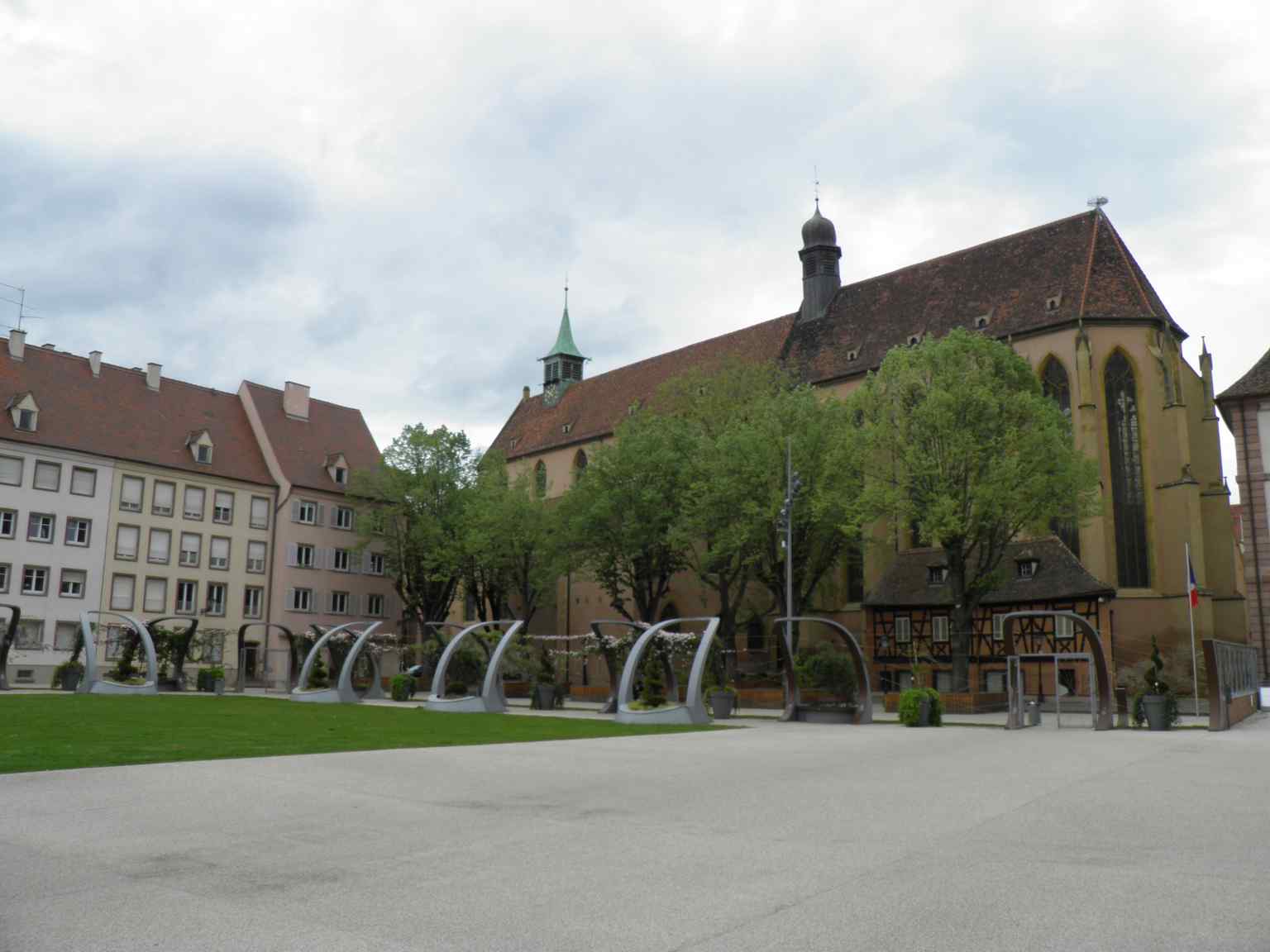
Place du 2-Février, église Saint-Matthieu (Colmar) (2)Photo: Gzen92, Wikimedia Commons, CC BY-SA 4.0. Cropped & resized. You will spot the Saint-Matthew Church of Colmar on your left, a massive stone building with tall, arched Gothic windows and a long tiled roof topped by a distinctive, small domed bell tower. From our spot behind the church, you get a clear view of its impressive scale.
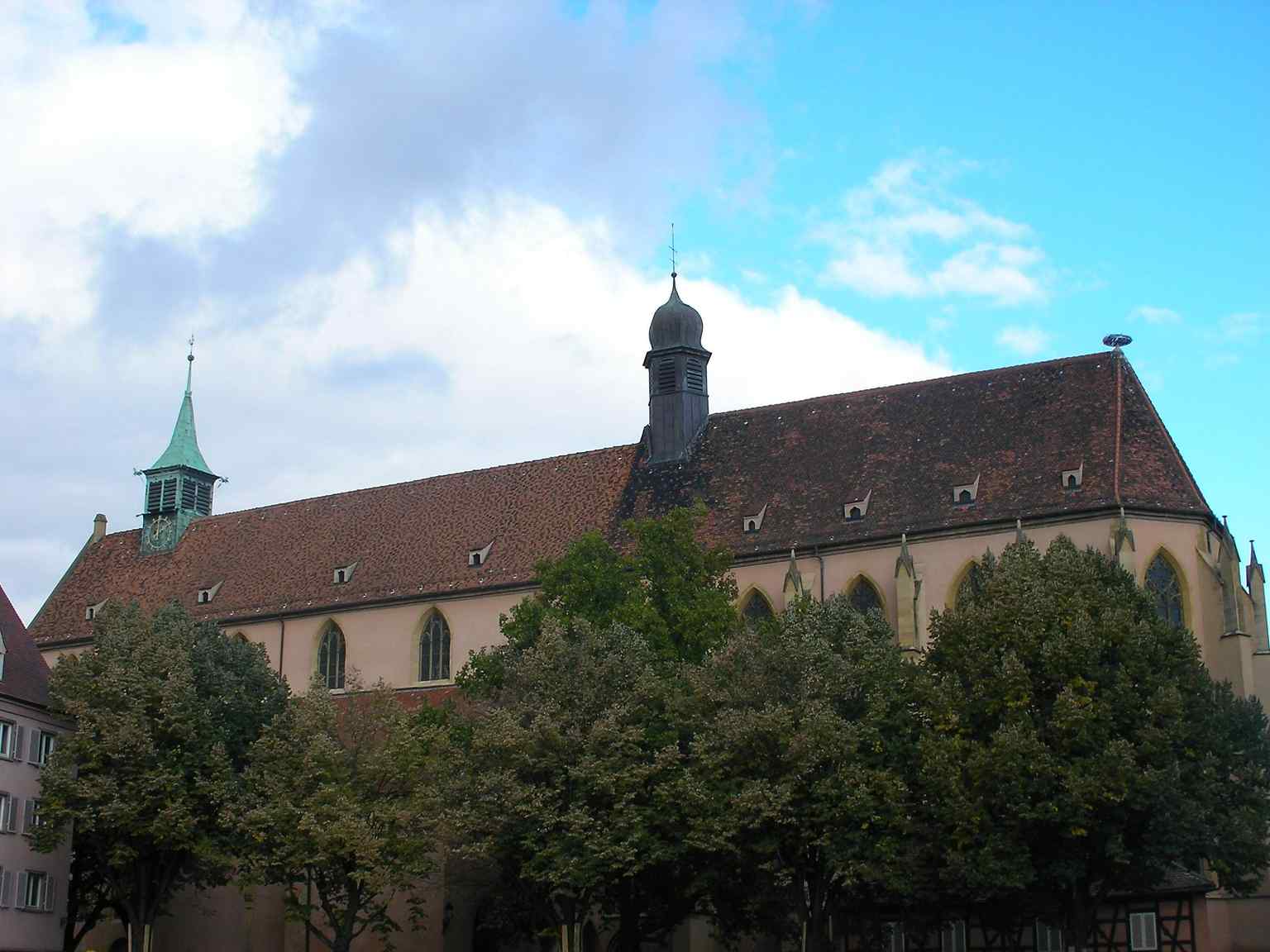
Église des Franciscains, église protestante Saint-Matthieu (Grand'Rue) (Colmar)Photo: Gzen92, Wikimedia Commons, CC BY-SA 4.0. Cropped & resized. This place began as a Franciscan church in 1292. The main central hall where the congregation sits, known as the nave, dates back to that era. Following the Reformation in 1575, the city handed the building over to the Protestants. Religion here quickly became a tug-of-war. In 1627, Jesuits took over and banned Lutheran worship. That ban lasted exactly five years, ending abruptly when a Swedish general named Gustaf Horn captured Colmar and promptly chased the Jesuits right back out. The drama did not stop there. In 1715, the French king ordered a literal wall built to separate the nave from the choir, the sacred space near the altar. It was not until 1987 that this physical barrier finally came down.
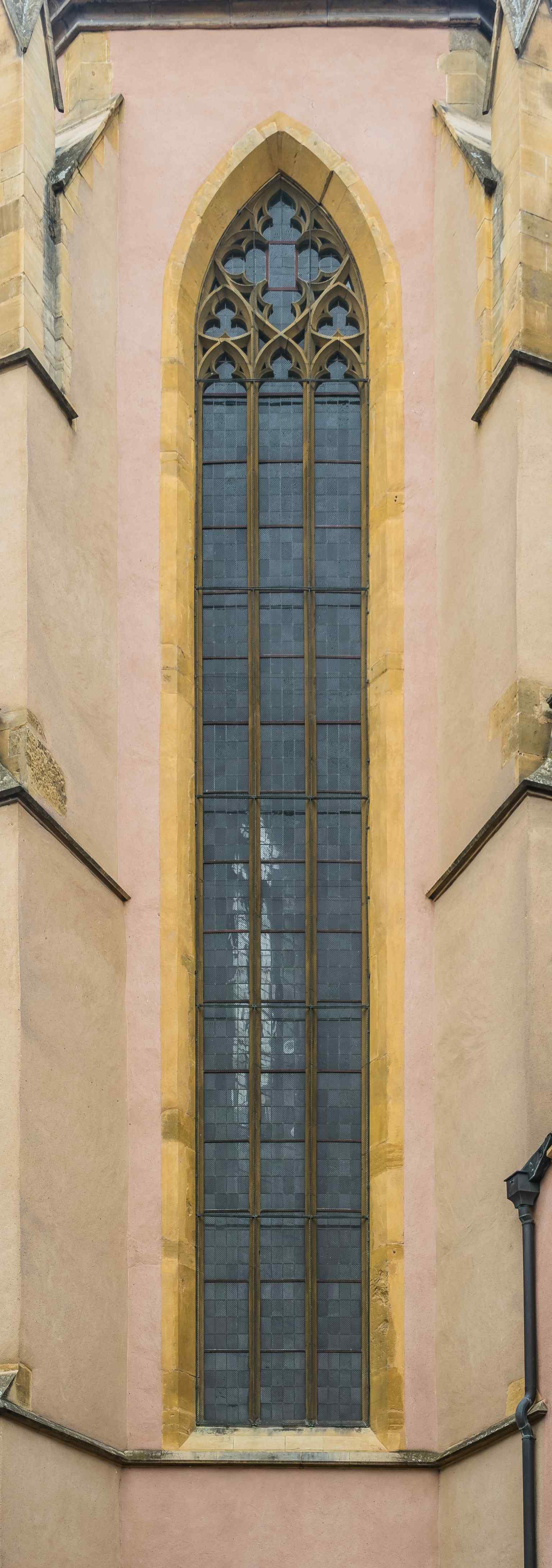
Saint Matthew church of Colmar 03Photo: Krzysztof Golik, Wikimedia Commons, CC BY-SA 4.0. Cropped & resized. Inside, a beautifully painted wooden partition called a rood screen divides the space, sitting near a grand 1731 Silbermann organ. The architecture creates such brilliant, resonant acoustics that the church hosts an international music festival every single year. If you want to check out the organ yourself, the church is open to visitors on Tuesday, Thursday, and Saturday afternoons from two to five.
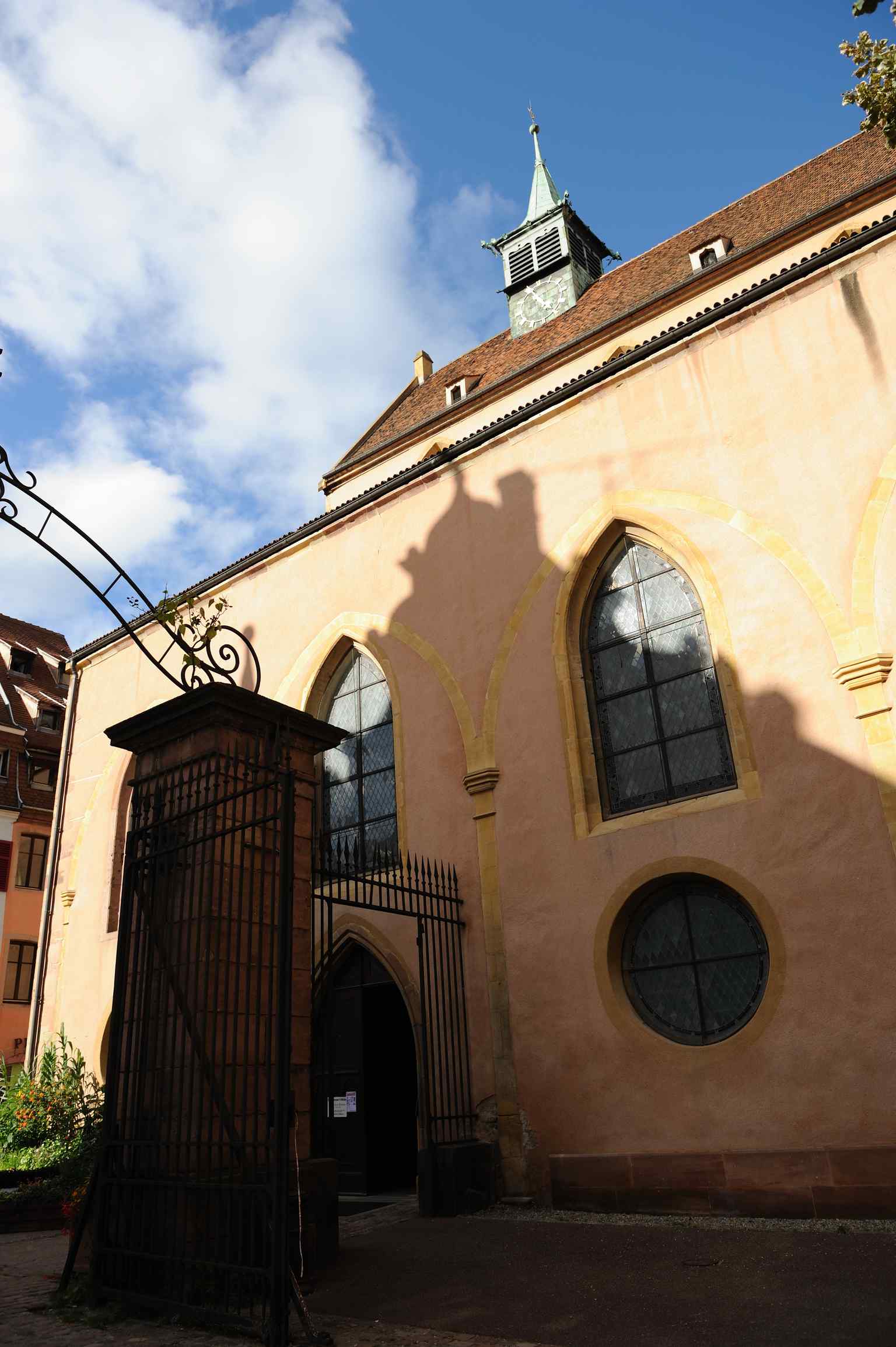
Eglise protestante Saint Matthieu - Colmar (68000)Photo: GuyFrancis, Wikimedia Commons, CC BY-SA 3.0. Cropped & resized. This remarkable building stands as a stubborn survivor of a very turbulent past. Whenever you are ready to move on, we can make the short walk over to our next stop, the Colmar synagogue.
On your slight right, look for a pale rectangular building accented with a reddish stone archway and topped by a wide triangular pediment. Just a short walk from Saint-Matthew…Read moreShow less
Open dedicated page →On your slight right, look for a pale rectangular building accented with a reddish stone archway and topped by a wide triangular pediment. Just a short walk from Saint-Matthew Church, this is the Colmar Synagogue at 3, rue de la Cigogne. This neo-classical building is actually the fourth synagogue in the city's history. The previous three met rather grim fates, courtesy of medieval Europe's notorious hospitality. The first was destroyed by fire in 1279. The second and third were confiscated around 1349 during the Great Plague, a period when the local Jewish community was unjustly blamed for the disease, massacred, and ultimately banished from Colmar for centuries.
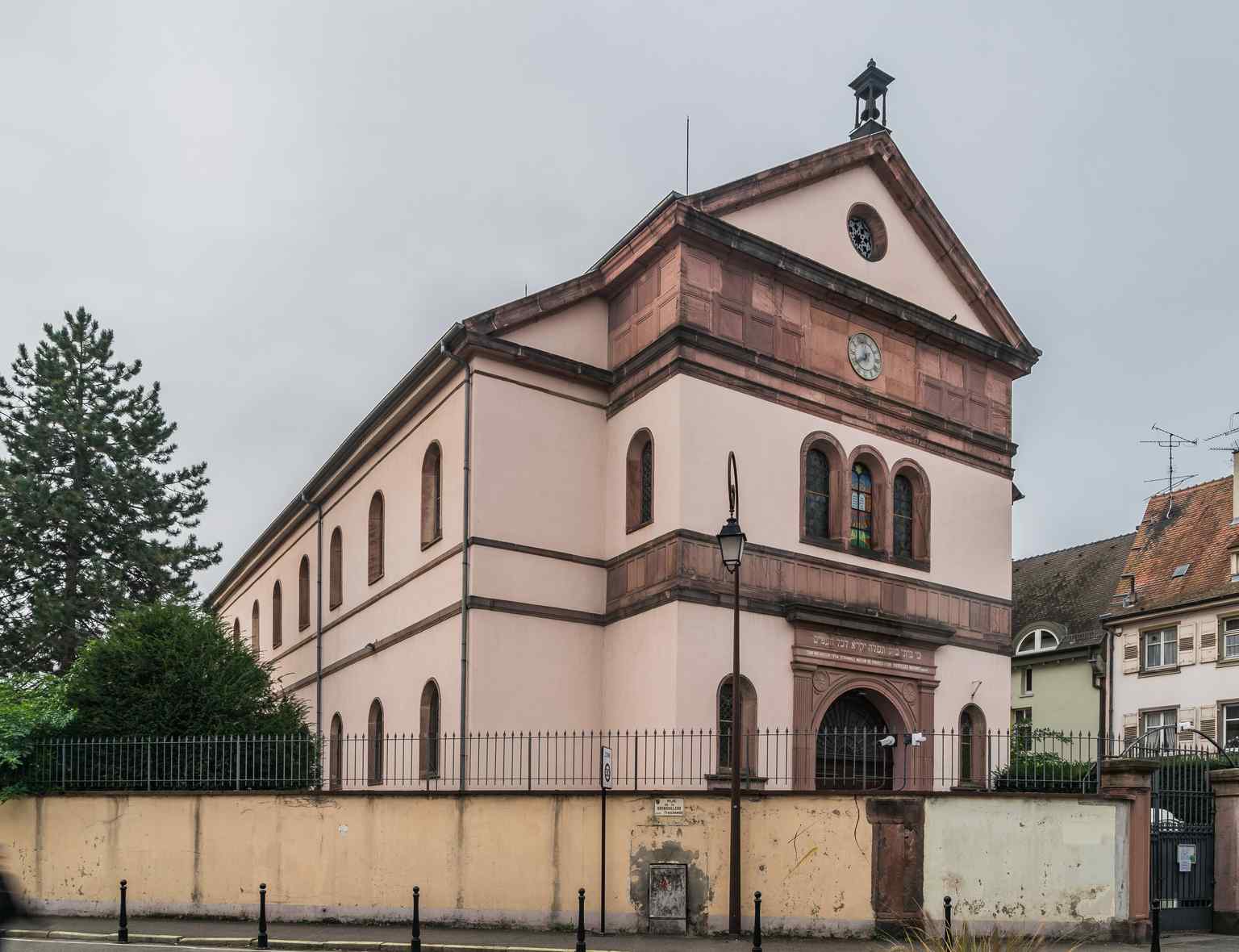
Synagogue of Colmar (1)Photo: Krzysztof Golik, Wikimedia Commons, CC BY-SA 4.0. Cropped & resized. It was finally during the relatively progressive era of the July Monarchy that the community decided to build this new temple, completing it in 1842. If you look just above the arched wooden doors, you will spot a verse from the prophet Isaiah inscribed in Hebrew. The design holds a few mysteries too. The facade features esoteric symbols inspired by the Kabbalah, an ancient Jewish tradition of mystical interpretation of the Bible. Curiously, it is also the only synagogue in the region boasting its own bell tower.
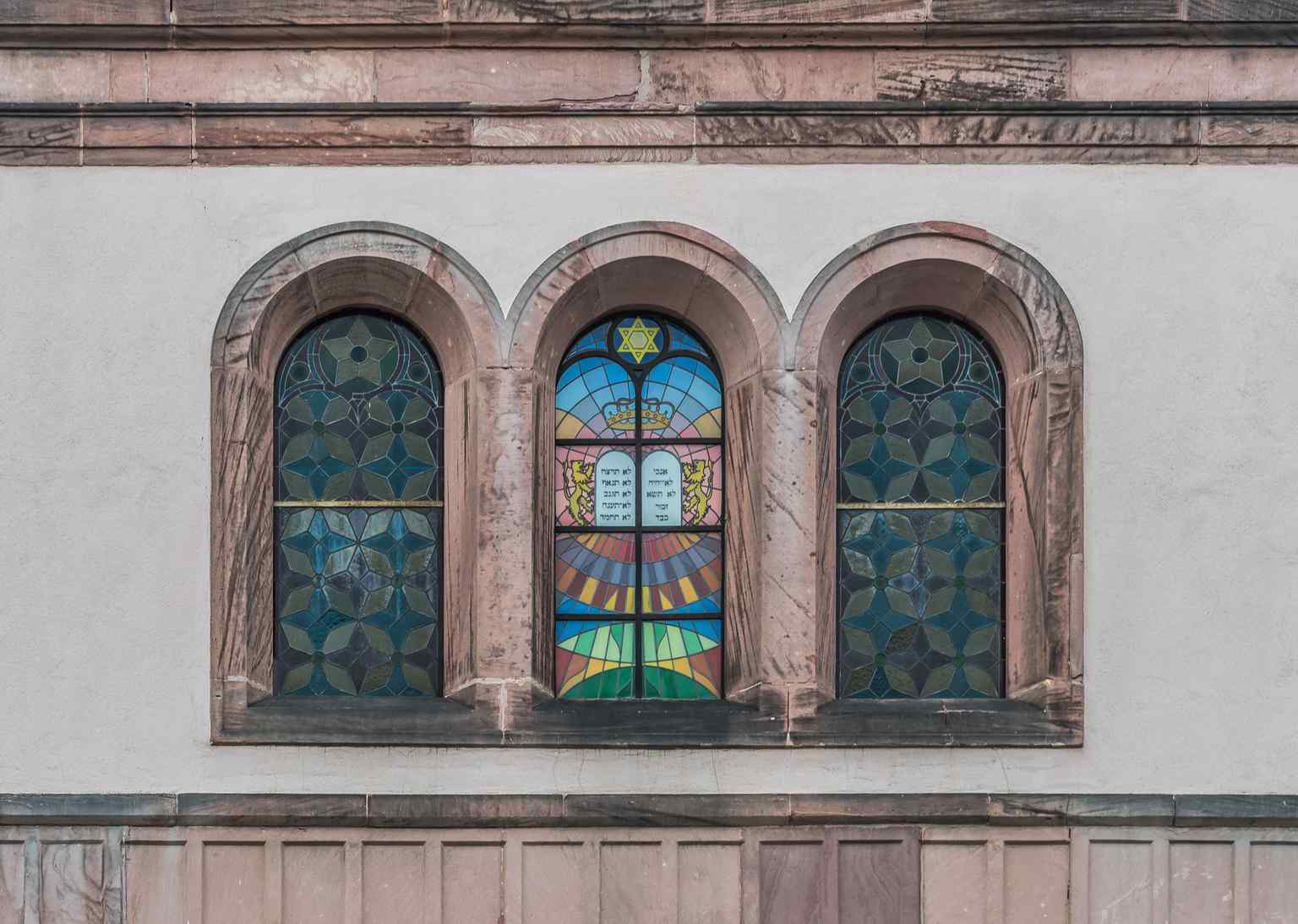
Synagogue of Colmar (3)Photo: Krzysztof Golik, Wikimedia Commons, CC BY-SA 4.0. Cropped & resized. While we are just admiring the outside, the interior has its own architectural quirks. Above the main hall, a large pyramid made of opaque glass filters the light, carefully tracking the sun's movement to indicate the proper times for daily prayers. That sunlight gently illuminates the aron-ha-qodesh, the sacred ark at the front of the room where the community's handwritten Torah scrolls are safely kept.
Frequently asked questions
How do I start the tour?
After purchase, download the AudaTours app and enter your redemption code. The tour will be ready to start immediately - just tap play and follow the GPS-guided route.
Do I need internet during the tour?
No! Download the tour before you start and enjoy it fully offline. Only the chat feature requires internet. We recommend downloading on WiFi to save mobile data.
Is this a guided group tour?
No - this is a self-guided audio tour. You explore independently at your own pace, with audio narration playing through your phone. No tour guide, no group, no schedule.
How long does the tour take?
Most tours take 60–90 minutes to complete, but you control the pace entirely. Pause, skip stops, or take breaks whenever you want.
What if I can't finish the tour today?
No problem! Tours have lifetime access. Pause and resume whenever you like - tomorrow, next week, or next year. Your progress is saved.
What languages are available?
All tours are available in 50+ languages. Select your preferred language when redeeming your code. Note: language cannot be changed after tour generation.
Where do I access the tour after purchase?
Download the free AudaTours app from the App Store or Google Play. Enter your redemption code (sent via email) and the tour will appear in your library, ready to download and start.
If you don't enjoy the tour, we'll refund your purchase. Contact us at [email protected]
Checkout securely with 






_(Colmar).jpg)

_-_Temptation_of_Saint_Anthony_the_Great_01.jpg)


_%26_Atelier%2C_ca_1480_-_Oil_on_wood_panel_-_The_Last_Supper.jpg)
_-_Crucifixion_02.jpg)
_1889_by_Claude_Monet_(1840-1926)_-_Oil_on_Canvas_01.jpg)

.jpg)
.jpg)


.jpg)


.jpg)
.jpg)


.jpg)
_(2).JPG)
_(Colmar).JPG)

.jpg)
.jpg)
.jpg)