
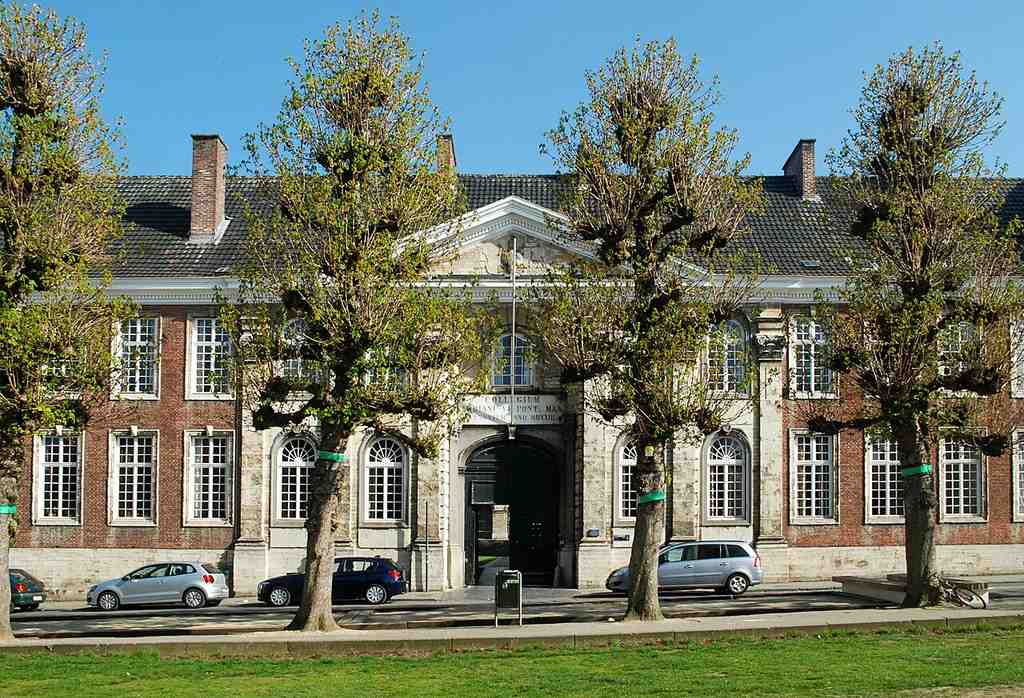
Look for the long pale brick façade, the central cut-stone section with giant flat columns, and the triangular pediment stamped with Pope Adrian the Sixth’s coat of arms.
This is the College of the Pope, or Pauscollege, and its story starts with one of Leuven’s most unlikely exports. Pope Adrian the Sixth was a Leuven-trained scholar who earned his doctorate in theology in fourteen ninety-one, then taught theology here and served as dean at Saint Peter’s before rising all the way to Rome. Six days before he died in fifteen twenty-three, he tied global rank to local need: he left his own house and two smaller houses to the university so poor theology students could have a college of their own.
That gesture matters because Adrian was not just a donor with a grand title. Before Rome claimed him, Adriaan van Utrecht had built his life in Leuven’s classrooms, and he remains the only Leuven professor ever to become pope. Later he served Charles the Fifth in Spain, and in fifteen forty the emperor himself stayed here, in the college founded by his former teacher. That gives the place a fine little reversal... the student becomes emperor, the teacher becomes pope, and Leuven keeps the address.
The first college opened in fifteen twenty-four. By fifteen thirty, it had grown into a complete working world: a chapel for prayer, a library and study hall for learning, guest rooms, staff quarters, and even granaries for storing grain. Theology did not float above daily life here. It ate, slept, studied, argued, and had to keep the pantry stocked.
Now here comes the turn in the story. This was never a quiet academic sanctuary that simply aged in peace. One wing collapsed in seventeen seventy-five, and that disaster pushed a major rebuild. Architects Corthouts and Ghenne gave the college its classical order in the years that followed, and in seventeen eighty-five Louis Montoyer added the eastern wing that closed the courtyard into a full rectangle. What looks steady and settled from out here is really the result of repair after damage.
And rulers kept commandeering it. Emperor Joseph the Second turned it into a general seminary, a centralized school for priests shaped by state policy. Under Napoleon, it became a hospital and then an annex for wounded veterans from the Invalides in Paris. Later it served as a barracks, and after Napoleon’s defeat, Russian and Prussian troops plundered it. So this building did not merely shelter learning; it became a tug-of-war between scholarship, religion, empire, and control.
That makes the façade in front of you feel almost stubborn. Those giant attached columns - architects call them pilasters, which simply means flat columns built into the wall - frame a formal entrance that insists on dignity after all that upheaval. If you like, tap the before-and-after image in the app; it quietly shows how this street front shifted from a sparse eighteen sixty-four view to the more settled landmark in front of you now.
Since eighteen thirty-five, students have lived here again, and the surviving records are wonderfully human: room requests, resident lists, staff wages, household accounts. After a major renovation in twenty nineteen and a reopening in twenty twenty-one, the college returned to its oldest purpose, now housing more than two hundred Belgian and international students. So the real monument here is not papal glory. It is the idea that learning, even after collapse, politics, and repurposing, keeps finding a room.
In about two minutes, the Cloth Hall shows Leuven making one of its boldest moves, turning a building of commerce into academic space. If you want another look later, the college is generally open every day from seven in the morning until ten-thirty at night.




