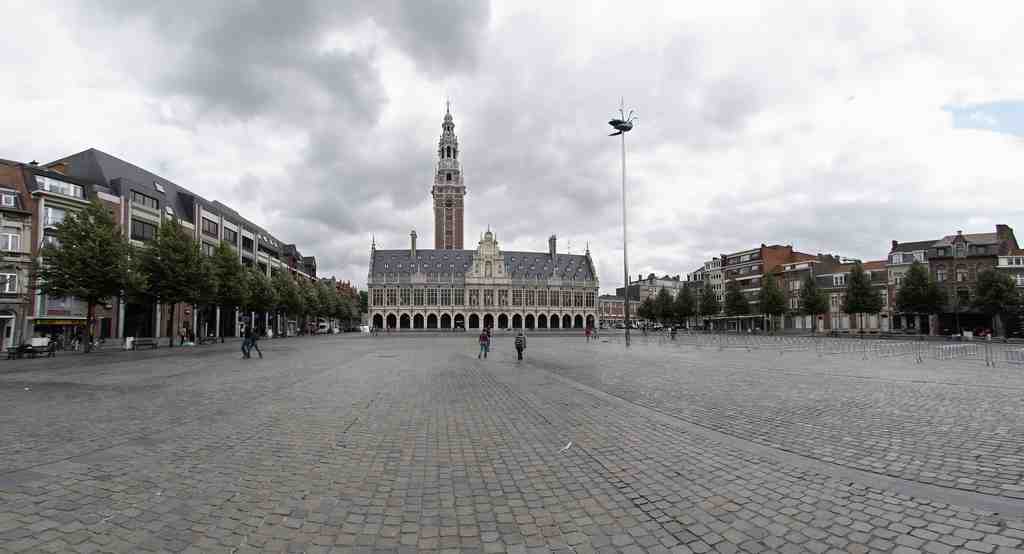
On your right, look for a broad stone-paved square opening around the red-brick university library, marked by its tall tower and the needle-thin Totem sculpture.
This is Ladeuzeplein, the largest square in central Leuven, and it feels like the city stepping into the open and clearing its throat. The name honors Monseigneur Paulin Ladeuze, a rector of the university. He was not a ceremonial figure in a fancy hat. In nineteen thirteen, he pushed to modernize the university library with metal furniture... and then, almost immediately, war swept in and wiped that effort away.
That first disaster did more than destroy shelves. It broke up Leuven’s university collections: manuscripts and books vanished in the flames, surviving knowledge had to be scattered, replaced, and rebuilt, and whole lines of memory were pieced together again through donations from abroad. So this square became something larger than a plaza. It became Leuven’s public declaration that learning would not stay buried.
The great landmark here is the central library of the Katholieke Universiteit Leuven, or K-U Leuven. If you want a closer look at its face, check the image in the app. Though the building looks older, with its revival of historic Flemish forms, architect Whitney Warren designed it in the nineteen twenties after the German destruction of the earlier library in August of nineteen fourteen. American donors, with powerful support from Herbert Hoover and other fundraisers in the U-S, financed the new building, and work began here in nineteen twenty-one.
Take a second and let your eyes travel across the square... the width of the open space, the formal symmetry of the façade, the tower rising like a civic exclamation point. Does it feel like a monument to books, to the city, or to recovery after catastrophe? Around Leuven, the smart money is on all three.
This spot had a life long before the library claimed it. Locals once called it Jeirkarlisse, after the Clarisse nuns whose monastery stood on a sandy hill here. The city later leveled that hill, turned the site into a wood market, named it Napoleon Square, then the People’s Place, and after the Second World War gave it the name Ladeuzeplein. Leuven has a habit of changing labels while keeping the deeper story underneath.
And the rebuilding did not end neatly. In May of nineteen forty, war struck again and the library burned again, with only a small fraction of its roughly nine hundred thousand books surviving. The tower and its carillon escaped, and after the war Leuven rebuilt the library almost exactly along the original plans. A carillon, by the way, is a keyboard-played set of tuned bells in a tower. Engineers from the U-S gave the original set in nineteen twenty-eight as a memorial to colleagues lost in the First World War, with forty-eight bells for the forty-eight states in the union at the time. Later restorers expanded it to sixty-three bells, so memory here does not just sit in stone... it rings.
Students keep this square from turning into a frozen memorial. They cross it in packs, argue, rally, celebrate, and occasionally make enough noise to remind everyone that ideas are living creatures, not museum pieces. That matters. A university city needs symbols, sure, but it also needs a restless public to test them.
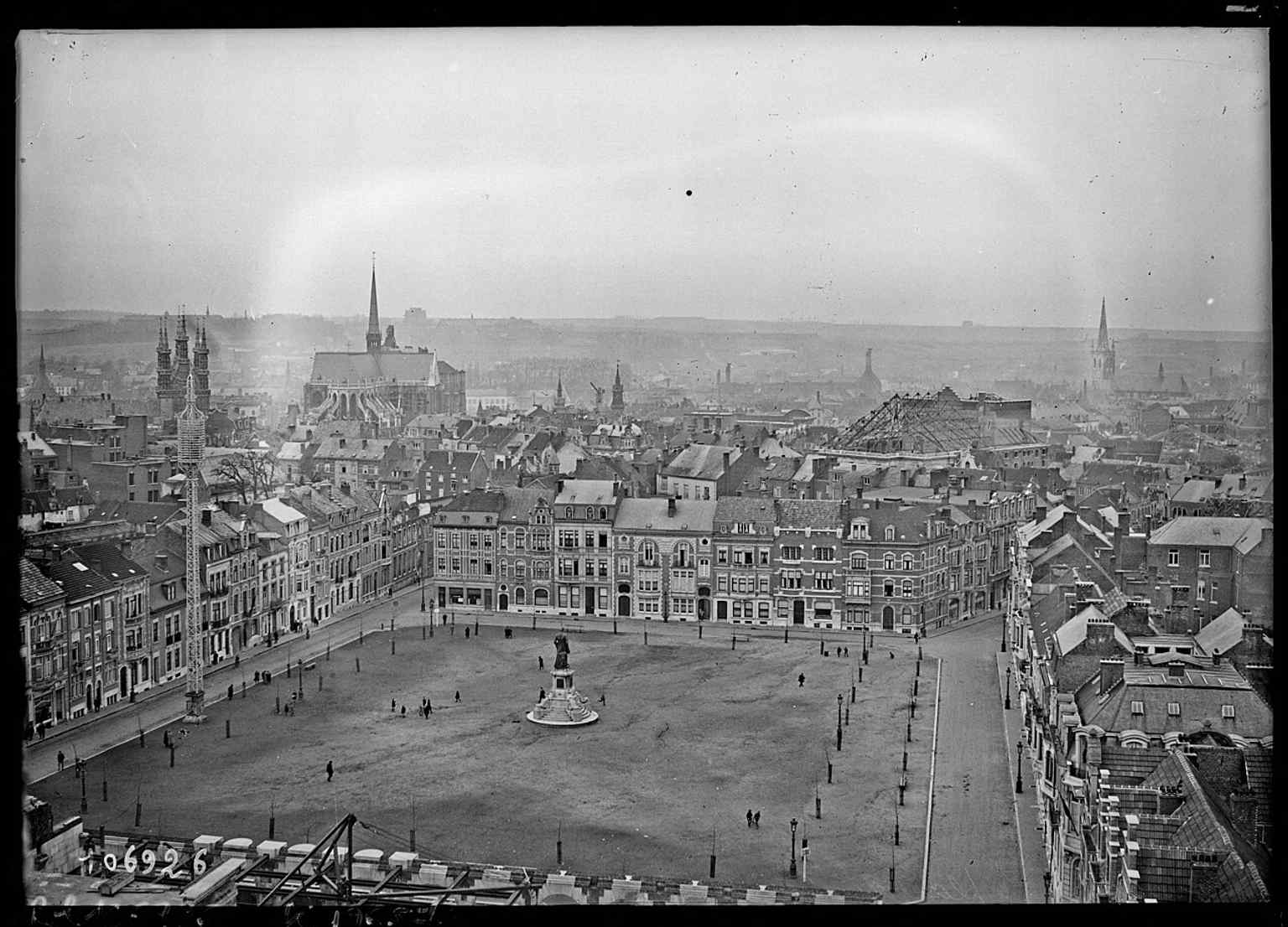
If you want a historical comparison, the older image in the app shows the square in nineteen twenty-six, still called the People’s Place, with the new library already shaping the center of town. From here, head on to M Leuven, about a three-minute walk away, and notice how this culture refuses to stay inside one building. The square is open all day and all night, which suits Leuven just fine.