
Vienna Audio Tour: Sacred Stories and Hidden Gems of Favoriten
Beneath the tranquil veneer of Vienna’s tenth district lies a landscape carved by brutal peasant rebellions and the haunting silence of forgotten plagues. Most tourists overlook these streets, but the shadows of Favoriten hold the true pulse of the city. This self-guided audio tour unlocks the gates to Oberlaa Parish Church, the solemn quiet of the cemetery, and the hidden sorrow of the Pietà Chapel. Did the screams of the 1683 siege truly fade from these hallowed fields? What dark scandal led to the abrupt sealing of the chapel’s original crypt? Why is a single unmarked stone near the cemetery wall still adorned with fresh flowers every winter? Traverse the ancient paths where political upheaval once silenced the choir. Feel the weight of centuries pressing against the pavement as you uncover the dramatic secrets lurking just beneath the surface. Begin the descent into the hidden history of Oberlaa now.
Tour preview
About this tour
- scheduleDuration 30–50 minsGo at your own pace
- straighten5.6 km walking routeFollow the guided path
- location_on
- wifi_offWorks offlineDownload once, use anywhere
- all_inclusiveLifetime accessReplay anytime, forever
- location_onStarts at Niche wayside shrine of Christ on the Mount of Olives
Stops on this tour
The structure in front of you is a tall white stone pillar featuring a four-sided base and a small tiled roof topped with a metal cross. This is the Christus am Ölberg shrine,…Read moreShow less
Open dedicated page →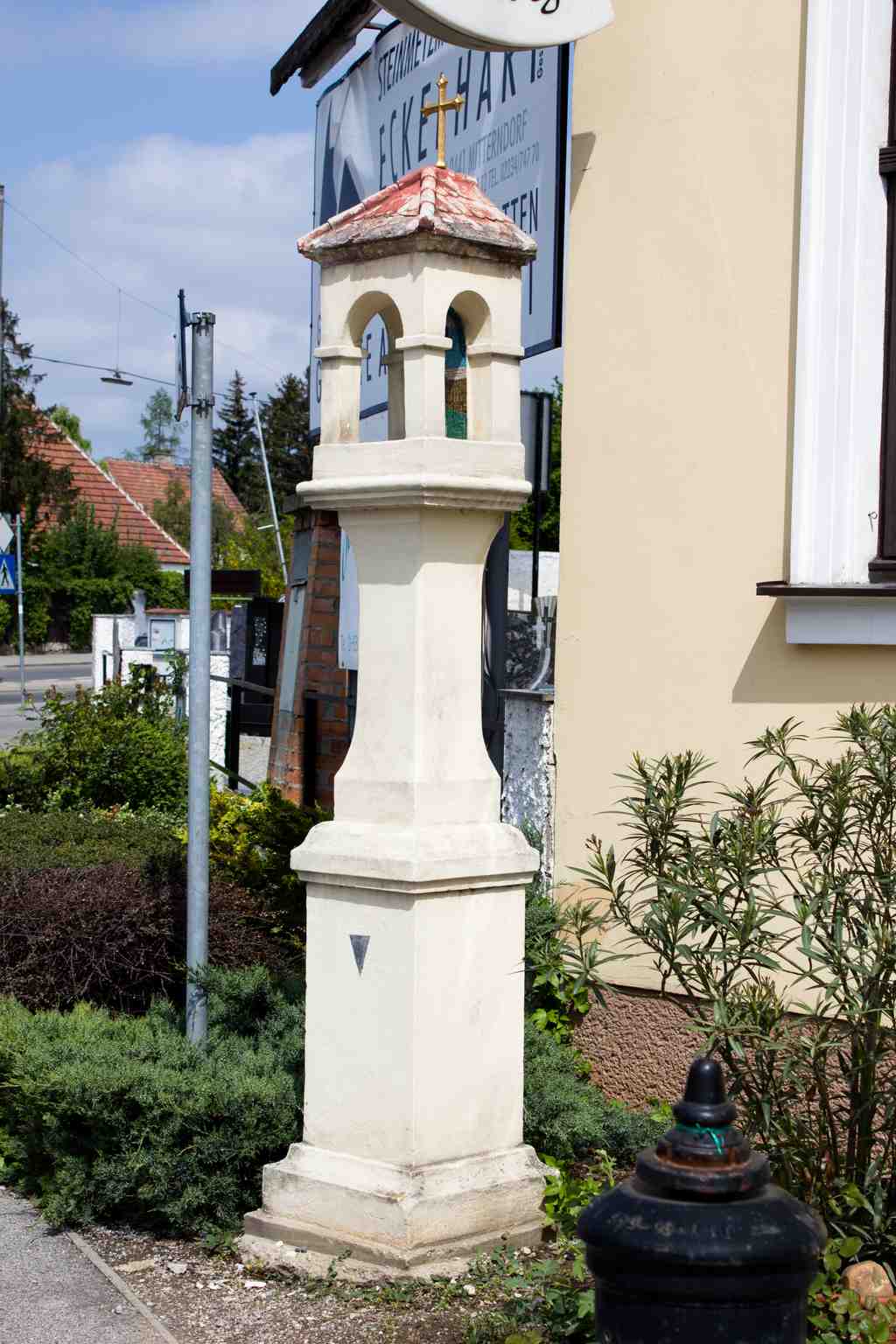
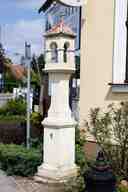
Niche wayside shrine of Christ on the Mount of OlivesPhoto: Andreas Kamhuber, Wikimedia Commons, CC BY-SA 3.0 AT. Cropped & resized. The structure in front of you is a tall white stone pillar featuring a four-sided base and a small tiled roof topped with a metal cross. This is the Christus am Ölberg shrine, standing at what used to be the absolute edge of Oberlaa. Back when the adjacent street was known as the Back Row, this corner marked the final line of houses. Why here? Because Oberlaa did not have defensive walls. Instead, the farming community relied on a concept called the gefeites Dorf, or protected village. They built a perimeter of sacred monuments at every exit, essentially creating a spiritual forcefield against disease and misfortune.
Sometimes, the world tested that perimeter. In May 1809, villagers were out in the fields for their traditional days of prayer. Suddenly, they ran headlong into a massive column of Napoleon's invading army, described by locals as a sea of blue. Naturally, you would expect a tactical retreat. Instead, the villagers just kept walking and praying right past the heavily armed troops. It was a staggering act of defiance.
Take a look at the artwork inside the top niche. You will notice it is a vibrant modern mosaic of the Mount of Olives scene, installed in 1970. This mosaic is proof of a community that refuses to let its spiritual markers fade away. When the original art began to decay, they simply commissioned a new piece to ensure the shrine stayed active.
If you pull up the app, you can see the shrine's details a bit more clearly. Originally, that niche held a Blechmalerei, a traditional painting on sheet metal. Decades of harsh elements eventually took their toll on the iron. In a major mid-century preservation push, local historians rescued these fragile, rusting artworks from across the district and secured them in a museum. Because of their foresight, the village's vulnerable heritage survived.
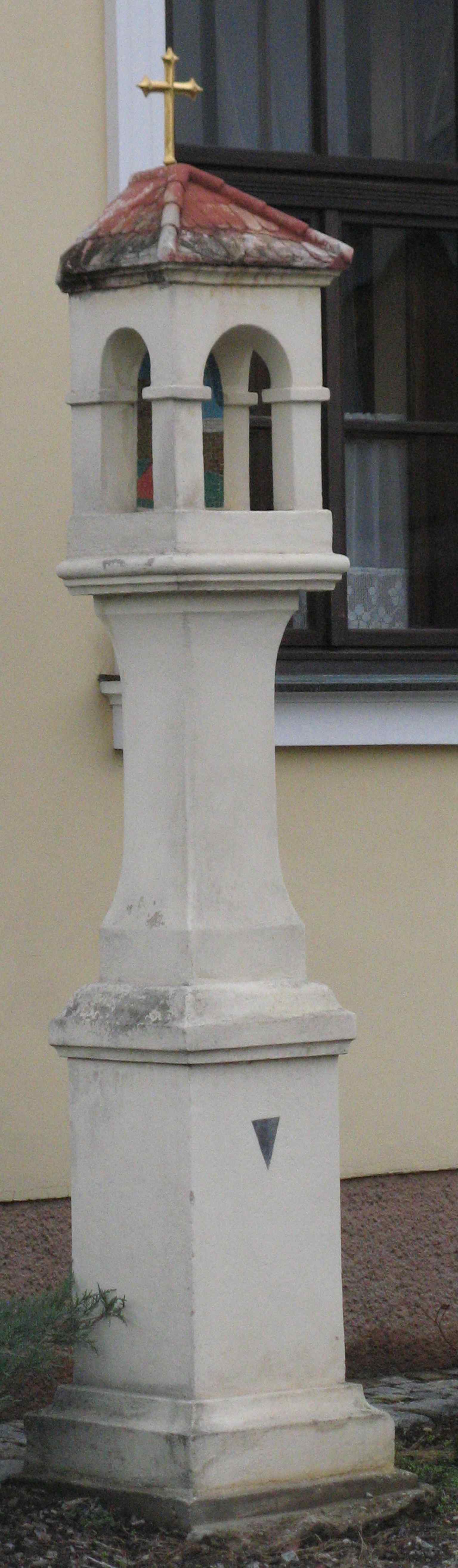
The Niche Wayside Shrine of Christ on the Mount of Olives stands at the historically significant corner of Laaer-Berg-Straße, marked by its distinctive four-sided plinth and the modern mosaic of the Mount of Olives scene installed in 1970.Photo: Buchhändler, Wikimedia Commons, CC BY-SA 3.0. Cropped & resized. These shrines stood guard over farmland that once funded the local institute for the poor. Now, turn away from the shrine and look toward the new parks that have replaced those old fields. Our next stop, Hubert-Blamauer-Park, is a ten minute walk away.
Look to your left and you will spot a wide green space anchored by a tall metal mesh sports cage and dotted with undulating wooden slatted loungers. Not long ago, these vast…Read moreShow less
Open dedicated page →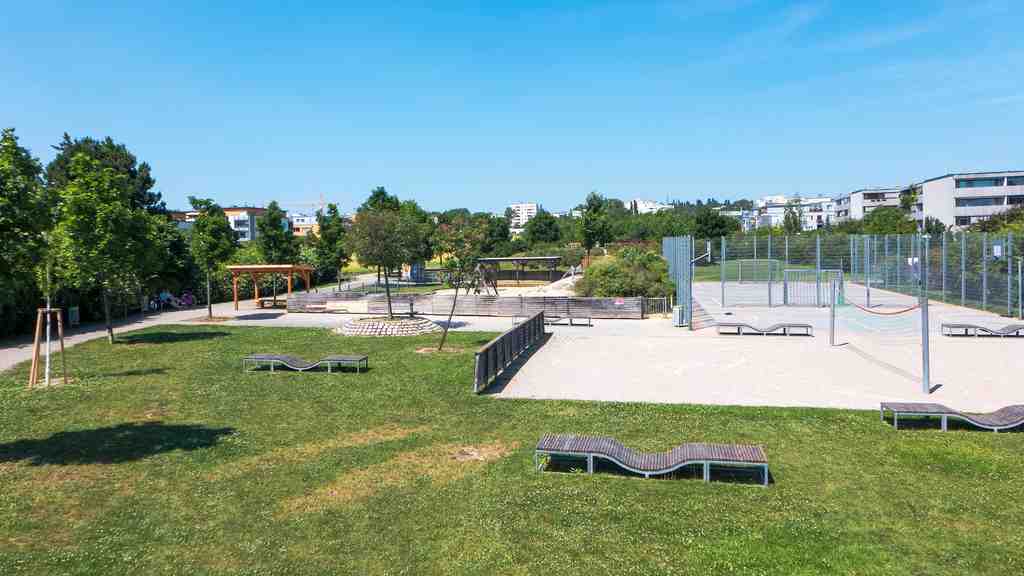
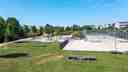
Hubert-Blamauer-ParkPhoto: Gugerell, Wikimedia Commons, CC0. Cropped & resized. Look to your left and you will spot a wide green space anchored by a tall metal mesh sports cage and dotted with undulating wooden slatted loungers.
Not long ago, these vast agricultural lands underwent a massive urban expansion to meet the demands of a rapidly growing population. The endless fields of crops were quickly transformed into dense residential zones and vital recreational buffer spaces. For generations, the people of Oberlaa were deeply tied to the soil, working this exact tract of land, known as the Grundaecker, to sustain themselves. Today, they have transitioned from farming the earth to utilizing this seven thousand square meter area as a modern, networked community hub.
When this space opened in 2005, it served as an innovative pilot project for the city of Vienna, featuring integrated public Wi-Fi to create a digital meeting point for the youth. It is a rather bright, progressive leap to go straight from plows to wireless hotspots.
The park is named after Hubert Blamauer, a dedicated local history teacher and politician who passed away in 2002. Blamauer strongly believed in youth development and saw physical education as a prime tool for social integration. That is exactly why the park features that prominent enclosed sports court, known locally as the cage. It is a robust, fenced in arena where kids can safely blast soccer balls without accidentally taking out a relaxing neighbor.
When the city laid out this park, they deliberately planted young saplings to symbolize the fresh roots and enduring adaptability of this neighborhood. The locals took a patch of farmland and grew a thriving, modern community out of it instead.
This park is open twenty four hours a day, so that community connection never has to pause. Our next stop highlights another green space honoring a different local figure, so let us take the eight minute walk over to Kurt Tichy Gasse Park.
You are looking at Kurt-Tichy-Gasse Park, a wide green lawn dotted with rectangular rusted steel planter boxes and curved wooden lounge chairs set beneath young shade trees. This…Read moreShow less
Open dedicated page →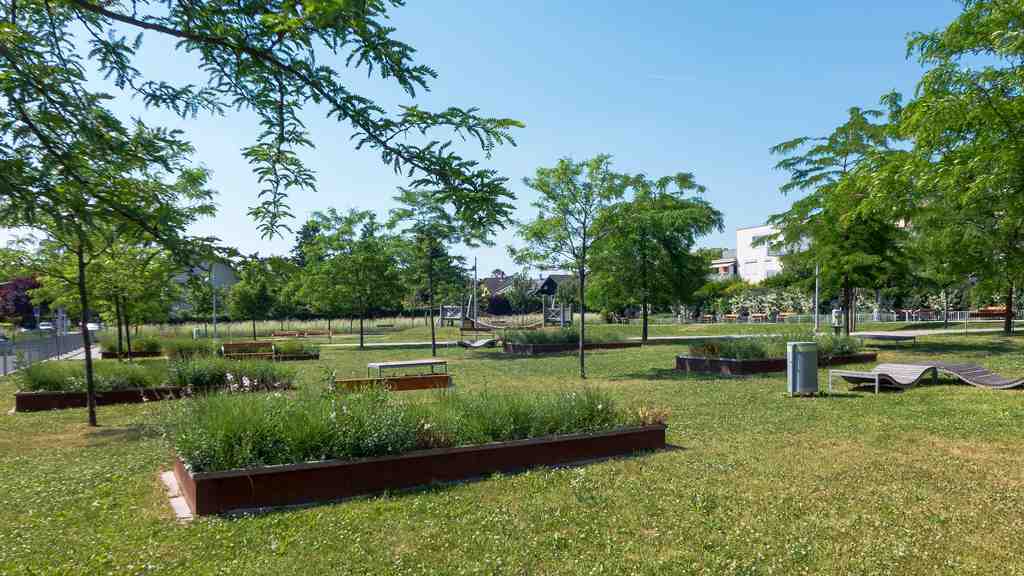
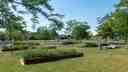
Kurt-Tichy-Gasse ParkPhoto: Gugerell, Wikimedia Commons, CC0. Cropped & resized. You are looking at Kurt-Tichy-Gasse Park, a wide green lawn dotted with rectangular rusted steel planter boxes and curved wooden lounge chairs set beneath young shade trees. This thirty-five hundred square meter space sits at the heart of the Grundäcker development.
There is a bit of a local identity crisis here. If you recall the Hubert-Blamauer-Park we visited a few minutes ago, that was originally called Grundäckerpark, but when the city renamed it, locals stubbornly transferred the old name to this very spot, thoroughly confusing city maps ever since.
Officially, this park honors Kurt Tichy, a man whose perseverance mirrors the growth of this very neighborhood. Returning as a soldier from the Second World War, his plans to take a master baker exam were severely delayed. Undeterred, in nineteen fifty-two, he and his wife Marianne began selling ice cream from a three-wheeled cart out of a modest basement. Facing post-war shortages of cocoa and butter, Tichy simply adapted, using fresh strawberries to create flavors that dominated the market. His philosophy was delightfully blunt. If there is nothing in it, it tastes like nothing.
In nineteen sixty-seven, he cemented his legacy by inventing the Eismarillenknödel. He engineered a way to replicate the traditional Austrian apricot dumpling using ice cream, wrapping a core of apricot ice cream in a vanilla dough and rolling it in roasted hazelnut splinters. He even patented the process, turning a struggling idea into a global culinary icon and earning himself the title of Ice Cream King of Favoriten.
The community here shares that same persistent drive, recently gathering hundreds of signatures to demand a direct walking path to the local transit station, ensuring their neighborhood stays connected. As we leave these modern triumphs behind, we must look toward the older, quieter histories carved into this land. Our next stop, the White Cross in Oberlaa, is just a seven-minute walk away, where a much more somber tradition awaits.
Show 7 more stopsShow fewer stopsexpand_moreexpand_less
 4
4Katholische Kirche Oberlaa (St. Ägyd)
Buy tour to unlock all 14 tracksYou are looking at a weathered stone statue of a robed woman, set atop a square stone pedestal, holding her left arm slightly extended with a small metal flower. Historically,…Read moreShow less
Open dedicated page →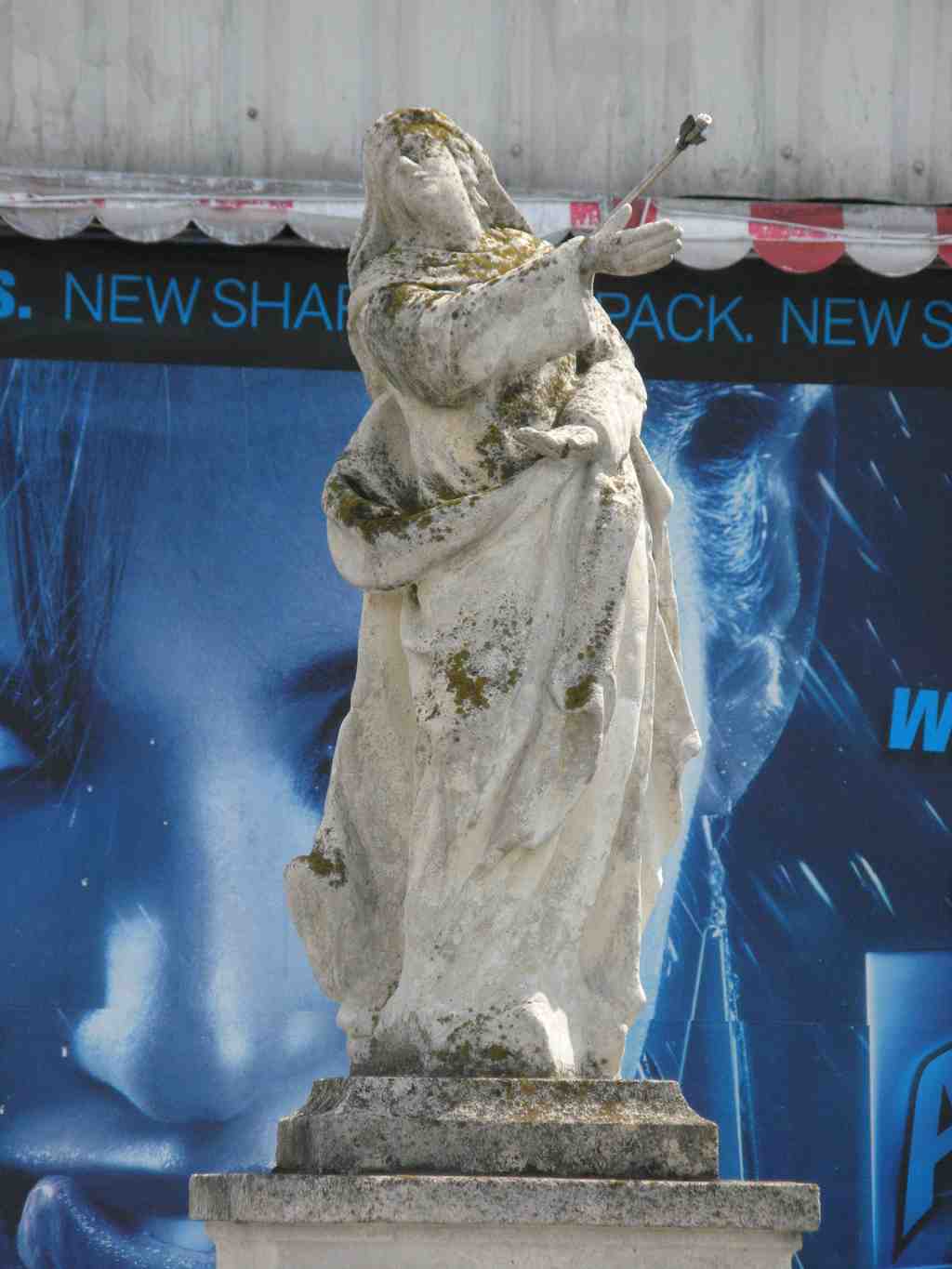
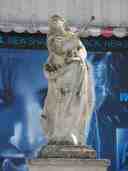
White Cross in OberlaaPhoto: Buchhändler, Wikimedia Commons, CC BY-SA 3.0. Cropped & resized. You are looking at a weathered stone statue of a robed woman, set atop a square stone pedestal, holding her left arm slightly extended with a small metal flower. Historically, locals did not call this the White Cross, but rather the Urlauberkreuz. Today, the German word Urlaub means vacation, but centuries ago, it meant a solemn farewell. This precise spot marked the final vantage point where travelers could look back and still see their home village of Oberlaa. Pilgrims heading to Mariazell and soldiers marching off to war would stop exactly where you are standing to share a tearful goodbye with their families, rooting deep, sorrowful memories into this very landscape.
Originally, a white stone cross stood here, built by villagers after an Ottoman siege leveled the town in 1683. By 1809, this statue of the Mater Dolorosa, Our Lady of Sorrows, had taken its place. Remember the village procession that bravely marched past Napoleon's army in 1809? During that same chaotic invasion, a French commander mocked a group of terrified schoolchildren praying near this very spot. The world has a strange habit of interrupting quiet prayers. The French commander mocked the terrified children. To drive his point home, he drew his saber and delivered a violent strike directly to this stone figure.
The locals took it as a dark omen. But fate, it seems, has a long memory. A few weeks later, at the Battle of Aspern, that same arrogant commander suffered a devastating injury in combat. He lost his right hand, the exact hand he had used to strike the sacred statue. In a twist of brutal irony, the dying officer was transported back here to Oberlaa. Instead of seeking revenge, the villagers and the local parish took him in and tended his wounds. He spent his final hours expressing deep remorse to the very people he had mocked, passing away the next day.
The monument was repaired in 1816 by a local magistrate, offering a bit of physical and moral healing for the traumatized community. When it was restored again in 1984, the village officially returned this specific statue to the top of the pillar, moving the original namesake white cross to a museum to preserve its history.
The quiet strength of these people outlasted empires and saber strikes alike. From this corner of tearful farewells, we will walk thirteen minutes to the Ecce homo column, where a very specific and violent tragedy is remembered. If you want to see the original cross, it is safely preserved in the local district museum.
 5
5Ecce homo column
Buy tour to unlock all 14 tracksBefore you stands the Ecce homo column, a tall, square stone pillar standing on a stepped base, adorned with carved relief objects down its shaft and topped by a solitary statue…Read moreShow less
Open dedicated page →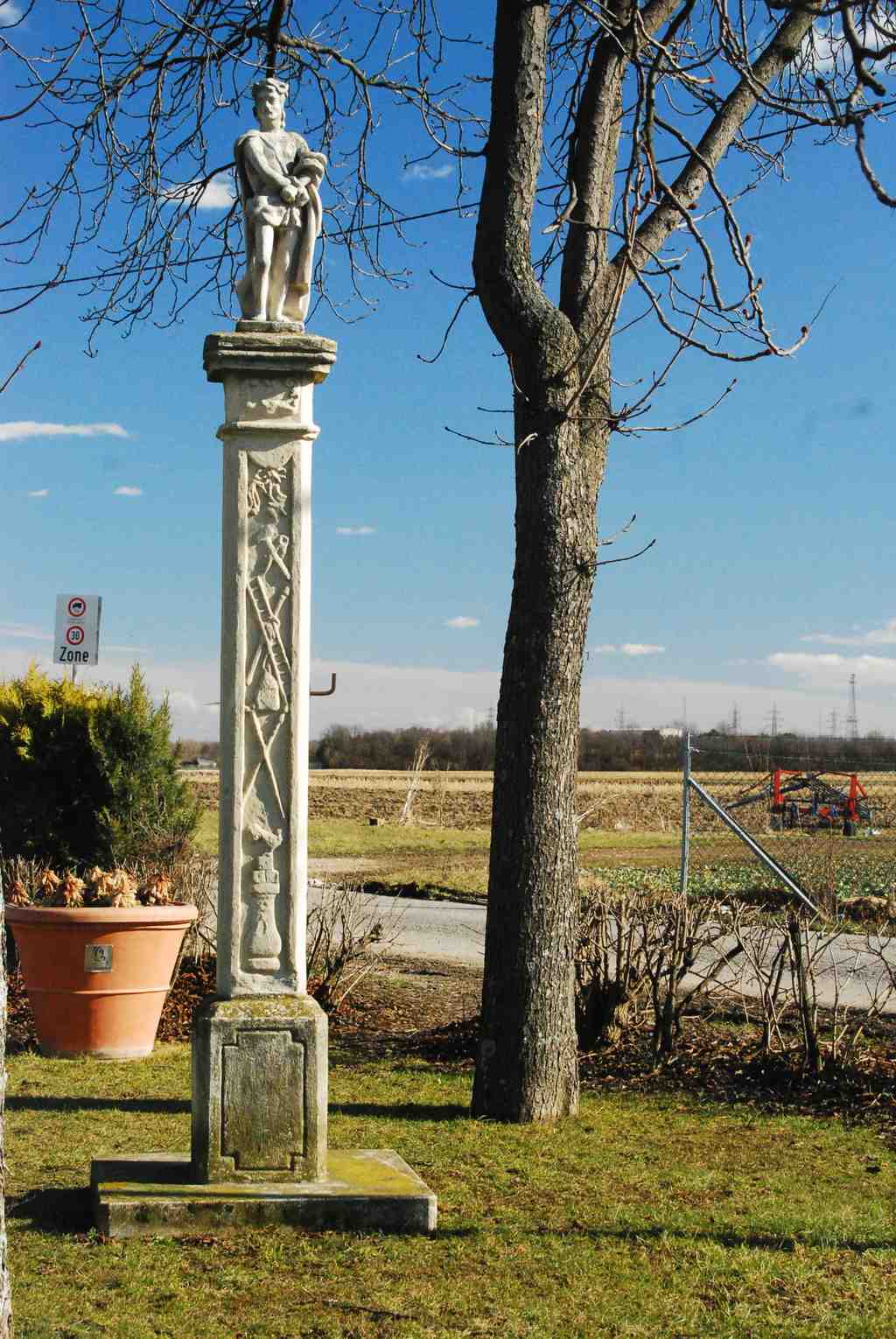
Ecce homo columnPhoto: GuentherZ, Wikimedia Commons, CC BY 3.0. Cropped & resized. Before you stands the Ecce homo column, a tall, square stone pillar standing on a stepped base, adorned with carved relief objects down its shaft and topped by a solitary statue of Christ.
This monument was born from an act of unspeakable violence. In the mid-nineteenth century, an Oberlaa citizen named Simon Knabl attended early morning mass, only to return home to a horrific discovery. He found his wife lying dead in their house with her throat slit. The sheer brutality of the murder shocked the quiet village, and despite intense investigations, no motive was found, and no killer was ever brought to justice. Knabl commissioned this monument not merely as a memorial, but as a permanent, public demand for divine intervention when earthly law had failed.
Personal tragedy and public memory are deeply intertwined in this stone. Take a moment to look closely at the front of the pillar, and you will see a series of carved objects including a ladder, a hammer, a sponge, and a lance. These reliefs represent the Arma Christi, a Latin term for the instruments of the Passion. Historically, these carvings functioned as a Poor Man's Bible, a visual guide allowing passersby who could not read to meditate on the specifics of suffering without needing a physical text. It is a rare survivor, being one of only three such crosses remaining in Vienna.
If those carvings look a bit soft or clogged, you can blame the local community's well-intentioned but highly destructive maintenance. For decades, residents tried to protect the monument by slathering it in thick layers of white lime paint, a practice known as Übertünchung. When professional restorers finally attempted to strip it back to the original stone in 1970, the buildup was so stubborn that some of the fine details were permanently lost.
There is also a rather peculiar architectural quirk here. You might notice the monument looks a little disjointed. Originally, the statue of Christ at the top, depicting the Man of Sorrows, faced north toward the village center. But when a new house was built directly adjacent to the site, it threatened to block the figure from public view. The pragmatic solution was to simply rotate the top statue to face west toward the road. So, the main pillar points north, while the statue gazes westward.
For over a century and a half, the four horse chestnut trees surrounding the pillar have protected this small island of grief, acting as a historical boundary line between the village's residential core and its agricultural fields. The rock and the roots here stubbornly hold onto the village's darkest memories, standing firm against the encroaching city.
Now, let us trace Simon Knabl's final peaceful steps before his world shattered. Head toward the Oberlaa Parish Church, where he likely prayed that morning, a twelve minute walk from here.
 6
6Katholische Kirche Oberlaa (St. Ägyd)
Buy tour to unlock all 14 tracksLook to your right at this pale yellow and white stucco building, distinguished by its gracefully curved upper facade and the dark bulbous onion dome capping the clock tower. This…Read moreShow less
Open dedicated page →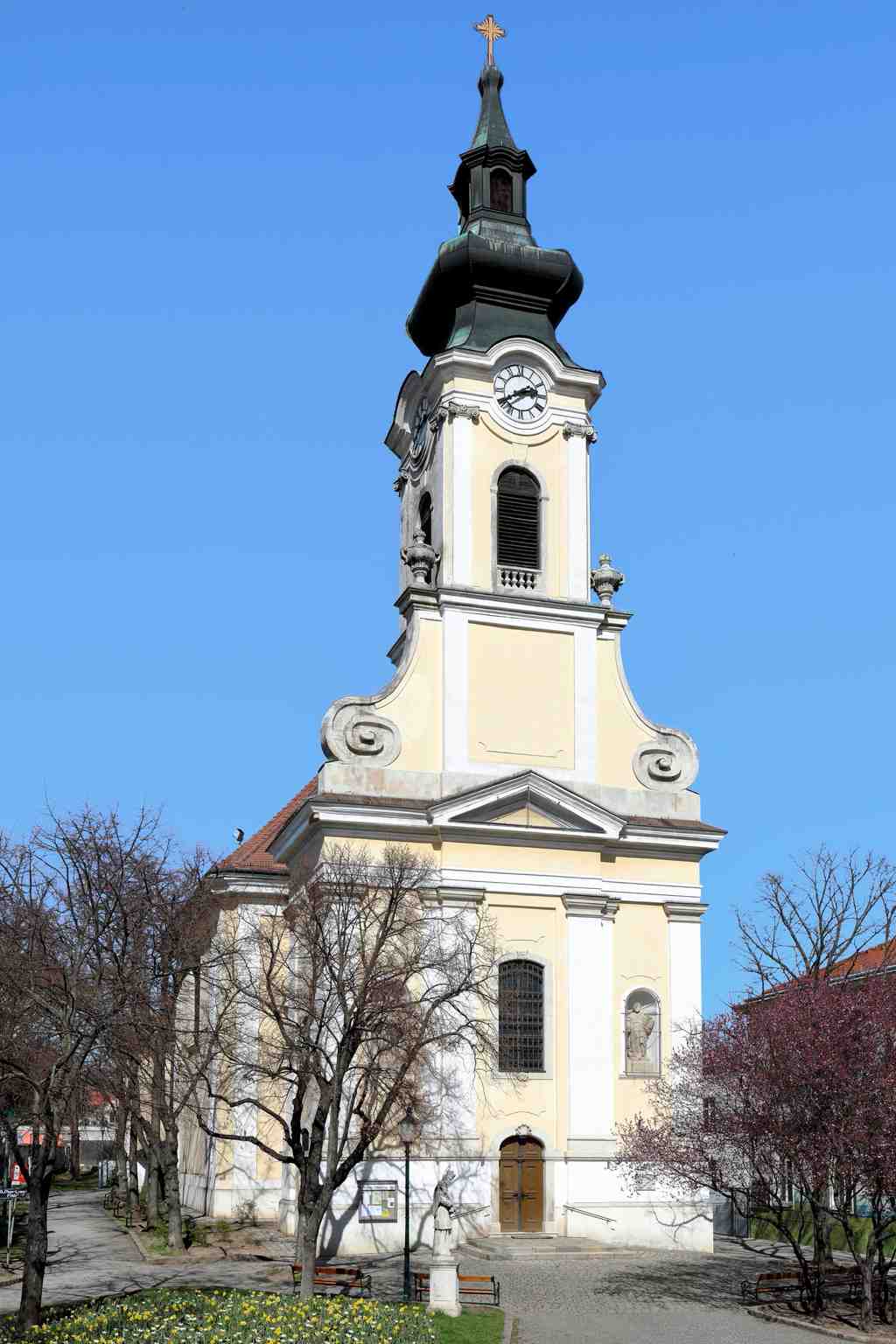
Oberlaa Parish ChurchPhoto: C.Stadler/Bwag, Wikimedia Commons, CC BY-SA 4.0. Cropped & resized. Look to your right at this pale yellow and white stucco building, distinguished by its gracefully curved upper facade and the dark bulbous onion dome capping the clock tower. This is the Oberlaa Parish Church. Like many structures in this part of Europe, an earlier version of it was completely leveled during the Turkish siege of 1683. When the architect Mathias Gerl was finally hired to rebuild it in the 1740s, he chose the elaborate Baroque style. You can see those characteristic dramatic flourishes right on your screen.
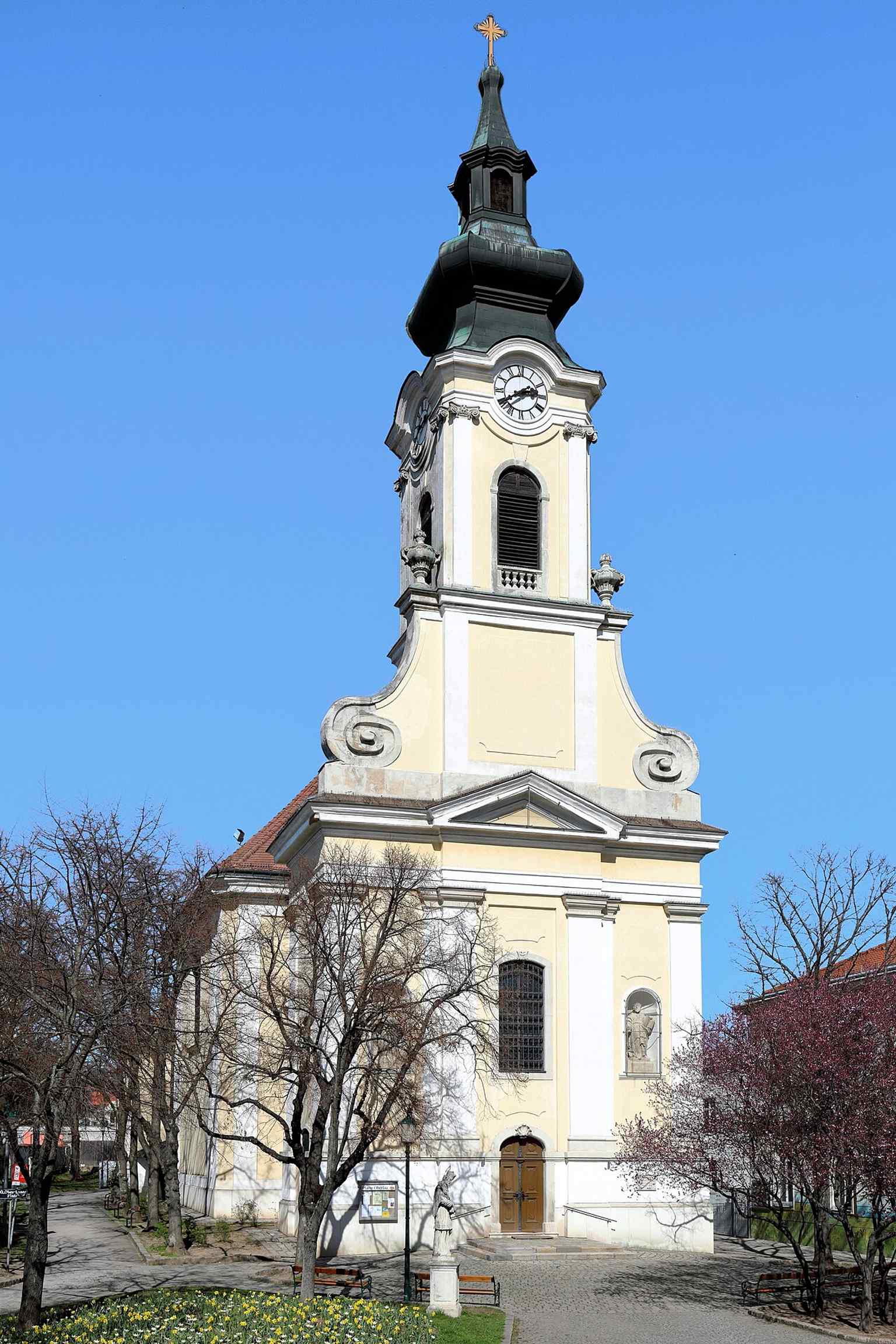
This southwest view showcases the Baroque style of the Oberlaa Parish Church, rebuilt by Mathias Gerl between 1744 and 1746 after its destruction during the 1683 Turkish siege.Photo: C.Stadler/Bwag, Wikimedia Commons, CC BY-SA 4.0. Cropped & resized. But monumental architecture is famously unforgiving on a budget. To finance this massive undertaking, the parish relied entirely on the Donati family. The local Catholic deans, Anton Donati and his successor Franz Anton, willingly drained their entire family fortune, originally accumulated in the Trentino region, to see this structure completed. It was an act of extreme devotion that essentially left the prominent family in financial ruin.
They did manage to get a small return on their investment, though. Gerl made a highly unusual engineering choice for the era. Instead of the standard east west orientation where the congregation faces east toward Jerusalem, he built the church on a strict north south axis. At the north end sits the high altar, featuring a grand painting of Saint Egidius. And if you look closely at the painted saint, he happens to bear the exact facial features of Anton Donati. It is perhaps the most expensive selfie in eighteenth century history.
The sheer cost of faith had lasting consequences. The financial toll was so severe that the church remained unconsecrated for over thirty years after the exterior was finished. They simply lacked the funds to complete the interior furnishings. The building finally received its official blessing in 1781, timed to coincide with Franz Anton Donati's fiftieth anniversary in the priesthood.
The people of Oberlaa have always carried a heavy burden to maintain this sacred ground. Through centuries of war, the congregation simply outlasted invading empires, repairing what was broken and continuing their traditions. They even honor the area's ancient hardships. Just a few years ago, the remains of five unknown medieval pilgrims were carefully reburied near the apse, which is the semi circular vaulted area at the rear of the building, ensuring their legacy remained protected.
If the doors are unlocked, step inside to view the magnificent interior. Take a moment to appreciate what this structure cost its creators, and then let us walk toward the Oberlaa Cemetery, just a three minute stroll away, where the ultimate toll of this neighborhood is recorded in stone.
 7
7Friedhof Wien Oberlaa
Buy tour to unlock all 14 tracksLook for the white stucco archway housing a black wrought-iron gate, topped with a simple dark cross mounted on its roofline. This is the entrance to the Oberlaa Cemetery. People…Read moreShow less
Open dedicated page →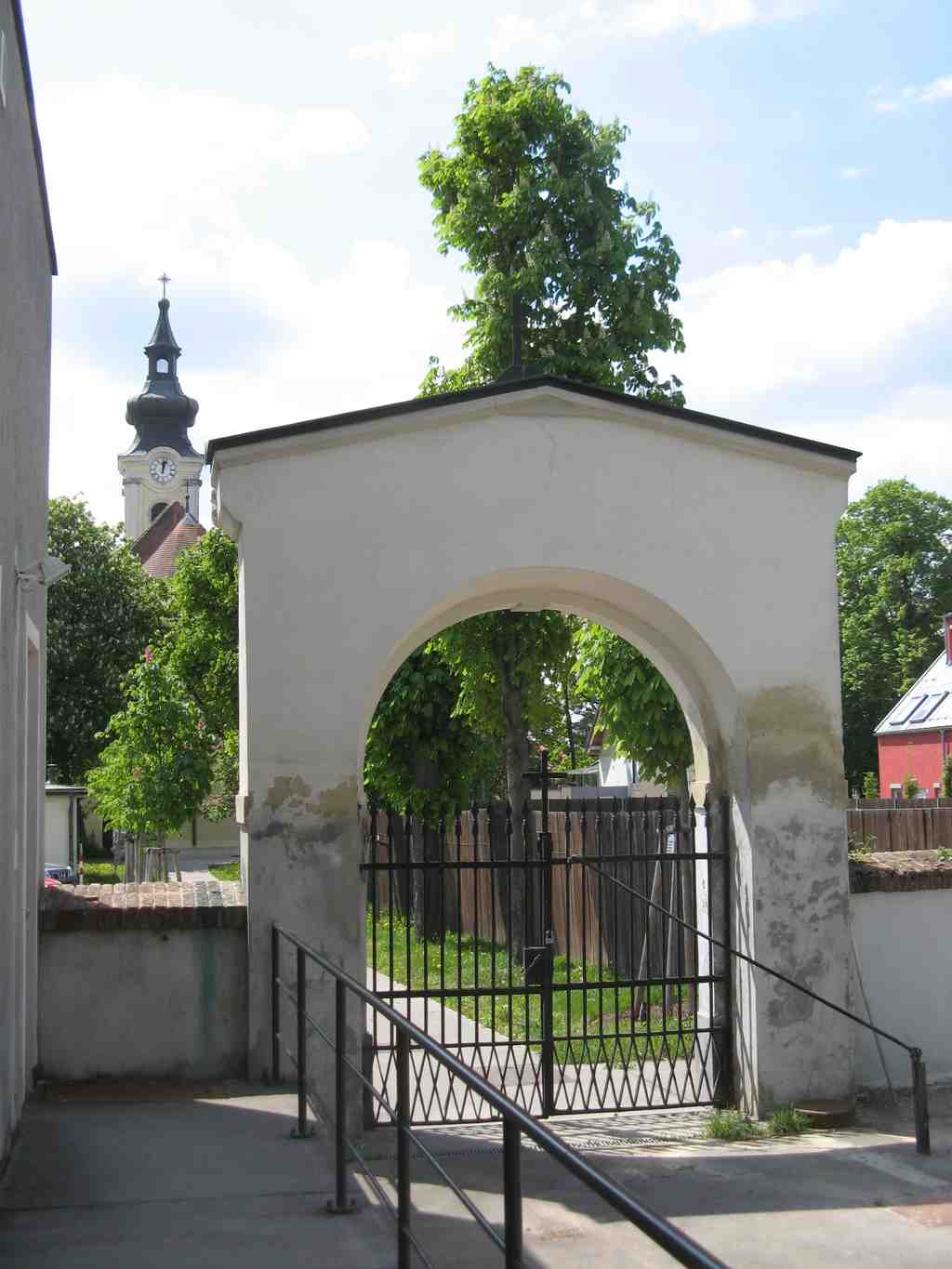
Oberlaa CemeteryPhoto: Buchhändler, Wikimedia Commons, CC BY-SA 3.0. Cropped & resized. Look for the white stucco archway housing a black wrought-iron gate, topped with a simple dark cross mounted on its roofline. This is the entrance to the Oberlaa Cemetery.
People have been burying their dead in Oberlaa since at least the year 1267. For centuries, the graveyard was just a modest plot of land wrapped around the local parish church. But a community can only endure so much tragedy before its physical geography has to change to accommodate the toll.
In 1831, a devastating cholera epidemic swept through this area, suddenly overwhelming the small churchyard and forcing the rapid, desperate expansion of these burial grounds. Just four years later, a severe outbreak of dysentery claimed another 118 lives in rapid succession. The community was forced into a grim cycle of continually purchasing surrounding farmland just to keep up with the staggering mortality rates. What you see today is the physical footprint of a village that had to drastically stretch its borders simply to hold its dead.
The overwhelming waves of disease shaped this space. And yet, this cemetery could have been vastly larger. In 1869, the city of Vienna was hunting for land to build a massive central cemetery. Oberlaa eagerly offered its fields. The city declined. At the time, this region was a massive hub for brick production. City planners were terrified that somber, horse-drawn funeral processions would constantly get stuck in traffic behind heavy, slow-moving wagons hauling bricks. Because of a hypothetical traffic jam, the city built its famous Central Cemetery elsewhere, and Oberlaa kept this space for itself.
As you look through the grounds, you will find structures that tell the story of the town social hierarchy. One prominent example is the Zwickelsdorfer mausoleum, built in 1855. A mausoleum is a large, freestanding monument built to enclose a burial chamber, and this one was constructed by a family of wealthy local landowners to ensure their high status remained visibly obvious long after they stopped breathing.
The modern residents of this cemetery are a bit more eclectic. You will find the grave of Karl Wrba, a former streetcar conductor who led the massive post-war reconstruction of this district. Not far from him lies Peter Rauhofer. He was a pioneer of global house music who won a Grammy in the year 2000 for his remixes. He spent his career spinning records in legendary New York dance clubs, yet he chose this quiet, historic village graveyard as his final resting place.
A word of warning if you wander too far into the newer, sprawling sections of the cemetery. The grounds have become so expansive that the administration issues a formal caution. It seems visitors frequently lose track of time in the sprawling avenues of stones, only to walk back and find the massive main gates permanently locked for the night. When that happens, there is no secret exit. The only solution is to call the local police, who keep a dedicated set of keys specifically to rescue involuntary overnight guests from the graveyard.
We are going to move from this vast resting place of the dead to a much smaller structure, a chapel originally built to ward off dark local folklore. It is about a six minute walk to our next stop, the Pietà Chapel Oberlaa.
 8
8Pieta-Kapelle
Buy tour to unlock all 14 tracksYou are looking at a square, pale-yellow masonry shrine capped with a wooden shingle roof, topped by a distinctive double iron cross featuring a bright red flaming heart. In…Read moreShow less
Open dedicated page →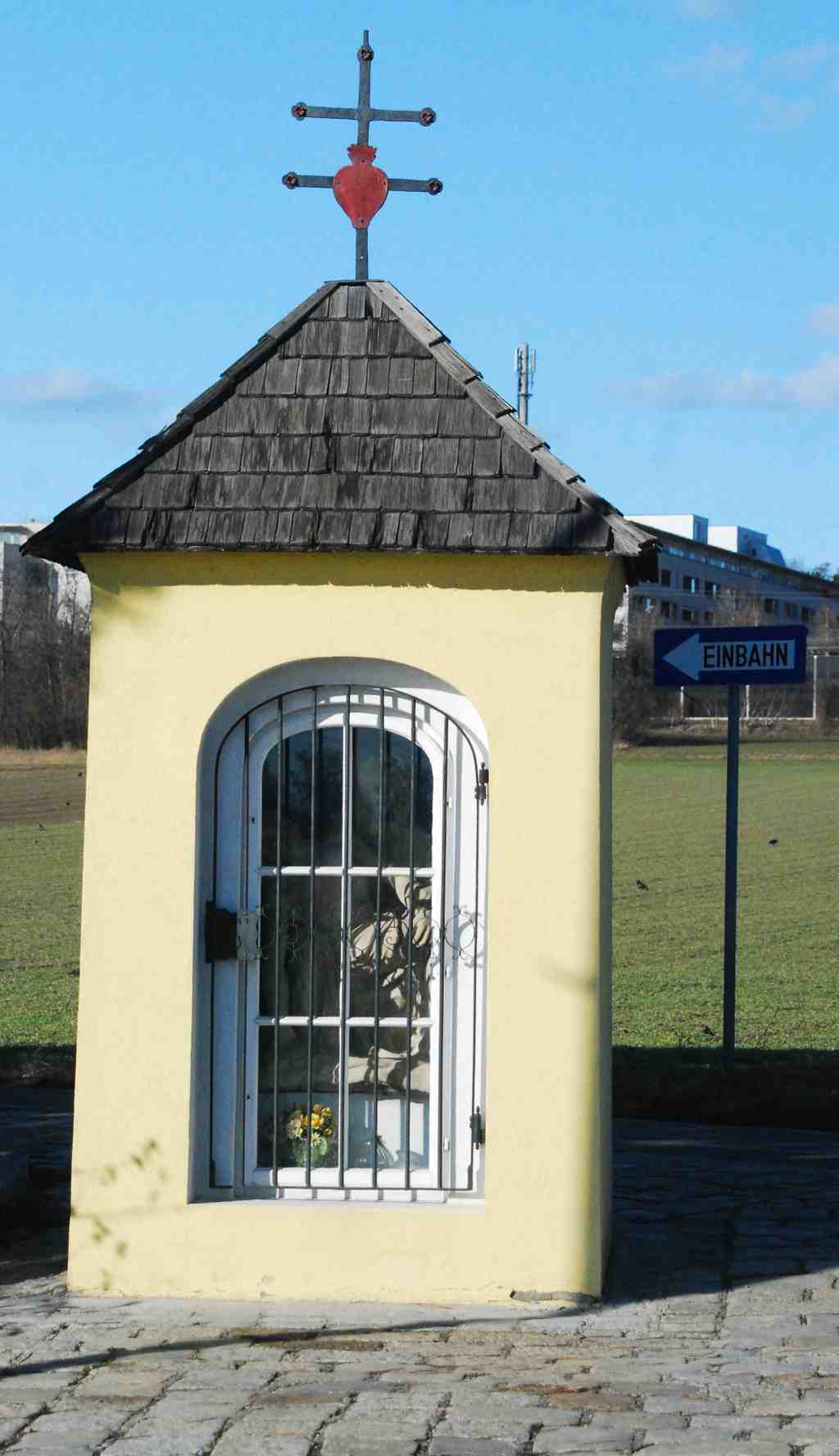
Pietà Chapel OberlaaPhoto: GuentherZ, Wikimedia Commons, CC BY 3.0. Cropped & resized. You are looking at a square, pale-yellow masonry shrine capped with a wooden shingle roof, topped by a distinctive double iron cross featuring a bright red flaming heart.
In centuries past, village borders were not just lines on a map, they were the frontline defense against the supernatural. According to local lore, this chapel was a key anchor in the village's spiritual perimeter. The strategy was to build a ring of sacred shrines to shield the inhabitants from plague, fire, and wandering spirits. Because nothing deters a ghost quite like solid stonework and a heavy iron gate.
The iron lock on that gate, along with the sculpture of the grieving Mary inside the niche, bears the year 1877. This marks a massive community effort to secure the boundary. Look up at that double-barred iron cross. That is a patriarchal cross, an architectural choice that signaled special spiritual rank, telling travelers they were entering a parish under serious divine watch. The red flaming heart on the lower beam symbolizes the Sacred Heart of Jesus, promising mercy and protection to the rural workers.
Long before this specific structure went up, an older shrine stood here, known simply as the cross below the village. It was the hub of the local Institute for the Poor, a social safety net established in the late eighteenth century. Farmhands returning from the vineyards would drop small coins into the Opferstock, an offering box at the base of the shrine. It was grassroots social welfare, directly funding care for the sick and elderly of the parish.
Even today, that agricultural bond holds firm. During an annual spring procession, the community pauses right here to pray for the wine harvest, specifically asking for protection against late frosts.
It is a quiet, enduring place, though its peace was violently interrupted in 1992 when a runaway truck completely obliterated the shrine. It went about as badly as you would expect, with the masonry reduced to rubble and only fragments of the original sculpture surviving the crash. But the community refused to let their boundary fall. Craftsmen used the original 1877 measurements to build a flawless replica from the ground up. They even took the opportunity to replace a highly practical but incredibly ugly tin roof added in the sixties, bringing back the historic wooden shingles. It was a stubborn act of resurrection by the local residents.
Since it sits right on the street corner, it is always accessible. Now, let us head toward the bridge to uncover more history at the Statue of St. John of Nepomuk, about an eight-minute walk away.
 9
9Statue: John of Nepomuk
Buy tour to unlock all 14 tracksLook for the pale sandstone figure of a robed man standing on a flared pedestal, cradling a crucifix against his chest just behind the metal bridge railing. For centuries, locals…Read moreShow less
Open dedicated page →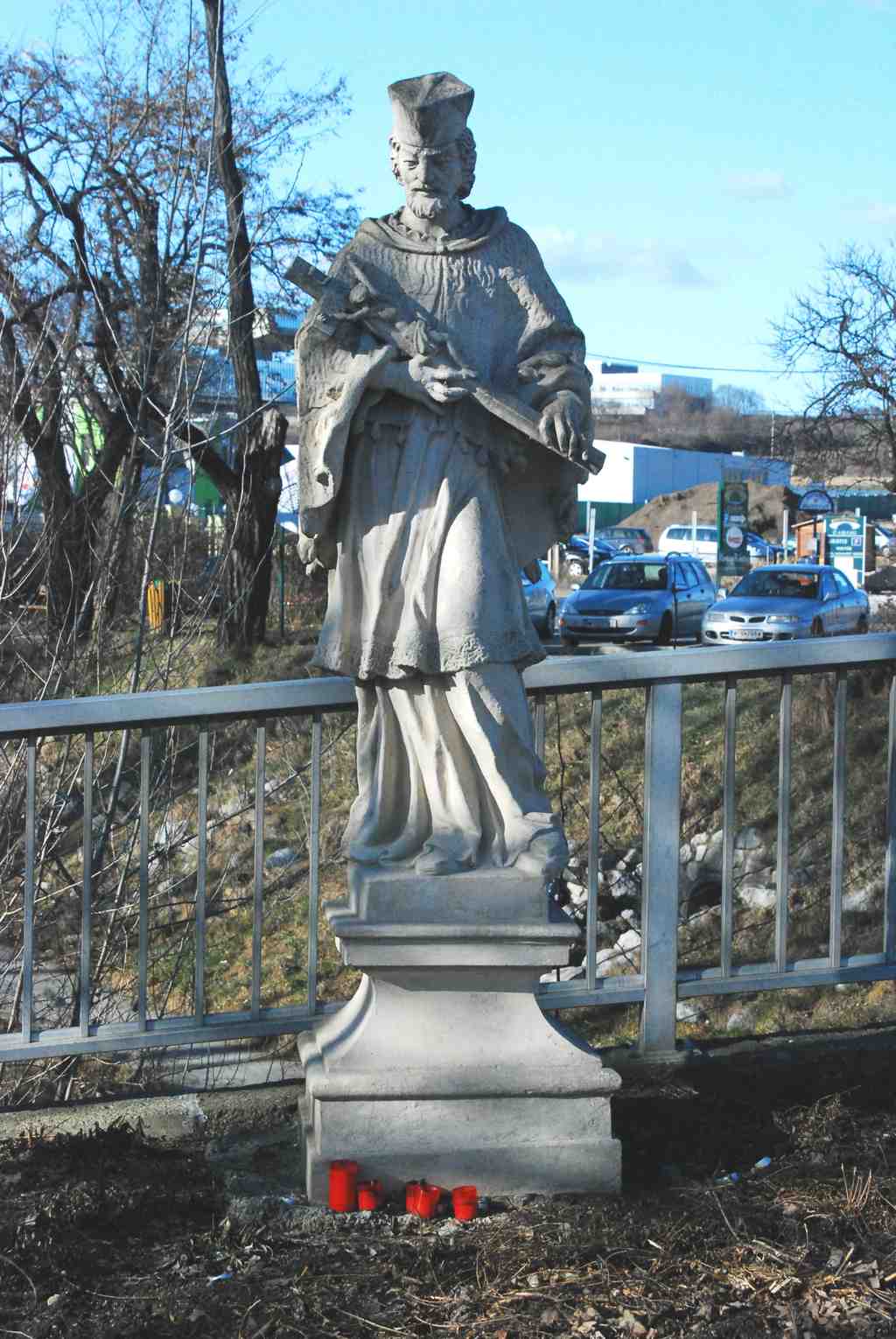
Statue of St. John of NepomukPhoto: GuentherZ, Wikimedia Commons, CC BY 3.0. Cropped & resized. Look for the pale sandstone figure of a robed man standing on a flared pedestal, cradling a crucifix against his chest just behind the metal bridge railing.
For centuries, locals affectionately called him Hansl am Weg, or Johnny on the path. Carved around 1750, Saint John of Nepomuk was placed here to protect travelers and guard the nearby mills against the unpredictable, destructive floods of the Liesingbach creek.
But in 1977, the saint needed a little protection himself. A car crashed directly into the bridge, completely obliterating the baroque monument.
The impact was devastating, shattering the centuries old sandstone into countless jagged pieces. The locals immediately rushed to gather up the rubble, determined to save their beloved statue, but they quickly ran into a rather glaring problem. The head was gone. Despite scouring the crash site and wading through the adjacent creek bed, the saint's head had vanished without a trace. You can imagine the colorful local gossip about exactly where a heavy stone head might have wandered off to in the middle of the night.
But the people of Unterlaa refused to let their local guardian end up in a landfill. Saving the monument became a point of local pride. They hired a sculptor named Kamenjetzky, who painstakingly studied old photographs to carve a brand new head from scratch, fitting it seamlessly back onto the pieced together body. On March 20, 1978, exactly 585 years to the day after the historical Saint John of Nepomuk was martyred by being thrown off a bridge in Prague, the reconstructed statue was returned to this exact spot. It stands today as a testament to pure community resilience, a stubborn refusal to let a piece of heritage become a casualty of bad driving.
Now, let us walk to our final stop, where a hidden trench holds the oldest and darkest secret of the tour, moving on to the Sebastianbildstock in Unterlaa, which is a ten minute walk away. Take a moment to admire the seamless repair work before we move on.
 10
10Sebastianbildstock
Buy tour to unlock all 14 tracksYou are looking at a broad, four-sided white stucco pillar topped with a small saddle roof and a distinct, double-armed metal cross. This architectural type is known as a…Read moreShow less
Open dedicated page →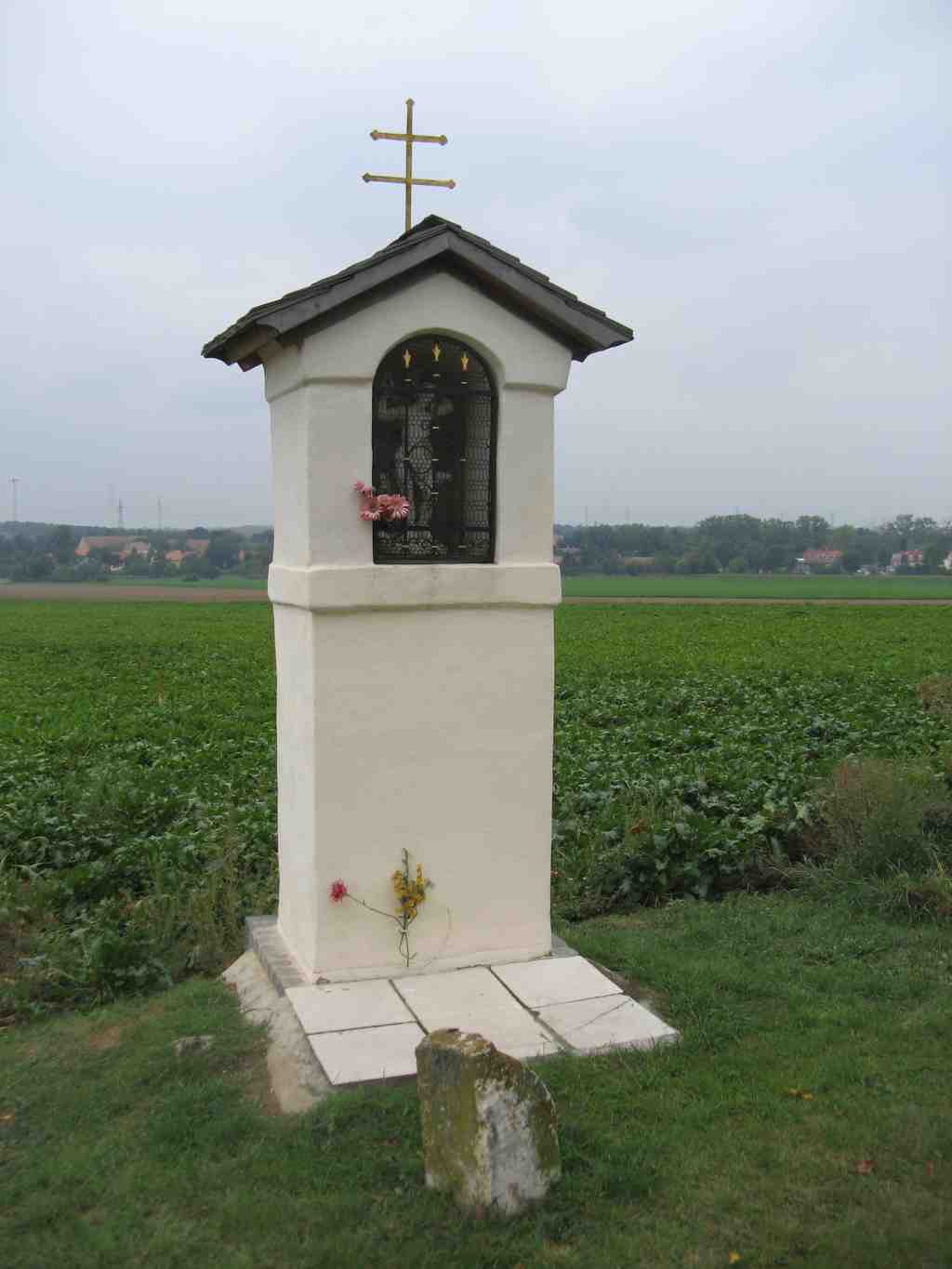
Sebastianbildstock in UnterlaaPhoto: Buchhändler, Wikimedia Commons, CC BY-SA 3.0. Cropped & resized. You are looking at a broad, four-sided white stucco pillar topped with a small saddle roof and a distinct, double-armed metal cross. This architectural type is known as a Breitpfeiler, a broad pillar engineered specifically to withstand the harsh elements of Vienna's rural outskirts and serve as a rigid boundary marker.
Behind the iron grate sits Saint Sebastian, the patron saint invoked against epidemics. Beneath him, you will notice a Maltese cross. That is not just a random decorative choice. The Sovereign Military Order of Malta held exclusive jurisdictional rights over this area starting way back in 1272, dictating both the physical infrastructure and the spiritual landscape of the village for centuries.
But the real weight of this site lies beneath your feet.
You are standing on top of a plague ditch. In 1713, an epidemic hit this area hard. Ten victims were buried right here in a deep hollow path. It was a grim, hasty shortcut for the dead, keeping highly contagious bodies far away from the town center. Local mutual aid societies, like the Brotherhood of Saint Sebastian, provided whatever relief they could when the community was entirely paralyzed by the outbreak.
Since these victims were buried out in unconsecrated fields, this shrine was intentionally built facing the Oberlaa Cemetery, which we visited earlier. It gave those isolated, unclean dead a direct visual and spiritual connection to the holy ground where they otherwise would have rested.
Today, much of the physical evidence of that mass grave has been erased, leveled by the expansion of the nearby railway. Yet this sturdy pillar survived, holding its ground between the living village and the memory of its deepest tragedy.
Standing over what was once a desperate, hollowed out shortcut for the dead, consider how many invisible layers of history you walk across every single day without even knowing.
Frequently asked questions
How do I start the tour?
After purchase, download the AudaTours app and enter your redemption code. The tour will be ready to start immediately - just tap play and follow the GPS-guided route.
Do I need internet during the tour?
No! Download the tour before you start and enjoy it fully offline. Only the chat feature requires internet. We recommend downloading on WiFi to save mobile data.
Is this a guided group tour?
No - this is a self-guided audio tour. You explore independently at your own pace, with audio narration playing through your phone. No tour guide, no group, no schedule.
How long does the tour take?
Most tours take 60–90 minutes to complete, but you control the pace entirely. Pause, skip stops, or take breaks whenever you want.
What if I can't finish the tour today?
No problem! Tours have lifetime access. Pause and resume whenever you like - tomorrow, next week, or next year. Your progress is saved.
What languages are available?
All tours are available in 50+ languages. Select your preferred language when redeeming your code. Note: language cannot be changed after tour generation.
Where do I access the tour after purchase?
Download the free AudaTours app from the App Store or Google Play. Enter your redemption code (sent via email) and the tour will appear in your library, ready to download and start.
If you don't enjoy the tour, we'll refund your purchase. Contact us at [email protected]
Checkout securely with 


%20-%20Kirche%20hl.%20%C3%84gydius.JPG)