
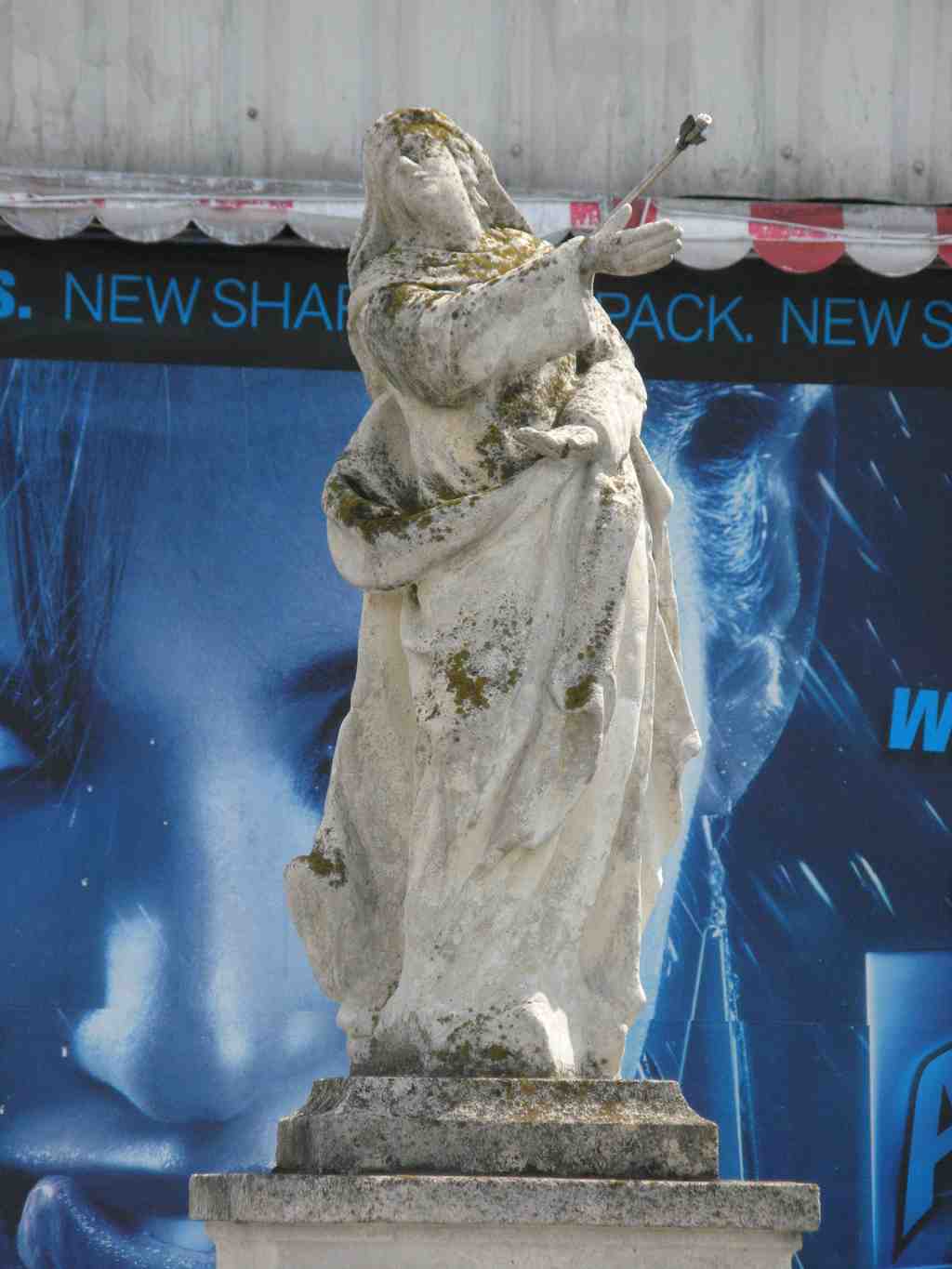
You are looking at a weathered stone statue of a robed woman, set atop a square stone pedestal, holding her left arm slightly extended with a small metal flower. Historically, locals did not call this the White Cross, but rather the Urlauberkreuz. Today, the German word Urlaub means vacation, but centuries ago, it meant a solemn farewell. This precise spot marked the final vantage point where travelers could look back and still see their home village of Oberlaa. Pilgrims heading to Mariazell and soldiers marching off to war would stop exactly where you are standing to share a tearful goodbye with their families, rooting deep, sorrowful memories into this very landscape.
Originally, a white stone cross stood here, built by villagers after an Ottoman siege leveled the town in 1683. By 1809, this statue of the Mater Dolorosa, Our Lady of Sorrows, had taken its place. Remember the village procession that bravely marched past Napoleon's army in 1809? During that same chaotic invasion, a French commander mocked a group of terrified schoolchildren praying near this very spot. The world has a strange habit of interrupting quiet prayers. The French commander mocked the terrified children. To drive his point home, he drew his saber and delivered a violent strike directly to this stone figure.
The locals took it as a dark omen. But fate, it seems, has a long memory. A few weeks later, at the Battle of Aspern, that same arrogant commander suffered a devastating injury in combat. He lost his right hand, the exact hand he had used to strike the sacred statue. In a twist of brutal irony, the dying officer was transported back here to Oberlaa. Instead of seeking revenge, the villagers and the local parish took him in and tended his wounds. He spent his final hours expressing deep remorse to the very people he had mocked, passing away the next day.
The monument was repaired in 1816 by a local magistrate, offering a bit of physical and moral healing for the traumatized community. When it was restored again in 1984, the village officially returned this specific statue to the top of the pillar, moving the original namesake white cross to a museum to preserve its history.
The quiet strength of these people outlasted empires and saber strikes alike. From this corner of tearful farewells, we will walk thirteen minutes to the Ecce homo column, where a very specific and violent tragedy is remembered. If you want to see the original cross, it is safely preserved in the local district museum.


