
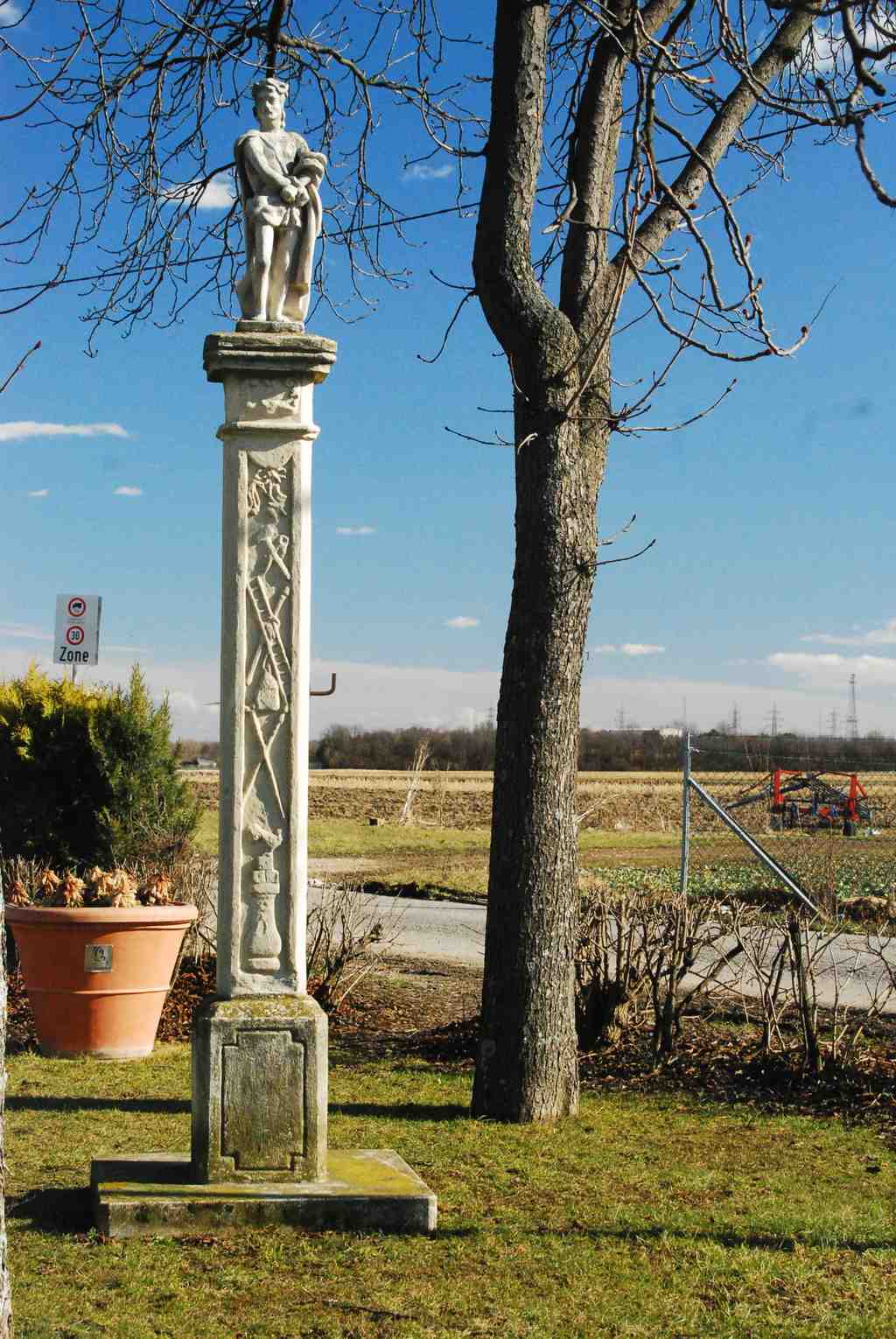
Before you stands the Ecce homo column, a tall, square stone pillar standing on a stepped base, adorned with carved relief objects down its shaft and topped by a solitary statue of Christ.
This monument was born from an act of unspeakable violence. In the mid-nineteenth century, an Oberlaa citizen named Simon Knabl attended early morning mass, only to return home to a horrific discovery. He found his wife lying dead in their house with her throat slit. The sheer brutality of the murder shocked the quiet village, and despite intense investigations, no motive was found, and no killer was ever brought to justice. Knabl commissioned this monument not merely as a memorial, but as a permanent, public demand for divine intervention when earthly law had failed.
Personal tragedy and public memory are deeply intertwined in this stone. Take a moment to look closely at the front of the pillar, and you will see a series of carved objects including a ladder, a hammer, a sponge, and a lance. These reliefs represent the Arma Christi, a Latin term for the instruments of the Passion. Historically, these carvings functioned as a Poor Man's Bible, a visual guide allowing passersby who could not read to meditate on the specifics of suffering without needing a physical text. It is a rare survivor, being one of only three such crosses remaining in Vienna.
If those carvings look a bit soft or clogged, you can blame the local community's well-intentioned but highly destructive maintenance. For decades, residents tried to protect the monument by slathering it in thick layers of white lime paint, a practice known as Übertünchung. When professional restorers finally attempted to strip it back to the original stone in 1970, the buildup was so stubborn that some of the fine details were permanently lost.
There is also a rather peculiar architectural quirk here. You might notice the monument looks a little disjointed. Originally, the statue of Christ at the top, depicting the Man of Sorrows, faced north toward the village center. But when a new house was built directly adjacent to the site, it threatened to block the figure from public view. The pragmatic solution was to simply rotate the top statue to face west toward the road. So, the main pillar points north, while the statue gazes westward.
For over a century and a half, the four horse chestnut trees surrounding the pillar have protected this small island of grief, acting as a historical boundary line between the village's residential core and its agricultural fields. The rock and the roots here stubbornly hold onto the village's darkest memories, standing firm against the encroaching city.
Now, let us trace Simon Knabl's final peaceful steps before his world shattered. Head toward the Oberlaa Parish Church, where he likely prayed that morning, a twelve minute walk from here.


