
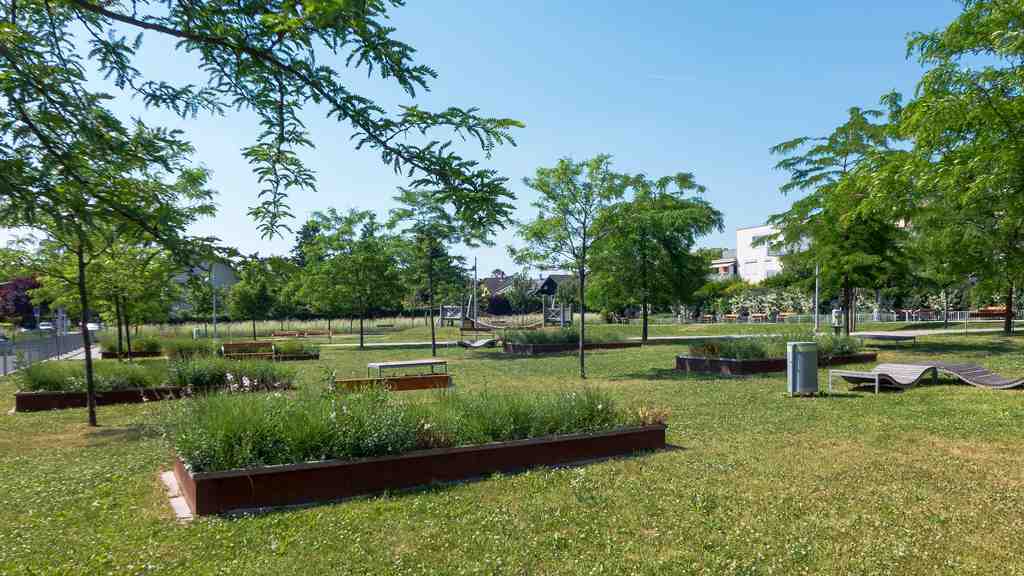
You are looking at Kurt-Tichy-Gasse Park, a wide green lawn dotted with rectangular rusted steel planter boxes and curved wooden lounge chairs set beneath young shade trees. This thirty-five hundred square meter space sits at the heart of the Grundäcker development.
There is a bit of a local identity crisis here. If you recall the Hubert-Blamauer-Park we visited a few minutes ago, that was originally called Grundäckerpark, but when the city renamed it, locals stubbornly transferred the old name to this very spot, thoroughly confusing city maps ever since.
Officially, this park honors Kurt Tichy, a man whose perseverance mirrors the growth of this very neighborhood. Returning as a soldier from the Second World War, his plans to take a master baker exam were severely delayed. Undeterred, in nineteen fifty-two, he and his wife Marianne began selling ice cream from a three-wheeled cart out of a modest basement. Facing post-war shortages of cocoa and butter, Tichy simply adapted, using fresh strawberries to create flavors that dominated the market. His philosophy was delightfully blunt. If there is nothing in it, it tastes like nothing.
In nineteen sixty-seven, he cemented his legacy by inventing the Eismarillenknödel. He engineered a way to replicate the traditional Austrian apricot dumpling using ice cream, wrapping a core of apricot ice cream in a vanilla dough and rolling it in roasted hazelnut splinters. He even patented the process, turning a struggling idea into a global culinary icon and earning himself the title of Ice Cream King of Favoriten.
The community here shares that same persistent drive, recently gathering hundreds of signatures to demand a direct walking path to the local transit station, ensuring their neighborhood stays connected. As we leave these modern triumphs behind, we must look toward the older, quieter histories carved into this land. Our next stop, the White Cross in Oberlaa, is just a seven-minute walk away, where a much more somber tradition awaits.


