
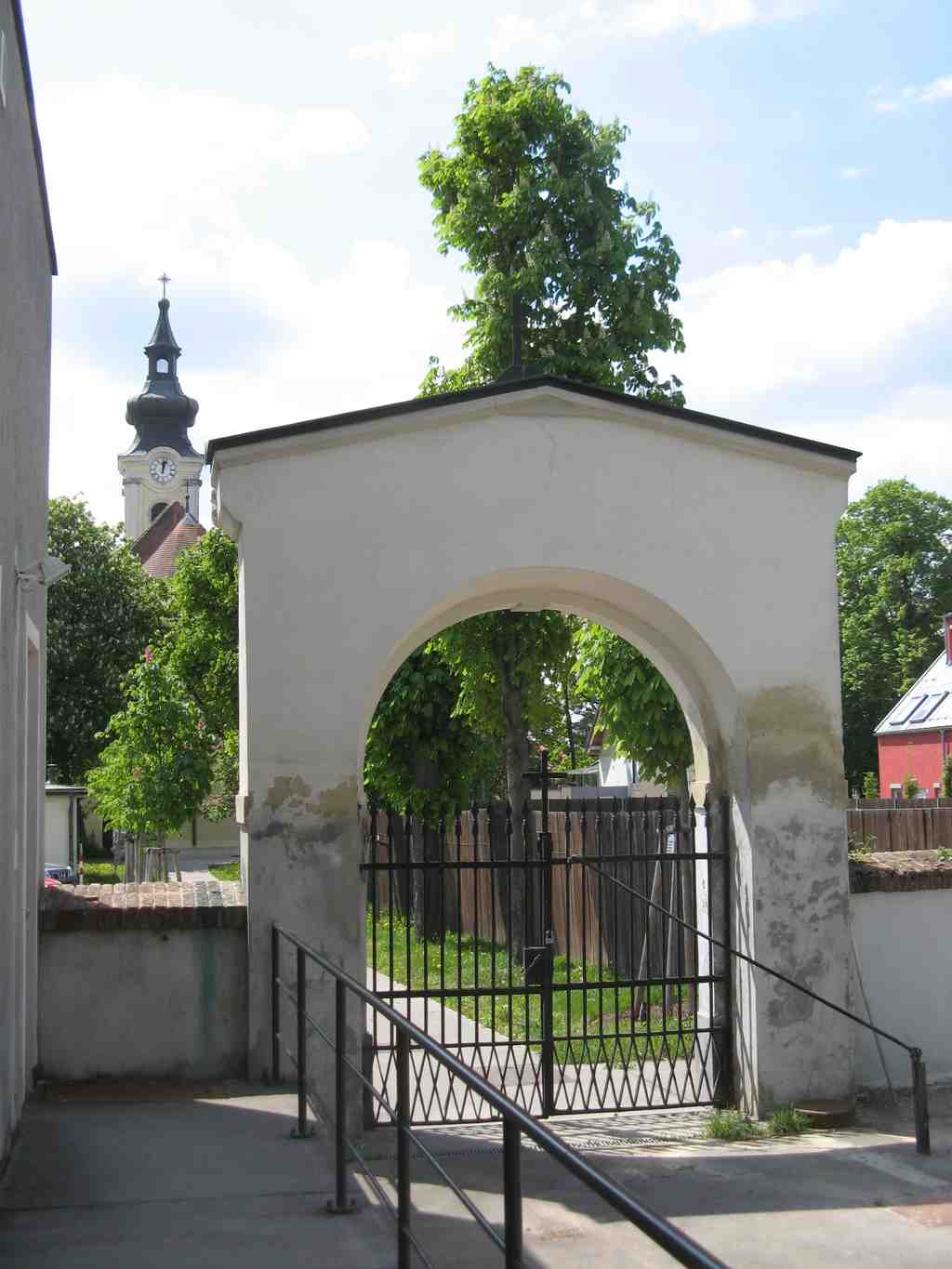
Look for the white stucco archway housing a black wrought-iron gate, topped with a simple dark cross mounted on its roofline. This is the entrance to the Oberlaa Cemetery.
People have been burying their dead in Oberlaa since at least the year 1267. For centuries, the graveyard was just a modest plot of land wrapped around the local parish church. But a community can only endure so much tragedy before its physical geography has to change to accommodate the toll.
In 1831, a devastating cholera epidemic swept through this area, suddenly overwhelming the small churchyard and forcing the rapid, desperate expansion of these burial grounds. Just four years later, a severe outbreak of dysentery claimed another 118 lives in rapid succession. The community was forced into a grim cycle of continually purchasing surrounding farmland just to keep up with the staggering mortality rates. What you see today is the physical footprint of a village that had to drastically stretch its borders simply to hold its dead.
The overwhelming waves of disease shaped this space. And yet, this cemetery could have been vastly larger. In 1869, the city of Vienna was hunting for land to build a massive central cemetery. Oberlaa eagerly offered its fields. The city declined. At the time, this region was a massive hub for brick production. City planners were terrified that somber, horse-drawn funeral processions would constantly get stuck in traffic behind heavy, slow-moving wagons hauling bricks. Because of a hypothetical traffic jam, the city built its famous Central Cemetery elsewhere, and Oberlaa kept this space for itself.
As you look through the grounds, you will find structures that tell the story of the town social hierarchy. One prominent example is the Zwickelsdorfer mausoleum, built in 1855. A mausoleum is a large, freestanding monument built to enclose a burial chamber, and this one was constructed by a family of wealthy local landowners to ensure their high status remained visibly obvious long after they stopped breathing.
The modern residents of this cemetery are a bit more eclectic. You will find the grave of Karl Wrba, a former streetcar conductor who led the massive post-war reconstruction of this district. Not far from him lies Peter Rauhofer. He was a pioneer of global house music who won a Grammy in the year 2000 for his remixes. He spent his career spinning records in legendary New York dance clubs, yet he chose this quiet, historic village graveyard as his final resting place.
A word of warning if you wander too far into the newer, sprawling sections of the cemetery. The grounds have become so expansive that the administration issues a formal caution. It seems visitors frequently lose track of time in the sprawling avenues of stones, only to walk back and find the massive main gates permanently locked for the night. When that happens, there is no secret exit. The only solution is to call the local police, who keep a dedicated set of keys specifically to rescue involuntary overnight guests from the graveyard.
We are going to move from this vast resting place of the dead to a much smaller structure, a chapel originally built to ward off dark local folklore. It is about a six minute walk to our next stop, the Pietà Chapel Oberlaa.


