
Tirana Audio Tour: Echoes of Art, Faith, and Revolution
Concrete and cheers collide in Tirana, where Qemal Stafa Stadium rises like a pressure valve beside a city built on secrets. This self guided audio tour threads through streets and monuments, from the Pyramid of Tirana to the Archdiocese of Tiranë Durrës, revealing political battles, rebellions, scandals, and forgotten moments most visitors walk past without noticing. What crisis made crowds turn into a force that could not be contained near Qemal Stafa Stadium? What hidden purpose lingered in the shadows of the Pyramid after the cameras moved on? Why does a single detail inside the Archdiocese of Tiranë Durrës hint at a story that was never meant to be public? Move from wide boulevards to tight corners, from loud history to quiet mystery, and feel Tirana shift underfoot as its past snaps into focus. Press play and chase the pulse that still beats in the concrete.
Tour preview
About this tour
- scheduleDuration 100–120 minsGo at your own pace
- straighten4.4 km walking routeFollow the guided path
- location_on
- wifi_offWorks offlineDownload once, use anywhere
- all_inclusiveLifetime accessReplay anytime, forever
- location_onStarts at University of Arts, Tirana
Stops on this tour
lock_open 3 free previews · 10 unlock with purchase
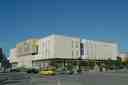
Take a moment to look at the wide, rectangular structure before you, clad in stark white marble and marked by a deeply recessed entrance with striking, square columns. This is the…Read moreShow less
Open dedicated page →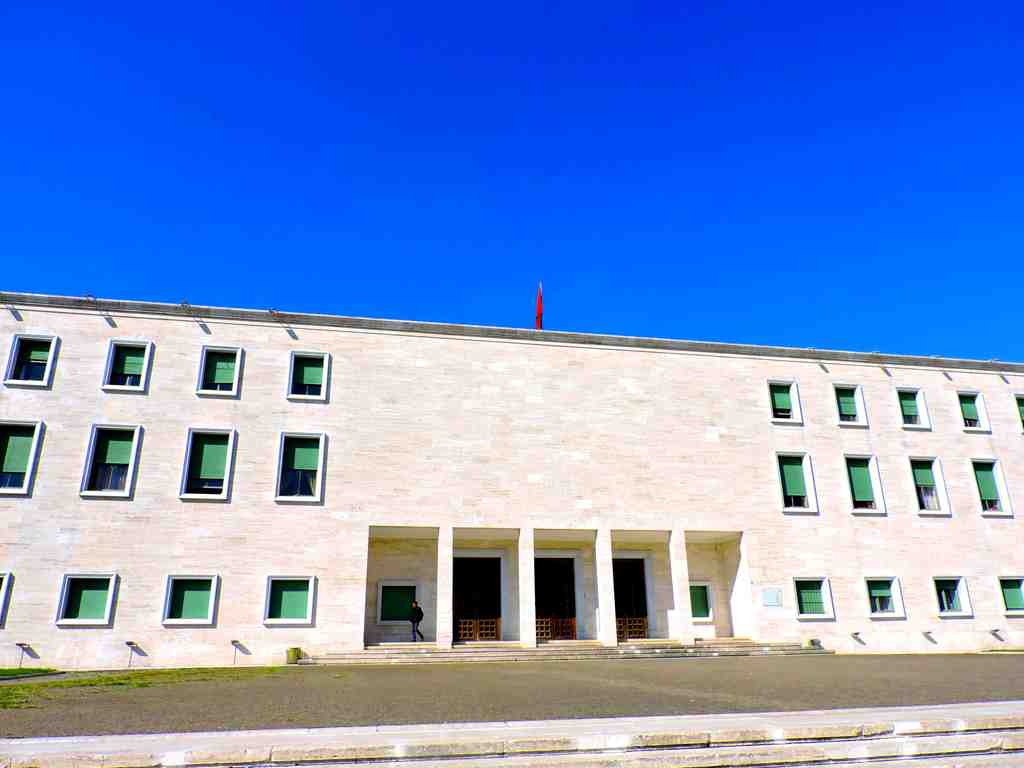
University of Arts, TiranaPhoto: InaMyrtollari, Wikimedia Commons, CC BY-SA 4.0. Cropped & resized. Take a moment to look at the wide, rectangular structure before you, clad in stark white marble and marked by a deeply recessed entrance with striking, square columns. This is the University of Arts.
We are walking through a city where history never rests, where each generation seems to bury the foundations of the past to forcefully plant the seeds of something new. This building is a perfect example. It was designed by Italian architects between 1939 and 1942 as part of a fascist monumental complex. Its rationalist architectural style, with those severe, uncompromising geometric lines, was a calculated tool of state messaging. The regime used this imposing, unyielding marble to project absolute authority and demand conformity from anyone who approached. If you glance at your screen, you can see a clean, wide view of this historic exterior.
The end of the Second World War did not bring freedom to these classrooms. Decades later, communist dictator Enver Hoxha launched a brutal crackdown on anything he considered a liberal manifestation, unleashing absolute terror on the arts in 1973. His harsh censorship meant that students and professors lived under the constant threat of surveillance and ruin. A prominent theater director was stripped of his title and banished to rural manual labor, while a young painting student was arrested and tortured simply because he refused to betray his classmates.
Yet, the human spirit is remarkably resilient. By 1990, this very academy became ground zero for the anti-government resistance. Brave students and faculty organized massive protests and a historic hunger strike right here, actions that directly pressured the crumbling regime to concede to multi-party elections.
Art, which had been so tightly controlled, became a fierce weapon of defiance. Future Albanian Prime Minister Edi Rama was an art professor here during that turbulent time, using the campus to host open meetings criticizing the political establishment. His rebellion made him a target, and he was severely beaten outside his home by unknown assailants before eventually surviving the attack and pivoting to lead the nation's government.
The creative fire still burns inside today, with the doors generally open to aspiring artists Monday through Friday from eight in the morning until ten at night, resting only for the weekend. We are now going to walk about eight minutes to our next stop, the site of the Qemal Stafa Stadium, where we will discover how yet another grand design attempted to mold the identity of this ever-changing city.
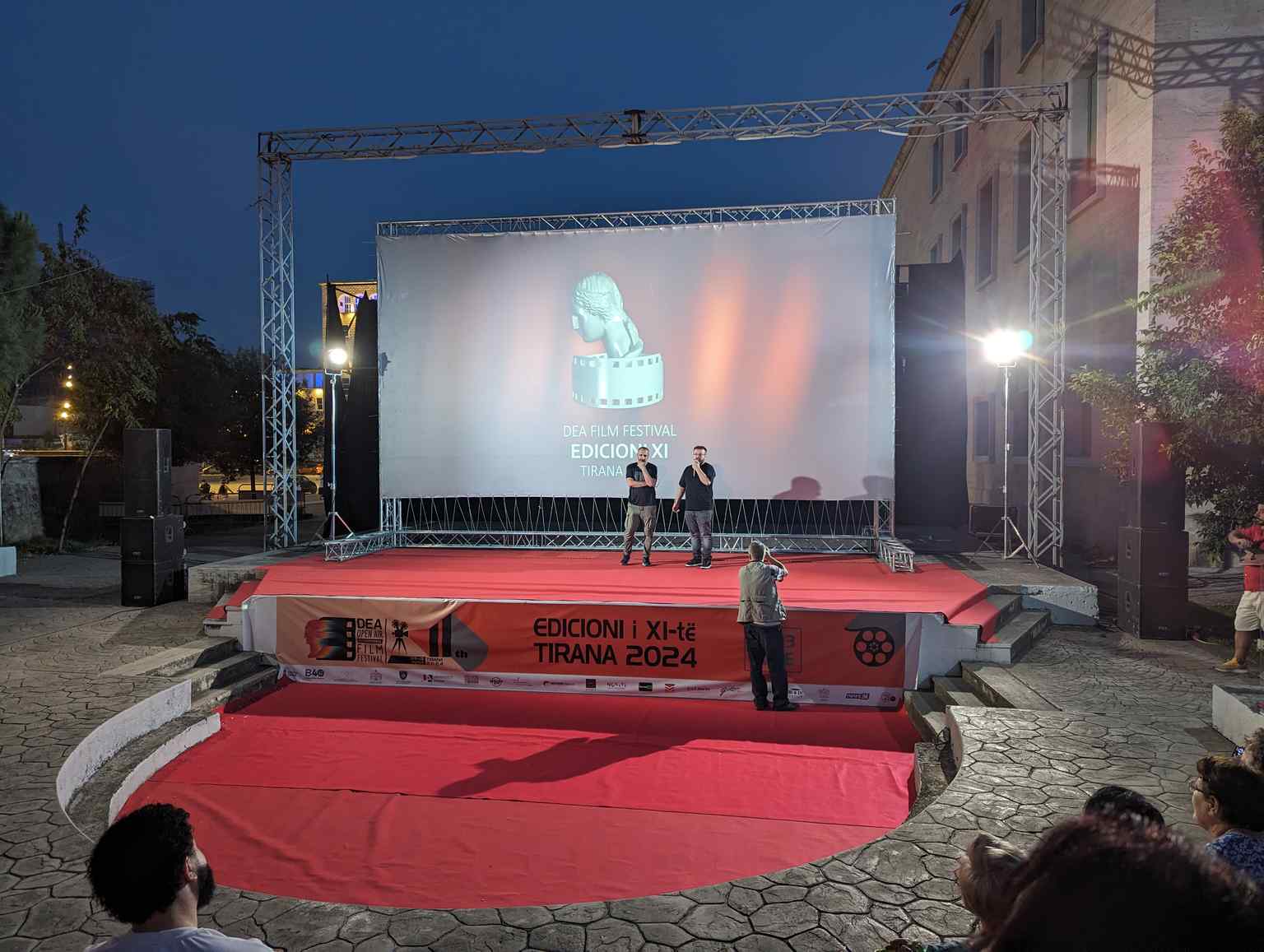
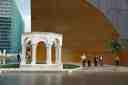
An open-air film festival is held in the University of Arts amphitheater, showcasing contemporary student and faculty activity in 2024.Photo: Ivan Ruggiero I'd appreciate if you could mail me ([email protected]) if you want to use this picture out of the Wikimedia project scope. Please attribute as: Ivan Ruggiero (Wikimedia), Wikimedia Commons, CC BY-SA 4.0. Cropped & resized. Look to your left and you will spot the sweeping elliptical bowl of the stadium, defined by its massive concrete tiered seating and the towering metal light masts rising proudly…Read moreShow less
Open dedicated page →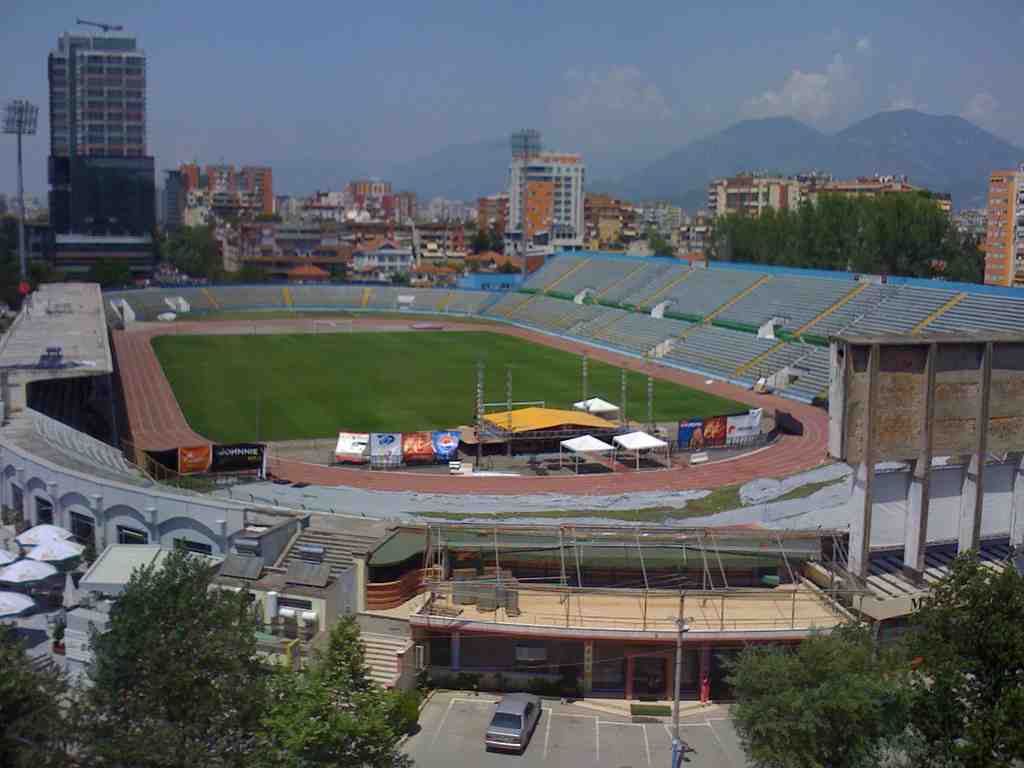
Qemal Stafa StadiumPhoto: Richardsut, Wikimedia Commons, CC BY-SA 3.0. Cropped & resized. Look to your left and you will spot the sweeping elliptical bowl of the stadium, defined by its massive concrete tiered seating and the towering metal light masts rising proudly above the rim. This patch of earth perfectly captures a rhythm you will feel everywhere here, a constant desire to erase the grand visions of yesterday to pour the shiny foundations of tomorrow.
The story of this ground begins in 1939 with an ambitious young Italian fascist architect named Gherardo Bosio. He designed the original structure in a deeply idealized, monumental Olympic shape, intending for every single inch of the massive arena to be clad in gleaming white marble to project absolute imperial power. But history rarely respects architectural pride. Construction was interrupted when Italy surrendered during the Second World War, and soon occupying German forces were using the half-finished concrete shell simply to park their military vehicles.
When the war ended, the community took their city back. Four hundred workers and over a hundred daily volunteers finished the monumental task with their own hands, though resources were so scarce they only managed to install that luxurious marble cladding on a single stand. They inaugurated it in 1946, naming it after Qemal Stafa, a beloved local hero who died in the war. That same year, the grass here absorbed the joy of a newly liberated people when Albania won the Balkan Cup, defeating teams from much larger nations.
But a city is a living thing. Very quickly, the energetic and growing Youth of Tirana completely outpaced the old stadium's modest capacity of fifteen thousand. The city was expanding, and its passionate younger generations simply needed far more space to gather and roar for their teams. To meet this demand, the stadium was heavily modified and expanded in 1974 for the National Spartakiad, a massive, state-sponsored athletic pageant modeled after the Olympics, meant to showcase communist strength and unity.
For years, this raw concrete oval was an absolute fortress. In the early two thousands, the stadium developed a reputation for holding a curse over visiting teams. For an incredible stretch of three years, the Albanian national soccer team went completely undefeated at home. They trapped illustrious, world-class teams like Greece, who had just won the European championship, along with Sweden and Bulgaria, in an incredibly intimidating arena where the deafening cheers of the locals seemed to magically block the visitors from winning.
But even beloved fortresses eventually fall to the wrecking ball. In 2016, the historic Qemal Stafa Stadium was entirely demolished. The classic athletic track and those old concrete tiers were wiped away to make room for a brand new, sixty million Euro modern arena. It is a stunning, state-of-the-art facility shared by the government and the football association, built right on top of the old footprint. Yet again, the city sacrificed its physical past to build a bolder future.
Whenever you are ready, we will take a twelve-minute walk toward our next destination, the Pyramid of Tirana, which stands as perhaps the city's ultimate expression of architectural hubris. Oh, and you can wander the public grounds around this arena twenty-four hours a day, any day of the week.
Show 10 more stopsShow fewer stopsexpand_moreexpand_less
The very soil beneath your feet holds a powerful story of cultural resilience, born from the hands of everyday citizens. Back in nineteen fifty, it was the young people of Tirana…Read moreShow less
Open dedicated page →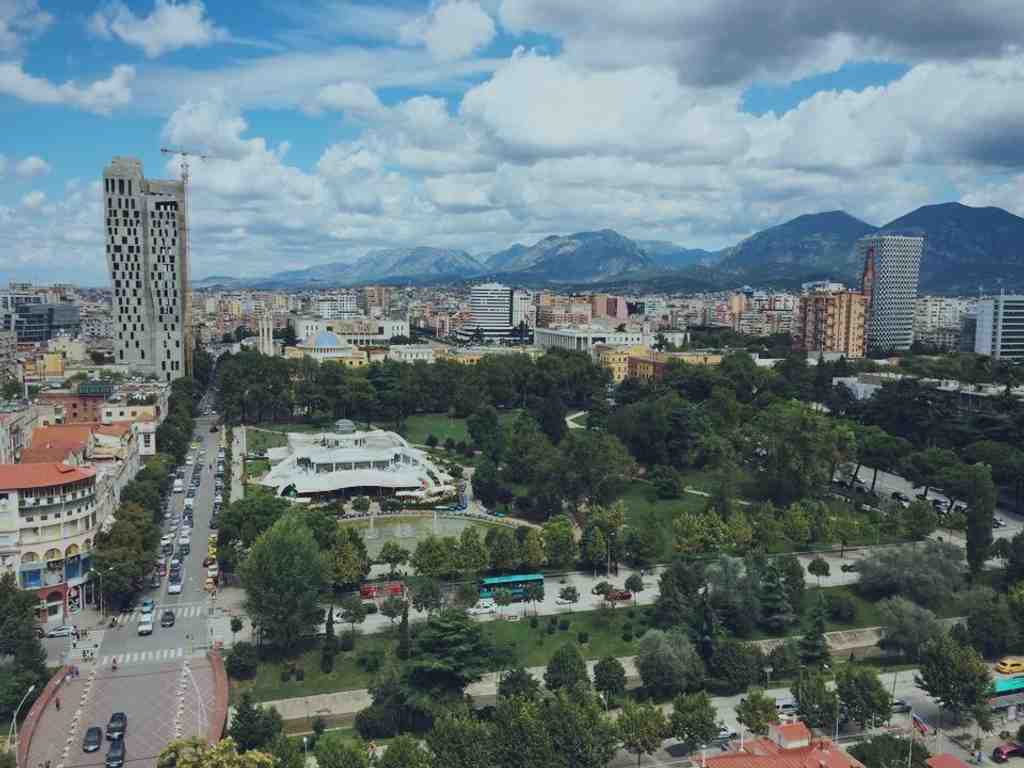
Rinia ParkPhoto: Kj1595, Wikimedia Commons, CC BY-SA 4.0. Cropped & resized. Welcome to Rinia Park, where you can easily spot the central Taivani complex, a striking white, terraced building that spreads out almost like a mechanical spider among the green trees and curved water fountains.
The very soil beneath your feet holds a powerful story of cultural resilience, born from the hands of everyday citizens. Back in nineteen fifty, it was the young people of Tirana who volunteered their sweat and strength to plant these trees and carve out a verdant sanctuary. They built their own joy and carved out a peaceful haven right amidst the heavy, watchful demands of a harsh communist regime, earning this place the official name of Youth Park.
But locals rarely call it Youth Park. Instead, they call it Taiwan, inspired by that unique central building. The origins of this nickname are wonderfully amusing. One popular rumor claims that in nineteen seventy eight, Albania's communist regime abruptly broke off diplomatic relations with China. In a remarkably petty gesture of international defiance, the state supposedly recognized the sovereignty of Taiwan and quietly named this new park structure in their honor. Another theory, championed by local artists of the era, suggests it was just simple geography. Whenever the area flooded, the park would fill with water, leaving the central white building totally isolated, looking exactly like the island of Taiwan.
As the decades passed, this beloved space suffered a dark transformation. When communism collapsed in nineteen ninety one, the city's green spaces were suddenly overrun. Over a hundred illegal structures sprouted up across the grass. What started as small kiosks quickly ballooned into makeshift concrete buildings towering two to three stories high. The park's tranquil nature was entirely swallowed up, turning into a notorious, concrete-choked hangout for the kingpins of Tirana's underworld.
Yet, a city's spirit is hard to keep buried forever. In the year two thousand, a massive cleanup campaign was launched by the city's mayor, former art professor Edi Rama. He personally ordered the bulldozing of the illegal structures. Over one hundred and thirty buildings were razed to the ground, and forty five thousand cubic meters of concrete and waste were hauled away. The youth of Tirana's original vision was honored as the space was beautifully replanted, breathing life back into the city.
As a true public space, this restored sanctuary remains open twenty four hours a day, all week long, welcoming anyone who needs a peaceful escape. Let us continue our walk to the Resurrection Cathedral, just a four minute stroll away, where we will witness another grand testament to a community reclaiming its light.
On your left stands the Resurrection Cathedral, a massive circular sanctuary built of smooth pale stone beneath a sweeping blue dome, accompanied by a soaring, freestanding bell…Read moreShow less
Open dedicated page →On your left stands the Resurrection Cathedral, a massive circular sanctuary built of smooth pale stone beneath a sweeping blue dome, accompanied by a soaring, freestanding bell tower.
Take a moment to look at that unique tower, reaching forty six meters into the sky. It was actually designed by Archbishop Anastasios himself, composed of four towering pillars meant to look like Paschal candles. In the Orthodox tradition, these tall ceremonial candles represent the light of the four Evangelists proclaiming resurrection. What a powerful metaphor for a country that spent decades actively tearing down places of faith.
This grand cathedral officially opened in two thousand twelve, marking the twentieth anniversary of the revival of the Albanian Orthodox Church. It stands as a profound testament to cultural resilience. Faith here was once silenced, but it was never truly extinguished. Now, its song rings out from sixteen bronze bells housed high up in that winding staircase.
If you check your screen, you will see that the space beneath our feet is just as vibrant as the sanctuary above. Two underground levels house an amphitheater that seats hundreds, serving as a dynamic center where lectures and theater thrive.
A vibrant life has poured back into these spaces, proving that what is broken down can be built anew. Let us continue our walk now toward the National Historical Museum, just six minutes away, to see exactly how Albania curates the complex chapters of its past. By the way, the cathedral welcomes visitors daily from nine to two, and four to seven.
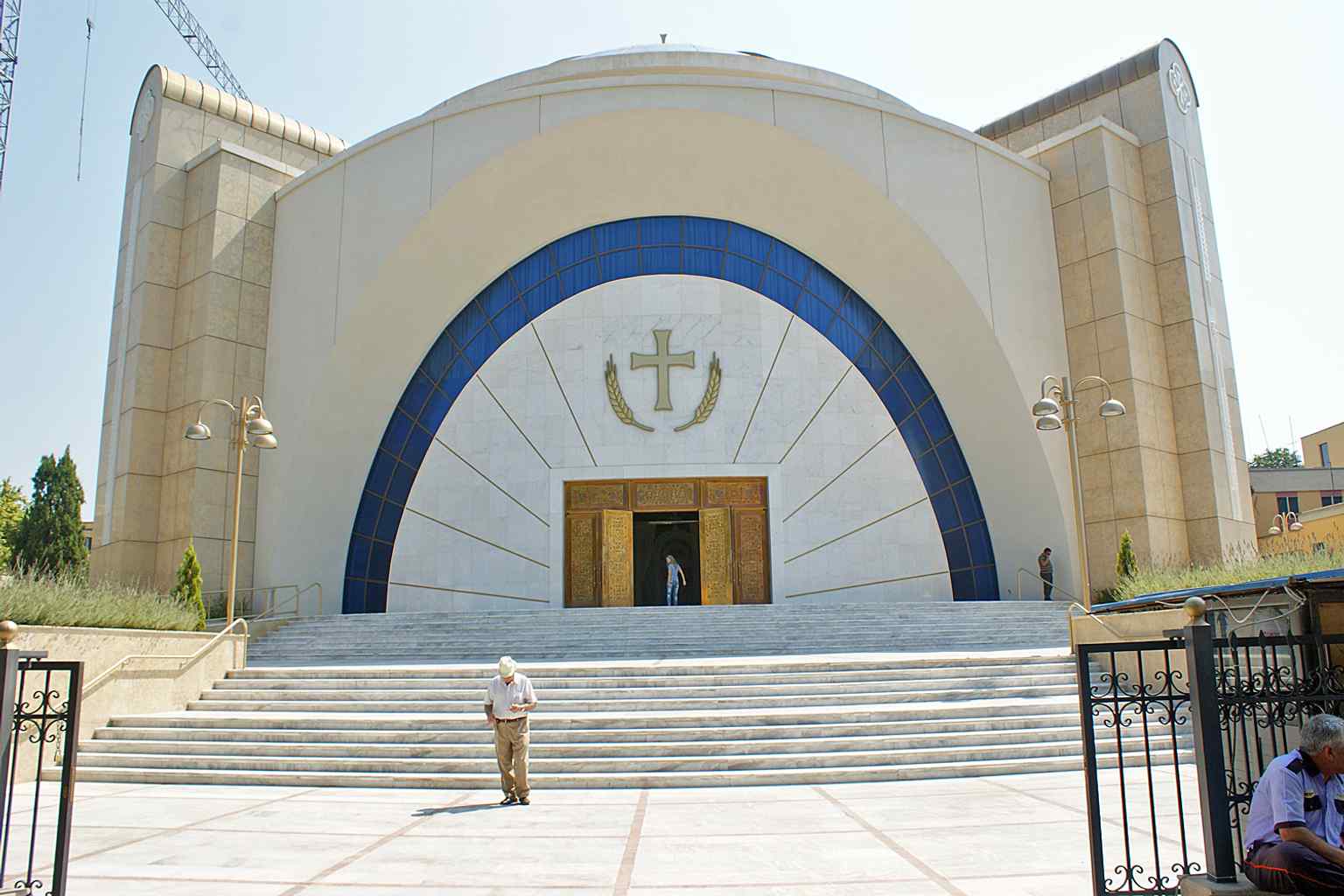
This grand exterior shot showcases the Resurrection of Christ Cathedral, one of the largest Eastern Orthodox churches in the Balkans, which officially opened in 2012.Photo: Albinfo, Wikimedia Commons, CC0. Cropped & resized. 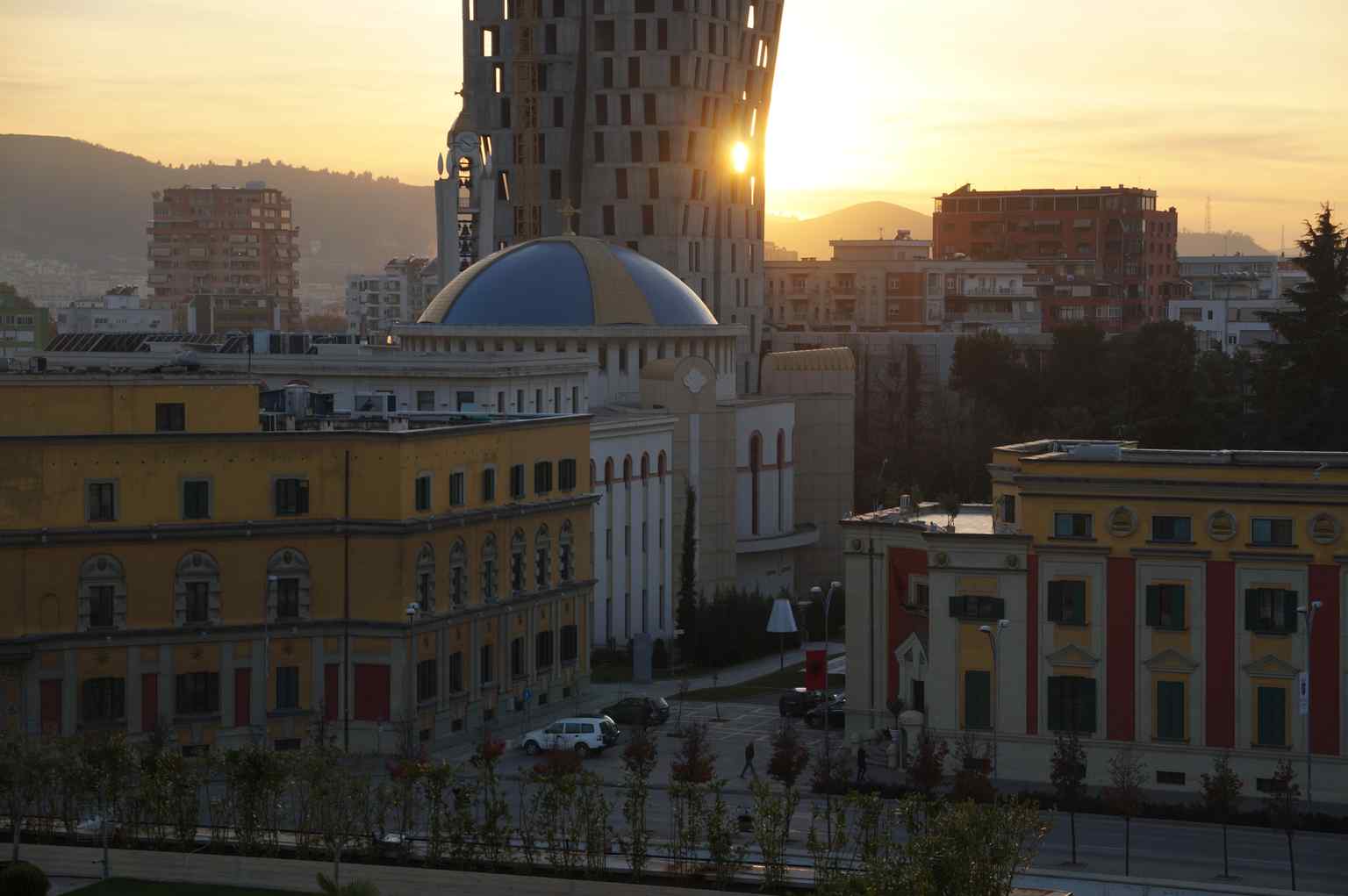
The Resurrection Cathedral stands prominently against the Tirana skyline at sunset, with its dome reaching 32.2 meters and bell tower 46 meters high.Photo: Albinfo, Wikimedia Commons, CC BY-SA 4.0. Cropped & resized. Look to your left, where the National Historical Museum stands as a massive rectangular block of pale smooth stone, unmistakably marked by the vibrant, monumental mosaic…Read moreShow less
Open dedicated page →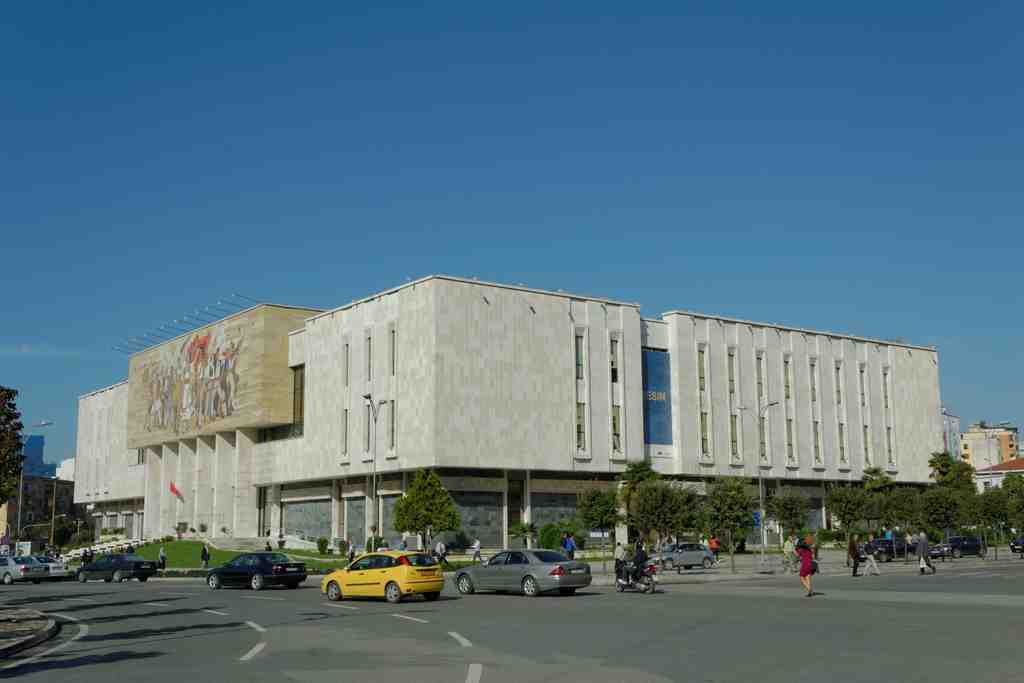
National Historical MuseumPhoto: Dritan Mardodaj, Wikimedia Commons, CC BY-SA 4.0. Cropped & resized. Look to your left, where the National Historical Museum stands as a massive rectangular block of pale smooth stone, unmistakably marked by the vibrant, monumental mosaic projecting outward over its main entrance.
It is quite a sight, isn't it. This immense structure, inaugurated on October 28th, 1981, is the largest museum in Albania. It is a formidable vault, holding around four thousand seven hundred fifty artifacts spanning from the fourth millennium BC to the late twentieth century. The grand mosaic crowning the facade tells a very specific story of victorious Albanians marching forward through time. If you look at your screen, you can see how this iconic piece was beautifully revived during a recent restoration. It is a prime example of socialist realism, which was an artistic style favored by communist regimes to glorify the state and the working class.
But while the exterior reflects the fierce, rigid political shifts of the twentieth century, the interior quietly guards the deep, ancient layers of this land. These pieces have endured the relentless turning over of empires. Think about how delicate human memory is, and yet, how incredibly resilient. For example, deep inside the Antiquity Pavilion rests the stunning Mesaplik Mosaic. It was unearthed from the soil in 1979 by the archaeologist Damian Komata. Imagine his profound awe, brushing away the damp earth to reveal a sprawling canvas of small, colorful stone cubes measuring over two meters wide.
The stones form elaborate zoomorphic shapes-patterns based on animal forms. But the absolute focal point of the mosaic is a human figure. It is a man depicted in profile, wearing a fascinating cap with a sort of antenna and a double ribbon. And, most wonderfully, he is smiling. Beside his face is a column of ancient text reading Aparkeas. Scholars believe this was the name of the ktitor, which is a historical term for the wealthy patron who funded the artwork's creation.
That simple stone smile has outlasted the Romans, the Byzantines, the Ottomans, and the harsh dictatorships of recent memory. It is a quiet, powerful reminder that while sweeping ideologies rise and attempt to overwrite the past, the true, enduring spirit of a culture often remains hidden just beneath the surface, waiting patiently to be brought back into the light.
We are very lucky to have institutions that guard these fragile pieces of the human puzzle. However, not every historical treasure in this city was so carefully protected. Sometimes, the drive to build a new society meant tearing down the old one completely. If you look ahead, our next stop is the Palace of Culture, just a three minute walk away. It stands on ground where history was actively and intentionally destroyed to make way for the future. Let us walk over there now and uncover what was lost.
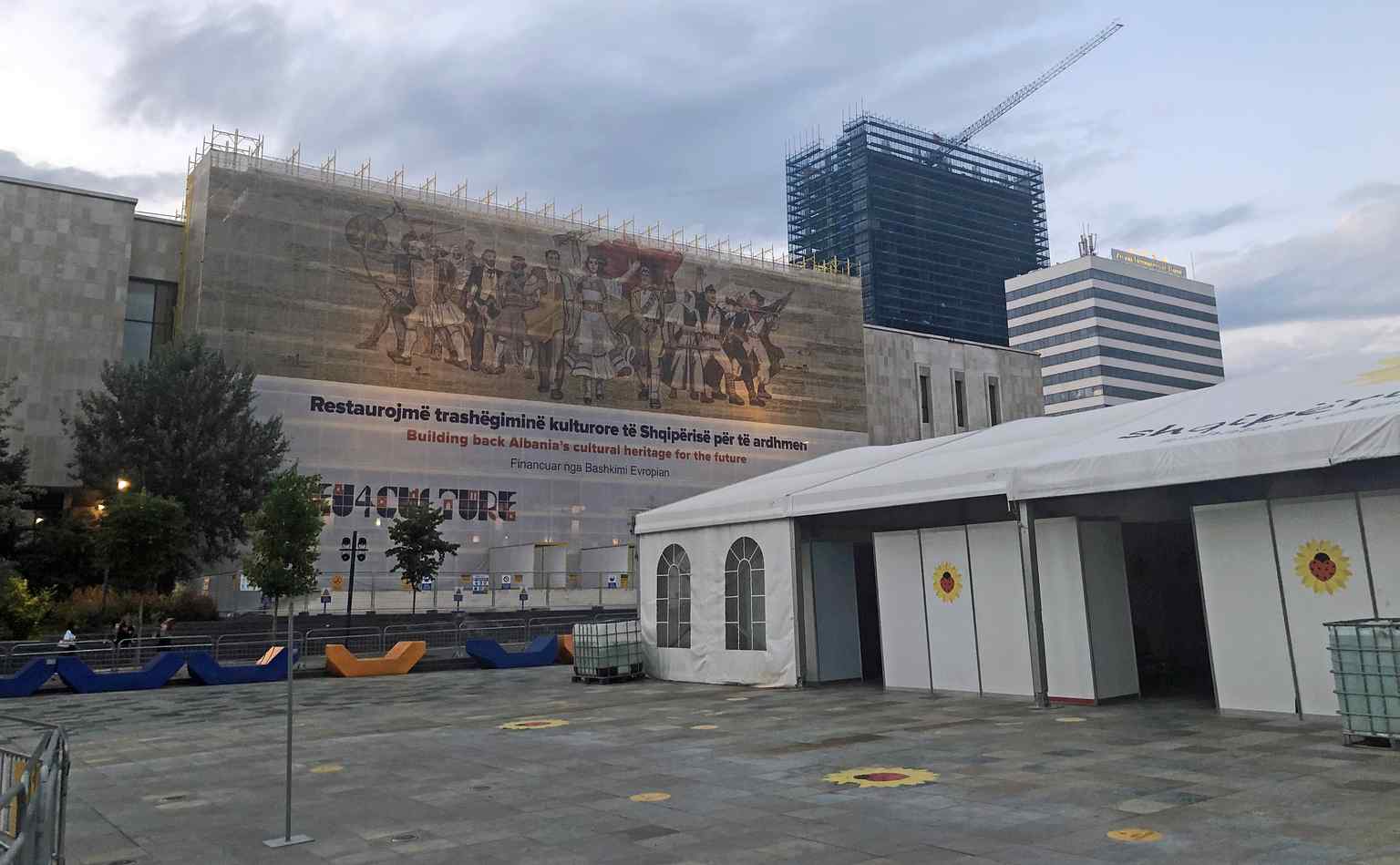
The grand mosaic on the National Historical Museum's facade, seen here under restoration, depicts key moments from Albania's history.Photo: Albinfo, Wikimedia Commons, CC BY-SA 4.0. Cropped & resized. 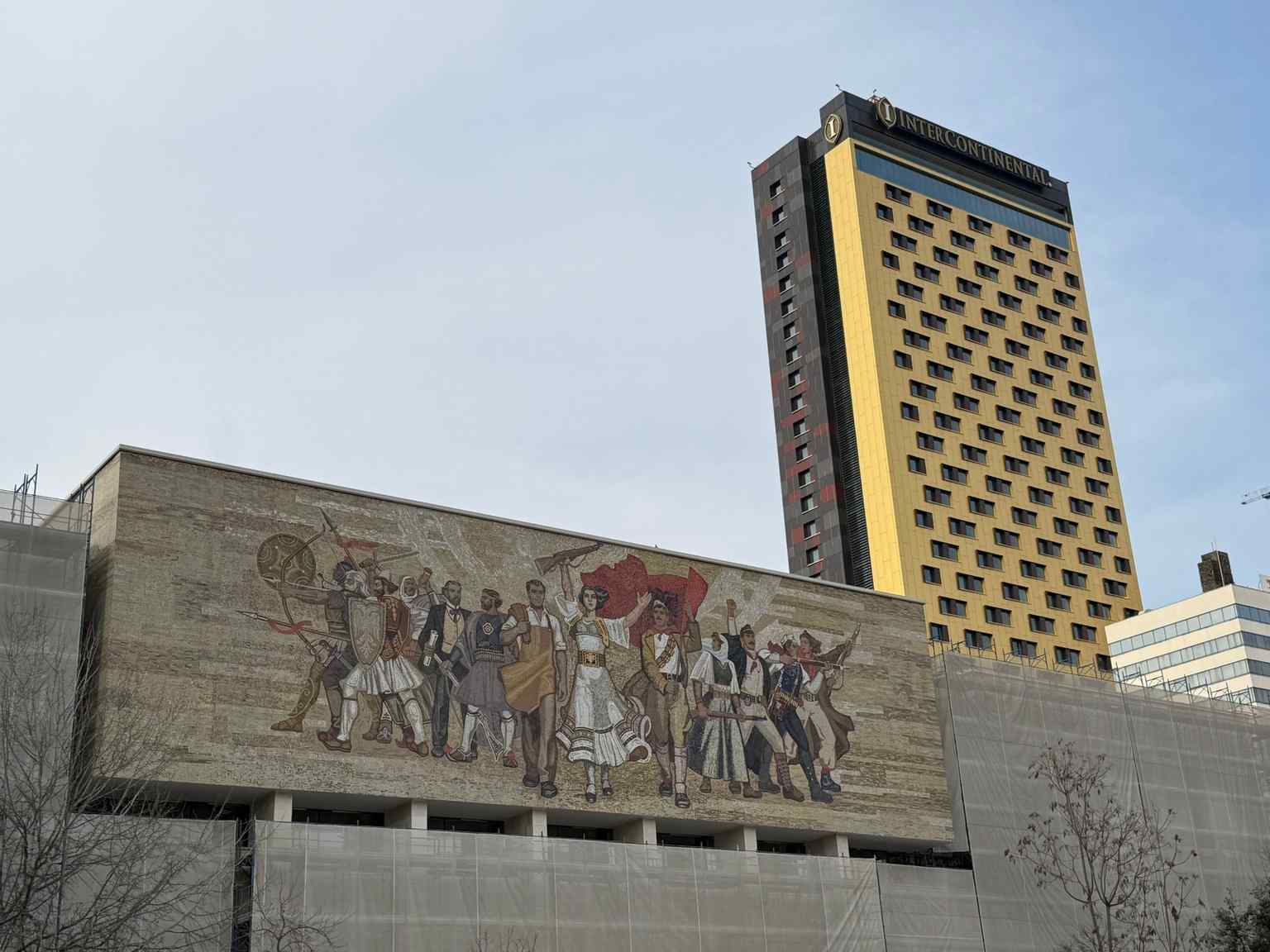
This view of Skanderbeg Square highlights the National Historical Museum, the largest museum institution in Albania, inaugurated in 1981.Photo: Yastay, Wikimedia Commons, CC BY 4.0. Cropped & resized. Look to your right at the massive rectangular building defined by a long colonnade of pale stone pillars and the word OPERA mounted above the entrance. This Palace of Culture,…Read moreShow less
Open dedicated page →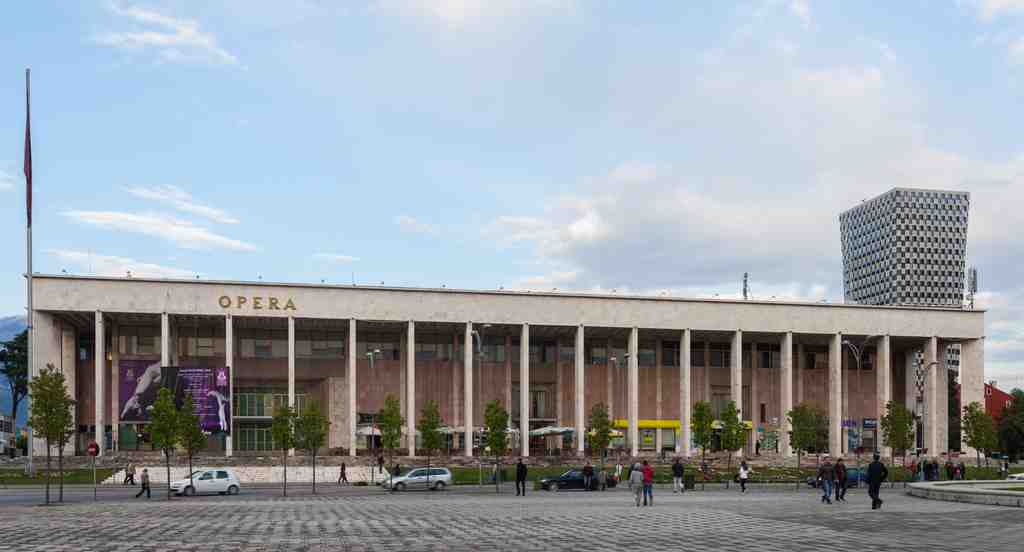
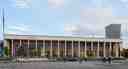
Palace of Culture of TiranaPhoto: Diego Delso, Wikimedia Commons, CC BY-SA 3.0. Cropped & resized. Look to your right at the massive rectangular building defined by a long colonnade of pale stone pillars and the word OPERA mounted above the entrance. This Palace of Culture, completed in 1963, stands as a heavy monument to the aggressive Soviet-backed construction that deliberately wiped out the past. In 1959, Soviet leader Nikita Khrushchev laid the first stone. To build this ideological fortress, the state annihilated the vibrant Old Bazaar that once thrived exactly where you are standing. Ruthlessly demolished alongside the lively merchant stalls was the nineteenth century Mahmud Muhsin Bey Stërmasi mosque. You can visualize this erased area on your screen. That mosque had a delicate tiled roof and a striking minaret with a sherefe, the traditional balcony from which the call to prayer was sung. Under the strict anti-religious regime, Tirana's historic heart was literally paved over. Check the before and after picture on your app to see how the busy roadway in front of the palace recently transformed into a pedestrian plaza. Though closed on Sundays, the venues inside remain open until eleven PM otherwise. Now, let us step out fully into Skanderbeg Square.
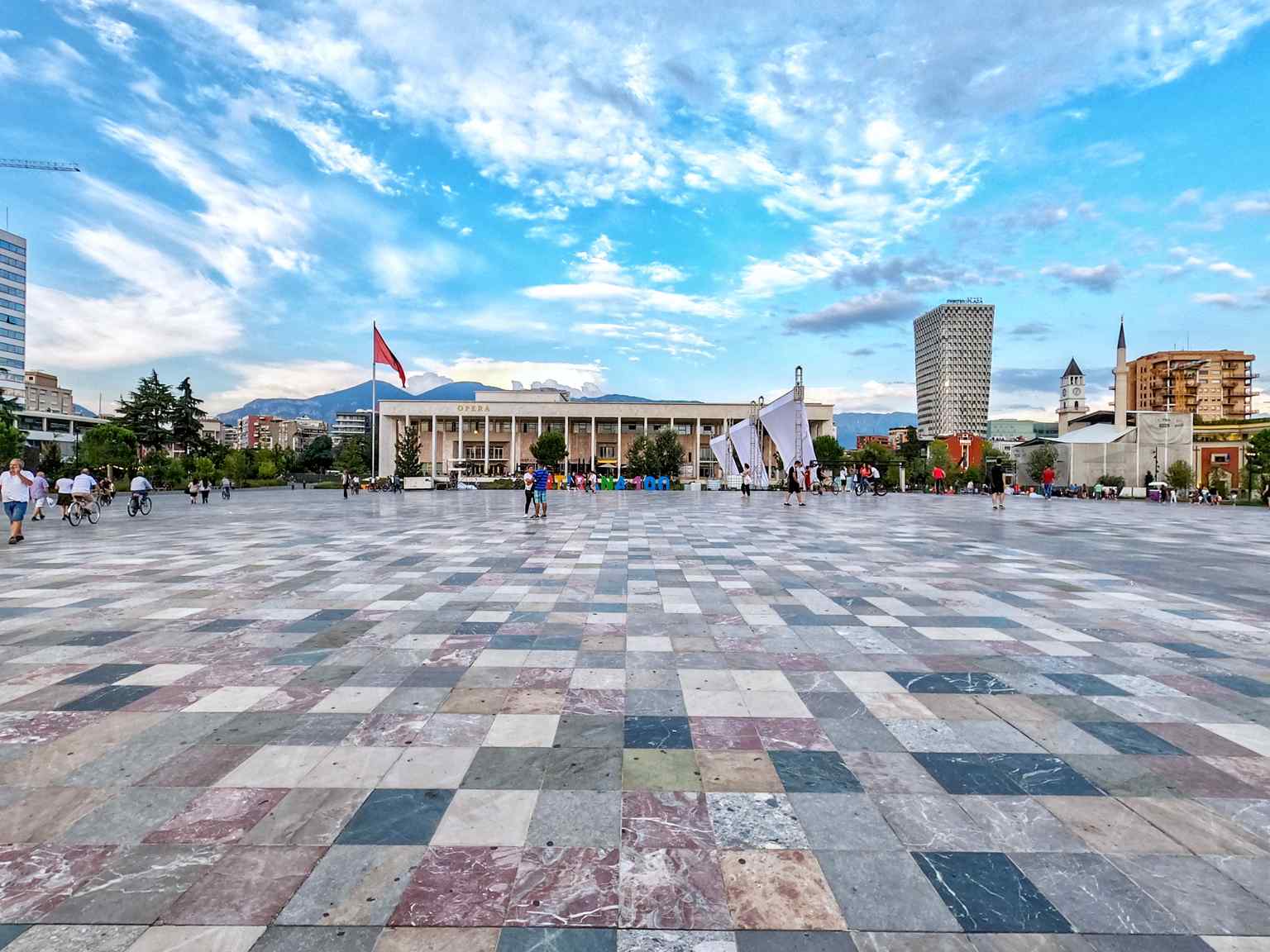
The Palace of Culture of Tirana, home to the National Library and Opera, completed in 1963, exemplifies communist-era architecture in Eastern Europe.Photo: KyokoMai, Wikimedia Commons, CC BY-SA 4.0. Cropped & resized. 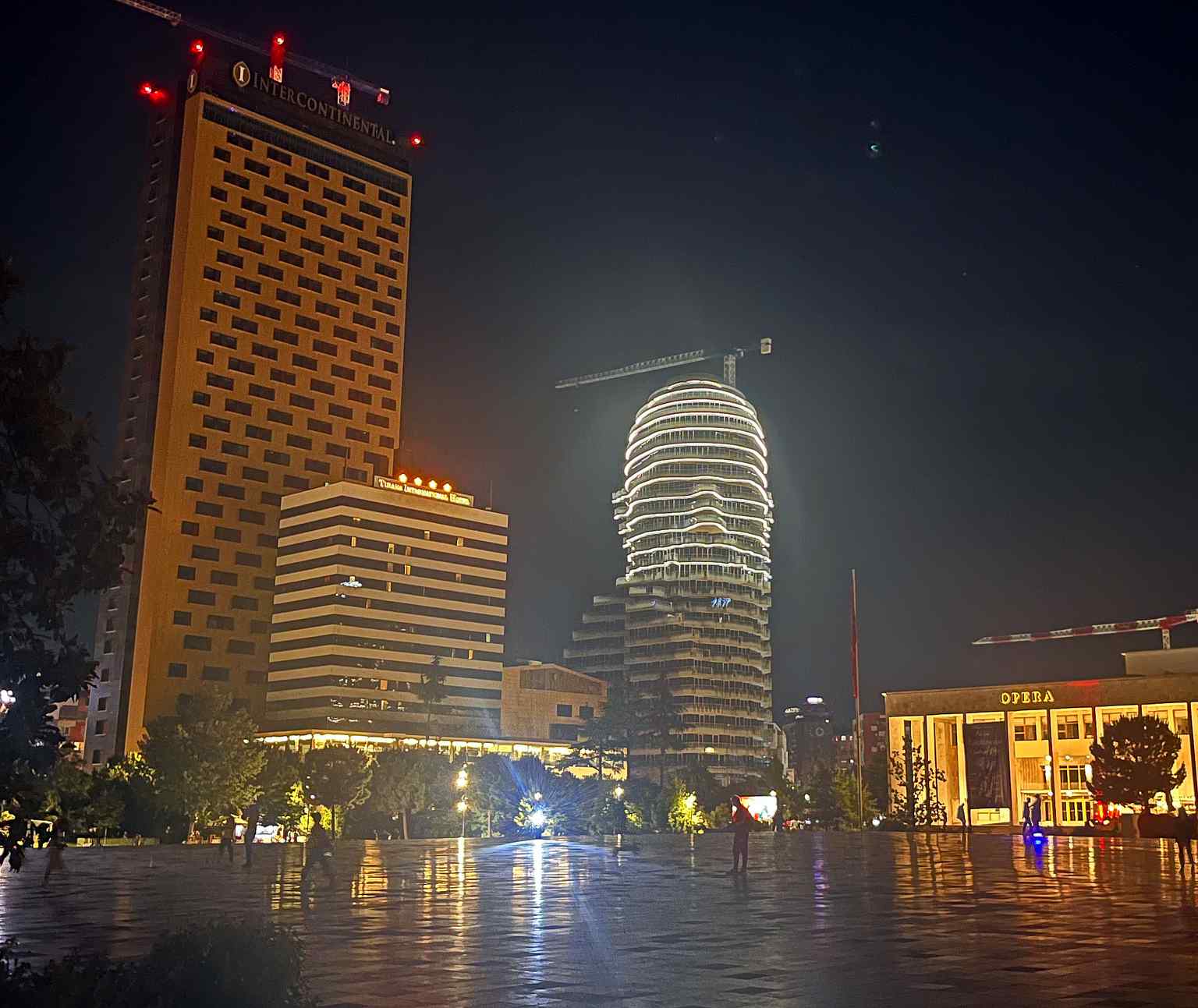
See the Palace of Culture, home to the National Theatre of Opera and Ballet, illuminated at night in Skanderbeg Square, where its first stone was symbolically placed by Nikita Khrushchev in 1959.Photo: Albinfo, Wikimedia Commons, CC BY 4.0. Cropped & resized. 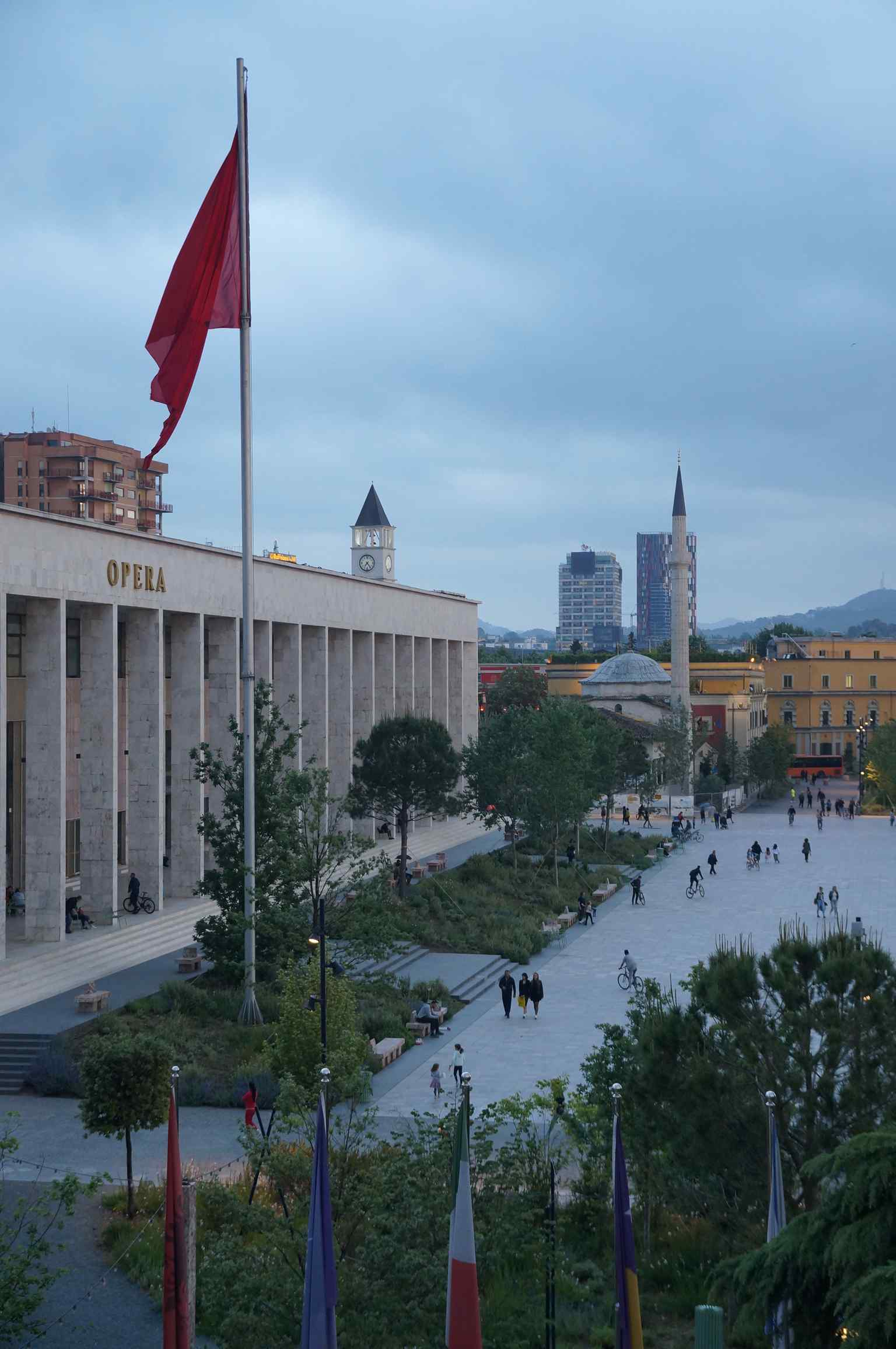
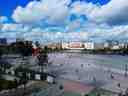
Experience the vibrant Skanderbeg Square in Tirana, the grand setting for the Palace of Culture, which was completed in 1963.Photo: albinfo, Wikimedia Commons, CC0. Cropped & resized. To your right opens a vast expanse of pale stone tiles forming a sweeping, subtly sloped plaza, anchored by a towering bronze equestrian statue resting on a rugged stone…Read moreShow less
Open dedicated page →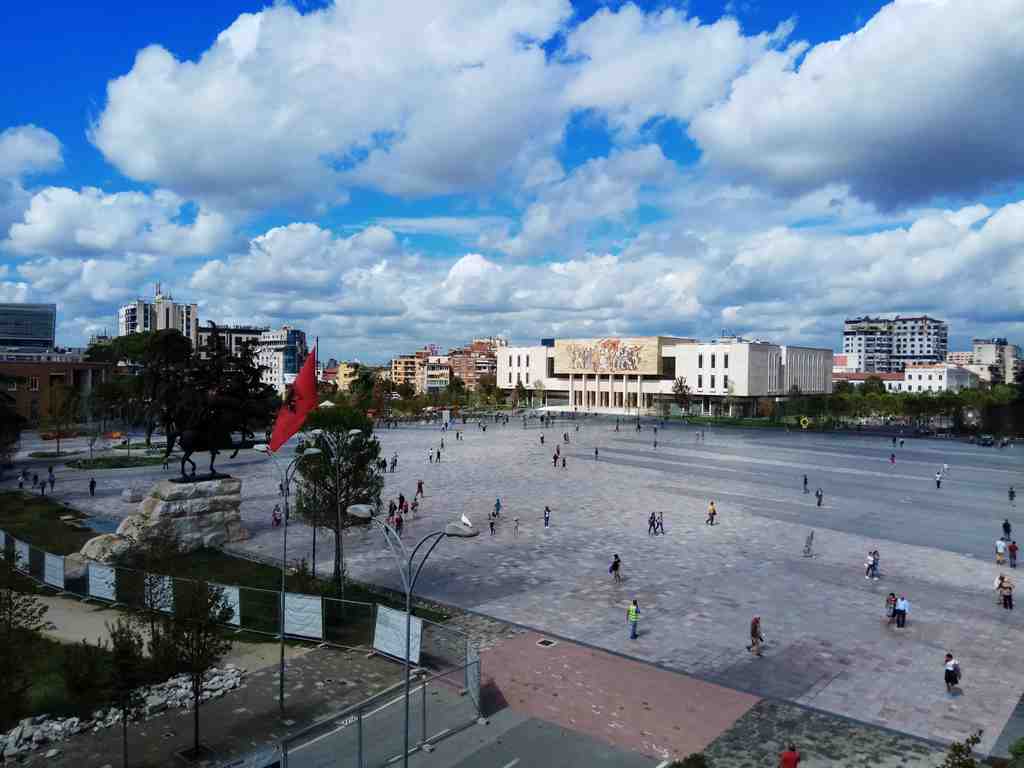
Skanderbeg SquarePhoto: Leeturtle, Wikimedia Commons, CC BY-SA 3.0. Cropped & resized. To your right opens a vast expanse of pale stone tiles forming a sweeping, subtly sloped plaza, anchored by a towering bronze equestrian statue resting on a rugged stone base.
This massive space is Skanderbeg Square, covering nearly forty thousand square meters. Just take a moment to look around. Standing here in the middle of this vast, monumental plaza, you might find yourself considering the scale of it all. How does a space this incredibly massive make a single, solitary citizen feel when measured against the overwhelming, towering presence of the state?
That feeling of isolation is not an accident. Over the last century, this very ground has been treated like a blank canvas by alternating regimes, each desperate to erase what came before them. Back in the nineteen twenties and thirties, Italian planners laid out designs in a Neo-Renaissance style, an architectural movement meant to revive the grand, classical public spaces of the past. Then came the communist regime. Remember the Old Bazaar we talked about a few minutes ago? It used to sit right here. But it was systematically crushed to dust to make way for monumental, cold grandeur, wiping away the vibrant heart of the city's daily life.
To enforce this new reality, the communist government erected a massive thirty foot bronze statue of dictator Enver Hoxha. They purposefully placed him on a raised platform so he would physically loom over the beloved national hero, Skanderbeg. It was a daily, inescapable visual reminder of absolute power.
But absolute power eventually fractures. On February twentieth, nineteen ninety one, tensions boiled over. Thousands of furious citizens swarmed this very stone plaza. Police fired warning shots and unleashed dogs, but the sheer volume of the jubilant, angry crowd was too much. The security forces finally stepped aside. The massive bronze dictator was pushed off its pedestal. In a powerful release of decades of pent up rage, the crowd tied the heavy statue to a government vehicle and dragged it through the streets.
The square you walk on today was designed to heal some of those deep historical wounds. It opened in two thousand seventeen after years of bitter political battles over its design. The ground beneath your feet is a mosaic made from over one hundred and twenty nine thousand stone tiles, cut from more than thirty different types of native rock from across Albania. The designers deliberately wove the geological diversity of the whole nation into a single center.
And you might notice a very slight incline as you walk. The square actually rises at a tiny three percent angle, forming a shallow pyramid whose peak is exactly two point three meters high. This was brilliantly calculated so that when you stand near the center, you are brought to exact eye level with the plinths, those heavy stone foundation blocks, of the surrounding fascist and communist era buildings. By physically lifting the people up, the designers subverted the architecture of ideology, finally placing the public on equal footing with the ghosts of authoritarian rule.
The square remains open twenty four hours a day, every day of the week, for everyone to explore freely. And right at the edge of all this sweeping grandeur sits something wonderfully intimate. Let us walk just a minute away to our next stop, the Ethem Bey Mosque.
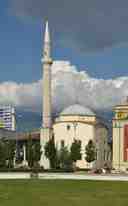
Directly in front of you stands the Et'hem Bey Mosque, instantly recognizable by its tall slender stone minaret, which is the tower used for the call to prayer, alongside a smooth…Read moreShow less
Open dedicated page →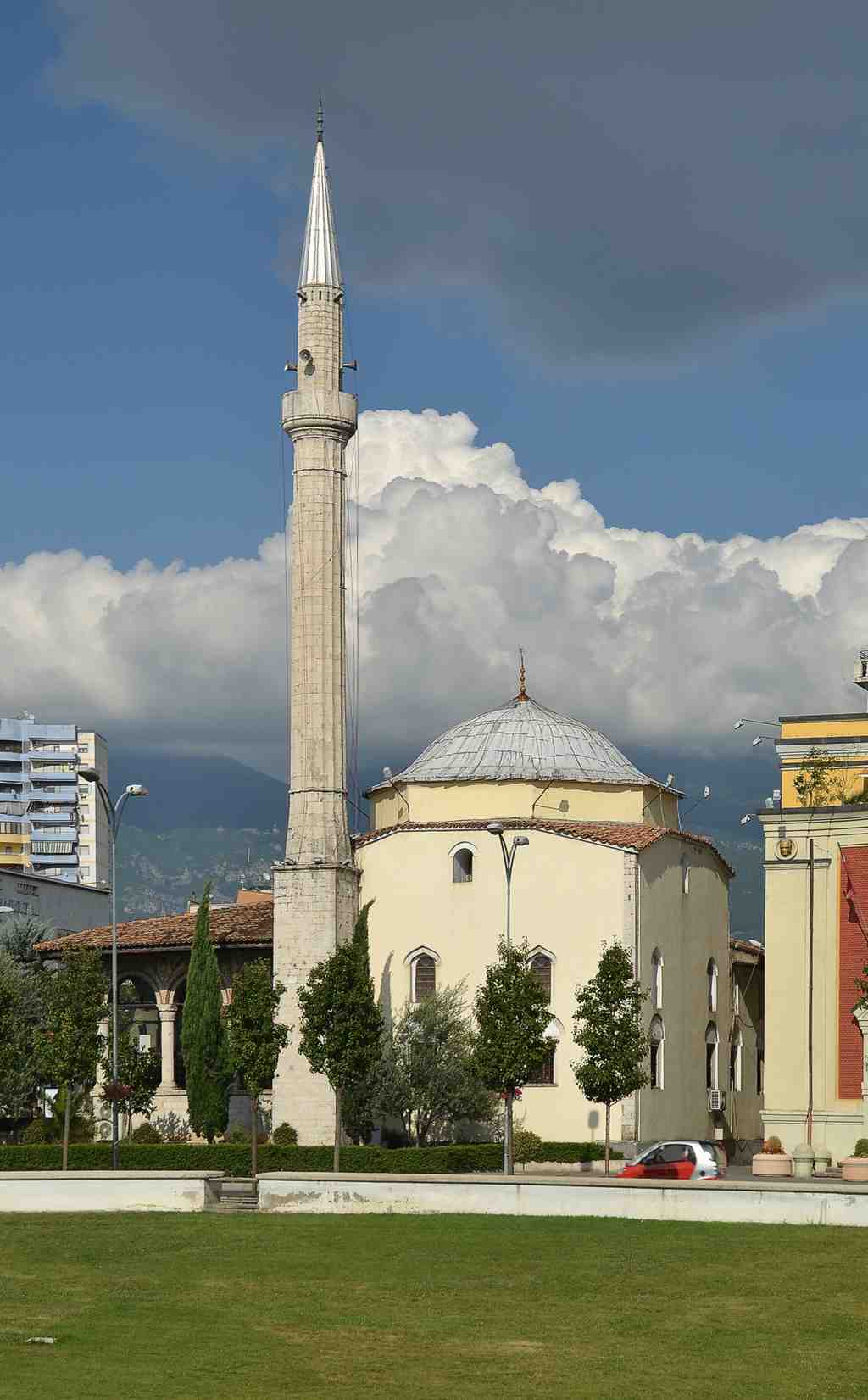
Et'hem Bey MosquePhoto: Pudelek, Wikimedia Commons, CC BY-SA 4.0. Cropped & resized. Directly in front of you stands the Et'hem Bey Mosque, instantly recognizable by its tall slender stone minaret, which is the tower used for the call to prayer, alongside a smooth semi-spherical dome and cream-colored walls framed by an arched portico. Built over two centuries ago by Molla Bey and his son, it was designed as a sanctuary of immense beauty. Its portico and interior are covered in stunning frescoes... that is, murals painted directly onto fresh plaster... depicting peaceful waterfalls, bridges, and lush trees. You can see how beautifully those delicate exterior frescoes and the elegant portico were restored in recent years by checking out the before and after picture in your app.
For decades, this beauty was locked away. During Albania's era of strict communist rule, all houses of worship were shuttered. The mosque survived destruction only because the government declared it a historical monument, essentially preserving it as a hollow shell.
But the spirit of this place could not be permanently erased. On January eighteenth, nineteen ninety-one, something miraculous happened. Without any official permission, a crowd of ten thousand citizens marched right up to these doors carrying flags. They simply walked in. After decades of absolute fear, the police did not interfere. They just stood by as the people reclaimed their sacred space. It was an incredibly dramatic, beautiful moment of cultural resilience... a massive, spontaneous reopening that signaled the collapse of the old regime.
Before we move on, know that tours are given daily outside of prayer times if you want to see the interior, just remember to slip off your shoes first. Let's continue walking toward the Kapllan Pasha Tomb, just a four-minute stroll away, where we will dive a little deeper into the power plays of the Ottoman era.
Look for the elegant octagonal white stone structure with eight delicately carved arches, sitting dramatically tucked beneath the sweeping, curved cutout of the towering modern…Read moreShow less
Open dedicated page →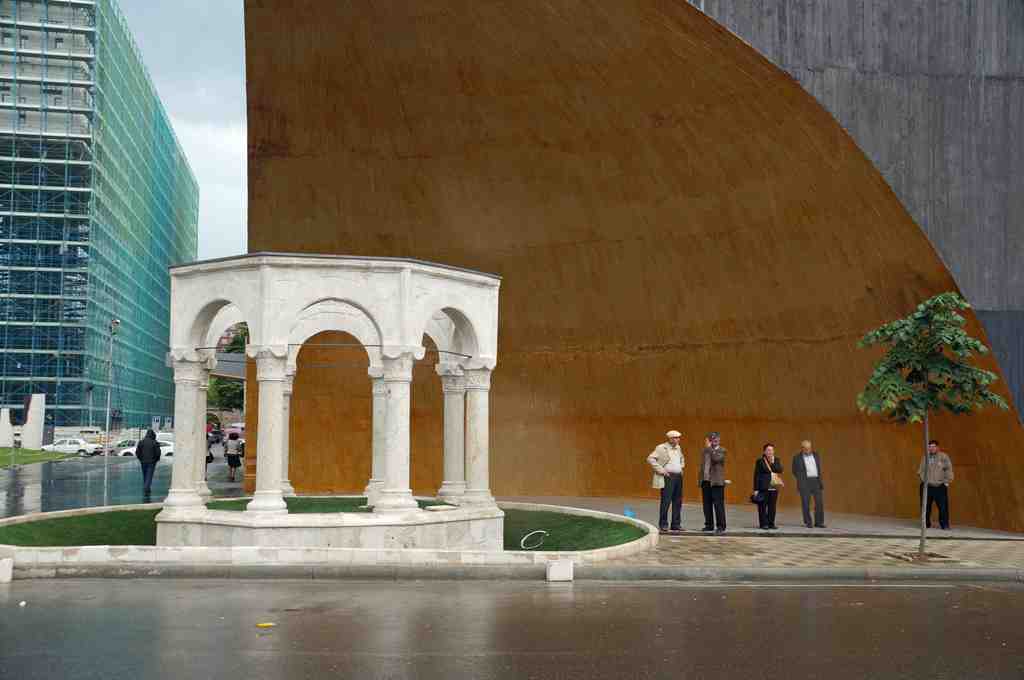
Kapllan Pasha TombPhoto: Albinfo, Wikimedia Commons, CC BY 4.0. Cropped & resized. Look for the elegant octagonal white stone structure with eight delicately carved arches, sitting dramatically tucked beneath the sweeping, curved cutout of the towering modern skyscraper behind it.
This tiny monument is a Türbe, a traditional Islamic mausoleum, and it holds the memory of a man who knew exactly how to build an empire without lifting a sword. Kapllan Pasha was an ambitious Ottoman administrator in the early nineteenth century. When a prominent local leader passed away, leaving behind vast estates and four orphaned daughters, Kapllan saw a golden opportunity. He swiftly arranged for his own sons to marry all four heiresses, instantly sweeping their immense landholdings into his own family's control. Legend says that as his sons moved to Tirana, Kapllan proudly declared they were now all together, or toptan in Turkish. That shrewd marital maneuvering birthed the formidable Toptani clan, whose massive wealth allowed them to raise private armies for the Ottoman Sultan.
But permanence is a fragile thing. This little tomb once stood beside a grand mosque and six other monumental graves. In November nineteen forty-four, intense urban combat leveled the surrounding buildings to dust, leaving only this single stone survivor. Years later, authorities bulldozed the remaining cemetery, finally prompting the relocation of Kapllan's remains to Istanbul.
Left completely empty, the tomb faced its greatest threat when developers planned to build a massive skyscraper directly on top of it. But instead of erasing this last thread of the past, they designed a brilliant compromise. The modern high-rise you see was built with a massive cantilever, a structural overhang supported on just one side, forming a protective canopy that arches safely over the ancient columns.
Since the open-air site is accessible twenty-four hours a day, it remains a quiet, steadfast witness to the city evolving around it. Let us continue our walk now toward the National Museum of Fine Arts, which is just about four minutes away.
Look to your right for a prominent rectangular building defined by a pale stone facade, sharp geometric lines, and a wide covered entranceway. This is the National Museum of Fine…Read moreShow less
Open dedicated page →
National Museum of Fine ArtsPhoto: Bes-ART, Wikimedia Commons, Public domain. Cropped & resized. Look to your right for a prominent rectangular building defined by a pale stone facade, sharp geometric lines, and a wide covered entranceway. This is the National Museum of Fine Arts. Tirana is a city that never stops shedding its old skin to grow anew, and its art is no different.
Back in 1946, a devoted group of artists formed a committee with a dream. They gathered the scattered fragments of Albanian visual culture, eventually opening the first Gallery of Arts in 1954. But as their collection grew, so did their ambitions. By 1974, they moved right here to this modernist block on the Martyrs of the Nation Boulevard. Inside, they safeguarded over five thousand artworks. This included the deeply moving pieces of pioneers like Kole Idromeno and Sadik Kaceli, alongside a vast permanent collection of Socialist Realism art... the government approved, highly idealized style from the communist era.
But a building is just a vessel, and vessels must sometimes be remade. In late 2021, the doors closed once more for a massive reconstruction project. The old structure is being completely revamped, and a brand new one is rising beside it. While the dust settles and the heavy machinery works outside, the precious art itself is being digitized over at the AlbaFilm studios. It is a beautiful kind of cultural resilience. The walls may come down, but the soul of Albanian art is carefully preserved, waiting for its next grand stage.
Make your way to our final stop, a modern answer to Tirana's evolving skyline. It is about a seven minute walk from here to the Namazgja Mosque.
Standing before you is the Namazgja Mosque, a breathtaking light stone sanctuary crowned by a soaring central dome and framed by four tall, slender minarets. For decades, the…Read moreShow less
Open dedicated page →Standing before you is the Namazgja Mosque, a breathtaking light stone sanctuary crowned by a soaring central dome and framed by four tall, slender minarets. For decades, the ground you are standing on was an unused park next to the Parliament, but its name, Namazgjah, always meant a place of prayer.
To understand what this beautiful building means to the people here, we have to look back at the deep scars left on this city. During the decades of harsh dictatorial rule, mosques, churches, and monasteries were systematically crushed and dismantled. When that dark era finally ended, the city slowly began to heal. Sweeping cathedrals were built for the Catholic and Orthodox communities, yet the Muslim majority was left waiting. We visited the beautiful Et'hem Bey Mosque earlier, but that historic gem only has room for about sixty worshippers. For years, during major holidays, thousands of Muslims had no choice but to pray out in the city streets, kneeling on the hard pavement.
They laid a foundation stone for a new mosque right here in 1992, but political disputes blocked the construction for over twenty long years. Finally, the dream was realized. Today, beneath that magnificent thirty meter high Ottoman style dome, up to four thousand five hundred believers can gather at once in a space meant just for them.
Take a moment to glance at your app to see a close up of the ornate ablution fountain just outside. Ablution is the traditional ritual of washing the hands, face, and feet to gently purify oneself before prayer, a beautiful physical honoring of the sacred space.
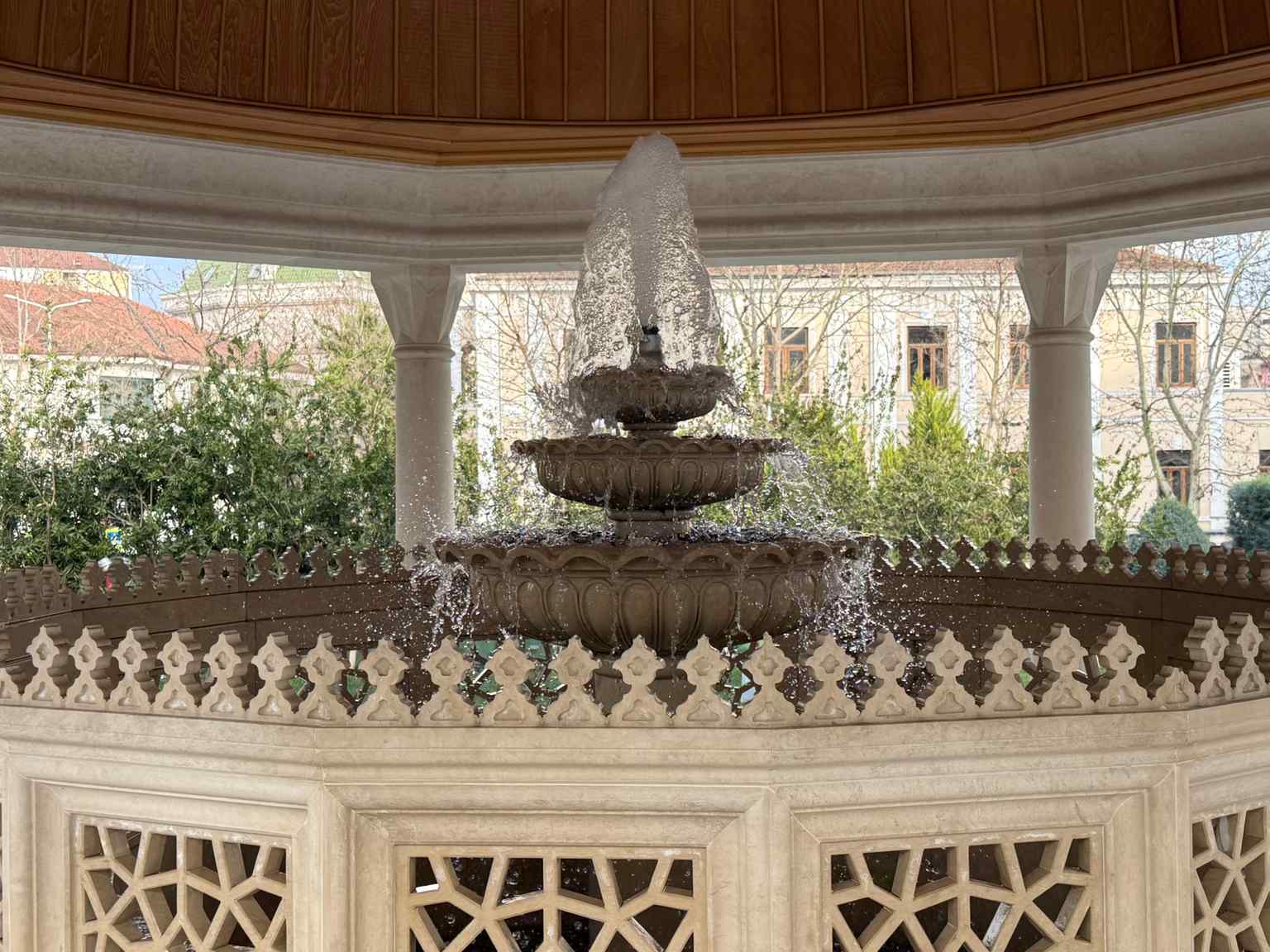
An ablution fountain outside the mosque, a traditional feature for ritual purification before prayer, emphasizing the 'Namazgjah' or 'place of prayer' concept.Photo: Yastay, Wikimedia Commons, CC BY 4.0. Cropped & resized. The realization of this mosque is a profound close to a painful chapter. The rigid mandate of the communist regime tried to silence the soul of this country, but faith easily outlasted the concrete of dictators. Now, with those four fifty meter minarets reaching upward, this city's spiritual landscape is finally balanced and whole again. Tirana has reclaimed every piece of its rich identity, allowing all its people to stand together. Should you wish to experience its quiet interior, the mosque is open to visitors every day of the week from nine in the morning until six in the evening.

Frequently asked questions
How do I start the tour?
After purchase, download the AudaTours app and enter your redemption code. The tour will be ready to start immediately - just tap play and follow the GPS-guided route.
Do I need internet during the tour?
No! Download the tour before you start and enjoy it fully offline. Only the chat feature requires internet. We recommend downloading on WiFi to save mobile data.
Is this a guided group tour?
No - this is a self-guided audio tour. You explore independently at your own pace, with audio narration playing through your phone. No tour guide, no group, no schedule.
How long does the tour take?
Most tours take 60–90 minutes to complete, but you control the pace entirely. Pause, skip stops, or take breaks whenever you want.
What if I can't finish the tour today?
No problem! Tours have lifetime access. Pause and resume whenever you like - tomorrow, next week, or next year. Your progress is saved.
What languages are available?
All tours are available in 50+ languages. Select your preferred language when redeeming your code. Note: language cannot be changed after tour generation.
Where do I access the tour after purchase?
Download the free AudaTours app from the App Store or Google Play. Enter your redemption code (sent via email) and the tour will appear in your library, ready to download and start.
If you don't enjoy the tour, we'll refund your purchase. Contact us at [email protected]
Checkout securely with 






.JPG)


.jpg)
