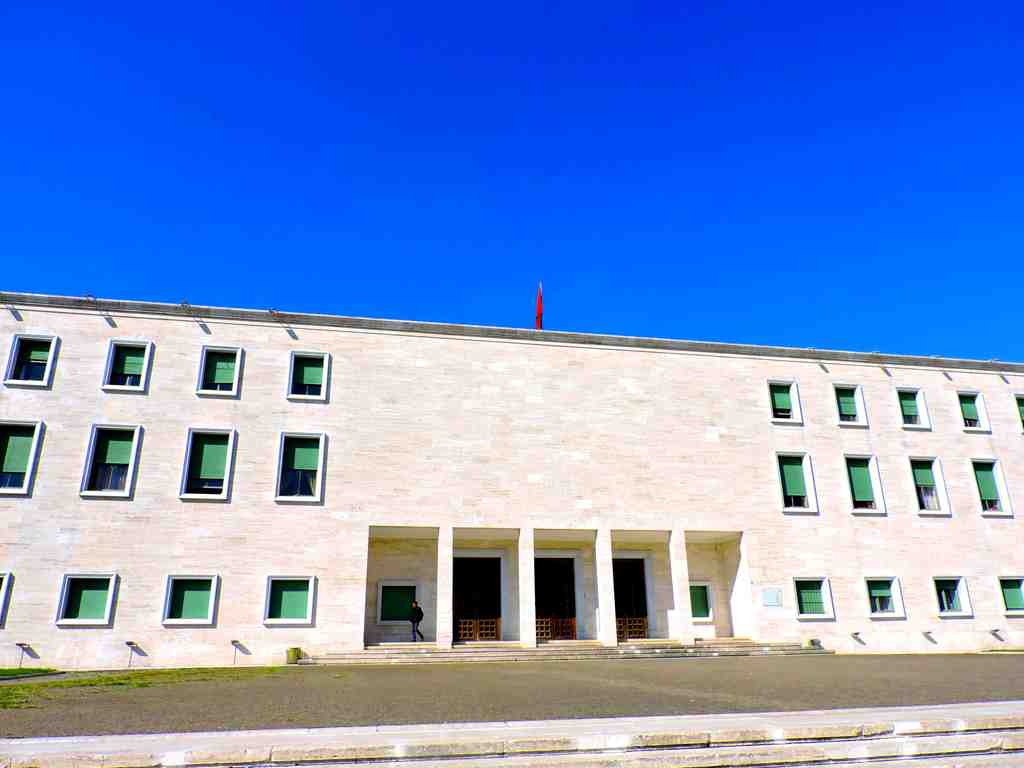
Take a moment to look at the wide, rectangular structure before you, clad in stark white marble and marked by a deeply recessed entrance with striking, square columns. This is the University of Arts.
We are walking through a city where history never rests, where each generation seems to bury the foundations of the past to forcefully plant the seeds of something new. This building is a perfect example. It was designed by Italian architects between 1939 and 1942 as part of a fascist monumental complex. Its rationalist architectural style, with those severe, uncompromising geometric lines, was a calculated tool of state messaging. The regime used this imposing, unyielding marble to project absolute authority and demand conformity from anyone who approached. If you glance at your screen, you can see a clean, wide view of this historic exterior.
The end of the Second World War did not bring freedom to these classrooms. Decades later, communist dictator Enver Hoxha launched a brutal crackdown on anything he considered a liberal manifestation, unleashing absolute terror on the arts in 1973. His harsh censorship meant that students and professors lived under the constant threat of surveillance and ruin. A prominent theater director was stripped of his title and banished to rural manual labor, while a young painting student was arrested and tortured simply because he refused to betray his classmates.
Yet, the human spirit is remarkably resilient. By 1990, this very academy became ground zero for the anti-government resistance. Brave students and faculty organized massive protests and a historic hunger strike right here, actions that directly pressured the crumbling regime to concede to multi-party elections.
Art, which had been so tightly controlled, became a fierce weapon of defiance. Future Albanian Prime Minister Edi Rama was an art professor here during that turbulent time, using the campus to host open meetings criticizing the political establishment. His rebellion made him a target, and he was severely beaten outside his home by unknown assailants before eventually surviving the attack and pivoting to lead the nation's government.
The creative fire still burns inside today, with the doors generally open to aspiring artists Monday through Friday from eight in the morning until ten at night, resting only for the weekend. We are now going to walk about eight minutes to our next stop, the site of the Qemal Stafa Stadium, where we will discover how yet another grand design attempted to mold the identity of this ever-changing city.