
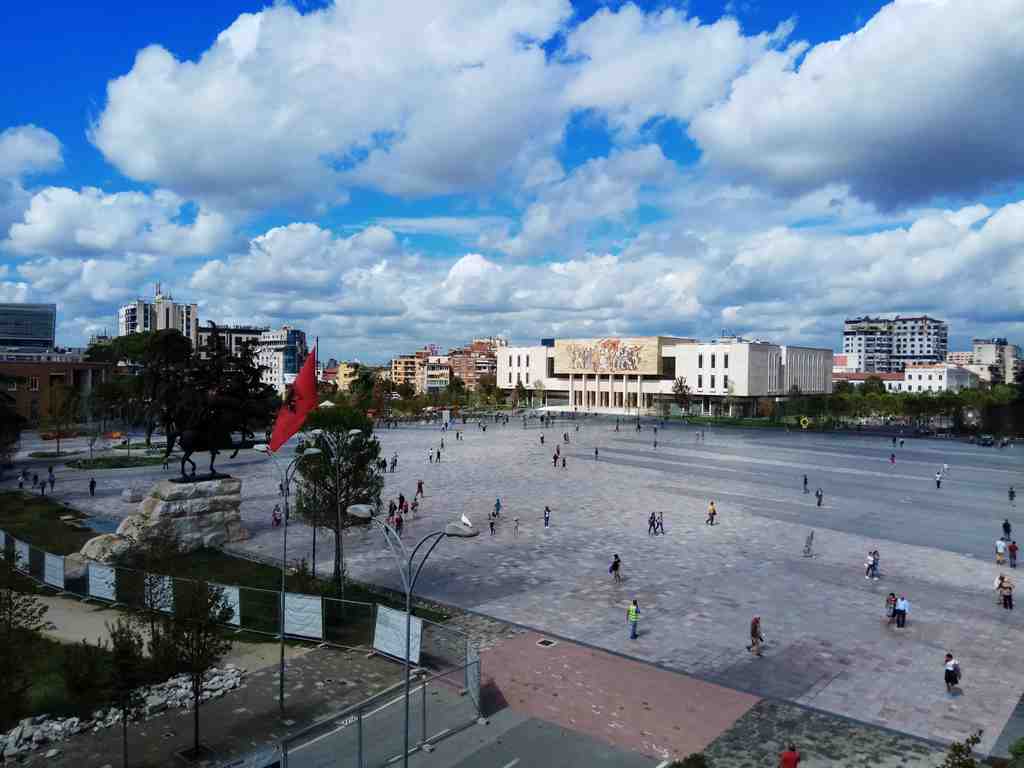
To your right opens a vast expanse of pale stone tiles forming a sweeping, subtly sloped plaza, anchored by a towering bronze equestrian statue resting on a rugged stone base.
This massive space is Skanderbeg Square, covering nearly forty thousand square meters. Just take a moment to look around. Standing here in the middle of this vast, monumental plaza, you might find yourself considering the scale of it all. How does a space this incredibly massive make a single, solitary citizen feel when measured against the overwhelming, towering presence of the state?
That feeling of isolation is not an accident. Over the last century, this very ground has been treated like a blank canvas by alternating regimes, each desperate to erase what came before them. Back in the nineteen twenties and thirties, Italian planners laid out designs in a Neo-Renaissance style, an architectural movement meant to revive the grand, classical public spaces of the past. Then came the communist regime. Remember the Old Bazaar we talked about a few minutes ago? It used to sit right here. But it was systematically crushed to dust to make way for monumental, cold grandeur, wiping away the vibrant heart of the city's daily life.
To enforce this new reality, the communist government erected a massive thirty foot bronze statue of dictator Enver Hoxha. They purposefully placed him on a raised platform so he would physically loom over the beloved national hero, Skanderbeg. It was a daily, inescapable visual reminder of absolute power.
But absolute power eventually fractures. On February twentieth, nineteen ninety one, tensions boiled over. Thousands of furious citizens swarmed this very stone plaza. Police fired warning shots and unleashed dogs, but the sheer volume of the jubilant, angry crowd was too much. The security forces finally stepped aside. The massive bronze dictator was pushed off its pedestal. In a powerful release of decades of pent up rage, the crowd tied the heavy statue to a government vehicle and dragged it through the streets.
The square you walk on today was designed to heal some of those deep historical wounds. It opened in two thousand seventeen after years of bitter political battles over its design. The ground beneath your feet is a mosaic made from over one hundred and twenty nine thousand stone tiles, cut from more than thirty different types of native rock from across Albania. The designers deliberately wove the geological diversity of the whole nation into a single center.
And you might notice a very slight incline as you walk. The square actually rises at a tiny three percent angle, forming a shallow pyramid whose peak is exactly two point three meters high. This was brilliantly calculated so that when you stand near the center, you are brought to exact eye level with the plinths, those heavy stone foundation blocks, of the surrounding fascist and communist era buildings. By physically lifting the people up, the designers subverted the architecture of ideology, finally placing the public on equal footing with the ghosts of authoritarian rule.
The square remains open twenty four hours a day, every day of the week, for everyone to explore freely. And right at the edge of all this sweeping grandeur sits something wonderfully intimate. Let us walk just a minute away to our next stop, the Ethem Bey Mosque.




