
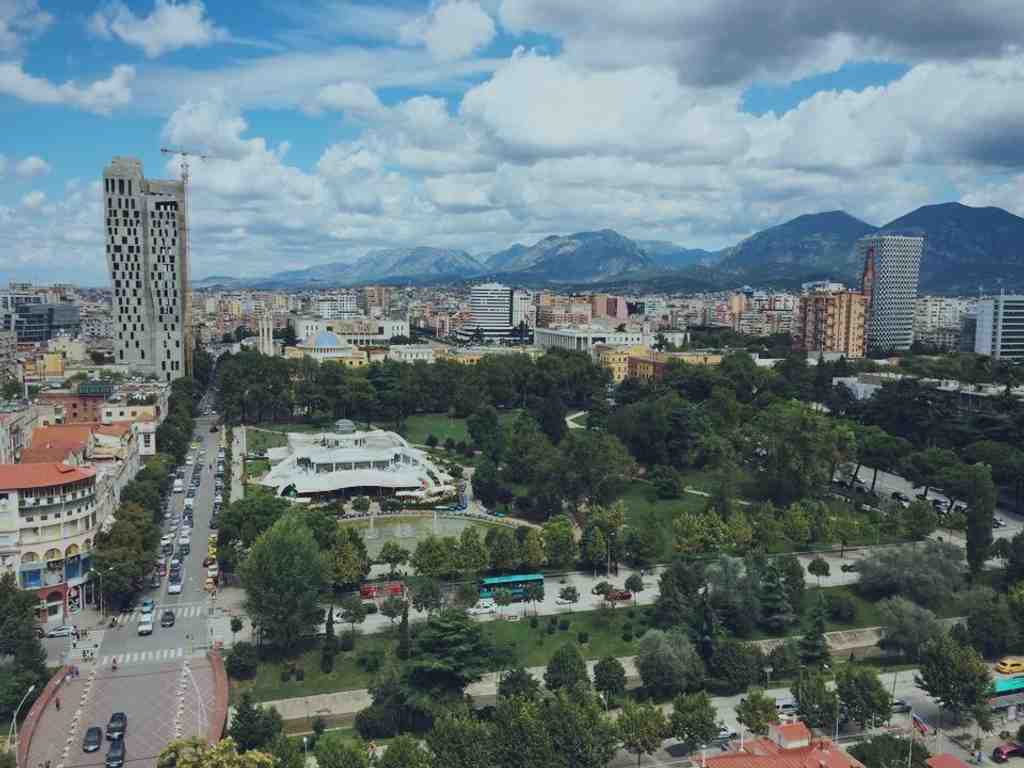
Welcome to Rinia Park, where you can easily spot the central Taivani complex, a striking white, terraced building that spreads out almost like a mechanical spider among the green trees and curved water fountains.
The very soil beneath your feet holds a powerful story of cultural resilience, born from the hands of everyday citizens. Back in nineteen fifty, it was the young people of Tirana who volunteered their sweat and strength to plant these trees and carve out a verdant sanctuary. They built their own joy and carved out a peaceful haven right amidst the heavy, watchful demands of a harsh communist regime, earning this place the official name of Youth Park.
But locals rarely call it Youth Park. Instead, they call it Taiwan, inspired by that unique central building. The origins of this nickname are wonderfully amusing. One popular rumor claims that in nineteen seventy eight, Albania's communist regime abruptly broke off diplomatic relations with China. In a remarkably petty gesture of international defiance, the state supposedly recognized the sovereignty of Taiwan and quietly named this new park structure in their honor. Another theory, championed by local artists of the era, suggests it was just simple geography. Whenever the area flooded, the park would fill with water, leaving the central white building totally isolated, looking exactly like the island of Taiwan.
As the decades passed, this beloved space suffered a dark transformation. When communism collapsed in nineteen ninety one, the city's green spaces were suddenly overrun. Over a hundred illegal structures sprouted up across the grass. What started as small kiosks quickly ballooned into makeshift concrete buildings towering two to three stories high. The park's tranquil nature was entirely swallowed up, turning into a notorious, concrete-choked hangout for the kingpins of Tirana's underworld.
Yet, a city's spirit is hard to keep buried forever. In the year two thousand, a massive cleanup campaign was launched by the city's mayor, former art professor Edi Rama. He personally ordered the bulldozing of the illegal structures. Over one hundred and thirty buildings were razed to the ground, and forty five thousand cubic meters of concrete and waste were hauled away. The youth of Tirana's original vision was honored as the space was beautifully replanted, breathing life back into the city.
As a true public space, this restored sanctuary remains open twenty four hours a day, all week long, welcoming anyone who needs a peaceful escape. Let us continue our walk to the Resurrection Cathedral, just a four minute stroll away, where we will witness another grand testament to a community reclaiming its light.




