AudaTours logoAudaTours

Lancaster Audio Tour: Wages, Warrants and Warehouses

Audioprzewodnik12 przystanków

Lancaster's Georgian prosperity is written in stone — the Custom House, the Priory, the grand merchant houses on Castle Hill. But the story of who actually built, guarded, clerked, stocked and served this town belongs to a different set of names: the gaoler who managed the Pendle witch hangings, the housekeeper who outlived her judges, the cabinet apprentices who hand-cut mahogany legs in a Castle Hill workshop, the dock workers who loaded cargoes whose profits built the churches, the Quaker merchants who funded both chapels and slave ships, and the women who kept the linoleum looms running when the men went to war. Heritage Open Days 2026 theme is Everyday Histories — this tour names the unnamed.

Podgląd trasy

map

O tej trasie

  • schedule
    Czas trwania 30–50 minsIdź we własnym tempie
  • straighten
    2.6 km trasy pieszejPodążaj wyznaczoną trasą
  • location_on
  • wifi_off
    Działa offlinePobierz raz, korzystaj gdziekolwiek
  • all_inclusive
    Dożywotni dostępOdtwarzaj ponownie w dowolnym momencie
  • location_on
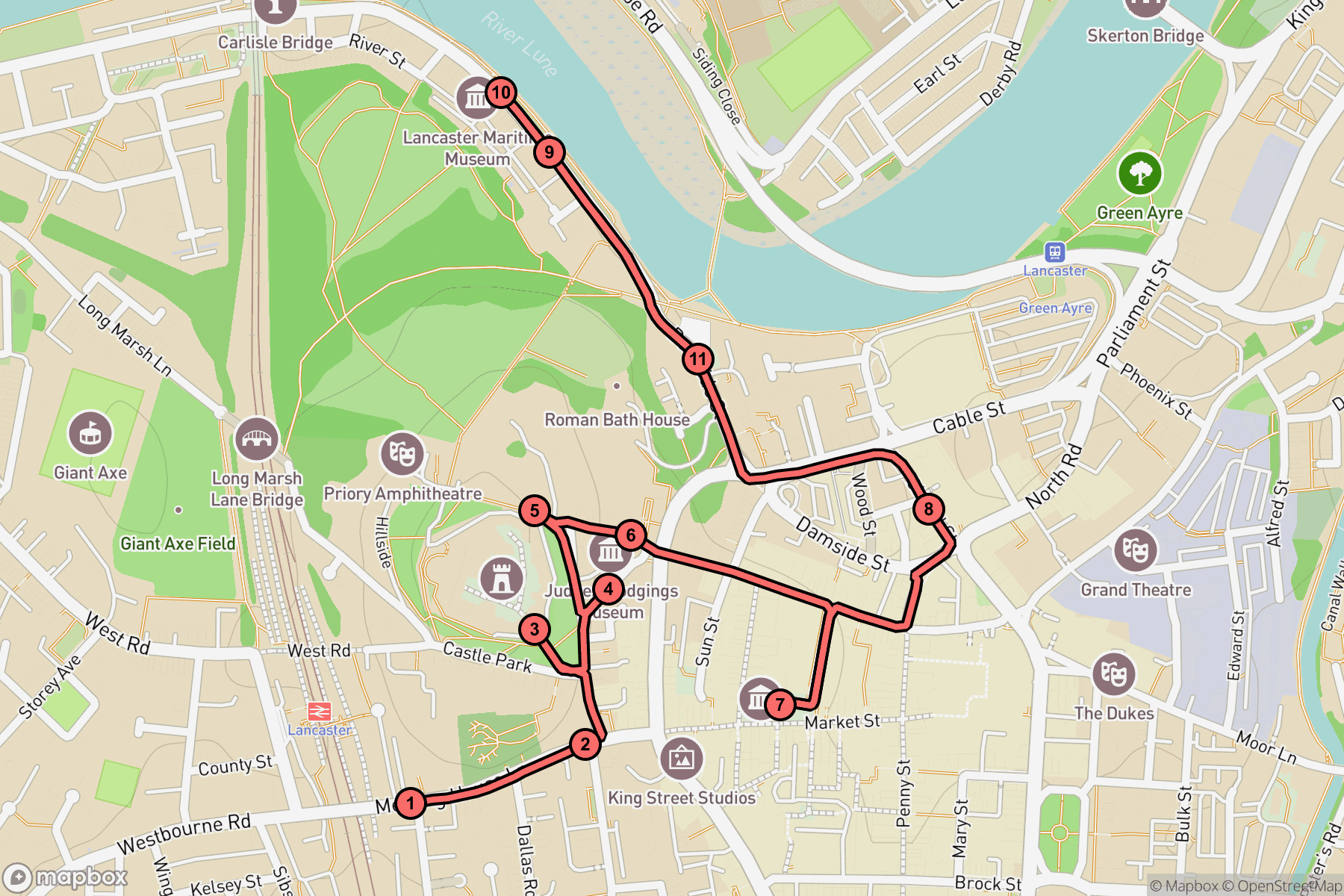
    Start przy Lancaster Castle, Castle Parade, Lancaster

Przystanki na tej trasie

location_on
1
lock
Lancaster CastleThe castle and former gaol whose gatehouse has been a working entrance for eight centuries. Thomas Covell — gaoler, six-time mayor of Lancaster — managed the prison in the early seventeenth century and kept the gaol during the 1612 Pendle witch trials. The Clerk of the Court Thomas Potts left detailed records of the nine women and men hanged here on 20 August 1612 after being convicted of causing the deaths of seventeen people. The castle operated as a working prison from 1196 until 2011, generating wages for generations of gaolers, turnkeys, matrons, and warders whose names survive only in the prison registers.
location_on
2
lock
Captured Africans Memorial, Damside Street, LancasterA sandstone, acrylic and steel sculpture on the quayside at Damside Street, completed in 2005 and designed by Kevin Dalton-Johnson. It was the first memorial in the United Kingdom specifically dedicated to the Africans enslaved in the transatlantic slave trade. The base features a mosaic map of the eighteenth-century world showing the triangular route between West Africa, Lancaster and the Americas; the sculpture names each of the slave ships that passed through the port, their captains, and the number of enslaved people on board. Thomas Hodgson and his brother John were involved in the trade for over thirty years and between 1763 and 1791 were involved in the capture and sale of approximately 14,000 people.
location_on
3
lock
Lancaster Priory Church of Saint MaryThe Priory Church of St Mary stands immediately beside the castle on Castle Hill, founded as a Benedictine priory by Roger de Poitou in 1094. The choir stalls — among the finest medieval woodwork in northern England — were carved in the early fifteenth century during a major reconstruction in the Perpendicular style after the priory was transferred to Syon Abbey in 1431. The craftsmen who cut them are anonymous; what survives is the detail of their work. The Rawlinson family tomb here — defaced during the Black Lives Matter protests — connects the church directly to the slave-trade wealth that funded much of Georgian Lancaster.
location_on
4
lock
Judges Lodgings MuseumA Georgian town house built by Thomas Covell — the same Thomas Covell who managed Lancaster Castle — in the early seventeenth century. From 1826 it served as lodgings for the travelling judges of the Assize Courts at the nearby castle. In 1841, the housekeeper was Betty Bateson, who managed the household alongside her elderly mother Ann and a servant, Ester King. When Betty died in 1858 of heart failure, the advert placed for her successor specified 'not exceeding 40 years of age'. Her replacement was Ellen Leighton, who brought her father and nephew to live with her.
location_on
5
lock
1 Castle HillThe site of Gillows' primary workshop and warehouse from 1770 to 1882 — the Castle Hill premises designed by Richard Gillow and operated as the nerve centre of the most important cabinet-making business outside London. Robert Gillow founded the firm in 1728 as a joiner, travelled to the West Indies in the 1720s and returned with samples of mahogany — among the first imported to Britain. By 1775 the Lancaster branch employed 42 workers; 137 apprentices passed through the workshop between 1731 and 1850. Richard Gillow, son of the founder, also designed the Custom House on St George's Quay.
location_on
6
lock
Quaker Meeting HouseLancaster Quakers have met on this site since 1677, when the first Meeting House was built. The current structure dates to 1708, extended in 1779 and again in 1789–90. George Fox — founder of the Society of Friends — preached in Lancaster in 1652 and was tried for blasphemy at the castle, where he was acquitted. The Lancaster Quaker community became commercially prominent in the eighteenth century; many of its members were merchants involved in Atlantic trade. Among them were the Rawlinsons, who attended this Meeting House while co-owning the ships named in the Captured Africans memorial at Damside Street.

Najczęściej zadawane pytania

Jak rozpocząć trasę?

Po zakupie pobierz aplikację AudaTours i wpisz kod realizacji. Trasa będzie gotowa do natychmiastowego rozpoczęcia – po prostu dotknij \"Play\" i podążaj trasą z nawigacją GPS.

Czy potrzebuję internetu podczas trasy?

Nie! Pobierz trasę przed rozpoczęciem i korzystaj z niej w pełni offline. Jedynie funkcja czatu wymaga internetu. Zalecamy pobieranie przez WiFi, aby oszczędzać dane mobilne.

Czy to wycieczka grupowa z przewodnikiem?

Nie – to samodzielny audioprzewodnik. Zwiedzasz niezależnie, we własnym tempie, z narracją audio odtwarzaną przez telefon. Bez przewodnika, bez grupy, bez harmonogramu.

Ile trwa trasa?

Większość tras zajmuje 60–90 minut, ale to Ty kontrolujesz tempo. Wstrzymuj, pomijaj przystanki lub rób przerwy, kiedy chcesz.

Co jeśli nie zdążę ukończyć trasy dzisiaj?

Żaden problem! Trasy mają dożywotni dostęp. Wstrzymaj i wznów, kiedy chcesz – jutro, za tydzień lub za rok. Twój postęp jest zapisywany.

W jakich językach są dostępne trasy?

Wszystkie trasy są dostępne w ponad 50 językach. Wybierz preferowany język podczas realizacji kodu. Uwaga: języka nie można zmienić po wygenerowaniu trasy.

Gdzie znajdę trasę po zakupie?

Pobierz darmową aplikację AudaTours z App Store lub Google Play. Wpisz kod realizacji (wysłany e-mailem), a trasa pojawi się w Twojej bibliotece, gotowa do pobrania i rozpoczęcia.

verified_user
Gwarancja satysfakcji

Jeśli trasa Ci się nie spodoba, zwrócimy Ci pieniądze. Skontaktuj się z nami pod adresem [email protected]

Bezpieczna płatność przez

Apple PayGoogle PayVisaMastercardPayPal
Uwielbiany przez podróżników na całym świecie

Tysiące rozpoczętych tras.
Mnóstwo opinii.

4.8 w App Store i Google Play. Oto kilka, do których wracamy.

starstarstarstarstar
To był solidny sposób na poznanie Brighton bez poczucia bycia turystą. Narracja miała głębię i kontekst, ale nie przesadzała.
starstarstarstarstar
Zacząłem tę trasę z croissantem w jednej ręce i zerowymi oczekiwaniami. Aplikacja po prostu idzie z Tobą, bez presji, tylko Ty, Twoje słuchawki i fajne historie.
download Pobierz aplikację

Słuchawki w uszach.
Wyjdź na zewnątrz.

Darmowe pobieranie. Trasy w każdym mieście. Zacznij w 60 sekund — bez konta, bez karty.

Download on the App StoreGet it on Google Play
starstarstarstarstar_half
4.8
AudaTours app icon
headphones
~ 4 min do startu pierwszej trasy
public
1000+ miast na świecie
all_inclusive
AudaTours
Unlimited

Każda trasa. Każde miasto. Jedna subskrypcja.

3323 tras2270 miast139 krajów50+ języków

