Wolverhampton's working history runs from Lady Wulfrun's wool grant to Ernest Bevin's forty-hour handshake — from the wool merchants whose money built St Peter's nave clerestory, to Edward Bird the japanning apprentice who became a Royal Academician, to Harry Inscoe who sat at his locksmith's bench for sixty years, to the young architects Lawrence Israel and Edward Lyons who won the Civic Hall competition aged twenty-two and twenty-five in what was their very first job, to John Baynton and John Brodie who were given a football by their headmaster and founded Wolverhampton Wanderers. These are the names the plaques missed.
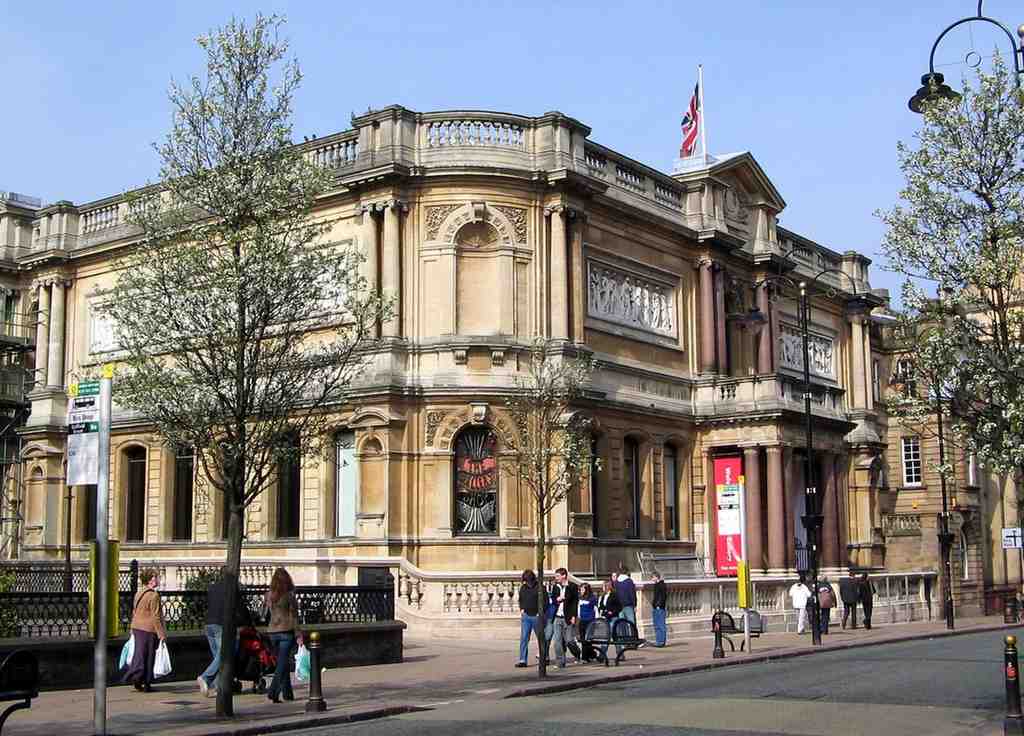
Wolverhampton Art GalleryArt gallery in West Midlands, United Kingdom
location_on
2
lock
The Chubb BuildingsThe purpose-built lock-making factory on Railway Street (now Fryer Street), constructed in 1898 to celebrate the eightieth anniversary of the company's founding. Designed by architect C. H. M. Mileham (1837–1917). Capable of accommodating 350 workers. The triangular plan was designed so that every locksmith's bench had its own window. Harry Inscoe is photographed at his bench on 9 October 1918, having completed sixty years of continuous service. The factory operated until 1960; it is now a Grade II listed arts and media centre.
location_on
3
lock
Wolverhampton Station
location_on
4
lock
Express & StarThe newspaper offices on Queen Street, home of the Express and Star — one of Britain's last independent regional dailies. In 1874 Wolverhampton's first paper, the Conservative Evening Express, was launched. Thomas Graham (1841–1909), a Liberal councillor from Dunfermline, persuaded his friend Andrew Carnegie to back a rival: the Evening Star, launched in 1880. Carnegie bought the Star; within four years it had absorbed the Evening Express to become the Evening Express and Star, with premises on Queen Street. The Graham family retained ownership almost continuously thereafter.
location_on
5
lock
Mander CentreThe modern shopping centre built on the site of the Mander Brothers varnish and paint factory, which had occupied land in St John's Street since 1845. The company was founded by Charles Benjamin Mander and Samuel Small Mander. Under its chairman Geoffrey Mander (Liberal MP), Mander Brothers was in September 1932 the first British company to sign a forty-hour working week — a historic agreement negotiated with Ernest Bevin, then general secretary of the Transport and General Workers' Union. The factory also pioneered a Works Council, pension schemes, and a sickness benefit scheme.
location_on
6
lock
St Peter’s GardensThe former churchyard of St Peter's, now a public garden. It contains the Bargain Stone — a medieval holed stone through which wool-traders sealed deals by handshake — and a statue of Lady Wulfrun by Sir Charles Wheeler, unveiled in 1974. The gardens were the commercial heart of the medieval town: market transactions, the weekly wool fair, and the physical memory of the Deanery Borough.
자주 묻는 질문
투어는 어떻게 시작하나요?
구매 후 AudaTours 앱을 다운로드하고 교환 코드를 입력하세요. 투어를 바로 시작할 수 있습니다 - 재생을 탭하고 GPS 안내 경로를 따라가시면 됩니다.
투어 중 인터넷이 필요한가요?
아닙니다! 시작 전에 투어를 다운로드하면 완전히 오프라인으로 즐길 수 있습니다. 채팅 기능만 인터넷이 필요합니다. 모바일 데이터 절약을 위해 WiFi에서 다운로드하시는 것을 권장합니다.
이것은 가이드가 안내하는 단체 투어인가요?
아닙니다 - 이것은 셀프 가이드 오디오 투어입니다. 폰을 통해 오디오 나레이션을 들으며 나만의 속도로 독립적으로 탐험합니다. 투어 가이드도, 단체도, 일정도 없습니다.
투어는 얼마나 걸리나요?
대부분의 투어는 60-90분이 소요되지만, 속도는 전적으로 본인이 조절합니다. 원할 때 언제든지 일시정지하거나, 정류장을 건너뛰거나, 휴식을 취하세요.
오늘 투어를 끝낼 수 없으면 어떻게 하나요?
괜찮습니다! 투어는 평생 이용이 가능합니다. 원할 때 언제든지 일시정지하고 다시 시작하세요 - 내일, 다음 주, 또는 내년에도. 진행 상황이 저장됩니다.
어떤 언어를 이용할 수 있나요?
모든 투어는 50개 이상의 언어로 이용 가능합니다. 코드를 교환할 때 원하는 언어를 선택하세요. 참고: 투어 생성 후에는 언어를 변경할 수 없습니다.
구매 후 투어는 어디에서 이용하나요?
App Store 또는 Google Play에서 무료 AudaTours 앱을 다운로드하세요. 교환 코드(이메일로 전송됨)를 입력하면 라이브러리에 투어가 나타나며, 다운로드하여 시작할 수 있습니다.