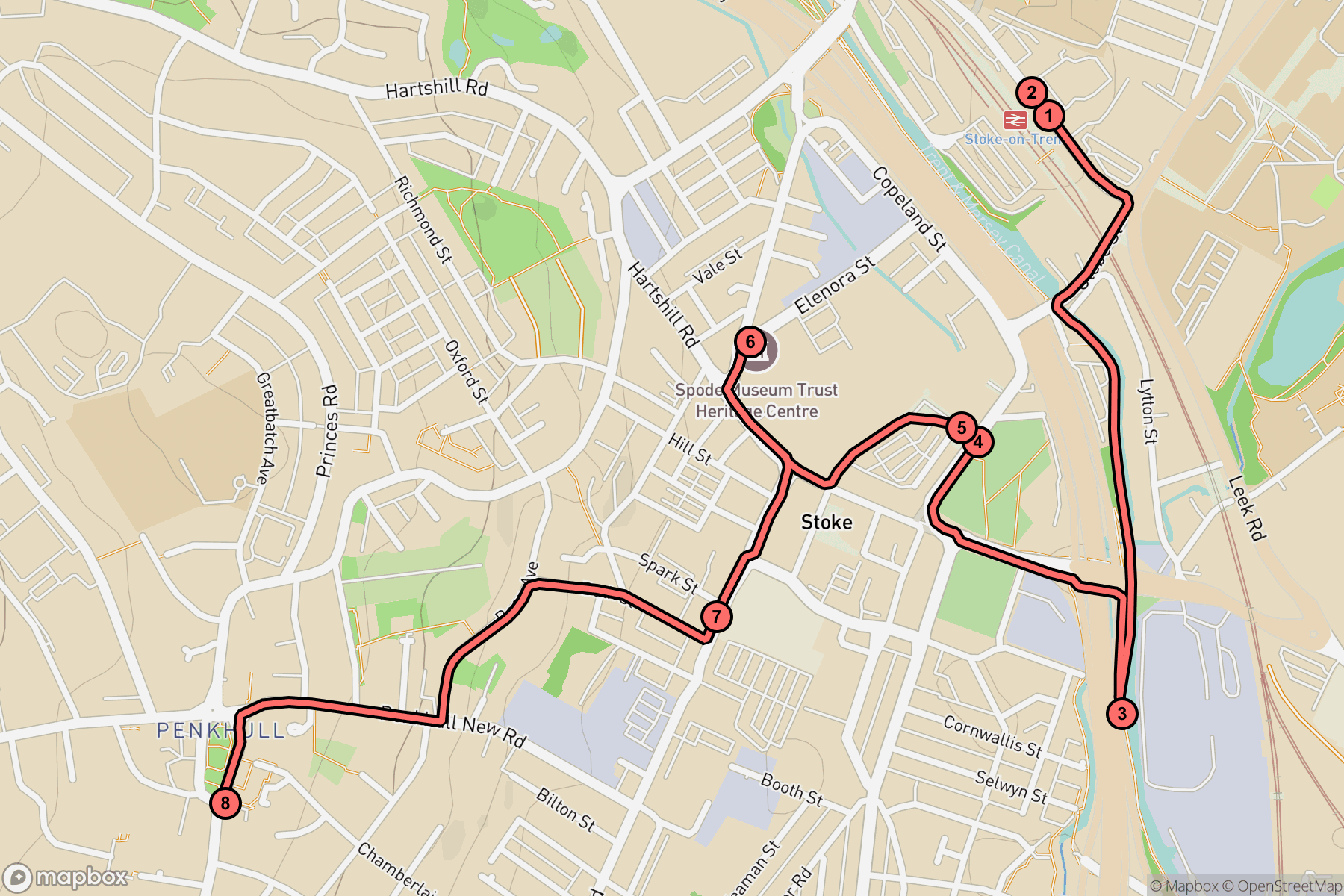
Stoke proper — a square kilometre between the Minster, the Spode works, the station, and the canal — was the engine room of the British ceramics industry. This tour is not about the great potters' families. It is about the throwers and paintresses, the kiln-firers and flint-grinders, the navvies who cut the canal and the boatmen who legged through Harecastle in the dark, the railwaymen who carried the finished ware south and the hotel staff who fed and housed them. It is about Potter's Rot, the workers' cottages Josiah Spode II built at minimum standard in Penkhull Square, the named casualties on the North Staffordshire Railway's war memorial, and the memorial school that Herbert Minton's workers' skills paid for.
Stoke-on-Trent railway station, Winton Square에서 시작
이 투어의 정류장
location_on
1
lock
Stoke-on-Trent railway stationThe Grade II*-listed Neo-Jacobean station designed by H.A. Hunt of London, begun in 1847 and opened for passengers on 17 April 1848. Built by the North Staffordshire Railway Company at a cost of £31,438. Until 1923, the building housed the NSR's boardroom and principal offices. The station entrance features a war memorial with brass nameplates naming NSR employees who died in the First World War.
location_on
2
lock
North Stafford HotelThe Grade II*-listed Jacobean-revival hotel built in 1849 for the North Staffordshire Railway Company to designs by H.A. Hunt, at a cost of £8,843. First tenant: John Cuff, who opened it in August 1849. By 1851 Henry Robert Shirreff, Cuff's nephew, had assumed management aged twenty-three; by 1861 the live-in staff had grown from 7 to 27.
location_on
3
lock
Trent and Mersey CanalThe towpath at the point where the Trent and Mersey Canal crosses the top of Glebe Street, north of the Town Hall. The canal opened in 1777 — the direct result of Josiah Wedgwood's lobbying — and ran from the River Trent at Derwent Mouth to the River Mersey at Runcorn, passing through Stoke and along the side of Wedgwood's Etruria factory village. The summit of the canal is nearby, at Etruria, where it meets the Caldon Canal.
location_on
4
lock
Stoke MinsterSt Peter ad Vincula — the parish church of Stoke, rebuilt on its present plan and consecrated in 1830. The churchyard contains the Grade II-listed tomb of Josiah Wedgwood (1730-1795), buried outside the church because he was a non-conformist. Inside, a marble memorial tablet by his friend and former employee John Flaxman. Around him in the register: the ordinary dead of a pottery town.
location_on
5
lock
Stoke Town HallThe Grade II*-listed classical Town Hall begun in 1834 to designs by Henry Ward, with the north wing completed around 1842. The largest and most imposing municipal building in the six towns. In 1847 a School of Design was opened in the south wing, sharing space with the Athenaeum. In 1843, the ground-floor north wing was given to the county police.
location_on
6
lock
Spode MuseumThe surviving warehouse complex and bottle-kiln stub on the north-west courtyard of the original Spode factory, established by Josiah Spode I in 1776 on a site that had operated as a pottery since at least 1751. The only major internationally-known pottery in the area to remain on its founding site throughout its operational history. At its Victorian peak, around a thousand workers and twenty-two bottle ovens.
자주 묻는 질문
투어는 어떻게 시작하나요?
구매 후 AudaTours 앱을 다운로드하고 교환 코드를 입력하세요. 투어를 바로 시작할 수 있습니다 - 재생을 탭하고 GPS 안내 경로를 따라가시면 됩니다.
투어 중 인터넷이 필요한가요?
아닙니다! 시작 전에 투어를 다운로드하면 완전히 오프라인으로 즐길 수 있습니다. 채팅 기능만 인터넷이 필요합니다. 모바일 데이터 절약을 위해 WiFi에서 다운로드하시는 것을 권장합니다.
이것은 가이드가 안내하는 단체 투어인가요?
아닙니다 - 이것은 셀프 가이드 오디오 투어입니다. 폰을 통해 오디오 나레이션을 들으며 나만의 속도로 독립적으로 탐험합니다. 투어 가이드도, 단체도, 일정도 없습니다.
투어는 얼마나 걸리나요?
대부분의 투어는 60-90분이 소요되지만, 속도는 전적으로 본인이 조절합니다. 원할 때 언제든지 일시정지하거나, 정류장을 건너뛰거나, 휴식을 취하세요.
오늘 투어를 끝낼 수 없으면 어떻게 하나요?
괜찮습니다! 투어는 평생 이용이 가능합니다. 원할 때 언제든지 일시정지하고 다시 시작하세요 - 내일, 다음 주, 또는 내년에도. 진행 상황이 저장됩니다.
어떤 언어를 이용할 수 있나요?
모든 투어는 50개 이상의 언어로 이용 가능합니다. 코드를 교환할 때 원하는 언어를 선택하세요. 참고: 투어 생성 후에는 언어를 변경할 수 없습니다.
구매 후 투어는 어디에서 이용하나요?
App Store 또는 Google Play에서 무료 AudaTours 앱을 다운로드하세요. 교환 코드(이메일로 전송됨)를 입력하면 라이브러리에 투어가 나타나며, 다운로드하여 시작할 수 있습니다.