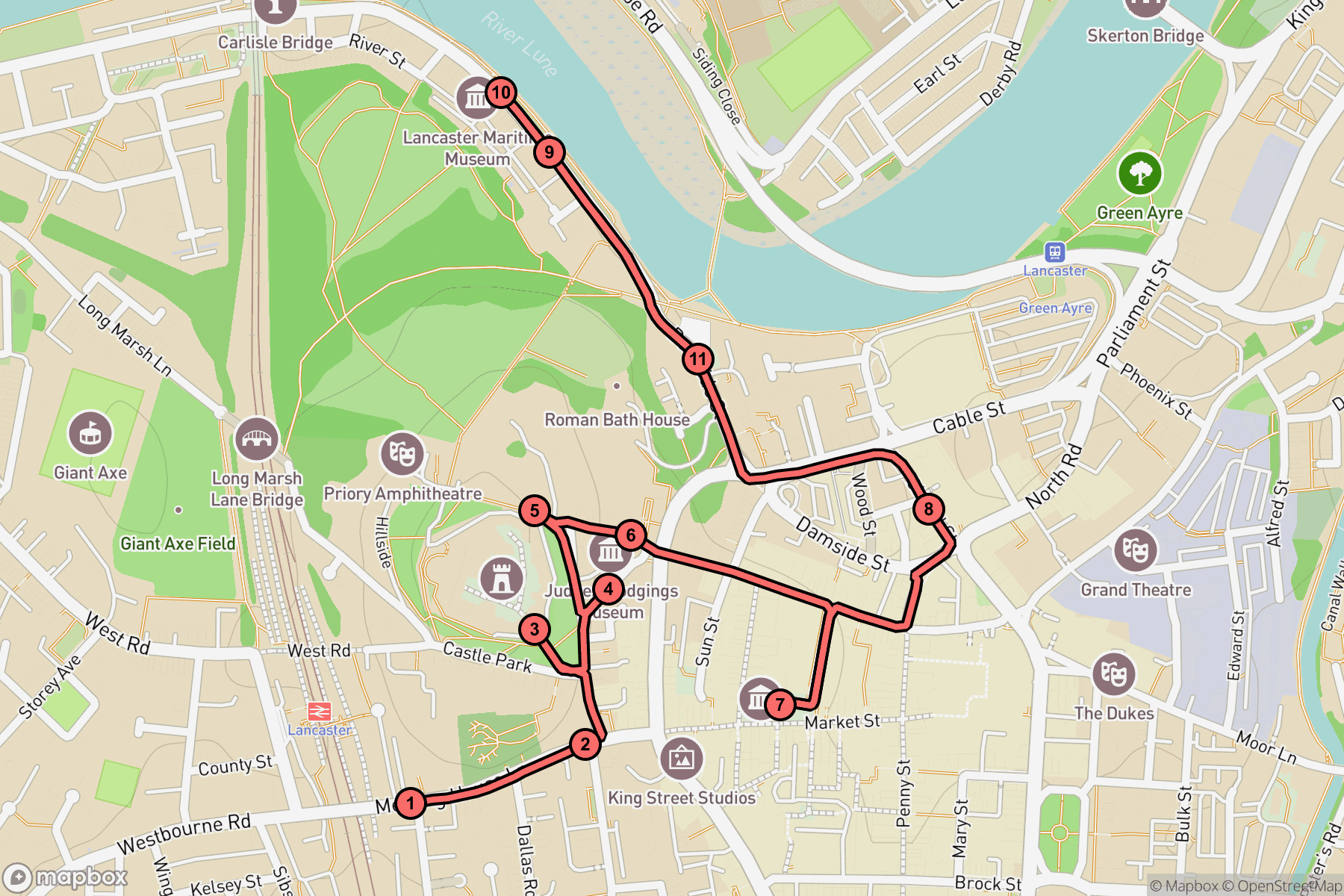
Quakers Religious Society of FriendsLancaster Quakers have met on this site since 1677, when the first Meeting House was built. The current structure dates to 1708, extended in 1779 and again in 1789–90. George Fox — founder of the Society of Friends — preached in Lancaster in 1652 and was tried for blasphemy at the castle, where he was acquitted. The Lancaster Quaker community became commercially prominent in the eighteenth century; many of its members were merchants involved in Atlantic trade. Among them were the Rawlinsons, who attended this Meeting House while co-owning the ships named in the Captured Africans memorial at Damside Street.
The StoreyBuilt between 1887 and 1891 as a replacement for the Lancaster Mechanics Institute — founded in 1824 by Lancaster industrialists to provide technical education for working people. Thomas Storey, a local cotton spinner and industrialist who had served as mayor in the year of Victoria's Golden Jubilee, gave £20,000 (approximately £2.7 million today) for a new building. Note: this Thomas Storey is distinct from Storey Brothers — the oilcloth firm founded in 1848 by William, Edward and Thomas Storey of a separate Lancaster family — whose workers appear later in the tour at Lune Mills. The Storey Institute contained a reading room, library, lecture room, laboratory, music room, picture gallery, school of art, and accommodation for a caretaker. Its purpose was 'the promotion of art, science, literature, and technical instruction' among the working population of Lancaster.
Lancaster CastleThe castle and former gaol whose gatehouse has been a working entrance for eight centuries. Thomas Covell — gaoler, six-time mayor of Lancaster — managed the prison in the early seventeenth century and kept the gaol during the 1612 Pendle witch trials. The Clerk of the Court Thomas Potts left detailed records of the nine women and men hanged here on 20 August 1612 after being convicted of causing the deaths of seventeen people. The castle operated as a working prison from 1196 until 2011, generating wages for generations of gaolers, turnkeys, matrons, and warders whose names survive only in the prison registers.
1 Castle HillThe site of Gillows' primary workshop and warehouse from 1770 to 1882 — the Castle Hill premises designed by Richard Gillow and operated as the nerve centre of the most important cabinet-making business outside London. Robert Gillow founded the firm in 1728 as a joiner, travelled to the West Indies in the 1720s and returned with samples of mahogany — among the first imported to Britain. By 1775 the Lancaster branch employed 42 workers; 137 apprentices passed through the workshop between 1731 and 1850. Richard Gillow, son of the founder, also designed the Custom House on St George's Quay.
Lancaster Priory Church of Saint MaryThe Priory Church of St Mary stands immediately beside the castle on Castle Hill, founded as a Benedictine priory by Roger de Poitou in 1094. The choir stalls — among the finest medieval woodwork in northern England — were carved in the early fifteenth century during a major reconstruction in the Perpendicular style after the priory was transferred to Syon Abbey in 1431. The craftsmen who cut them are anonymous; what survives is the detail of their work. The Rawlinson family tomb here — defaced during the Black Lives Matter protests — connects the church directly to the slave-trade wealth that funded much of Georgian Lancaster.
Judges Lodgings MuseumA Georgian town house built by Thomas Covell — the same Thomas Covell who managed Lancaster Castle — in the early seventeenth century. From 1826 it served as lodgings for the travelling judges of the Assize Courts at the nearby castle. In 1841, the housekeeper was Betty Bateson, who managed the household alongside her elderly mother Ann and a servant, Ester King. When Betty died in 1858 of heart failure, the advert placed for her successor specified 'not exceeding 40 years of age'. Her replacement was Ellen Leighton, who brought her father and nephew to live with her.