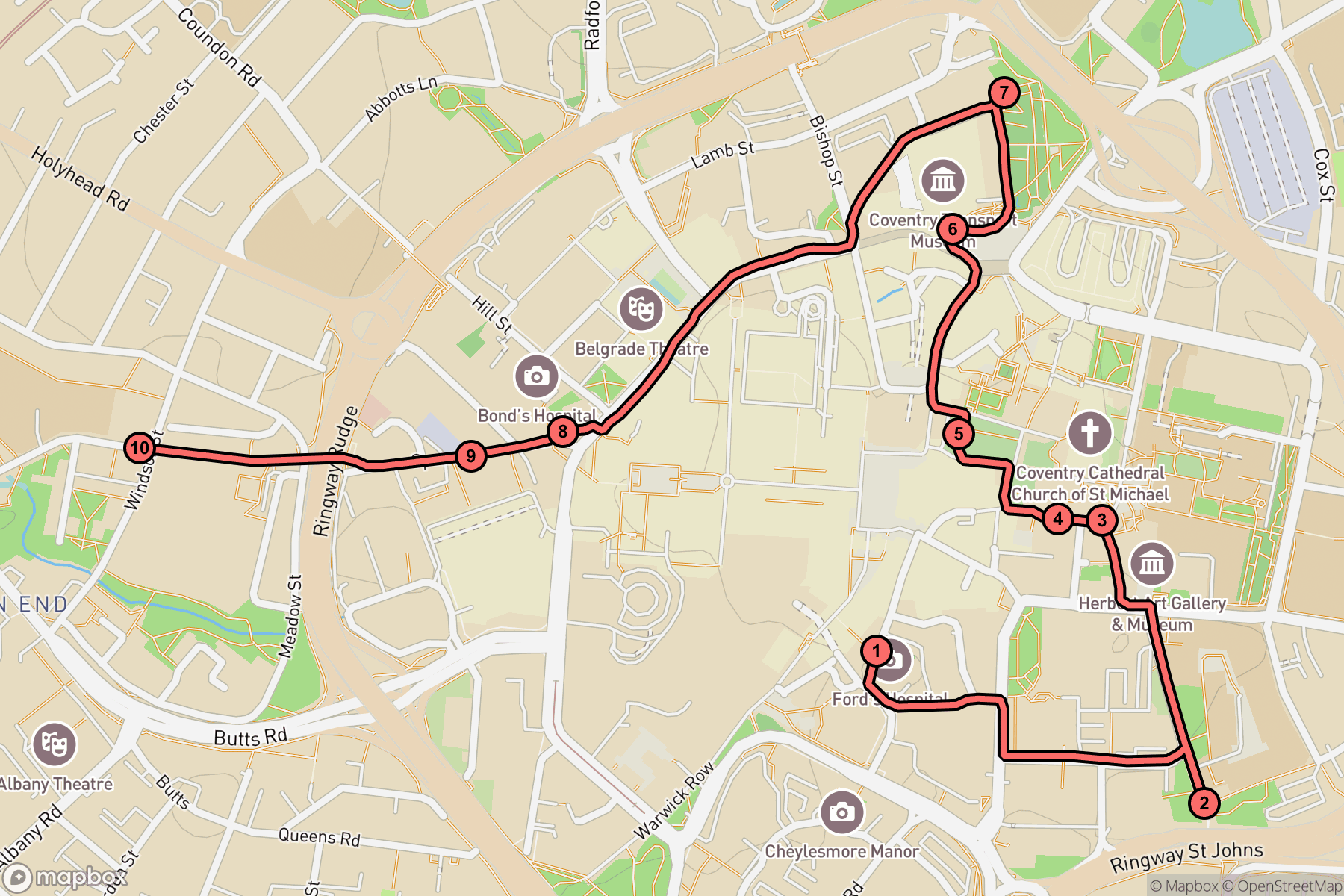
Coventry's spires and ruins belong to history. The streets between them belong to a different city — the narrow-loom weavers who lived and worked in the same three rooms, the dyers who produced a blue famed across Europe, the watchmakers who crowded Spon Street with their outworkers and their jewelling benches, the guild drapers and merchants who built almshouses for the elderly poor, the medieval craftsmen who staged mystery plays on wagons through the streets as an act of both worship and civic glory, the friars who put their names to a surrender document, the ward watchmen who rotated civic duty by trade, the cyclists and motor workers who made Coventry the workshop of the modern world, and Jock Forbes the cathedral stonemason who walked the roof on the worst night in Coventry's history and made a cross from the charred beams. This is the city that wove, wound, built and forgave.
Holy Trinity CoventryOne of the largest medieval parish churches in England, with a soaring early sixteenth-century spire. The interior contains the 'Coventry Doom' — a large-scale painting of the Last Judgement created in the 1430s above the tower arch. Covered in whitewash during the Reformation, discovered in 1831 and fully conserved and revealed in 2004. The painter is unknown. John Thornton of Coventry, whose International Gothic workshop style is associated with the city's medieval artistic tradition, may have been known to craftsmen who worked here — though no document links him to this specific building.
location_on
2
lock
St John the Baptist ChurchA medieval church on Fleet Street associated in popular tradition with the origin of the phrase 'sent to Coventry'. During the Civil War, Royalist prisoners were brought to the Parliamentary stronghold of Coventry c.1647; Edward Hyde's History of the Rebellion provides the first written record of the phrase. The church has medieval weaver and guild connections through the Spon Street parish. It was used as a prison for Royalist soldiers and a stable for Parliamentary horses during the Interregnum.
location_on
3
lock
Spon StreetOne of the most significant collections of medieval timber-framed buildings surviving in England, on a street first settled by weavers and dyers as early as the twelfth century. Twelve original buildings remain in situ on Spon Street; a further ten have been relocated here from demolished sites elsewhere in Coventry. The buildings functioned as live-work units: weavers, dyers, watchmakers, bicycle makers and car builders all traded from premises where they also lived.
location_on
4
lock
The Weaver's HouseA terrace of six cottages at 121 Upper Spon Street, built in 1455 by Coventry Priory as rent-paying live-work units. One cottage has been restored to show exactly how the narrow-loom weaver in whose name the 1540 cottage is restored — John Croke — and his family would have lived and worked: the loom on the upper floor, the family's entire domestic life in the three rooms below. At the back, a medieval garden shows the plants grown for food, medicine and household use. The Weaver's House is the only surviving working-weaver's interior in Coventry.
location_on
5
lock
Fords Hospital Alms HouseA Grade I listed half-timbered almshouse on Greyfriars Lane, founded by the merchant William Ford in the early sixteenth century to provide accommodation for six elderly poor people. After Ford's death, subsequent endowments extended it to provide shelter for couples. One of the finest examples of timber-framed domestic architecture surviving in England. Thomas Bond, a draper and Mayor of Coventry since 1497, founded his own almshouse nearby in 1506 — leaving money in his will for ten poor men and a woman attendant, who were required to attend church three times daily and pray for the founder and the Trinity Guild. Two named merchant-philanthropists, two sets of unnamed residents: the six and the ten elderly poor whose working lives built the cloth wealth that funded their shelter.
location_on
6
lock
St Mary's GuildhallBuilt between 1340 and 1342 on the site of a twelfth-century castle, St Mary's Guildhall was the meeting place of the Guild of St Mary and the Guild of Holy Trinity — the merchant associations that included the leading traders of medieval Coventry. The guilds performed the Corpus Christi mystery plays, ran the cloth and wool trade, and funded the building of almshouses. The hall contains one of the oldest tapestries in Britain, woven somewhere between 1505 and 1515, depicting Henry VI and the court — but no record survives of who commissioned or made it.
자주 묻는 질문
투어는 어떻게 시작하나요?
구매 후 AudaTours 앱을 다운로드하고 교환 코드를 입력하세요. 투어를 바로 시작할 수 있습니다 - 재생을 탭하고 GPS 안내 경로를 따라가시면 됩니다.
투어 중 인터넷이 필요한가요?
아닙니다! 시작 전에 투어를 다운로드하면 완전히 오프라인으로 즐길 수 있습니다. 채팅 기능만 인터넷이 필요합니다. 모바일 데이터 절약을 위해 WiFi에서 다운로드하시는 것을 권장합니다.
이것은 가이드가 안내하는 단체 투어인가요?
아닙니다 - 이것은 셀프 가이드 오디오 투어입니다. 폰을 통해 오디오 나레이션을 들으며 나만의 속도로 독립적으로 탐험합니다. 투어 가이드도, 단체도, 일정도 없습니다.
투어는 얼마나 걸리나요?
대부분의 투어는 60-90분이 소요되지만, 속도는 전적으로 본인이 조절합니다. 원할 때 언제든지 일시정지하거나, 정류장을 건너뛰거나, 휴식을 취하세요.
오늘 투어를 끝낼 수 없으면 어떻게 하나요?
괜찮습니다! 투어는 평생 이용이 가능합니다. 원할 때 언제든지 일시정지하고 다시 시작하세요 - 내일, 다음 주, 또는 내년에도. 진행 상황이 저장됩니다.
어떤 언어를 이용할 수 있나요?
모든 투어는 50개 이상의 언어로 이용 가능합니다. 코드를 교환할 때 원하는 언어를 선택하세요. 참고: 투어 생성 후에는 언어를 변경할 수 없습니다.
구매 후 투어는 어디에서 이용하나요?
App Store 또는 Google Play에서 무료 AudaTours 앱을 다운로드하세요. 교환 코드(이메일로 전송됨)를 입력하면 라이브러리에 투어가 나타나며, 다운로드하여 시작할 수 있습니다.

