Exeter's fame rests on its cathedral, its Roman walls and its role as the capital of the south-west. This tour belongs to the people those monuments required: the wool-workers whose trade made the city the third richest in England, the engineer who cut Britain's first pound-lock canal, the plasterer who decorated the Custom House ceiling, the masons who carved the Cathedral's longest medieval vault, the tunnel-diggers who plumbed the city's water supply through the rock, the Guildhall beadles who kept order for eight centuries, and the wardens who pulled people from the rubble when the Baedeker bombers came. They built the city; it rarely put their names on the plaques.
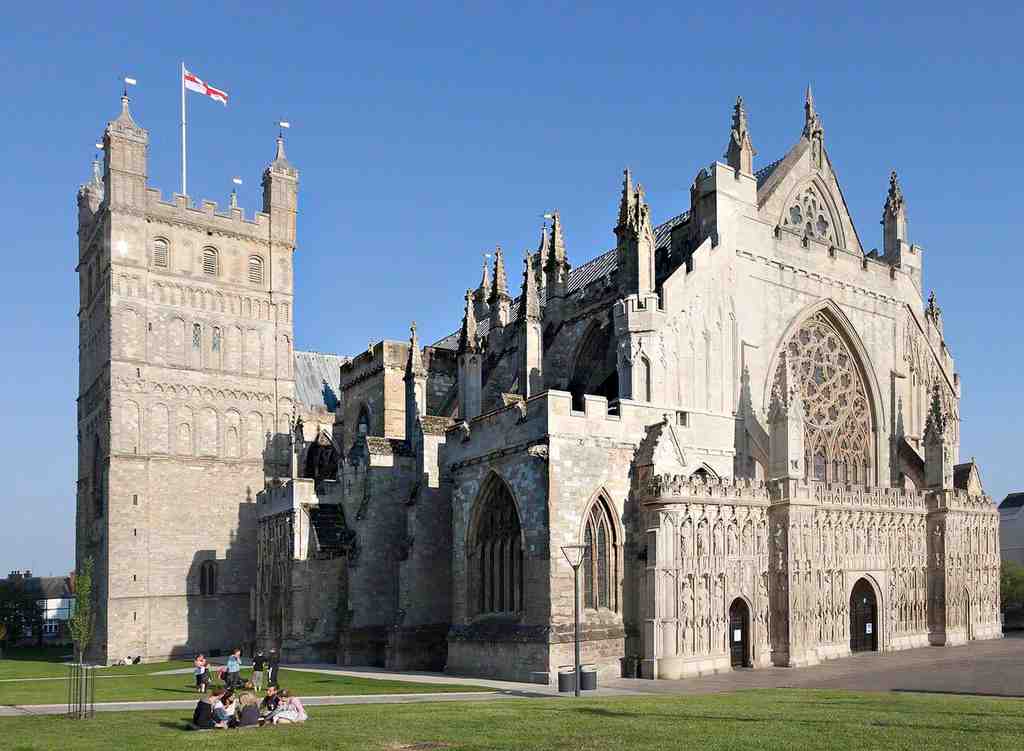
Exeter CathedralAnglican cathedral, and the seat of the Bishop of Exeter in England, UK
location_on
2
lock
The Devon & Exeter InstitutionA learned institution founded in 1813 in Cathedral Close, holding a library of 40,000 books devoted to Exeter and the West Country. Its first librarian was John Squance, who moved into the cottage at the rear in 1813; his daughter Eliza Squance went on to become the country's first professional female librarian from 1849. The building survived the Blitz and continues as a registered charity with over 700 members.
location_on
3
lock
Exeter Historic GuildhallThe oldest municipal building in continuous use in England, with origins in the civic record from the 12th century, a great hall roofed in 1467–69, and an elaborately carved oak door made by local carpenter Nicholas Baggett in 1593. The Guildhall has been the seat of Exeter's mayors, aldermen, quarter sessions and civic ritual without interruption for over eight centuries.
location_on
4
lock
Guildhall Shopping Centre ExeterThe central stretch of Exeter's High Street, rebuilt after the Blitz alongside the surviving medieval fabric. The Guildhall Shopping Centre occupies the site of a block that included the medieval Guildhall precinct. The High Street has been the city's commercial spine since the Roman forum stood nearby in the 1st and 2nd centuries.
location_on
5
lock
Custom House Visitor CentreThe 1680 canal warehouse at the heart of the Exeter Quayside, beside the Custom House — the first brick building in Exeter, designed by Richard Allen and plastered by John Abbot of Frithelstock, built in 1681 to serve the post-Civil-War wool-export boom. The canal that made this quay possible — Britain's first ship canal with pound locks, cut in 1566 by engineer John Trew of Glamorgan — brought vessels directly to this spot. Trew's Weir, named after its builder, still controls the water level today.
location_on
6
lock
Roman West GateThe site of Exeter's West Gate, demolished in 1815 — the gate where, during the Prayer Book Rebellion of 1549, a local man named John Newcombe thwarted a rebel attempt to blow up the entrance with gunpowder. The city's six-week siege by the Prayer Book rebels was one of the defining working-people's conflicts of the Tudor period.