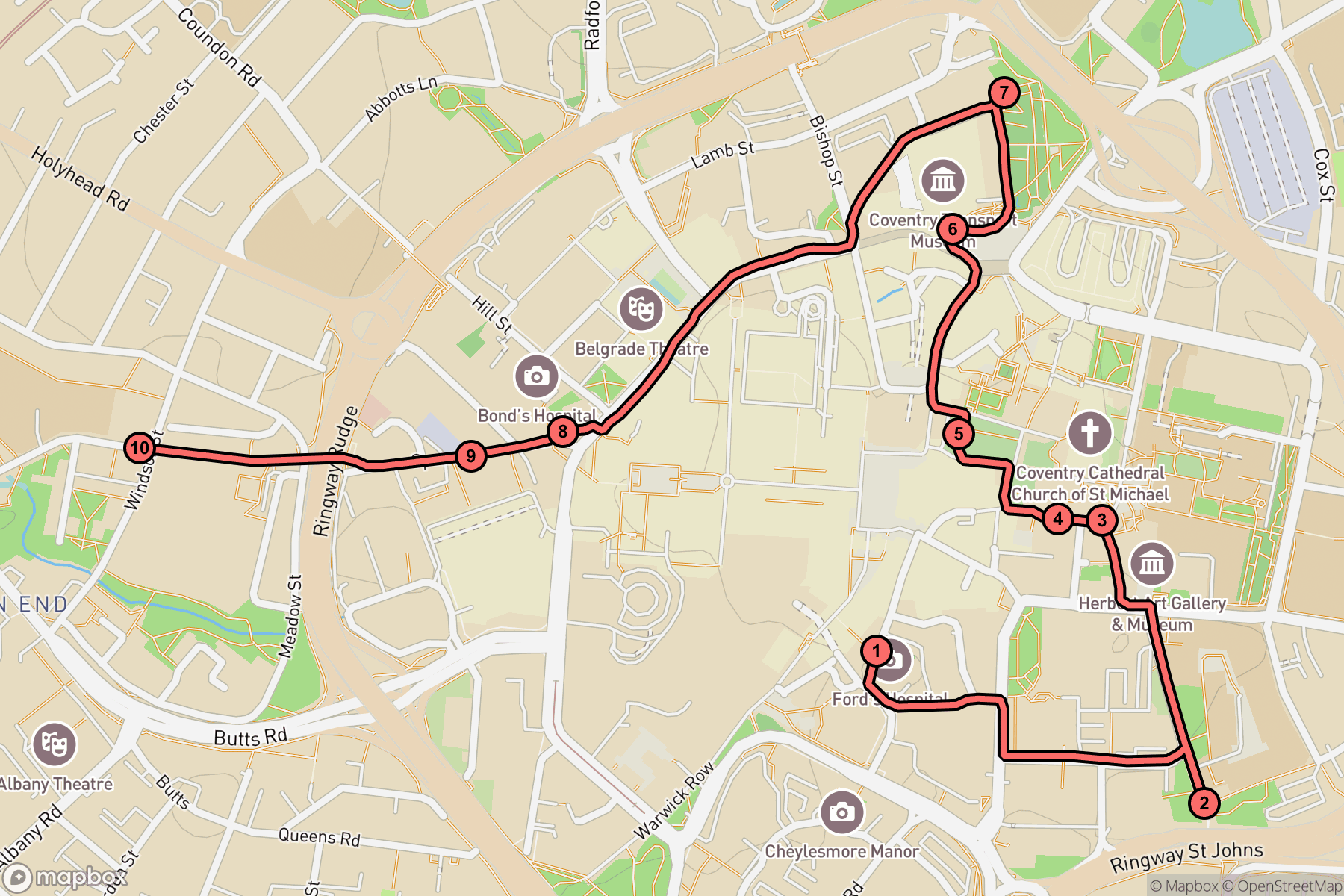
Coventry's spires and ruins belong to history. The streets between them belong to a different city — the narrow-loom weavers who lived and worked in the same three rooms, the dyers who produced a blue famed across Europe, the watchmakers who crowded Spon Street with their outworkers and their jewelling benches, the guild drapers and merchants who built almshouses for the elderly poor, the medieval craftsmen who staged mystery plays on wagons through the streets as an act of both worship and civic glory, the friars who put their names to a surrender document, the ward watchmen who rotated civic duty by trade, the cyclists and motor workers who made Coventry the workshop of the modern world, and Jock Forbes the cathedral stonemason who walked the roof on the worst night in Coventry's history and made a cross from the charred beams. This is the city that wove, wound, built and forgave.
Fonctionne hors ligneTéléchargez une fois, utilisez n'importe où
all_inclusive
Accès à vieRéécoutez n'importe quand, pour toujours
location_on
Commence à Holy Trinity Church, Coventry
Arrêts de ce tour
location_on
1
lock
Holy Trinity CoventryOne of the largest medieval parish churches in England, with a soaring early sixteenth-century spire. The interior contains the 'Coventry Doom' — a large-scale painting of the Last Judgement created in the 1430s above the tower arch. Covered in whitewash during the Reformation, discovered in 1831 and fully conserved and revealed in 2004. The painter is unknown. John Thornton of Coventry, whose International Gothic workshop style is associated with the city's medieval artistic tradition, may have been known to craftsmen who worked here — though no document links him to this specific building.
location_on
2
lock
St John the Baptist ChurchA medieval church on Fleet Street associated in popular tradition with the origin of the phrase 'sent to Coventry'. During the Civil War, Royalist prisoners were brought to the Parliamentary stronghold of Coventry c.1647; Edward Hyde's History of the Rebellion provides the first written record of the phrase. The church has medieval weaver and guild connections through the Spon Street parish. It was used as a prison for Royalist soldiers and a stable for Parliamentary horses during the Interregnum.
location_on
3
lock
Spon StreetOne of the most significant collections of medieval timber-framed buildings surviving in England, on a street first settled by weavers and dyers as early as the twelfth century. Twelve original buildings remain in situ on Spon Street; a further ten have been relocated here from demolished sites elsewhere in Coventry. The buildings functioned as live-work units: weavers, dyers, watchmakers, bicycle makers and car builders all traded from premises where they also lived.
location_on
4
lock
The Weaver's HouseA terrace of six cottages at 121 Upper Spon Street, built in 1455 by Coventry Priory as rent-paying live-work units. One cottage has been restored to show exactly how the narrow-loom weaver in whose name the 1540 cottage is restored — John Croke — and his family would have lived and worked: the loom on the upper floor, the family's entire domestic life in the three rooms below. At the back, a medieval garden shows the plants grown for food, medicine and household use. The Weaver's House is the only surviving working-weaver's interior in Coventry.
location_on
5
lock
Fords Hospital Alms HouseA Grade I listed half-timbered almshouse on Greyfriars Lane, founded by the merchant William Ford in the early sixteenth century to provide accommodation for six elderly poor people. After Ford's death, subsequent endowments extended it to provide shelter for couples. One of the finest examples of timber-framed domestic architecture surviving in England. Thomas Bond, a draper and Mayor of Coventry since 1497, founded his own almshouse nearby in 1506 — leaving money in his will for ten poor men and a woman attendant, who were required to attend church three times daily and pray for the founder and the Trinity Guild. Two named merchant-philanthropists, two sets of unnamed residents: the six and the ten elderly poor whose working lives built the cloth wealth that funded their shelter.
location_on
6
lock
St Mary's GuildhallBuilt between 1340 and 1342 on the site of a twelfth-century castle, St Mary's Guildhall was the meeting place of the Guild of St Mary and the Guild of Holy Trinity — the merchant associations that included the leading traders of medieval Coventry. The guilds performed the Corpus Christi mystery plays, ran the cloth and wool trade, and funded the building of almshouses. The hall contains one of the oldest tapestries in Britain, woven somewhere between 1505 and 1515, depicting Henry VI and the court — but no record survives of who commissioned or made it.
Foire aux questions
Comment commencer le tour ?
Après l'achat, téléchargez l'application AudaTours et entrez votre code de réduction. Le tour sera prêt à commencer immédiatement - il suffit d'appuyer sur lecture et de suivre l'itinéraire guidé par GPS.
Ai-je besoin d'Internet pendant le tour ?
Non ! Téléchargez le tour avant de commencer et profitez-en pleinement hors ligne. Seule la fonction de chat nécessite Internet. Nous recommandons de télécharger en WiFi pour économiser vos données mobiles.
S'agit-il d'une visite de groupe guidée ?
Non - il s'agit d'un audioguide en autonomie. Vous explorez indépendamment à votre propre rythme, avec une narration audio diffusée par votre téléphone. Pas de guide, pas de groupe, pas d'horaire.
Combien de temps dure le tour ?
La plupart des tours durent entre 60 et 90 minutes, mais vous contrôlez totalement le rythme. Faites des pauses, sautez des arrêts ou arrêtez-vous quand vous le voulez.
Et si je ne peux pas finir le tour aujourd'hui ?
Pas de problème ! Les tours disposent d'un accès à vie. Faites une pause et reprenez quand vous le souhaitez - demain, la semaine prochaine ou l'année prochaine. Votre progression est sauvegardée.
Quelles sont les langues disponibles ?
Tous les tours sont disponibles dans plus de 50 langues. Sélectionnez votre langue préférée lors de l'utilisation de votre code. Note : la langue ne peut pas être changée après la génération du tour.
Où accéder au tour après l'achat ?
Téléchargez l'application gratuite AudaTours sur l'App Store ou Google Play. Entrez votre code de réduction (envoyé par e-mail) et le tour apparaîtra dans votre bibliothèque, prêt à être téléchargé et commencé.
verified_user
Satisfaction garantie
Si vous n'appréciez pas le tour, nous vous rembourserons votre achat. Contactez-nous à [email protected]
Paiement sécurisé avec
Adoré par les voyageurs du monde entier
Des milliers de tours commencés. Plein d'avis.
4,8 sur l'App Store et Google Play. En voici quelques-uns qu'on adore relire.
starstarstarstarstar
Ce tour était un excellent moyen de voir la ville. Les histoires étaient intéressantes sans paraître trop scénarisées, et j'ai adoré pouvoir explorer à mon propre rythme.
J'ai commencé ce tour avec un croissant dans une main et zéro attente. L'application vibre tout simplement avec vous, pas de pression, juste vous, vos écouteurs et quelques histoires sympas.

