AudaTours logoAudaTours

Lancaster Audio Tour: Wages, Warrants and Warehouses

Guía de audio12 paradas

Lancaster's Georgian prosperity is written in stone — the Custom House, the Priory, the grand merchant houses on Castle Hill. But the story of who actually built, guarded, clerked, stocked and served this town belongs to a different set of names: the gaoler who managed the Pendle witch hangings, the housekeeper who outlived her judges, the cabinet apprentices who hand-cut mahogany legs in a Castle Hill workshop, the dock workers who loaded cargoes whose profits built the churches, the Quaker merchants who funded both chapels and slave ships, and the women who kept the linoleum looms running when the men went to war. Heritage Open Days 2026 theme is Everyday Histories — this tour names the unnamed.

Vista previa del tour

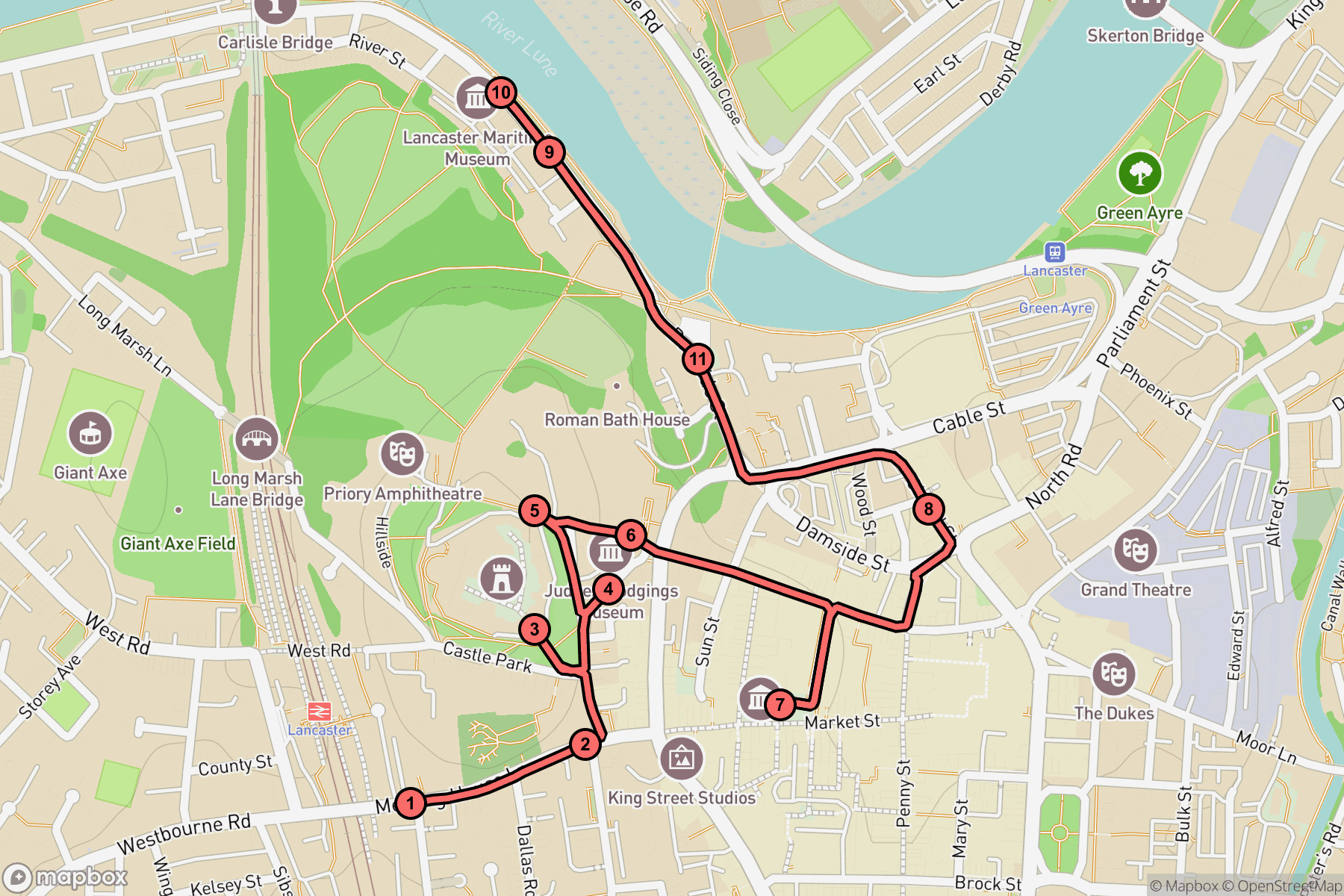
map

Sobre este tour

  • schedule
    Duración 30–50 minsVe a tu propio ritmo
  • straighten
    2.6 km de ruta a pieSigue el camino guiado
  • location_on
  • wifi_off
    Funciona sin conexiónDescarga una vez, úsalo en cualquier lugar
  • all_inclusive
    Acceso de por vidaReprodúcelo en cualquier momento, para siempre
  • location_on
    Comienza en Lancaster Castle, Castle Parade, Lancaster

Paradas en este tour

location_on
1
lock
Lancaster CastleThe castle and former gaol whose gatehouse has been a working entrance for eight centuries. Thomas Covell — gaoler, six-time mayor of Lancaster — managed the prison in the early seventeenth century and kept the gaol during the 1612 Pendle witch trials. The Clerk of the Court Thomas Potts left detailed records of the nine women and men hanged here on 20 August 1612 after being convicted of causing the deaths of seventeen people. The castle operated as a working prison from 1196 until 2011, generating wages for generations of gaolers, turnkeys, matrons, and warders whose names survive only in the prison registers.
location_on
2
lock
Captured Africans Memorial, Damside Street, LancasterA sandstone, acrylic and steel sculpture on the quayside at Damside Street, completed in 2005 and designed by Kevin Dalton-Johnson. It was the first memorial in the United Kingdom specifically dedicated to the Africans enslaved in the transatlantic slave trade. The base features a mosaic map of the eighteenth-century world showing the triangular route between West Africa, Lancaster and the Americas; the sculpture names each of the slave ships that passed through the port, their captains, and the number of enslaved people on board. Thomas Hodgson and his brother John were involved in the trade for over thirty years and between 1763 and 1791 were involved in the capture and sale of approximately 14,000 people.
location_on
3
lock
Lancaster Priory Church of Saint MaryThe Priory Church of St Mary stands immediately beside the castle on Castle Hill, founded as a Benedictine priory by Roger de Poitou in 1094. The choir stalls — among the finest medieval woodwork in northern England — were carved in the early fifteenth century during a major reconstruction in the Perpendicular style after the priory was transferred to Syon Abbey in 1431. The craftsmen who cut them are anonymous; what survives is the detail of their work. The Rawlinson family tomb here — defaced during the Black Lives Matter protests — connects the church directly to the slave-trade wealth that funded much of Georgian Lancaster.
location_on
4
lock
Judges Lodgings MuseumA Georgian town house built by Thomas Covell — the same Thomas Covell who managed Lancaster Castle — in the early seventeenth century. From 1826 it served as lodgings for the travelling judges of the Assize Courts at the nearby castle. In 1841, the housekeeper was Betty Bateson, who managed the household alongside her elderly mother Ann and a servant, Ester King. When Betty died in 1858 of heart failure, the advert placed for her successor specified 'not exceeding 40 years of age'. Her replacement was Ellen Leighton, who brought her father and nephew to live with her.
location_on
5
lock
1 Castle HillThe site of Gillows' primary workshop and warehouse from 1770 to 1882 — the Castle Hill premises designed by Richard Gillow and operated as the nerve centre of the most important cabinet-making business outside London. Robert Gillow founded the firm in 1728 as a joiner, travelled to the West Indies in the 1720s and returned with samples of mahogany — among the first imported to Britain. By 1775 the Lancaster branch employed 42 workers; 137 apprentices passed through the workshop between 1731 and 1850. Richard Gillow, son of the founder, also designed the Custom House on St George's Quay.
location_on
6
lock
Quaker Meeting HouseLancaster Quakers have met on this site since 1677, when the first Meeting House was built. The current structure dates to 1708, extended in 1779 and again in 1789–90. George Fox — founder of the Society of Friends — preached in Lancaster in 1652 and was tried for blasphemy at the castle, where he was acquitted. The Lancaster Quaker community became commercially prominent in the eighteenth century; many of its members were merchants involved in Atlantic trade. Among them were the Rawlinsons, who attended this Meeting House while co-owning the ships named in the Captured Africans memorial at Damside Street.

Preguntas frecuentes

¿Cómo empiezo el tour?

Después de la compra, descarga la app AudaTours e ingresa tu código de canje. El tour estará listo para comenzar de inmediato - solo toca play y sigue la ruta guiada por GPS.

¿Necesito internet durante el tour?

¡No! Descarga el tour antes de empezar y disfrútalo completamente sin conexión. Solo la función de chat requiere internet. Recomendamos descargar en WiFi para ahorrar datos móviles.

¿Es un tour guiado en grupo?

No - esta es una audioguía autoguiada. Exploras de forma independiente a tu propio ritmo, con narración de audio reproduciéndose en tu teléfono. Sin guía, sin grupo, sin horario.

¿Cuánto dura el tour?

La mayoría de los tours toman 60–90 minutos para completar, pero tú controlas el ritmo completamente. Pausa, salta paradas o toma descansos cuando quieras.

¿Qué pasa si no puedo terminar el tour hoy?

¡No hay problema! Los tours tienen acceso de por vida. Pausa y continúa cuando quieras - mañana, la próxima semana o el próximo año. Tu progreso se guarda.

¿Qué idiomas están disponibles?

Todos los tours están disponibles en más de 50 idiomas. Selecciona tu idioma preferido al canjear tu código. Nota: el idioma no se puede cambiar después de generar el tour.

¿Dónde accedo al tour después de comprarlo?

Descarga la app gratuita AudaTours desde App Store o Google Play. Ingresa tu código de canje (enviado por email) y el tour aparecerá en tu biblioteca, listo para descargar y comenzar.

verified_user
Satisfacción garantizada

Si no disfrutas el tour, te reembolsamos tu compra. Contáctanos en [email protected]

Paga de forma segura con

Apple PayGoogle PayVisaMastercardPayPal
Amado por viajeros de todo el mundo

Miles de tours comenzados.
Y muchas opiniones.

4.8 en App Store y Google Play. Estos son los comentarios a los que siempre volvemos.

starstarstarstarstar
Esta fue una forma sólida de conocer Brighton sin sentirme como un turista. La narración tenía profundidad y contexto, pero no se excedía.
starstarstarstarstar
Empecé este tour con un croissant en una mano y cero expectativas. La app simplemente vibra contigo, sin presión, solo tú, tus auriculares y algunas historias geniales.
download Descargar la app

Ponte los auriculares.
Sal a la calle.

Gratis para descargar. Tours en cada ciudad. Empieza en 60 segundos — sin cuenta, sin tarjeta.

Download on the App StoreGet it on Google Play
starstarstarstarstar_half
4.8
AudaTours app icon
headphones
~ 4 min hasta que empiece tu primer tour
public
1,000+ ciudades en todo el mundo
all_inclusive
AudaTours
Unlimited

Cada tour. Cada ciudad. Una suscripción.

3323 tours2270 ciudades139 países50+ idiomas

