AudaTours logoAudaTours

Funchal Audio Tour: Caminos Atemporales y Susurros de Palacio

Guía de audio13 paradas

Las palomas sobrevuelan antiguas torretas mientras la brisa marina susurra secretos por las calles soleadas de Funchal; el corazón de esta ciudad esconde historias que la mayoría de los viajeros nunca escuchan. En este audioguía autoguiado, descubre historias talladas en grandes palacios y catedrales resonantes. Pasea a tu propio ritmo, descubriendo momentos de rebelión, intriga y asombro que yacen justo debajo de la superficie. ¿Quién planeó una fuga a medianoche a través de los muros fortificados del Palácio de São Lourenço? ¿Por qué los susurros de traición rompieron la paz dentro de la Diócesis de Funchal hace siglos? ¿Qué vidriera de la Catedral de Funchal guarda el recuerdo de un milagro olvidado? Deja que la curiosidad marque el ritmo mientras callejones escondidos y fachadas majestuosas se despliegan bajo una nueva luz. Entra en cámaras que una vez estuvieron llenas de escándalo y pisa donde el poder cambió de manos en tenso silencio. Cada giro trae un pulso de drama y descubrimiento. Pulsa reproducir y adéntrate en las sombras donde esperan las verdaderas historias de Funchal.

Vista previa del tour

map

Sobre este tour

  • schedule
    Duración 40–60 minsVe a tu propio ritmo
  • straighten
    2.8 km de ruta a pieSigue el camino guiado
  • location_on
    UbicaciónFunchal, Portugal
  • wifi_off
    Funciona sin conexiónDescarga una vez, úsalo en cualquier lugar
  • all_inclusive
    Acceso de por vidaReprodúcelo en cualquier momento, para siempre
  • location_on
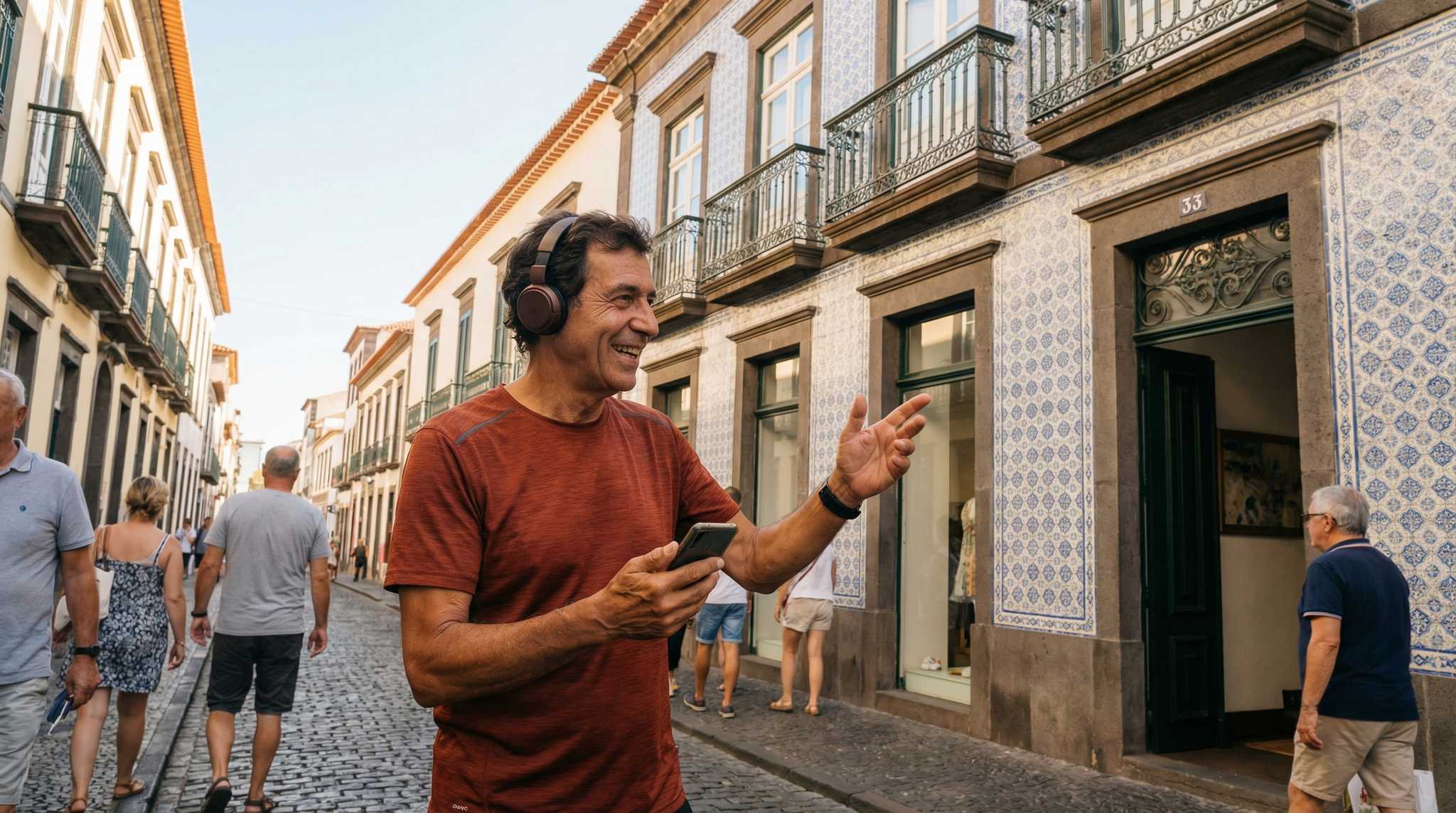
    Comienza en Edificio en Rua do Carmo, n.º 33

Paradas en este tour

  1. To spot the building at Rua do Carmo, n.º 33, just look for a three-story cream-colored façade with fancy pointed trim at the top and a row of rounded arched windows above two…Leer másMostrar menos

    To spot the building at Rua do Carmo, n.º 33, just look for a three-story cream-colored façade with fancy pointed trim at the top and a row of rounded arched windows above two shopfronts-it really stands out from its neighbors! Welcome, intrepid explorer, to one of Funchal’s most mysterious and debated buildings! If you’re standing outside and peering up, you’ll notice those elegant horseshoe arches and the rows of windows that almost look like they’re winking at you. Some people say this place is a “hidden synagogue,” but the truth is more tangled than a bowl of spaghetti left out in the Funchal sun. Let’s wind the clock back to the 1880s, when this spot was busy with the comings and goings of travelers at the Hotel Lisbonense. Later, it was home to piano lessons courtesy of Madame Fuchs-all the way from Hamburg, no less. The building as you see it rose up after the turn of the 20th century, filling Rua do Carmo with fresh walls, topped by that distinctive row of decorative crenellations. Listen closely-can you hear the tinkling of a distant piano? The grand story about it being a synagogue? That tale first took flight because of those arched windows and architectural flourishes, suspected to be inspired by Portugal’s most famous synagogue in Lisbon. Some even credited Miguel Ventura Terra, the genius behind the Lisbon synagogue, as the designer here. The only catch? By the time Terra ever set foot in Funchal, the building was already standing, probably looking smug about its own mysterious origins! Even a prominent local historian scratched his head and said, “Sinagoga? Never heard of one here!” The actual evidence is as rare as rainfall in August. Throughout the decades, this building lived through waves of different lives. In the early 1900s, you might have caught the ring of a bell signaling the start of business for William Reid’s telephone branch. By the 1950s, you could have browsed auctions or perhaps considered renting an apartment-imagine getting a 10-room flat with a terrace, a kitchen, and a full bath all announced in the local paper! Sometimes even the local police set up shop here, and for a moment, this was the HQ for the Basket and Volleyball Associations. There was even a time, in the wild throes of Portugal’s 1975 revolution, when the offices buzzed with political plotting. Meanwhile, the ground floor was always being reborn. In the 1960s, you’d smell soap and fresh laundry from the “Lavandaria Brasileira”-the island’s claim for the oldest laundry, bustling next door to a café or shop selling eggs, barley, or fresh pastries depending on the year. Pastelaria Estrela do Carmo still tempts anyone nearby with sweets today! Residents came and went-one even won a Toyota in a beer company raffle, right here in this very building. There have been tailors and accountants, clinics for little ones who’d returned from Angola, and even-no joke-a spot where the neighborhood’s best-dressed folks got their high-fashion trousers professionally hemmed. Through it all, whispers of its “secret synagogue” past clung to the arches and the six-pointed star above the door, but no one’s found the real proof. All that remains are stories, rumors, and the echo of centuries of ordinary lives in an extraordinary home. So as you stand here, let your mind wander: Wonder about the mysteries shut behind those old doors, listen for the echoes of auctions, debates, and delicately played piano keys, and imagine what tales the stones might tell-if only walls could talk!

    Abrir página dedicada →
  2. To spot the Diocese of Funchal, look for a grand, fortress-like building with striking reddish-brown stonework and crisp white side walls, crowned by a rose window and a tall,…Leer másMostrar menos

    To spot the Diocese of Funchal, look for a grand, fortress-like building with striking reddish-brown stonework and crisp white side walls, crowned by a rose window and a tall, clock-towered bell steeple to the left. Now, let your imagination whisk you back to the early 1500s, where the warm Madeiran sunlight glistens off the stone and the chatter of city folk fills the air. Picture yourself standing right where it all began: the seat of a diocese so powerful and vast it once stretched over much of the known world! I promise, the story of the Diocese of Funchal is bigger than its front doors-and that says something! In 1514, Funchal’s little village heart was pounding with excitement because, drumroll, it was declared a city! King Manuel I and Pope Leo X worked together on this grand upgrade, and the Diocese of Funchal was born with a mighty papal bull-no, not a real bull, just a very important letter! Suddenly, this diocese wasn’t just a tiny island affair. Its bishop ruled over all the Portuguese lands across the Atlantic and Indian Oceans, from Brazil to Goa to Africa-talk about a travel headache! It quickly became the world’s largest metropolitan ecclesiastical province, with suffragans in places you’d need a dozen maps to find. The first bishop, D. Diogo Pinheiro, even got to call himself the Primate-just imagine the business cards. But power can be as fleeting as a seagull’s attention span. In 1533 the diocese was made an archdiocese, but only for 22 years-blink and you’d miss it-before being slimmed back down and tucked as a simple suffragan under Lisbon. Still, its impact could be felt everywhere. When plague struck Funchal in 1521, the city turned to faith for hope. In a scene right out of a medieval lottery, a young boy named John drew the name of St. James the Less from a basket to be the city's new patron saint. The city erupted in celebration, hoping for a little less sickness and a lot more joy. Since then, the first of May has meant annual festivities, mass, and procession in honor of St. James-picture a swirl of robes and incense rolling out the cathedral doors each year. Now, the bishops of Funchal were an adventurous bunch. Some rarely even set foot on these cobbled streets, ruling from afar, like stubborn pen pals. It wasn’t until 1558 that Bishop Jorge de Lemos decided to finally unpack his suitcases and reside on the island full-time. Over five centuries, only two local Madeirans have ever led the flock, such as D. Aires de Ornelas e Vasconcelos, who went on to even greater heights as Archbishop of Goa. The seat of this mighty diocese is none other than the Cathedral of Our Lady of the Assumption-right behind you! The Diocese wasn’t just about prayers and processions-it also shaped education, running schools for all ages, from the Superior School for Nursing José de Cluny to schools on distant Porto Santo Island. And let’s not forget culture! The old Episcopal Palace, now the Sacred Art Museum, is packed to its rafters with paintings, goldsmith work, and treasures by Flemish masters. Over the years, these works survived time and travel, from Lisbon restorers to museum showcases, where today they dazzle art lovers from around the globe. Even today, the Diocese embraces music, opening its historic churches to the organ festival-so you might catch grand music floating through these old stone walls if you’re lucky. And if you need a bit of news, they run their own radio station and online newspaper, keeping everyone up to date. So as you stand beneath this ancient entrance, remember: this place isn’t just a building-it’s the heart and history of a community that’s shaped islands and continents alike. And isn’t it funny how a place so rooted in tradition can still feel like the center of something new? That’s Funchal for you… always a step ahead, or at least a saint ahead! Seeking more information about the choice of patron saint, schools or the culture? Ask away in the chat section and I'll fill you in.

    Abrir página dedicada →
  3. To spot the Cathedral of Funchal, look for a sturdy, square-fronted building made of reddish volcanic stone blocks, with a large wooden door and a rose window set above, while a…Leer másMostrar menos

    To spot the Cathedral of Funchal, look for a sturdy, square-fronted building made of reddish volcanic stone blocks, with a large wooden door and a rose window set above, while a tall clock-tower with a pointy roof rises just to its left. Now, imagine the year is 1486, and the people of Funchal are bustling about, carrying blocks of volcanic rock under the hot Madeiran sun-no easy task, especially when your shoes are probably not much better than fancy socks! This was the start of a new church, ordered by the Duke of Viseu-future King Manuel I-at a time when Funchal was turning from a sleepy sugarcane field into the beating heart of Madeira. Of course, no great project goes off without a hitch, and this one was no exception. Political bickering, arguments over overseas territories, and a royal piggy bank running low delayed things time and again. The town’s leaders debated and huffed and puffed over whether they should just extend an old church or build a grand, brand new one. Eventually, they chose this spot-the “Chão do Duque,” once muddy from all those sugar experiences-and set their sights on something truly ambitious. As the sounds of hammers and saws filled the air, plans for Madeira’s very own bishopric took shape, a big move for an island at the edge of the known world. Building this cathedral was a community effort. Skilled craftsmen, royal carpenters, and everyday locals all got involved, their sweat and hopes working their way into every stone. They even brought in Pêro Anes, a royal carpenter, who introduced clever mainland techniques-think of him as the “DIY king” of early Portugal. To pay for all of this, the king funneled customs revenues and donations from local people and church brotherhoods, along with profits from new towns like Ponta do Sol. By 1508, the sturdy walls you see in front of you were complete, and Funchal earned its title as a city. The bishop gave his blessing, the church officially opened for Mass, and just as things got rolling, the Pope himself made it official: this was now the Cathedral of the Diocese of Funchal. It even earned the nickname, the “Diocese of the Discoveries,” as Madeira became a crucial part of Portugal’s epic voyages and global ambitions. Now, take in the gothic style-the three wide naves, the golden cedar-wood ceiling inspired by Arabic art, and choir stalls decorated with saints, prophets, and even a cheeky cherub or two showing off bananas and wineskins. Don’t miss the silver processional cross-one of King Manuel’s masterpieces of silverwork! And if you have super-powered vision, look at the handcrafted arches and wooden sculptures, some still bearing traces of the original artists’ hands. Over the centuries, this cathedral has seen popes visit, city life bloom, and-believe it or not-a statue of Pope John Paul II even relocated right outside as a reminder of his 1991 visit. Funchal’s Cathedral is a patchwork of local rock, royal ambition, and generations of everyday islanders who gave it life. It stands as a monument not only to faith, but to Madeira’s journey from a forgotten field of sugarcane to the front lines of the Age of Discoveries.

    Abrir página dedicada →
Mostrar 10 paradas másMostrar menos paradasexpand_moreexpand_less
  1. In front of you, Columbus Square is easy to spot-just look for the cluster of cheerful yellow buildings with green shutters circling a bright, open plaza, their sunlit facades…Leer másMostrar menos

    In front of you, Columbus Square is easy to spot-just look for the cluster of cheerful yellow buildings with green shutters circling a bright, open plaza, their sunlit facades impossible to miss against the blue sky. Welcome to Praça de Colombo-locally, some folks just call it the “Yellow Square!” This square might look modern, but oh, it’s simmering with adventure and more than a hint of drama. Picture yourself back in 1498: rumor has it, right on this spot, Christopher Columbus himself once rested his weary explorer’s boots in a grand old mansion after a long sea journey-probably savoring some local sugar cane, or maybe even daydreaming of new continents to get lost on! That very house belonged to João Esmeraldo, whose name now hugs the square to the east. Over the centuries, noble palaces rose and fell here, only to be torn down for warehouses and shops that packed the square with the hum of island business. Then, in the 1970s, disaster struck-a massive fire swept the area, leaving only ruins and memories clinging to the walls. Not one to let a good story burn out, the city rolled up its sleeves in the 1980s, demolished what was left, and started fresh. During rebuilding, archaeologists even uncovered ancient treasures, some now on show at the Sugar Museum just nearby. Now, the square sparkles with new life and color. Not bad for a place once left in ashes, right?

    Abrir página dedicada →
  2. Straight ahead, you’ll recognize Largo da Restauração by its beautiful stone fountain at the center, bright streamers overhead, and the lively patchwork of shady palm trees right…Leer másMostrar menos

    Straight ahead, you’ll recognize Largo da Restauração by its beautiful stone fountain at the center, bright streamers overhead, and the lively patchwork of shady palm trees right where two busy avenues meet. Now, picture yourself in Funchal, June of 1834. The air buzzes with excitement-cheers erupting as news spreads: the liberals have won, the constitutional monarchy is restored, and the days of absolutist rule are over. The “square of restoration” celebrates this moment when locals gathered right on this spot after D. Miguel finally surrendered and packed his royal bags for exile. But don’t think it was always calm here! Before all the commotion, this was the site of the famous Casa de Ópera, where high society enjoyed music and drama, until a rather grumpy governor ordered it torn down in 1833. In its place today stands the noble stone fountain, carved from the sturdy rock of Câmara de Lobos in 1941-the perfect centerpiece. And if you visit at Christmas, you’ll marvel at a giant nativity built right over the fountain, surrounded by a miniature Madeiran village. For years, this square was also the stage for the quirky Lagartixa Fair, where antiques, trinkets, and crafts created a maze for bargain hunters. Every corner here has a story-sometimes dramatic, often festive, and always unforgettable!

    Abrir página dedicada →
  3. To spot the São Lourenço Palace, look for a long white fortress with thick walls, a row of green shuttered windows above, and a round corner tower poking up-right where the bright…Leer másMostrar menos

    To spot the São Lourenço Palace, look for a long white fortress with thick walls, a row of green shuttered windows above, and a round corner tower poking up-right where the bright palace holds court over the old cobblestone street. Now, as you’re standing here, let your imagination take you back through time-right into the heart of action, intrigue, and a few royal headaches. This mighty fortress and palace has stood guard over Funchal since the 1500s, when pirates wouldn’t think twice about paying an unwanted visit. Imagine the air filled with shouts, the clang of hammers, and the nervous glances of townsfolk as a new master builder, Mateus Fernandes, worked feverishly to make these thick walls and sturdy towers, all while everyone kept an eye out for trouble on the horizon. Back in 1566, French corsairs raided Funchal, so everyone agreed-bigger walls, more towers, and a fortress that no enemy could easily take. Picture huge stone blocks hauled into place, and the scent of mortar thick in the air. At one point, this fortress was surrounded by a rectangular curtain wall, with four strong towers-two facing the sea and two watching over the town, ready to unleash cannon fire on any would-be invader. But this wasn’t just a fort-oh no, you’d also find grand halls and lush gardens inside. Through the years, it became the bouncing baby of both defense and luxury. It sheltered governors, captains, and later, civil rulers. In the 17th century, the Spanish ruled Madeira during the Philippine Dynasty. The fortress’ watchful guns and cool cellars held Castilian soldiers, and later Portuguese nobles. There’s even a record of a fierce-looking image of São Lourenço being added above the main gate, which gave this place its lasting name. During the long, dramatic years that followed, including a fiery blaze in 1699, it was always being rebuilt, expanded, or reimagined. Hear the crackling of flames as the residence caught fire, forcing new renovations and even grander living quarters. The 18th century saw ornate salons sprout up-think high ceilings and opulent décor, where balls and important gatherings filled the air with music and laughter. The defensive elements became less important, as the palatial beauty stole the spotlight, and the governor’s parties were almost as famous as the walls themselves. In the 19th century, the British made a surprise cameo during the Napoleonic Wars! For a while, the Union Jack flew overhead and British officers made themselves quite at home, probably wondering how the local wine compared to the stuff back in London. The grand staircases you see today were reimagined; even the gardens grew in elegance, with a neat little pond-until, sadly, tragedy struck and the pond was filled in after an unhappy accident. When civil war and political turmoil struck Portugal, this palace was commandeered by revolutionaries, soldiers, and all manner of bigwigs. At times, it was even a prison-so let’s just say these walls have heard as much plotting as a whole season of your favorite drama. After rougher times, the 20th century brought new restoration, and by 1943, this palace was declared a national monument. Today, it remains the official residence for the Republic’s representative on Madeira-a symbol of strength, style, and a touch of royal flair. So as you look at its white walls, imagine all the stories trapped inside. From cannon blasts to ballroom dances, pirate threats to peaceful gardens-this place is the very heart of Funchal’s history, always ready to protect, impress, and maybe throw a legendary party!

    Abrir página dedicada →
  4. Look to your left, and you’ll spot the Praça do Povo as a wide, open garden promenade lined with geometric lawns and paths right next to the sparkling blue Atlantic, with the city…Leer másMostrar menos

    Look to your left, and you’ll spot the Praça do Povo as a wide, open garden promenade lined with geometric lawns and paths right next to the sparkling blue Atlantic, with the city rising up the hillside in the background. Now, take a deep breath and imagine the salty sea breeze whipping past your face as you stand here on ground that wasn’t always here. Praça do Povo is one of Funchal’s youngest squares, only opened in 2014, and it has already become the city’s living room by the sea. But its story starts with a dramatic twist: In 2010, heavy floods swept through Funchal, carrying debris and silt all the way to the bay. Instead of seeing disaster, the city saw opportunity, and the land formed by the flood’s aftermath became the base of this beautiful promenade. To your north stand important buildings like the Legislative Assembly, the National Guard, and the Customs House, making this a place where old power and new life meet. The ocean is always at your side, reminding everyone here that nature might have a temper, but humans can be pretty creative when it comes to making the best of things! So, next time you see a puddle, just remember: it could turn into a park someday!

    Abrir página dedicada →
  5. Right in front of you, you’ll spot a lovely garden oasis with lush trees and a glimmering pond, marked by playful fountains and a marble sculpture of two children. Welcome to the…Leer másMostrar menos

    Right in front of you, you’ll spot a lovely garden oasis with lush trees and a glimmering pond, marked by playful fountains and a marble sculpture of two children. Welcome to the Funchal Municipal Garden, where nature, history, and a little bit of mischief all come together! Imagine, centuries ago, this spot was actually home to the grand Convento de São Francisco. If you wander the alleys, you’ll even find a marble coat of arms from the 1600s, once proudly belonging to the Franciscan friars and Portugal. Fast forward to August of 1880, when gardeners started transforming the grounds into the blooming paradise you see now, with the first plants arriving all the way from Paris and Porto. You’ll find plants from around the world here-an African sausage tree that will surely make you chuckle, mangosteen from distant India and Malaysia, and even the toothache plant from Mexico. But don’t worry, the locals are represented too, like ancient dragon trees and rare Madeiran “tis.” Every now and then, you might hear as you pass the small lake with its friendly swans and ducks. In 1992, the garden grew even livelier with a brand new amphitheater for concerts and fun all year round. And if you need a break, there’s a kiosk and a bar-so you can enjoy a snack as you watch the garden’s beautiful sculptures, like the charming “Meninos” made in 1943, playing by the water just as you might want to!

    Abrir página dedicada →
  6. As you stand before the Museum of Sacred Art of Funchal, just imagine stepping back in time to the old Episcopal Palace, with its grand halls once echoing with the footsteps of…Leer másMostrar menos

    As you stand before the Museum of Sacred Art of Funchal, just imagine stepping back in time to the old Episcopal Palace, with its grand halls once echoing with the footsteps of bishops in flowing robes. Now, since 1955, this palace has been filled with art treasures from centuries ago. Picture canvases arriving from faraway Flanders in the 15th and 16th centuries, carried by merchant ships when Madeira's sugar was worth its weight in gold. These aren’t just any paintings-these are huge, vibrant panels that would turn even the fanciest European museums green with envy! And if you think Funchal’s only about its sweet wine, just wait until you see the Flemish sculptures from places like Malines and Antwerp, their fine faces watching over the collection. You might even imagine the whisper of silk as priests once admired delicate vestments or the glint of goldwork shining in candlelight. Don’t rush; each room has a secret from the 1400s to the 1800s, just waiting for you to discover. Step inside, and who knows-you might leave with a little medieval mystery in your pocket!

    Abrir página dedicada →
  7. To spot the Igreja de São João Evangelista, look straight ahead for a striking white church with dark stone trim, tall statues gazing from deep-set windows, and a grand,…Leer másMostrar menos

    To spot the Igreja de São João Evangelista, look straight ahead for a striking white church with dark stone trim, tall statues gazing from deep-set windows, and a grand, symmetrical façade dominating the square-kind of like a historic cake with a lot of architectural icing! Now, let’s travel back in time to the 1600s, when the streets of Funchal echoed with the footsteps of Jesuit monks and the air buzzed with excitement over a spectacular new project-a church so grand that the city had never seen anything like it. Built by the Society of Jesus, this was the largest structure in Funchal for centuries, and oh, did the Jesuits want everyone to notice! As you step closer, imagine the scent of incense drifting past, and picture the sunlight bouncing off the thick layers of gold leaf and intricate woodwork inside; the decorations are so rich it feels like stepping into a treasure chest. The church marks a transition in style, from simple Mannerism to the show-off sparkle of the Baroque-you could say it’s where “subtle” went out the window! Don’t miss the blue and white tiles from the 1600s or the altar honoring the rather mysterious Eleven Thousand Virgins. And if you’re really lucky, you might catch the deep, dramatic tones of a giant organ, installed only in 2008. The building still buzzes with life, now as part of the University of Madeira, echoing with new voices-but its walls remember every whisper of the past.

    Abrir página dedicada →
  8. Take a deep breath and look out over the landscape in front of you-believe it or not, you’re standing on the tip of a massive volcano that’s been sleeping for about 6,500 years.…Leer másMostrar menos

    Take a deep breath and look out over the landscape in front of you-believe it or not, you’re standing on the tip of a massive volcano that’s been sleeping for about 6,500 years. But let’s rewind: picture the Atlantic Ocean more than five million years ago, calm and blue-until a fiery volcano starts erupting, pushing its way six kilometers straight up from the bottom of the sea, like a magician pulling a never-ending ribbon from his hat. Suddenly, you’re not walking on ordinary ground-you’re walking on layers of old lava and volcanic rock that built Madeira itself. As the volcano cooled, time and wind began to play sculptor, carving deep amphitheaters into the southern side of the island, leaving behind valleys, cliffs, and ravines that twist and turn through the landscape. Sometimes it’s so wild and steep, goats look at each other and say, “Nope, not today!” Villages grew where the land flattens out at the end of these ravines-perfect for people who enjoy dramatic entrances when the autumn rains come roaring through. Don’t forget the party hats-after some millions of years off, Madeira’s volcanoes fired up again and spewed out new scoria cones and rivers of lava, shaping the mountain ridge that runs through the island’s heart. At its tallest, Pico Ruivo stands proud at 1,862 meters-tall enough to poke the clouds. Madeira is 57 kilometers long and at its widest, just about 22 kilometers, but it’s packed with coastline-150 kilometers, to be exact. So whether you’re dreaming of mountain hikes, cliff-top selfies, or finding ancient calcareous reefs, you’re in the right place. Just watch your step near those ravines-nature’s been busy here for a very, very long time.

    Abrir página dedicada →
  9. Rui Aguilar, captivated by engineering and the mysteries of how we see the world, began collecting tiny marvels: cameras, microscopes, binoculars, and projectors. He wasn’t…Leer másMostrar menos

    Rui Aguilar, captivated by engineering and the mysteries of how we see the world, began collecting tiny marvels: cameras, microscopes, binoculars, and projectors. He wasn’t building a museum - at least not yet! It was more of a hobby that quietly grew, one lens and gadget at a time, while the rest of Madeira went about its business. Now, fast forward to 2014. Rui and his son Sérgio sat down for what was probably history’s most eye-opening father-son chat. “Why not build a museum?” they wondered. As they teamed up, the Aguilars didn’t just gather gadgets; they collected stories. Imagine handling a telescope that once revealed Saturn’s rings or a battered old medical device that might have looked very high-tech fifty years ago. Each of the almost 2,000 pieces now inside has its own little chapter in the grand tale of seeing and being seen. And this building, with its classic Madeiran style, hasn’t changed much since the 1800s. It’s classified as especially important for its architecture and culture, so restorations in 2018 were done lovingly, preserving its soul - and its squeaky floorboards, so don’t try to sneak in for a midnight peek! So, as you step closer, remember: you’re not just visiting a museum, you’re peering through a window into the world of optic wonders, thanks to a half-century of passion... and one really good family conversation. Now, if only they had collected a crystal ball - you could see the rest of the tour before we even begin!

    Abrir página dedicada →
  10. To spot the Frederico de Freitas House-Museum, look for the grand, coral-pink building with elegant white trim and dark green shutters, topped by a unique little dome and a…Leer másMostrar menos

    To spot the Frederico de Freitas House-Museum, look for the grand, coral-pink building with elegant white trim and dark green shutters, topped by a unique little dome and a charming entrance porch just off the courtyard. Welcome to the Frederico de Freitas House-Museum, a place where history, art, and a dash of whimsy come together! Picture yourself standing before a mansion that has seen centuries roll by, first built for the Counts of Calçada in the late 1600s. Back in those days, I bet it was the fanciest address in all of Funchal-imagine the sound of horse-drawn carriages rolling over cobblestones heading to grand parties inside. In the 19th century, the house got a stylish makeover to impress the neighbors, and by the early 1940s, a certain Frederico de Freitas-lawyer, notary, and enthusiastic collector of beautiful things-moved in. For nearly forty years he lived among glittering crystal, quirky ceramic mugs, rows of antique furniture, and religious paintings that might just have whispered their secrets to him on long, quiet evenings. When Frederico passed away in 1978, he left his treasure trove to Madeira, with everything from grand European sculptures to playful Portuguese tiles, lovingly arranged to feel just like a real home. Today, the house is a museum where you can spot Dutch, Islamic, and Portuguese tiles in the “House of Tiles”-there’s even a collection old enough to have survived many generations of clumsy guests, so don’t trip! With items stretching from the 17th to the 20th centuries, every corner crackles with stories of parties, prayers, and late-night curiosity. Wander through, and see if you can imagine Frederico himself, carefully dusting off his collection and maybe telling his favorite jokes to an appreciative, if silent, audience of statues.

    Abrir página dedicada →

Preguntas frecuentes

¿Cómo empiezo el tour?

Después de la compra, descarga la app AudaTours e ingresa tu código de canje. El tour estará listo para comenzar de inmediato - solo toca play y sigue la ruta guiada por GPS.

¿Necesito internet durante el tour?

¡No! Descarga el tour antes de empezar y disfrútalo completamente sin conexión. Solo la función de chat requiere internet. Recomendamos descargar en WiFi para ahorrar datos móviles.

¿Es un tour guiado en grupo?

No - esta es una audioguía autoguiada. Exploras de forma independiente a tu propio ritmo, con narración de audio reproduciéndose en tu teléfono. Sin guía, sin grupo, sin horario.

¿Cuánto dura el tour?

La mayoría de los tours toman 60–90 minutos para completar, pero tú controlas el ritmo completamente. Pausa, salta paradas o toma descansos cuando quieras.

¿Qué pasa si no puedo terminar el tour hoy?

¡No hay problema! Los tours tienen acceso de por vida. Pausa y continúa cuando quieras - mañana, la próxima semana o el próximo año. Tu progreso se guarda.

¿Qué idiomas están disponibles?

Todos los tours están disponibles en más de 50 idiomas. Selecciona tu idioma preferido al canjear tu código. Nota: el idioma no se puede cambiar después de generar el tour.

¿Dónde accedo al tour después de comprarlo?

Descarga la app gratuita AudaTours desde App Store o Google Play. Ingresa tu código de canje (enviado por email) y el tour aparecerá en tu biblioteca, listo para descargar y comenzar.

verified_user
Satisfacción garantizada

Si no disfrutas el tour, te reembolsamos tu compra. Contáctanos en [email protected]

Paga de forma segura con

Apple PayGoogle PayVisaMastercardPayPal

AudaTours: Audioguías

Tours a pie autoguiados entretenidos y económicos

Probar la app arrow_forward

Amado por viajeros de todo el mundo

format_quote Este tour fue una excelente manera de ver la ciudad. Las historias fueron interesantes sin parecer demasiado guionadas, y me encantó poder explorar a mi propio ritmo.
Jess
Jess
starstarstarstarstar
Tour de Tbilisi arrow_forward
format_quote Esta fue una forma sólida de conocer Brighton sin sentirme como un turista. La narración tenía profundidad y contexto, pero no se excedía.
Christoph
Christoph
starstarstarstarstar
Tour de Brighton arrow_forward
format_quote Empecé este tour con un croissant en una mano y cero expectativas. La app simplemente vibra contigo, sin presión, solo tú, tus auriculares y algunas historias geniales.
John
John
starstarstarstarstar
Tour de Marsella arrow_forward

Audioguías Ilimitados

Desbloquea el acceso a TODOS los tours del mundo

0 tours·0 ciudades·0 países
all_inclusive Explorar Ilimitado

