AudaTours logoAudaTours

Lancaster Audio Tour: Wages, Warrants and Warehouses

Audioguide12 Stopps

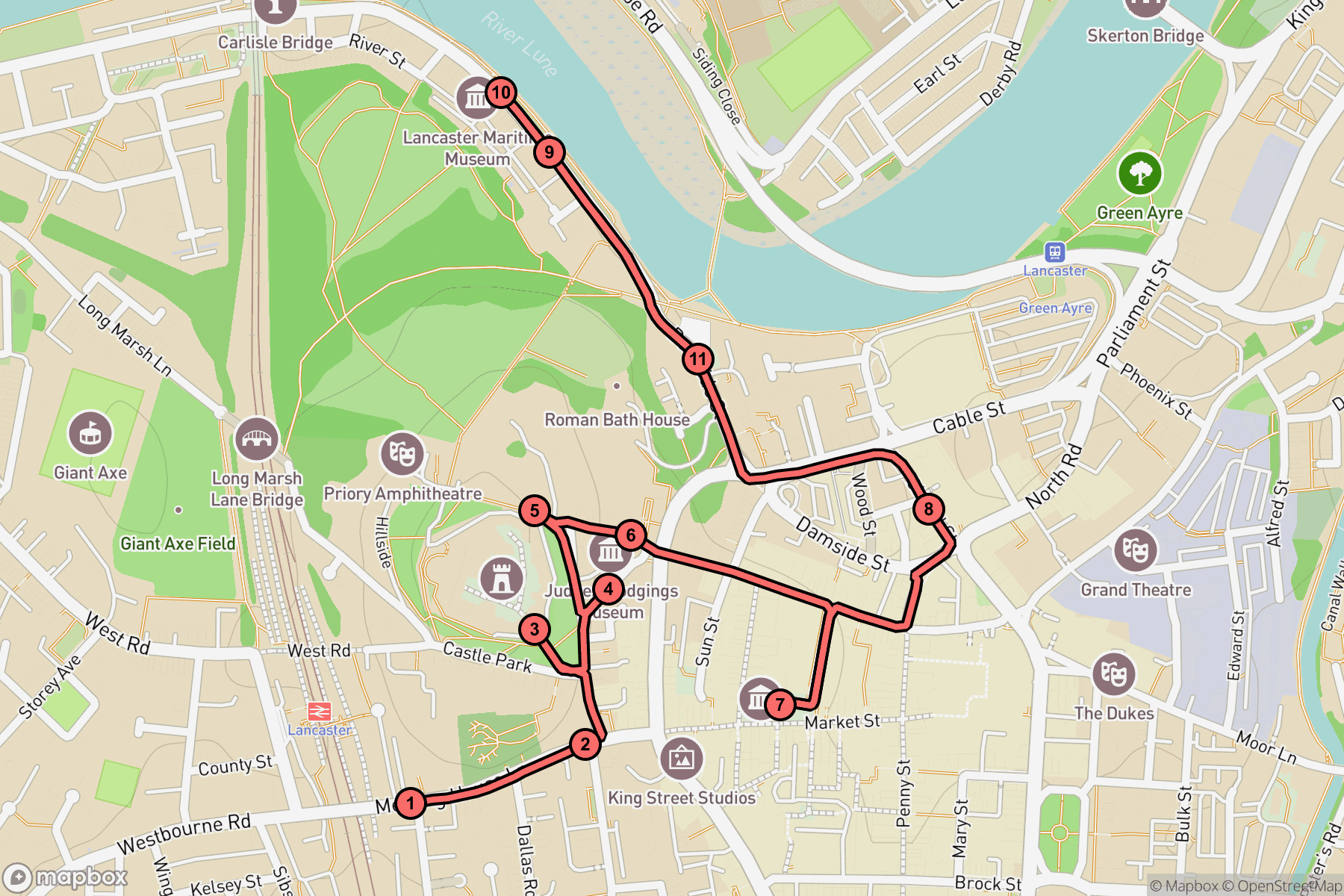
Lancaster's Georgian prosperity is written in stone — the Custom House, the Priory, the grand merchant houses on Castle Hill. But the story of who actually built, guarded, clerked, stocked and served this town belongs to a different set of names: the gaoler who managed the Pendle witch hangings, the housekeeper who outlived her judges, the cabinet apprentices who hand-cut mahogany legs in a Castle Hill workshop, the dock workers who loaded cargoes whose profits built the churches, the Quaker merchants who funded both chapels and slave ships, and the women who kept the linoleum looms running when the men went to war. Heritage Open Days 2026 theme is Everyday Histories — this tour names the unnamed.

Tourvorschau

map

Über diese Tour

  • schedule
    Dauer 30–50 minsEigenes Tempo
  • straighten
    2.6 km FußwegDem geführten Pfad folgen
  • location_on
  • wifi_off
    Funktioniert offlineEinmal herunterladen, überall nutzen
  • all_inclusive
    Lebenslanger ZugriffJederzeit wiederholen, für immer
  • location_on
    Startet bei Lancaster Castle, Castle Parade, Lancaster

Stopps auf dieser Tour

location_on
1
lock
Lancaster CastleThe castle and former gaol whose gatehouse has been a working entrance for eight centuries. Thomas Covell — gaoler, six-time mayor of Lancaster — managed the prison in the early seventeenth century and kept the gaol during the 1612 Pendle witch trials. The Clerk of the Court Thomas Potts left detailed records of the nine women and men hanged here on 20 August 1612 after being convicted of causing the deaths of seventeen people. The castle operated as a working prison from 1196 until 2011, generating wages for generations of gaolers, turnkeys, matrons, and warders whose names survive only in the prison registers.
location_on
2
lock
Captured Africans Memorial, Damside Street, LancasterA sandstone, acrylic and steel sculpture on the quayside at Damside Street, completed in 2005 and designed by Kevin Dalton-Johnson. It was the first memorial in the United Kingdom specifically dedicated to the Africans enslaved in the transatlantic slave trade. The base features a mosaic map of the eighteenth-century world showing the triangular route between West Africa, Lancaster and the Americas; the sculpture names each of the slave ships that passed through the port, their captains, and the number of enslaved people on board. Thomas Hodgson and his brother John were involved in the trade for over thirty years and between 1763 and 1791 were involved in the capture and sale of approximately 14,000 people.
location_on
3
lock
Lancaster Priory Church of Saint MaryThe Priory Church of St Mary stands immediately beside the castle on Castle Hill, founded as a Benedictine priory by Roger de Poitou in 1094. The choir stalls — among the finest medieval woodwork in northern England — were carved in the early fifteenth century during a major reconstruction in the Perpendicular style after the priory was transferred to Syon Abbey in 1431. The craftsmen who cut them are anonymous; what survives is the detail of their work. The Rawlinson family tomb here — defaced during the Black Lives Matter protests — connects the church directly to the slave-trade wealth that funded much of Georgian Lancaster.
location_on
4
lock
Judges Lodgings MuseumA Georgian town house built by Thomas Covell — the same Thomas Covell who managed Lancaster Castle — in the early seventeenth century. From 1826 it served as lodgings for the travelling judges of the Assize Courts at the nearby castle. In 1841, the housekeeper was Betty Bateson, who managed the household alongside her elderly mother Ann and a servant, Ester King. When Betty died in 1858 of heart failure, the advert placed for her successor specified 'not exceeding 40 years of age'. Her replacement was Ellen Leighton, who brought her father and nephew to live with her.
location_on
5
lock
1 Castle HillThe site of Gillows' primary workshop and warehouse from 1770 to 1882 — the Castle Hill premises designed by Richard Gillow and operated as the nerve centre of the most important cabinet-making business outside London. Robert Gillow founded the firm in 1728 as a joiner, travelled to the West Indies in the 1720s and returned with samples of mahogany — among the first imported to Britain. By 1775 the Lancaster branch employed 42 workers; 137 apprentices passed through the workshop between 1731 and 1850. Richard Gillow, son of the founder, also designed the Custom House on St George's Quay.
location_on
6
lock
Quaker Meeting HouseLancaster Quakers have met on this site since 1677, when the first Meeting House was built. The current structure dates to 1708, extended in 1779 and again in 1789–90. George Fox — founder of the Society of Friends — preached in Lancaster in 1652 and was tried for blasphemy at the castle, where he was acquitted. The Lancaster Quaker community became commercially prominent in the eighteenth century; many of its members were merchants involved in Atlantic trade. Among them were the Rawlinsons, who attended this Meeting House while co-owning the ships named in the Captured Africans memorial at Damside Street.

Häufig gestellte Fragen

Wie starte ich die Tour?

Laden Sie nach dem Kauf die AudaTours-App herunter und geben Sie Ihren Einlösecode ein. Die Tour ist sofort startbereit – tippen Sie einfach auf „Play“ und folgen Sie der GPS-geführten Route.

Benötige ich während der Tour Internet?

Nein! Laden Sie die Tour vor dem Start herunter und genießen Sie sie vollständig offline. Nur die Chat-Funktion benötigt Internet. Wir empfehlen den Download über WLAN, um mobiles Datenvolumen zu sparen.

Handelt es sich um eine geführte Gruppentour?

Nein – dies ist ein selbstgeführter Audioguide. Sie erkunden unabhängig in Ihrem eigenen Tempo, wobei die Audioerzählung über Ihr Telefon abgespielt wird. Kein Reiseleiter, keine Gruppe, kein Zeitplan.

Wie lange dauert die Tour?

Die meisten Touren dauern 60–90 Minuten, aber Sie kontrollieren das Tempo vollständig. Pausieren Sie, überspringen Sie Stopps oder machen Sie Pausen, wann immer Sie wollen.

Was, wenn ich die Tour heute nicht beenden kann?

Kein Problem! Touren haben lebenslangen Zugriff. Pausieren Sie und setzen Sie sie fort, wann immer Sie möchten – morgen, nächste Woche oder nächstes Jahr. Ihr Fortschritt wird gespeichert.

Welche Sprachen sind verfügbar?

Alle Touren sind in über 50 Sprachen verfügbar. Wählen Sie Ihre bevorzugte Sprache beim Einlösen Ihres Codes. Hinweis: Die Sprache kann nach der Tour-Generierung nicht mehr geändert werden.

Wo greife ich nach dem Kauf auf die Tour zu?

Laden Sie die kostenlose AudaTours-App aus dem App Store oder von Google Play herunter. Geben Sie Ihren Einlösecode (per E-Mail gesendet) ein, und die Tour erscheint in Ihrer Bibliothek, bereit zum Download und Start.

verified_user
Zufriedenheit garantiert

Wenn Ihnen die Tour nicht gefällt, erstatten wir Ihnen den Kaufpreis. Kontaktieren Sie uns unter [email protected]

Sicher bezahlen mit

Apple PayGoogle PayVisaMastercardPayPal
Beliebt bei Reisenden weltweit

Tausende gestartete Touren.
Genug Meinungen.

4,8 im App Store und Google Play. Hier sind ein paar, zu denen wir immer wieder zurückkehren.

starstarstarstarstar
Das war eine solide Art, Brighton kennenzulernen, ohne sich wie ein Tourist zu fühlen. Die Erzählung hatte Tiefe und Kontext, übertrieb es aber nicht.
Christoph
Christoph
Brighton-Tour
starstarstarstarstar
Habe diese Tour mit einem Croissant in der einen Hand und null Erwartungen gestartet. Die App schwingt einfach mit einem mit, kein Druck, nur man selbst, Kopfhörer und ein paar coole Geschichten.
download App holen

Kopfhörer rein.
Raus nach draußen.

Kostenlos herunterladen. Touren in jeder Stadt. Startklar in 60 Sekunden — kein Konto, keine Karte.

Download on the App StoreGet it on Google Play
starstarstarstarstar_half
4.8
AudaTours app icon
headphones
~ 4 Min. bis deine erste Tour startet
public
1.000+ Städte weltweit
all_inclusive
AudaTours
Unlimited

Jede Tour. Jede Stadt. Ein Abo.

3323 Touren2270 Städte139 Länder50+ Sprachen

