
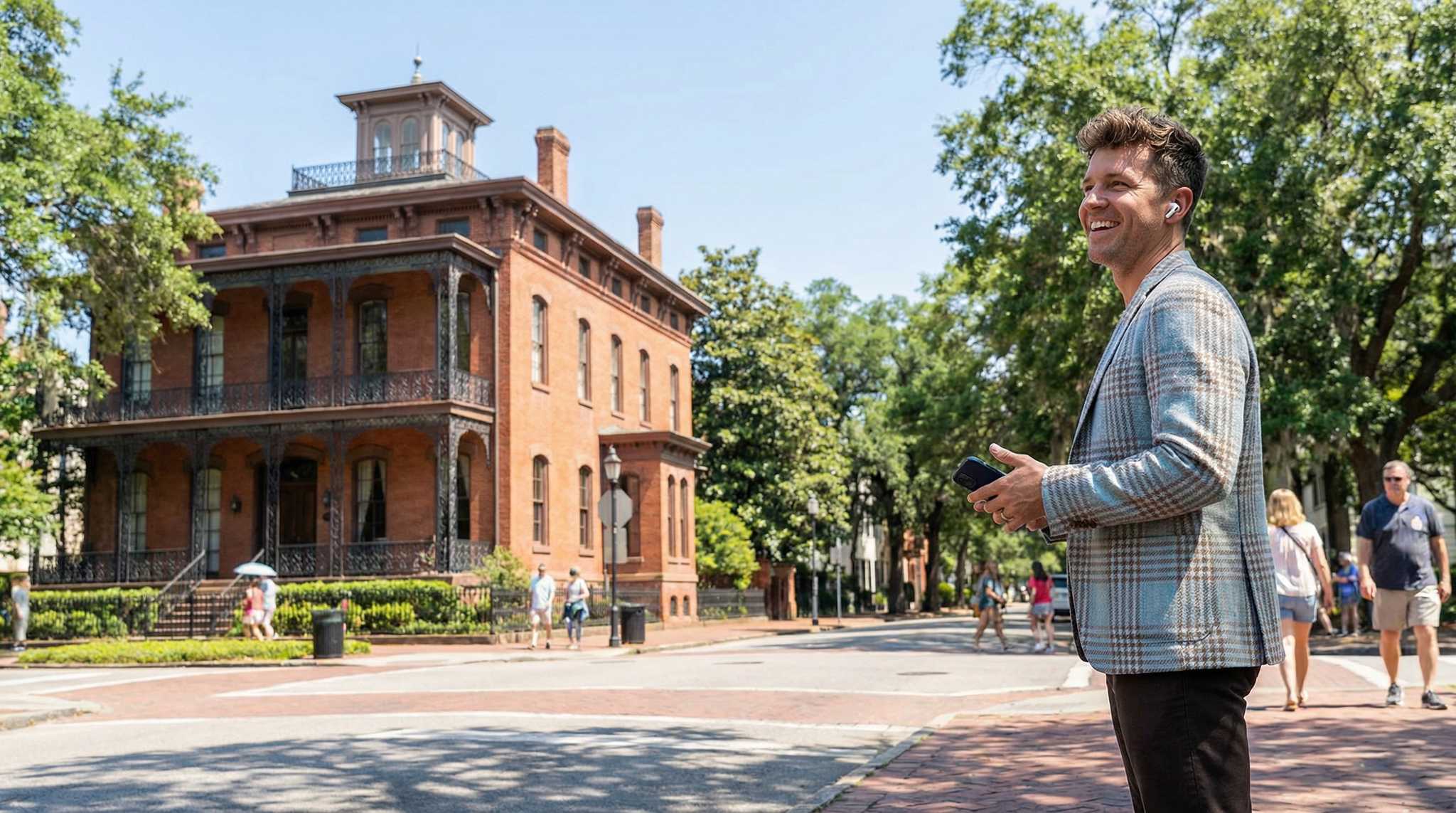
Savannah Audio Tour: Echoes, Icons & Legends of Southern Splendor
Silver Torah scrolls once smuggled past pirates glint in the heart of Savannah’s moss-lined streets. This self-guided audio tour unlocks secret stories and hidden corners that most travelers never find. What bold act inside Congregation Mickve Israel rattled Savannah’s elite? Who left behind a cryptic message in the Juliette Gordon Low Historic District that still stirs unrest? Why did art students at Savannah College of Art and Design suddenly vanish after midnight in 1996? Move through shady squares and sunlit facades as whispered scandals, lost rebellions, and eccentric legacies unfold at your every stop. Each turn brings a new clue or lingering question, revealing Savannah not as an old postcard but as a restless crossroads pulsing with intrigue. Ready to hunt for the glint beneath the Spanish moss? Press play and let Savannah’s secrets pull you in.
Tour preview
About this tour
- scheduleDuration 100–120 minsGo at your own pace
- straighten3.7 km walking routeFollow the guided path
- location_onLocationSavannah, United States
- wifi_offWorks offlineDownload once, use anywhere
- all_inclusiveLifetime accessReplay anytime, forever
- location_onStarts at Savannah Civic Center
Stops on this tour
lock_open 3 free previews · 12 unlock with purchase
You are looking at a massive concrete and brick structure defined by wide, flat facades and strict geometric lines. Welcome to the Savannah Civic Center, a place that perfectly…Read moreShow less
Open dedicated page →
Savannah Civic CenterPhoto: Lowcountry7655, Wikimedia Commons, CC BY-SA 3.0. Cropped & resized. You are looking at a massive concrete and brick structure defined by wide, flat facades and strict geometric lines. Welcome to the Savannah Civic Center, a place that perfectly captures how a city wrestles with its own ghosts. This site is a fascinating collision of glamorous pop culture and deeply tragic losses.
Let us go back to the 1970s. Savannah leaders wanted a modern, multi-purpose facility, embracing a New Formalist architectural style, which is a mid-century design trend that prized wide, open spaces and enormous parking lots over historical charm. To build this massive seven-acre complex, they spent 7.9 million dollars, which is roughly forty-five million today. But the cost of preservation, or rather the lack of it, was devastating.
At the time, the Historic District Ordinance was not yet in place to protect the area. Preservationists watched in absolute outrage as bulldozers obliterated the historic fabric of the city before modern protections existed. To lay this concrete footprint, they destroyed two original city wards and Elbert Square. This violently disrupted the Oglethorpe Plan, Savannah's world-renowned grid system of interlacing streets and public squares. It also created a literal physical and cultural barrier between downtown and the predominantly Black neighborhoods of West Savannah.
Even earlier, this very ground was home to the 1819 Archibald Bulloch House. That masterpiece was designed by William Jay, a brilliant architect whose innovative, sweeping mansions helped define Savannah's early beauty, yet his work here was completely lost to this massive footprint.
But once the doors opened, this controversial space became a vibrant hub of entertainment. Picture the absolute electricity in the air on February 17, 1977. Elvis Presley arrived to a sold-out crowd of eight thousand fans! Billed as Emperor Elvis, he strutted onto the stage in a form-fitting white suit featuring a dazzling sequined sun medallion on the back. Fans paid between ten and fifteen dollars, about fifty to seventy-five bucks today, to watch him play the piano on Unchained Melody and shimmy through Jailhouse Rock. The energy was so infectious that fans completely mobbed his hotel afterward, desperately hoping for a glimpse of the King just months before his tragic death.
Over the years, the building tried to honor Savannah's diverse voices. The theater was named for local legend Johnny Mercer, and the arena was named for civil rights icon Dr. Martin Luther King Jr. But the city recently voted to demolish the arena to finally restore the historic streets and squares that were destroyed in the seventies, while renaming the remaining theater complex to ensure Dr. King's legacy here is not erased.
It is wild to stand here and ponder the heavy cost of urban progress, where concrete replaced architectural masterpieces. Let that sink in as we head to a much quieter mystery. The famous Bird Girl statue is just a five minute walk away.
Take a look at your screen for a clear view of our subject. We are looking at a fifty-inch tall bronze sculpture of a young girl wearing a simple dress, her elbows propped against…Read moreShow less
Open dedicated page →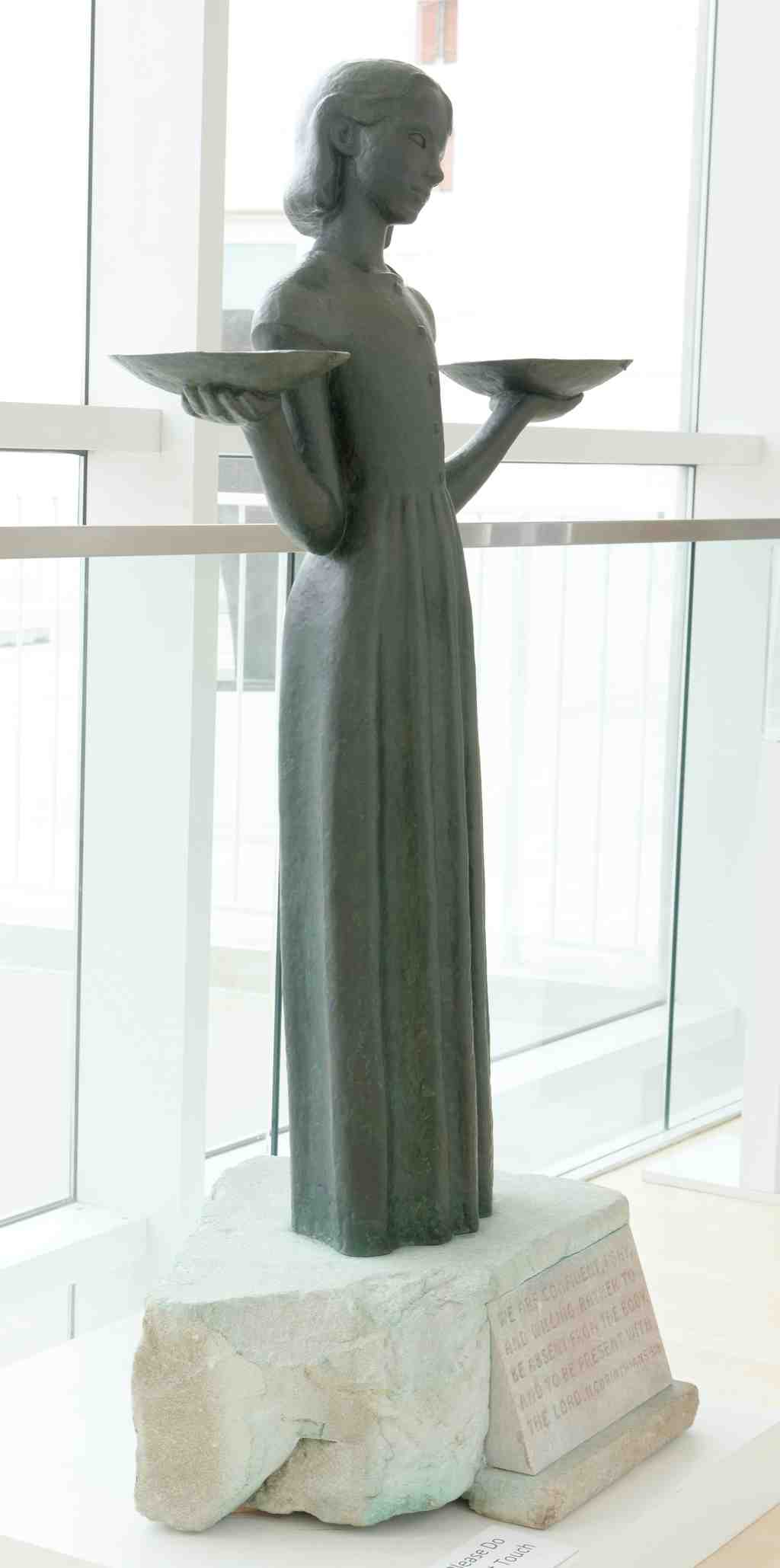
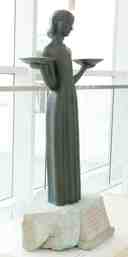
Bird GirlPhoto: Judson McCranie, Wikimedia Commons, CC BY-SA 4.0. Cropped & resized. Take a look at your screen for a clear view of our subject. We are looking at a fifty-inch tall bronze sculpture of a young girl wearing a simple dress, her elbows propped against her waist as she holds two shallow, circular bowls out to her sides.
Savannah is a place heavy with ancient oaks and grand architecture, but beneath that polished surface lies a city built on quiet secrets. This is a town that loves its beautiful illusions, carefully hiding true identities to protect its delicate social fabric. Behind almost every stunning facade here, there is a hidden history trying to stay out of the spotlight.
Take this famous girl, for instance. Sculpted in nineteen thirty-six by Sylvia Shaw Judson, she was originally intended to be a peaceful garden fountain. Those bowls were not meant to symbolize the heavy scales of good and evil, but were simply designed to hold water or seeds for birds.
The true mystery, though, was the girl herself. Judson discovered an eight-year-old named Lorraine Greenman at a dance class in a working-class immigrant neighborhood in Chicago. Lorraine was the perfect model with her soft features and serene gaze, but for decades, her identity was a closely guarded secret.
Around nineteen thirty-eight, a local cultural leader named Lucy Boyd Trosdal bought this exact bronze cast and placed it in her family's burial plot in Bonaventure Cemetery. For over fifty years, the Bird Girl stood there in total peace. Then came the nineteen nineties. Photographer Jack Leigh spent two days searching the cemetery for a book cover image. Just as it was getting dark, he found her. Using darkroom techniques like dodging and burning, which is a traditional method of manually lightening specific parts of a photograph during printing, he created a monumental, glowing, mysterious image. That book was Midnight in the Garden of Good and Evil.
The book became a massive hit, and the consequences were immediate. Fans swarmed the quiet cemetery plot. People trampled adjacent graves and some even tried to chip off pieces of the bronze statue to take home as souvenirs! To protect their family legacy and preserve the art itself, the Trosdals had to yank her from the cemetery, hiding her away in a private home before moving her here to the Telfair Academy. You can visit her safely behind museum glass from Tuesday through Sunday, between ten AM and five PM.
And what about little Lorraine, the model? She grew up, moved away, and married a dentist, completely shielded from the chaotic fame that consumed her bronze twin. When she was ninety years old, she finally contacted the book's publisher to share her true identity, but they reportedly were not even interested. She remained a quiet footnote, safe from the frenzy.
We are moving from the quiet secrets of an artist's model to a scandal that played out on a massive, historic stage. Let's head over to the Tomochichi Federal Building and United States Court House, just a quick three-minute walk away.
On your left stands a massive three-story block of white Georgia marble, featuring grand semicircular arched windows along its rusticated base and a striking red pantile…Read moreShow less
Open dedicated page →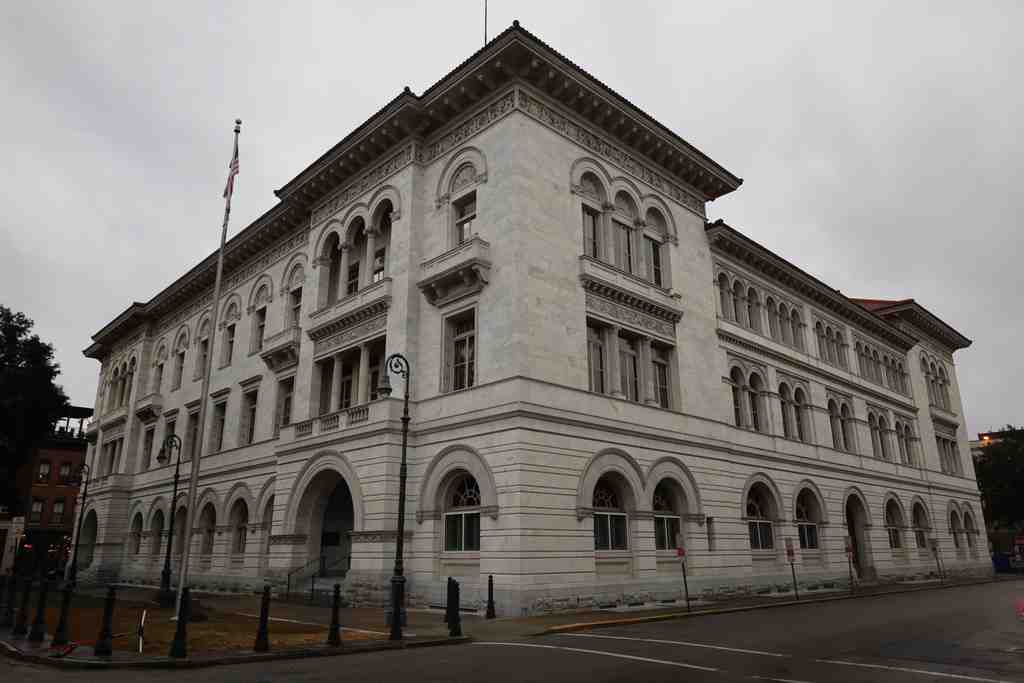
Tomochichi Federal Building and United States Court HousePhoto: Antony-22, Wikimedia Commons, CC BY-SA 4.0. Cropped & resized. On your left stands a massive three-story block of white Georgia marble, featuring grand semicircular arched windows along its rusticated base and a striking red pantile roof.
This magnificent structure was renamed the Tomochichi Federal Building and United States Court House in 2005. The tribute is profoundly fitting, considering it sits on Wright Square, the very site where Tomochichi, the Yamacraw Indian Chief, was buried in 1739. Tomochichi formed a vital friendship with General James Oglethorpe back in 1733. Because of their alliance, Oglethorpe was able to ensure the peaceful founding of the Georgia colony. Their cooperation is a defining reason why the city survived its fragile early years.
Notice how the majestic Tomochichi Federal Building has gracefully weathered over a century of change in Savannah, retaining its striking 1899 architecture even as modern life continues to evolve around Wright Square. Take a peek at your screen to see the impressive 150-foot marble bell tower rising from the northern side of the building, complete with open arcaded loggias, which are covered exterior galleries.
But true to the city's nature, this pristine monument hides bitter human flaws. Long before this stunning Second Renaissance Revival structure was built to mimic grand Italian palaces, this exact piece of land hosted a much smaller courthouse... and a massive scandal.
Enter John Wesley, the famous preacher and founder of Methodism whose time in Georgia ended in complete and utter disgrace. Wesley found himself tangled up in a disastrous romance with a young colonist named Sophy Hopkey. When the relationship fell apart and Sophy married another man, a bitter public feud erupted.
Well, Sophy's furious new husband sued Wesley for defamation of character. He dragged the preacher right before the local magistrate at the old courthouse that used to stand right where you are looking now.
That tension between noble facades and tragic reality has haunted this site ever since. Even the current building's original architect, Jeremiah O'Rourke, was fired during construction in 1894 after a nasty power struggle. Local lore says his supporters carved his face into the marble exterior as a permanent, petty act of revenge. And sadly, the shadows over the site continued into the present day. In April of 2023, during a massive ninety million dollar renovation, a portion of the third floor collapsed due to insufficient support, injuring workers and halting the project entirely.
Back in August of 1737, John Wesley found himself indicted by a grand jury on ten charges right on this spot. We will uncover exactly what provoked those charges, and how Wesley ultimately escaped them, when we reach his church later on. Let us leave this scene of historic drama behind and make our way over to our next stop, the Nathanael Greene Monument, which is just a five minute walk away.

Show 12 more stopsShow fewer stopsexpand_moreexpand_less
On your right, you will see a towering fifty-foot granite obelisk with dark bronze plaques resting on a stepped stone base. This is the Nathanael Greene Monument. Check out the…Read moreShow less
Open dedicated page →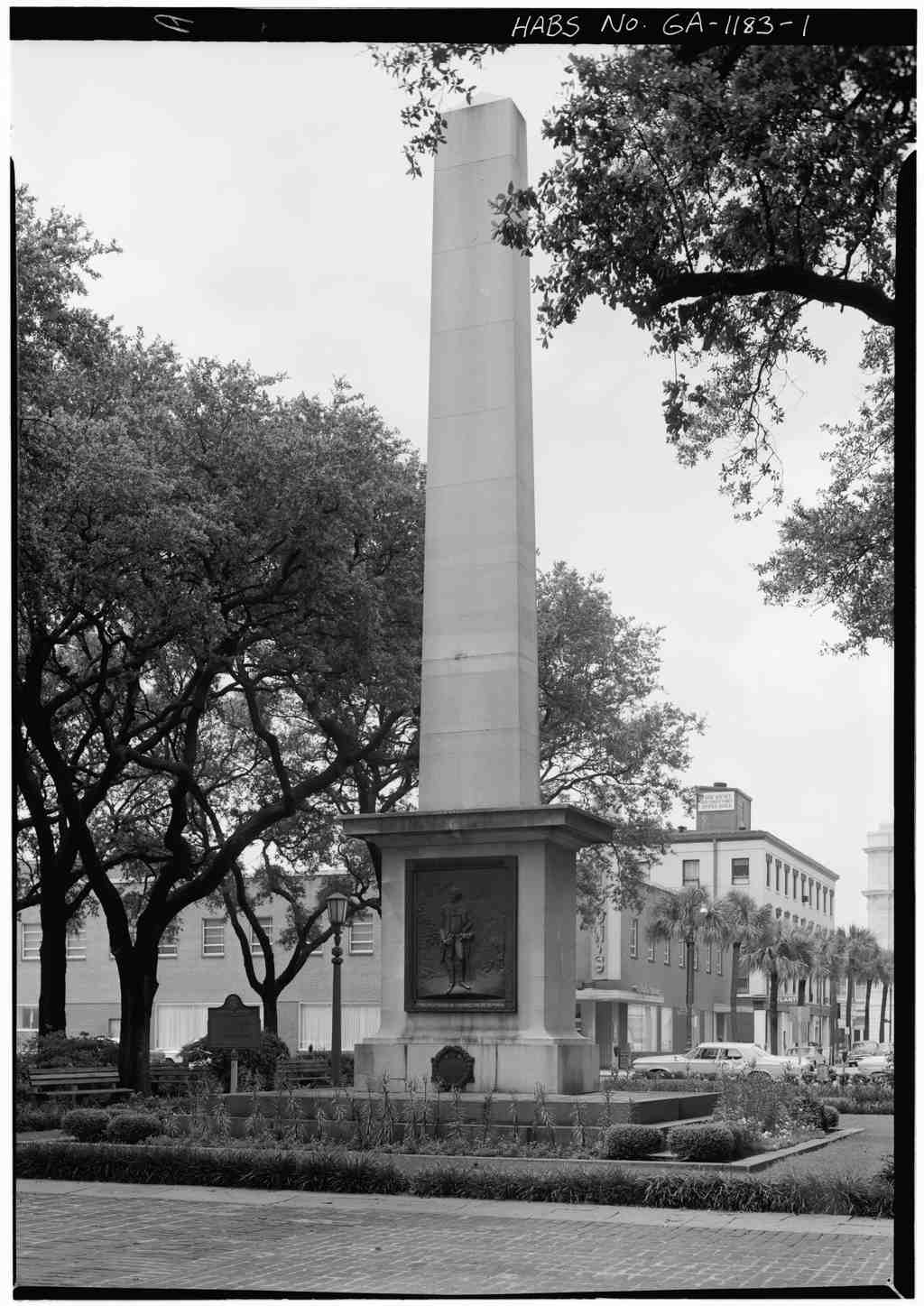
Nathanael Greene MonumentPhoto: Wikimedia Commons contributor, Wikimedia Commons, Public domain. Cropped & resized. On your right, you will see a towering fifty-foot granite obelisk with dark bronze plaques resting on a stepped stone base.
This is the Nathanael Greene Monument. Check out the artwork in your app to see a portrait of the man himself. Greene was born in Rhode Island and raised as a pacifist Quaker, meaning he belonged to a Christian denomination that strictly opposed all forms of violence and war. Yet, when the American Revolution broke out, he chose to fight, eventually becoming one of George Washington's most trusted generals and leading campaigns right here in Georgia.
As a reward for his service, the state of Georgia gave him a sprawling plantation. Sadly, Greene died just a few years later in 1786. His death was a terrible blow to his loved ones, but the heartbreak for his family was only just beginning.
Take a moment to look at the massive stone blocks forming the base of this monument. Imagine the famous French military leader, the Marquis de Lafayette, standing on this very spot in 1825 to lay the cornerstone. He was here to honor an American hero, but he was also honoring a family completely shattered by grief.
In the spring of 1793, Greene's eighteen-year-old son, George Washington Greene, took a canoe trip up the Savannah River with a friend. The young man had only recently returned home from France, where he had been personally educated under the supervision of Lafayette. The river was swollen and treacherous... and the canoe capsized. George drowned. His remains were placed alongside his father's in a burial vault at Colonial Park Cemetery.
It took decades to complete this monument. The state even authorized a lottery in 1826 to raise thirty-five thousand dollars... which would be over a million dollars today... just to fund the project. The architect patterned the monument in the Egyptian style of Cleopatra's Needle, a tall, four-sided pillar ending in a pyramid shape. You can get a clear view of its stark architectural lines in the second photo on your screen.
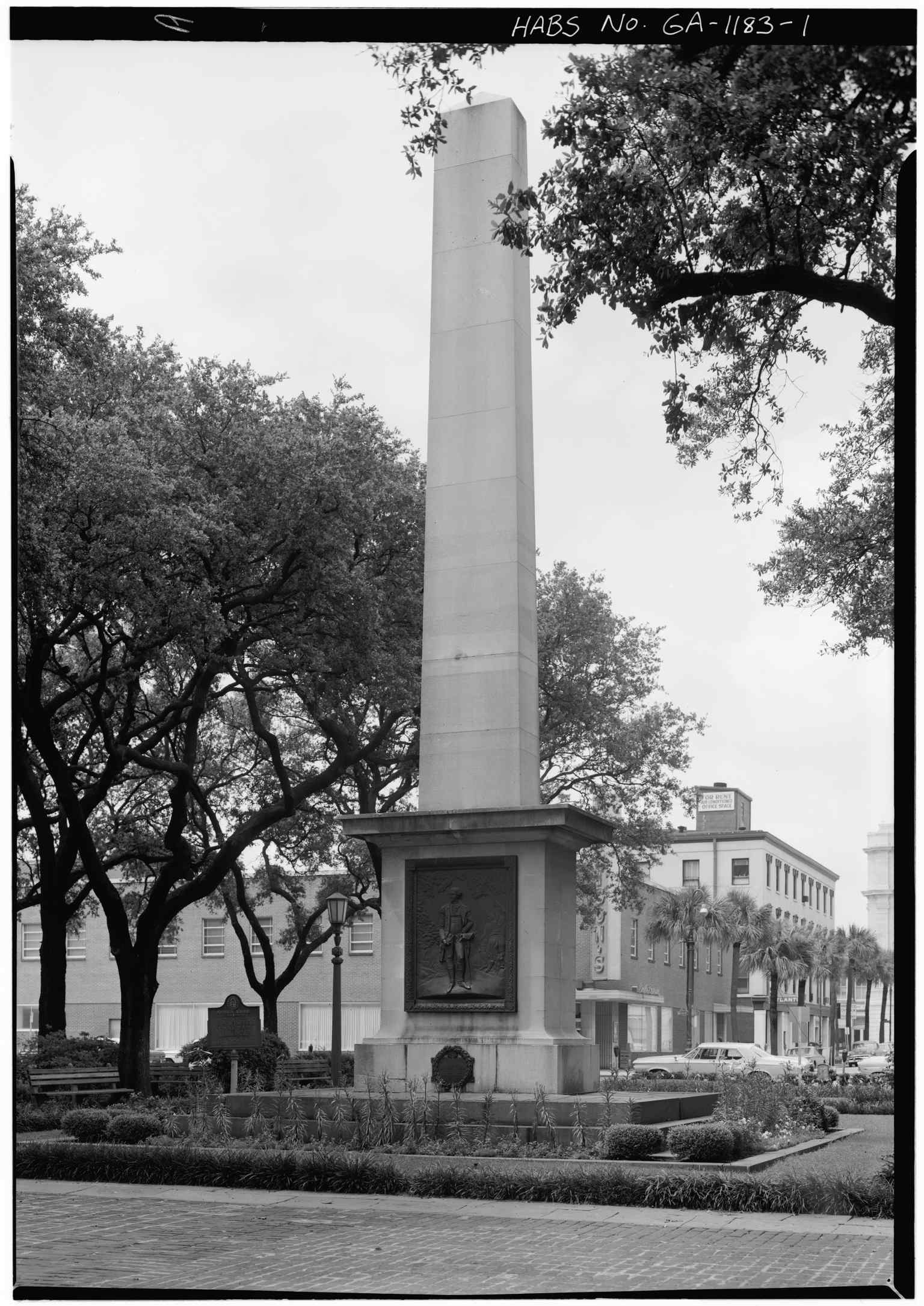
A detailed view of the Nathanael Greene Monument's north and west sides, an obelisk patterned after the Egyptian style of Cleopatra's Needle.Photo: Unknown, Wikimedia Commons, Public domain. Cropped & resized. But while this grand stone pillar stood proudly in the square, the bodies of Greene and his son were lost. During the American Civil War, occupying Union forces vandalized the cemetery, and the exact location of the family vault was forgotten. For over a century, the brilliant general and his tragically young son sat unidentified in the dark. Ironically, they were resting right next to the remains of John Maitland, Greene's greatest British rival from the Revolutionary War.
It was not until 1901 that a search team finally identified them. They knew they had found the elder Greene because three metal military uniform buttons and a pair of heavy French silk gloves had miraculously survived intact on the skeletal hands. Father and son were brought here and reinterred directly beneath this granite shaft in 1902.
Look up at the top of the obelisk. We build these massive markers to freeze our heroes in time, chasing an immortal legacy of triumph and perfection. But no amount of carved granite can erase the profound personal tragedies that so often haunt the lives of great historical figures.... When you are ready to leave this quiet reflection behind, we will continue our walk. Our next stop, Christ Church, is just a short two-minute stroll away.
Look to your left for the imposing white Neo-Classical building, defined by its six massive fluted columns supporting a wide triangular pediment with a simple recessed cross near…Read moreShow less
Open dedicated page →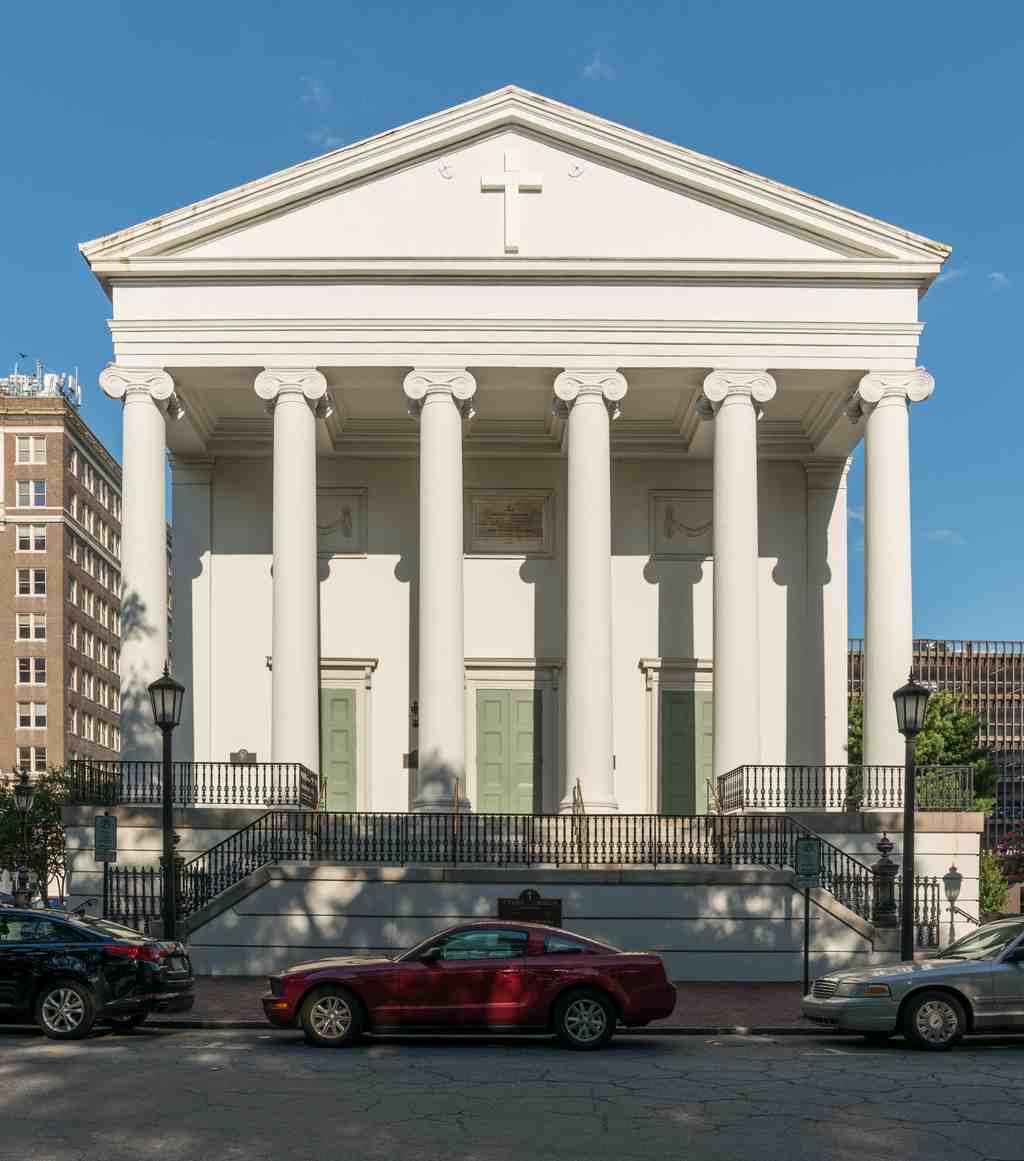
Christ ChurchPhoto: DXR, Wikimedia Commons, CC BY-SA 4.0. Cropped & resized. Look to your left for the imposing white Neo-Classical building, defined by its six massive fluted columns supporting a wide triangular pediment with a simple recessed cross near the top. This is Christ Church, affectionately known as the Mother Church of Georgia. It was founded in 1733, and while those pristine white columns project absolute peace and harmony today, do not be fooled. There is a deeply personal, hidden scandal behind this splendor.
Back in 1736, a young, intensely serious minister arrived to serve this parish. His name was John Wesley. Long before he became a legendary figure who catalyzed the global Methodist movement, he was a stressed out young missionary caught in a massive colonial soap opera.
Enter Sophy Hopkey. She was the charming niece of Savannah's chief magistrate, and Wesley fell head over heels for her. But Wesley was a man divided. He agonized over his strict commitment to clerical celibacy, a religious vow to remain unmarried, and his desperate desire to be a pioneering missionary. He kept Sophy waiting in a romantic limbo. Finally, frustrated by his endless hesitation, Sophy abruptly broke off the courtship and married another man named William Williamson.
Wesley was absolutely devastated. Convinced that Sophy's spiritual devotion was rapidly declining, he retaliated in the most public way possible. During a Sunday service, Wesley strictly enforced a minor technicality in the Book of Common Prayer, the official rulebook for church ceremonies. Because Sophy had not given prior notice of her intention to take Holy Communion, Wesley publicly denied her the sacred ritual.
It was a calculated, devastating public humiliation. But the move backfired spectacularly. The young colony exploded in outrage. Sophy's new husband filed a massive defamation lawsuit against Wesley, and a local magistrate issued a warrant for his arrest. Suddenly, Wesley was facing severe legal trouble, a hostile trial he believed was a sham, and a congregation completely fed up with his rigid, unforgiving discipline.
The pressure became unbearable. In December 1737, Wesley fled Georgia in the dead of night, sneaking away under the cover of darkness to escape his mounting legal battles. He later wrote that he shook the dust off his feet as he left Savannah behind.
The actual building where all this dramatic tension went down did not survive. A devastating fire wiped out the first permanent church in 1796, and a massive hurricane completely destroyed the congregation's second attempt in 1804. Finally, in 1838, the resilient parish constructed the grand Neo-Classical masterpiece you are looking at right now. Take a quick look at the before and after image in the app to see how this incredible street view has stood the test of time.
This site is a perfect reflection of Savannah itself, continually rising from the ashes of bitter disputes, fire, and storm to project an enduring image of grace. Come on, let us jump forward into the true architectural grandeur of the nineteenth century as we take a seven minute walk over to the stunning Owens-Thomas House.
Right in front of you stands a grand mansion built of smooth tan Bath stone, featuring a striking curved entrance portico supported by columns and framed by a pair of winding iron…Read moreShow less
Open dedicated page →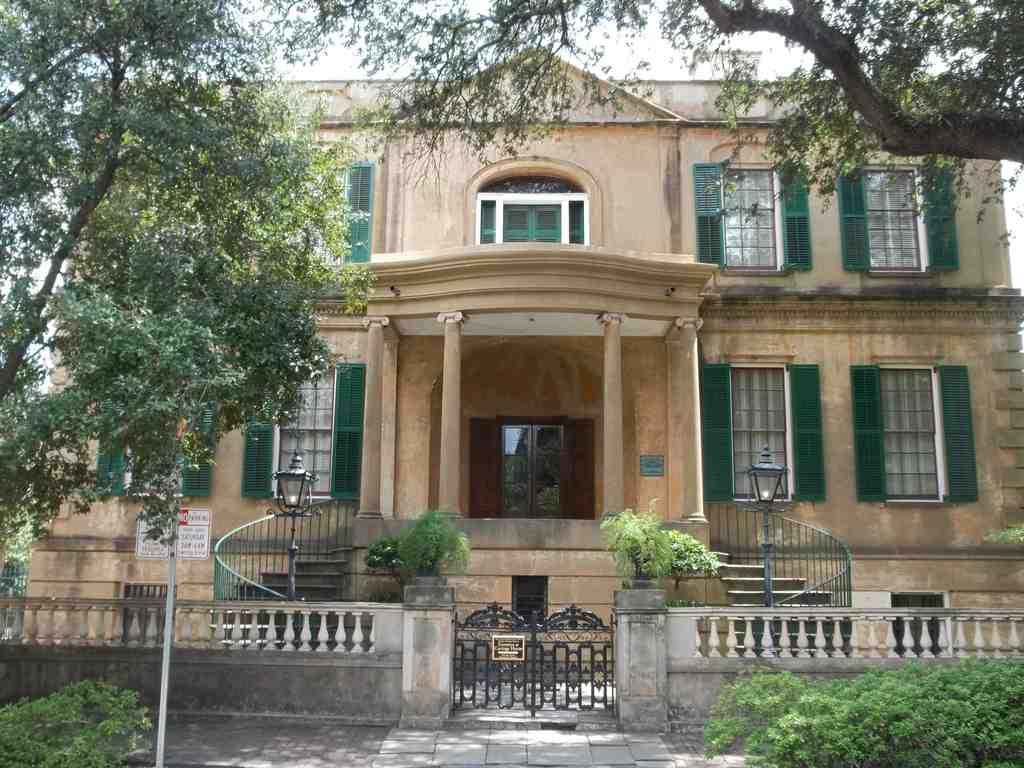
Owens–Thomas HousePhoto: Ebyabe, Wikimedia Commons, CC BY-SA 3.0. Cropped & resized. Right in front of you stands a grand mansion built of smooth tan Bath stone, featuring a striking curved entrance portico supported by columns and framed by a pair of winding iron staircases. It is an absolute masterpiece of English Regency architecture, a style defined by its clean, classical symmetry.
It was commissioned in 1816 by Richard Richardson, a massively wealthy shipping merchant and domestic slave trader who wanted a house that proved his supreme status. He hired an English architect, a young visionary named William Jay, who actually drew the plans in England and shipped them over. Richardson spared no expense, even installing Savannah's very first indoor plumbing system, utilizing massive attic cisterns to catch rainwater that supplied a basement bathing room.
But this grand monument to his success rapidly became a house of horrors. Shortly after moving in, Richardson lost his wife Frances and two of their children to a brutal yellow fever epidemic. Then came the financial panic of 1819, followed by a massive fire that destroyed half of Savannah in 1820. He was completely ruined. In a harsh twist of fate, the very bank he had served as president of seized this mansion in 1824.
The bank leased the home out as an elegant boarding house. Pull out your phone and take a look at the first picture. That is the home's side veranda, wrapped in elaborate cast iron shaped like swirling acanthus leaves. In 1825, the Marquis de Lafayette stayed here and stood right on that balcony, addressing an adoring crowd in both English and French.
In 1830, a politician named George Welshman Owens bought the estate at auction for ten thousand dollars, which is roughly a third of a million today. He brought his wife, six children, and up to fifteen enslaved laborers. For decades, the museum here used the carriage house out back as a simple gift shop, ignoring its true history. But renovations in the 1990s uncovered one of the oldest and best preserved urban slave quarters in the American South.
Tap to the next photo on your screen to see the brick exterior of these quarters. This is where a woman named Emma lived. She was an enslaved nursemaid forced to raise the Owens children, spending far more time with them than their own parents did. She had a biological daughter of her own on the property, but the brutal demands of bondage meant she had to prioritize her enslavers' children over her own flesh and blood.
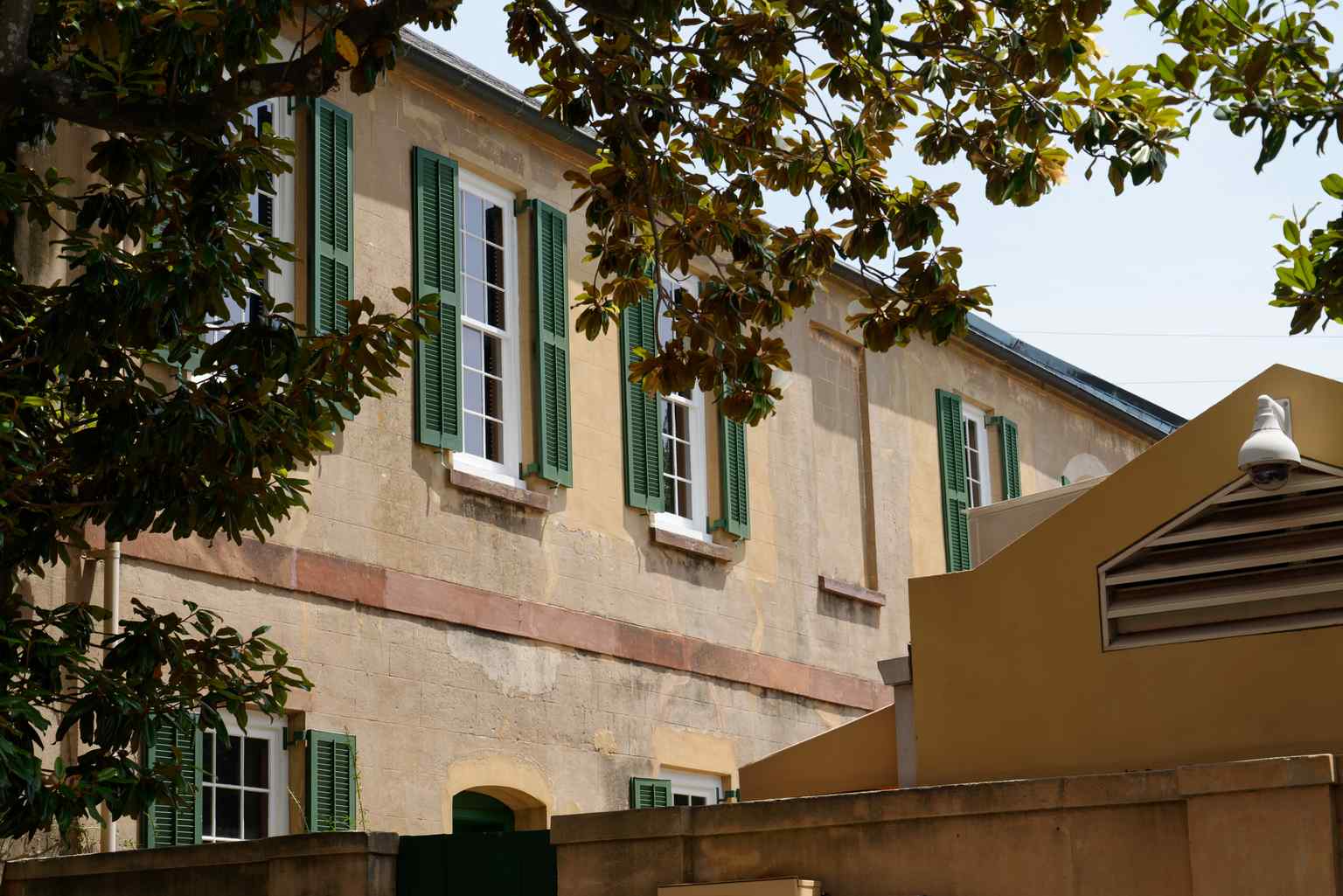
A view of the historic slave quarters, where individuals like Peter, Diane, and Emma lived and worked, their lives starkly contrasting the main house's elegance.Photo: Bubba73, Wikimedia Commons, CC BY-SA 3.0. Cropped & resized. Inside those quarters, the ceiling is painted a striking shade called haint blue. This was a deep tradition in Gullah culture, an African American community of the coastal South, used to ward off ghosts and malevolent spirits. It is actually the largest surviving swath of haint blue paint in North America. Even after slavery was abolished in 1865, the carriage house was simply renamed servant quarters. Stripped of education and resources, many formerly enslaved people had no choice but to stay, continuing their grueling labor to maintain this very estate.
It is a stark reminder that the most breathtaking architectural facades often conceal the deepest human sorrow. If you want to explore the interior and the slave quarters yourself, the museum is open Tuesday through Sunday from 10 AM to 5 PM. Our next stop is the Juliette Gordon Low Historic District, which is just a seven minute walk from here.
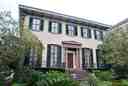
Look for the stately two-story building coated in smooth stucco, which is a durable plaster over brick, featuring dark green shutters and a brownstone staircase flanked by two…Read moreShow less
Open dedicated page →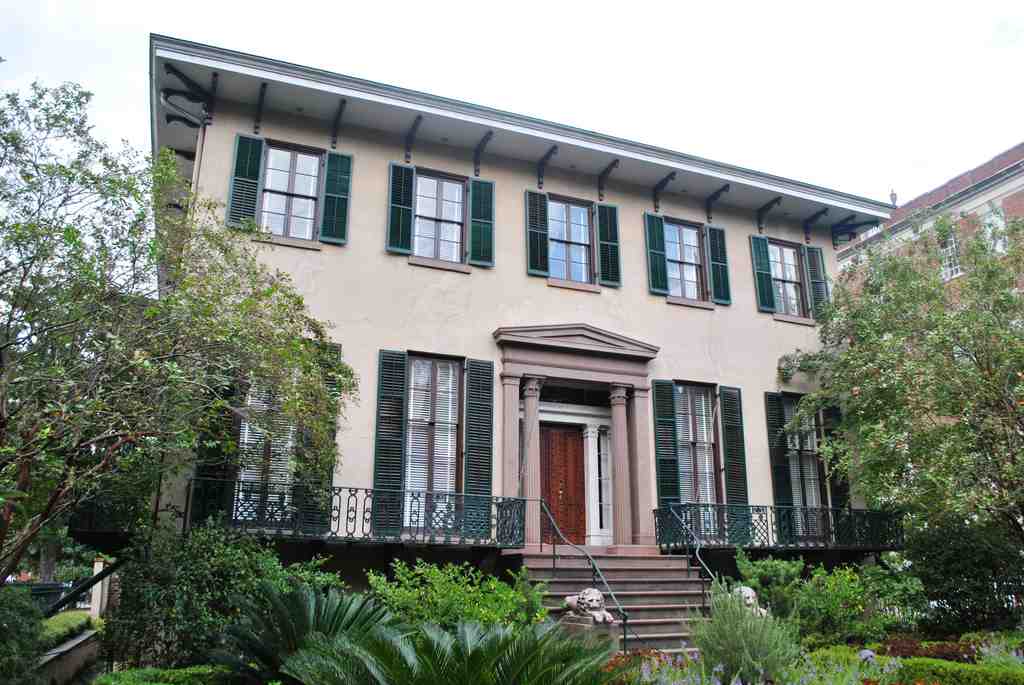
Juliette Gordon Low Historic DistrictPhoto: Elisa.rolle, Wikimedia Commons, CC BY-SA 4.0. Cropped & resized. Look for the stately two-story building coated in smooth stucco, which is a durable plaster over brick, featuring dark green shutters and a brownstone staircase flanked by two cast-iron lions. This is the Andrew Low House, one of three buildings making up the Juliette Gordon Low Historic District. Most people know this area as the birthplace of the Girl Scouts, but these properties hide intense family dramas and bitter conflicts.
Before the Lows and Gordons took over, the original 1820 home in this district belonged to James Moore Wayne. He was a wealthy slaveowner and an influential Supreme Court Justice who helped push through the infamous 1857 Dred Scott decision, an expansive legal ruling that denied citizenship to African Americans and protected the expansion of slavery. When the Civil War erupted, it immediately tore through the social fabric of this city, forcing neighbors and kin to draw hard battle lines. Political beliefs and war completely fractured Savannah's elite families. Despite his devastating rulings protecting slavery, Wayne remained fiercely loyal to the Union, refusing to step down from the Supreme Court even when Georgia seceded. His son took the opposite path, resigning his United States Army commission to serve as a Confederate General, tearing the family apart.
By then, Wayne had sold the family estate to the Gordon family, and Juliette Gordon Low was born there in 1860. She later moved into this building, the Andrew Low House. Check out the image on your app to get a closer look at its Greek Revival design, specifically the entry portico inspired by the ancient Tower of the Winds in Athens.
Juliette's adult life here was incredibly difficult. She went completely deaf in one ear after a doctor accidentally punctured her eardrum trying to remove a grain of good-luck rice from her wedding. Her marriage to William Low was a disaster, plagued by his drinking and a very public affair with an actress. He even withheld her money to force a divorce, but he died suddenly of a seizure in 1905. When Juliette discovered he had secretly left his fortune to his mistress, she fought back and won a five hundred thousand dollar settlement, which equals roughly fifteen million dollars today. That massive financial victory gave her the independence to found the Girl Scouts in 1912.
Watch the decades slip by at the historic Andrew Low House, where a 1939 black-and-white snapshot transitions into vibrant modern photography while the grand architecture remains beautifully preserved. Today, the National Society of the Colonial Dames uses this house as its headquarters, and you can explore the district buildings any day of the week from 10 AM to 5 PM.
From a powerful family tragically divided by war, we are now going to explore the heartbreaking origins of the entire Georgia colony. We are heading to the James Oglethorpe Monument, just a three-minute walk away.
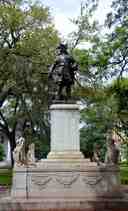
Right in front of you stands a towering bronze statue of a man in an eighteenth century military uniform, elevated on a massive square marble pedestal guarded by four roaring…Read moreShow less
Open dedicated page →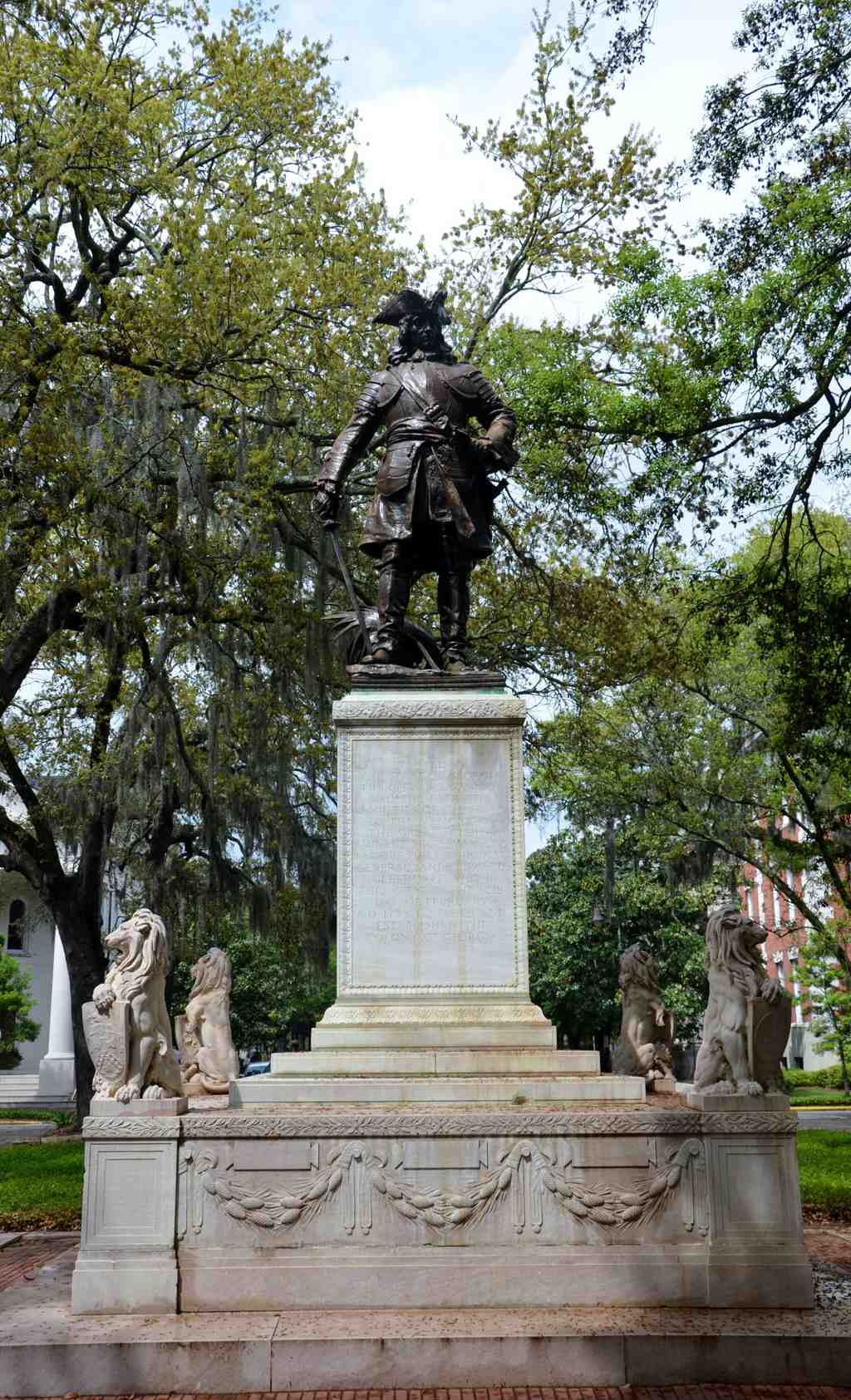
James Oglethorpe MonumentPhoto: Roman Eugeniusz, Wikimedia Commons, CC BY-SA 3.0. Cropped & resized. Right in front of you stands a towering bronze statue of a man in an eighteenth century military uniform, elevated on a massive square marble pedestal guarded by four roaring lions at its corners.
That is James Oglethorpe, the founder of Georgia. When we look at monuments like this, it is easy to see just the triumph, the military commander holding his sword. But the real reason this man sailed across the Atlantic to build a new world is rooted in absolute heartbreak.
Back in England, Oglethorpe had a dear friend named Robert Castell. Castell was an architect who fell into financial ruin and was thrown into a debtor's prison, a harsh jail specifically for people who owed money. Because Castell could not afford to pay the jailers extortionate fees for better treatment, he was forced into a cell with inmates suffering from smallpox. Castell caught the disease and died in 1729. This devastating loss shattered Oglethorpe. It pushed him to investigate the horrific conditions of British jails and ultimately sparked a bold vision. He wanted to create a philanthropic utopia, a fresh start for the worthy poor. That vision became Savannah, established in 1733.
To honor that legacy, local patriotic groups banded together in the early nineteen hundreds to build a grand monument. They raised thirty eight thousand dollars, which is over a million dollars today. They hired sculptor Daniel Chester French and architect Henry Bacon. Take a look at the image on your app to see the incredible detail of French's nine foot bronze figure. Notice how Oglethorpe holds his sword. It is unsheathed but pointing downward, a deliberate choice showing him as a resolute protector facing south toward the Spanish threat, rather than an active attacker. French loved this piece so much he called it his life's finest work, and he and Bacon would later go on to design the Lincoln Memorial in Washington DC.
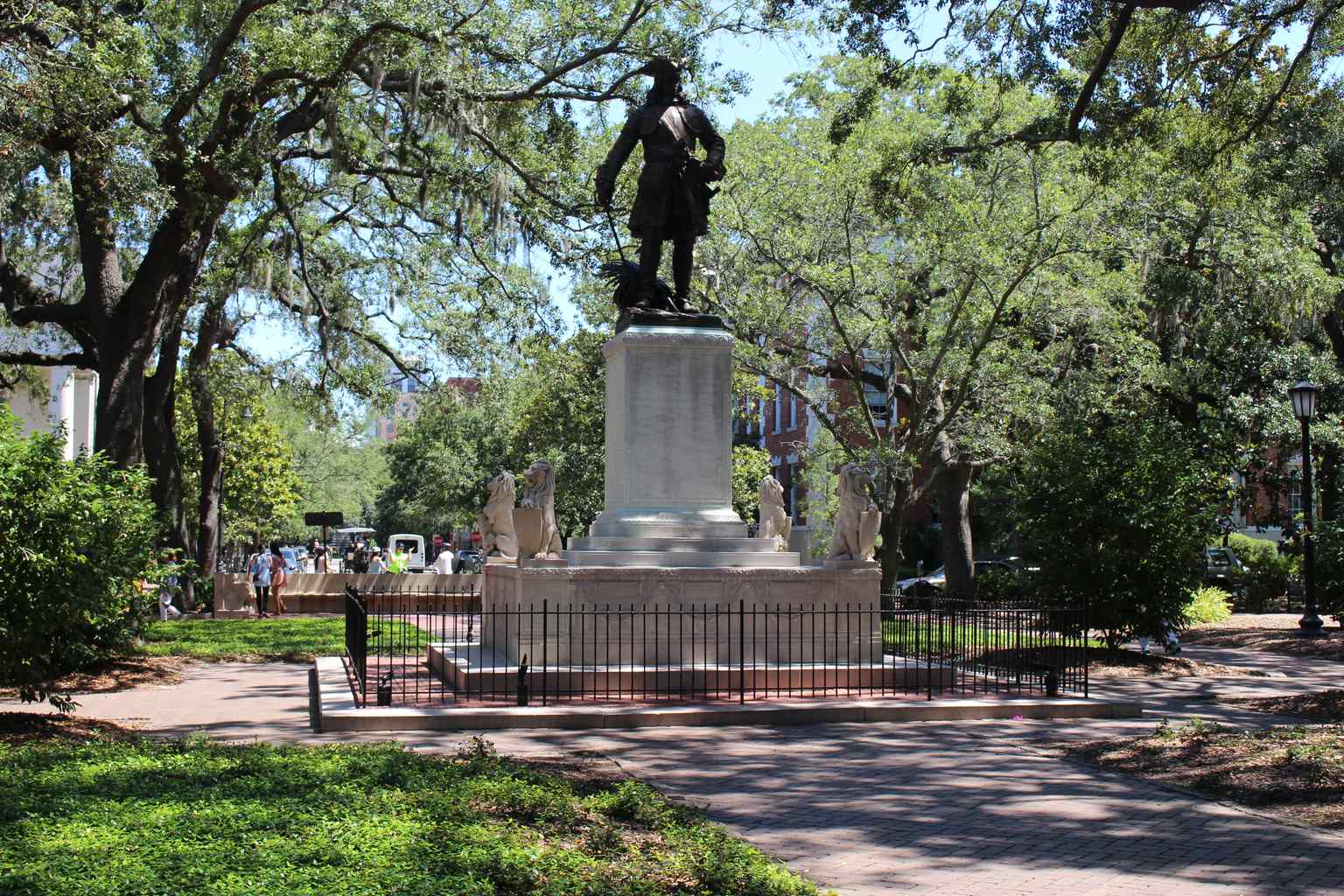
A detailed shot of James Oglethorpe's 9-foot bronze statue, depicting him in 18th-century military uniform with a sword, deliberately posed facing south to symbolize the threat from Spain.Photo: Michael Rivera, Wikimedia Commons, CC BY-SA 4.0. Cropped & resized. Placing Oglethorpe here required a major physical shift in the city's landscape. In nineteen ten, two busts of Confederate generals were evicted from this square and relocated to Forsyth Park. The city was quite literally reshaping its identity, physically moving monuments of a fractured, tragic war to make room for a man whose utopian dream started it all. Over a century later, the towering monument has developed a rich patina, while the canopy of live oaks in the square has grown dramatically around it.
The dedication ceremony in nineteen ten was a massive spectacle. Thousands gathered as the flags of Georgia and England were pulled away. The organizers even relocated the annual Thanksgiving football rivalry game between the Georgia Bulldogs and the Auburn Tigers to a nearby field just to capitalize on the enormous crowds. You might think unveiling a monument to Georgia's founder would bring the home team good luck, but the Bulldogs suffered a crushing twenty six to zero defeat.
As you look up at Oglethorpe, think about how this entire beautiful, orderly city grew out of one man's grief for his lost friend. It is a striking reminder of how deeply personal pain can be transformed into a lasting public legacy. The square is open to visitors every day from eight in the morning until six in the evening. Let us head toward our next stop, the Savannah Historic District, which is just a four minute walk away.
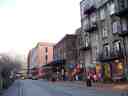
Look down this cobblestone street lined with towering multi story buildings made of aged stucco and rugged brick, their facades wrapped in distinctive black iron balconies.…Read moreShow less
Open dedicated page →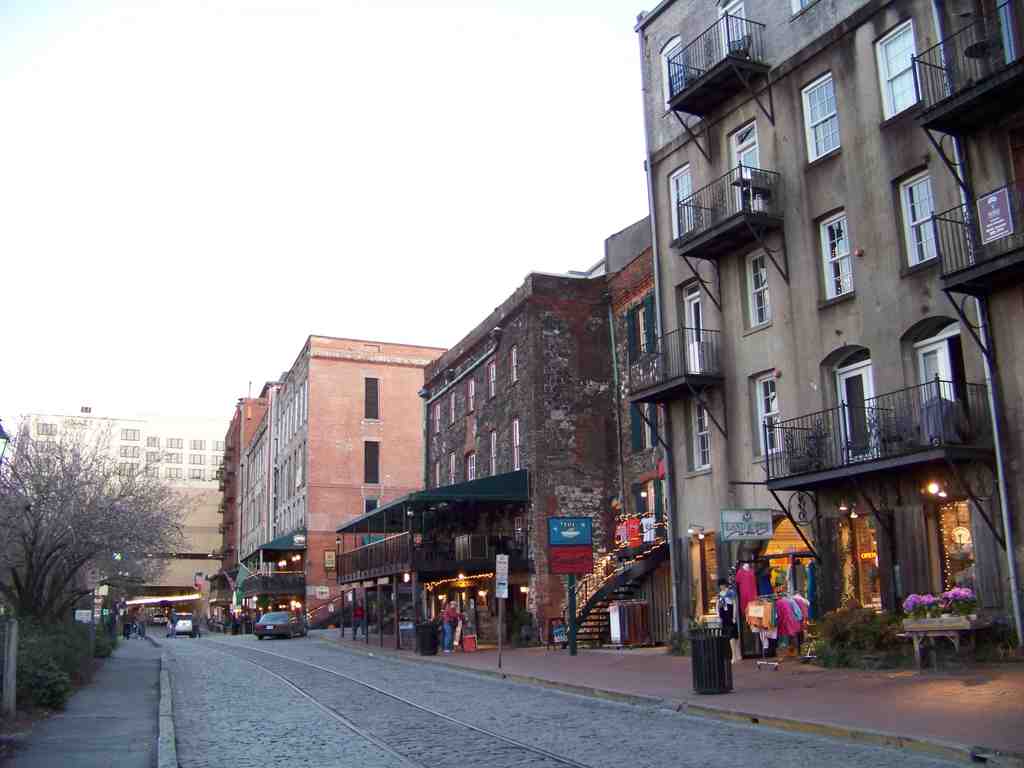
Savannah Historic DistrictPhoto: Lvklock, Wikimedia Commons, CC BY-SA 3.0. Cropped & resized. Look down this cobblestone street lined with towering multi story buildings made of aged stucco and rugged brick, their facades wrapped in distinctive black iron balconies. Welcome to the Savannah Historic District! This massive preservation area owes its orderly feel to the Oglethorpe Plan from 1733. James Oglethorpe designed the city using wards. Each ward had a beautiful central square flanked by trust lots, which were plots of land set aside for civic buildings like churches. Then you had the tythings, blocks subdivided into residential homes.
Wandering this grid is like stepping back in time, but the cost of preservation was steep. Buildings like the elegant Davenport House were nearly bulldozed into parking lots before locals banded together to save them. Yet, preservation here goes deeper than just saving pretty architecture. Beneath the surface, Savannah's historic spaces often served as secret sanctuaries for those escaping persecution or slavery, acting as a hidden refuge for those seeking freedom.
The most powerful example is the First African Baptist Church. Take a look at your screen to see the 1933 exterior of this sanctuary. Founded in 1788 by Andrew Bryan, a man who purchased his own freedom, the current structure was completed in 1859. It was built by free African Americans and enslaved people who molded the bricks by hand after laboring in the fields all day.
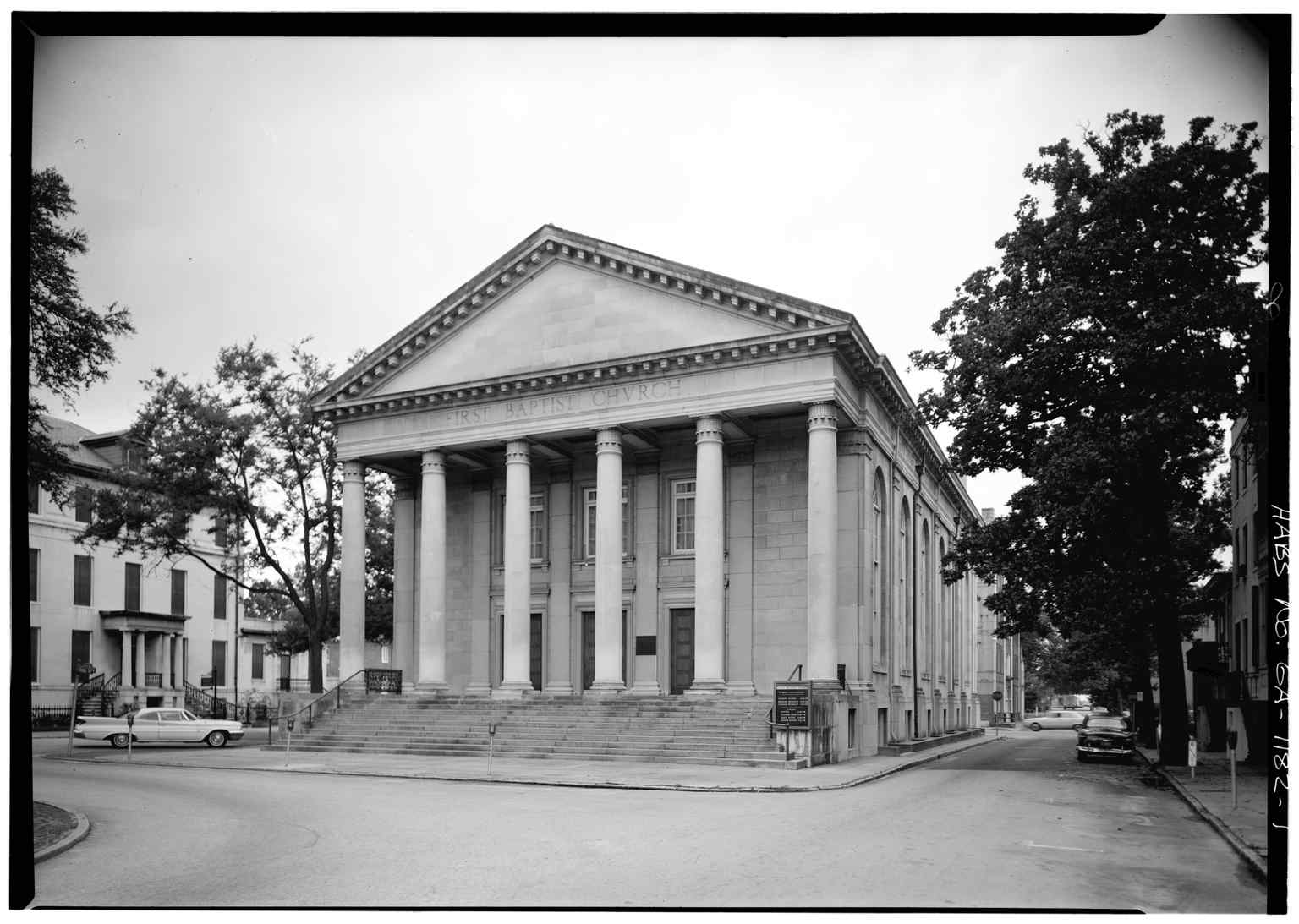
The First African Baptist Church, founded in 1788, is the oldest African American Baptist congregation in the United States, built by free and enslaved people.Photo: Unknown, Wikimedia Commons, Public domain. Cropped & resized. Beyond its religious significance, this church operated as a vital stop on the Underground Railroad. To protect everyone involved, no written records were kept. Instead, the building itself held the codes. The ceiling featured a Nine Patch Quilt design, a subtle architectural pattern designating the church as a safe house.
The most ingenious concealment lay beneath the sanctuary floorboards, in a four foot high space where runaway slaves hid. The floor featured holes shaped like a Congolese Cosmogram, an African prayer symbol representing birth, life, death, and rebirth. While they looked decorative, they were actually breathing holes for the people hiding below. Up in the balcony, pews nailed to the floor by enslaved members still bear faint carvings of West African Arabic script.
Savannah was a city of deep contrasts, relying heavily on the grueling labor of Irish immigrants to load ships with cotton. You can actually see how beautifully the striking red brick Cotton Exchange has been preserved on your app, standing firm as the riverfront evolved.
It leaves you marveling at the sheer courage required to hide such a massive secret in plain sight. Keep that in mind as we head to the Cathedral Basilica of St. John the Baptist, just a three minute walk away. By the way, the main sites here are generally open from 9 AM to 5:30 PM every day.
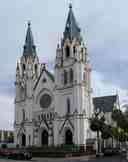
On your left, you will see a massive white stucco over brick church defined by two soaring pointed twin spires and a magnificent central circular rose window. It is hard to…Read moreShow less
Open dedicated page →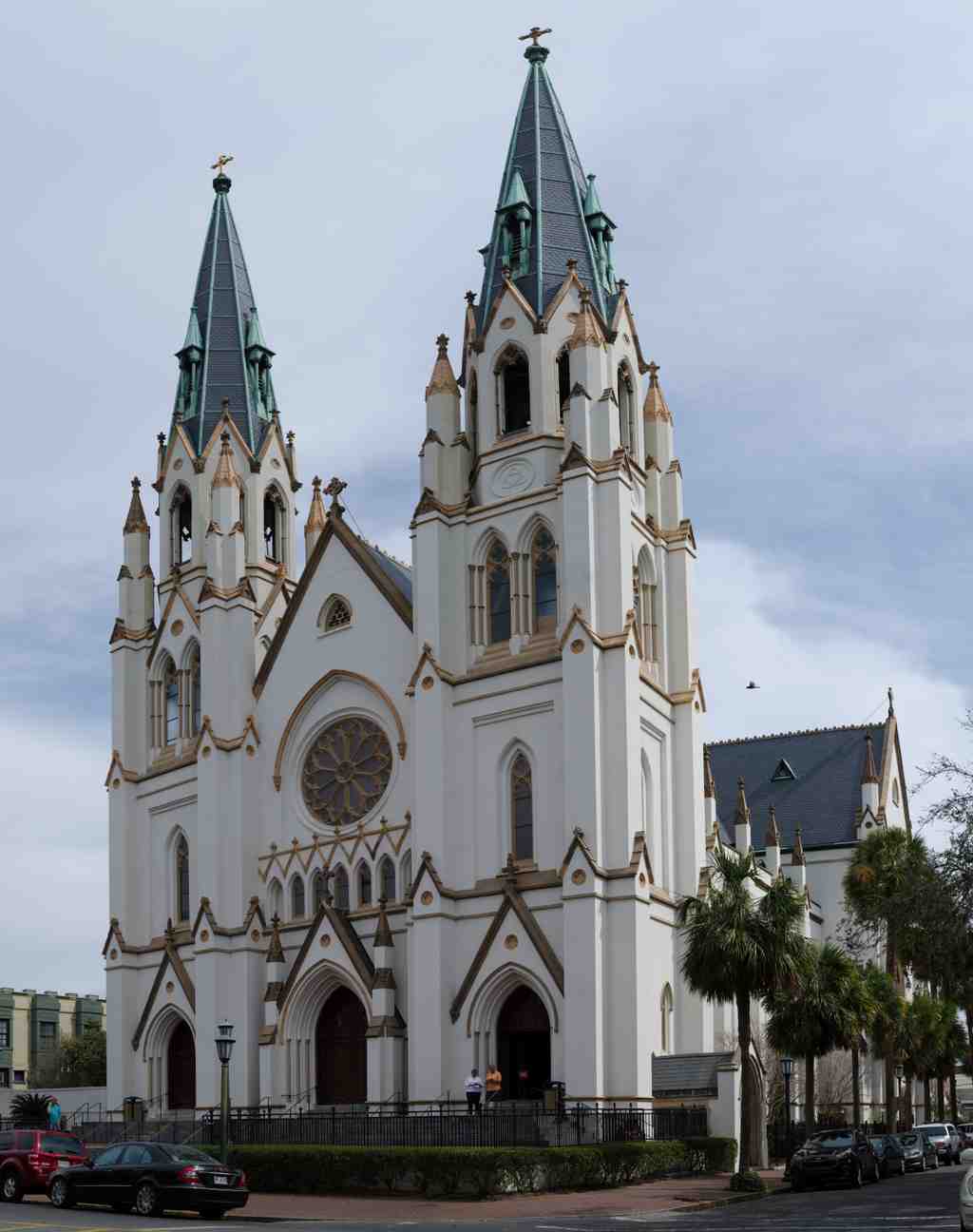
Cathedral Basilica of St. John the BaptistPhoto: Tim Pierce, Wikimedia Commons, CC BY-SA 4.0. Cropped & resized. On your left, you will see a massive white stucco over brick church defined by two soaring pointed twin spires and a magnificent central circular rose window.
It is hard to believe looking at this grand architectural marvel today, but when Savannah was first founded, Roman Catholics were strictly forbidden from settling here. The English trustees who ran the colony were completely paranoid. They feared that Catholic settlers would be secretly loyal to the Spanish authorities down in Florida rather than to the English crown right here in Georgia.
That early prejudice finally faded after the American Revolution. By 1799, French Catholic refugees fleeing uprisings in Haiti established the first real church here, which eventually became a spiritual home for free Black Haitians in the early nineteenth century.
But getting to the magnificent building you are standing in front of took some serious maneuvering. In the 1870s, Bishop Ignatius Persico orchestrated a strategic land swap with the Sisters of Mercy, trading away another diocesan lot just to secure this prime footprint. And here is the genuinely funny quirk of history. After all that political wheeling and dealing to build the new Cathedral of Saint John the Baptist, when the doors finally opened, it was dedicated as Our Lady of Perpetual Help. It kept that completely different title for about ten years before quietly reverting to its intended namesake.
This building perfectly captures the constant push and pull of Savannah... a place constantly striving to cement its legacy, even when tragedy strikes. In 1898, a terrifying fire ripped right through the sanctuary. Imagine the crowds of locals standing helplessly in the square right behind you, watching the intense heat cause the walls to crumble and the original stained glass windows to explode into shards. When the ash settled, almost nothing was left but the outside brick walls and those two newly constructed spires.
But the congregation refused to let their legacy become a pile of rubble. Take a peek at your screen to see the breathtaking sanctuary they built from the ashes. The brilliant light you see filters through eighty one masterful stained glass windows imported from the Austrian Tyrol. The soaring Neo Gothic design... an architectural style known for pointed arches and cross ribbed vault ceilings... was intentionally built to draw your eyes upward, making you feel closer to the divine.
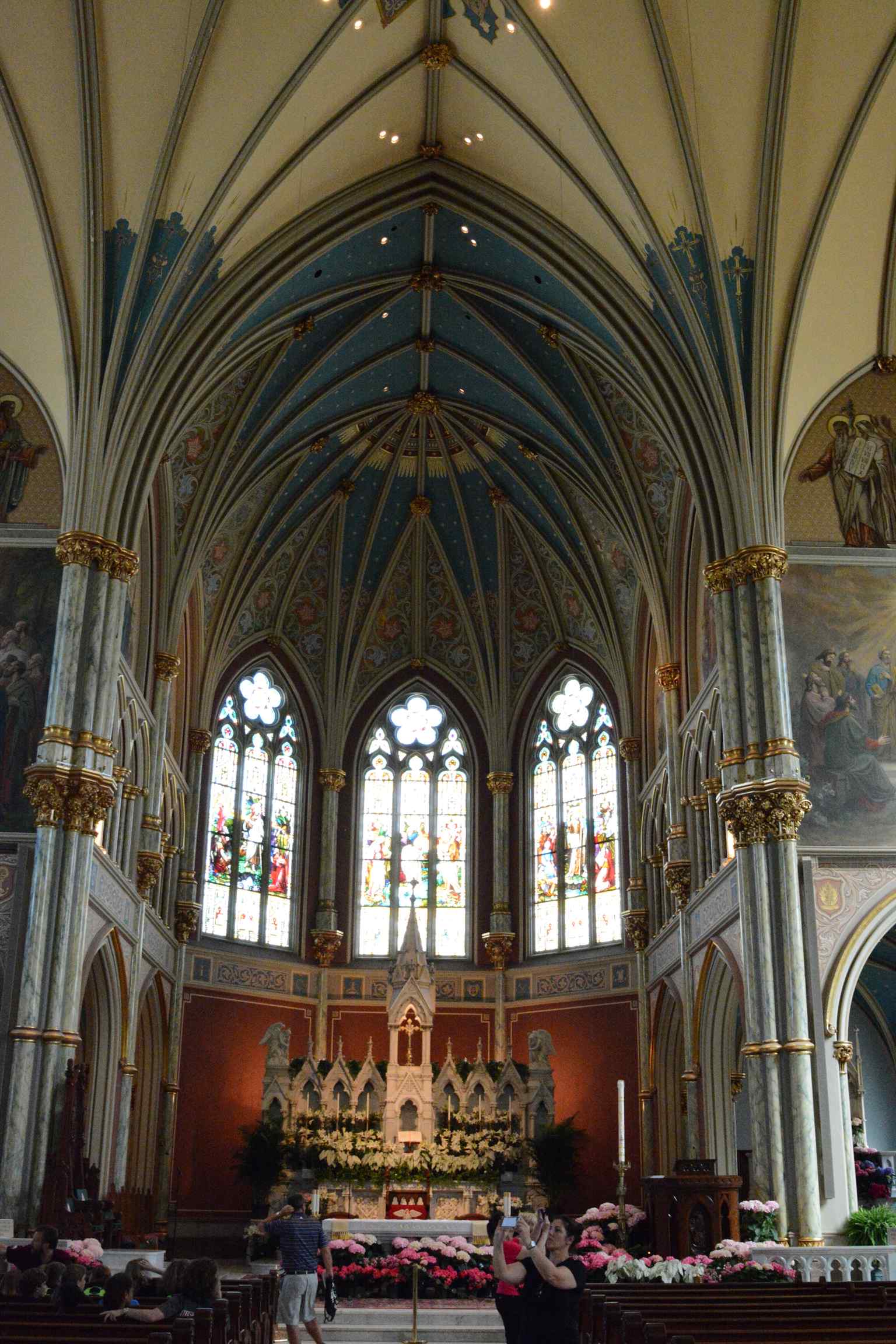
An alternate view of the spacious interior, showcasing the vibrant light filtering through the numerous stained glass windows.Photo: bubba73, Wikimedia Commons, CC BY-SA 3.0. Cropped & resized. While the vintage streetlamps and vehicles of 1936 have long since been replaced, the towering French Gothic spires of Savannahs beloved cathedral remain a timeless fixture of the historic district.
If you want to experience those slack jawed stares for yourself, the cathedral welcomes visitors daily from 9:00 AM to 4:30 PM.
Now, we are going to explore the darker side of preservation. We are heading toward another grand home with deep, complicated ties to the Confederacy, so let us take the five minute walk over to the Sorrel Weed House.
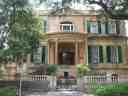
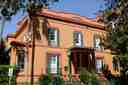
Look right to find a massive, square-shaped mansion finished in vibrant orange stucco, accented by dark green window shutters and a heavy entrance porch with dark wooden columns.…Read moreShow less
Open dedicated page →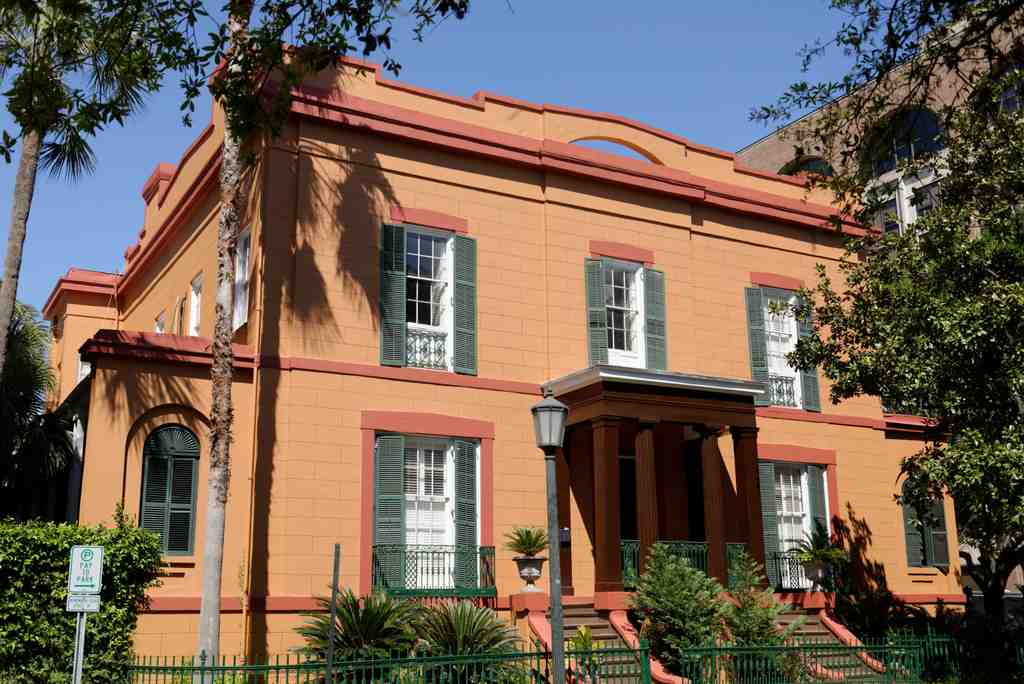
Sorrel–Weed HousePhoto: Jud McCranie, Wikimedia Commons, CC BY-SA 4.0. Cropped & resized. Look right to find a massive, square-shaped mansion finished in vibrant orange stucco, accented by dark green window shutters and a heavy entrance porch with dark wooden columns. This is the Sorrel-Weed House, and let me tell you, it is an absolute architectural heavyweight. It is one of the city's finest examples of Greek Revival architecture, which is a style designed to mimic the grand, symmetrical temples of ancient Greece.
You might notice it shares a bit of architectural DNA with the Owens-Thomas House we visited earlier. Both homes use a clever trick of placing large interior columns inside the foyer, which is the main entrance hall, to firmly separate the formal greeting areas for guests from the private, hidden rooms used only by the family.
This grand estate was the boyhood home of Moxley Sorrel. Before the Civil War began, Moxley was just an ordinary young bank clerk living right here. But when the conflict erupted, he traveled to Virginia and threw himself into the fight. His courage was unmistakable. Despite being wounded three times across major campaigns, he was promoted to brigadier general at just twenty-six years old, making him one of the youngest generals in the entire Confederate army. He was fiercely dedicated, and his peers later praised him as the greatest staff officer they had ever seen.
But a building this old rarely survives without a few scars. People are always trying to shape a property to fit their own legacy. In the mid-twentieth century, a businessman named A.J. Cohen Jr. literally built a large brick addition onto the side of the house so he could open an upscale women's clothing store. For decades, the original, elegant footprint of this mansion was buried under commercial brick.
Then, in nineteen ninety-six, a man named Stephen Bader bought the estate and immediately fired up the bulldozers. He tore away that brick addition to restore the home's original layout. A few years later, a top architectural curator from Colonial Williamsburg came down to inspect the house. He actually confirmed that a Victorian dividing wall and a stairway the new owners had demolished were indeed later additions. By tearing them down, they had successfully resurrected the original, open layout the Sorrel family built. It is a constant tug-of-war here between altering a building for modern use and meticulously peeling back the layers to rescue the past.
If you want to see exactly how much this property has transformed over the decades, take a quick peek at the comparison photo on your screen.
Today, the house operates as a museum and is open daily from eleven in the morning until eleven at night, except Monday through Wednesday when they open a bit later in the evening.
Keep walking, because you are going to love our next stop. Prepare yourself for another Civil War tale, but this one involves scandalous wealth and a high-profile arrest. The Green-Meldrim House is just a quick one-minute walk away.
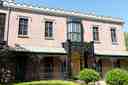
On your left, look for the grand, stuccoed brick mansion featuring a crenellated roofline, which looks like the notched top of a medieval castle, along with a delicate cast iron…Read moreShow less
Open dedicated page →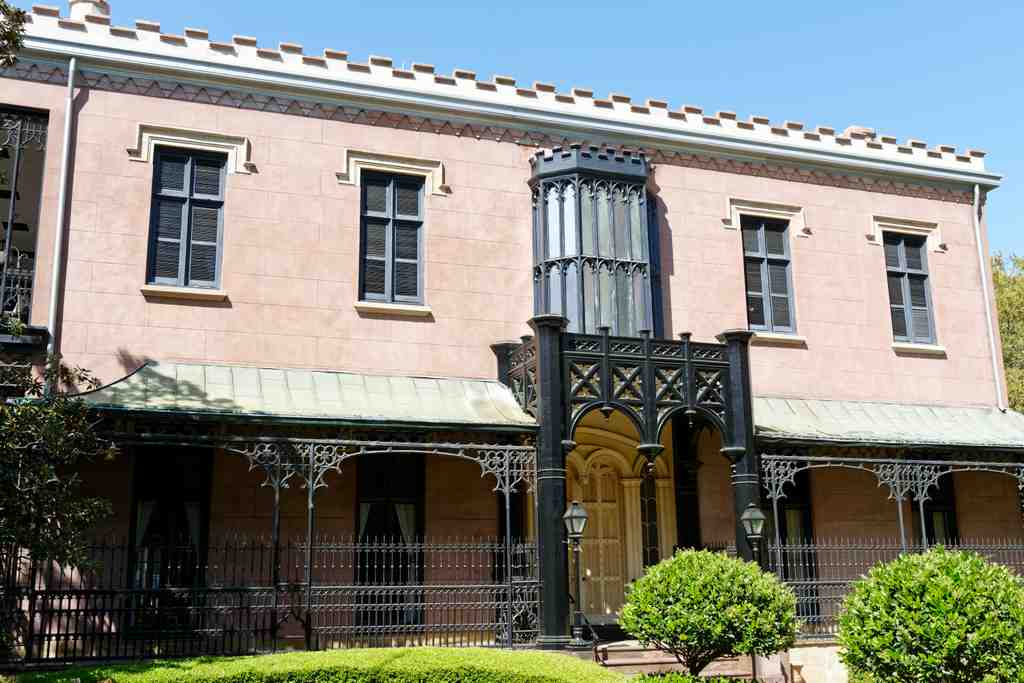
Green–Meldrim HousePhoto: Bubba73 (Jud McCranie), Wikimedia Commons, CC BY-SA 4.0. Cropped & resized. On your left, look for the grand, stuccoed brick mansion featuring a crenellated roofline, which looks like the notched top of a medieval castle, along with a delicate cast iron porch and an ornate iron front gate.
What you are looking at is the result of a massive, wildly extravagant promise. Back in 1850, a wealthy English cotton merchant named Charles Green signed a marriage contract with his second wife, Lucy, promising to build her an absolute palace. He spent ninety three thousand dollars on this Gothic Revival masterpiece in 1853, which is roughly three point five million dollars today. The newlyweds actually spent their honeymoon touring Europe just to shop for the house. They shipped back flawless Carrara marble and shimmering gold leaf mirrors from Austria. If you pull up your screen, check out the original freestanding iron staircase they installed inside. It is a stunning piece of mid nineteenth century engineering.
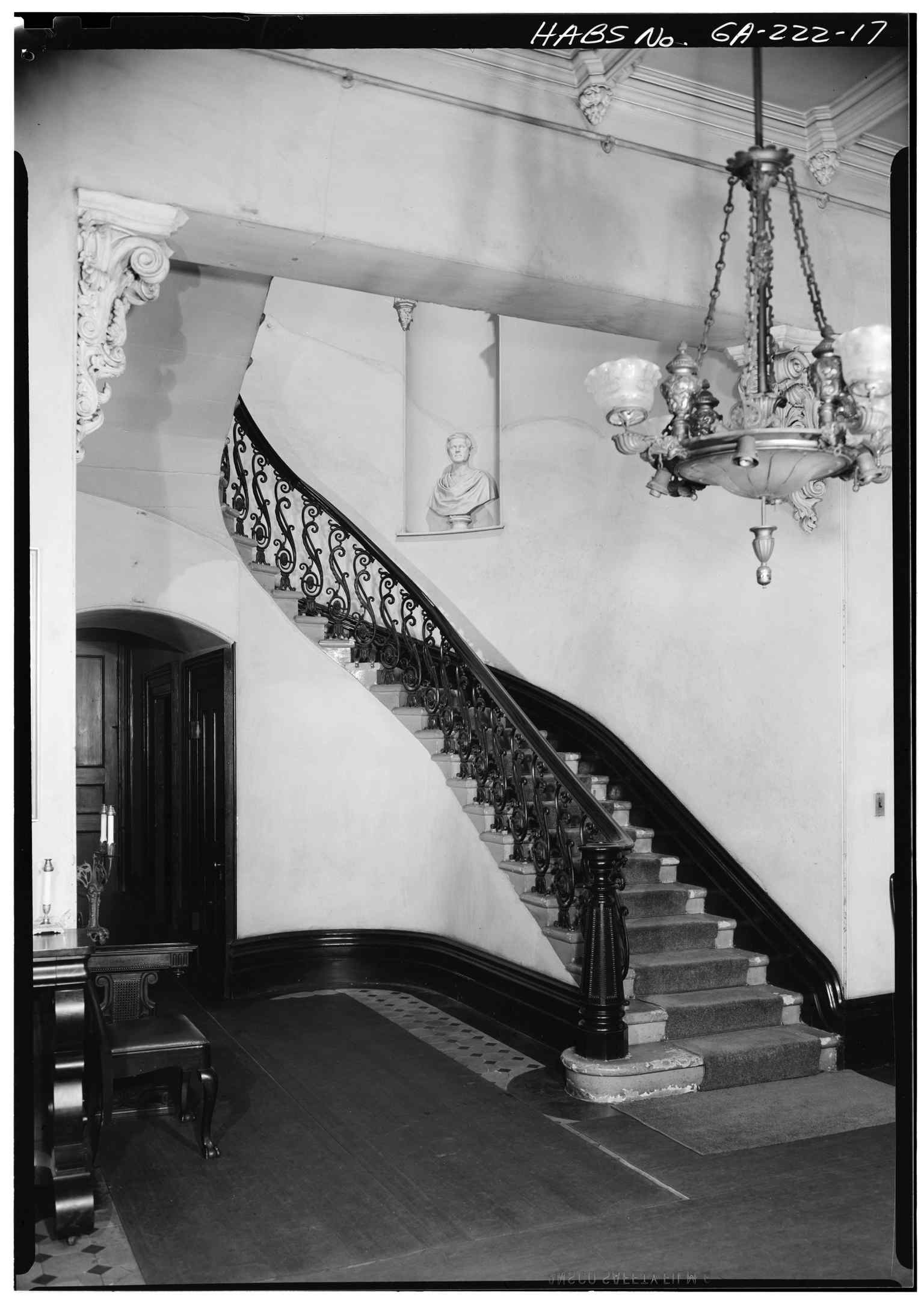
Features the house's magnificent freestanding staircase, a highlight of its original interior ironwork and craftsmanship from 1853.Photo: Related names: Green, Charles Sherman, William Tecumseh Meldrim, Peter Norris, John S, Wikimedia Commons, Public domain. Cropped & resized. But underneath all that splendor, a massive scandal was brewing. Charles Green was legally a British citizen, but his loyalties were secretly poured into the Confederacy. Early in the Civil War, Green and his business partner were suddenly ambushed and arrested by Pinkerton detectives right after returning from Europe. He was accused of arranging foreign loans to buy Confederate weapons and was locked up in a Boston Harbor military prison for three months. It turns out, his covert activities were incredibly extensive. He even helped secure a blockade running ship carrying one of the most valuable military cargoes to reach the South during the entire war.
When Union General William T. Sherman captured the city in 1864, the war arrived right at Green's doorstep. Fearing his opulent home would be incinerated, Green rode out, found Sherman, and practically insisted the General use the mansion as his headquarters. Look at your app to see a historic illustration of Sherman's troops occupying the grand entrance hall. It was right in this house that Sherman wrote his famous telegram to President Lincoln, offering him the city of Savannah and twenty five thousand bales of cotton as a Christmas gift. The irony? Every single bale of that confiscated cotton belonged to Charles Green. His strategic hospitality saved the building, but ruined his fortune.
This mansion also hosted the Savannah Colloquy, a profoundly historic meeting where Sherman sat down with twenty African American ministers. Their spokesperson, Garrison Frazier, eloquently argued for the independence of newly freed people, directly inspiring Sherman's famous order allocating forty acres and a mule to freed families.
Today, St. John's Episcopal Church owns the property. Miraculously, over a hundred pieces of Green's original antique furniture were recently returned to the house from France by the estate of his grandson. You can tour the interior Tuesday through Saturday from ten to four.
Now, let us leave behind the high drama of nineteenth century billionaires and generals. We are going to trade all this intense, grand wealth for some incredibly humble, heartwarming Southern hospitality. We are heading over to Mrs. Wilkes Dining Room, just a four minute walk away, where the food is passed family style and everyone is treated like kin. Let us go!
Look to your left for a distinctive wooden sign with an arched top, square side cutouts, and elegant red lettering marking 107 The Wilkes House. Take a glance at your phone to see…Read moreShow less
Open dedicated page →
Mrs. Wilkes' Dining RoomPhoto: JeffersonLH, Wikimedia Commons, CC BY-SA 4.0. Cropped & resized. Look to your left for a distinctive wooden sign with an arched top, square side cutouts, and elegant red lettering marking 107 The Wilkes House. Take a glance at your phone to see the lovely 1870 townhouse exterior where this culinary treasure is hidden.
Welcome to Mrs. Wilkes Dining Room. Savannah is a city that fiercely guards its past, often fighting a tug of war between dramatic histories and the deep desire to preserve its soul. Here, legacy is not carved into stone. It is served on a platter.
In 1943, Sema Wilkes started helping in the kitchen of a boardinghouse where her husband was staying. A boardinghouse was simply a private home providing lodgers with a room and daily meals. Growing up on a farm, Sema had cooked since she was seven. She soon took over with a simple dream of offering homestyle Southern cooking, building incredible bonds with local farmers who dug sweet potatoes for her harvests.
By 1965, the food was so wildly popular that Sema closed the lodging business to focus entirely on feeding the public. She actually refused to put a sign out front until 1987, relying entirely on word of mouth.
What makes this place magical is how fiercely her family protects her vision. Today, managed by her granddaughter and great grandson, the restaurant still uses Sema's time tested recipes. They kept her old school rules, too. Guests are escorted in shifts of ten to sit at large communal tables. There are no reservations, it is cash only, and there is no menu. You just sit down and pass steaming bowls of fried chicken to perfect strangers. When you finish, you are expected to carry your own dirty plates to the kitchen.
This deliberate choice to foster connection means everyone is treated equally. When President Obama visited in 2010, right after learning he had borderline high cholesterol, he looked at his massive plate of comfort food and joked to the press pool, the traveling group of journalists, not to tell Michelle. Hollywood stars like the cast of Magic Mike XXL have dined here, yet they wait in the same long line as local workers.
Of course, Savannah always adds a twist of scandal to its traditions. Jim Williams, the wealthy antiques dealer famous from Midnight in the Garden of Good and Evil, actually had Mrs. Wilkes cater to his jail cell while awaiting his murder trial, throwing a lavish luncheon of roast lamb and cornbread behind bars.
If you want to experience this unpretentious slice of history, they offer a moderately priced lunch on weekdays from eleven to two. Now, as we step away from this deeply preserved culinary past, we move right into the modern, sometimes turbulent creative engine of the city, at the Savannah College of Art and Design, which is just steps away.
Look for the prominent circular sign marking the entrance, featuring a classic crest divided into quadrants with a prominent bee, a small acorn, and a distinct checkerboard…Read moreShow less
Open dedicated page →
Savannah College of Art and DesignPhoto: Unknown author, Wikimedia Commons, Public domain. Cropped & resized. Look for the prominent circular sign marking the entrance, featuring a classic crest divided into quadrants with a prominent bee, a small acorn, and a distinct checkerboard pattern. You have arrived at the Savannah College of Art and Design, widely known as SCAD.
This massive institution started as a scrappy family dream back in 1978. Paula Wallace was an elementary school teacher who realized her students had nowhere in the region to continue their artistic pursuits. So, she and her family took a massive leap, selling off their personal belongings to purchase a towering Romanesque Revival red brick building, the Savannah Volunteer Guards Armory. If you check your screen and look at the seventh image, you can see that very flagship building, now called Poetter Hall. They started with just four staff members and seventy one students. Today, the university owns sixty seven historic buildings across the grid of downtown Savannah, meticulously restoring old masonry and ironwork that had been left to decay.
But this incredible story of architectural rescue hides a profoundly dark chapter. By the early nineteen nineties, the school was expanding rapidly, yet deep unrest was brewing. In 1991, profound tragedy struck the campus. An architecture professor named Juan Bertotto took his own life in a highly public manner by setting himself on fire. This horrifying event was soon followed by two students jumping to their deaths.
The administration responded with intense secrecy, which quickly ignited outrage and paranoia among the students and staff. Frustrated students demanded transparency about where their tuition fees were going and formed their own rebellious newspaper. When a group of faculty members rallied behind the students, SCAD fired twelve of those professors. The campus practically exploded. And I mean that literally. Someone detonated a pipe bomb at the administration building, and two more went off later that year at the Savannah Civic Center, which we walked past way back at the start of our tour.
Instead of looking inward, administrators claimed these bombings and protests were a massive corporate conspiracy. They pointed fingers at a rival school, the New York based School of Visual Arts, which had just announced plans to open a branch right here in Savannah. This sparked an all out war. SCAD filed a hundred and three million dollar lawsuit against their rival to protect their reputation. Former SCAD professors even countersued, accusing the college of violating the RICO Act, a complex federal law normally used to prosecute mafia bosses and organized crime syndicates. The legal battle took bizarre local twists, even involving a fired community booster who was locally famous for running around Savannah dressed as Batman. Eventually, the bitter lawsuit was settled right before trial, and the rival school retreated from the city entirely.
SCAD beautifully preserved the physical bones of Savannah, but its own foundation rests on a fierce, sometimes ruthless fight for survival. It really shows how monumental institutions can be born from a collision of brilliant vision and absolute turmoil. Let that complicated legacy settle in your mind as we head to our final destination. We will take a short six minute walk over to Congregation Mickve Israel.
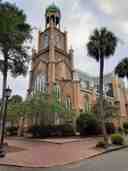
Look right in front of you at that striking tan stucco building with its tall pointed arch windows and that prominent square tower topped by an unusual open green domed cupola.…Read moreShow less
Open dedicated page →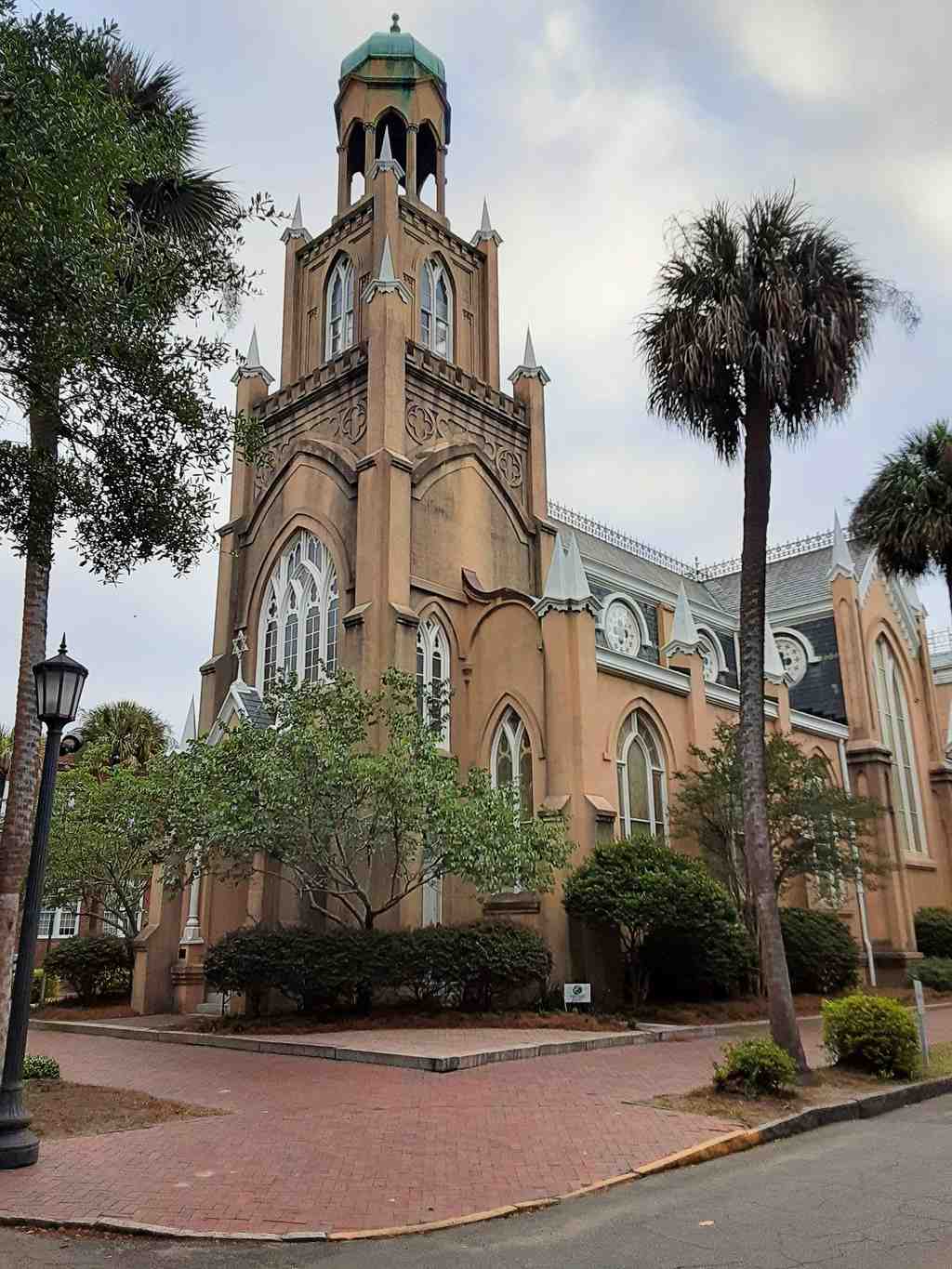
Congregation Mickve IsraelPhoto: JeffersonLH, Wikimedia Commons, CC BY-SA 4.0. Cropped & resized. Look right in front of you at that striking tan stucco building with its tall pointed arch windows and that prominent square tower topped by an unusual open green domed cupola. Welcome to Congregation Mickve Israel. This is one of the oldest Jewish congregations in the United States, and the only purely Gothic Revival synagogue in the country. Standing proudly for over a century, the rare neo Gothic architecture remains a timeless anchor in Savannahs historic district, gracefully weathering the decades as the city transformed around it... you should definitely check out the before and after image on your screen to see how it has stood the test of time.
Now, you might be thinking this building looks an awful lot like a traditional Christian church. That was entirely intentional. If you pull up the side view on your app, you can see the building was designed in a cruciform plan, which simply means the layout forms the shape of a cross. Back in 1876, the congregation deliberately chose this popular architectural style to blend in with the neighboring churches. They wanted to link their house of worship in dignity with the surrounding community. It worked so well that a local woman actually wrote a letter to the synagogue president, absolutely thrilled that they had built a church in the shape of a cross, and she welcomed them to the Christian fold. Of course, she completely misunderstood. It was not a conversion... it was a strategic compromise. It was a conscious choice to find harmony in a new world while fiercely guarding their ancient traditions.
And they definitely guarded their history. Today, the museum inside holds a rare deerskin Torah scroll brought from London in 1733. It miraculously survived a massive fire in 1829 that completely destroyed their very first wooden synagogue.
But the story of how those founders even got to Georgia is a wild ride. In the early seventeen hundreds, many of the original founders were living in secret in Lisbon, hiding from the terrifying Spanish and Portuguese Inquisition. One of them, a brilliant physician named Diogo Nunes Ribeiro, pulled off a breathtaking escape. He hosted a party, managed to smuggle his entire family aboard an English ship right under the authorities noses, and the captain immediately raised anchor and sailed them to safety in London. There, he openly returned to his Jewish faith and changed his name to Samuel Nunez.
In 1733, Dr. Nunez and a group of forty two Jewish immigrants sailed to Savannah. When they arrived, they found the brand new colony collapsing from a deadly yellow fever epidemic. The settlements only doctor had already died. Dr. Nunez immediately stepped in and his medical expertise curbed the disease, saving Savannah from total ruin. The colonial leaders back in London had strictly forbidden Jewish settlement, but the founder of Georgia, James Oglethorpe, was so profoundly grateful for the doctors life saving work that he openly defied his superiors and granted the Jewish families land, giving them a true hidden refuge.
Standing here, imagine leaving everything behind... your home, your identity, your wealth... just to survive. What would you risk for a chance at freedom? This congregation is a beautiful testament to those who risked everything, helping to build Savannah into a flawed but incredible sanctuary for those seeking a new beginning. If you want to explore the history further, you can hop on a guided tour of the stunning interior and museum during their regular weekday opening hours.


Frequently asked questions
How do I start the tour?
After purchase, download the AudaTours app and enter your redemption code. The tour will be ready to start immediately - just tap play and follow the GPS-guided route.
Do I need internet during the tour?
No! Download the tour before you start and enjoy it fully offline. Only the chat feature requires internet. We recommend downloading on WiFi to save mobile data.
Is this a guided group tour?
No - this is a self-guided audio tour. You explore independently at your own pace, with audio narration playing through your phone. No tour guide, no group, no schedule.
How long does the tour take?
Most tours take 60–90 minutes to complete, but you control the pace entirely. Pause, skip stops, or take breaks whenever you want.
What if I can't finish the tour today?
No problem! Tours have lifetime access. Pause and resume whenever you like - tomorrow, next week, or next year. Your progress is saved.
What languages are available?
All tours are available in 50+ languages. Select your preferred language when redeeming your code. Note: language cannot be changed after tour generation.
Where do I access the tour after purchase?
Download the free AudaTours app from the App Store or Google Play. Enter your redemption code (sent via email) and the tour will appear in your library, ready to download and start.
If you don't enjoy the tour, we'll refund your purchase. Contact us at [email protected]
Checkout securely with 





.jpg)

.jpg)