
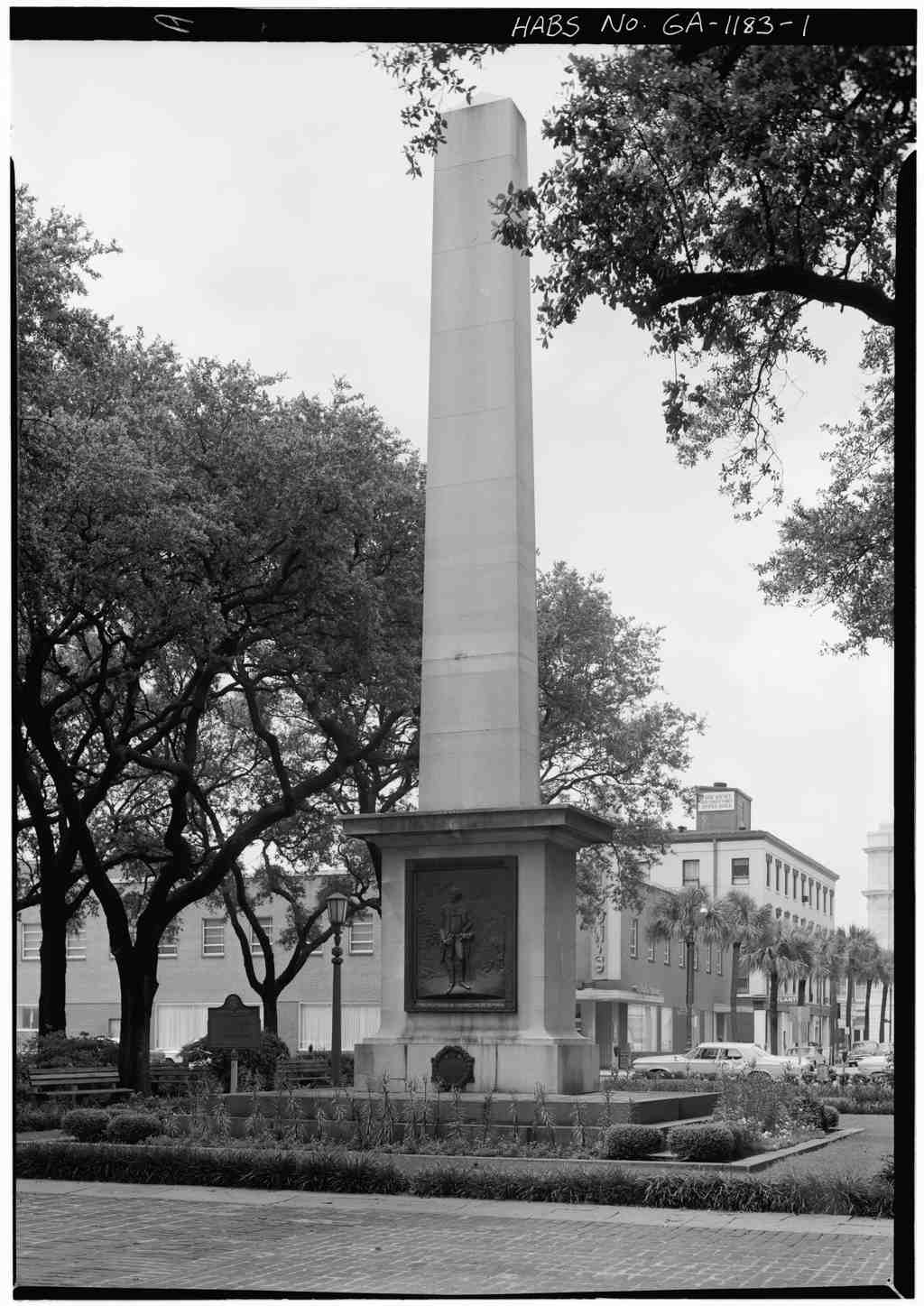
On your right, you will see a towering fifty-foot granite obelisk with dark bronze plaques resting on a stepped stone base.
This is the Nathanael Greene Monument. Check out the artwork in your app to see a portrait of the man himself. Greene was born in Rhode Island and raised as a pacifist Quaker, meaning he belonged to a Christian denomination that strictly opposed all forms of violence and war. Yet, when the American Revolution broke out, he chose to fight, eventually becoming one of George Washington's most trusted generals and leading campaigns right here in Georgia.
As a reward for his service, the state of Georgia gave him a sprawling plantation. Sadly, Greene died just a few years later in 1786. His death was a terrible blow to his loved ones, but the heartbreak for his family was only just beginning.
Take a moment to look at the massive stone blocks forming the base of this monument. Imagine the famous French military leader, the Marquis de Lafayette, standing on this very spot in 1825 to lay the cornerstone. He was here to honor an American hero, but he was also honoring a family completely shattered by grief.
In the spring of 1793, Greene's eighteen-year-old son, George Washington Greene, took a canoe trip up the Savannah River with a friend. The young man had only recently returned home from France, where he had been personally educated under the supervision of Lafayette. The river was swollen and treacherous... and the canoe capsized. George drowned. His remains were placed alongside his father's in a burial vault at Colonial Park Cemetery.
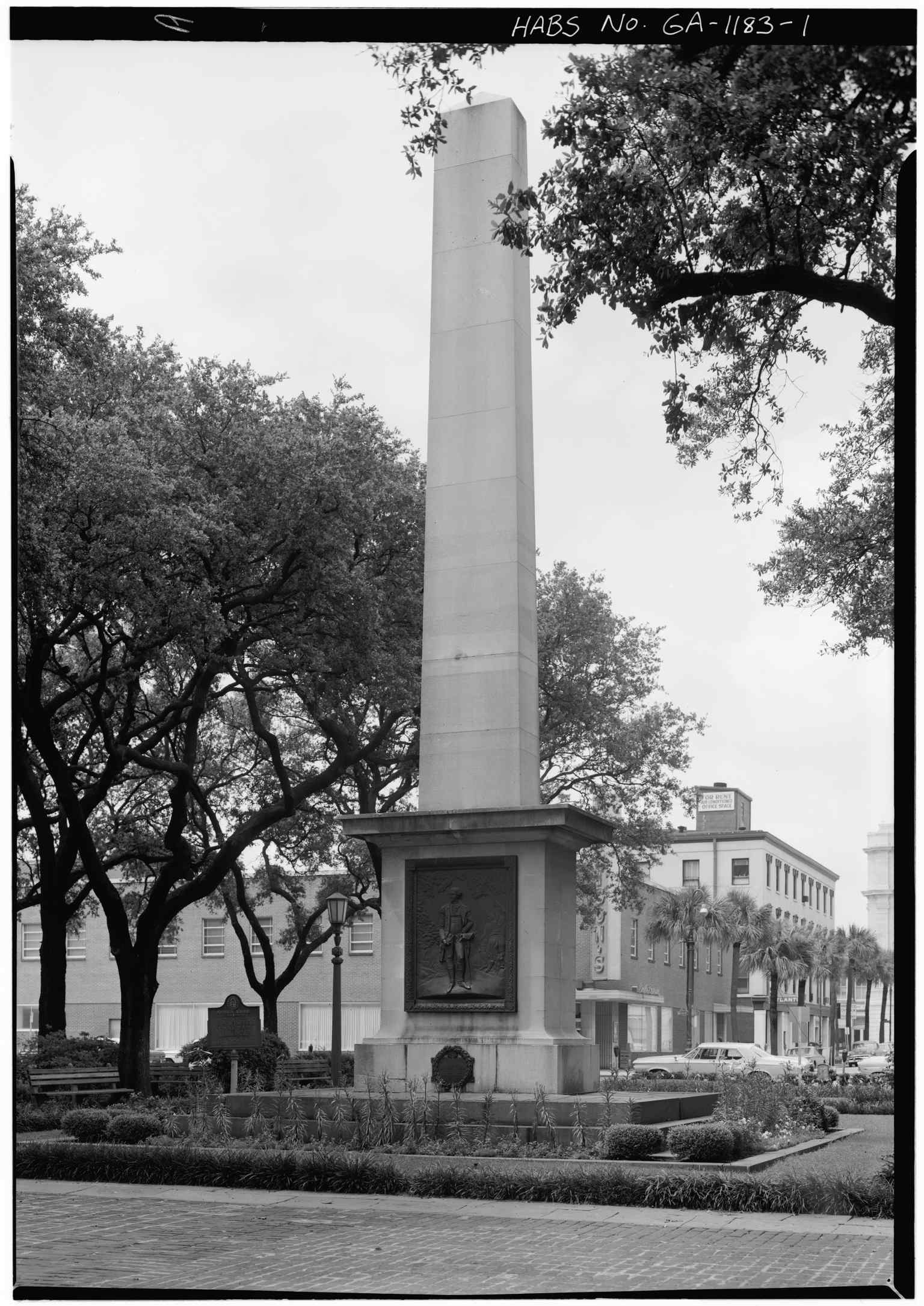
It took decades to complete this monument. The state even authorized a lottery in 1826 to raise thirty-five thousand dollars... which would be over a million dollars today... just to fund the project. The architect patterned the monument in the Egyptian style of Cleopatra's Needle, a tall, four-sided pillar ending in a pyramid shape. You can get a clear view of its stark architectural lines in the second photo on your screen.
But while this grand stone pillar stood proudly in the square, the bodies of Greene and his son were lost. During the American Civil War, occupying Union forces vandalized the cemetery, and the exact location of the family vault was forgotten. For over a century, the brilliant general and his tragically young son sat unidentified in the dark. Ironically, they were resting right next to the remains of John Maitland, Greene's greatest British rival from the Revolutionary War.
It was not until 1901 that a search team finally identified them. They knew they had found the elder Greene because three metal military uniform buttons and a pair of heavy French silk gloves had miraculously survived intact on the skeletal hands. Father and son were brought here and reinterred directly beneath this granite shaft in 1902.
Look up at the top of the obelisk. We build these massive markers to freeze our heroes in time, chasing an immortal legacy of triumph and perfection. But no amount of carved granite can erase the profound personal tragedies that so often haunt the lives of great historical figures.... When you are ready to leave this quiet reflection behind, we will continue our walk. Our next stop, Christ Church, is just a short two-minute stroll away.




