
Krakow Audio Tour: A Mosaic of Jewish Heritage and Culture Tour
Centuries ago, Kazimierz was its own city—a crossroads of faith, art, and secret rebellions carved into every cobblestone. Unlock Kraków’s layered history with a self-guided audio tour winding through the heart of Kazimierz. Venture beyond the surface to discover stories and hidden corners missed by most travelers. Who risked everything inside the Old Synagogue when soldiers marched through the night? What shadows linger in the stone walls of the High Synagogue, whispered about by those who once gathered here in secret? And why did a forgotten artist choose this neighborhood as his final refuge, leaving cryptic marks that puzzle historians to this day? Trace intrigue and transformation with each step along narrow alleys and sunlit squares. Feel the pulse of rebellion, resilience, and reinvention that still moves through these storied streets. Press play now—Kraków’s secrets are waiting beneath your feet.
Tour preview
About this tour
- scheduleDuration 80–100 minsGo at your own pace
- straighten2.6 km walking routeFollow the guided path
- location_on
- wifi_offWorks offlineDownload once, use anywhere
- all_inclusiveLifetime accessReplay anytime, forever
- location_onStarts at Cimitero di Remah
Stops on this tour
lock_open 3 free previews · 12 unlock with purchase
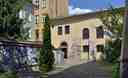
Look for a pale stone wall and dark iron gate beside a low synagogue building, with the cemetery’s compact enclosure tucked closely behind them. Stand here for a moment, and…Read moreShow less
Open dedicated page →Look for a pale stone wall and dark iron gate beside a low synagogue building, with the cemetery’s compact enclosure tucked closely behind them.
Stand here for a moment, and Kazimierz begins not with a square or a market, but with a boundary: wall, gate, names, and the patient weight of stone. This is the Old Jewish Cemetery, better known as the Remah Cemetery, laid out between the fifteen thirties and fifteen fifties, one of the oldest surviving Jewish burial grounds in Poland. Places like this keep a different sort of record. Official history likes neat summaries; graves preserve human scale, one life, one family, one inscription at a time.
The man at the heart of this place is Rabbi Moses Isserles, known as the Remah. He was one of the great Jewish scholars of Kraków, but here he is also something more intimate: a mourner. He founded the synagogue next door in memory of his first wife, so this whole corner became not only a public religious site, but a private landscape of grief turned outward into communal memory. If you glance at the image on your screen, you can see his grave, the one that drew generations of visitors.
And visitors truly came. Before the Second World War, thousands arrived here every year, especially on Lag Ba’omer and around the anniversary of Remah’s death, turning this cemetery into a place of active devotion rather than hushed abandonment. His tombstone carried the famous line, “From Moses to Moses there was none like Moses,” placing him in the company of Maimonides and making this grave a destination for pilgrimage.
Now, let me put a question to you. Who earns remembrance most deeply: the celebrated scholar, the person misjudged in life, or the descendants who keep returning to speak a name aloud?
Locals would point you toward the back of the cemetery for the answer. Legend says Yossele the Holy Miser was buried there in disgrace because his neighbours thought him mean and cold. Only after his death did they discover that he had quietly given charity to the poor, and the rabbi added HaTzadik, meaning “the righteous one,” to his stone. Nearby lies Rabbi Yom-Tov Lipmann Heller, another learned figure whose life also carried hardship and survival after imprisonment in Vienna.
What you see today is a rescue as much as a relic. The Nazis tore down walls, ripped up tombstones, and reused many as building material elsewhere or sold them off. After the war, workers recovered fragments, and in nineteen fifty-nine a major clearing and reconstruction effort helped reassemble this ground. The dense restored stones in the cemetery images are not just old; many are survivors.
From one rabbi’s grave, an entire district begins to unfold: prayer, scholarship, legend, loss, and the stubborn habit of return. When you’re ready, continue to the Izaak Synagogue, about a two-minute walk from here. If you plan to come back, the cemetery generally opens from nine, closes on Saturdays, stays open until six from Tuesday to Thursday, and closes earlier on Monday, Friday, and Sunday.
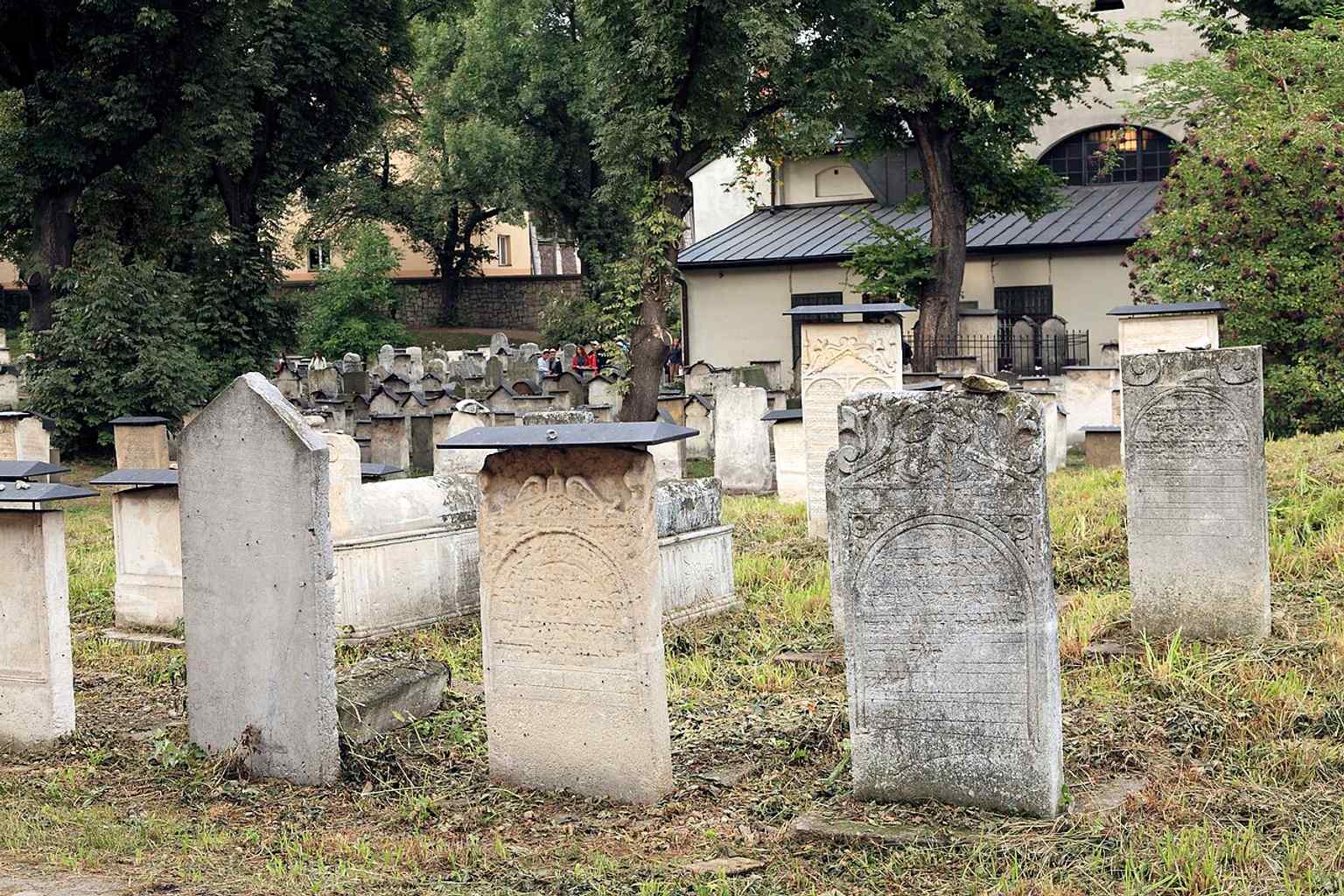
The cemetery wrapped around the Remah Synagogue, illustrating the intimate layout of one of Poland’s oldest surviving Jewish burial grounds.Photo: Falk2, Wikimedia Commons, CC BY-SA 4.0. Cropped & resized. 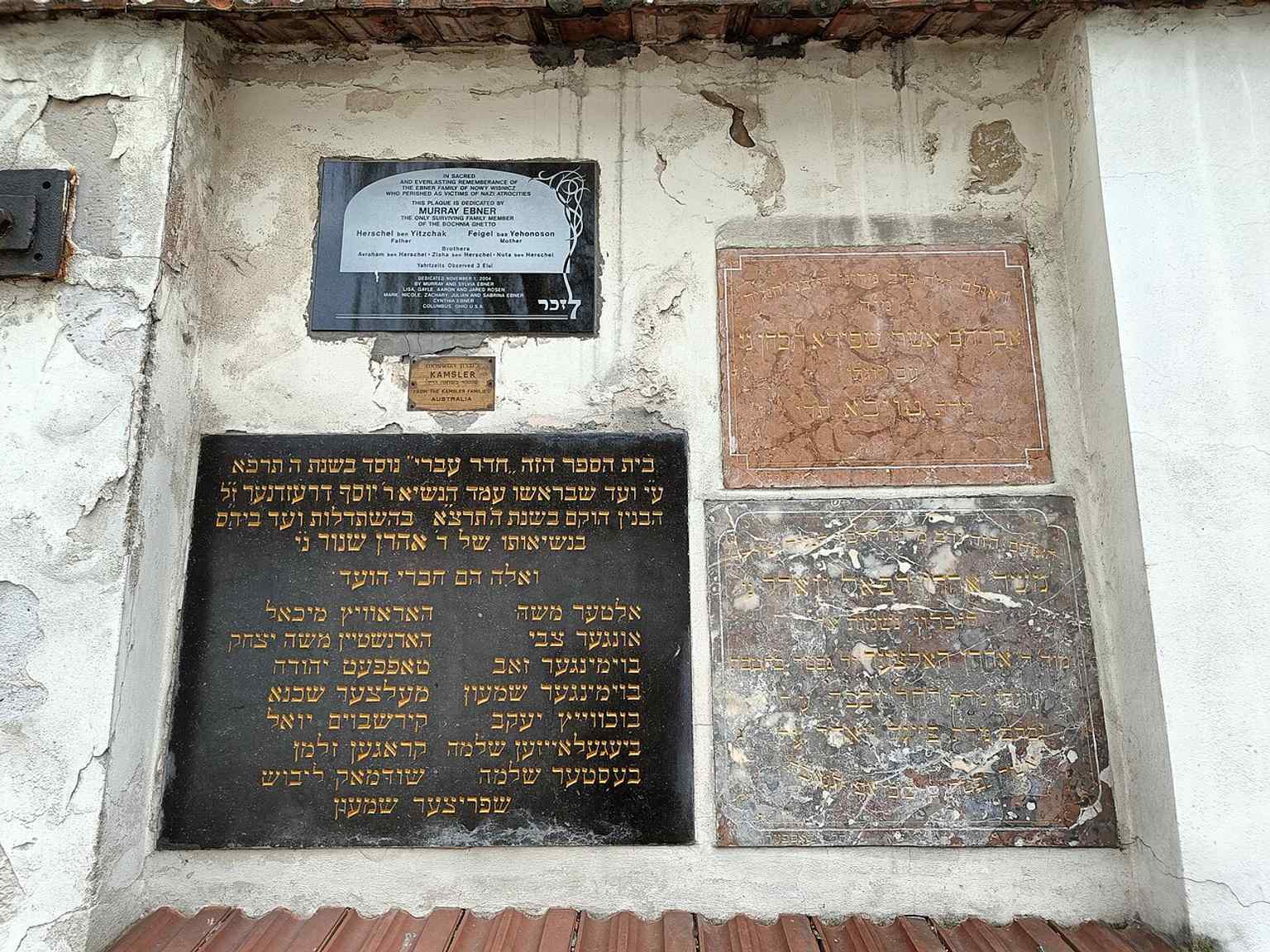
A close cemetery view that shows the crowded matzevot restored after wartime damage, when many tombstones were recovered from being reused as paving stones.Photo: Zala, Wikimedia Commons, CC BY-SA 4.0. Cropped & resized. 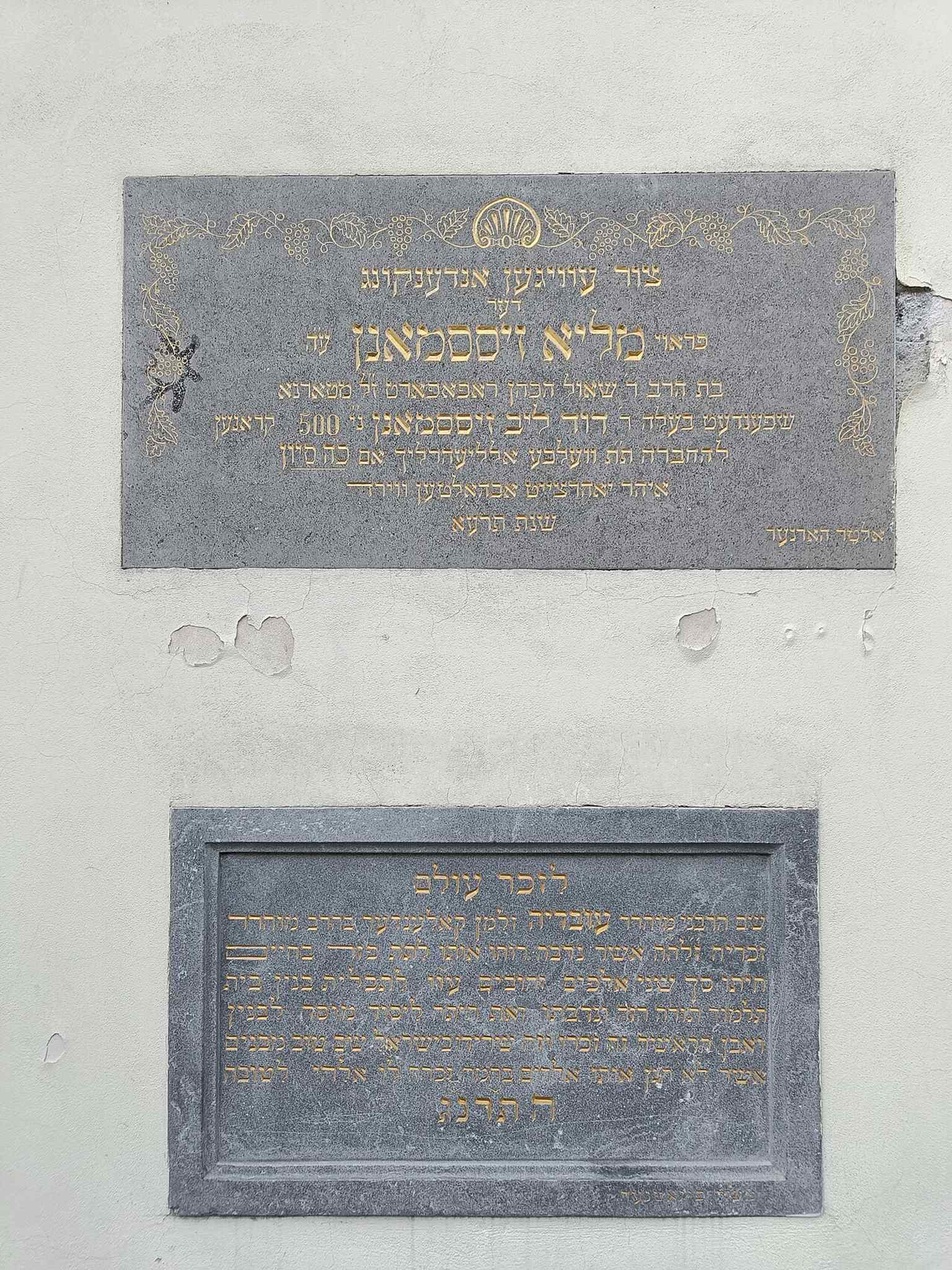
Inside the cemetery among the old gravestones, reflecting the dense memorial landscape of scholars, rabbis, and legendary figures like Yossele the Holy Miser.Photo: Zala, Wikimedia Commons, CC BY-SA 4.0. Cropped & resized. 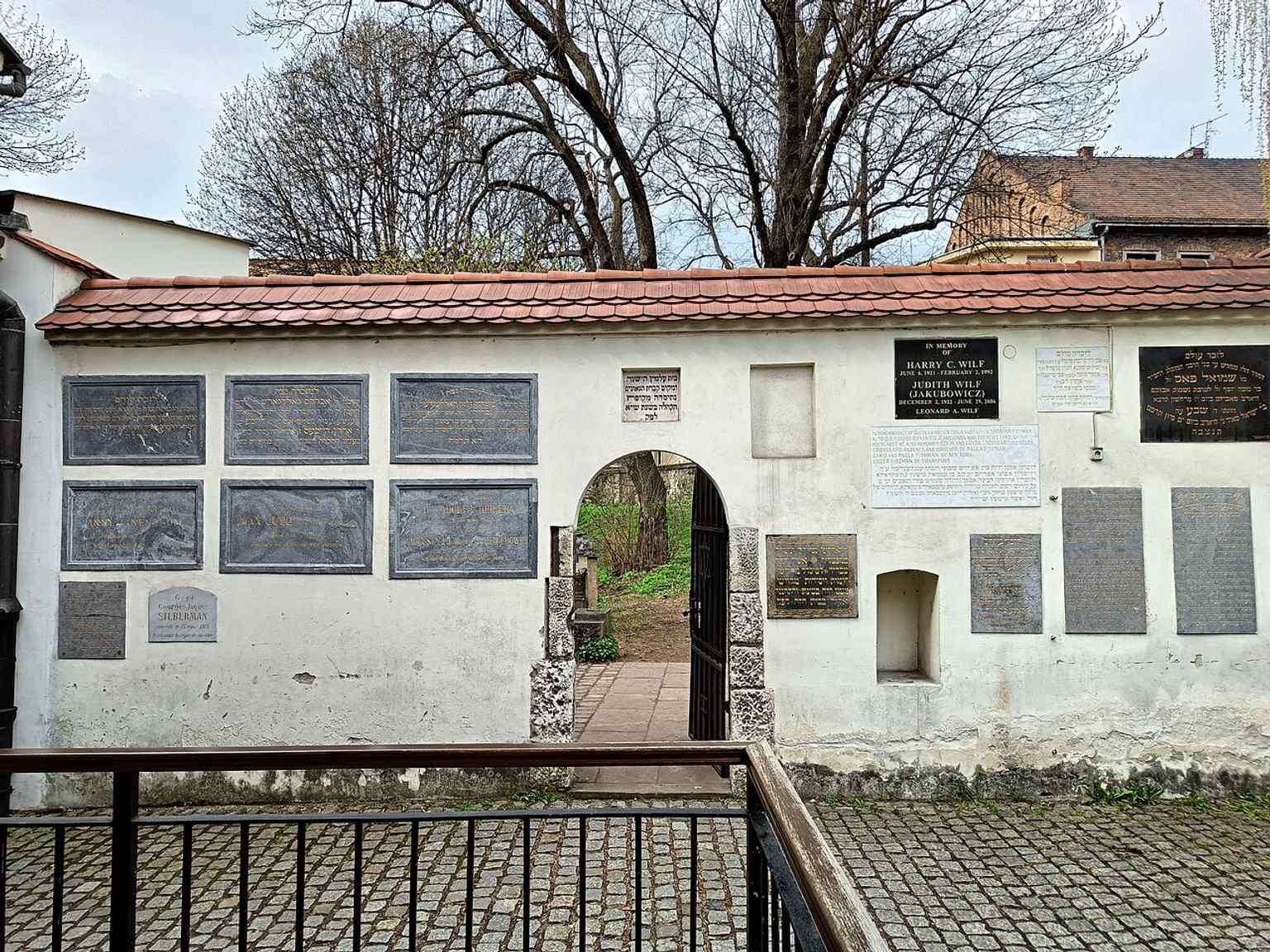
Another interior angle on the historic burial ground, evoking the layered centuries of graves from the 16th century onward.Photo: Zala, Wikimedia Commons, CC BY-SA 4.0. Cropped & resized. 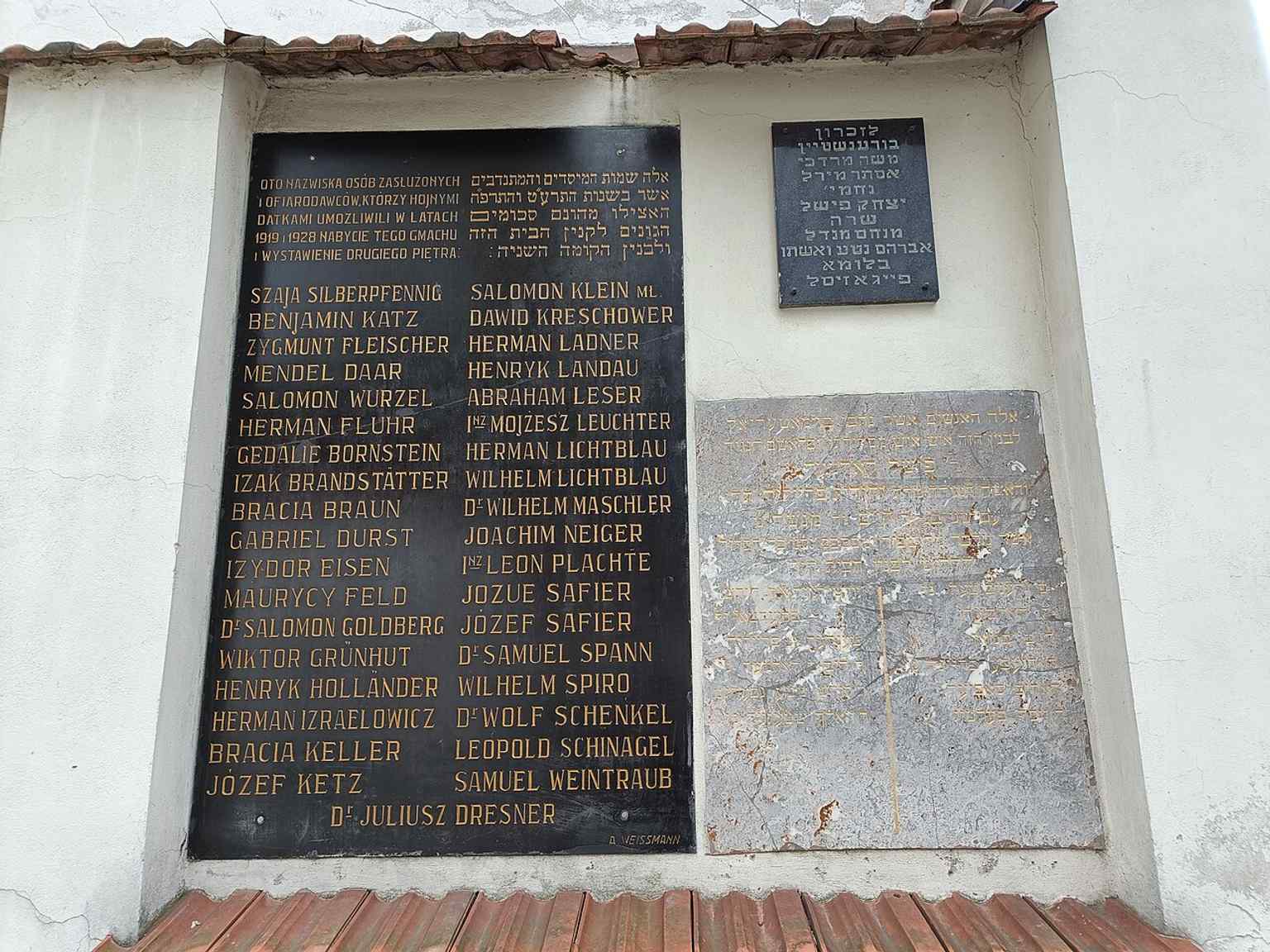
A detailed view of the old stones and enclosure, fitting the story of postwar reconstruction when the cemetery was reassembled from fragments.Photo: Zala, Wikimedia Commons, CC BY-SA 4.0. Cropped & resized. 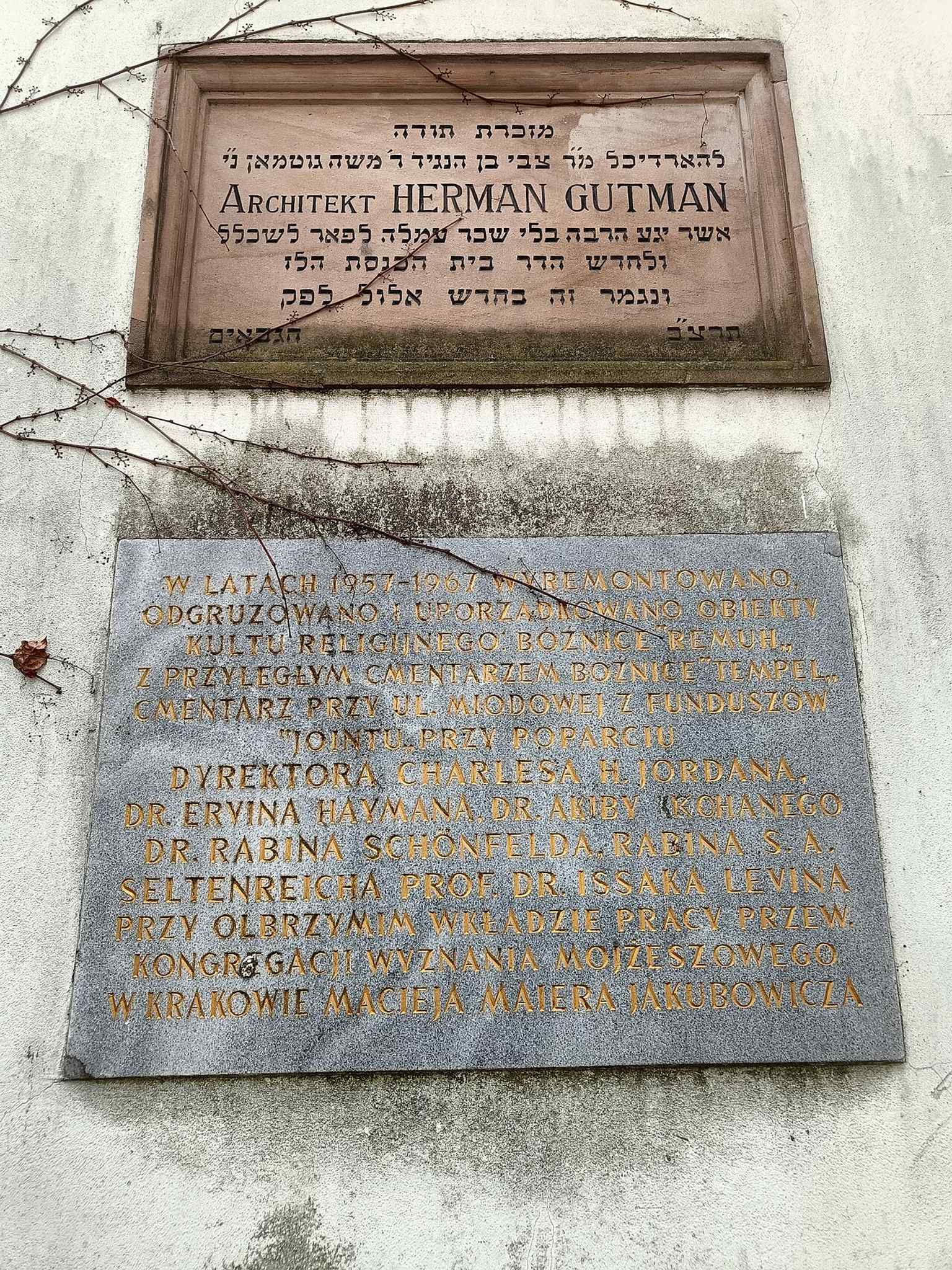
A close look at the weathered gravestones, representative of the cemetery’s rare preserved burials from the 1500s through 1850.Photo: Zala, Wikimedia Commons, CC BY-SA 4.0. Cropped & resized. 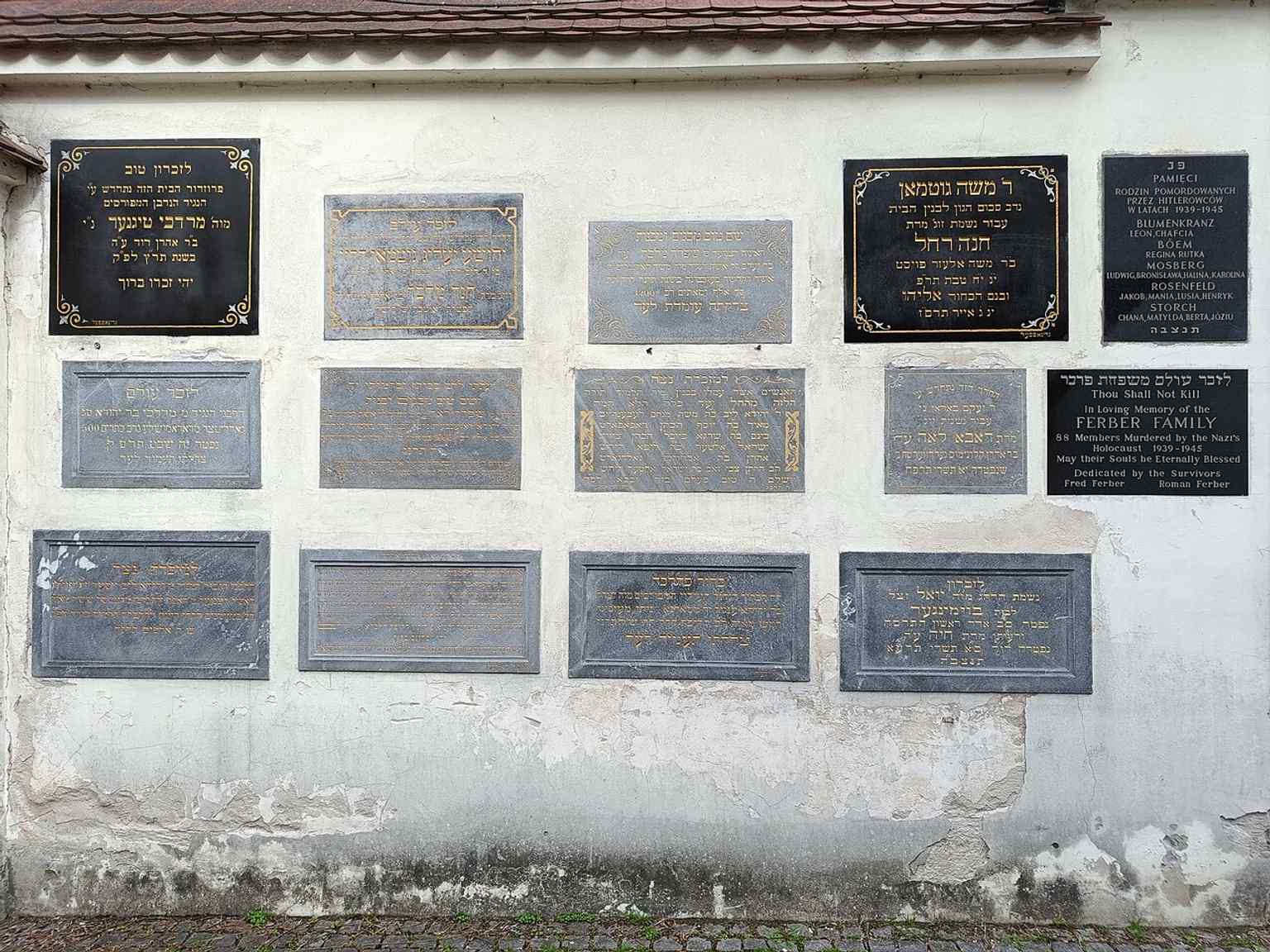
The restored tombstones highlight how the cemetery was rebuilt after Nazi destruction and later cleared in a major 1959 recovery effort.Photo: Zala, Wikimedia Commons, CC BY-SA 4.0. Cropped & resized. 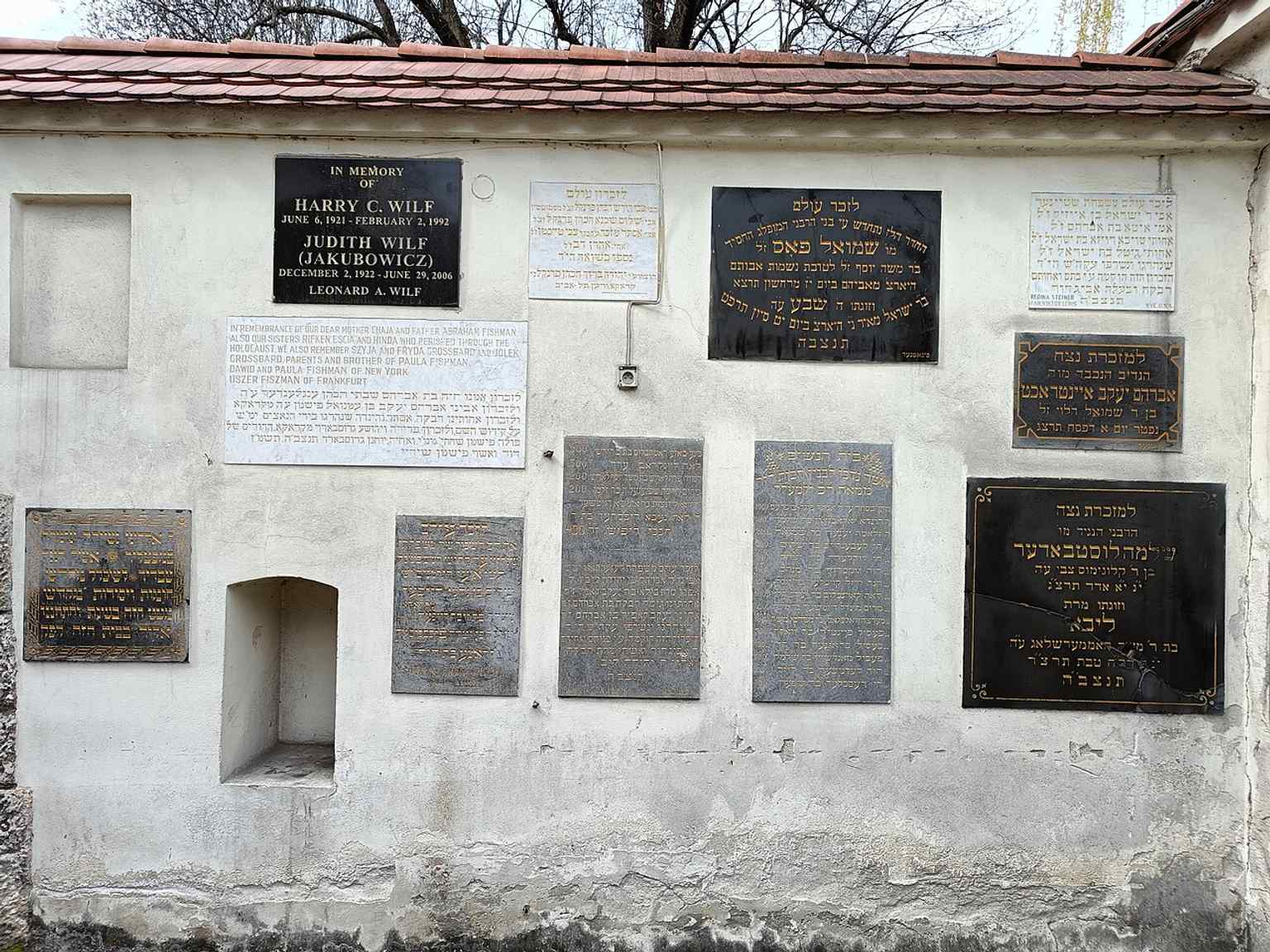
A detail of the graveyard’s surviving matzevot, linking this site to notable rabbis such as Yom-Tov Lipmann Heller and Nathan Nata Spira.Photo: Zala, Wikimedia Commons, CC BY-SA 4.0. Cropped & resized. 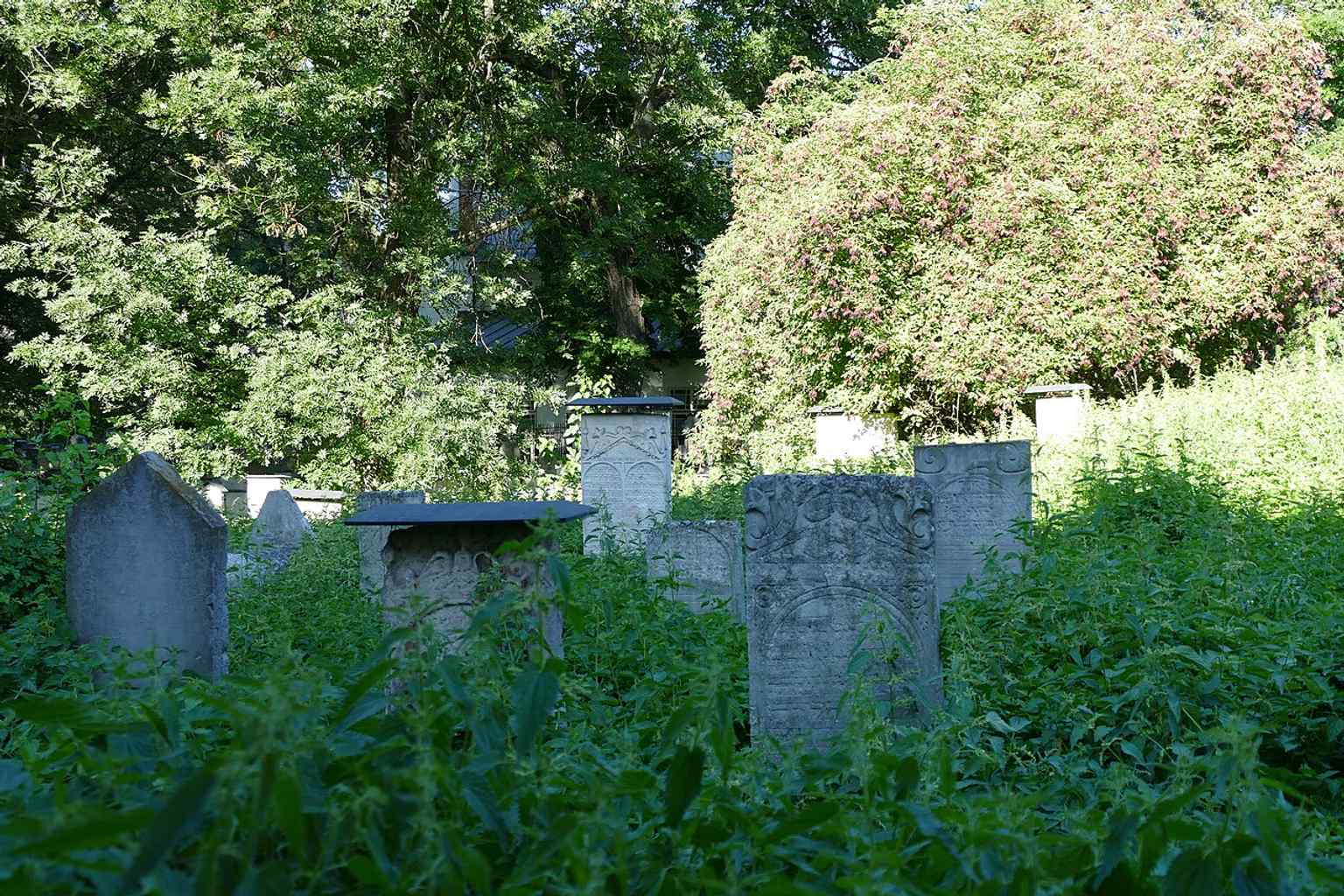
A contemporary record of the cemetery’s restored condition, after postwar work returned many original tombstones that had been found reused in the city.Photo: Kritzolina, Wikimedia Commons, CC BY-SA 4.0. Cropped & resized. On your right, look for a pale stone-and-plaster synagogue with a tall rectangular facade, arched windows, and a broad exterior stairway rising to the women’s gallery. This is…Read moreShow less
Open dedicated page →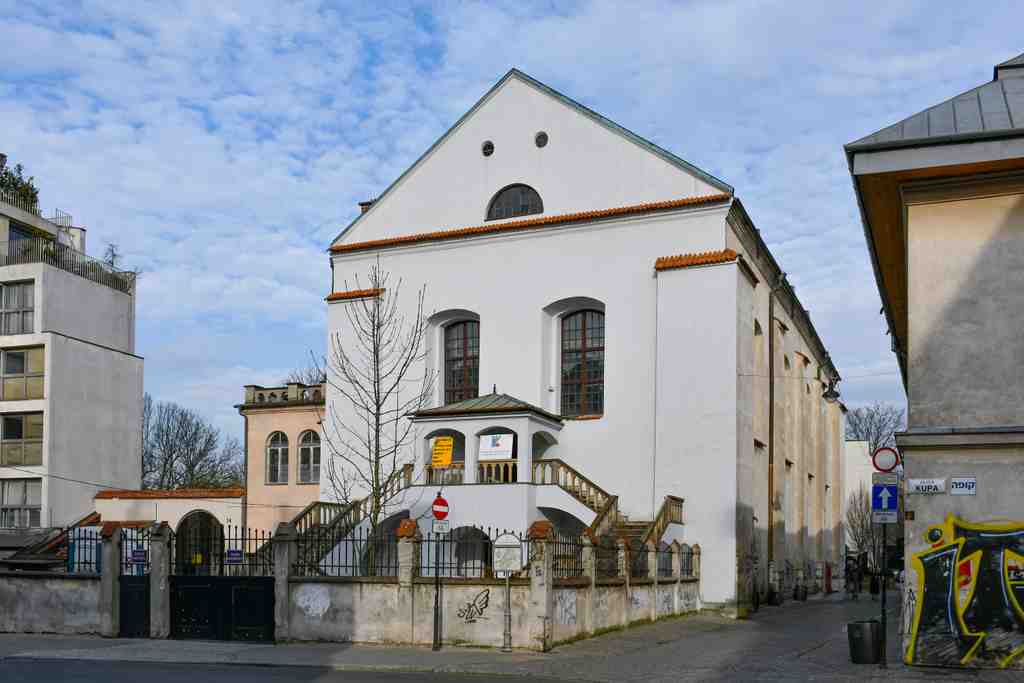
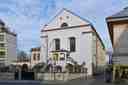
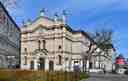
Izaak SynagoguePhoto: Jeremiah Z. Cockroach, Wikimedia Commons, CC BY-SA 4.0. Cropped & resized. On your right, look for a pale stone-and-plaster synagogue with a tall rectangular facade, arched windows, and a broad exterior stairway rising to the women’s gallery.
This is the Izaak Synagogue, one of the grandest Jewish buildings in Kazimierz, and from the very start it asks a rather good question: did this place begin with a dream, with family gratitude, or with official paperwork? The honest answer is all three.
Its founder, Izaak Jakubowicz, known as Isaac the Rich, served as banker to King Ladislaus the Fourth. He had the means, and he hired Francesco Olivierri to design this early Baroque synagogue, completed in sixteen forty-four. But locals quietly keep another version alive. They say Izaak’s wife, Braindla, urged him to found it in thanks for her family’s good fortune, even rescue. Most visitors hear about the wealthy donor. Fewer hear the domestic motive, a wife turning gratitude into architecture.
And that matters in Kazimierz, because Jewish monumental life here did not grow in comfort. After the fire and expulsion of fourteen ninety-four from medieval Kraków, Jews were pushed out of the old city and concentrated here. Over time, this district filled with prayer houses, schools, cemeteries, trade, argument, and memory. In other words, the community did not simply arrive and build; it had to rebuild its world after being forced to move.
Even this synagogue had to be negotiated into existence. When the roof was already on, the parish priest of Corpus Christi, Marcin Kłodziński, objected and halted the work. He complained that Christian clergy carrying the sacrament might have to pass the synagogue on a nearby street. Izaak appealed to Bishop Jakub Zadzik, who upheld the royal permission to build, and only then did the project move toward completion. So before a single prayer was said inside, the building had already become a public argument about who might be visible, and where.
Then there is the famous legend. A rebbe, Simcha Bunim of Peshischa, retold the story of poor Ayzik Jakubowicz, who dreamt of treasure under a bridge in Prague. He travelled there, found soldiers guarding the bridge, confessed his dream to an officer, and heard the officer laugh that he himself had dreamt of treasure in the oven of a poor Jew in Kazimierz named Ayzik son of Jacob. Ayzik returned home, broke apart his own oven, found the treasure, and became rich. It is a marvellous tale, slightly absurd and perfectly serious at once: search the world, and you may discover the thing you needed was at home.
If you glance at the image on your screen, you can see how this synagogue still commands its patch of Kazimierz. Inside, conservators later uncovered painted prayers on the walls, and restored traces of the lost interior. The Aron Kodesh, the sacred cabinet that holds Torah scrolls, was once especially admired here; another image shows that vanished splendour. The Nazis destroyed the furnishings, including the bimah, the raised platform where the Torah is read, and later the building served as a sculptors’ workshop and even a theatre space, with Tadeusz Kantor working here as a set painter. In Kazimierz, sacred spaces rarely keep just one identity; conflict, damage, repair, and retelling keep pressing new layers into them.
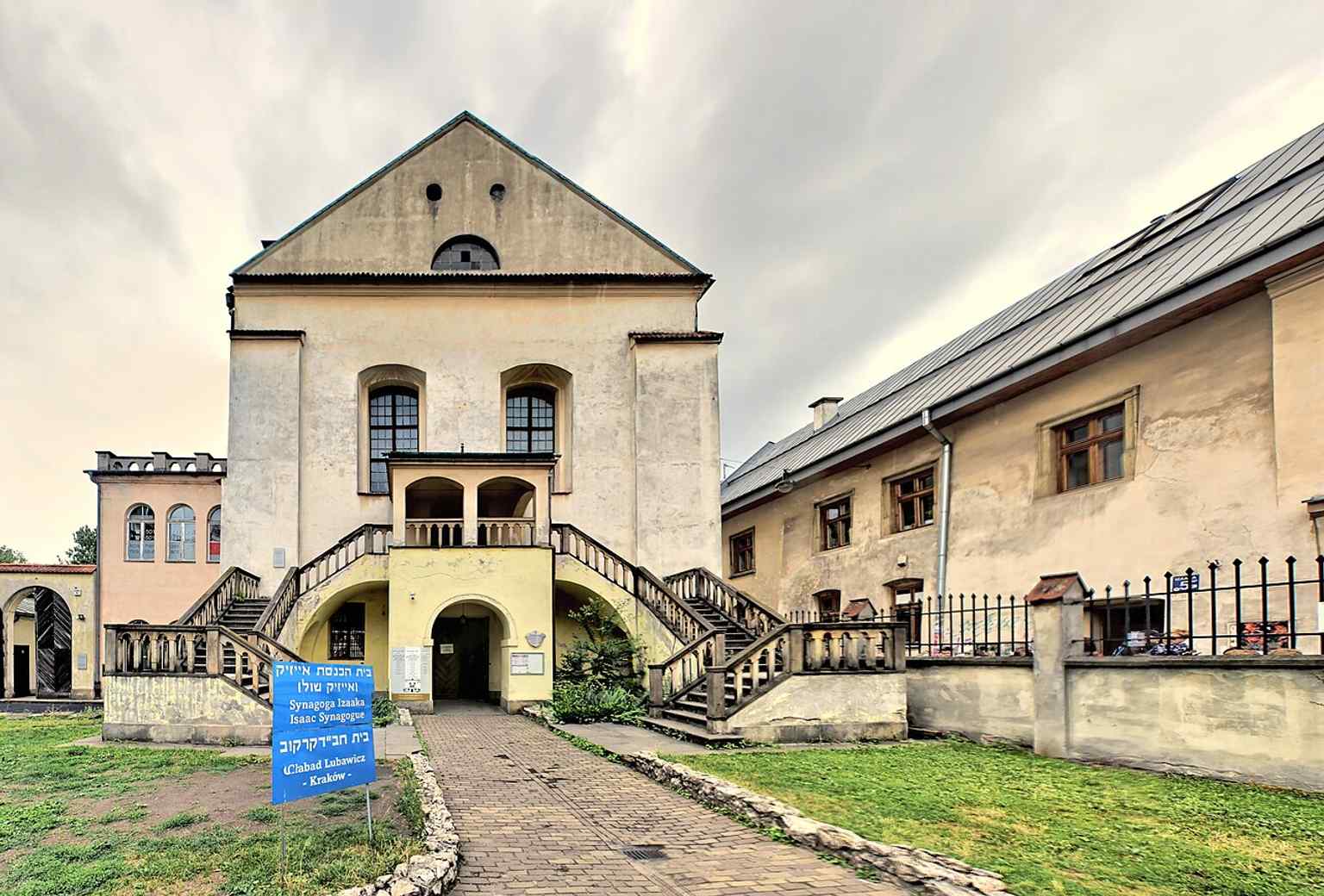
A high-resolution contemporary exterior image, showing the synagogue as a prominent monument in Kazimierz today.Photo: Krystyna Pruchniewska, Wikimedia Commons, CC BY 3.0. Cropped & resized. So here, even before you cross the threshold, a synagogue already stands as a contest between dream and document, prayer and public law. In about one minute, we’ll continue to the High Synagogue. If you plan to look inside here another time, it generally opens from ten in the morning, and stays closed on Saturdays.
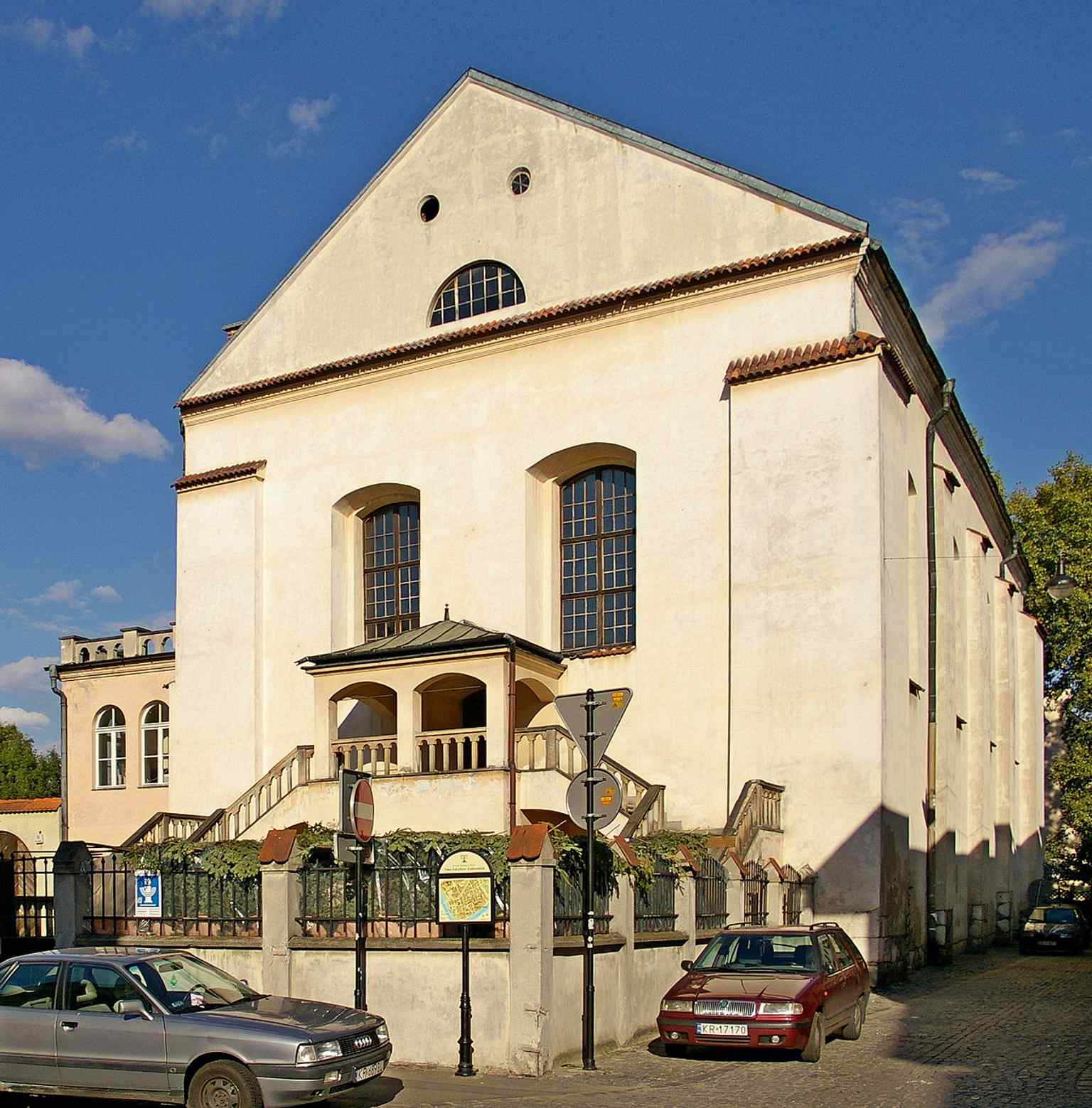
A 2007 documentary-style photo of the synagogue exterior, capturing the building during its modern life as both heritage site and active synagogue.Photo: Jakub Hałun, Wikimedia Commons, CC BY-SA 3.0. Cropped & resized. 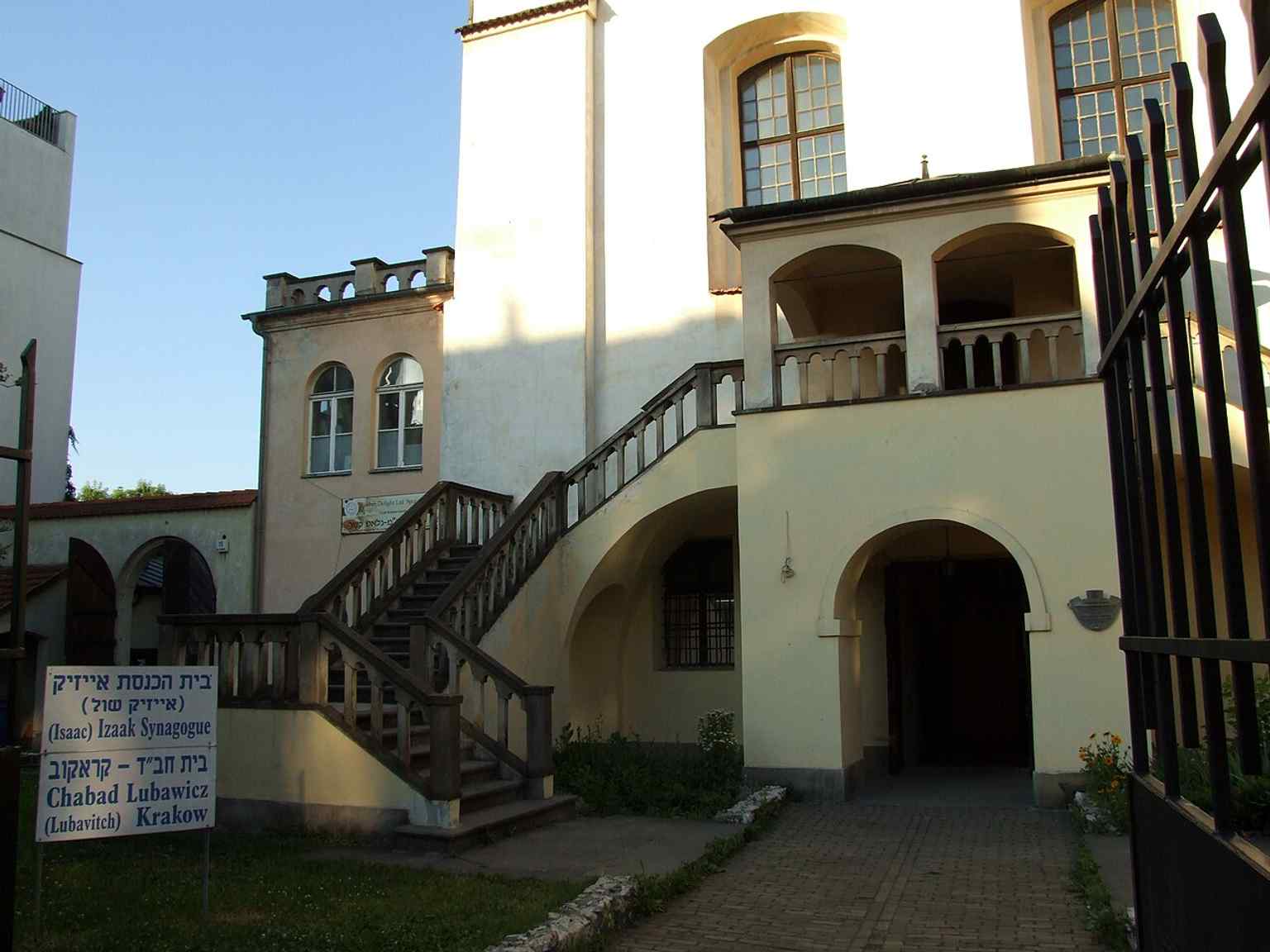
An elevated view over Kazimierz with the synagogue in its urban context, evoking the bustling prewar neighborhood around it.Photo: Modris Putns, Wikimedia Commons, CC BY-SA 3.0. Cropped & resized. On your left, look for a tall, pale plastered Renaissance building with a broad rectangular front and rows of simple windows set above the ground-floor level, its unusual height…Read moreShow less
Open dedicated page →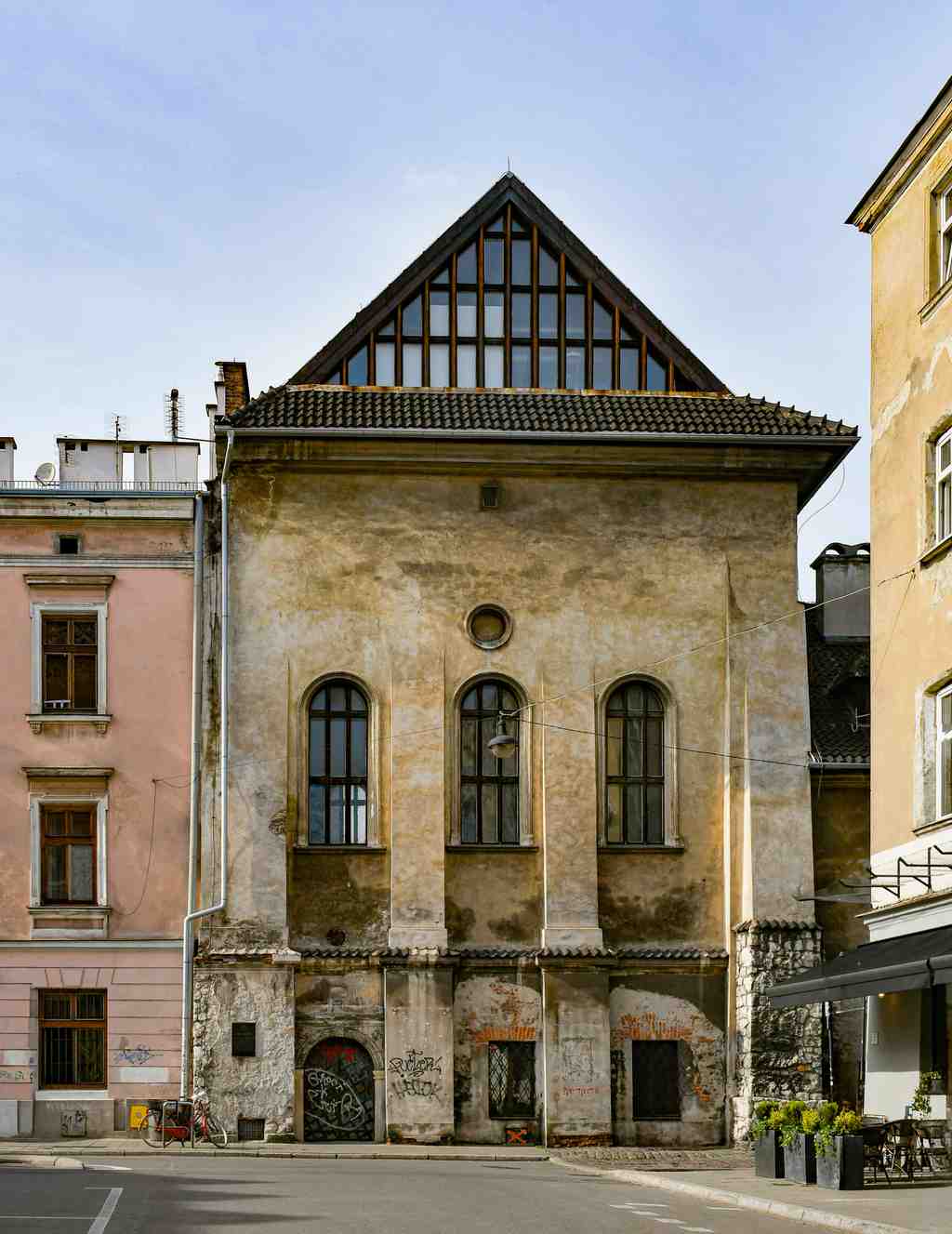
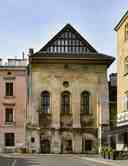
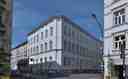
High SynagoguePhoto: Jeremiah Z. Cockroach, Wikimedia Commons, CC BY-SA 4.0. Cropped & resized. On your left, look for a tall, pale plastered Renaissance building with a broad rectangular front and rows of simple windows set above the ground-floor level, its unusual height giving away why people called it the High, or Tall, Synagogue.
This building tells its story first through shape. The prayer hall sat above street-level shops, and that arrangement was not merely an architectural quirk. It likely gave the congregation privacy, dignity, and a measure of practical protection from unfriendly Christian neighbors. In other words, the elevation helped worshippers gather slightly apart from the street without vanishing from the city altogether.
A wealthy merchant, known to us only as Israel, set that story in motion in the second half of the sixteenth century. He petitioned King Sigismund the Second Augustus for permission to build a Jewish house of prayer here in Kazimierz. He received consent, and by fifteen sixty-three the synagogue stood complete in the late Renaissance style. Some historians suspect Sephardic Jews, perhaps from Greece or Italy, shaped its beginnings. If so, this modest facade holds a surprisingly wide map of Jewish movement across Europe.
Pause for a moment and notice the building’s height in relation to the street. Even from where you stand, across the road, the separation still changes the feeling of approach. It is not lofty in the grand church sense; it is lifted, guarded, deliberate. If you glance at the image on your screen, the raised prayer level becomes especially clear.
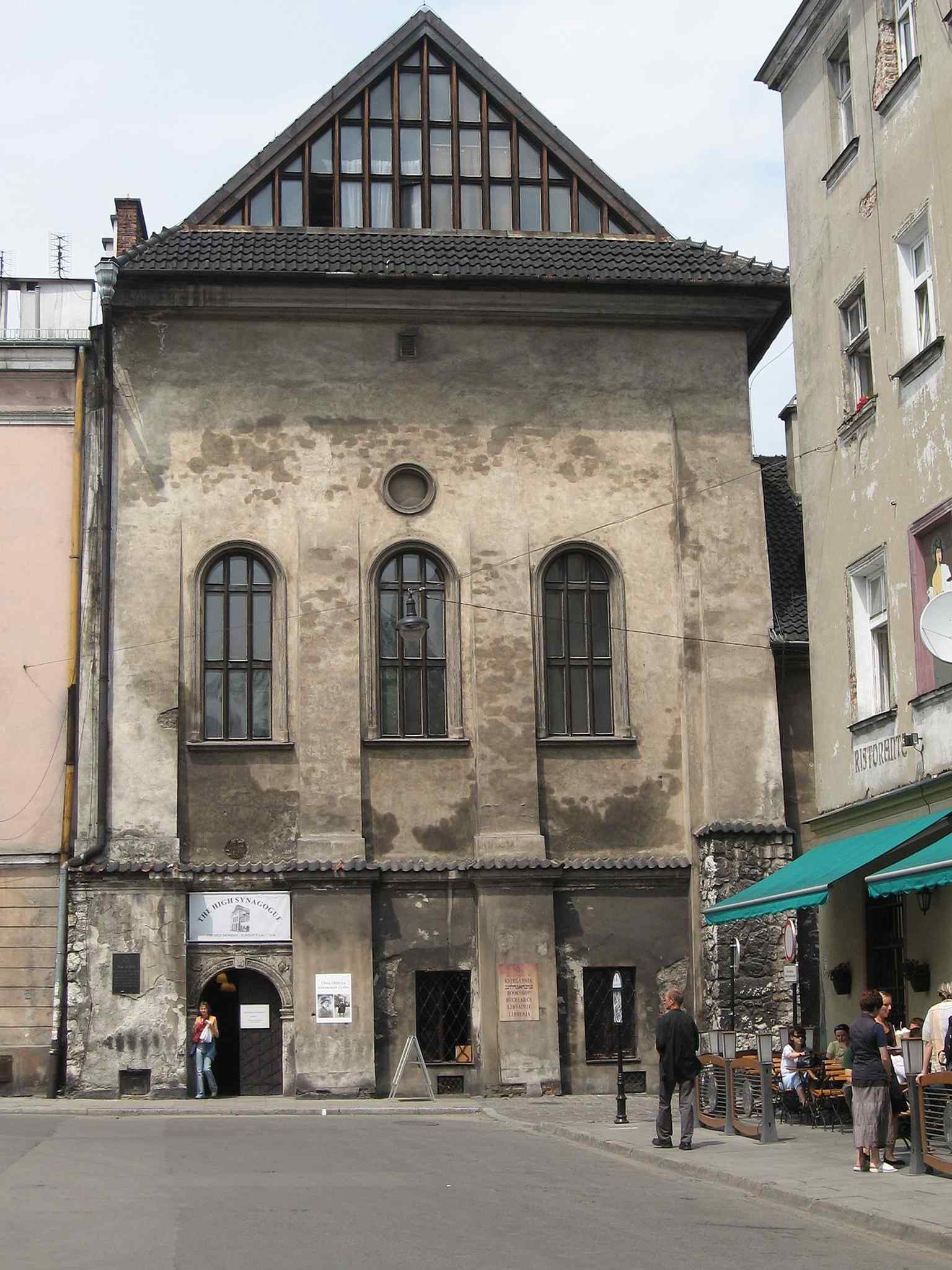
A closer exterior angle from the street, highlighting the elevated prayer level above the ground-floor frontage described in the source.Photo: Ludek, Wikimedia Commons, CC BY-SA 3.0. Cropped & resized. Inside, the sanctuary once carried far more colour than the exterior suggests. The walls showed scenes of Jerusalem, including the Western Wall and the Tomb of the Israelite Kings, and the women’s gallery included a handsome pair of lions. The sacred focal point was the Aron HaKodesh - the cabinet that holds the Torah scrolls - on the eastern wall. Remarkably, its stone niche survives, and it is considered the oldest and largest Renaissance Aron HaKodesh in Poland. It has channeled pillars, composite capitals, and above the frame, griffins that once supported the Crown of the Torah inscription. If you open the interior view, you can sense how the prayer room once hovered above the commerce below.
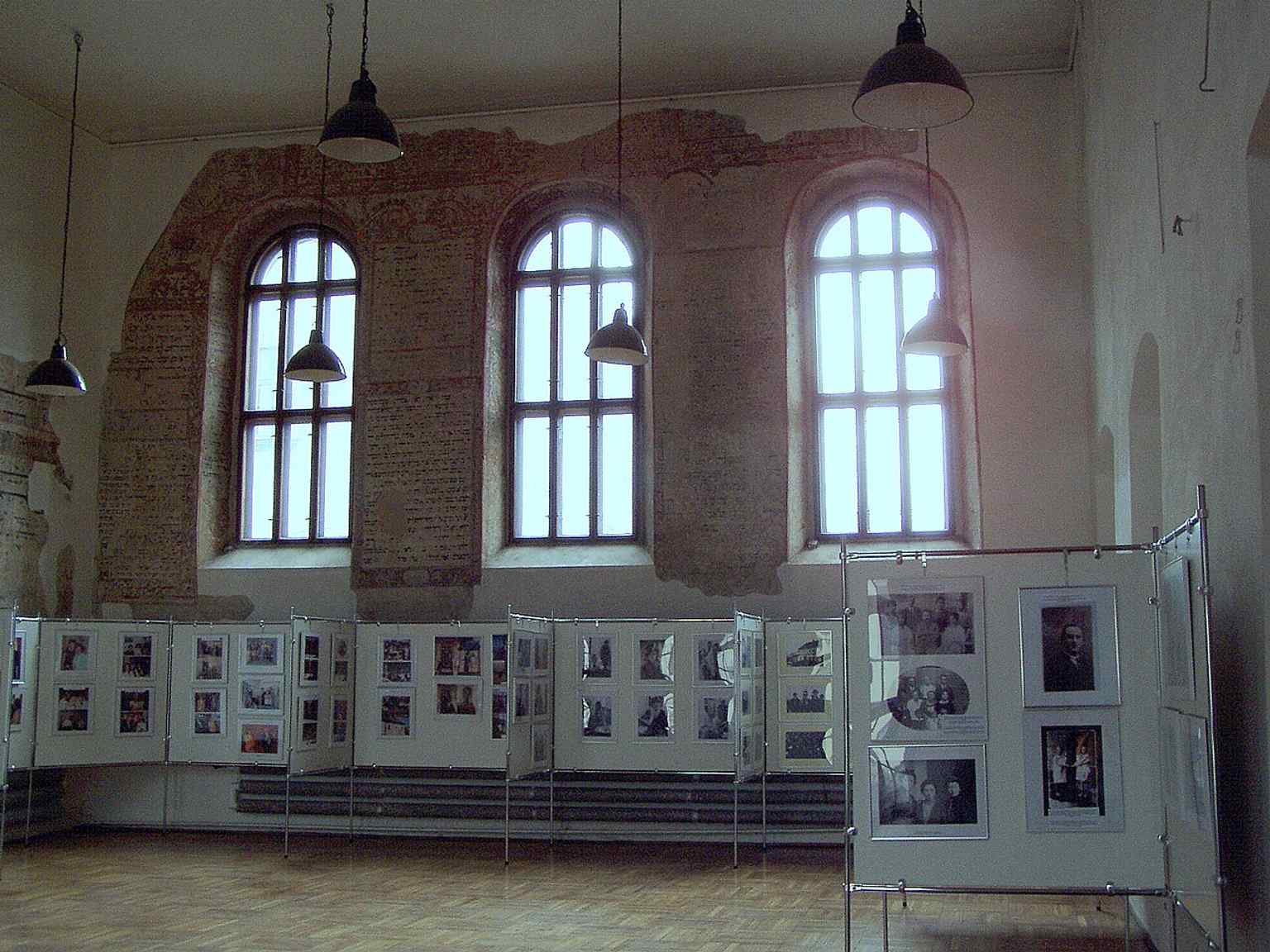
The prayer hall interior, where the congregation once worshipped above street-level shops before the wartime destruction.Photo: Birczanin at Polish Wikipedia, Wikimedia Commons, Public domain. Cropped & resized. Then came rupture. In nineteen thirty-nine, the Nazis stripped the synagogue interior, turned the building into warehouses and a locksmith’s shop, and in nineteen forty-one they intensified the destruction. Iron fittings went for scrap. Textiles, documents, books, and ritual objects were carried off. One rare survivor, a seventeenth-century Baroque Hanukkah lamp, was taken on Hans Frank’s order to Wawel Castle; we will meet that survivor again later at the Old Synagogue.
What followed was not one neat restoration, but a long argument on behalf of the building. Władysław Łuszczkiewicz began early conservation research in the nineteenth century. Jan Ertl designed new roofs. Jan Sas-Zubrzycki proposed another facade plan. By nineteen hundred, Samuel Tilles, Józef Sare, and Stanisław Tomkowicz formed a reconstruction committee, and Zygmunt Hendel prepared the renovation project. After the war, conservators such as Józef Jamroz and Józef Ptak rebuilt vaults, the bimah - the platform where the Torah is read - the eternal lamp, portals, doors, and stone details. Later restorers uncovered painted curtains beside the Aron HaKodesh and wall paintings hidden for decades.
So when you look at this altered building, do not treat the changes as flaws. Think of them as pressure marks: proof that a damaged sacred place can still be argued back into view. When you are ready, continue on to the Bobov Synagogue, about three minutes away.
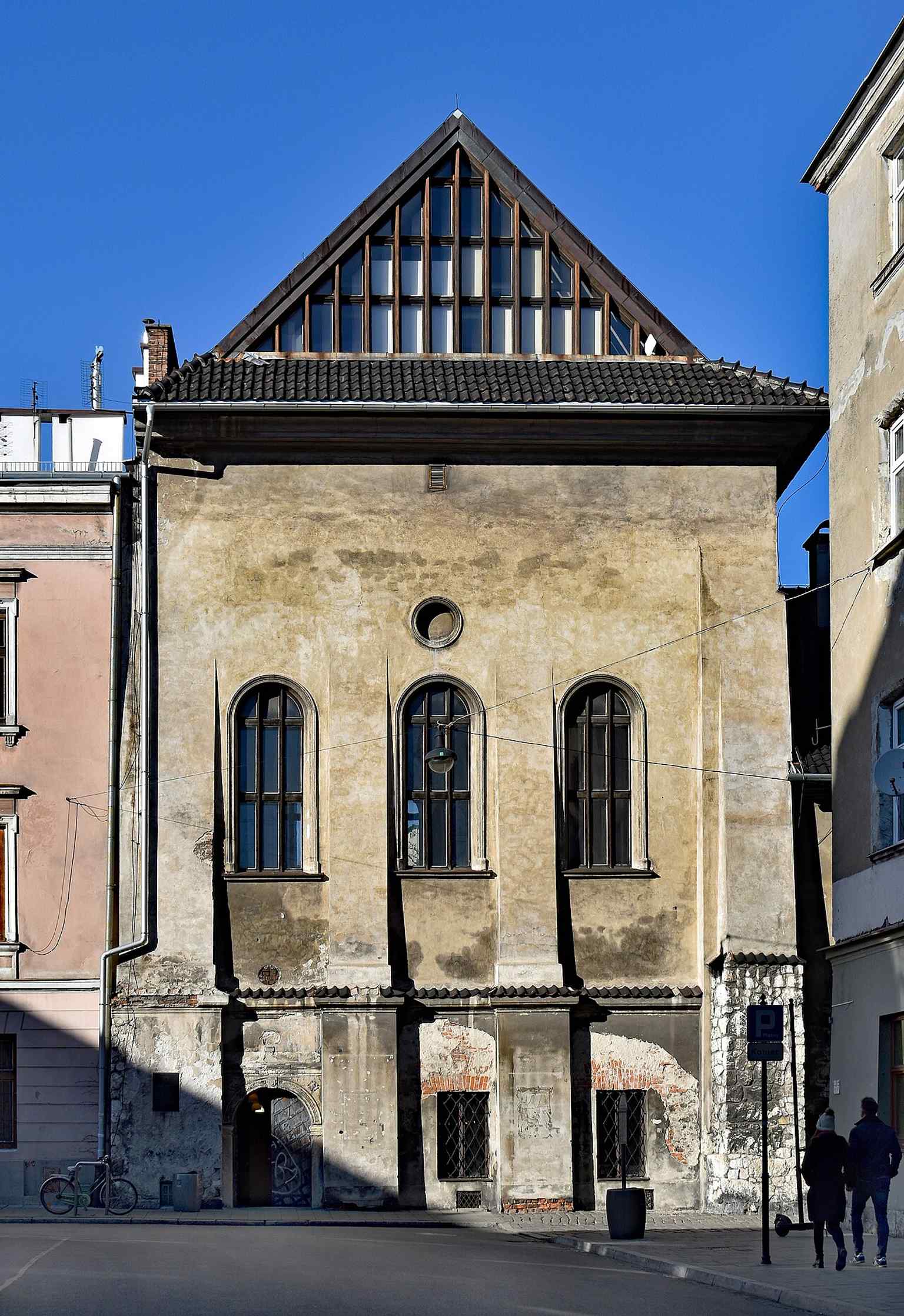
Clear street-level view of the High Synagogue on Józefa Street, showing why it was called the “Tall Synagogue” in Kazimierz.Photo: Zygmunt Put, Wikimedia Commons, CC BY-SA 4.0. Cropped & resized. 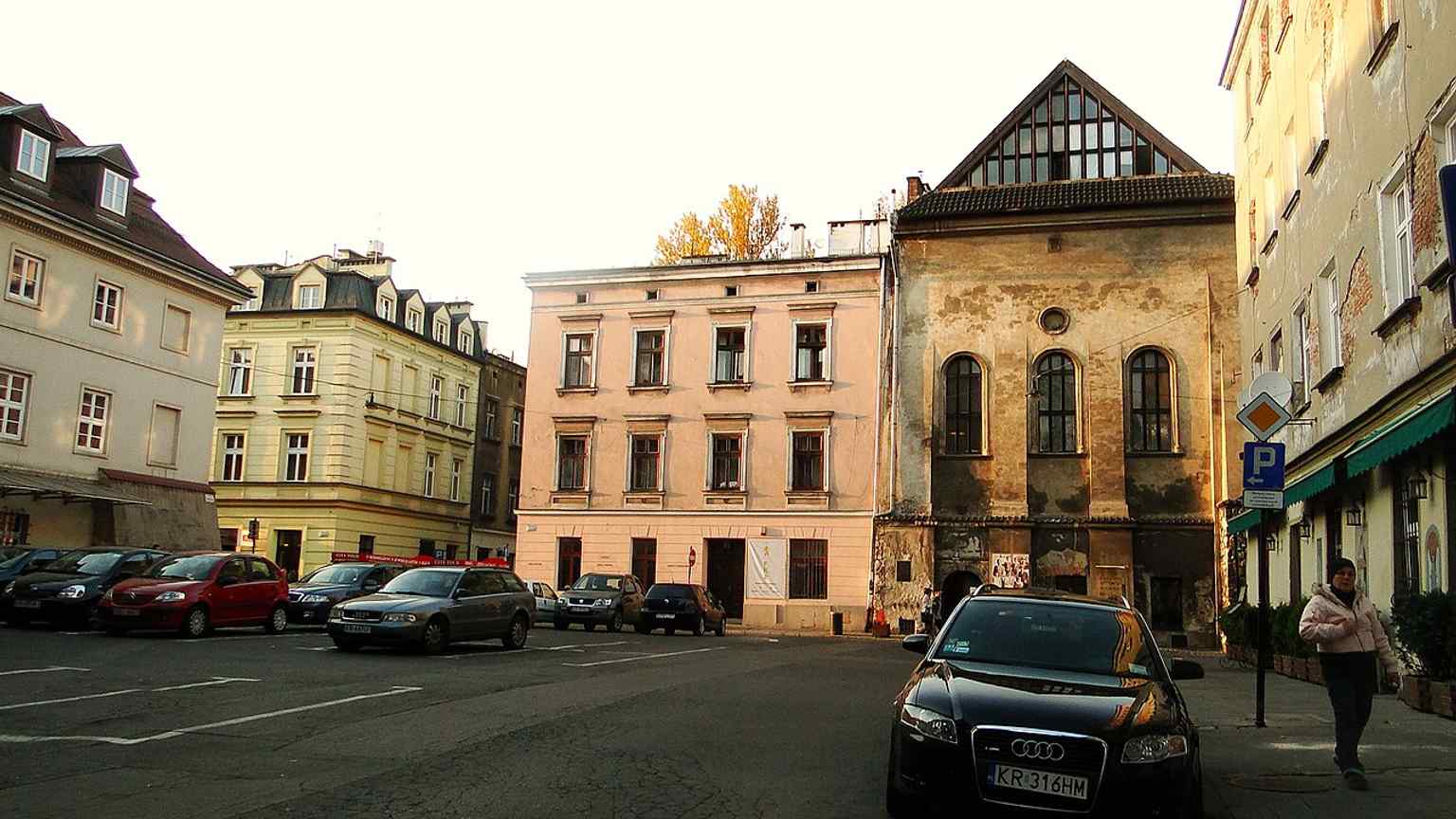
The synagogue and the small square by Wąska Street, giving context to its place in the Kazimierz streetscape.Photo: Mateusz Giełczyński, Wikimedia Commons, CC BY-SA 3.0. Cropped & resized. 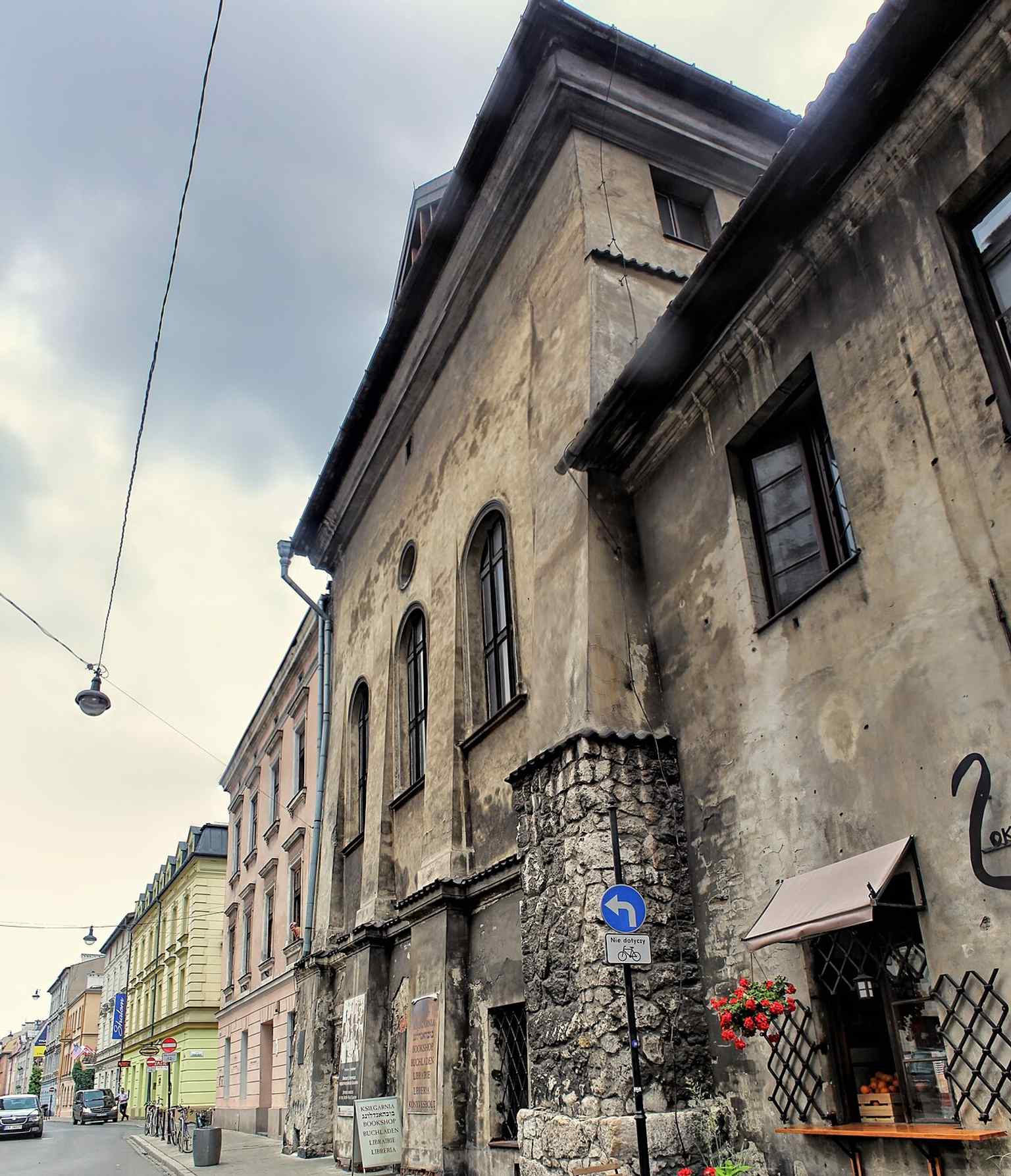
A large, detailed modern exterior view of the landmark, useful for showing its restored façade and scale.Photo: Abri Pix, Wikimedia Commons, CC BY-SA 4.0. Cropped & resized. 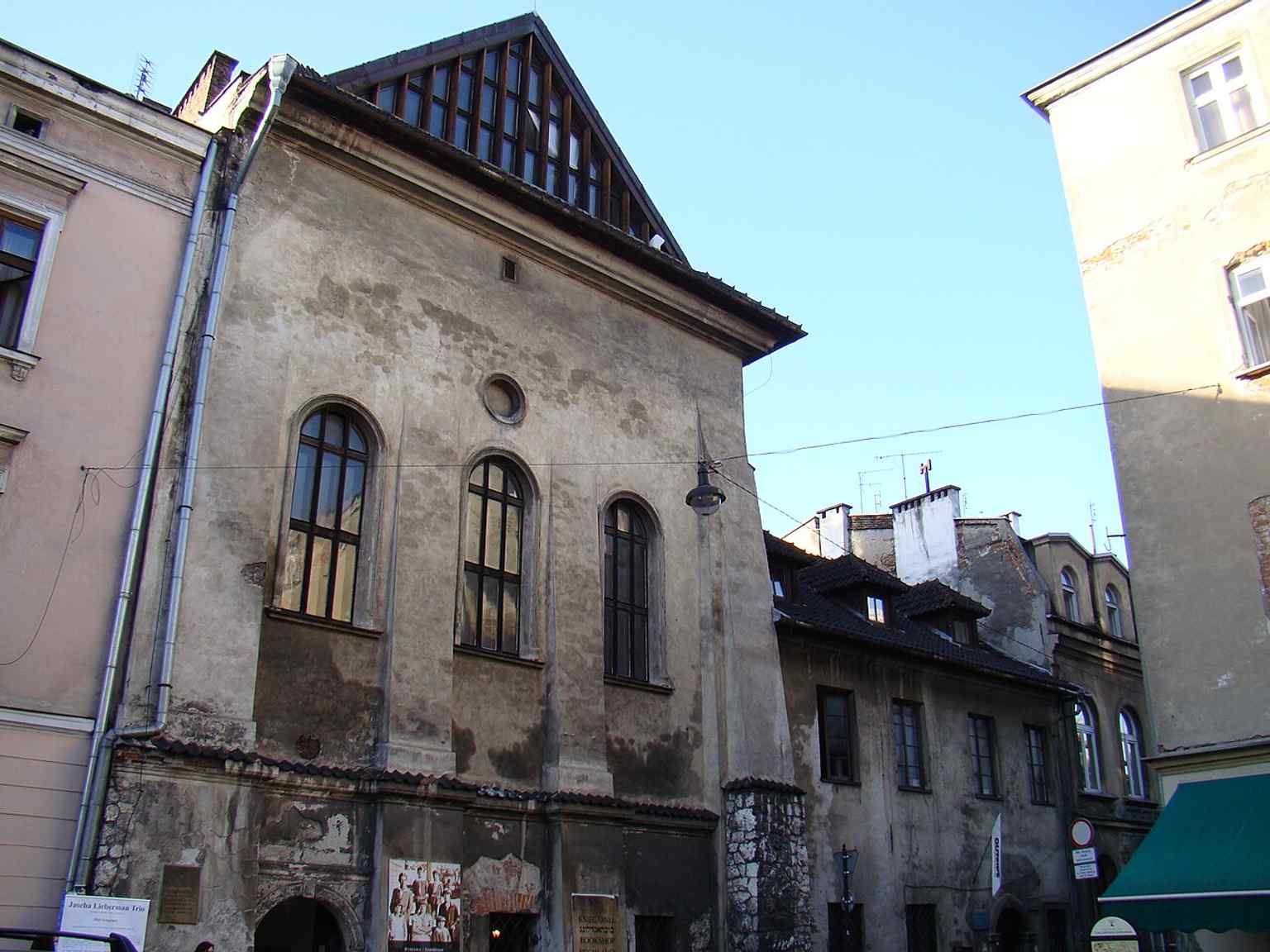
Conservation detail from the building, reflecting the long restoration history that began in the 19th century and continued after the war.Photo: Polar123, Wikimedia Commons, CC BY-SA 3.0 pl. Cropped & resized. 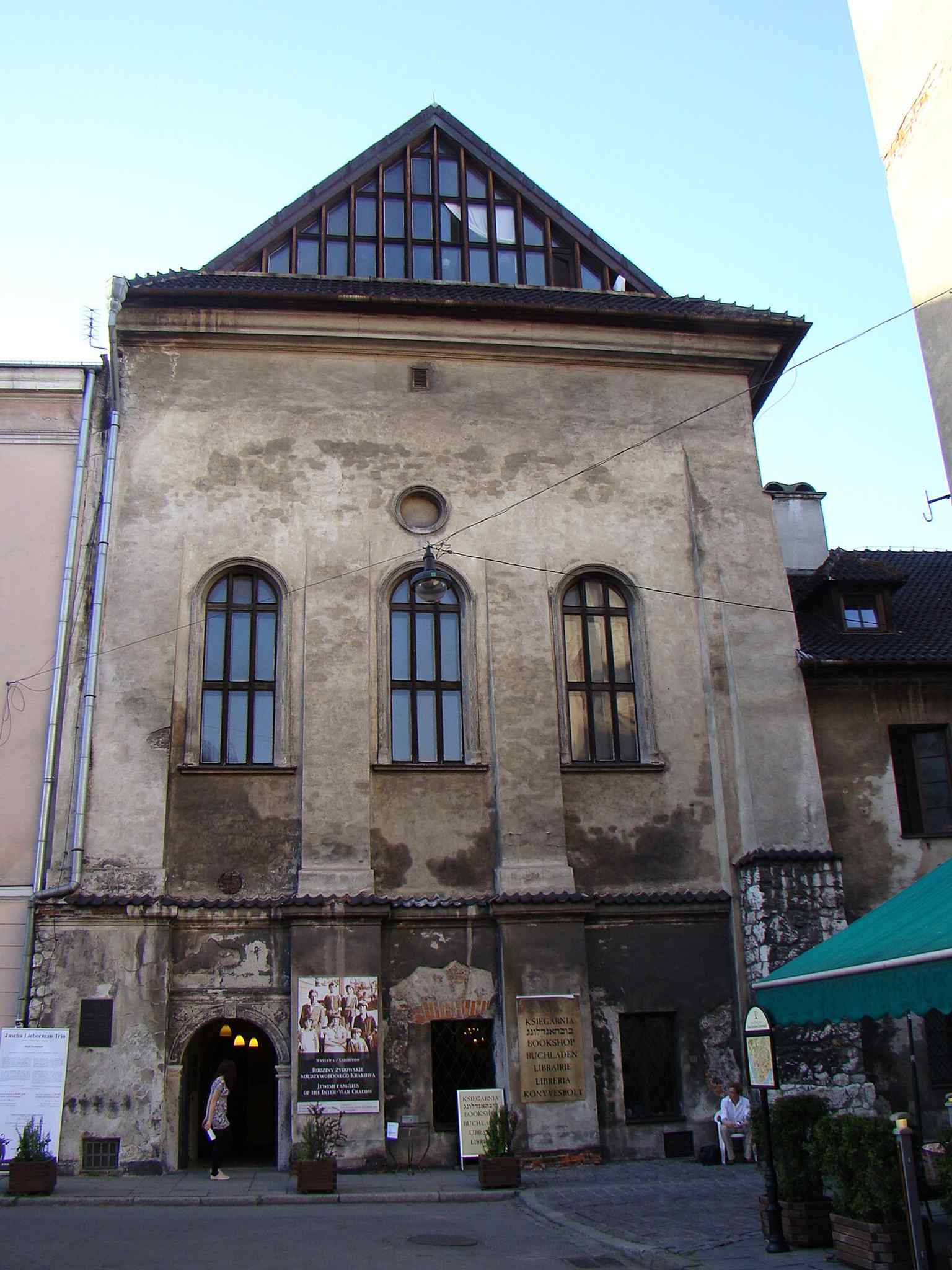
Another conservation close-up, useful for showing surviving historic fabric from the synagogue’s layered restorations.Photo: Polar123, Wikimedia Commons, CC BY-SA 3.0 pl. Cropped & resized. 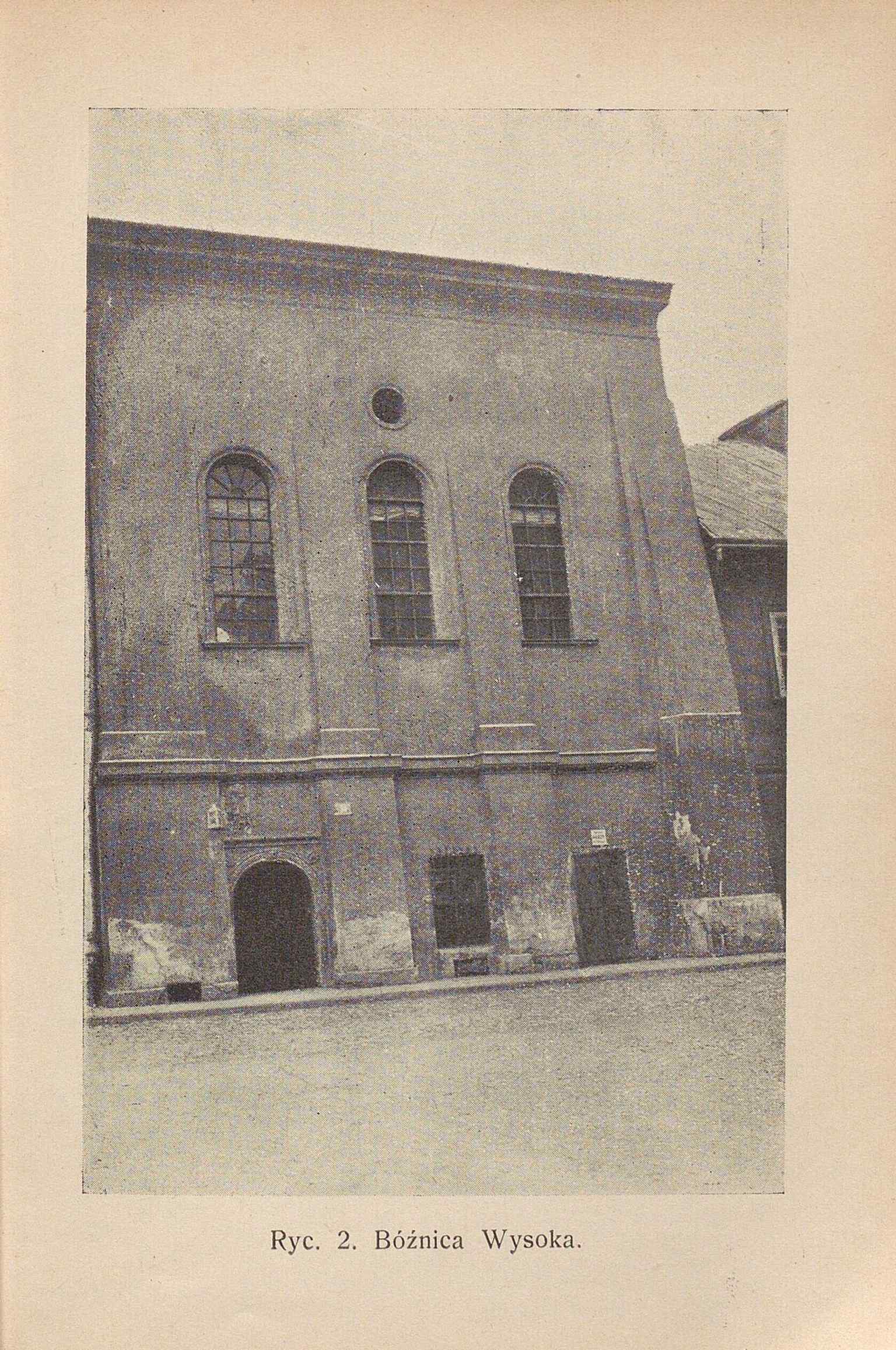
A 1935 Jewish heritage guide, capturing how the High Synagogue was presented before World War II and museum use.Photo: Ozjasz Mahler, Wikimedia Commons, Public domain. Cropped & resized. 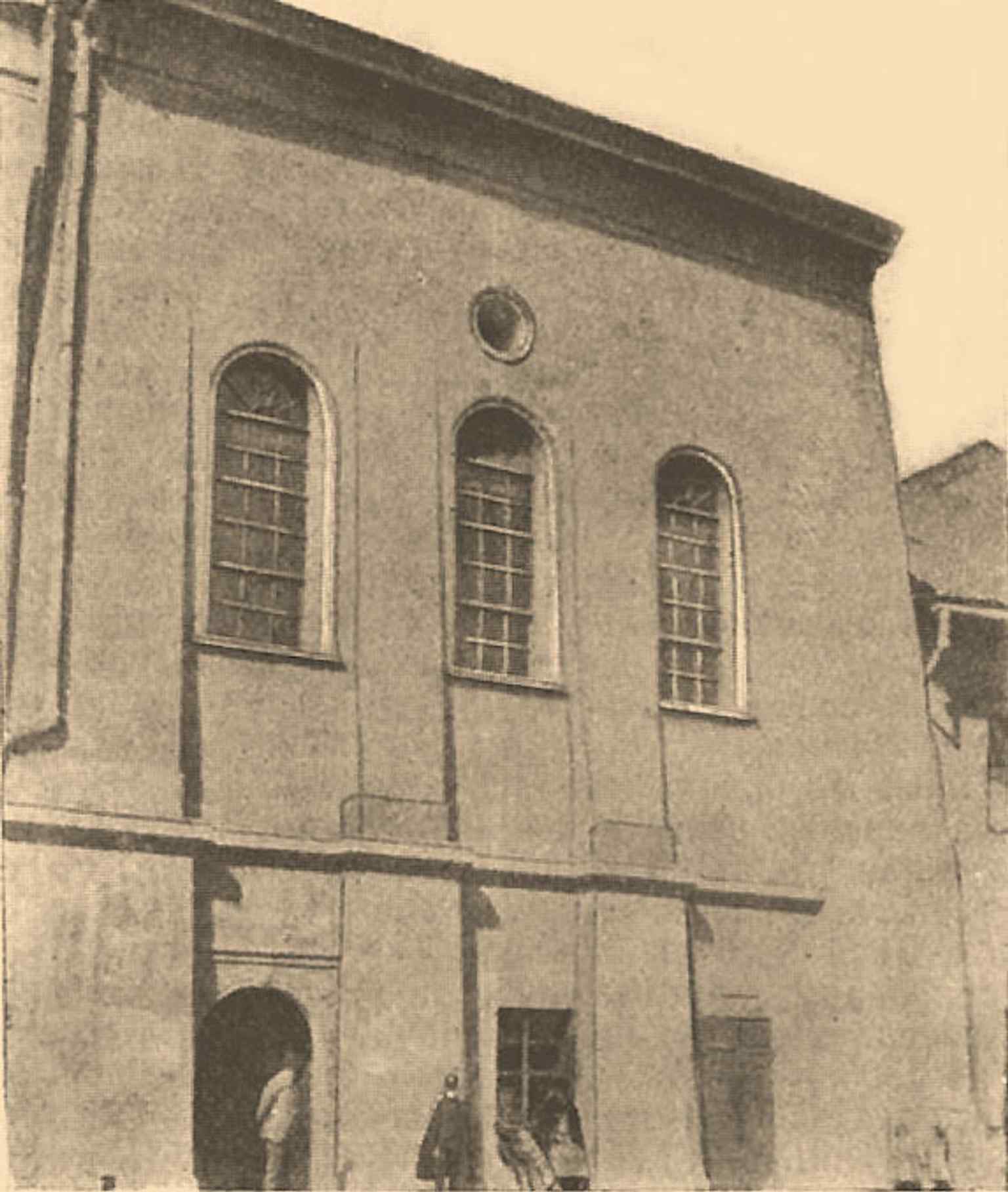
An old encyclopedia illustration of the High Synagogue, showing the building’s longstanding fame in printed sources.Photo: Unknown authorUnknown author, Wikimedia Commons, Public domain. Cropped & resized. 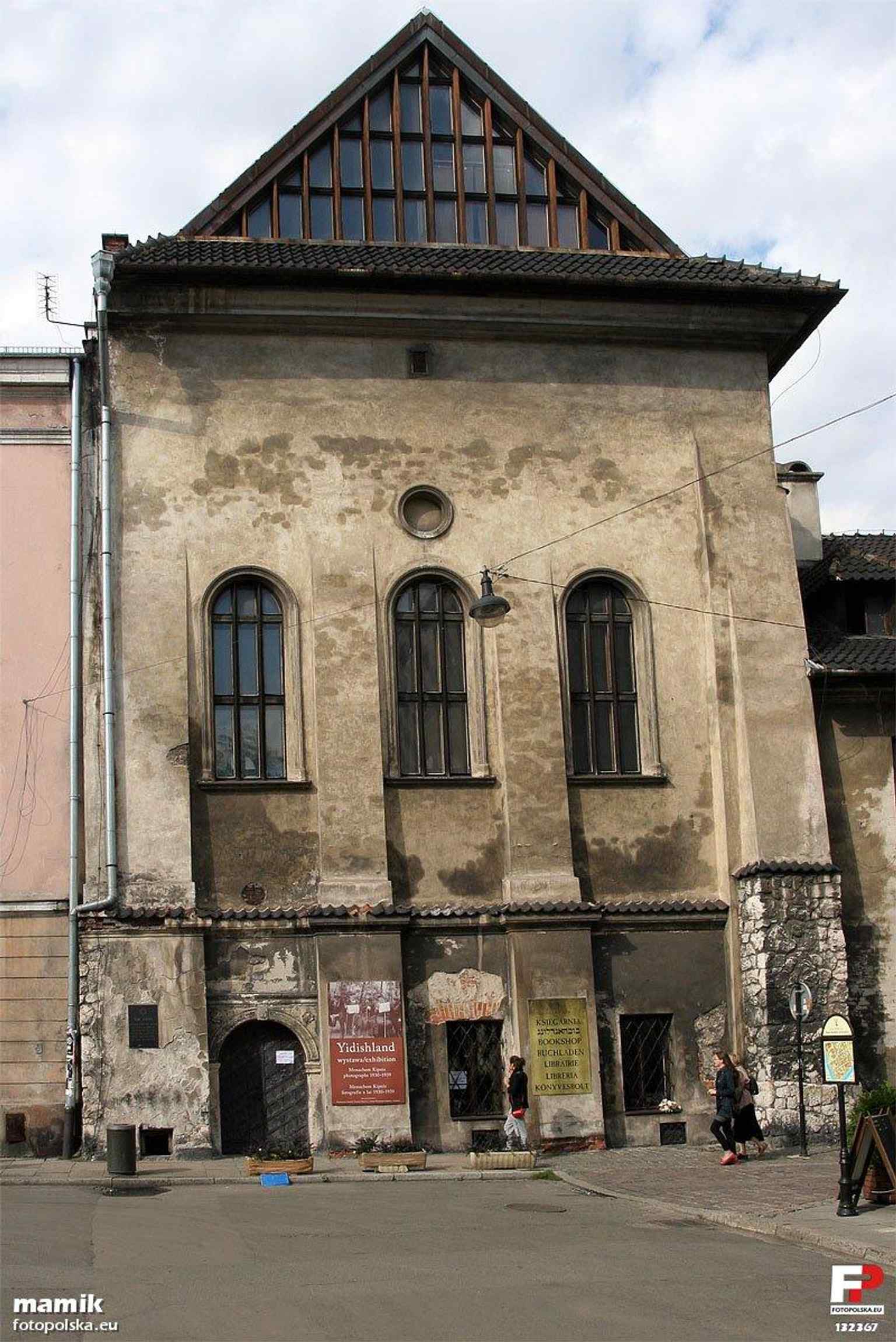
View from Wąska Street that emphasizes the synagogue’s urban setting and its elevated, defensive-looking massing.Photo: mamik, Wikimedia Commons, CC BY-SA 3.0. Cropped & resized. 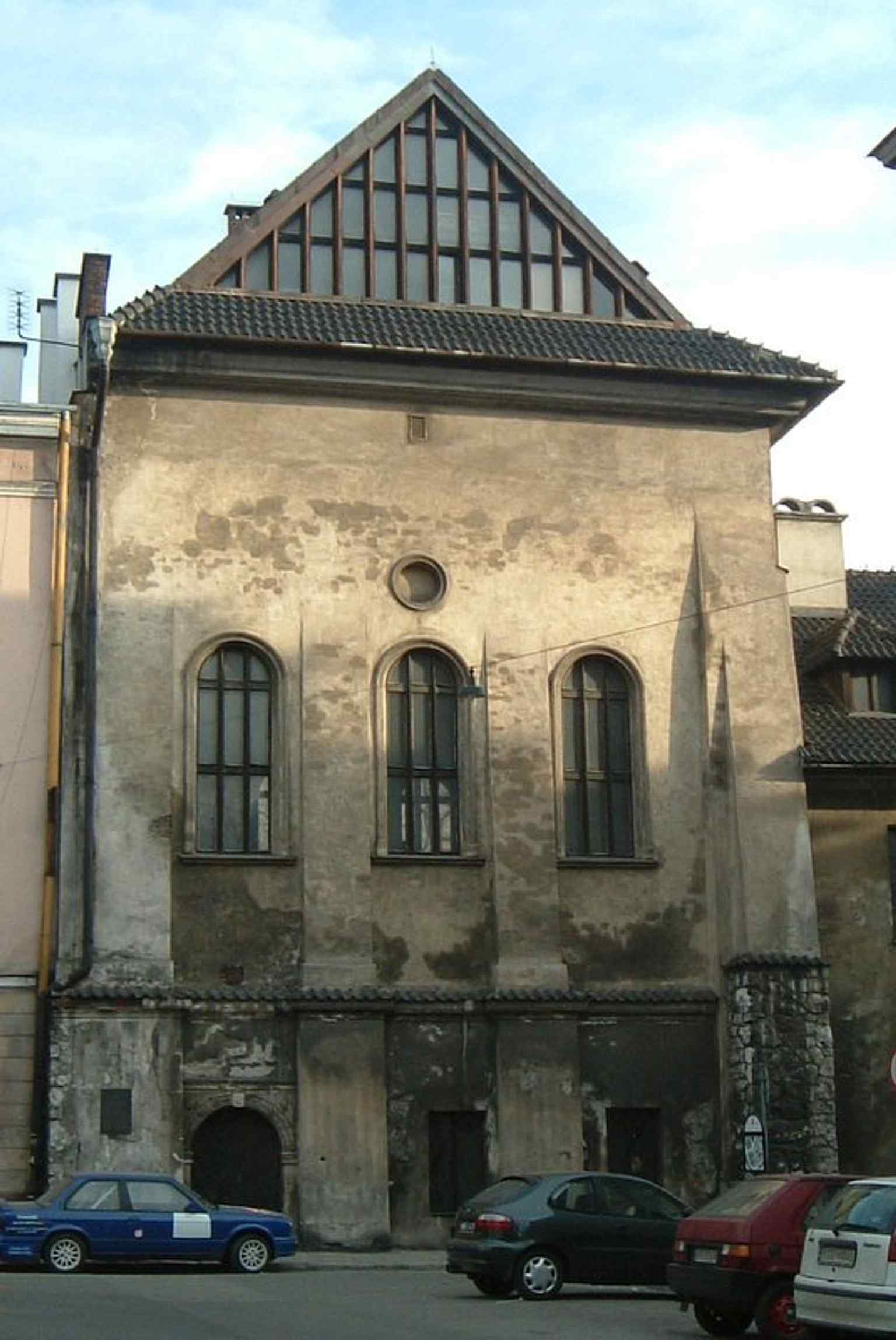
A compact exterior image that clearly identifies the High Synagogue and its distinctive tall profile.Photo: No machine-readable author provided. Tukan~commonswiki assumed (based on copyright claims)., Wikimedia Commons, CC BY-SA 3.0. Cropped & resized. 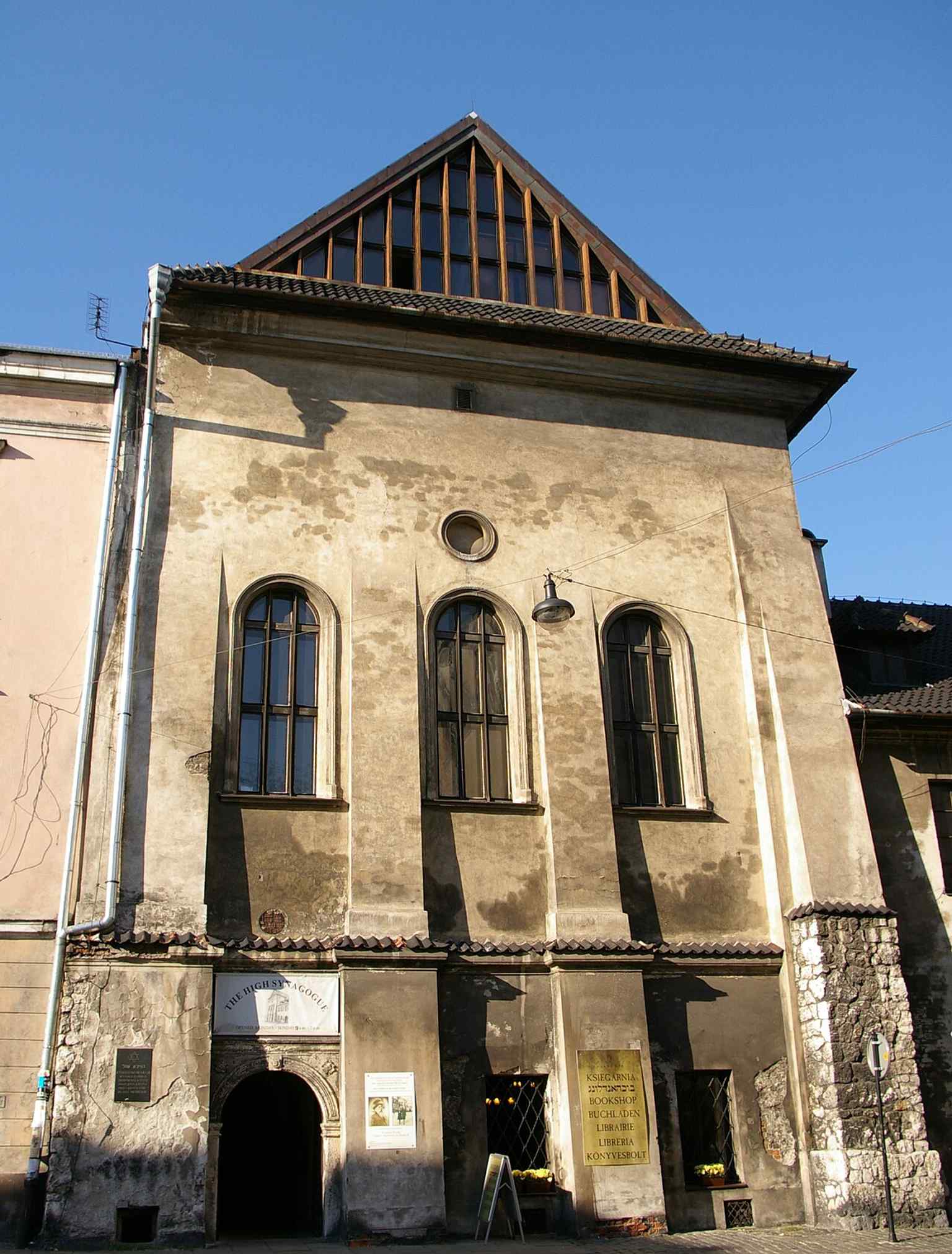
A broader exterior perspective from 2007, useful for showing the synagogue’s restored appearance in Kazimierz.Photo: Jakub Hałun, Wikimedia Commons, CC BY-SA 3.0. Cropped & resized. 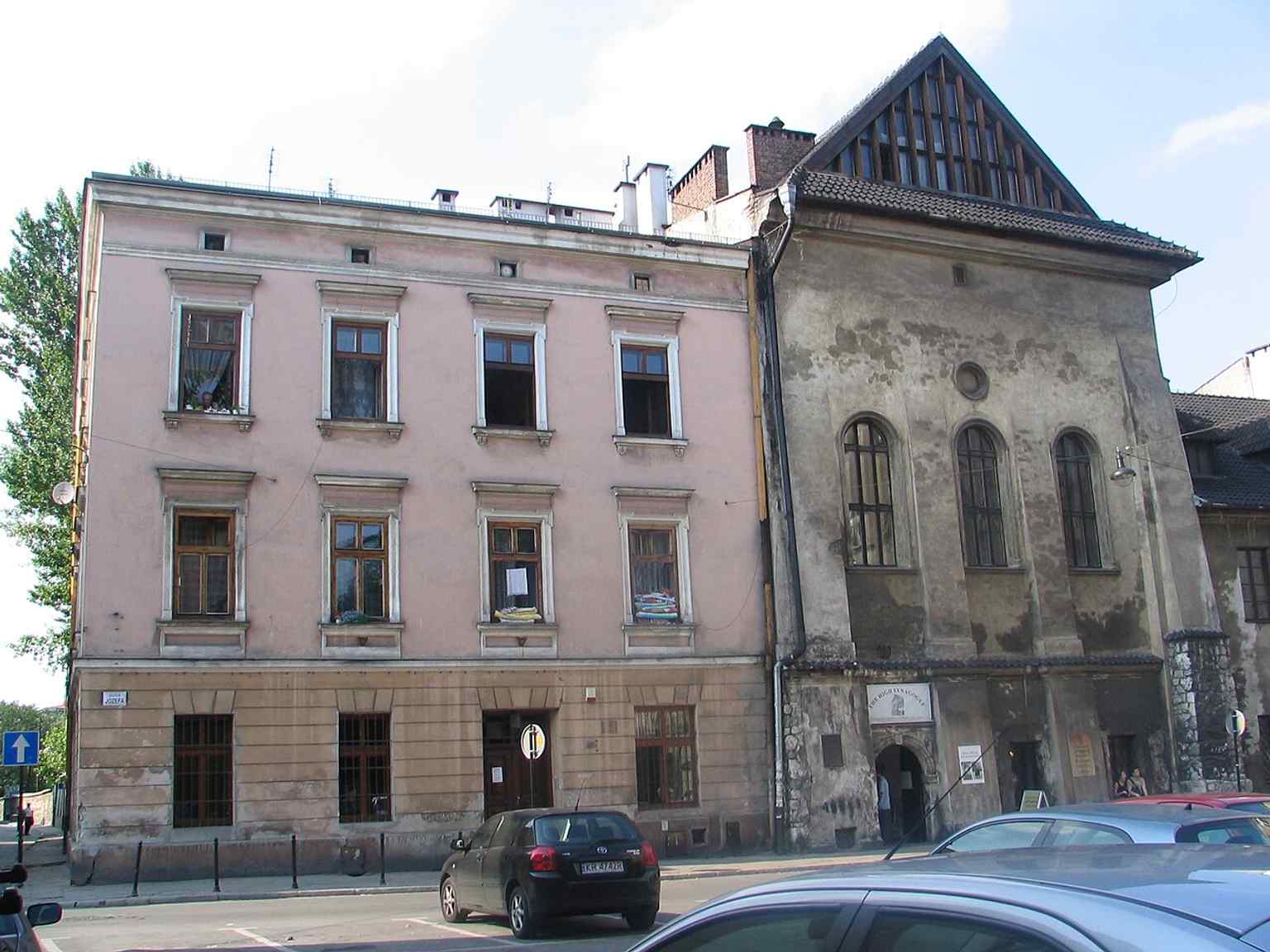
Another strong exterior view of the High Synagogue, helping round out the modern look of the building.Photo: ekeidar, Wikimedia Commons, CC BY-SA 3.0. Cropped & resized. 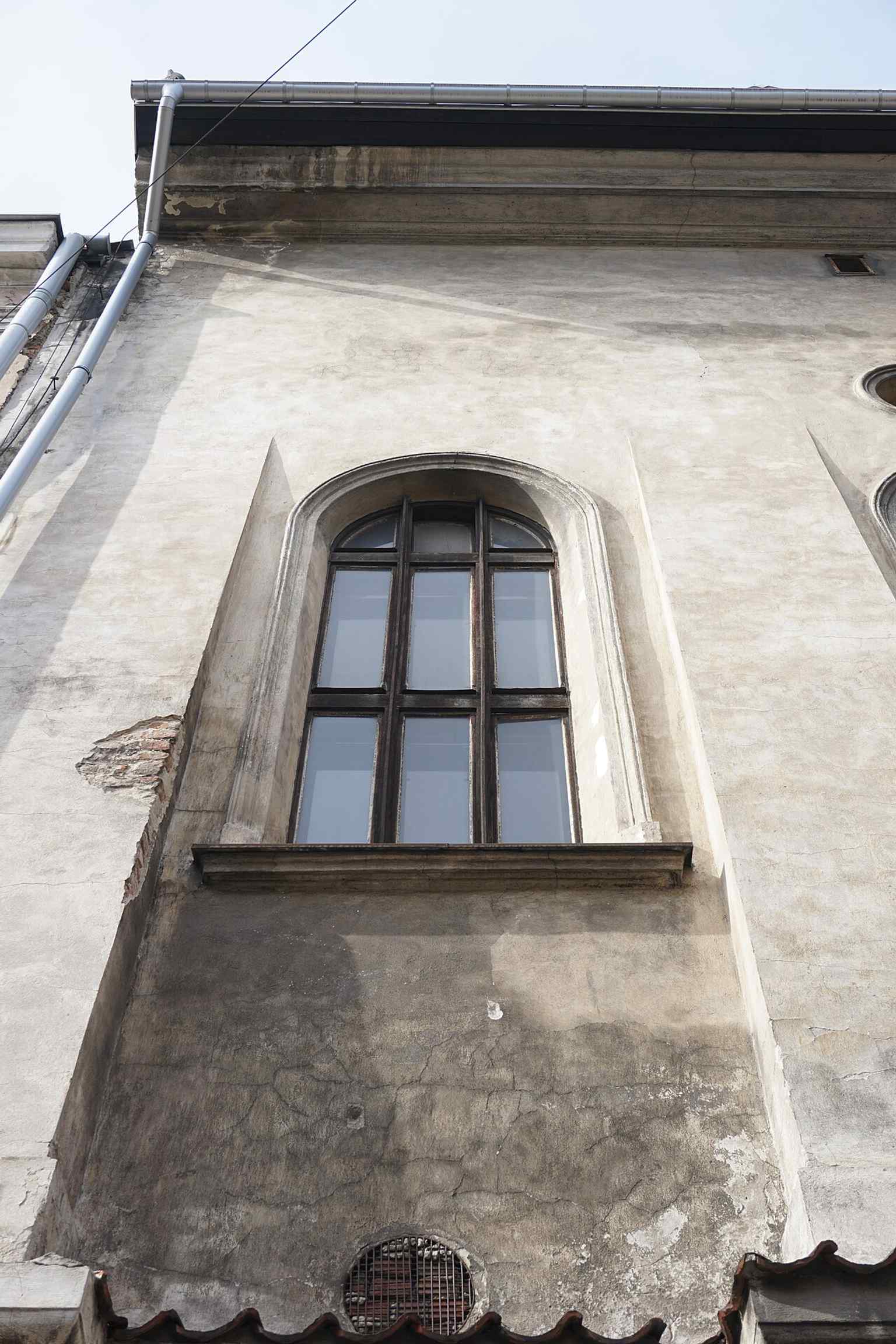
A recent high-resolution street view of Józefa 38, showing the synagogue as it appears to visitors today.Photo: Igor123121, Wikimedia Commons, CC BY 4.0. Cropped & resized.
Show 12 more stopsShow fewer stopsexpand_moreexpand_less
On your right is a modest brick facade set into an apartment block, marked by three pairs of rounded windows and a plain, house-like front that once concealed a synagogue in full…Read moreShow less
Open dedicated page →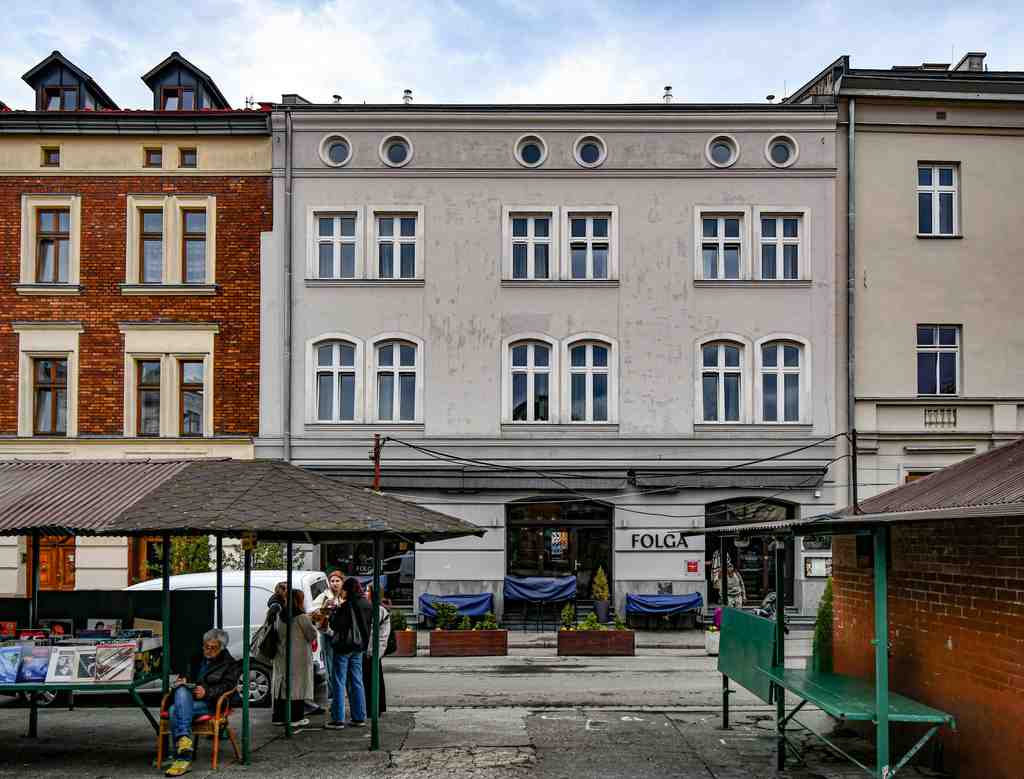
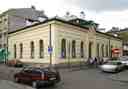
Bobov SynagoguePhoto: Jeremiah Z. Cockroach, Wikimedia Commons, CC BY-SA 4.0. Cropped & resized. On your right is a modest brick facade set into an apartment block, marked by three pairs of rounded windows and a plain, house-like front that once concealed a synagogue in full view.
What you are looking at was the Bobov Synagogue, completed in eighteen seventy-one for followers of Rabbi Shlomo Halberstam of Bobowa. This was part of the Bobov Hasidic network: a web of small prayer houses across Galicia, all tied to one spiritual center. Hasidic Judaism is a devotional branch of Jewish life shaped by loyalty to a revered rabbi, and Shlomo Halberstam inspired exactly that kind of bond. His fame drew pilgrims from across Eastern Europe. Some stories say even local Catholics respected him.
If Remah showed you pilgrimage at a grave, this address shows pilgrimage turned into neighbourhood routine. A Jew in Kazimierz could enter here and feel linked to a much larger world.
Museum records preserve a detail most passersby miss. This was a brick neo-Romanesque facade, with three pairs of semicircular windows declaring its identity to the street, even though the prayer hall occupied only the first floor of the building. Right beside it stood a Talmudic school, a place for serious Jewish study. So the life of this house was compact, but never small.
And here is the detail locals remember because it suddenly enlarges everything. In nineteen thirty-one, Ben Zion Halberstam’s daughter, Nechema Golda, married Moyzesh Stempel of Kraków. Reports say around five thousand guests came, many on special trains. The family housed visitors, and the main ceremony spilled into the market square. That is the scale of feeling attached to the Bobov name.
Then came rupture. The Nazis vandalized the synagogue. After the war, people turned it into apartments, and in the summer of nineteen ninety it became a hostel for the poor. By twenty seventeen, no original furnishings remained.
So this quiet front belongs to a world far larger than the street suggests. In about one minute, we will reach the Talmud Torah Synagogue, where prayer and study shared another intimate address.
On your left stands a pale plastered corner tenement, tall and rectangular, with rows of upright windows turning neatly around the angle of Estery and Warszauera. This is the…Read moreShow less
Open dedicated page →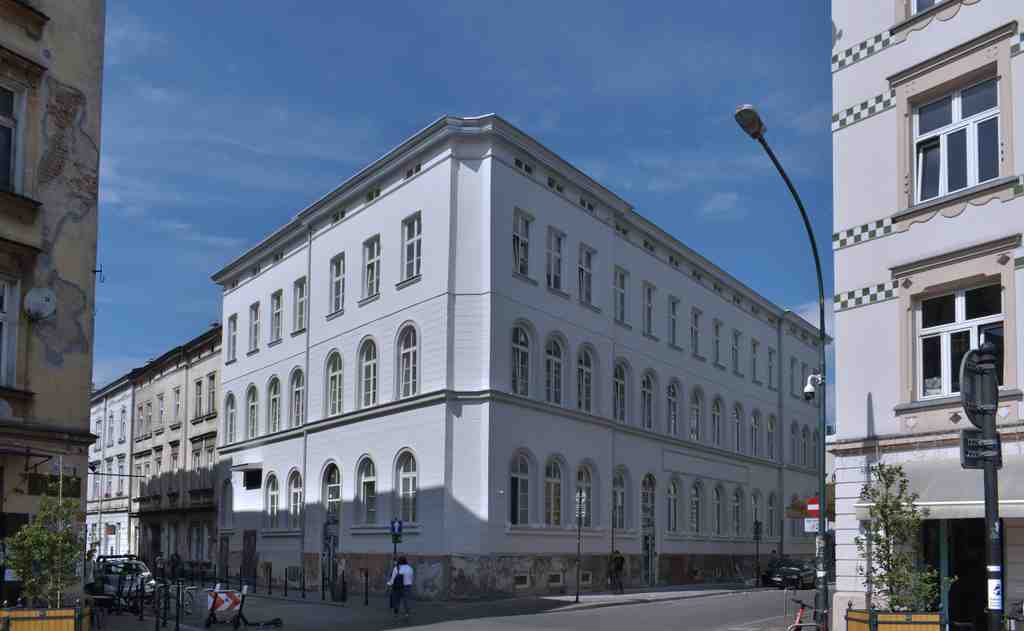
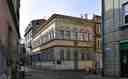
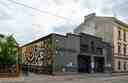
Talmud Torah Synagogue in KrakowPhoto: Zygmunt Put, Wikimedia Commons, CC BY-SA 4.0. Cropped & resized. On your left stands a pale plastered corner tenement, tall and rectangular, with rows of upright windows turning neatly around the angle of Estery and Warszauera.
This is the former Talmud Torah Synagogue, and its modesty matters. Jewish life in Kazimierz did not depend only on grand sanctuaries; it also lived in schoolrooms, in lessons, in the steady habits of pupils, teachers, and neighbours who needed a place to pray close at hand.
Architect Leopold Tlachna designed this house in nineteen oh nine. He was no minor craftsman passing through. He also worked on nearby houses on Estery Street, which places this address within his wider work in Kraków. His brother Maurycy came from Moravia with him, and together they ran a busy building firm. So this quiet address belongs to a man who left his mark all over the city.
In the interwar years, one room inside served as a synagogue for the Talmud Torah religious school. It mainly welcomed students and teachers, though local residents likely joined as well. The school taught around fifteen hundred pupils, and leaders of synagogues and Hasidic prayer houses oversaw it; a rabbinical school also worked here. So behind this ordinary façade stood a serious engine of daily religious life.
The Nazis wrecked the synagogue during the war. Afterward, doctors’ clinics moved in. Today the building serves as Hotel Estera. That is Kazimierz in miniature: prayer, loss, reuse, and memory folded into one address. In a moment, we’ll continue to the Judaica Foundation, where culture carries the story forward.
On your left, look for a modest stucco-faced building with a broad rectangular front, tall evenly spaced windows, and the entrance set into number seventeen on Meiselsa…Read moreShow less
Open dedicated page →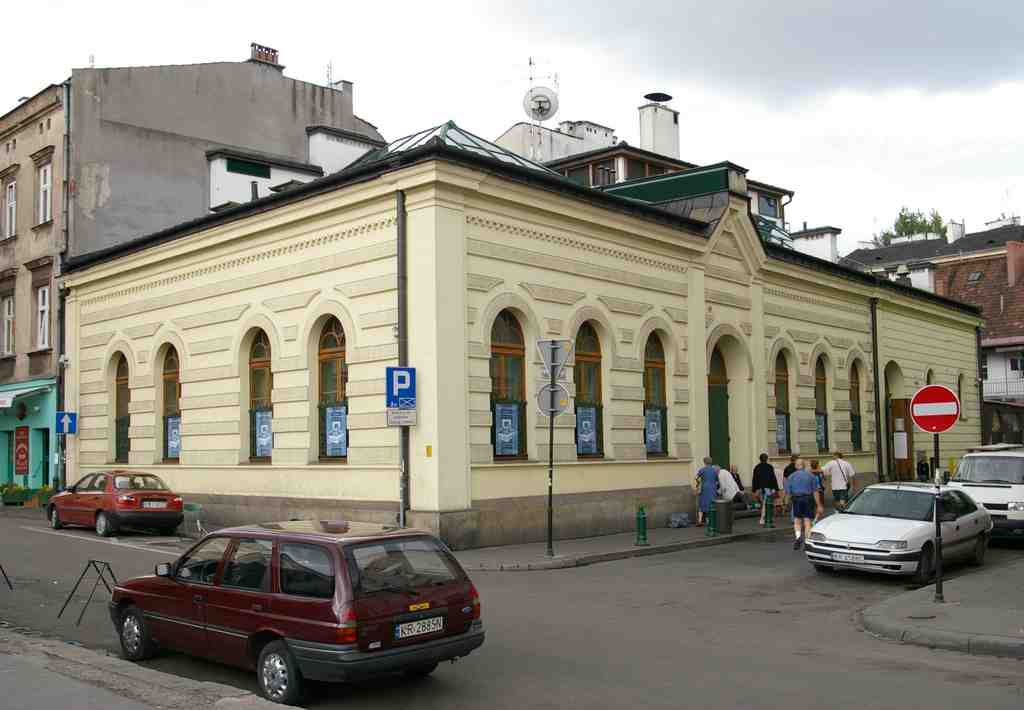
Judaica Foundation – Center For Jewish CulturePhoto: Jakub Hałun, Wikimedia Commons, CC BY-SA 3.0. Cropped & resized. On your left, look for a modest stucco-faced building with a broad rectangular front, tall evenly spaced windows, and the entrance set into number seventeen on Meiselsa Street.
This address marks a quiet turning point in Kazimierz. Earlier on our walk, we met buildings that carried Jewish life in their original purpose. Here, the story shifts. This was once a Beit Tefillah, a house of prayer, built in the eighteen eighties and used for worship right up to the outbreak of the Second World War. Then, after ruin, neglect, and silence, people chose not merely to admire what had been lost, but to act.
That sort of rescue takes more than sentiment. In the nineteen eighties, the idea for the Judaica Foundation began to gather force, encouraged by the president of Kraków’s Jewish community. The foundation itself took shape in nineteen ninety-one, dedicated to preserving Jewish culture here in Kazimierz and, crucially, to opening it outward. Not a sealed memorial. Not a frozen ruin. A living place.
Architect Dariusz Gruszka supervised the building’s renovation from nineteen eighty-eight to nineteen ninety-three. The work was serious and painstaking, funded largely by the Congress of the United States, with further support from the city of Kraków, the provincial governor’s office, and monument conservators. Inside, restorers even rebuilt the men’s hall ceiling ornament and a plaster rosette, a circular ceiling decoration, using traces left from the turn of the twentieth century. Memory, in other words, was not guessed at. It was read in the walls.
If you look at the image on your screen, you can see the building after that revival, still modest, still reserved, but no longer abandoned to forgetting.
The Centre for Jewish Culture opened here on the twenty-fourth of November, nineteen ninety-three. From the outset, it welcomed Jews and non-Jews, visitors from Poland and abroad, and anyone willing to learn about Jewish history and Polish-Jewish coexistence. That openness mattered. Preservation here meant lectures, workshops, exhibitions, and difficult conversations. In nineteen ninety-six, the foundation launched Bayit Hadash, the Month of Encounters with Jewish Culture, often built around a single figure or theme, from Franz Kafka to Mordechaj Gebirtig to the history of Jewish Galicia.
This hall also gave space to voices that stretched far beyond Kraków. Czesław Miłosz opened the Aleksander and Alicja Hertz memorial lecture in nineteen ninety-nine. Israel Gutman later spoke here. So did Ryszard Kapuściński. In two thousand and nineteen, the center hosted a memorial evening for Henryk Halkowski and, in the same month, a debate on collaboration in occupied Kraków alongside survivor testimony on film.
So here is the question to carry with you: when a former house of prayer becomes a shared cultural space, has it lost its first calling, or has it found another way to gather souls?
That is the deeper rescue, I think: not only saving a building, but reopening conversation inside it. When you are ready, we shall continue to Chewra Thilim Synagogue, about one minute away.
This is a modest two-storey brick-and-plaster corner building, rectangular in form, marked by round-arched windows and a distinctive row of small blind arches just beneath the…Read moreShow less
Open dedicated page →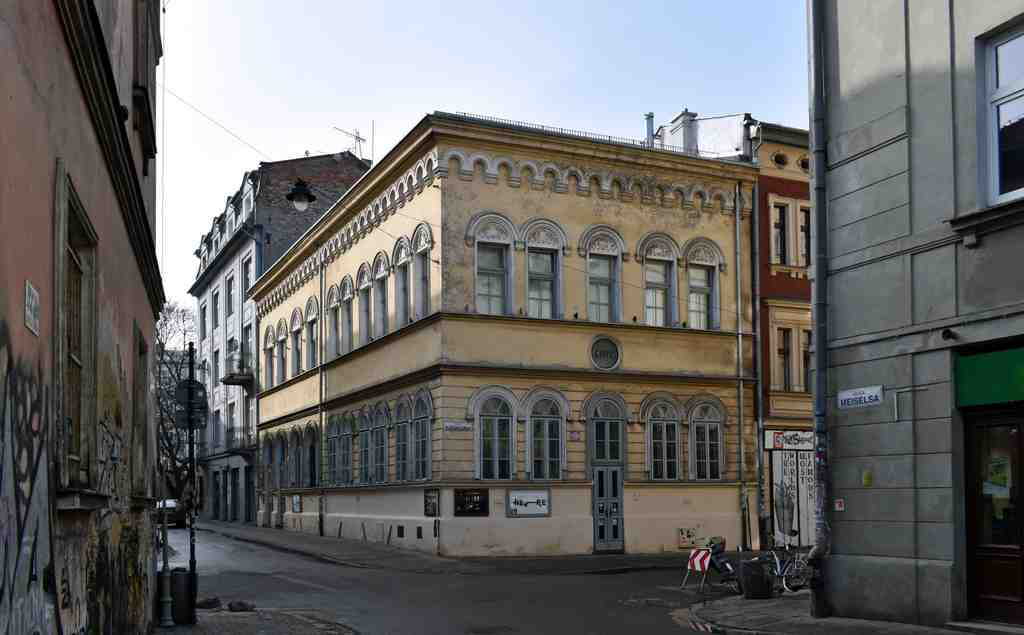
Chevra Thilim Synagogue in KrakowPhoto: Zygmunt Put, Wikimedia Commons, CC BY-SA 4.0. Cropped & resized. This is a modest two-storey brick-and-plaster corner building, rectangular in form, marked by round-arched windows and a distinctive row of small blind arches just beneath the roof.
At first glance, it can seem restrained, almost shy. But that is part of its story. This was never one of Kazimierz’s grandest synagogues. In eighteen ninety-six, the Psalm Brotherhood founded it as Chewra Thilim, literally the Psalm Society, and architect Nachman Kopald gave them a practical house of prayer with a touch of late nineteenth-century flourish. Those rounded windows and that arcaded frieze under the roofline borrow from older styles, giving a small communal building a certain dignity.
Behind this facade stood a whole little religious world: the men’s prayer hall on the ground floor, a women’s gallery upstairs, and a Talmudic school as well. Like some of the humbler prayer rooms we have met already, this place mattered because ordinary people kept it alive through repeated daily use, not because it dominated the skyline.
If you glance at the image on your screen, you can see the building from a little farther back and appreciate how firmly it sits in the street corner, still carrying the outline of its original purpose. In nineteen thirty-one, Salomon Jonkler remodelled the synagogue. Then the Germans came, and during the occupation they wrecked the interior. The shell survived, but survival here rarely meant peace. After the war, the building housed the Jewish Socialist Party. In nineteen fifty-one, the Krakowiacy folk song and dance ensemble moved in. That decision sounds odd until you remember the wider problem: many Jewish buildings in Kraków remained standing after the people who animated them had been murdered, scattered, or reduced to tiny communities.
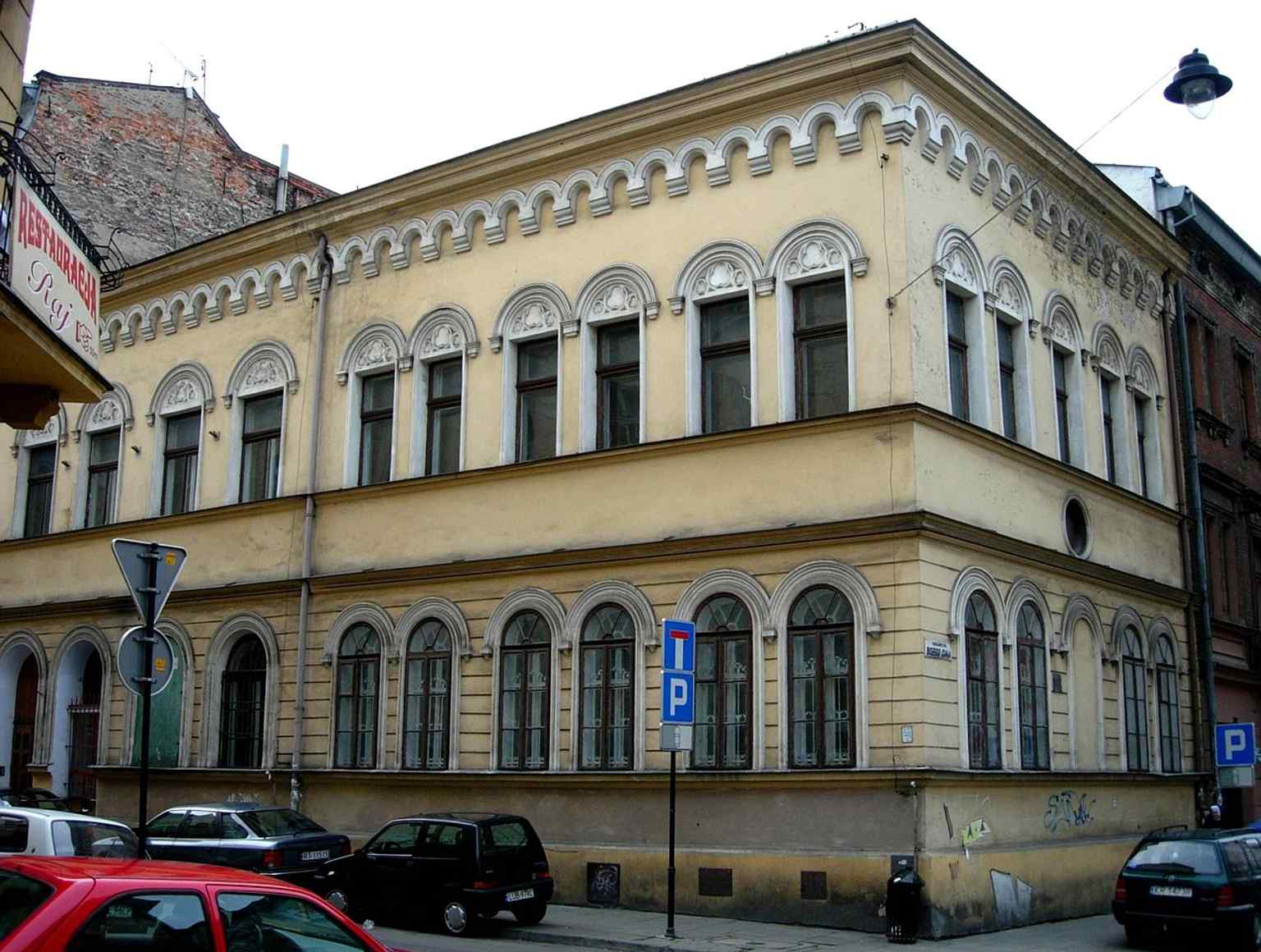
A clear exterior view of the former prayer house on Meiselsa Street, where the building’s modest, historic facade still marks its synagogue origins.Photo: Jakub Hałun, Wikimedia Commons, CC BY-SA 3.0. Cropped & resized. That brings us to Tadeusz Jakubowicz, head of Kraków’s Jewish community after the building returned to communal ownership in two thousand and one under the restitution law. He faced a miserably practical question: how do you keep a former synagogue in Jewish hands when the community is small and the building needs constant care? His answer was a very local compromise. He allowed the ensemble to stay, but only on condition that it improve the building and prevent further decay.
Most tourists never notice that this synagogue’s fate turned not on a dramatic restoration campaign, but on that compromise between ownership and use. The ensemble said the condition was good enough and that the city funded occasional interior repairs. But they could not afford a major roof repair or new windows, and the city did not want to pay for a property it did not own. By two thousand and six, they left.
Then came a startling discovery. In two thousand and eight, conservators uncovered wall paintings inside: mostly blue and green, with biblical scenes, a lion, a tiger, part of an eagle, and a deer; views of Jerusalem and Rachel’s Tomb; and, near the wooden women’s gallery, Hebrew words meaning “the candle of the soul.” Fragments of the red curtain around the Aron ha-Kodesh, the holy ark niche where Torah scrolls were kept, also survived.
And yet discovery did not settle the building’s future. In two thousand and thirteen, a lease to the Mezcal nightclub provoked outrage. Scholar Jonathan Webber wrote publicly of his horror. Critics pointed to a bar installed in the former prayer hall, directly before exposed paintings that still lacked proper protection. Even after the building entered the heritage register, later alterations cut a new passage near the old ark niche. Activists answered with the RememberChewra actions, insisting that preservation means more than leaving the walls standing.
So here you are before a building that still exists because people kept finding uses for it, and yet each use asked a painful question. When the original world cannot simply be restored, what does respectful care actually look like?
When you are ready, continue to Corpus Christi Street. It is about a two-minute walk from here.
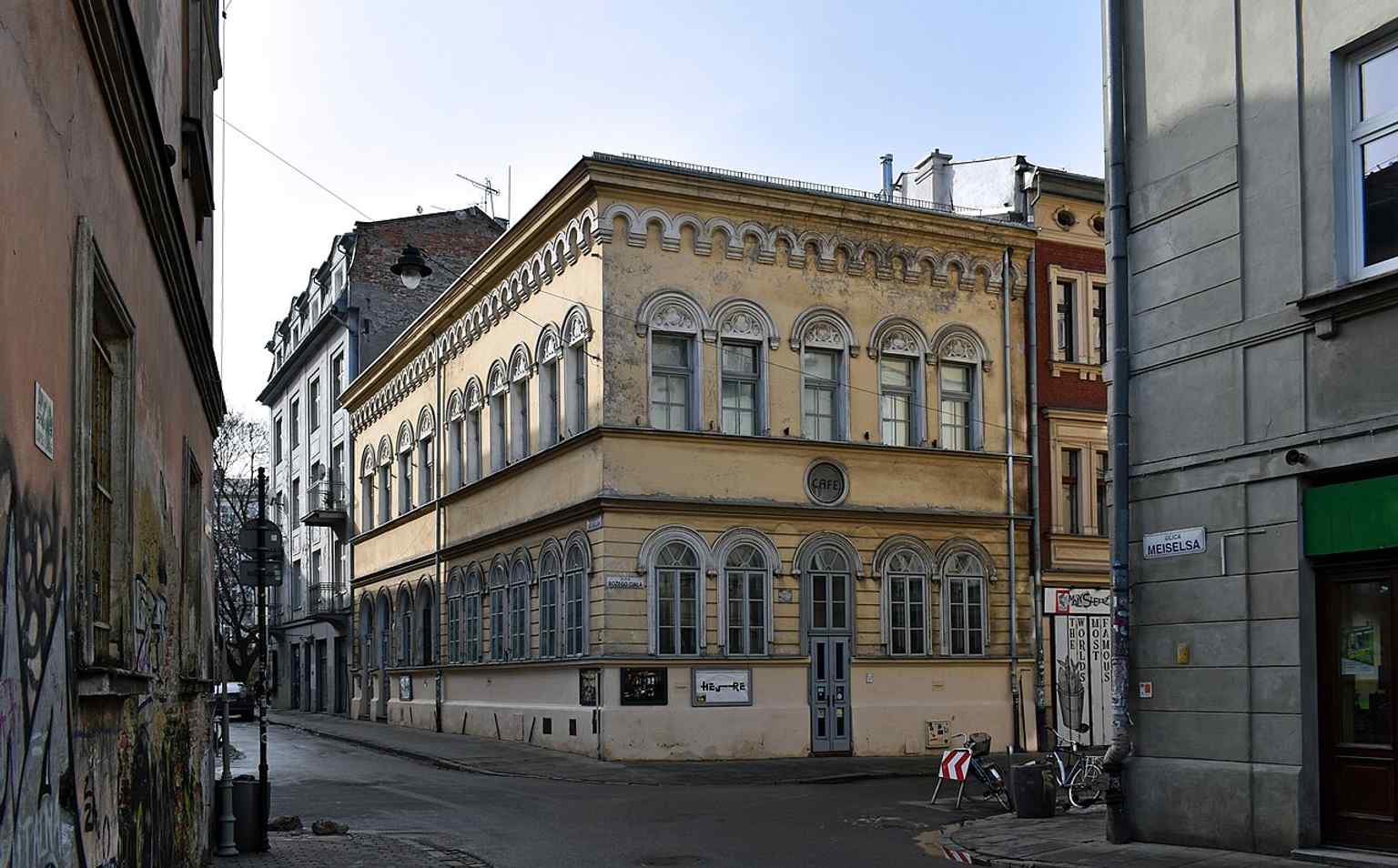
The former Chewra Thilim synagogue in its restored street setting — a rare surviving prayer house from 1896 in Kraków’s Kazimierz district.Photo: Zygmunt Put, Wikimedia Commons, CC BY-SA 4.0. Cropped & resized. Look for a straight street framed by tall plastered townhouses, with a long, stone-edged perspective and the great church tower of Bożego Ciała rising as its unmistakable…Read moreShow less
Open dedicated page →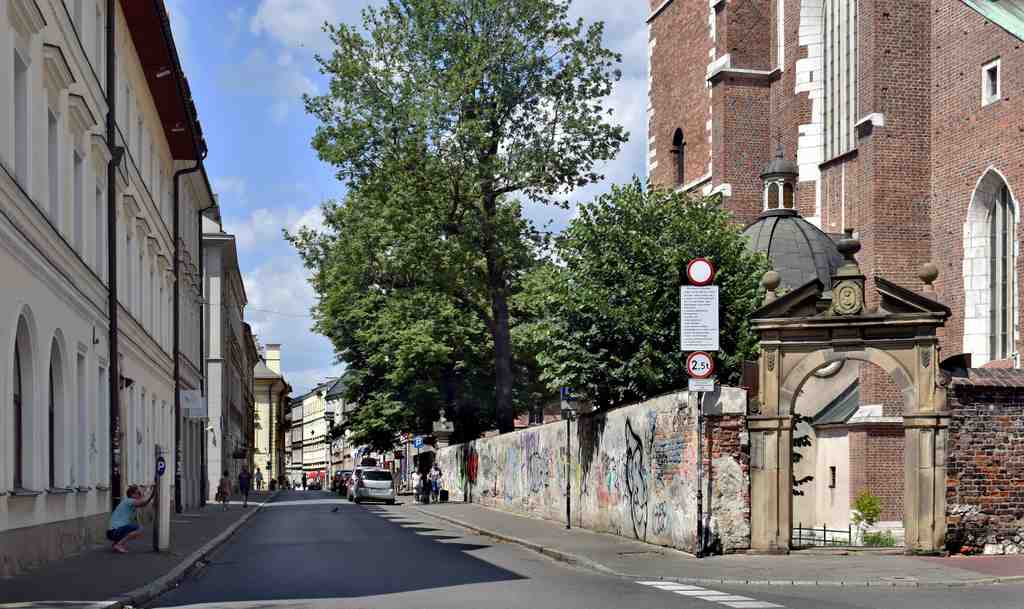
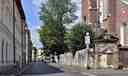
Corpus Christi Street in KrakowPhoto: Zygmunt Put, Wikimedia Commons, CC BY-SA 4.0. Cropped & resized. Look for a straight street framed by tall plastered townhouses, with a long, stone-edged perspective and the great church tower of Bożego Ciała rising as its unmistakable marker.
This street tells Kazimierz how to behave, or rather, how it learned not to behave neatly at all. Bożego Ciała Street, literally Corpus Christi Street, began in thirteen thirty-five as part of the original plan of Kazimierz. At first it was barely built up. The parish school stood here, and beyond that, open space. What you see now came much later, when the district pressed outward and filled itself in.
And that is the important shift. This is not simply a road between one sight and another. It is a shared urban axis, a seam where Jewish and Christian histories met in stone, trade, prayer, argument, and daily routine. Along one stretch you could find a church and monastic buildings, a former inn, prayer houses, and later the solid ranks of late nineteenth-century rental tenements. Kazimierz never lived in separate boxes for very long.
The street’s name also carries ritual memory. Kraków’s Corpus Christi procession passed into legend here, and so did the Lajkonik story, linked to an old tale of a Tatar raid during the feast. In other words, the street belonged not only to maps, but to processions, performance, and civic memory. People walked belief through this space. They made the street by using it.
Then history turned abruptly. In sixteen fifty-five, during the Swedish invasion known in Poland as the Deluge, King Charles Gustav took over the Corpus Christi church at the end of this street and used it as his quarters while directing the siege of Kraków. That is quite a reversal, is it not? A church made for worship became a military command post. The interior suffered heavy damage, and when people repaired it later, the balance tipped toward Baroque furnishings rather than the earlier Gothic character. Conquest left its fingerprints not only in chronicles, but in style.
The street changed again when Kazimierz lost its medieval walls in eighteen forty-two. Once those walls came down, Bożego Ciała no longer stopped at the old edge of town. The city pushed it outward to Miodowa, and later, in eighteen ninety-two, onward to Józefa Dietla Street. Most of the townhouses you see belong to that period of expansion, when old Kazimierz was being stretched beyond its original limits.
Even the individual addresses carry this layered life. At number thirteen, the Chewra Tehilim prayer house served a real neighborhood community; in nineteen thirty-seven, Eizyk Kryngel led a congregation of two hundred forty worshippers there. At numbers eighteen to twenty, an inn from eighteen oh two later housed the Etz Chaim prayer house before the war. One building held lodging, commerce, and devotion under the same roof. That, too, is Kazimierz.
So stand still for a moment and let the street speak. It records procession and occupation, demolition and expansion, worship and reuse. It is not just a route through Kazimierz. It is the hinge on which the district swung open. From here, we continue to the Tempel Synagogue, where another kind of reinvention awaits.
On your right, look for a cream-coloured masonry facade with a tall central block, lower side wings, and broad round-arched windows that give the synagogue an almost theatrical…Read moreShow less
Open dedicated page →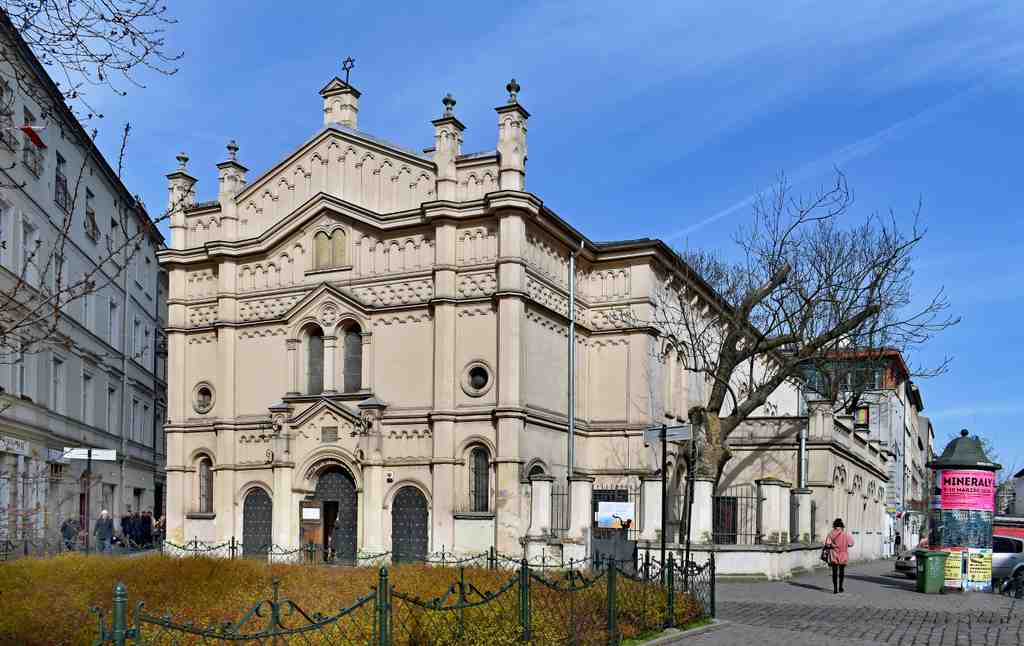
Tempel SynagoguePhoto: Zygmunt Put, Wikimedia Commons, CC BY-SA 4.0. Cropped & resized. On your right, look for a cream-coloured masonry facade with a tall central block, lower side wings, and broad round-arched windows that give the synagogue an almost theatrical sense of arrival.
This is Tempel Synagogue, completed in eighteen sixty-two, and it announced something bold before anyone even stepped inside. Architect Ignacy Hercok gave Kraków’s Progressive Jewish community a building in the Moorish Revival manner, mixed with a German round-arched style called Rundbogenstil. In plain terms, it was meant to look modern, confident, and very much part of the wider world of the Austro-Hungarian Empire. Hercok even followed the example of the famous Leopoldstädter Tempel in Vienna. This was not a shy neighbourhood prayer room. It was a public statement.
And the congregation inside was making a statement too. These were reform-minded Jews who wanted worship to follow the German model rather than traditional Orthodox practice. To more conservative neighbours, some ceremonies here seemed downright scandalous. In the interwar years, women sang together with the cantor and choir. That alone tells you something important about Kazimierz: disagreement lived here not at the edges, but at the heart of communal life.
Take a moment and study the front. Notice how the taller middle section stages itself against the street, almost like a civic hall. Imagine how startling that must have seemed to those who thought a synagogue should speak more softly.
If you glance at the image on your screen, you can see another layer of ambition inside: donor names preserved in stained glass panes, the community’s memory written quite literally into the building. The Torah Ark, the sacred cabinet that holds the Torah scrolls, came from Leon Horowitz, president of Kraków’s Jewish congregation. And the interior grew lavishly ornate, with dense colour, gold leaf, and a gilded dome over the Ark that quietly echoes the famous dome of the Sigismund Chapel at Wawel. You can see that richness here.
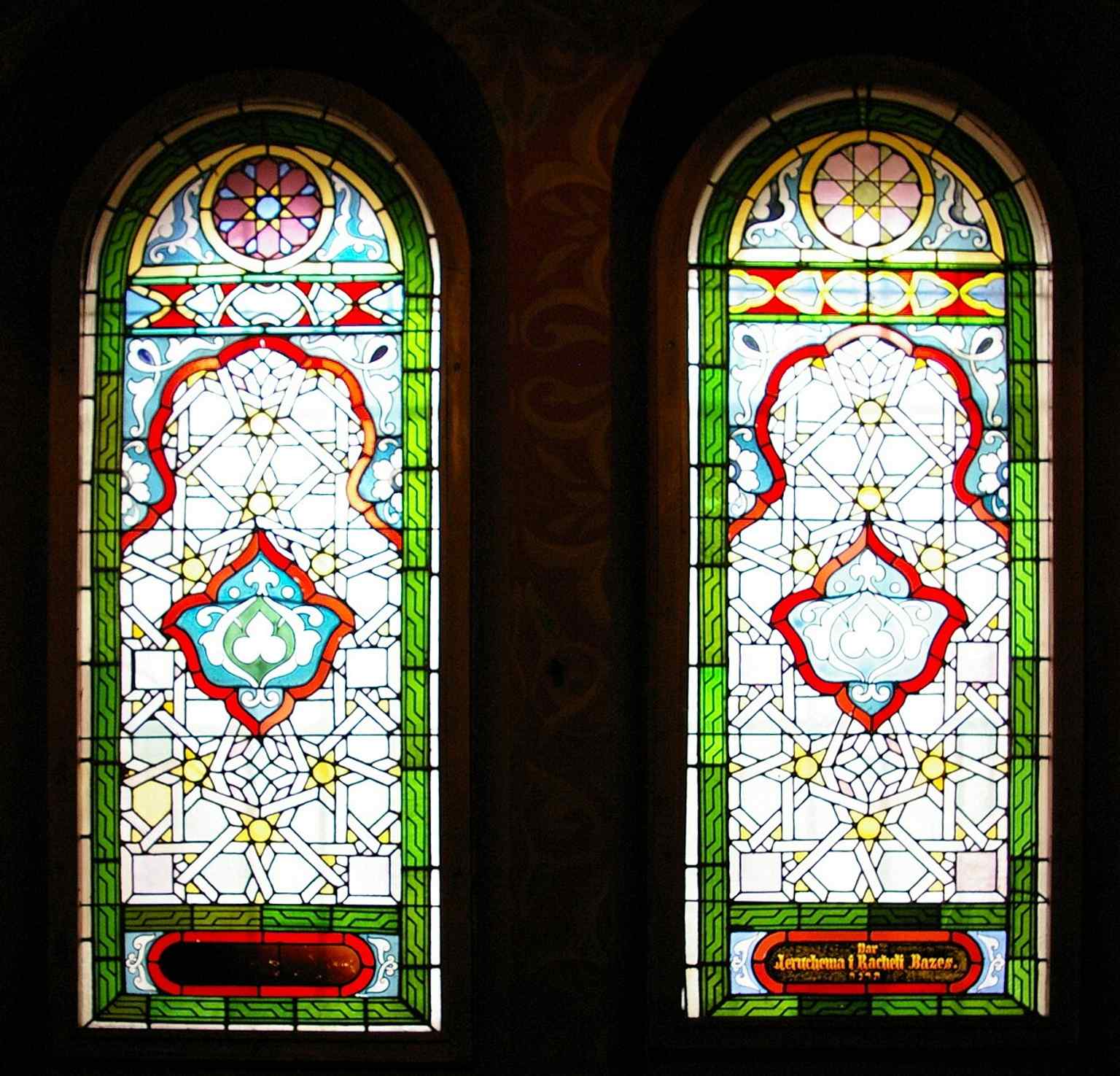
Stained-glass panes that still carry donor names, preserving the people who funded Tempel’s original progressive congregation.Photo: Jakub Hałun, Wikimedia Commons, CC BY-SA 4.0. Cropped & resized. One man shaped this place more than any other voice: Rabbi Doctor Ozjasz Thon. From eighteen ninety-seven until nineteen thirty-six he preached here in Polish and German, and he also served in the Polish parliament. So Tempel joined religious reform to public life in a very unusual way.
The building kept expanding in eighteen sixty-eight, then again in the eighteen nineties, and again in nineteen twenty-four as the congregation grew to around eight hundred members, including artists and intellectuals. Then came wartime abuse: the Germans turned the synagogue into storage, even an ammunition depot and stable. That profaned it, but also helped it survive. After the war, prayer returned, a ritual bath opened here in nineteen forty-seven, restoration followed in the nineteen nineties, and new communal life returned again.
That is Tempel’s quiet lesson: continuity here never meant everyone agreeing. It meant arguing, rebuilding, and deciding again how Jewish life should look and sound. When you are ready, continue to the Wolf Popper Synagogue, about an eight-minute walk from here. If you plan to come back inside, Tempel usually opens from ten in the morning until four in the afternoon, and it closes on Saturdays.
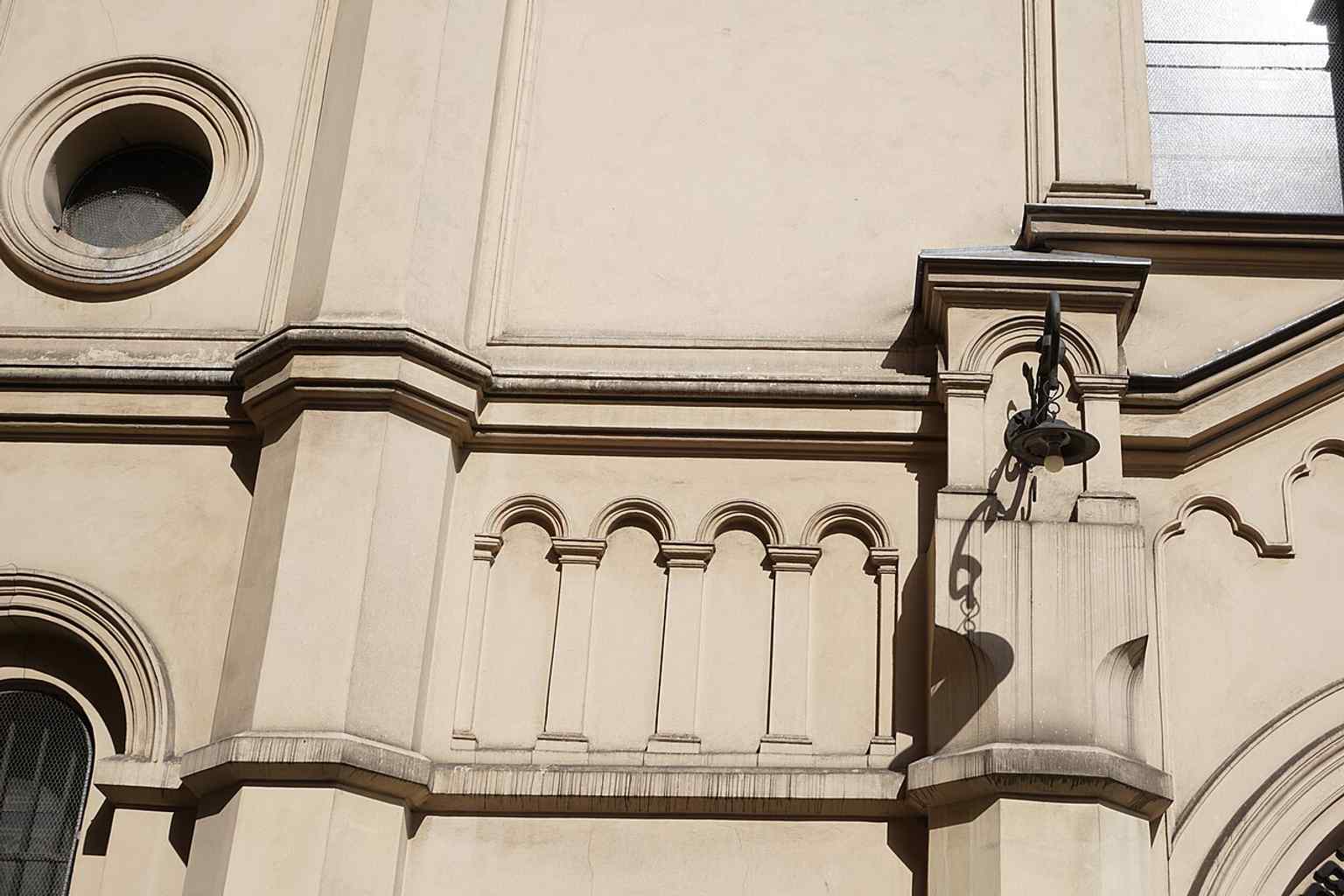
The main facade on Miodowa Street, where Tempel Synagogue has stood since 1862 as a landmark of Kraków’s Progressive Jewish movement.Photo: Igor123121, Wikimedia Commons, CC BY 4.0. Cropped & resized. 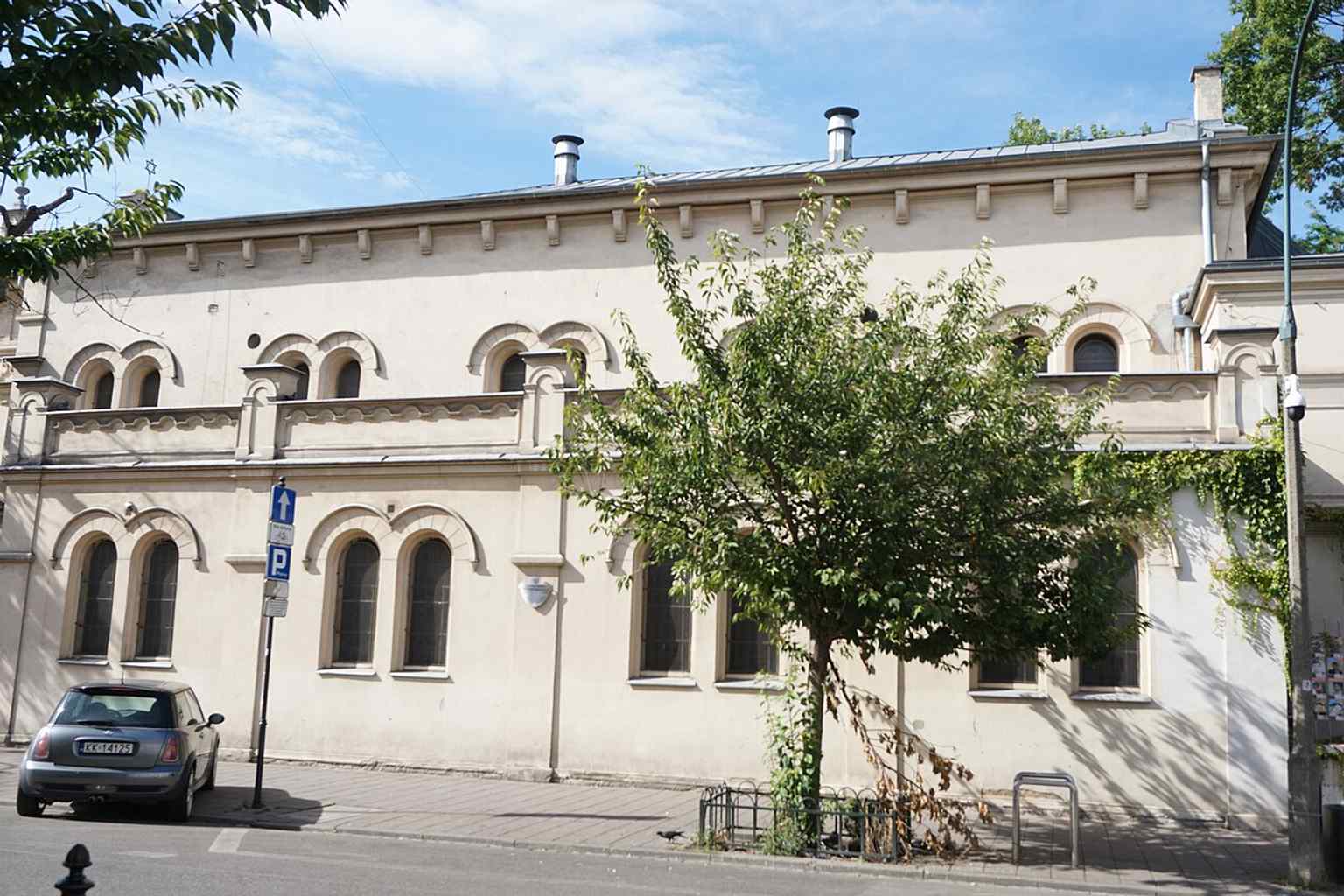
A clear recent view of the synagogue’s tall central body and side wings, reflecting the Moorish Revival and Rundbogenstil design.Photo: Igor123121, Wikimedia Commons, CC BY 4.0. Cropped & resized. 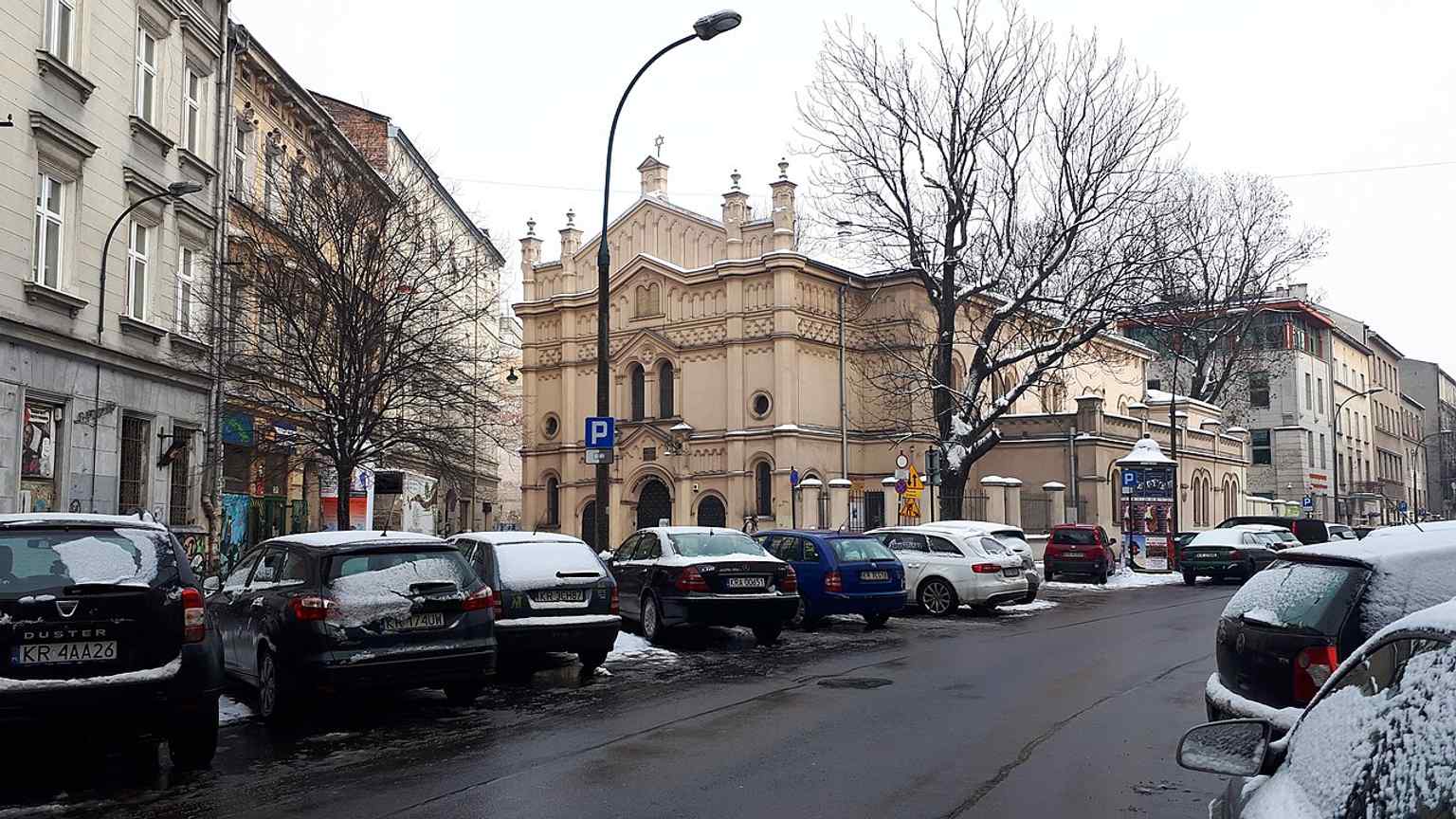
A wider street-level view that shows Tempel Synagogue in its Kazimierz context, still active at the heart of Kraków’s Jewish quarter.Photo: Rakoon, Wikimedia Commons, CC0. Cropped & resized. 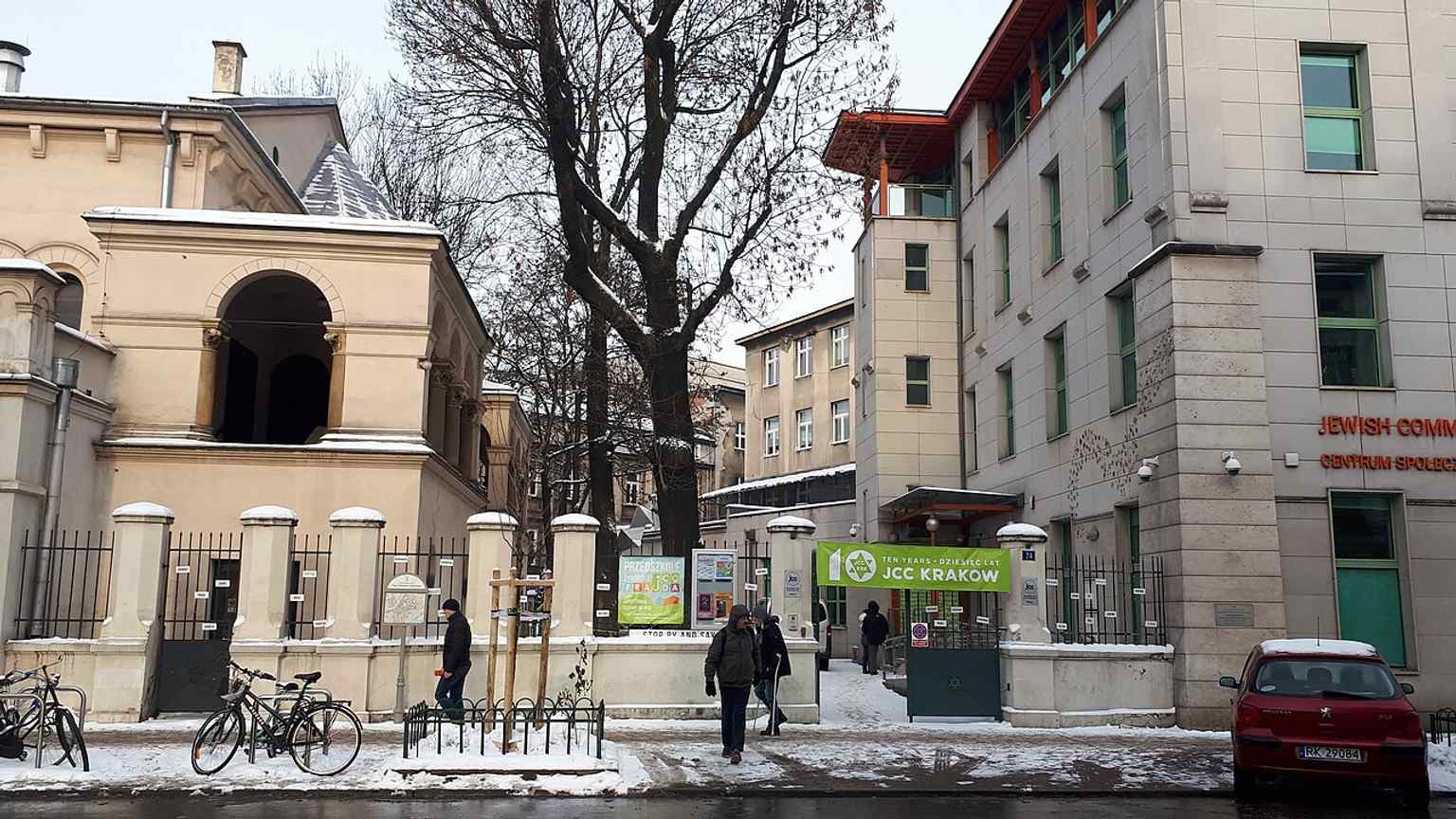
Tempel beside the Jewish Community Centre, showing how the site has grown into a living cultural campus, not just a historic monument.Photo: Rakoon, Wikimedia Commons, CC0. Cropped & resized. 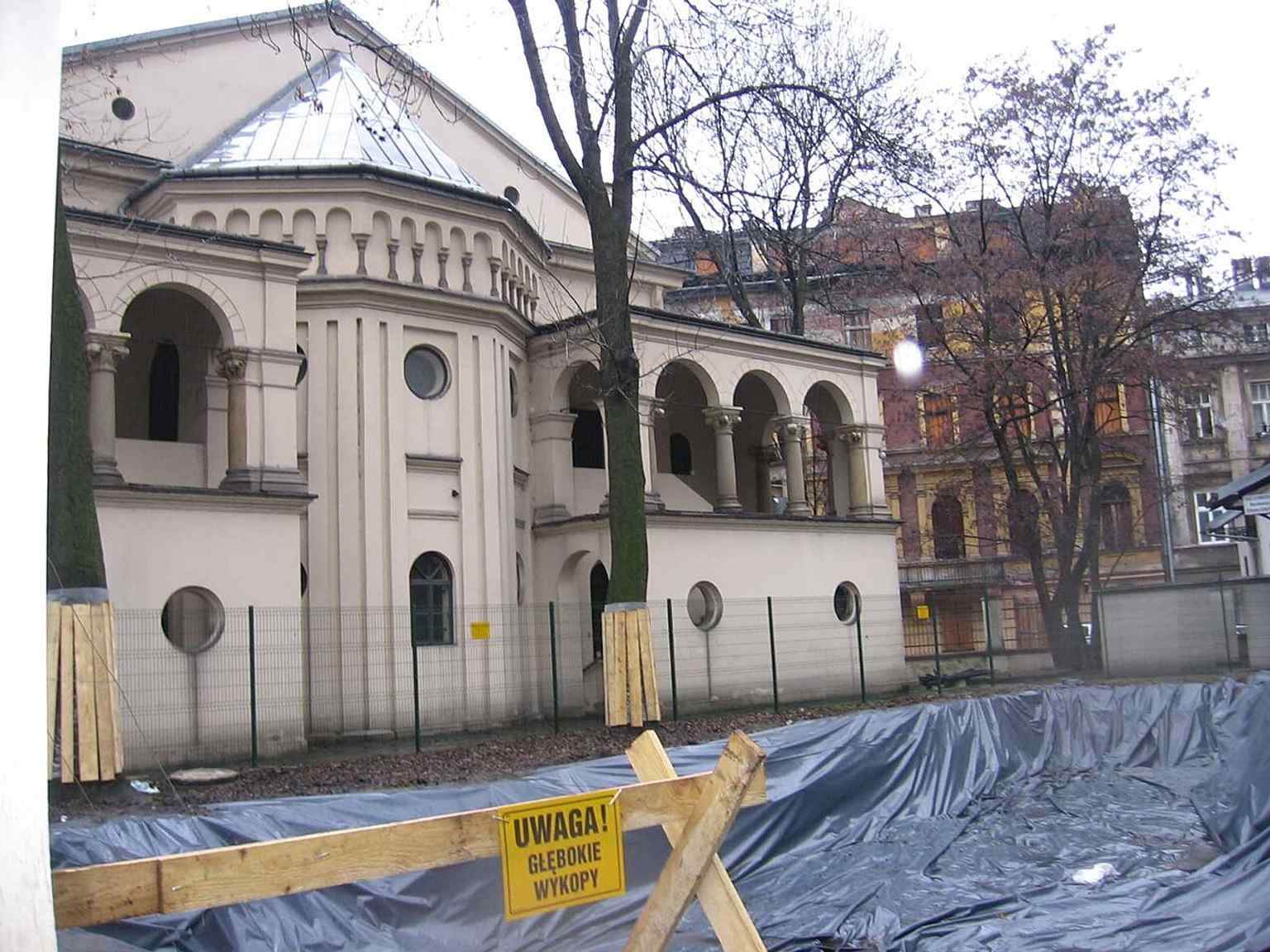
The Jewish Community Centre under construction behind Tempel, a sign of the synagogue’s modern revival as a communal hub.Photo: No machine-readable author provided. Slav assumed (based on copyright claims)., Wikimedia Commons, Public domain. Cropped & resized. 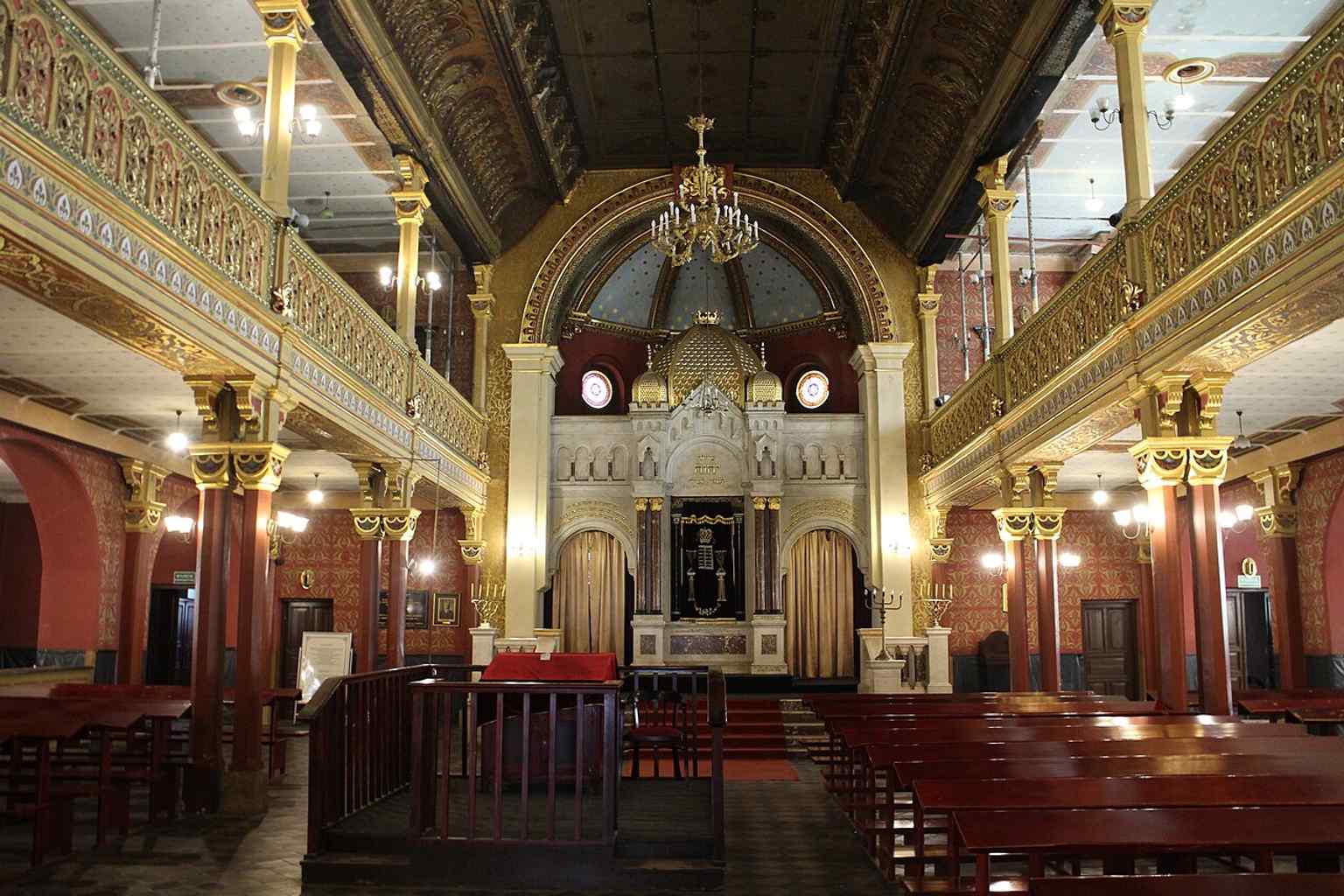
The synagogue interior during a service, with the richly decorated sanctuary still used for prayer and cultural events today.Photo: Suicasmo, Wikimedia Commons, CC BY-SA 4.0. Cropped & resized. 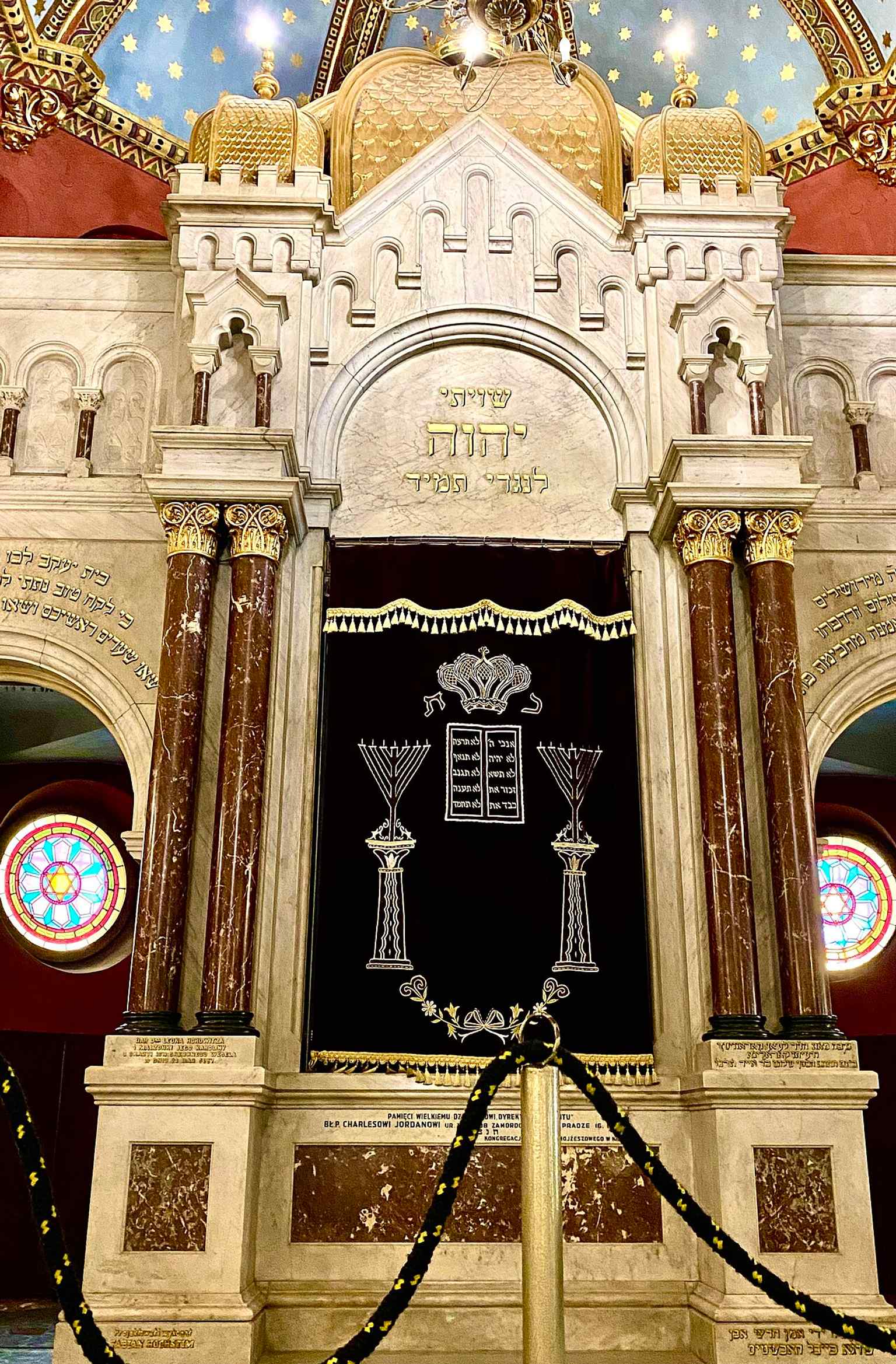
A close look at the Aron Kodesh area, where the gold-leaf finish and ornate decoration reflect the synagogue’s lavish 19th-century interior.Photo: Steven1991, Wikimedia Commons, CC BY-SA 4.0. Cropped & resized. 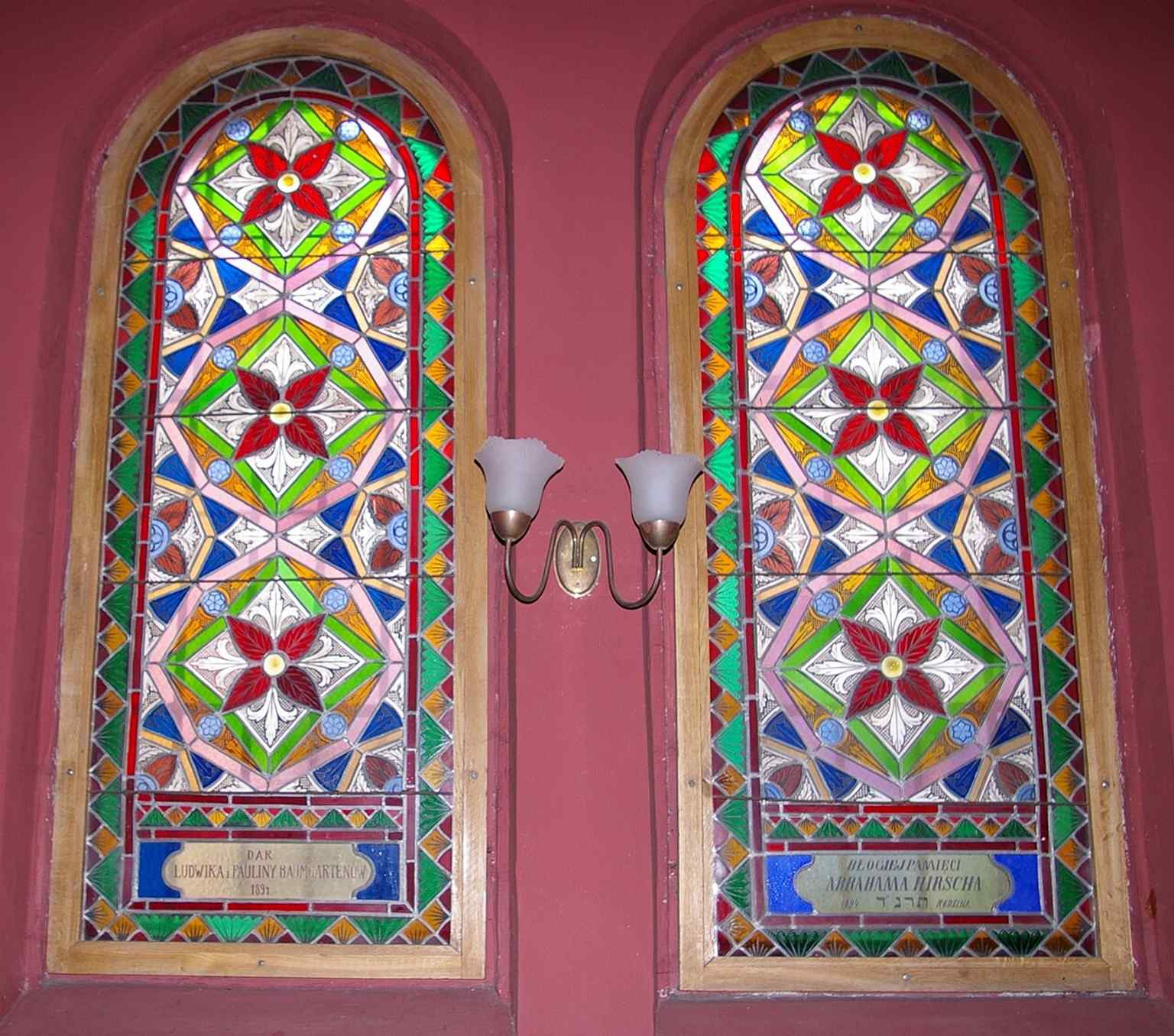
One of Tempel’s colorful stained-glass windows, part of the decorative interior that survived later renovations and restoration.Photo: Jakub Hałun, Wikimedia Commons, CC BY-SA 4.0. Cropped & resized. 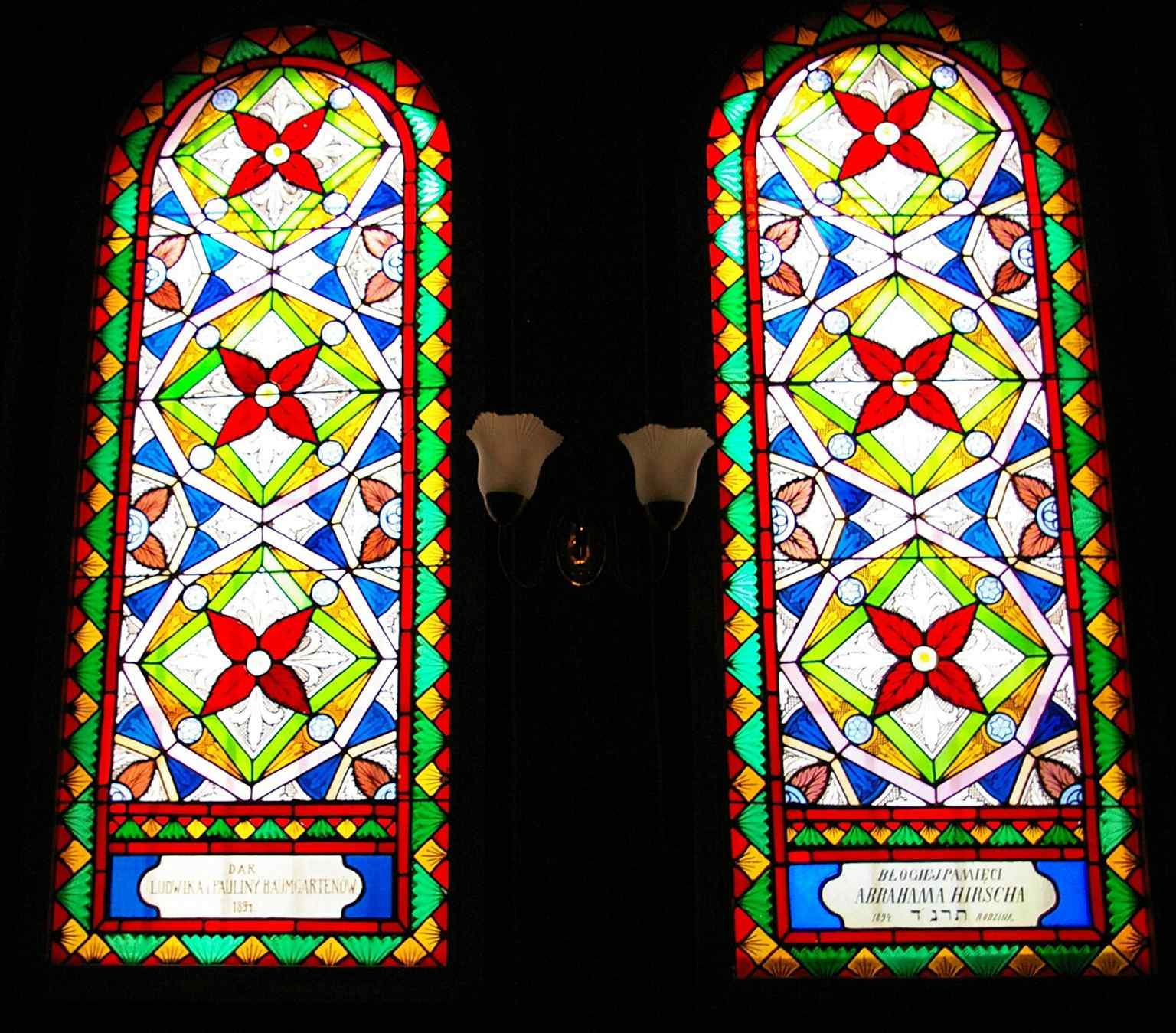
Another stained-glass detail from Tempel, echoing the synagogue’s long tradition of donor patronage and careful restoration.Photo: Jakub Hałun, Wikimedia Commons, CC BY-SA 4.0. Cropped & resized. 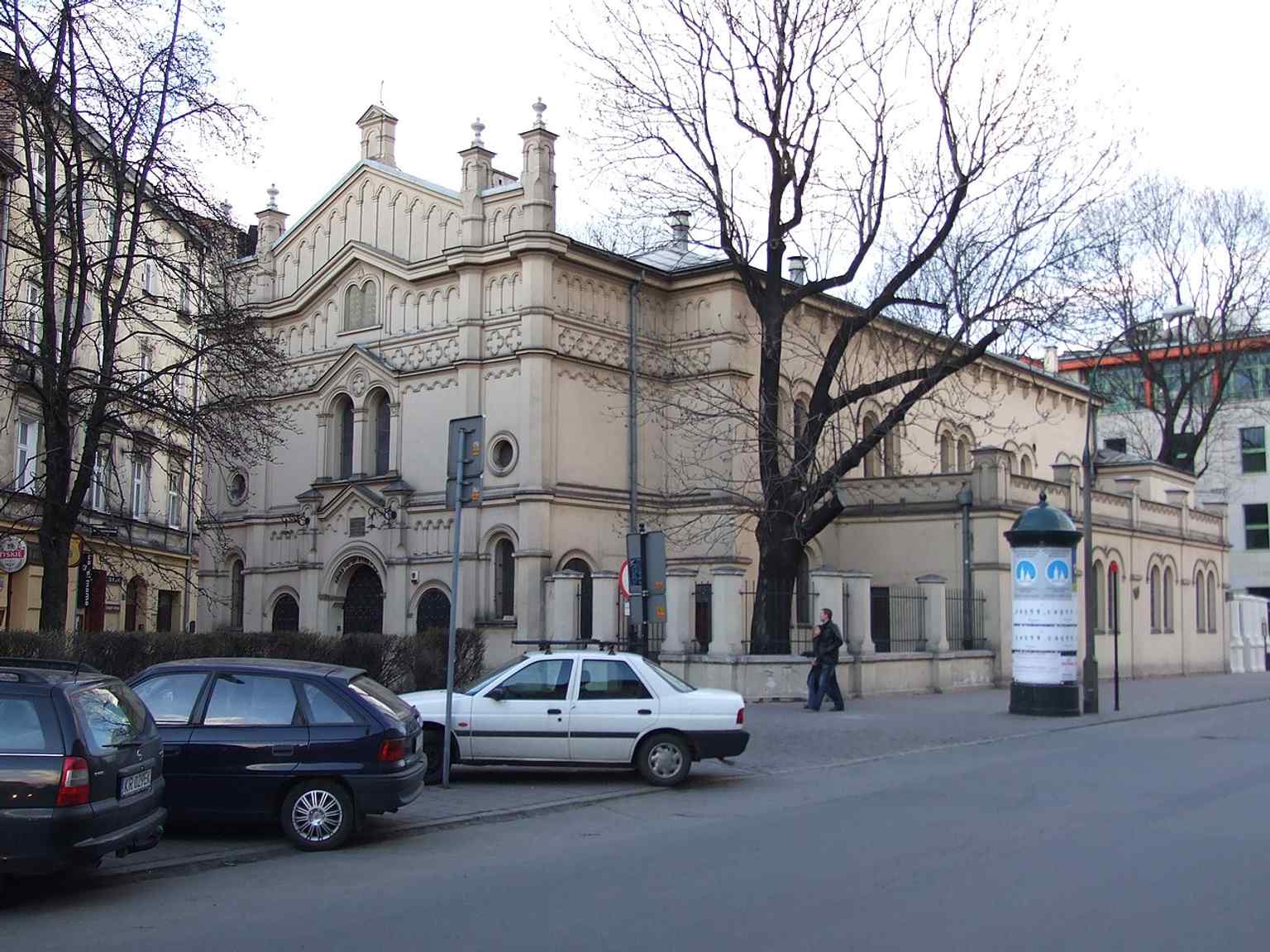
A 2008 view of Tempel Synagogue in Kazimierz, useful as a modern historical record of the building’s exterior after restoration.Photo: I would appreciate being notified if you use my work outside Wikimedia. More of my work can be found in my personal gallery., Wikimedia Commons, CC BY-SA 3.0. Cropped & resized. 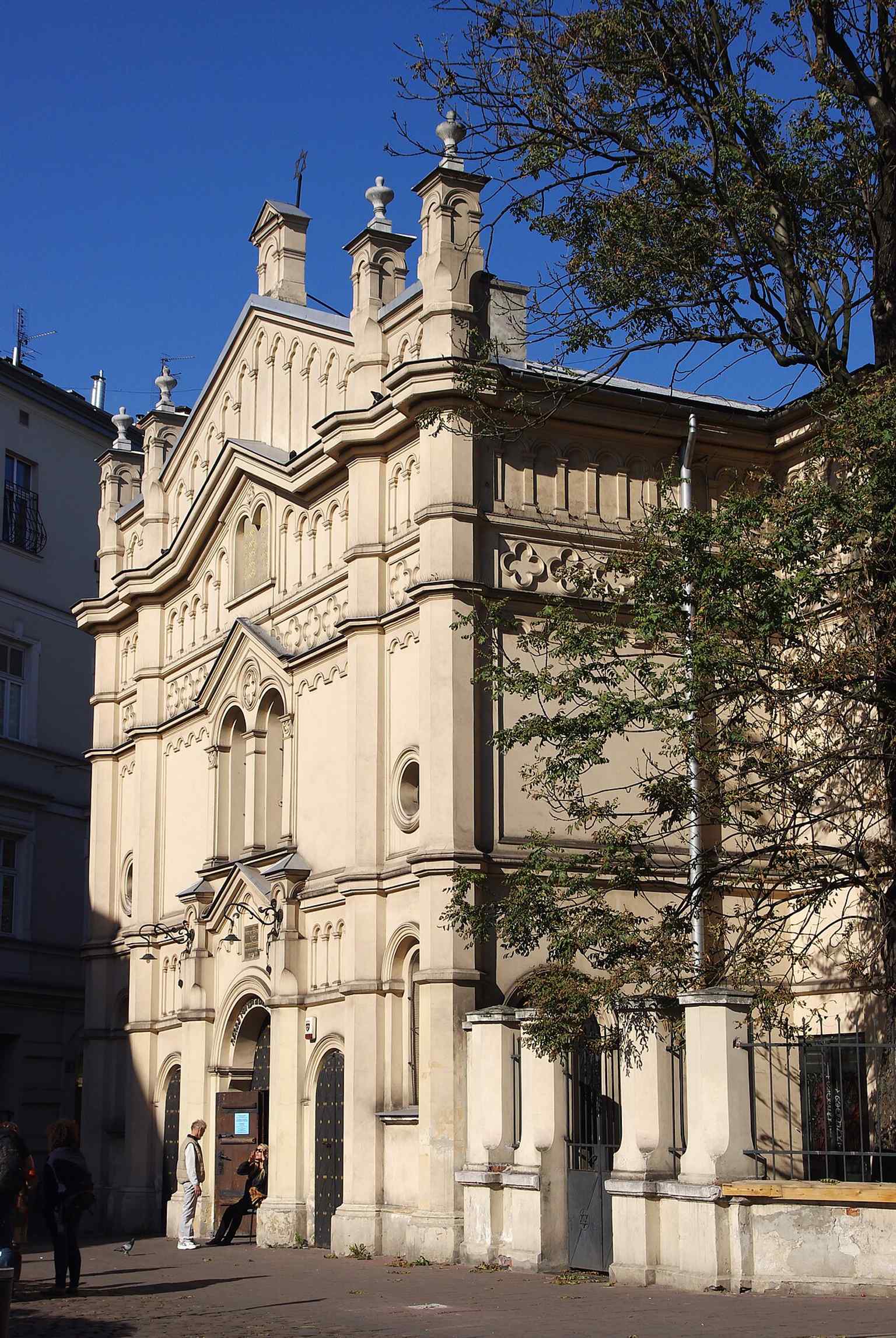
A 2012 exterior view documenting Tempel after renovation, when the synagogue had already resumed its role as a cultural landmark.Photo: Jakub Hałun, Wikimedia Commons, CC BY-SA 3.0. Cropped & resized. 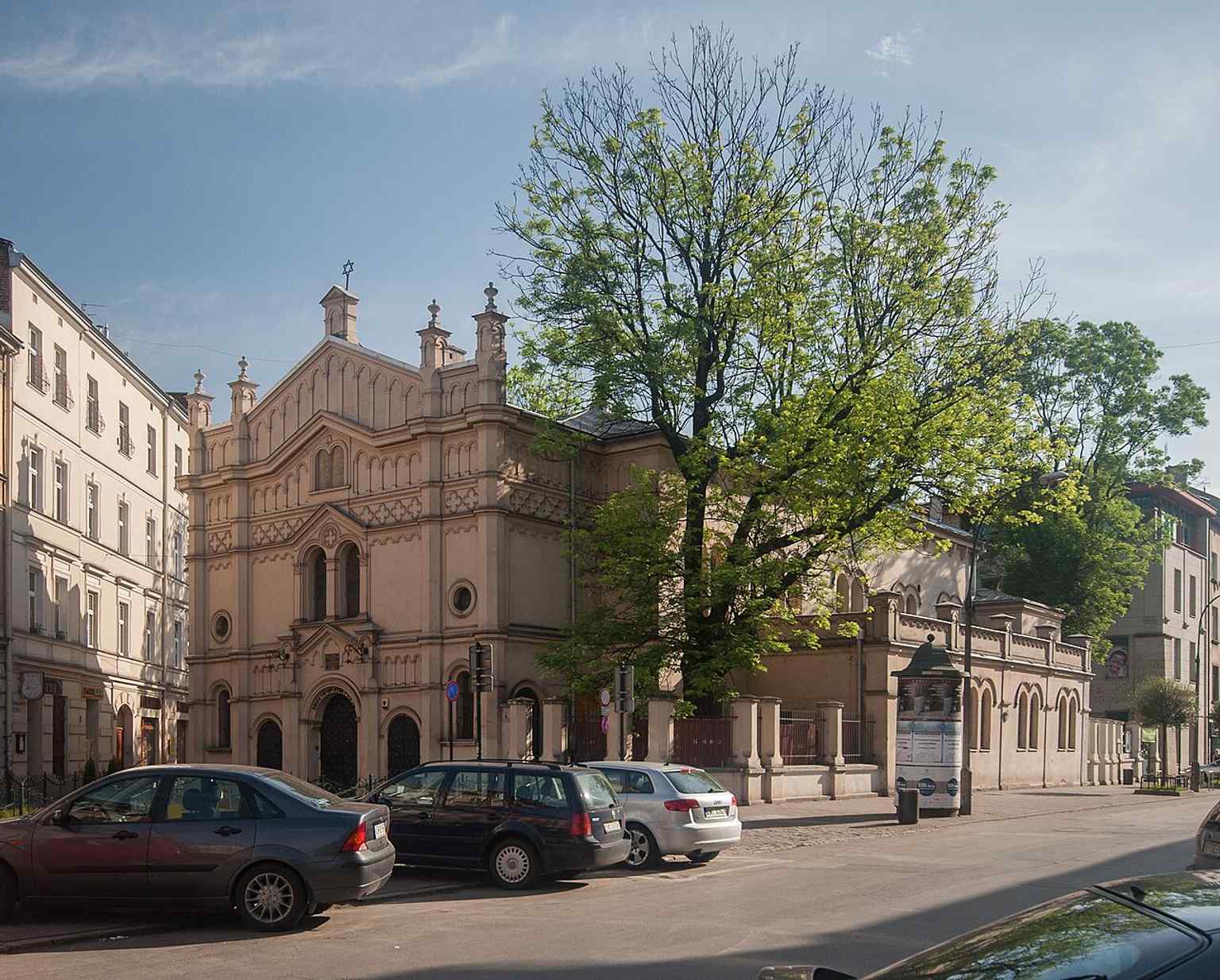
This 2014 image records the facade and its 19th-century form, recalling the original 1860–1862 construction and later reconstructions.Photo: Daniel.zolopa, Wikimedia Commons, CC BY-SA 3.0 pl. Cropped & resized. 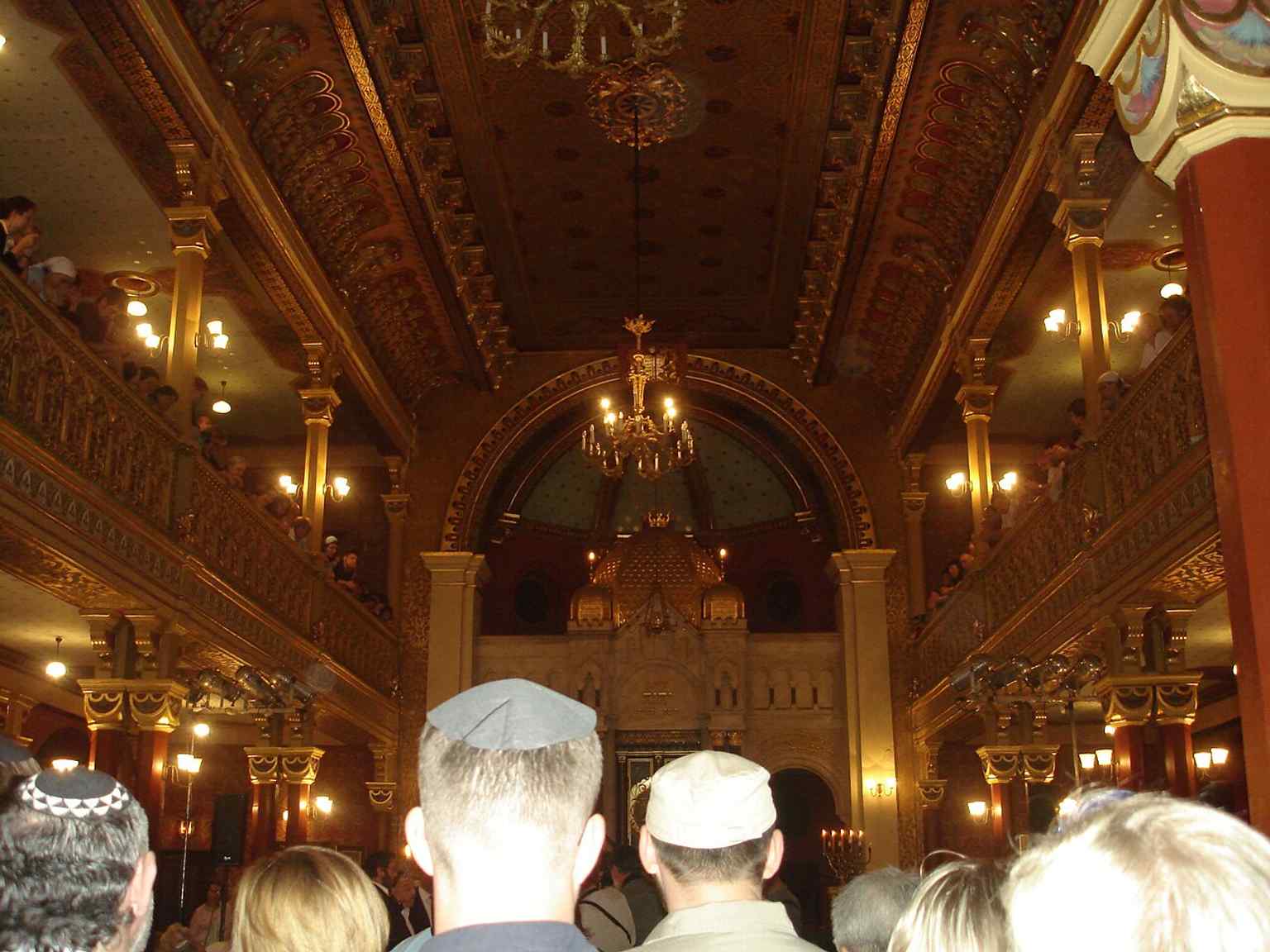
A lively service inside Tempel, showing the synagogue’s continued use for religious life and community gatherings in the postwar era.Photo: Rj1979, Wikimedia Commons, Public domain. Cropped & resized. 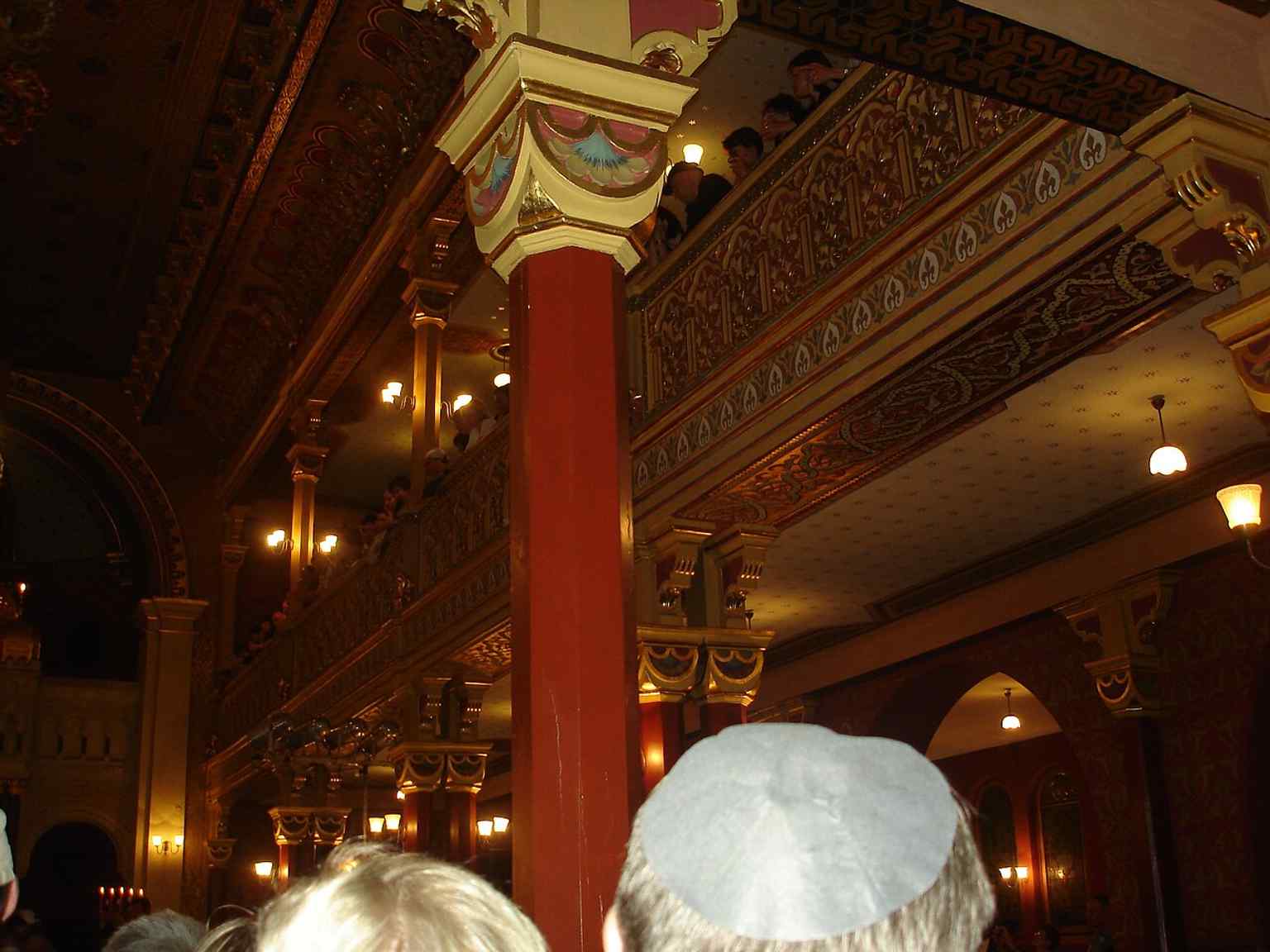
Interior worship in Tempel, a reminder that the building was returned to prayer after wartime desecration and later restoration.Photo: Rj1979, Wikimedia Commons, Public domain. Cropped & resized. On your right, look for a pale plastered rectangular building tucked behind a high wall, marked by arched upper windows and a surviving nineteenth-century gate. From where you…Read moreShow less
Open dedicated page →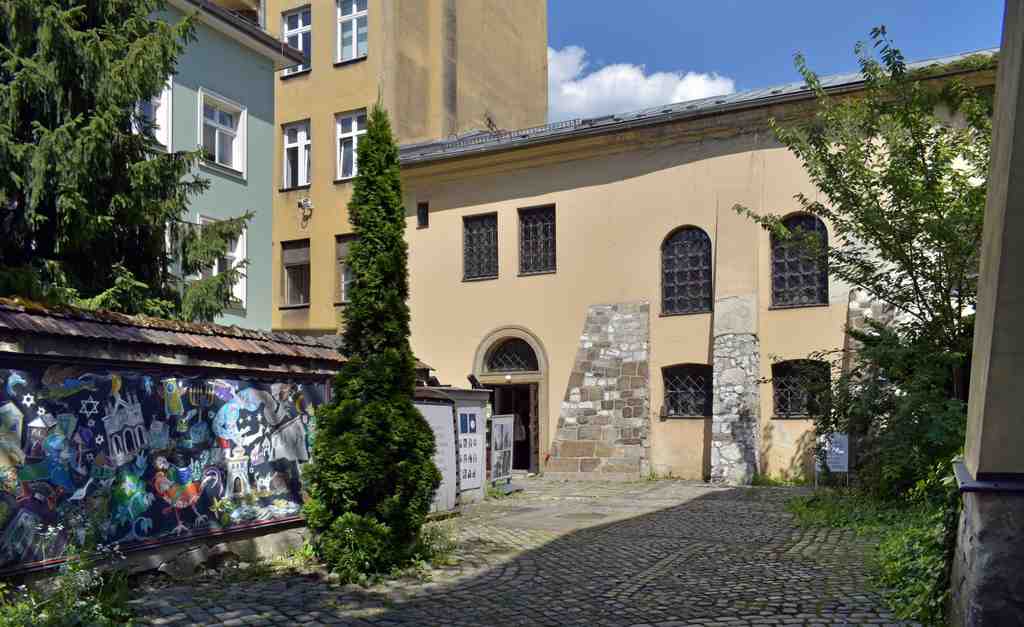
Wolf Popper SynagoguePhoto: Zygmunt Put, Wikimedia Commons, CC BY-SA 4.0. Cropped & resized. On your right, look for a pale plastered rectangular building tucked behind a high wall, marked by arched upper windows and a surviving nineteenth-century gate.
From where you stand, the former Wolf Popper Synagogue feels almost secretive, and that is part of its story. Most people notice only the modest exterior. Locals know the concealment begins earlier, at the street itself: a high-walled courtyard and three nineteenth-century gates screen the synagogue from Szeroka, with the central gate made wider than the others, as if the building wanted one careful breath of ceremony before revealing itself. If you glance at your screen, image two shows that threshold rather nicely. Wolf Popper, the wealthy benefactor called “the Stork”, financed this synagogue in sixteen twenty, near the end of his life. People gave him that nickname because, when deep in thought, he could stand on one leg like a stork. Charming folklore, yes, but behind it stood astonishing wealth. Popper traded in cloth and saltpetre, the ingredient used to make gunpowder, and became Kazimierz’s richest banker. His fortune reached two hundred thousand zloty, an enormous sum for the time. His marriage to Cyrla, daughter of the merchant Juda Leib Landau, strengthened the family alliances behind that rise.
And so this tucked-away place was once among the grandest synagogues in Kazimierz. The entrance had openwork doors showing four animals: an eagle, a leopard, a lion, and a buck deer, each symbolising a virtue of a devout life. Inside stood porches, annexes, rich furnishings, and the Aron Kodesh, the holy cabinet for Torah scrolls, all of it lavishly adorned. If you want a sense of the hall’s later afterlife, image six offers a quiet glimpse indoors. Then the story darkened with almost indecent speed. Cyrla died in sixteen twenty-one. In sixteen twenty-five, Popper returned from a journey, fell ill, summoned a local official, and dictated his will. After his death, the family fortune faltered under wars, epidemics, fires, and heavy payments of allegiance. A succession battle followed, and by about sixteen fifty-three the synagogue had passed into communal hands, already appearing in tax records before anyone thought of it as heritage.
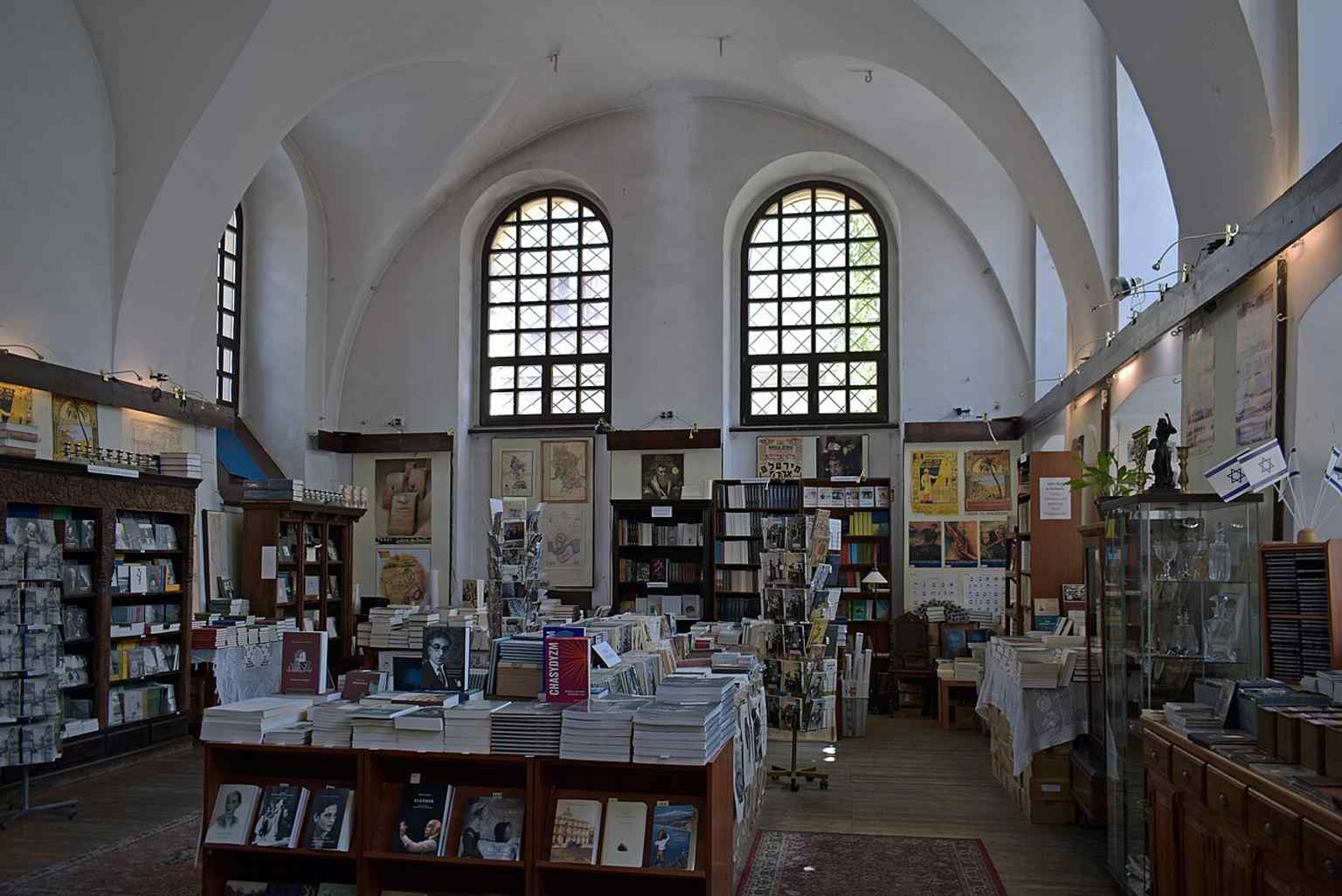
The interior of the former prayer hall, where traces of its synagogue past survive despite later reuse.Photo: Zygmunt Put, Wikimedia Commons, CC BY-SA 4.0. Cropped & resized. The building kept losing and changing. Repairs came in eighteen thirteen. In eighteen twenty-seven, builders added the women’s gallery upstairs and rebuilt the roof and stairs. The Nazis later destroyed the rich interior. In nineteen sixty-four, Józef Steiglitz rescued the surviving ark doors and sent them to the Wolfson Museum in Jerusalem. After the war, repatriates lived here for a time; later it became a youth cultural centre, and since twenty seventeen it has housed the Austeria bookshop, with art upstairs where the women once prayed.
So the shell remains, while much of its splendour survives only in records, in museum pieces, and in a name. In two minutes, we continue to Dajwór Street, where the district turns outward again. If you plan to return, the building generally opens daily from ten in the morning until six in the evening, staying open until seven on Friday and Saturday.
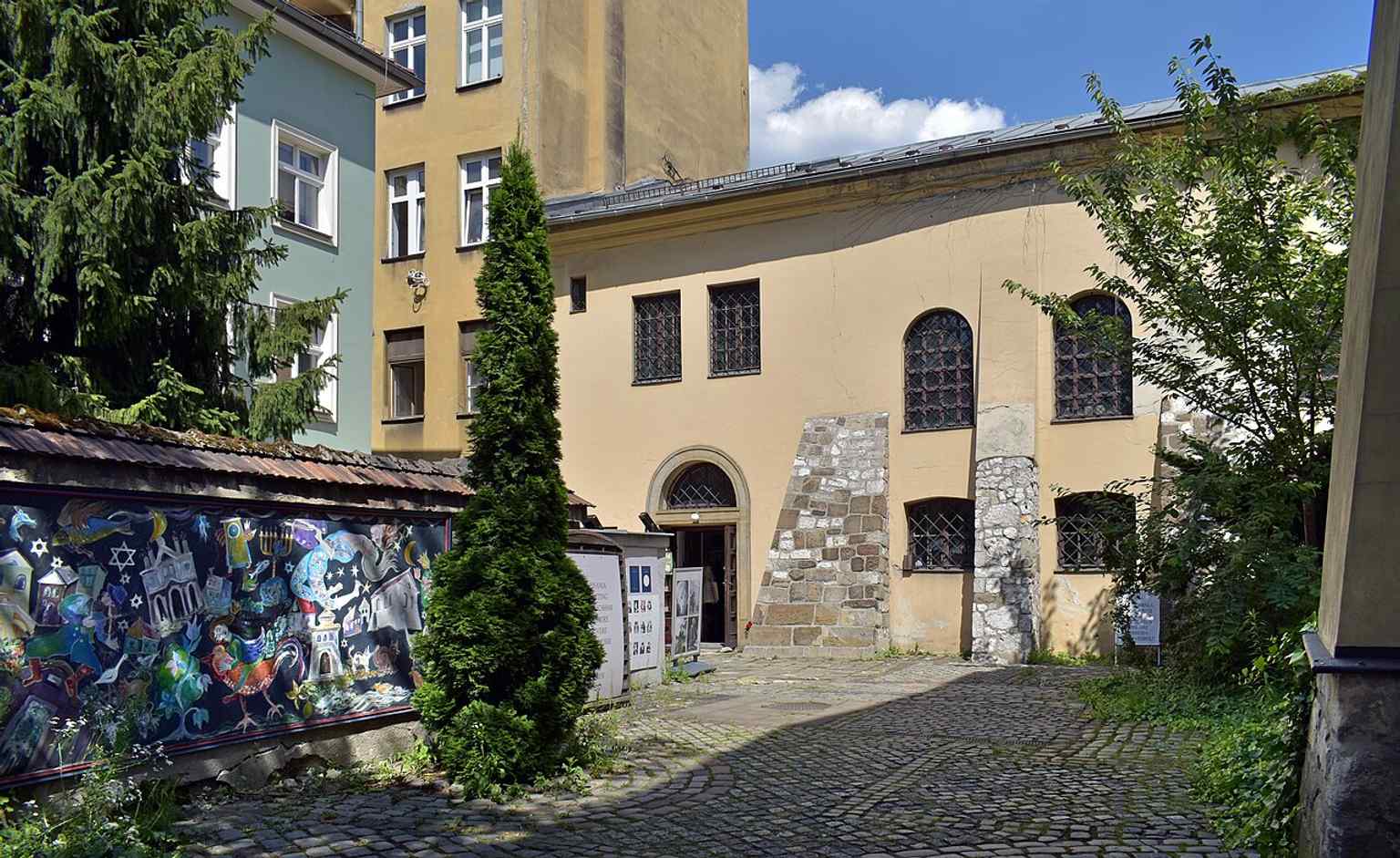
The main exterior of the former synagogue at 16 Szeroka Street, now part of Kazimierz’s busy cultural landscape.Photo: Zygmunt Put, Wikimedia Commons, CC BY-SA 4.0. Cropped & resized. 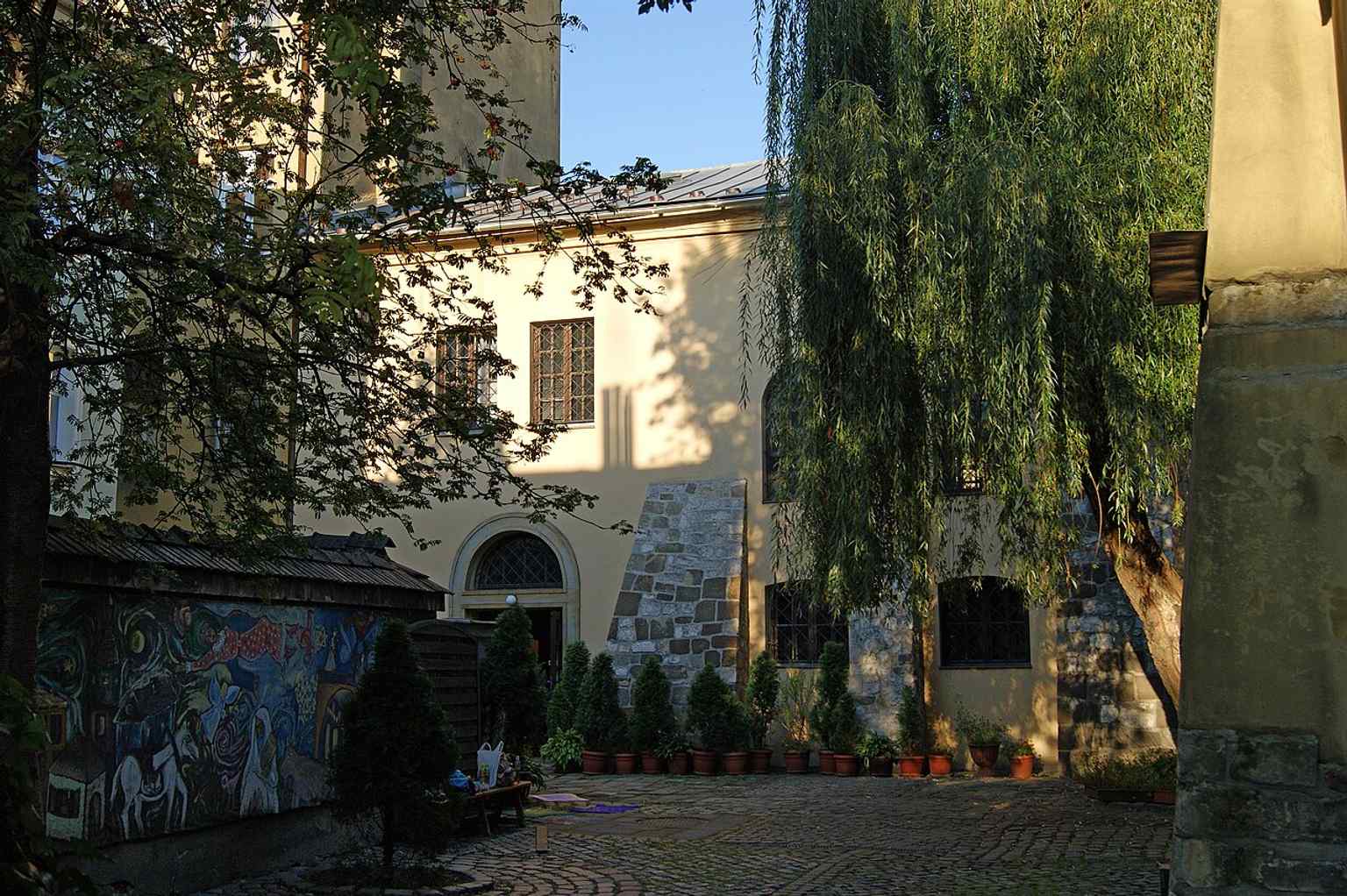
A wide exterior view of the historic building, useful for showing its scale and setting in Kazimierz.Photo: Zygmunt Put Zetpe0202, Wikimedia Commons, CC BY-SA 4.0. Cropped & resized. 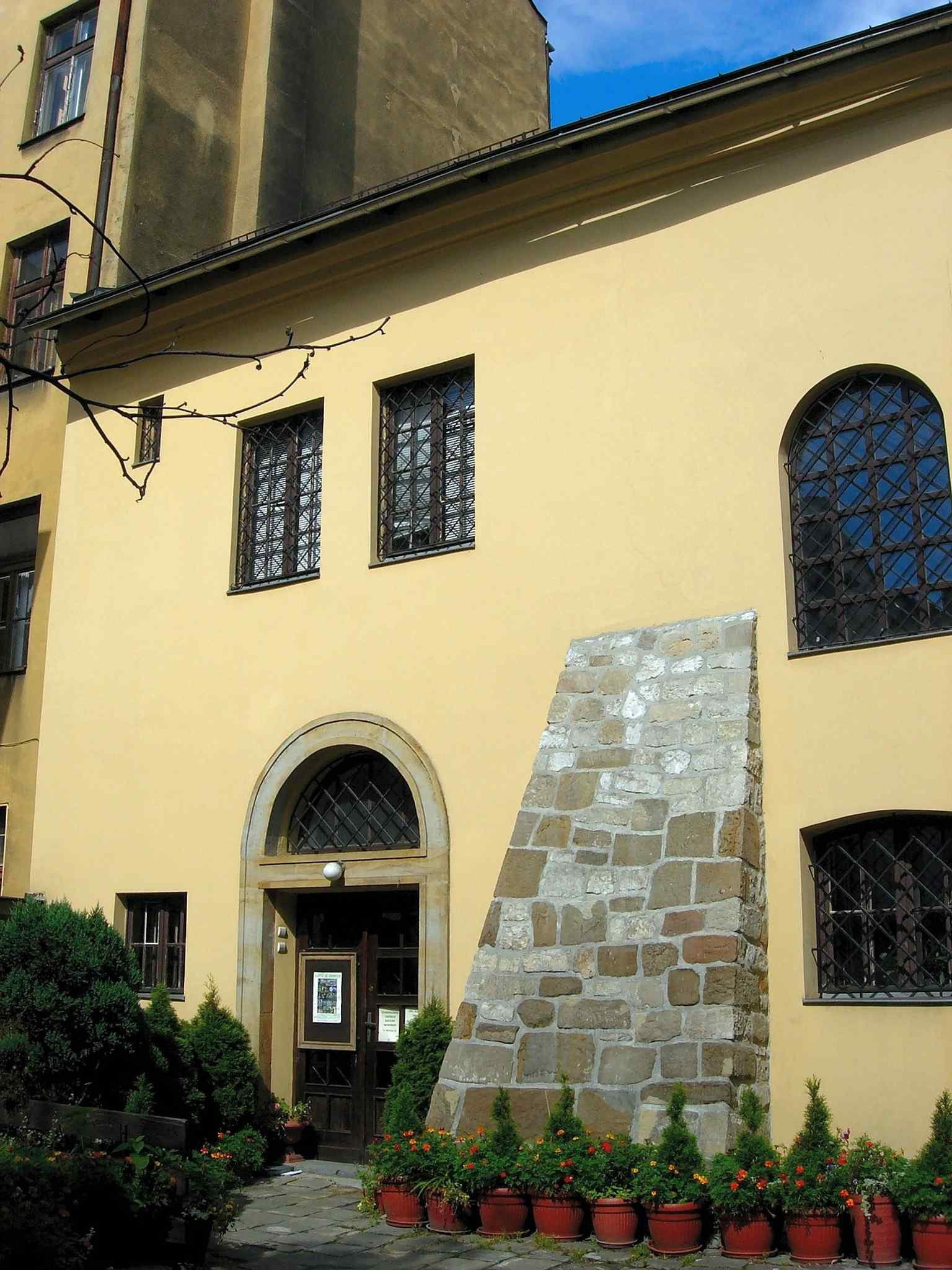
An earlier view of the Popper Synagogue facade, documenting the building before its more recent presentation as a bookstore and cultural venue.Photo: Jakub Hałun, Wikimedia Commons, CC BY-SA 3.0. Cropped & resized. 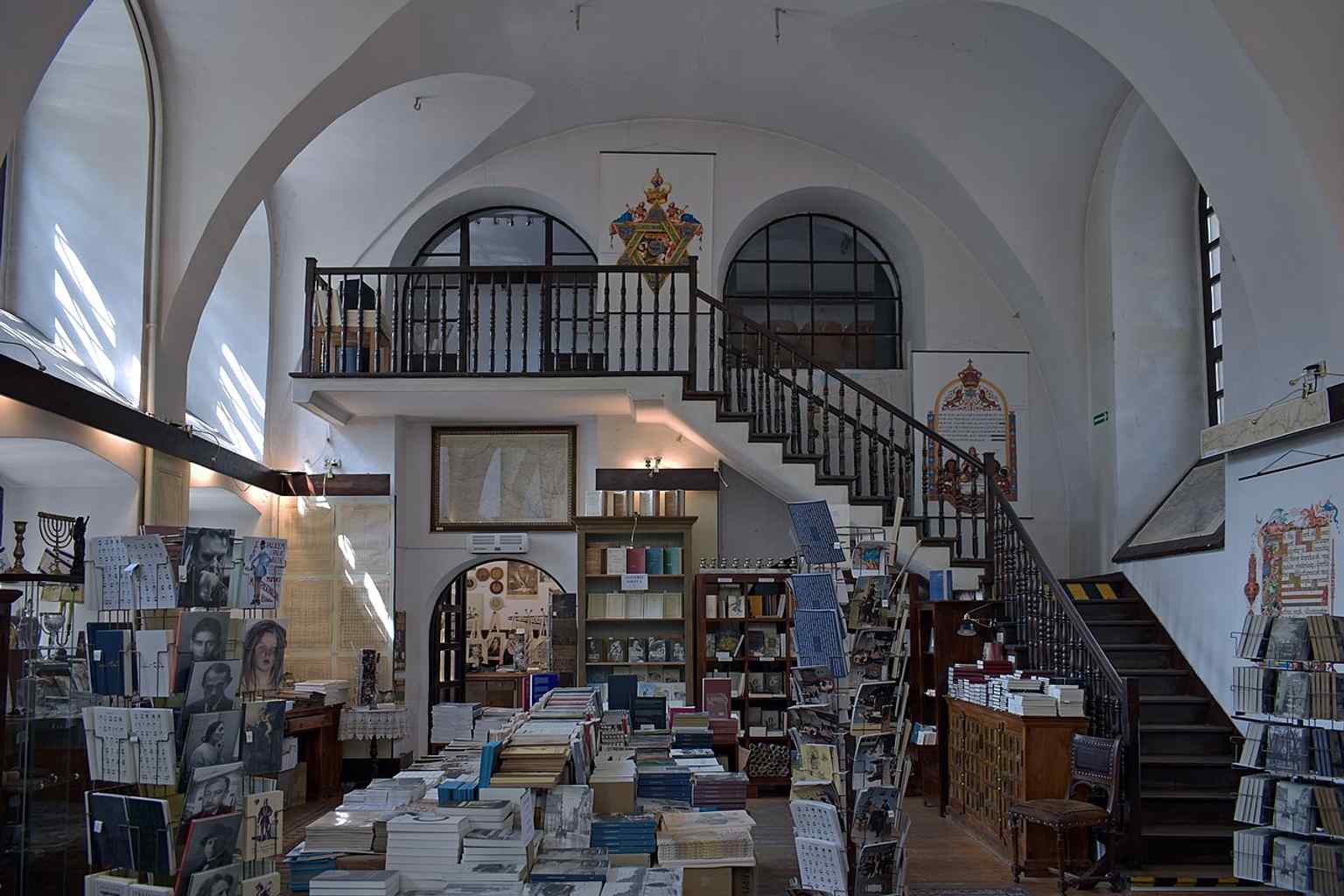
Another interior view, showing the adapted space that once held a richly decorated Jewish house of prayer.Photo: Zygmunt Put, Wikimedia Commons, CC BY-SA 4.0. Cropped & resized. 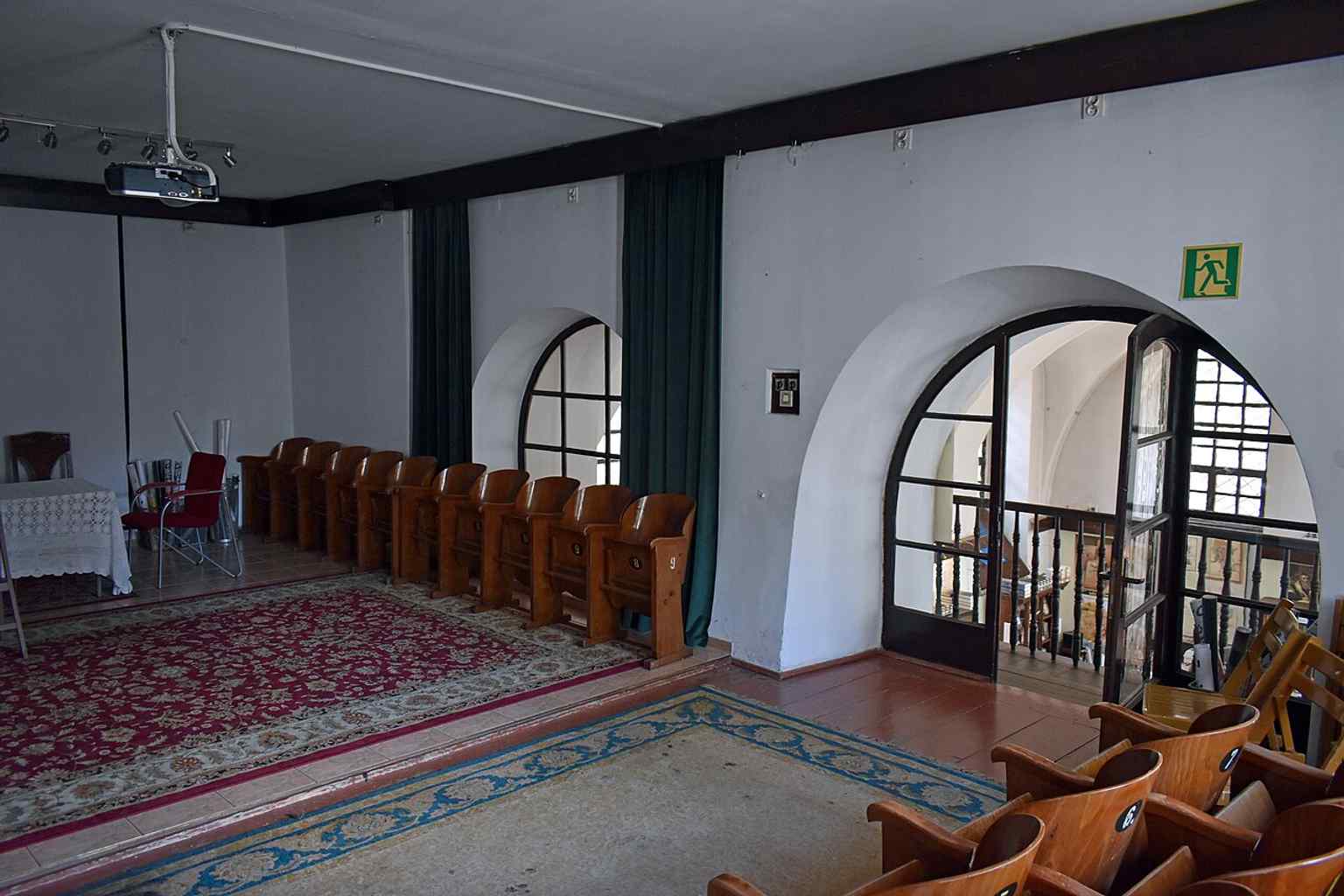
The interior at high resolution, helpful for touring the building’s long afterlife after wartime damage and later renovation.Photo: Zygmunt Put, Wikimedia Commons, CC BY-SA 4.0. Cropped & resized. 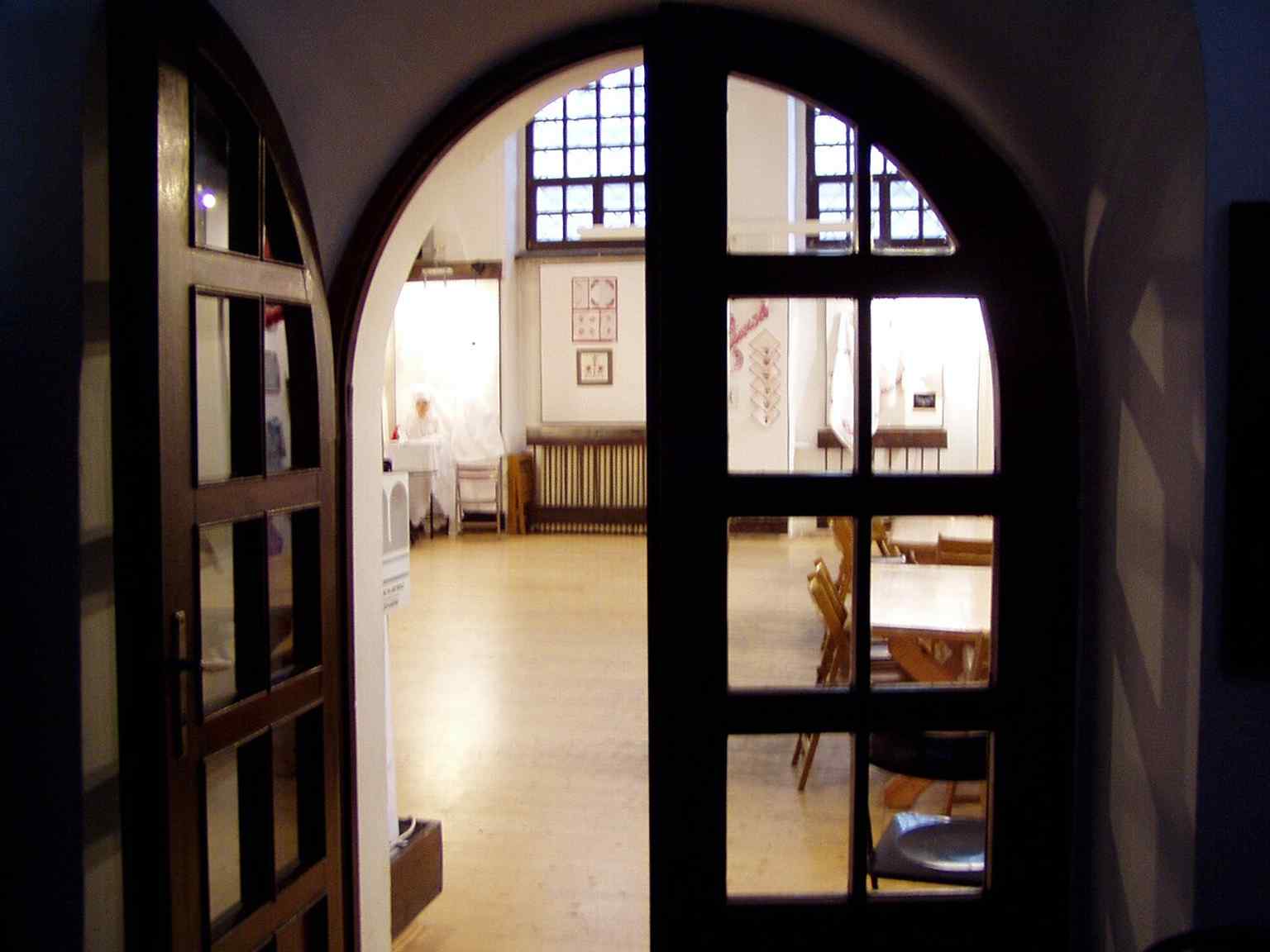
A close view of the surviving arched doorway detail, echoing the ornate entrance once associated with the synagogue.Photo: Birczanin at Polish Wikipedia, Wikimedia Commons, Public domain. Cropped & resized. 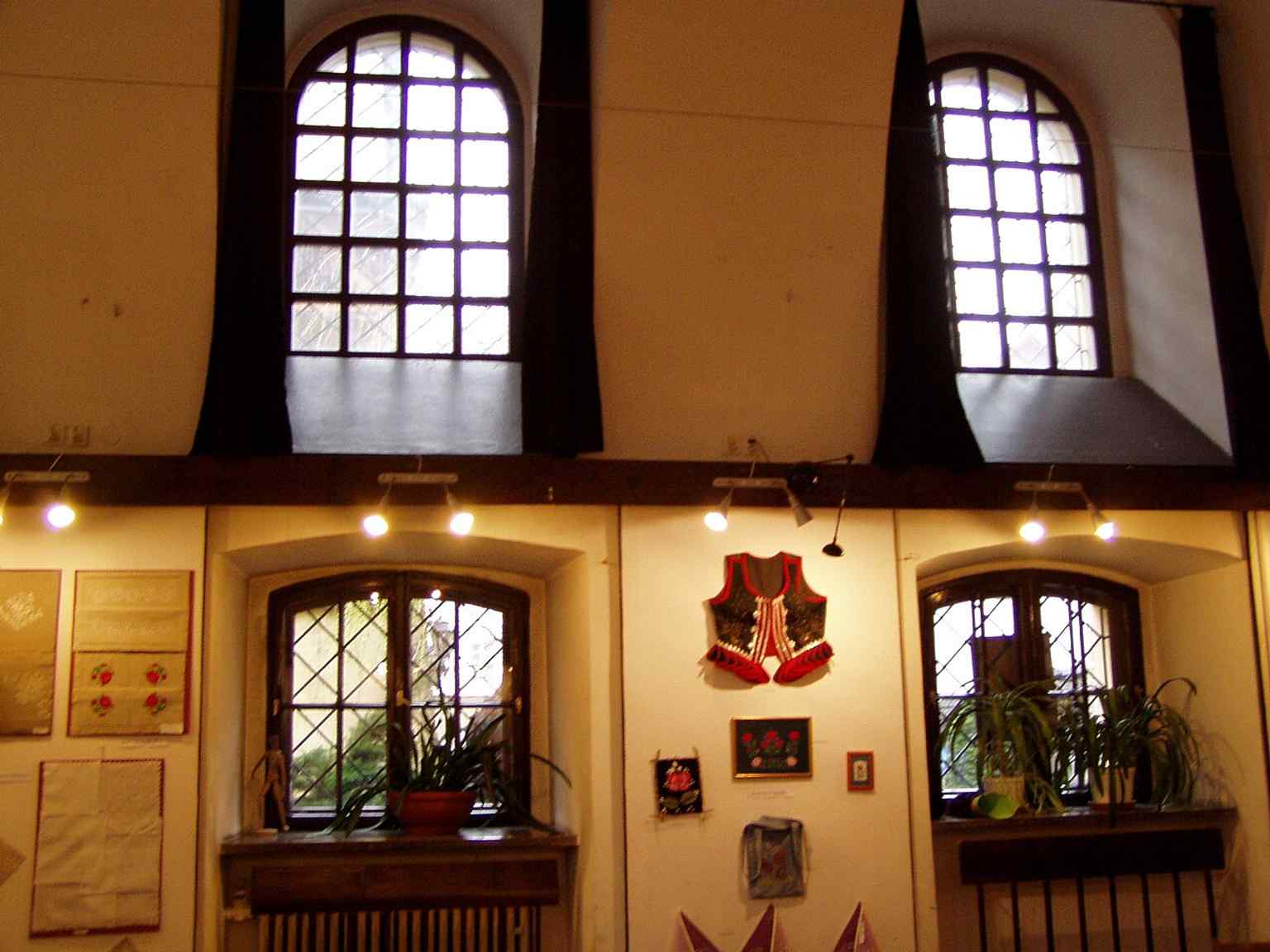
Windows on the building’s upper level, near the former women’s area that was later adapted for other uses.Photo: Birczanin at Polish Wikipedia, Wikimedia Commons, Public domain. Cropped & resized. 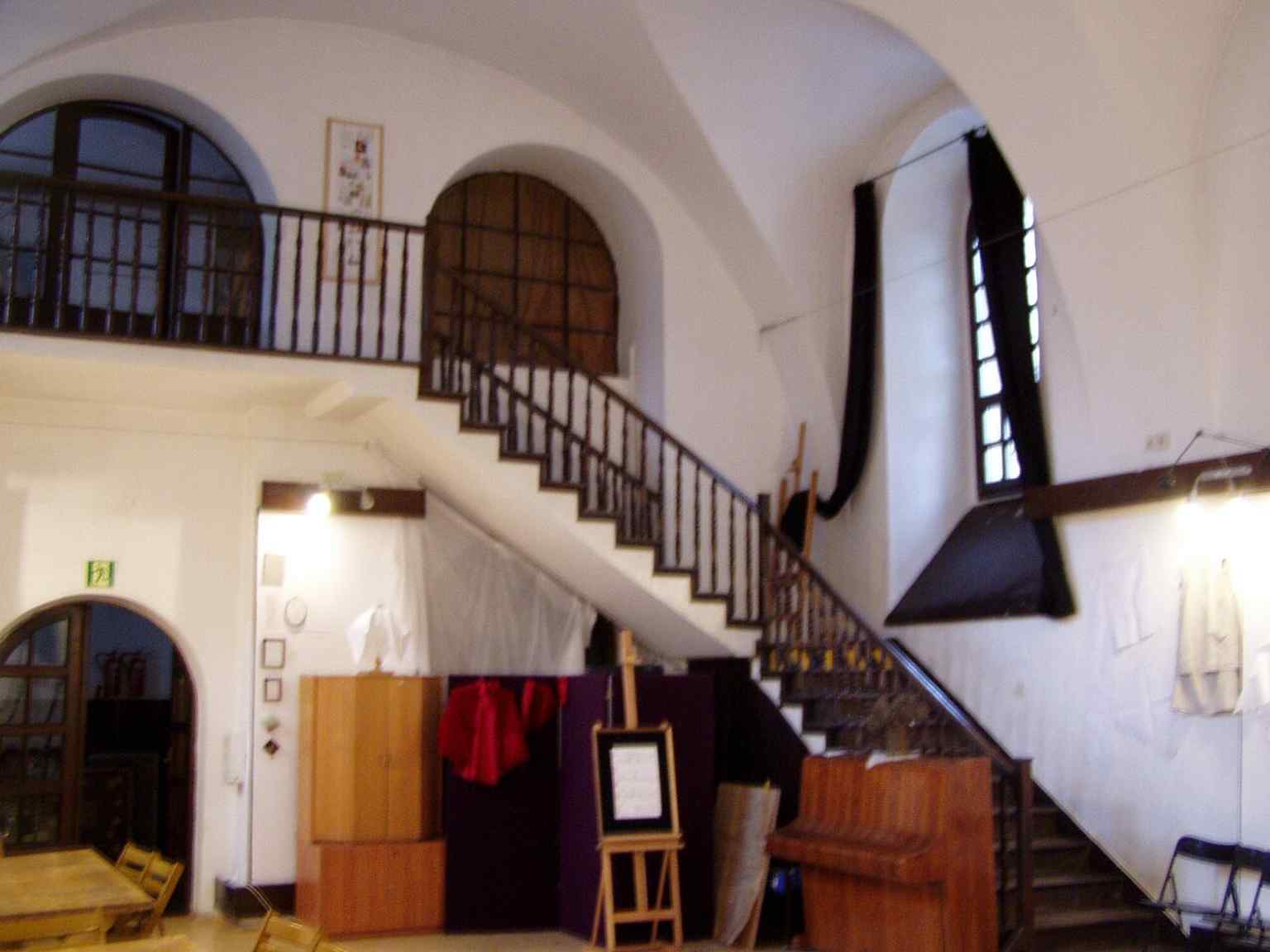
Stairs inside the building, recalling the 1827 alterations that rebuilt the roof and stair access.Photo: Birczanin at Polish Wikipedia, Wikimedia Commons, Public domain. Cropped & resized. 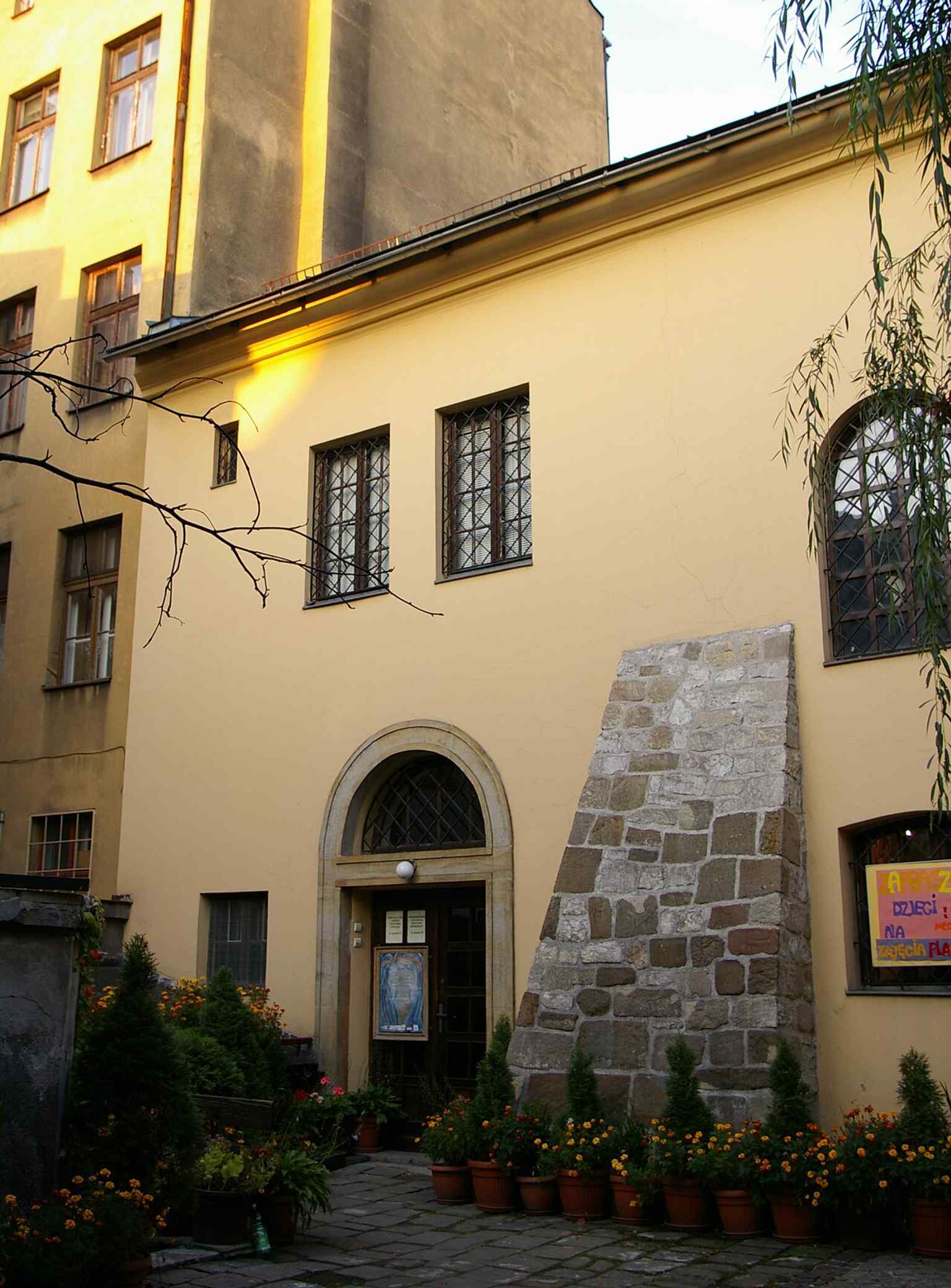
A side-angle exterior that helps show the synagogue’s modest street presence compared with its historical importance.Photo: Jakub Hałun, Wikimedia Commons, CC BY-SA 3.0. Cropped & resized. 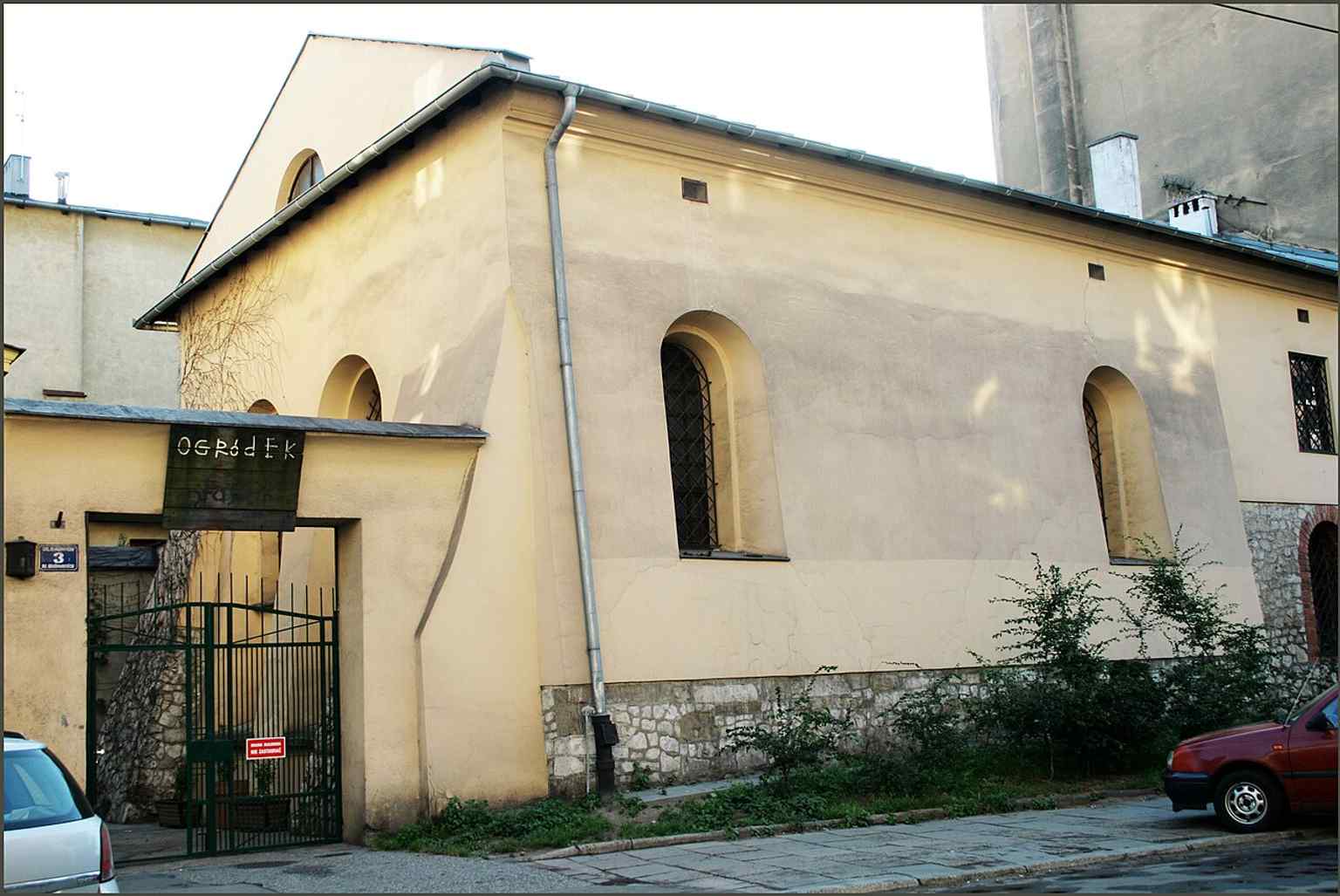
A broader contextual view of the synagogue in Kazimierz, placing the site within Kraków’s historic Jewish quarter.Photo: Laima Gūtmane (simka…, Wikimedia Commons, CC BY-SA 3.0. Cropped & resized. 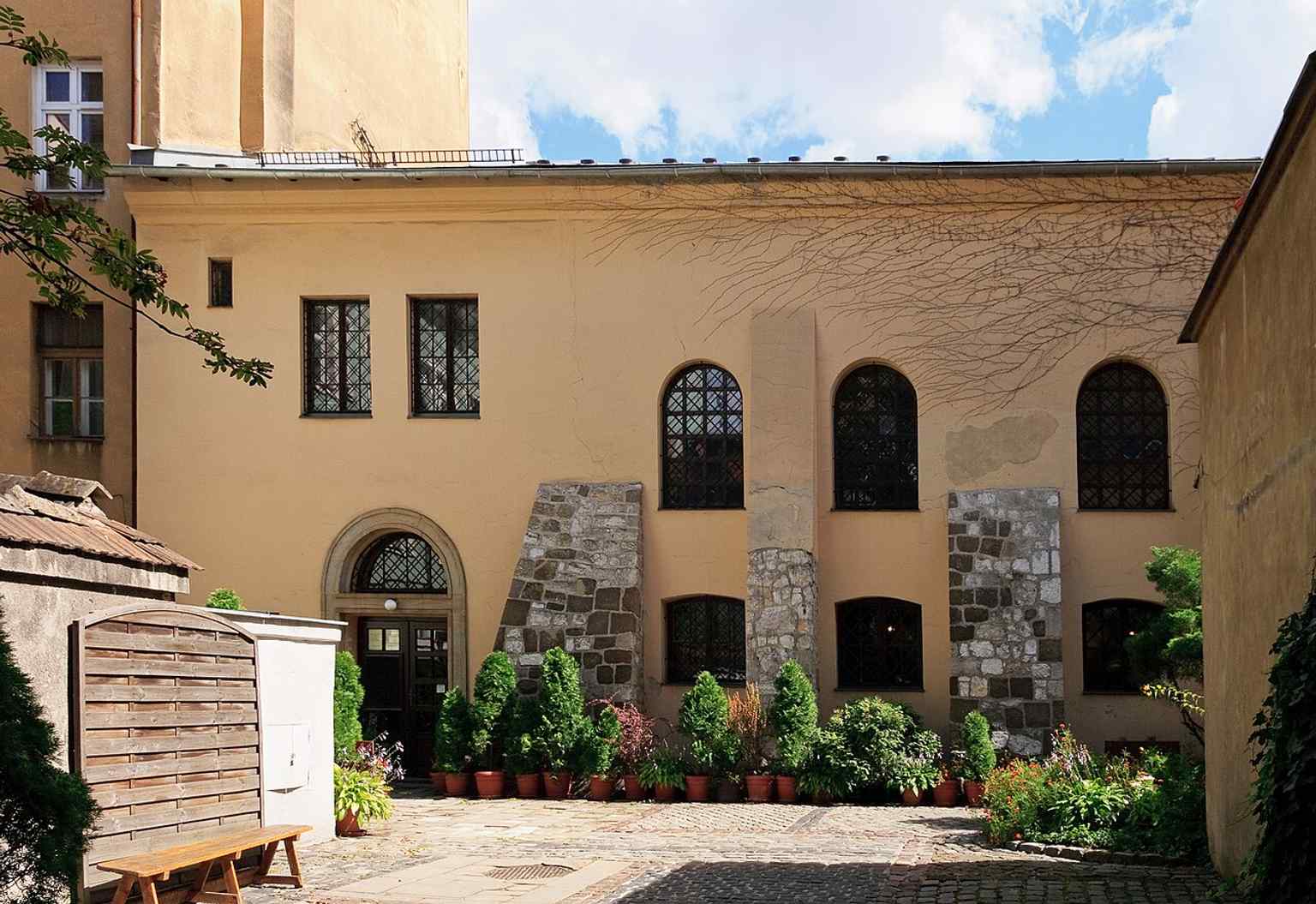
A later exterior photo that captures the restored building in the modern era, after decades of change and reuse.Photo: Ludvig14, Wikimedia Commons, CC BY-SA 4.0. Cropped & resized. Dajwór is a long, straight street lined with plaster-fronted tenements and red-brick industrial buildings, with tram tracks running firmly through its centre. It looks like…Read moreShow less
Open dedicated page →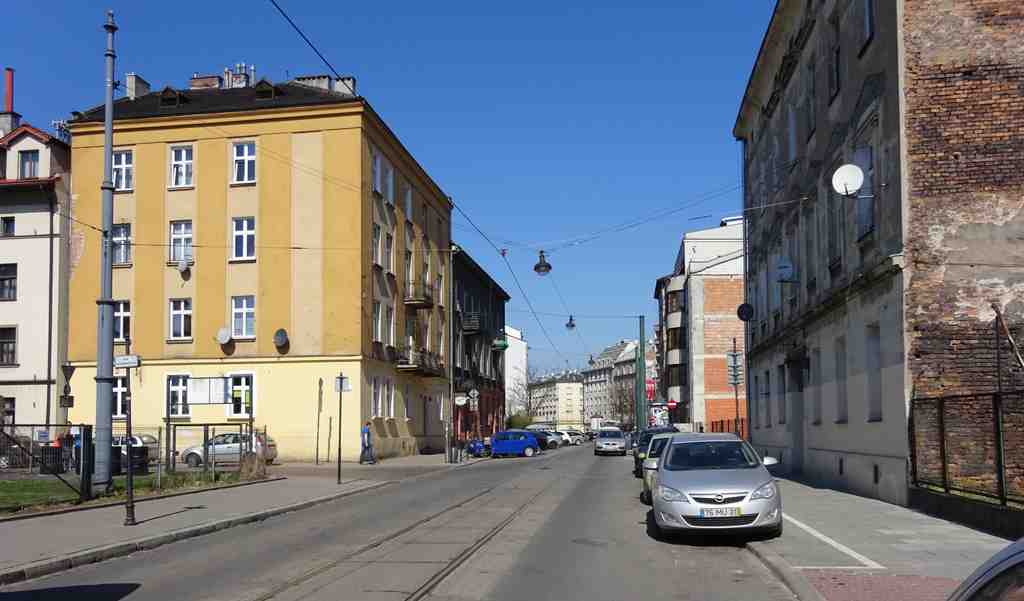
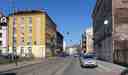
Dajwór Street in KrakowPhoto: Mach240390, Wikimedia Commons, CC BY 4.0. Cropped & resized. Dajwór is a long, straight street lined with plaster-fronted tenements and red-brick industrial buildings, with tram tracks running firmly through its centre.
It looks like ordinary city fabric. That is precisely the point. Streets like this absorb history without announcing it.
In the seventeenth century, this was not yet a proper urban street at all. A road ran here along the eastern walls of Kazimierz, leading to a farm. In sixteen forty, Marcin Dajwór leased that farm, and people began calling the route the Road to Dajwór. Later, in the eighteen forties, planners fixed the street in its present form. Officials tried to rename it Wałowa in the eighteen eighties, but residents kept saying Dajwór until the city finally accepted the popular memory.
At number one, the Popper Synagogue tied this street to Jewish life from sixteen twenty onward. You have already met Wolf Popper. Here, his legacy becomes more difficult. During the Second World War, the synagogue suffered devastation, and the Jewish residents of this street were forced into the ghetto in Podgórze. After the war, builders repaired the synagogue, but they did not restore it faithfully. Between nineteen sixty-five and nineteen sixty-seven, they bricked up the niche for the Aron ha-kodesh. They turned the entrance from Dajwór into a window. They removed the wooden arcades and side annexes. So the building survived, yet part of its old face vanished.
That pattern repeats along the street. In the late nineteenth century, a brickworks here made prized roof tiles. Tram lines arrived. At number twenty-seven, engineers raised a municipal power station in the years from nineteen oh-four to nineteen oh-eight, though Kraków’s gas authority resisted electric power for years. Across the street, a transformer station from nineteen thirty still shows a lightning emblem on its brick wall.
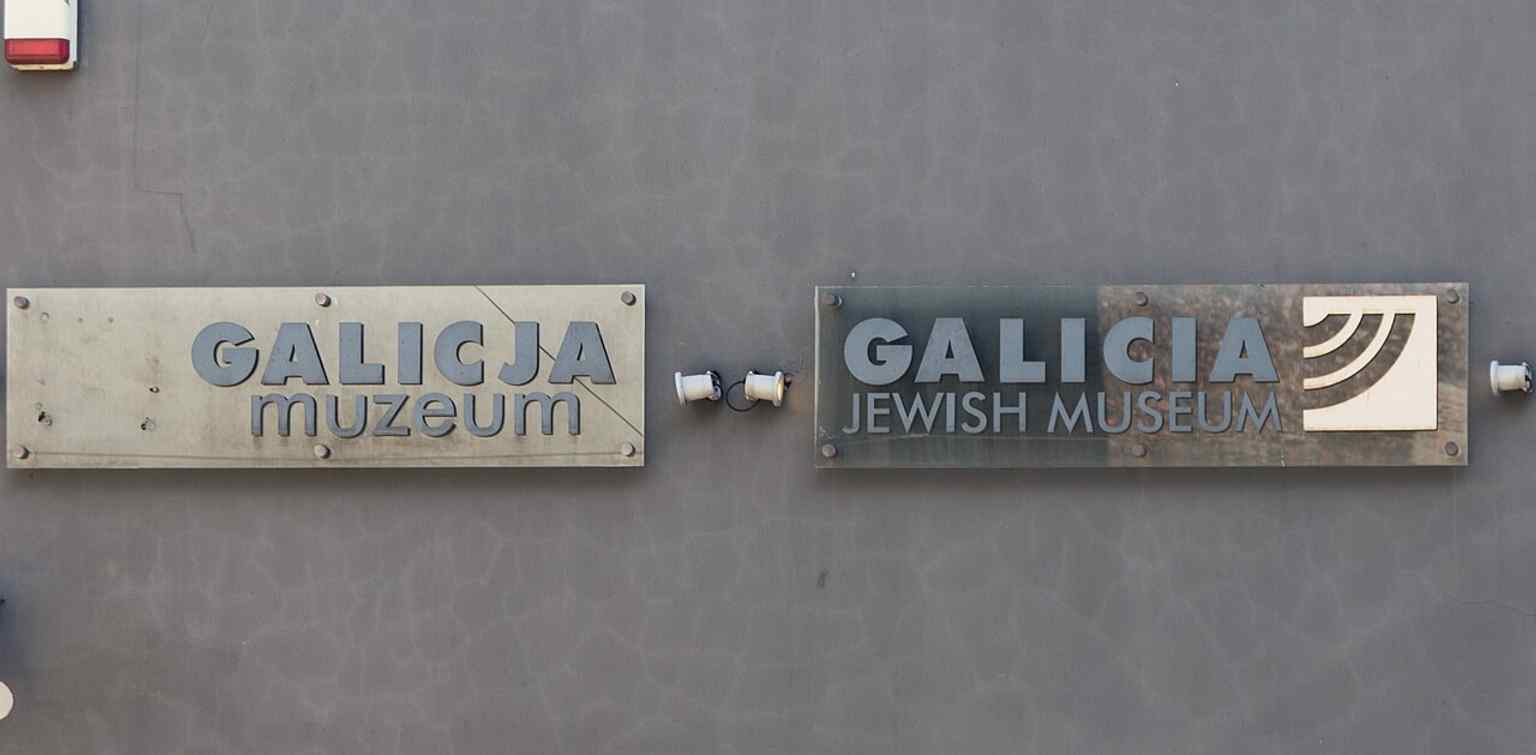
And then, quietly, life returns. At number eighteen, the Galicia Jewish Museum documents what endured, and Tanja Segal leads a musical Shabbat there each Friday.
Dajwór teaches a sober lesson: a calm facade can carry rupture for centuries. We’ll follow that thread next at the Galicia Jewish Museum, just ahead.
On your left, look for a clean modern facade of pale brick and broad glass rectangles, with a recessed entrance marked by the museum’s name. From where you stand, the building…Read moreShow less
Open dedicated page →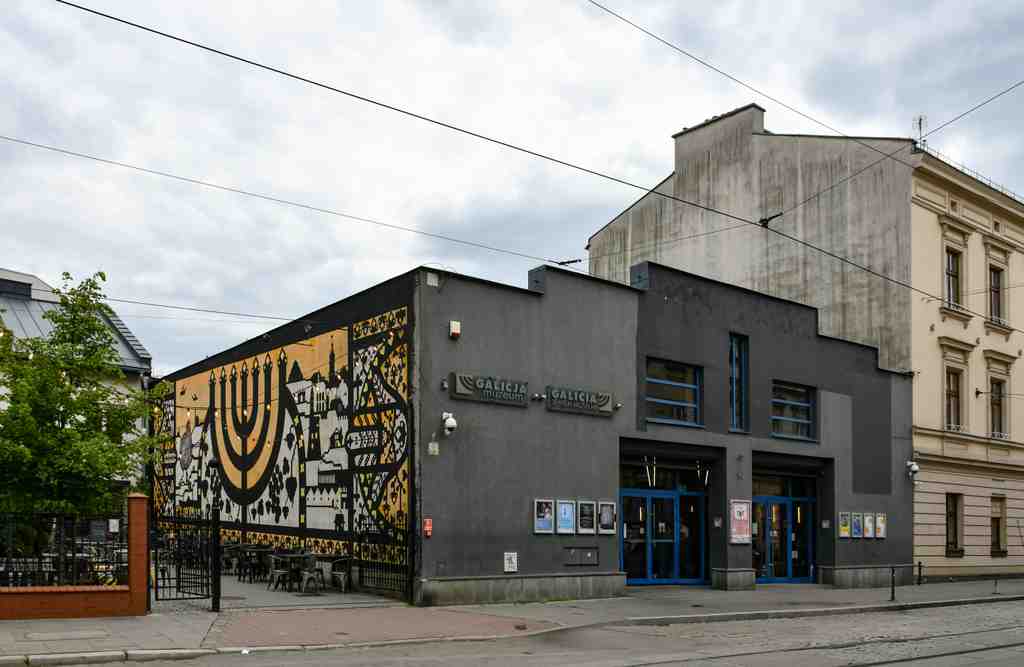
Galicia Jewish MuseumPhoto: Lesnydzban, Wikimedia Commons, CC BY-SA 4.0. Cropped & resized. On your left, look for a clean modern facade of pale brick and broad glass rectangles, with a recessed entrance marked by the museum’s name.
From where you stand, the building looks restrained, almost careful. That is quite fitting, because this museum does not try to replace what was lost. It tries to make loss readable.
The Galicia Jewish Museum opened here on Dajwór Street in April, two thousand and four. A British photojournalist, Chris Schwarz, created it with Professor Jonathan Webber, working with UNESCO, the United Nations Educational, Scientific and Cultural Organization. Schwarz’s connection was personal: his father came from Lwów, and Schwarz did not approach Galicia as a neat historical subject. He approached it as unfinished family terrain. Webber later recalled that Schwarz had already turned his own house in Britain into a cultural salon, with concerts, films, lectures, and workshops. Then he sold that house and moved to Poland to help finance this place. There is something rather bracing about that. Not a committee first, not a grand state plan. One man deciding memory required bricks, salaries, and a front door.
His great project here was Traces of Memory, a twelve-year collaboration with Webber. Schwarz travelled through roughly one hundred and fifty towns and villages, taking about one thousand photographs of synagogues, cemeteries, ruined prayer houses, massacre sites, and surviving fragments of Jewish life across Galicia. He waited for the right light. He crossed deep snow in Birkenau. He worked with the stubborn patience of a field naturalist, except what he was tracking was human presence after catastrophe. The exhibition does not simply say, “Here is what once existed.” It asks five harder questions: how Jewish life survives in ruins, what culture once looked like, how the Holocaust marked the landscape, how people remember, and who is making memory now.
If you glance at the image in the app, the interior galleries are spare and photographic, almost disciplined, so the evidence can do the talking. Another image shows a klezmer concert here, which reminds you this is not only a place of mourning but a working cultural house.
That mattered even more after Schwarz died in two thousand and seven, aged fifty-nine. Rabbi Michael Schudrich said he had constantly fought for funding, because an independent institution like this still felt unusual in Poland. Kate Craddy, who became director after him, said Schwarz had put procedures in place so the museum could continue. That sounds mundane, but it is not. Filing systems, budgets, bilingual programming in Polish and English, school workshops, survivor meetings, lectures, concerts: these are the quiet mechanics that keep memory from collapsing into sentiment.
And the museum kept adjusting. By two thousand and twelve, it recognised that the landscape Schwarz documented had changed. Some synagogues had been restored, new memorials had appeared, and Jewish life had begun to show itself again. So the museum updated its core work rather than pretending the story had frozen.
That, perhaps, is the real lesson here. Heritage does not preserve itself. Someone frames it, someone pays for it, someone argues over it, and someone keeps it legible for the next person who arrives. In about three minutes, we’ll continue to the Old Synagogue, where that question of survival takes on stone and weight. If you plan to come back inside, the museum is open every day from ten in the morning until six in the evening.
The museum’s contemporary street-facing entrance in Kazimierz, where the Galicia Jewish Museum welcomes visitors from around the world.Photo: Pymouss, Wikimedia Commons, CC BY-SA 4.0. Cropped & resized. 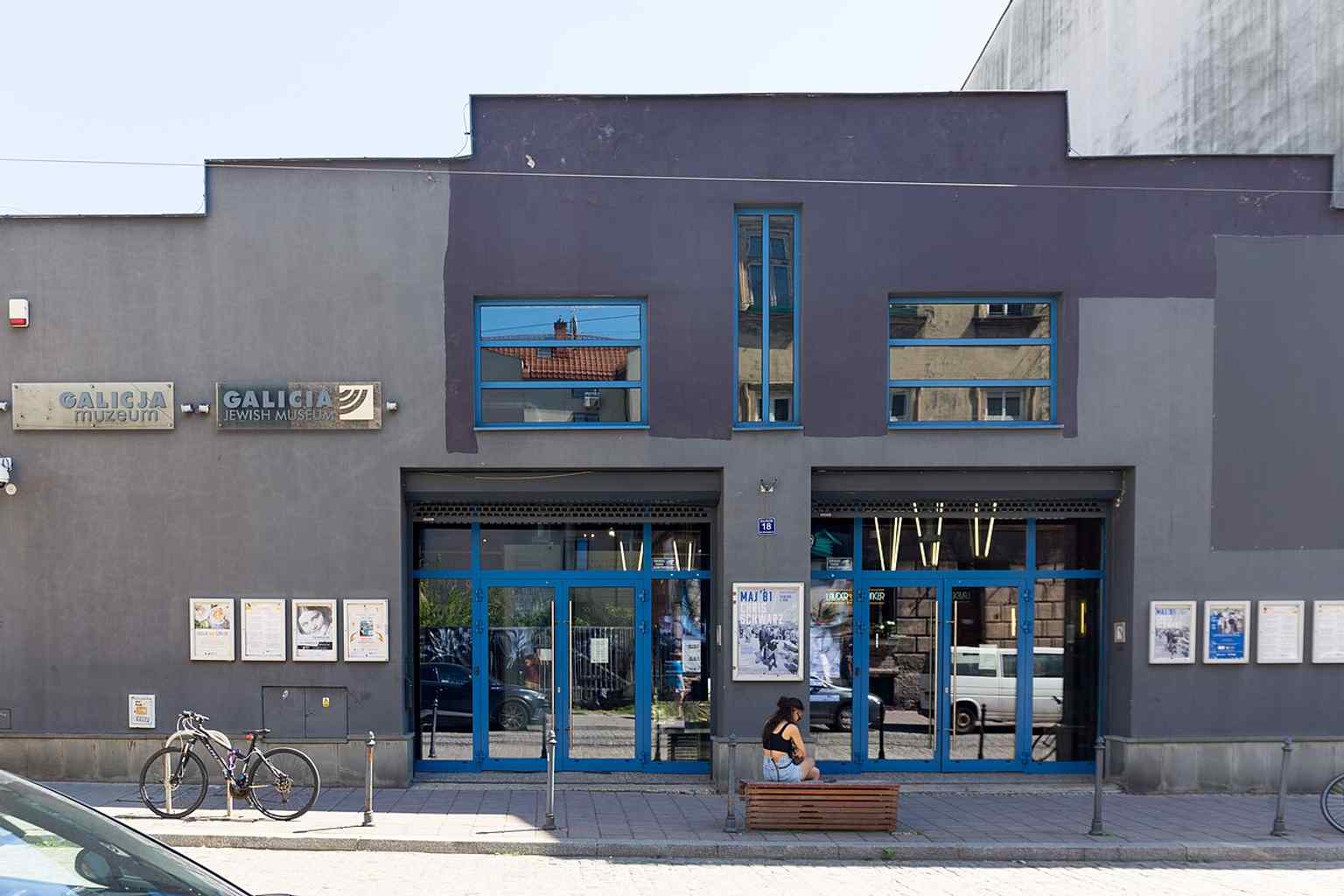
A wider view of the Galicia Jewish Museum on Dajwór Street, the Kraków base for exhibitions on Jewish life in Polish Galicia.Photo: Pymouss, Wikimedia Commons, CC BY-SA 4.0. Cropped & resized. In front of you stands a low, heavy synagogue of pale masonry, almost fortress-like in shape, with a stepped gable and windows set strikingly high above the ground. This is the…Read moreShow less
Open dedicated page →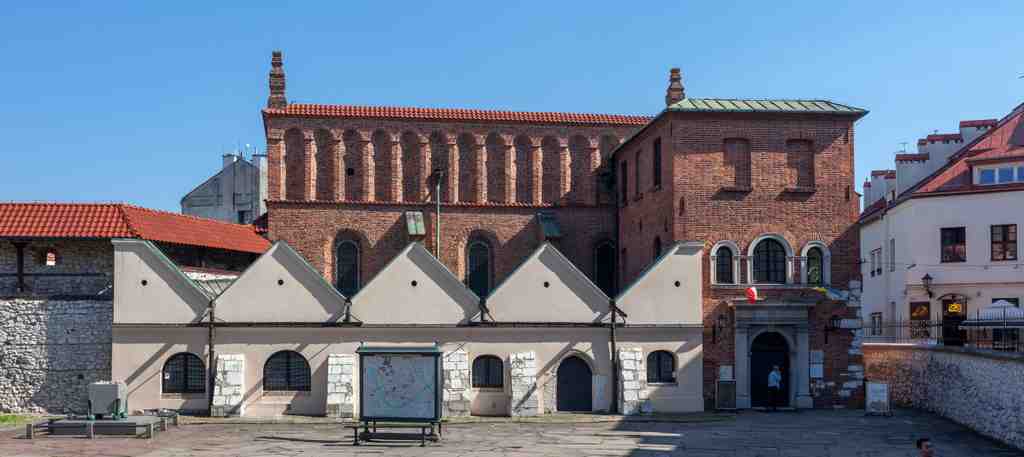
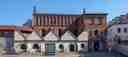
Old SynagoguePhoto: Marco Almbauer, Wikimedia Commons, CC BY-SA 4.0. Cropped & resized. In front of you stands a low, heavy synagogue of pale masonry, almost fortress-like in shape, with a stepped gable and windows set strikingly high above the ground.
This is the Old Synagogue, the oldest synagogue building still standing in Poland, and in many ways the stone anchor of Jewish Kazimierz. Its story begins with disaster elsewhere. After the great fire of fourteen ninety-four devastated streets around Szczepański Square in medieval Kraków, the city blamed its Jews and pushed them out of the Old Town. Much of Jewish communal life moved here, into Kazimierz. So this building does not simply mark a neighborhood; it marks a forced beginning again.
By fifteen fifty-six, King Sigismund Augustus already referred to it as the “Old Synagogue,” which tells you how deeply rooted it had already become in communal memory. A year later, fire struck again. Then Matteo Gucci, the Florence-born architect, rebuilt it and finished the work by fifteen seventy. He gave it Gothic strength and Mannerist elegance, a late Renaissance style that prized refined proportion. More importantly, he made it defensive: thick walls, heavy exterior supports called buttresses, loopholes in the attic wall, and windows raised far above reach. This was a house of prayer designed to endure siege as well as sorrow. If you glance at the image on your screen, you can see those fortress qualities especially clearly. The learned Jewish world that later included figures like Remah grew within the communal landscape this synagogue helped secure. And this place did not serve prayer alone. Rabbi Isaac Levita used it to pronounce cherem, a formal religious ban, against Kraków Hasidim. In seventeen ninety-four, General Tadeusz Kościuszko came here to appeal for Jewish support in his uprising. Sacred space and public life met under one roof.
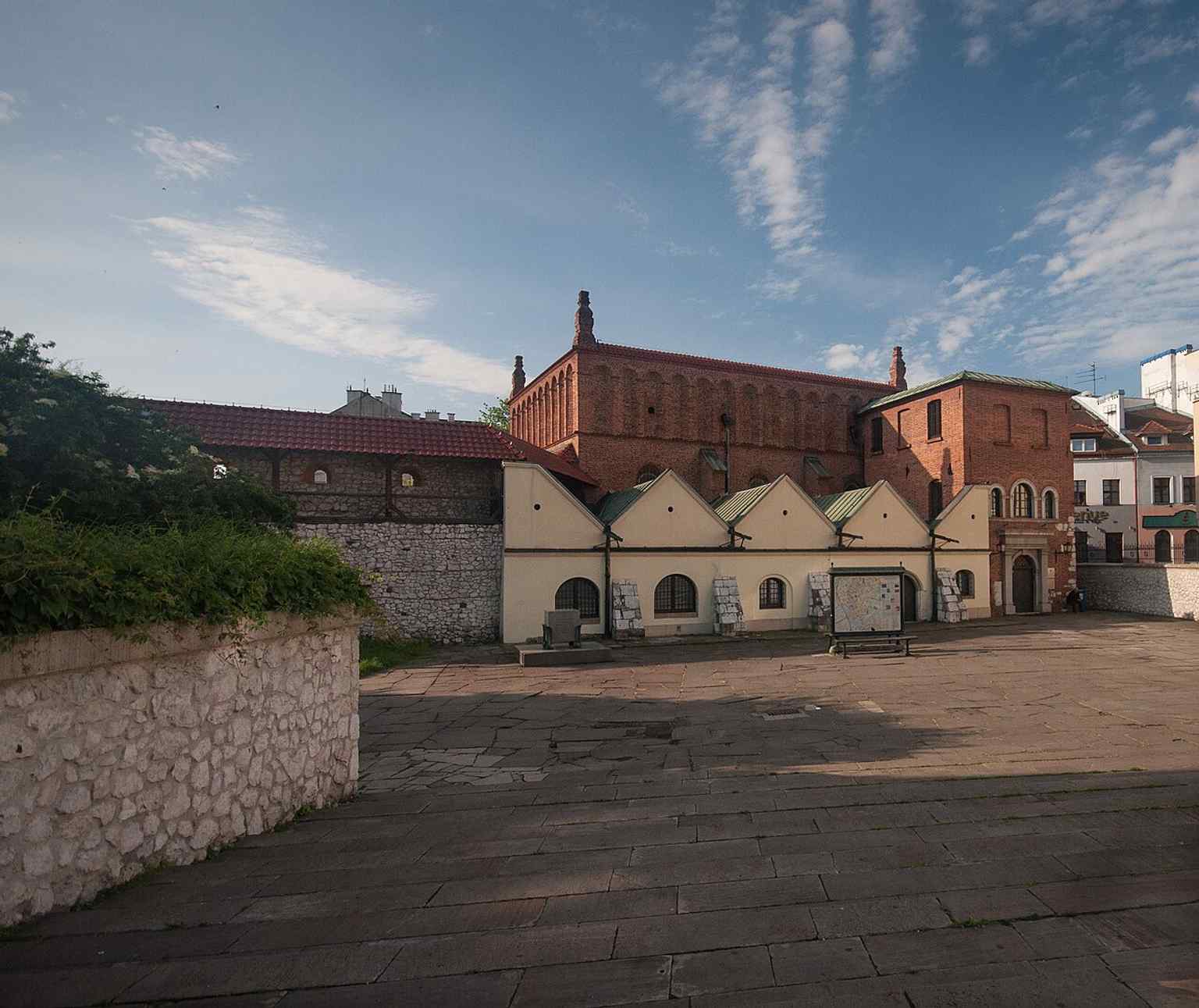
A sharper architectural view of the synagogue exterior, useful for highlighting its thick masonry walls and the Renaissance rebuilding led by Mateo Gucci.Photo: Daniel.zolopa, Wikimedia Commons, CC BY-SA 3.0 pl. Cropped & resized. Then came the twentieth century’s worst rupture. German occupiers ransacked the synagogue in nineteen thirty-nine, looted its ritual objects, and used the building as a warehouse. On the twenty-eighth of October, nineteen forty-three, they shot thirty Polish hostages at its wall. If you like, take a look at the before-and-after image in the app; it quietly shows how much this place lost, and how carefully it was brought back.
After the war, conservators secured the ruin, researchers studied it, and from nineteen fifty-six to nineteen fifty-nine it was restored. Since nineteen fifty-eight, it has lived on as a branch of the Historical Museum of Kraków, telling Jewish life through birth, prayer, food, divorce, and death.
So what are we hearing in these walls now: the silence of something ended, or the stubborn afterlife of a people still speaking through stone? In a former synagogue that no longer functions as it once did, memory has not retired; it has changed its work. In about five minutes, we will continue to Corpus Christi Church. If you want to go inside here, the museum usually opens from ten to three on Monday and from nine to five on the other days.
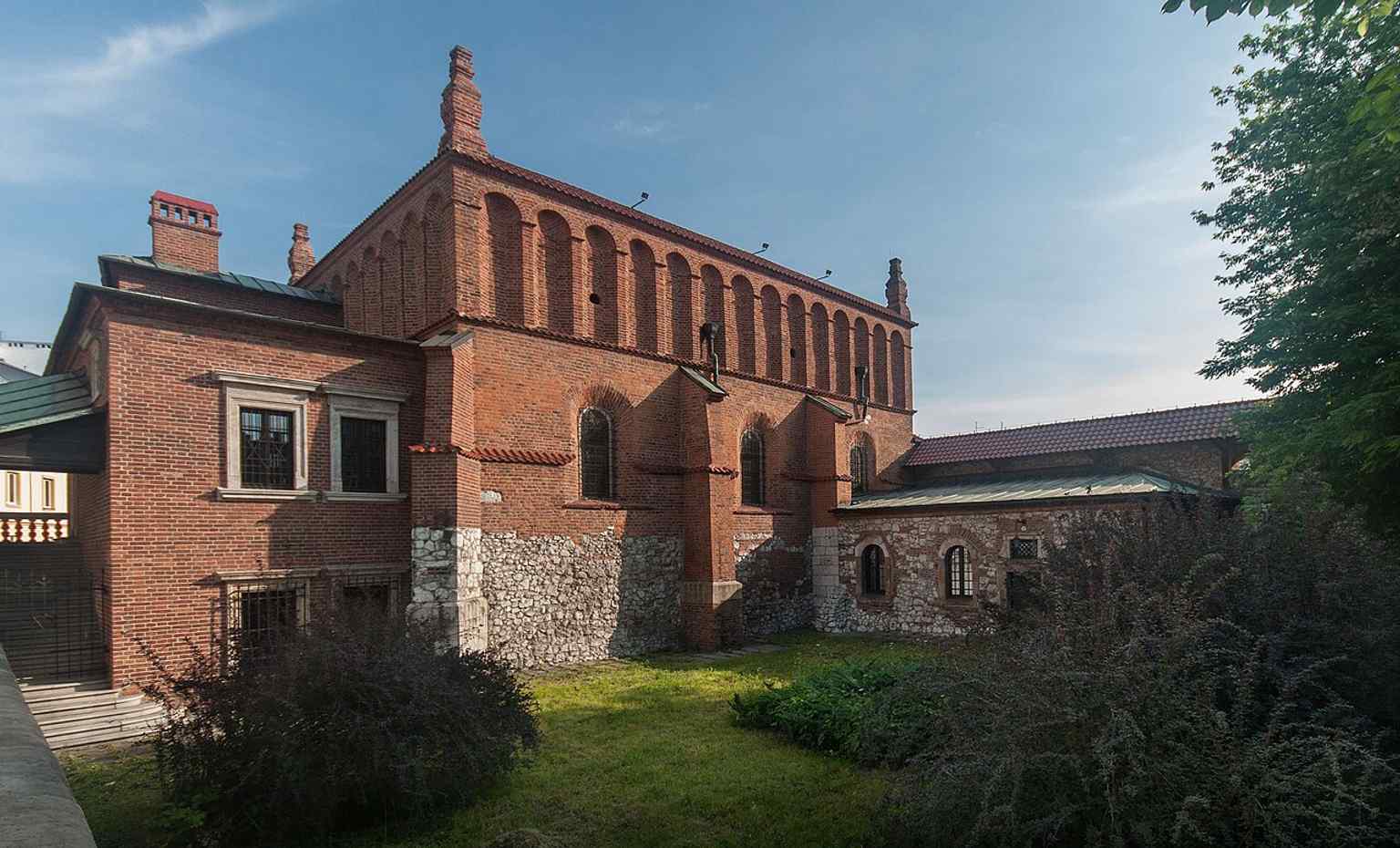
Wide view of the Old Synagogue’s restored façade on Szeroka Street, showing the fortress-like exterior that made it one of Poland’s rare synagogue strongholds.Photo: Daniel.zolopa, Wikimedia Commons, CC BY-SA 3.0 pl. Cropped & resized. 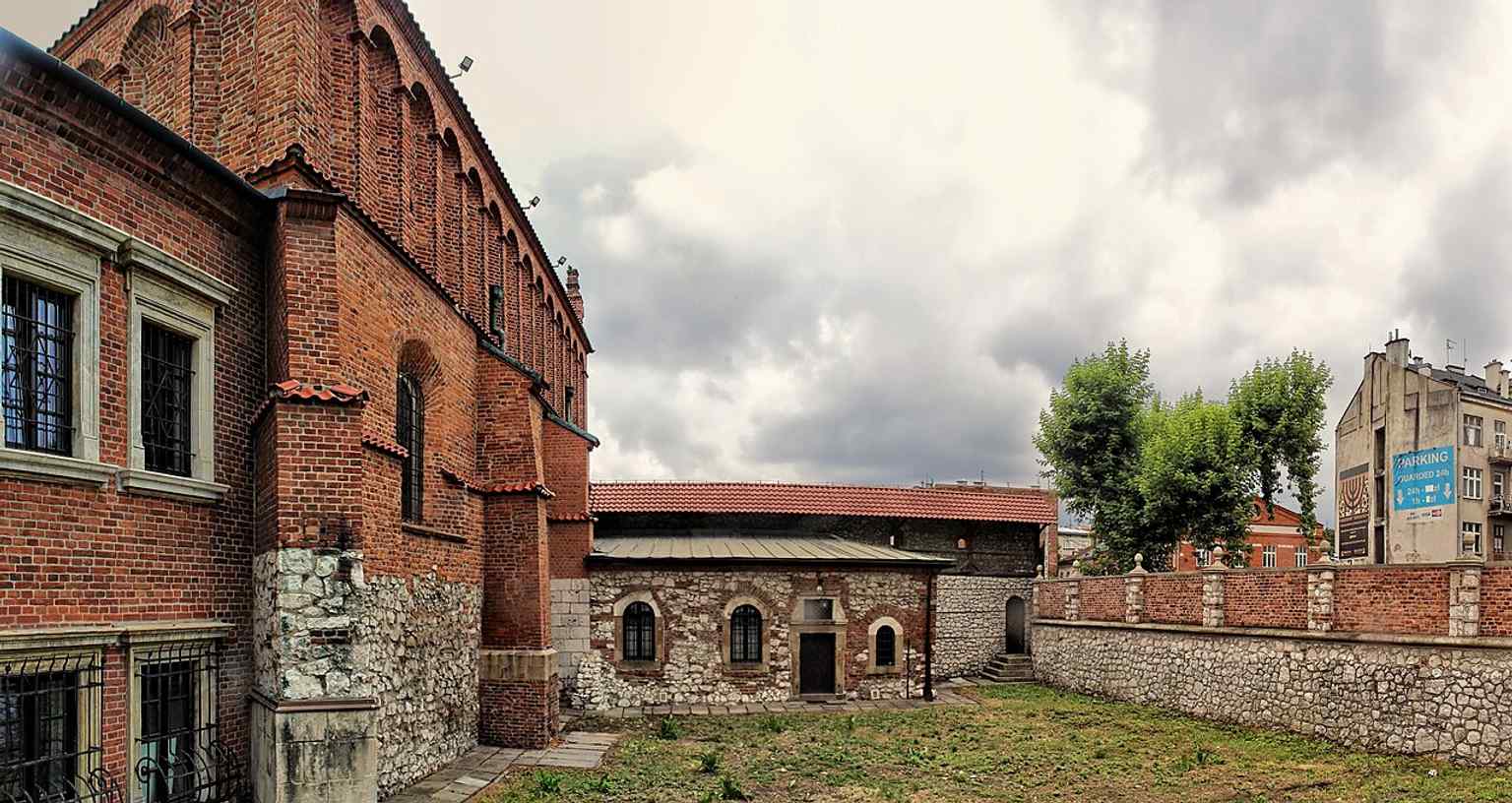
The building seen in context on Szeroka Street, where the Old Synagogue became the heart of Kazimierz after Kraków’s Jews were forced out of the Old Town.Photo: Krystyna Pruchniewska, Wikimedia Commons, CC BY-SA 4.0. Cropped & resized. 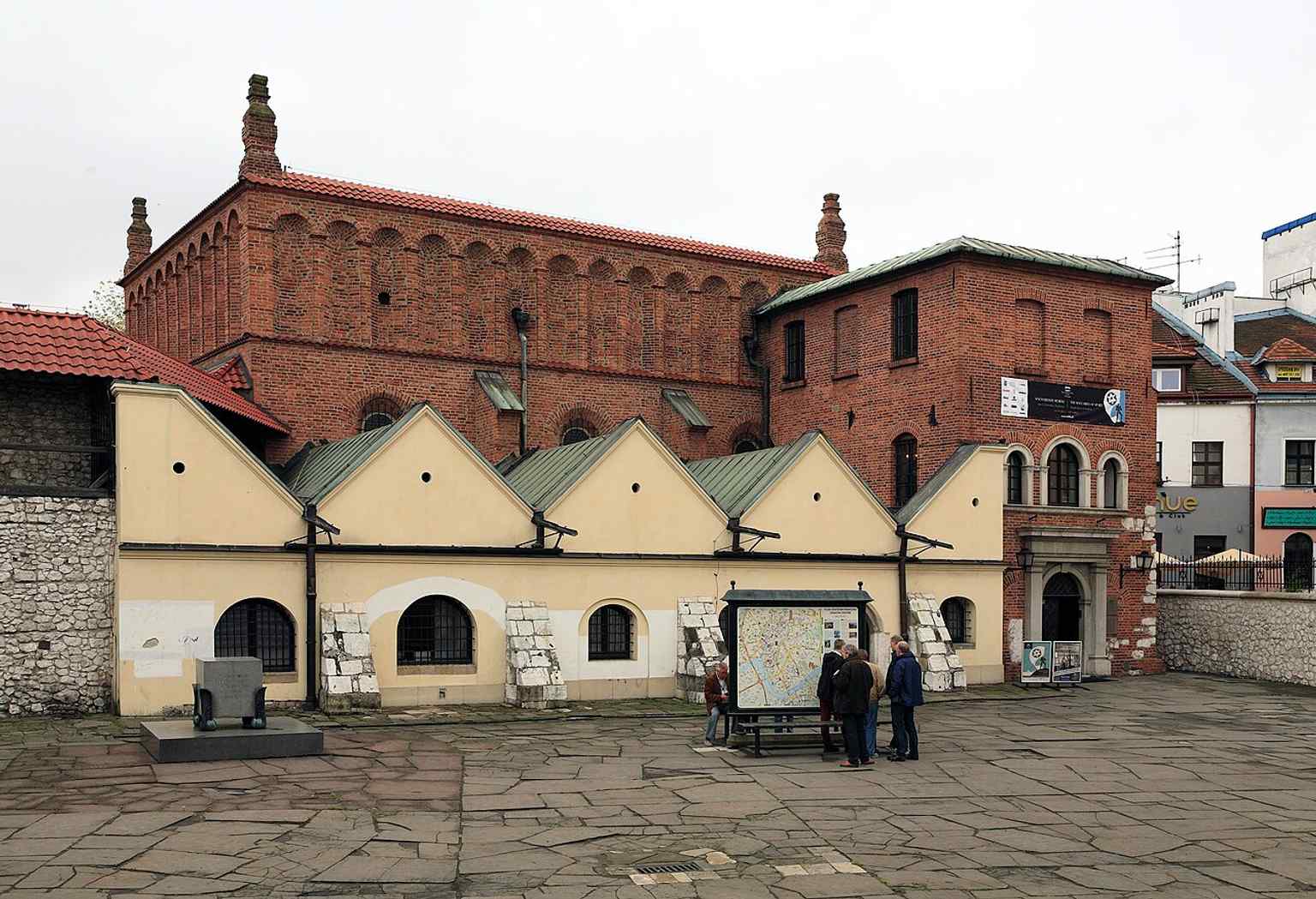
Side elevation showing the women’s prayer-room additions, a reminder that the synagogue served both ritual and communal life for centuries.Photo: Falk2, Wikimedia Commons, CC BY-SA 4.0. Cropped & resized. 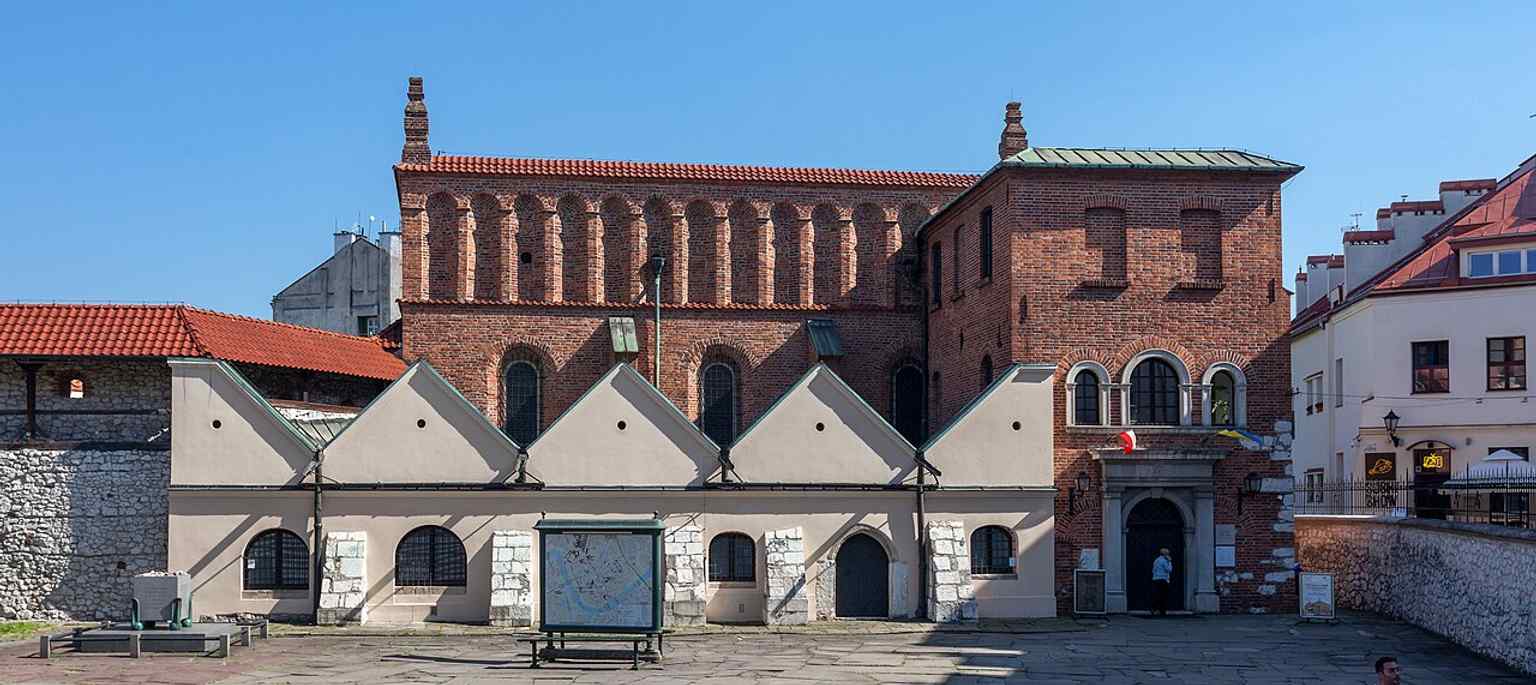
Modern front view of the Old Synagogue, now a museum branch of the Historical Museum of Kraków rather than an active house of prayer.Photo: Marco Almbauer, Wikimedia Commons, CC BY-SA 4.0. Cropped & resized. 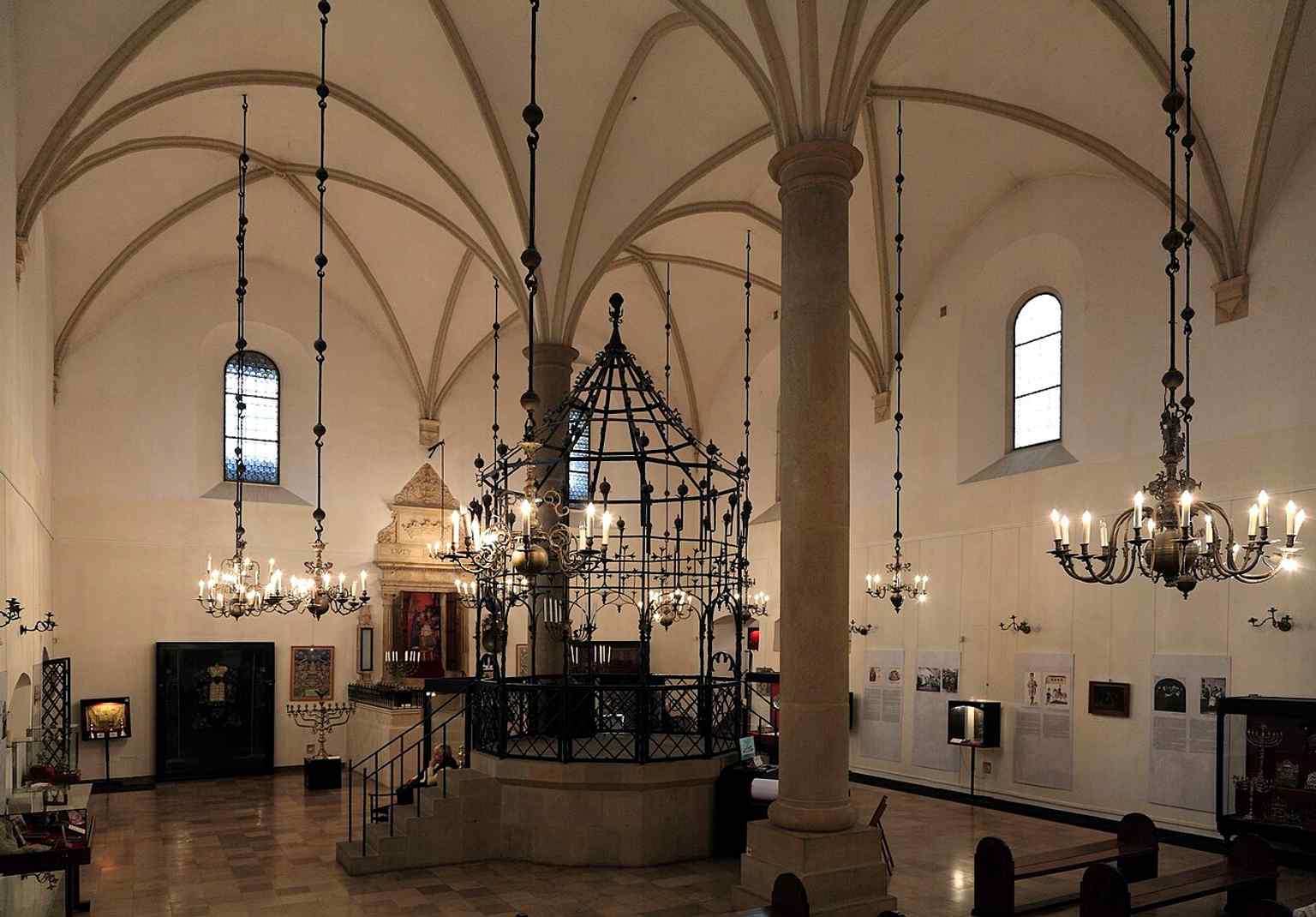
The men’s main hall, with the text’s history in mind: the building was used as a warehouse during the war and later restored as a Jewish museum.Photo: Falk2, Wikimedia Commons, CC BY-SA 4.0. Cropped & resized. 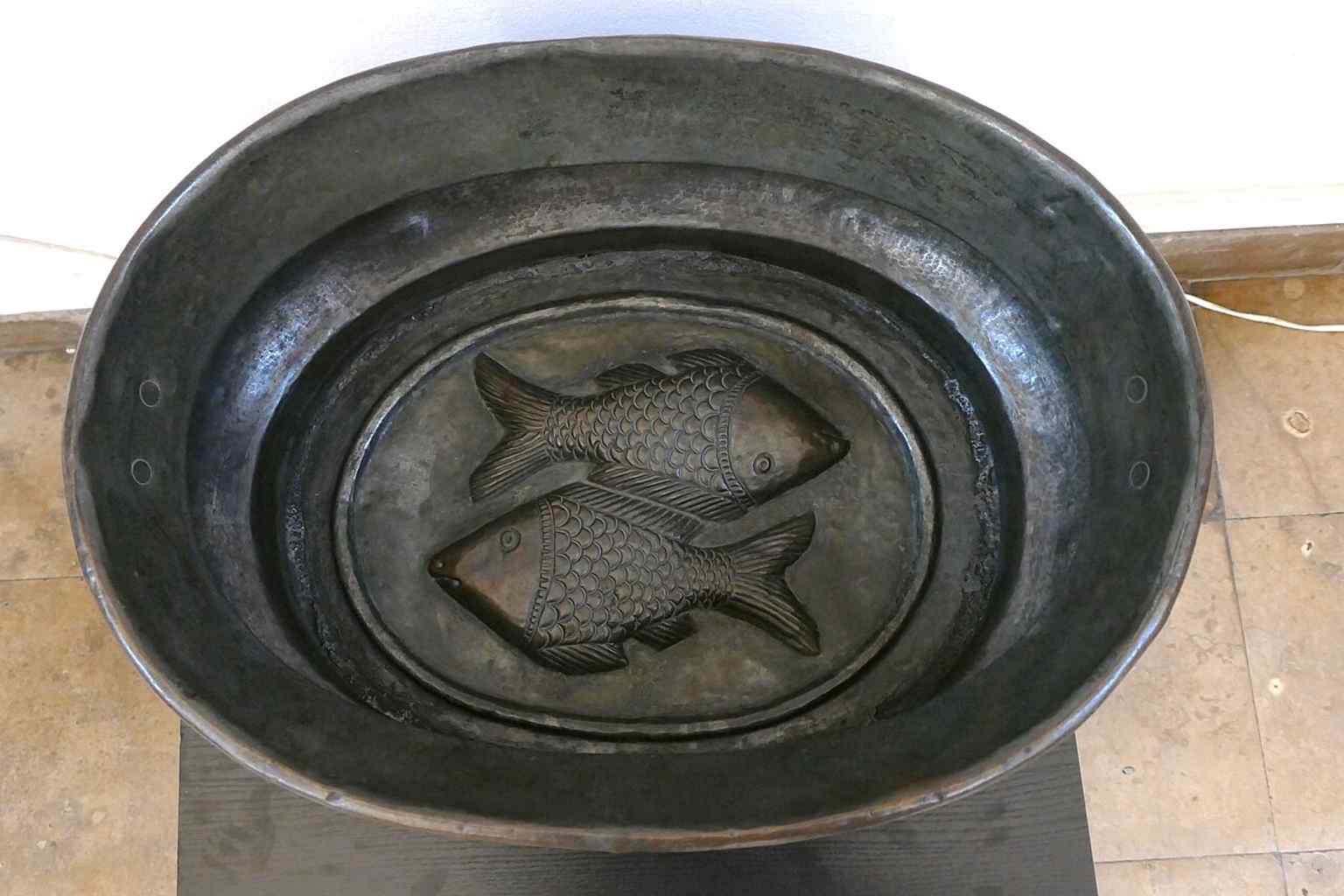
A ritual washing basin with fish ornament, one of the museum objects that helps tell the story of prayer and daily religious practice.Photo: Kritzolina, Wikimedia Commons, CC BY-SA 4.0. Cropped & resized. 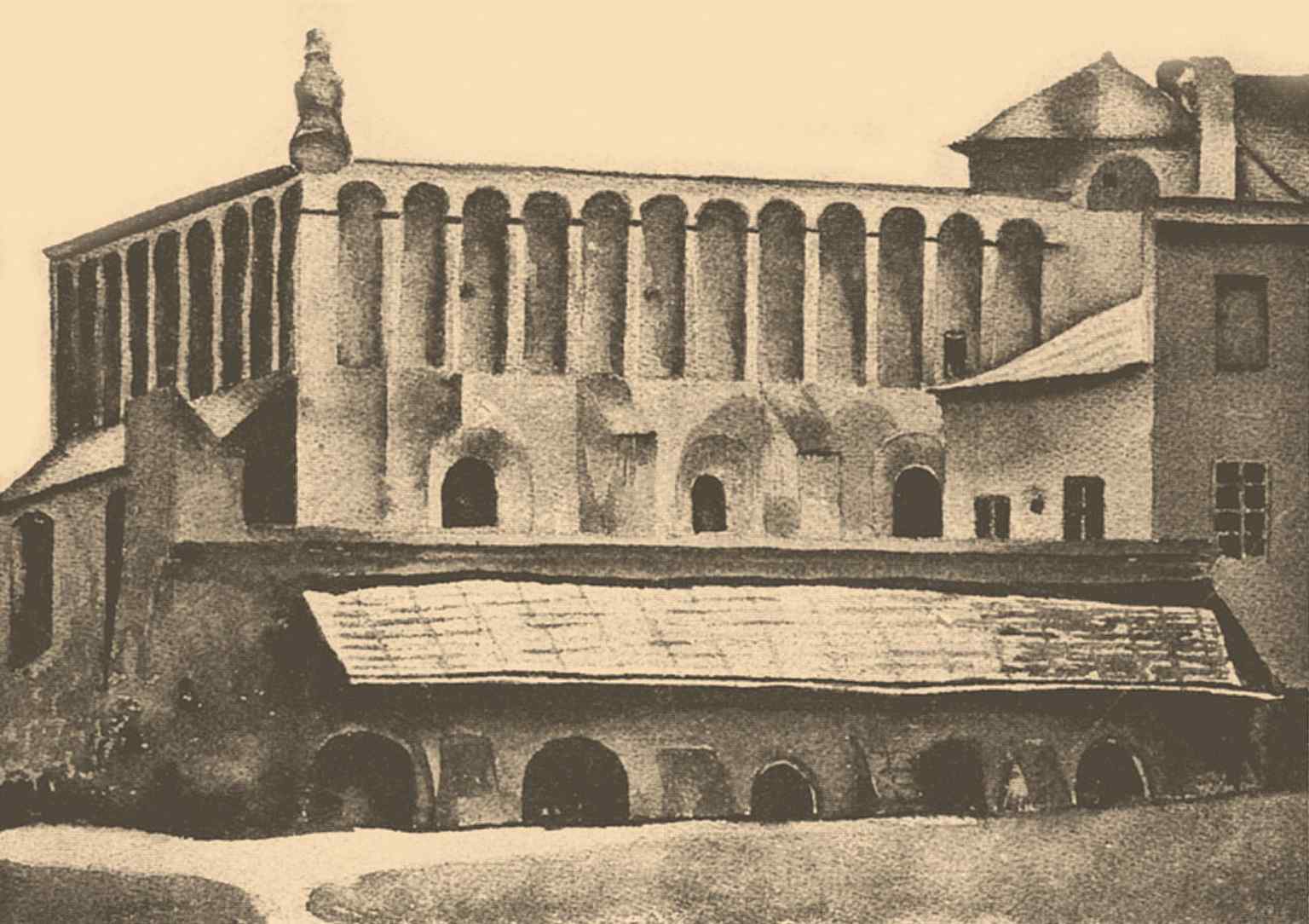
Early 20th-century encyclopedia illustration of the Old Synagogue, when preservation efforts were turning it into a monument of Jewish heritage.Photo: Unknown authorUnknown author, Wikimedia Commons, Public domain. Cropped & resized. 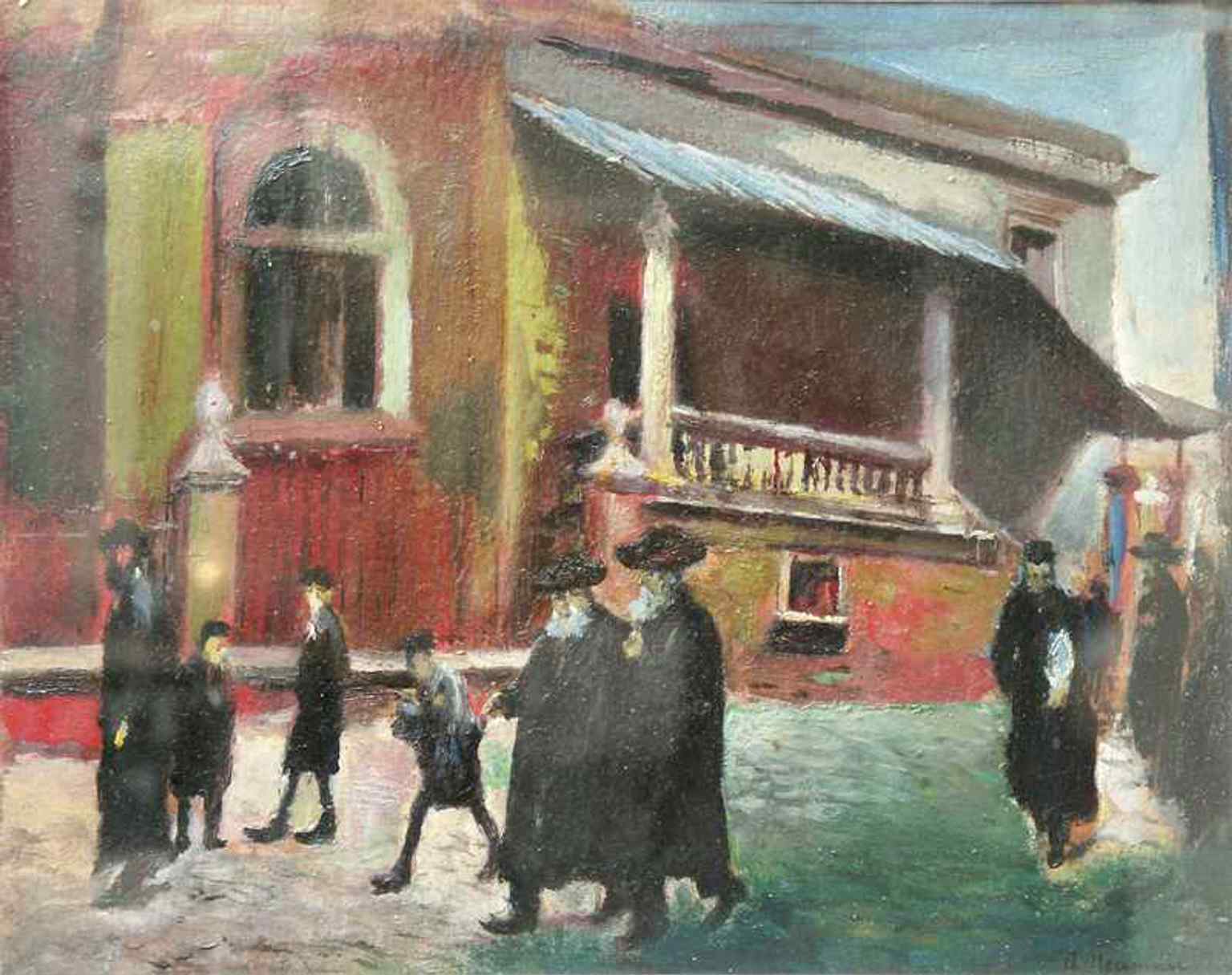
Abraham Neumann’s 1939 painting of the Old Synagogue, created on the eve of the wartime destruction that would devastate the building.Photo: Abraham Neumann (1873-1942), Wikimedia Commons, Public domain. Cropped & resized. 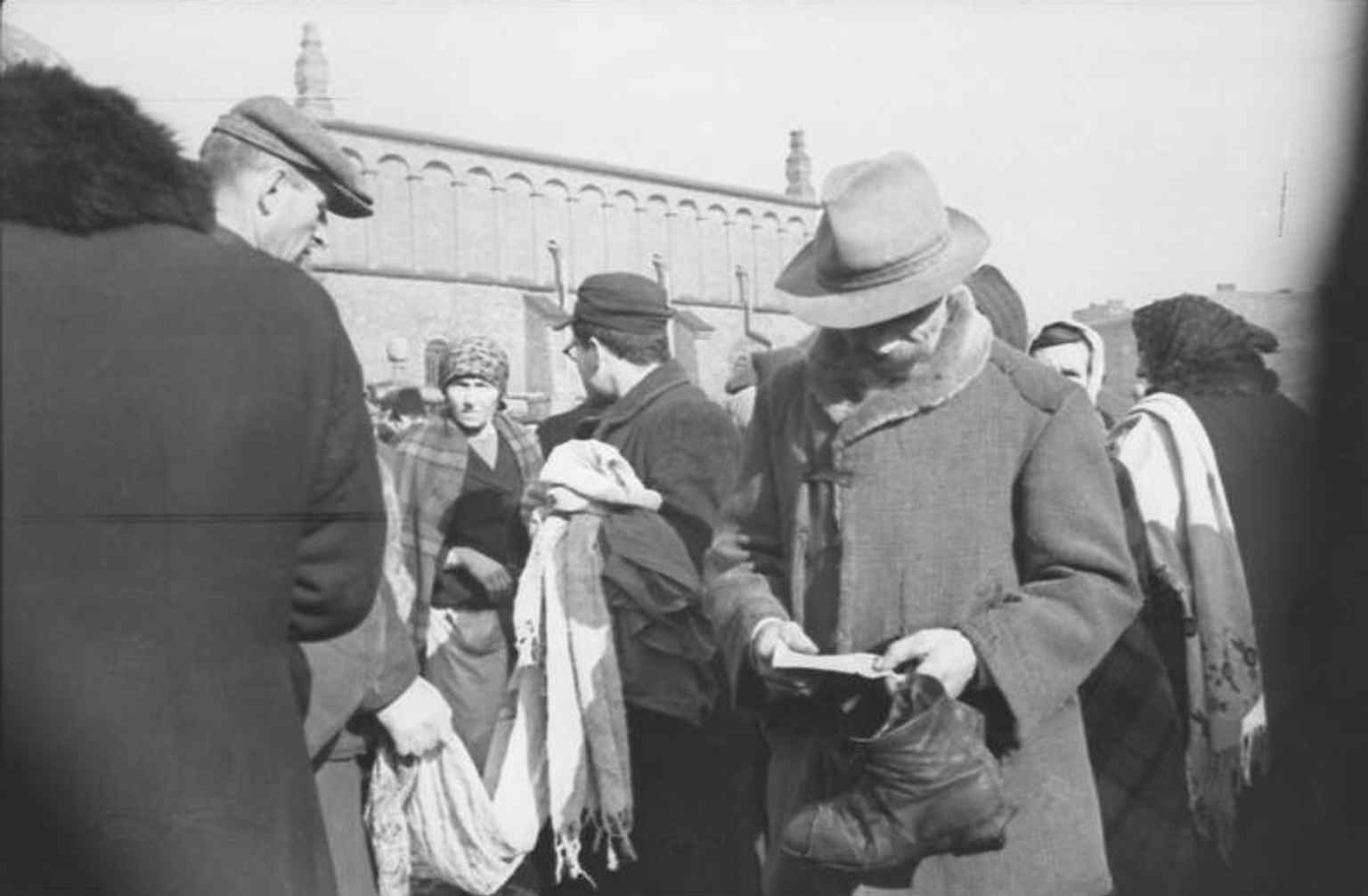
Wartime archival image from 1941 connected to the synagogue’s occupied surroundings, evoking the era when the building was stripped and used as a warehouse.Photo: Rössler, Wikimedia Commons, CC BY-SA 3.0 de. Cropped & resized. 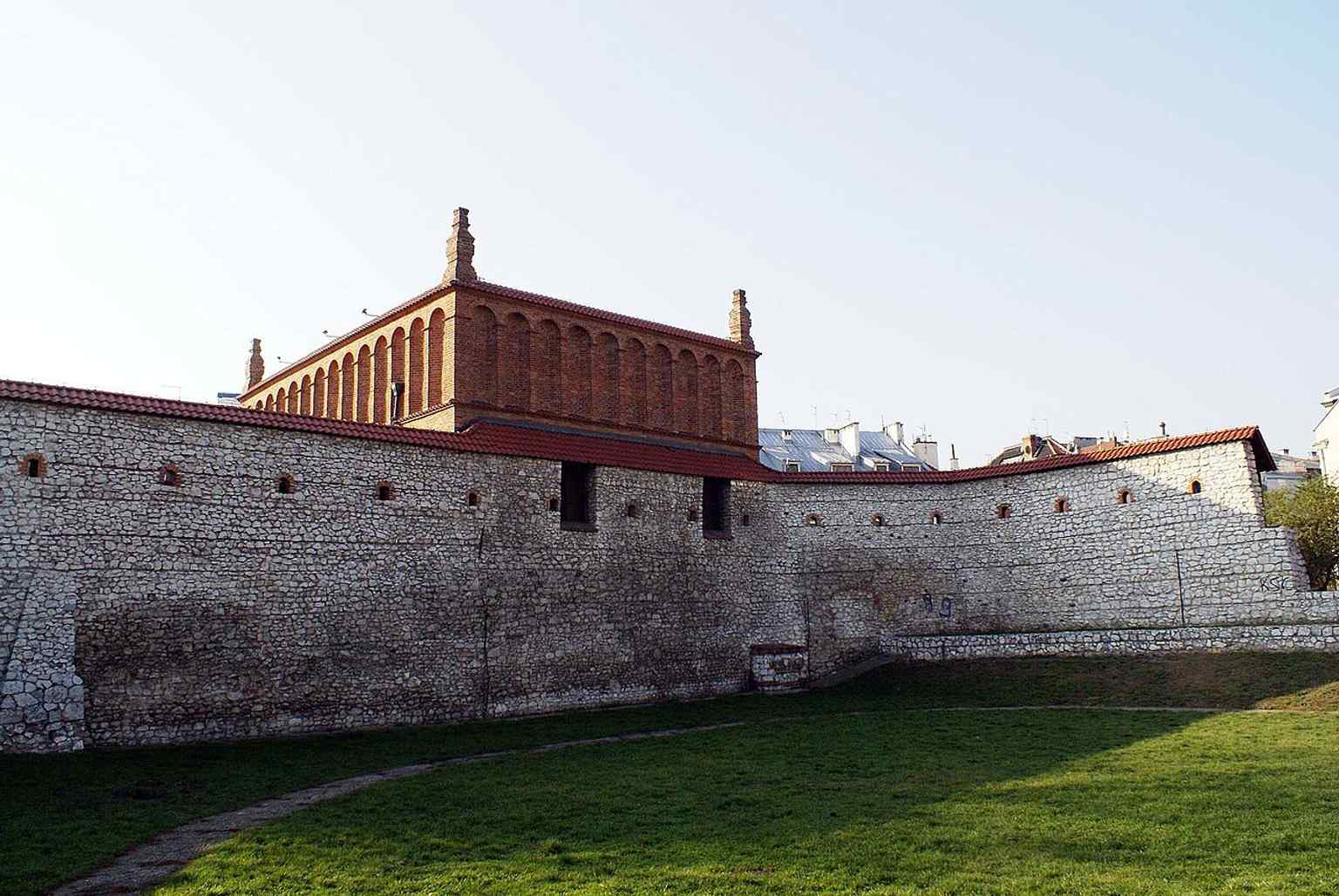
Urban-context view of Kazimierz and the synagogue area, helpful for showing how the Old Synagogue sits within the historic Jewish district.Photo: Barbara Maliszewska, Wikimedia Commons, CC BY-SA 3.0 pl. Cropped & resized. Look to your right for a long red-brick church with a pointed Gothic façade, tall narrow windows, and a square tower rising above the west front. Corpus Christi Basilica reminds…Read moreShow less
Open dedicated page →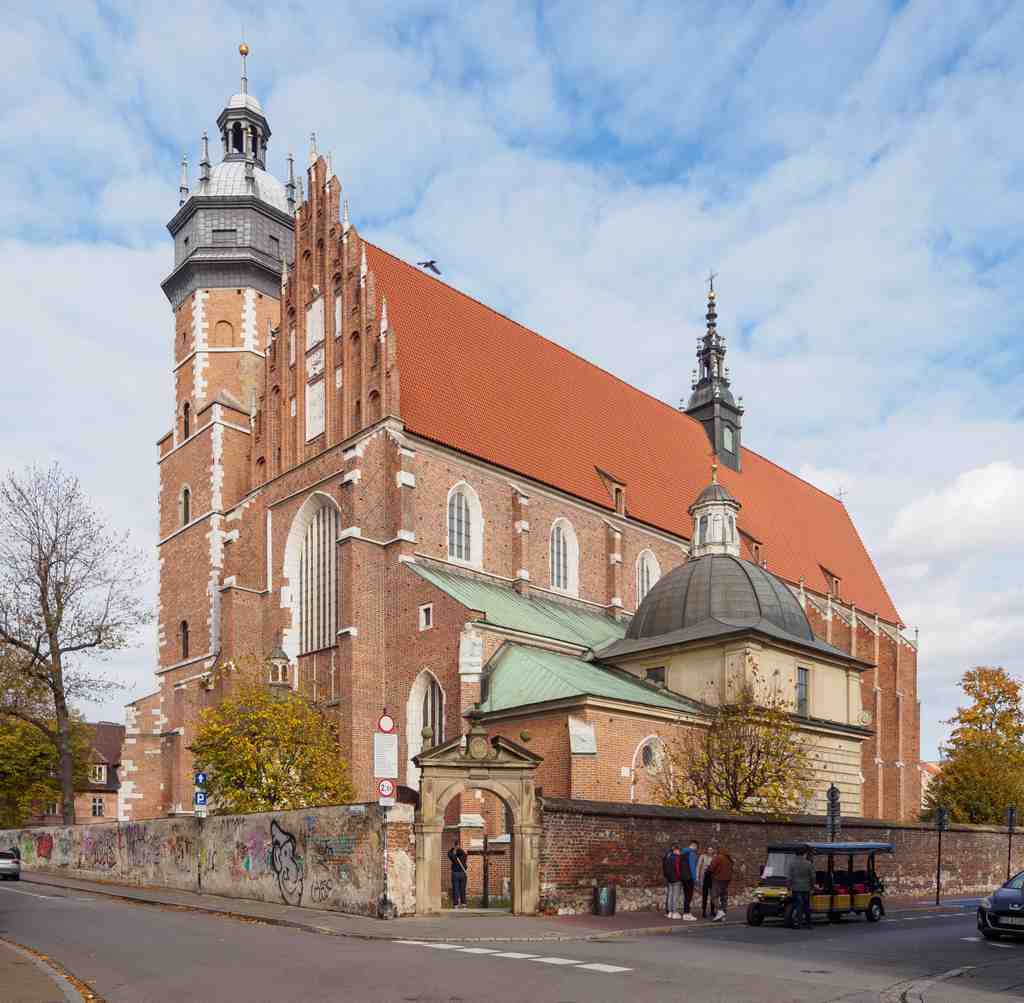
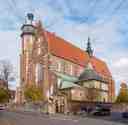
Corpus Christi BasilicaPhoto: C messier, Wikimedia Commons, CC BY-SA 4.0. Cropped & resized. Look to your right for a long red-brick church with a pointed Gothic façade, tall narrow windows, and a square tower rising above the west front.
Corpus Christi Basilica reminds you, rather firmly, that Kazimierz never belonged to just one story. This great church entered the district in thirteen thirty-five, when King Casimir the Great founded it. Yet people preferred a better tale to a dry date. The chronicler Jan Długosz wrote that a stolen monstrance - the vessel that holds the consecrated host - reappeared on the marshy ground where the basilica now stands. In that version, the king did not simply sponsor a parish church; he answered a mystery with a public act of thanks.
The building grew slowly, and that matters. Work began around thirteen forty, but the church did not rise in one clean sweep. In thirteen seventy the city took patronage. Planners changed the original scheme and turned it into a basilica, meaning a taller central hall with lower aisles beside it. The chancel, the space around the altar, reached completion and consecration in fourteen oh one. Only later did royal backing carry the nave and the front façade to completion, with a second consecration in fifteen hundred. If you glance at the image on your screen, you can sense that long, staged growth in the church’s stretched brick body.
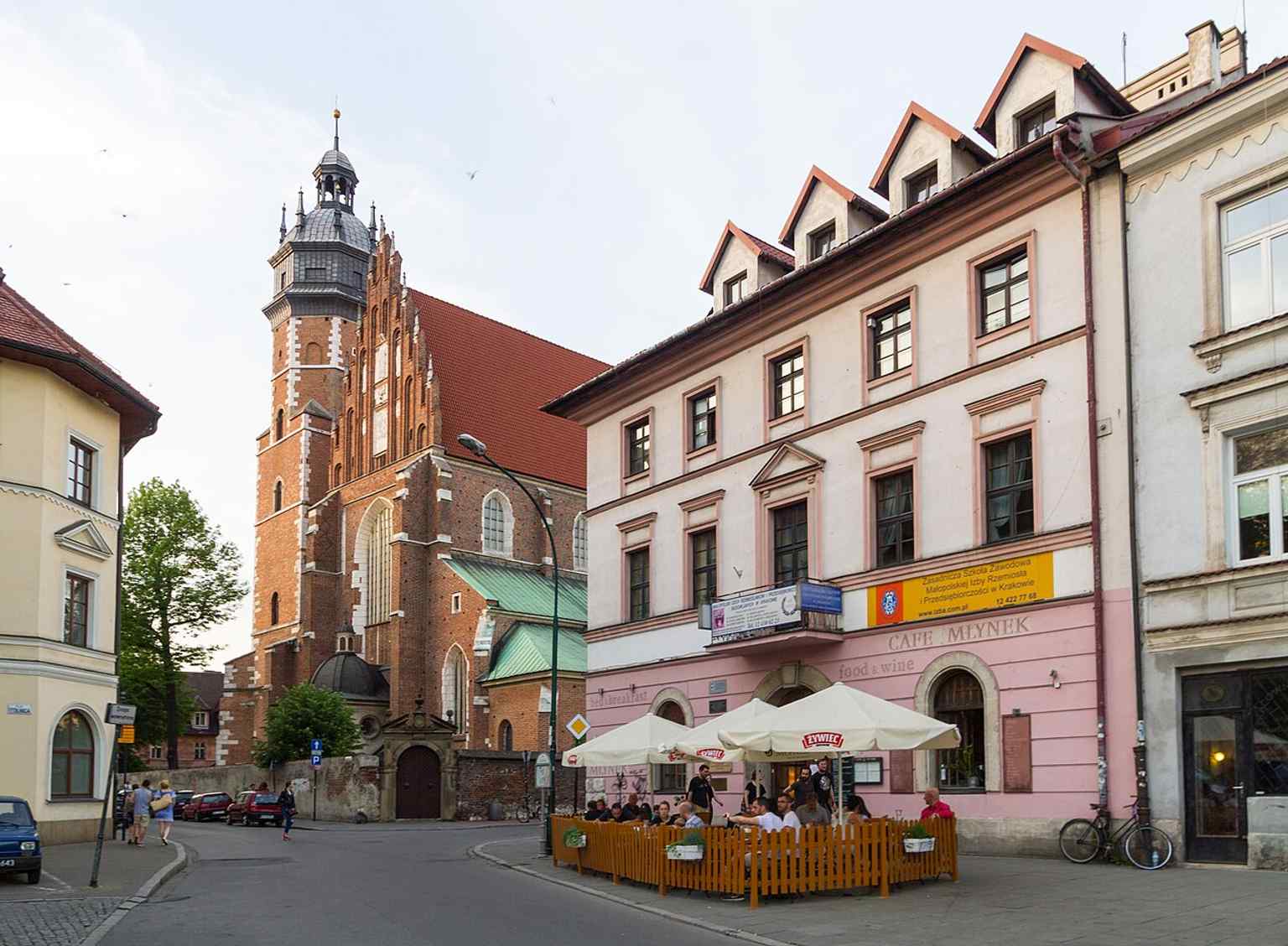
A broad view of the basilica from Kazimierz, showing the long Gothic body that grew in stages from the 14th to 15th centuries.Photo: Maksym Kozlenko, Wikimedia Commons, CC BY-SA 4.0. Cropped & resized. King Władysław Jagiełło then gave the place a settled community. In fourteen oh five he brought the Canons Regular of the Lateran from Kłodzko, and Corpus Christi became not only a parish church but a monastic one, woven into daily prayer, study, and work. The adjoining complex still hints at that enclosed life: porch, cells, treasury, oratory. Bożego Ciała Street is not merely an address here. It is one of Kazimierz’s binding lines, carrying sacred memory, royal intent, and ordinary urban life along the same route.
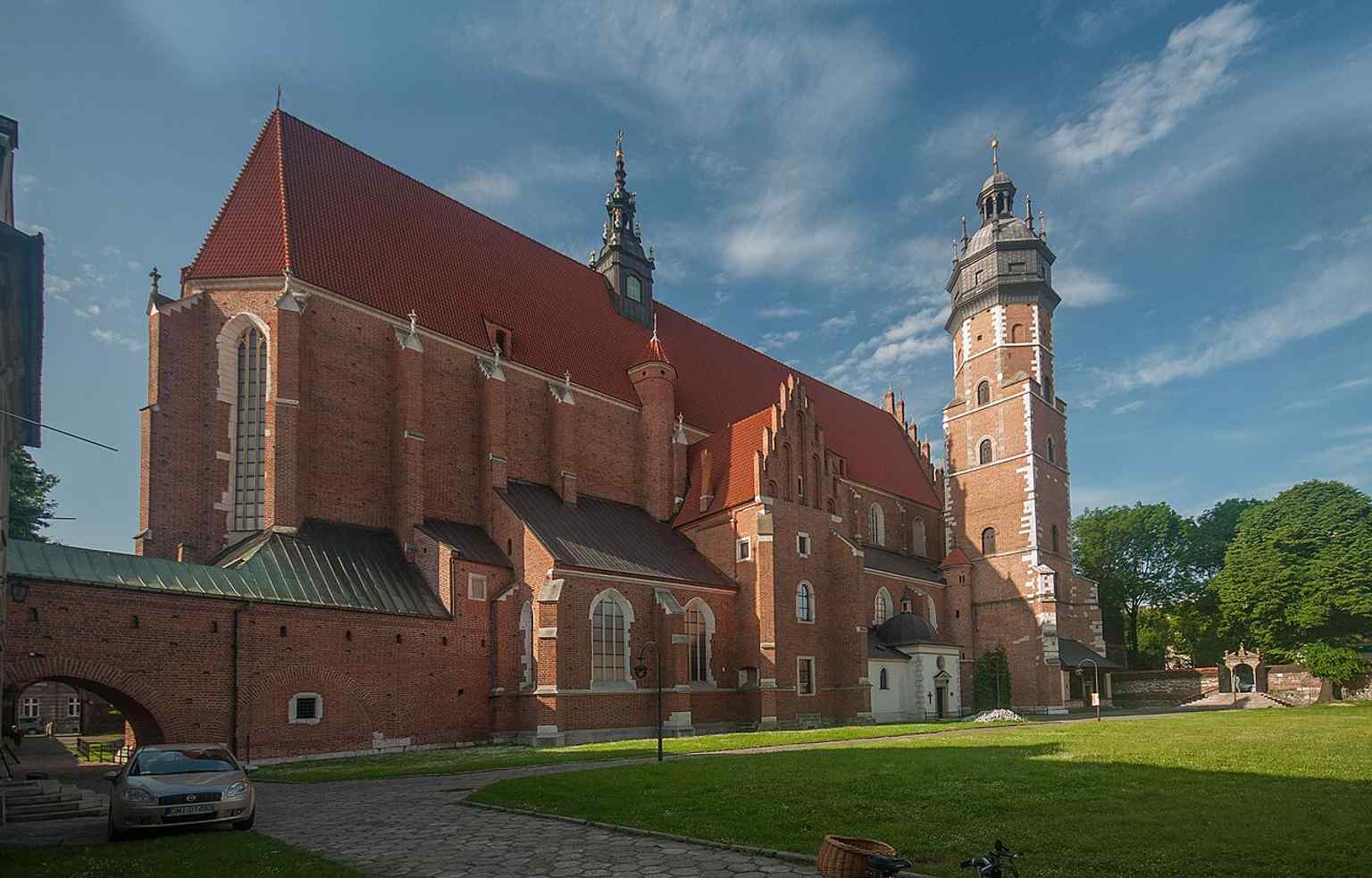
The monastery complex beside the church, a reminder that Corpus Christi was planned as a monastic church with its own cloistered community.Photo: Daniel.zolopa, Wikimedia Commons, CC BY-SA 3.0 pl. Cropped & resized. The church suffered, repeatedly. Fire damaged the tower in fifteen fifty-six and the roof again in fifteen ninety-four. Then, during the Swedish invasion in sixteen fifty-five, King Charles Gustav made this church his headquarters for the attack on Kraków. Soldiers turned sacred rooms into warehouses and stables, while the monks were confined to a single cell and the sacristy. Much of what you would see inside now - the rich Baroque decoration, the gilded high altar, even the sense of theatrical recovery - grew from that ruin.
One man resting here captures that wider world: Bartolommeo Berrecci, the Florentine architect of Wawel’s Sigismund Chapel. He died in Kraków in fifteen thirty-seven, perhaps murdered by a rival, perhaps from an infected work accident, and they buried him here.
So as you leave, take this church as context, not contrast. Kazimierz is larger than any single quarter or creed; it is a whole memory-city made from lives that overlapped, argued, borrowed, and endured. Our final stop, Kazimierz itself, is about a two-minute walk away. If you hope to step inside later, the basilica usually opens daily from early morning until early evening, with slightly longer hours on Sundays.
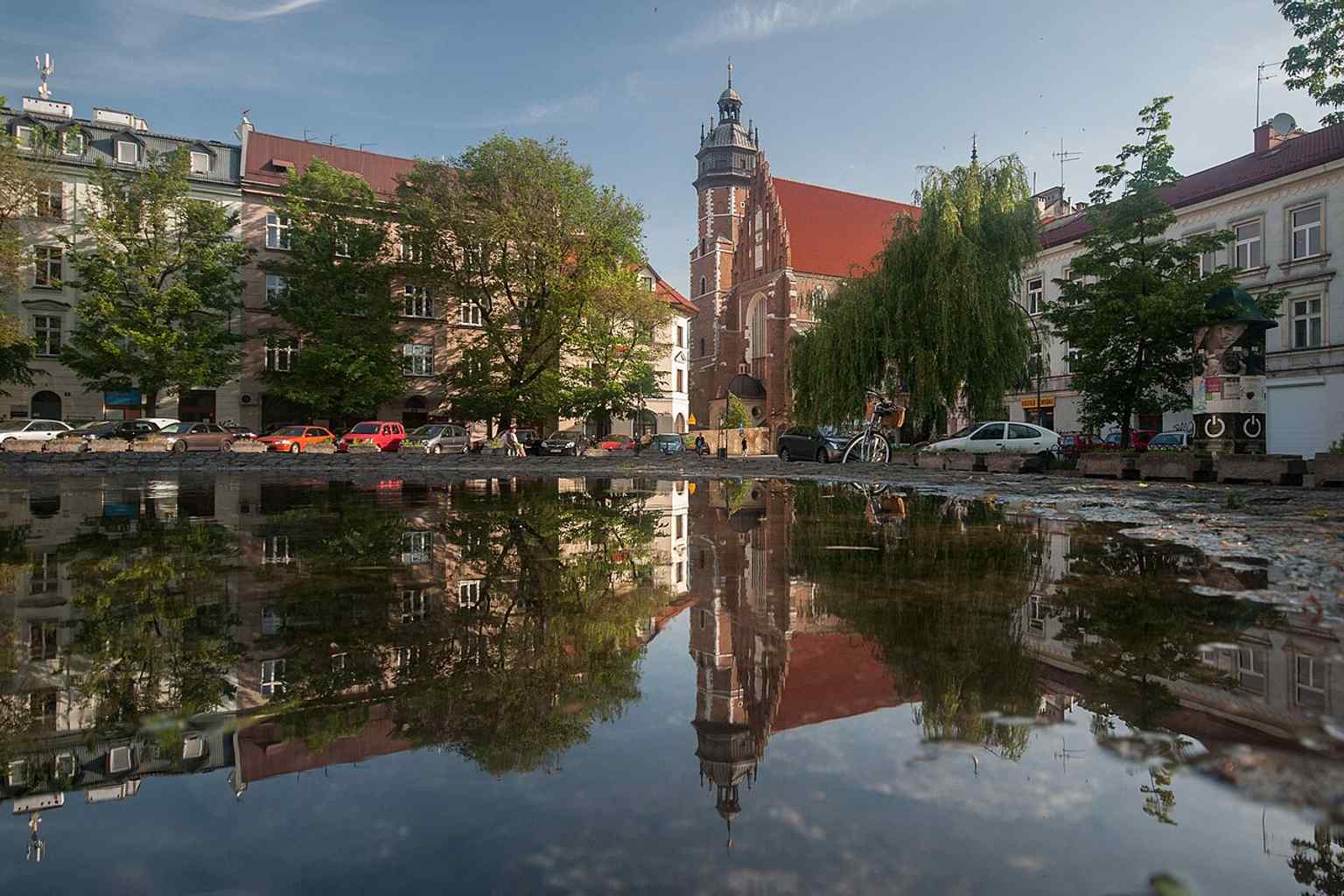
The church set by water and open space, echoing the marshy site linked to the legend of the recovered monstrance.Photo: Daniel.zolopa, Wikimedia Commons, CC BY-SA 3.0 pl. Cropped & resized. 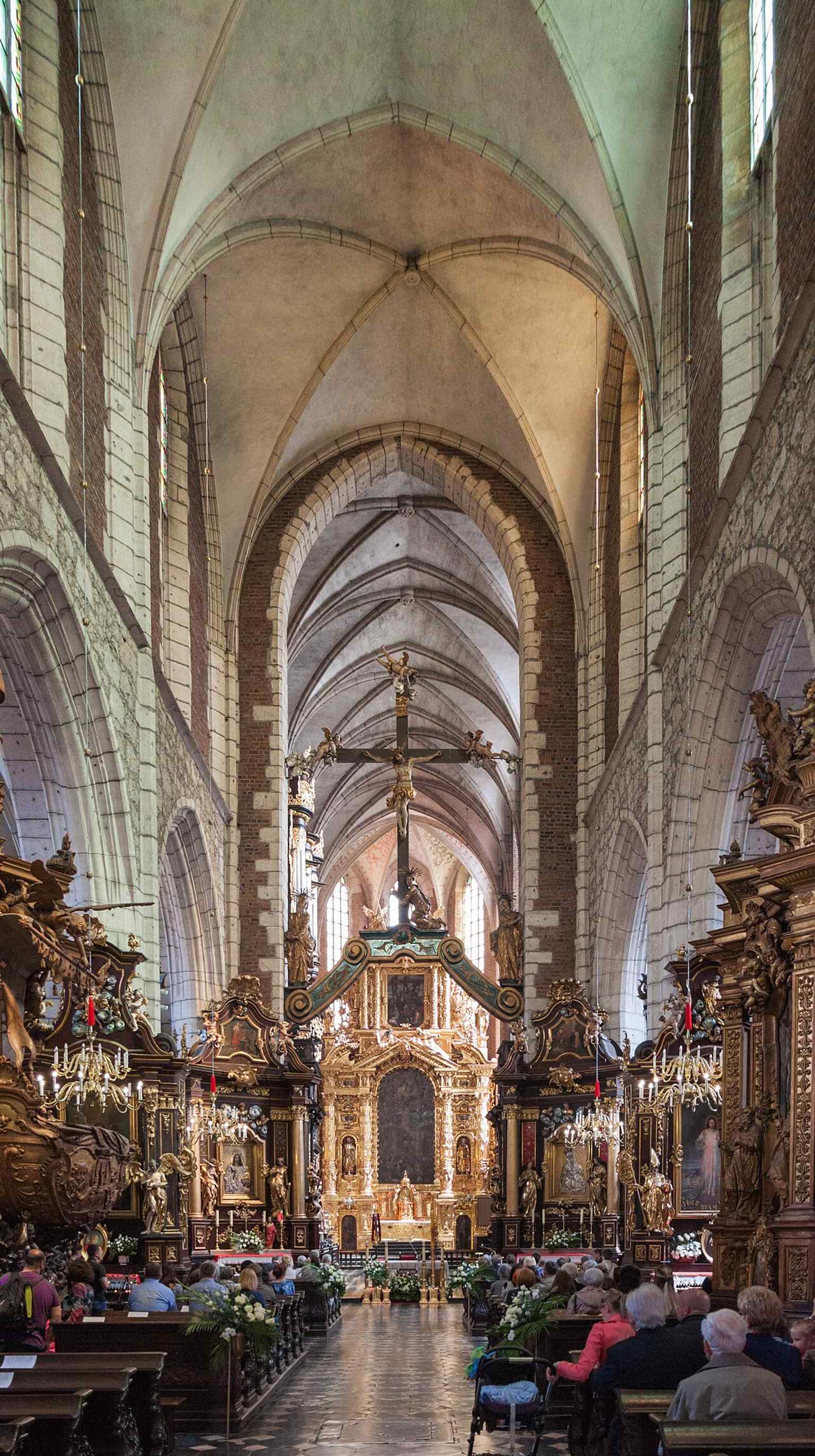
A view into the nave, where Polish Gothic structure meets the rich Baroque rebuilding that followed the Swedish Deluge.Photo: Marcin Konsek, Wikimedia Commons, CC BY-SA 4.0. Cropped & resized. 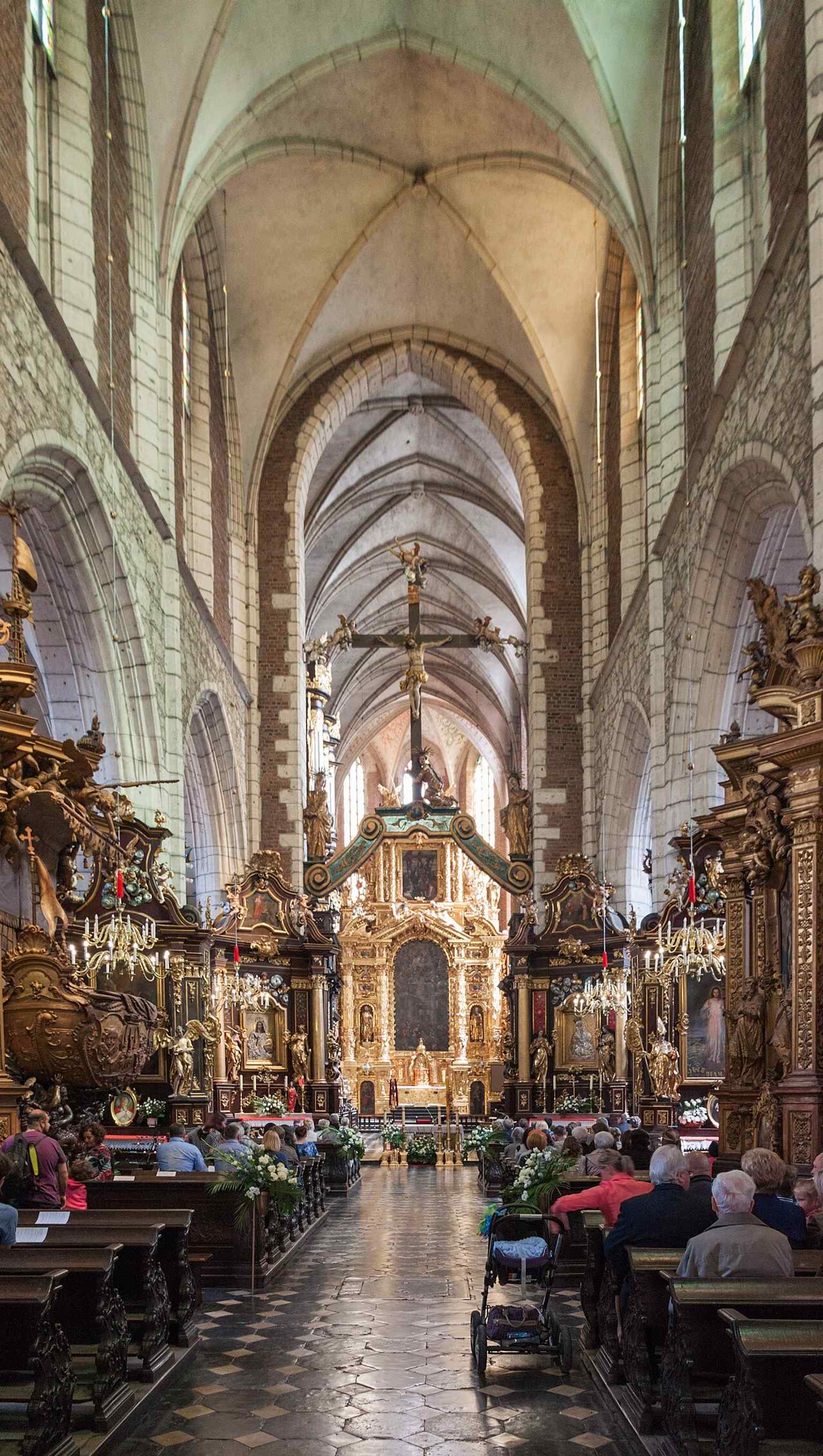
The soaring interior emphasizes the basilica layout and the later Baroque decoration that replaced the lost medieval furnishings.Photo: Marcin Konsek, Wikimedia Commons, CC BY-SA 4.0. Cropped & resized. 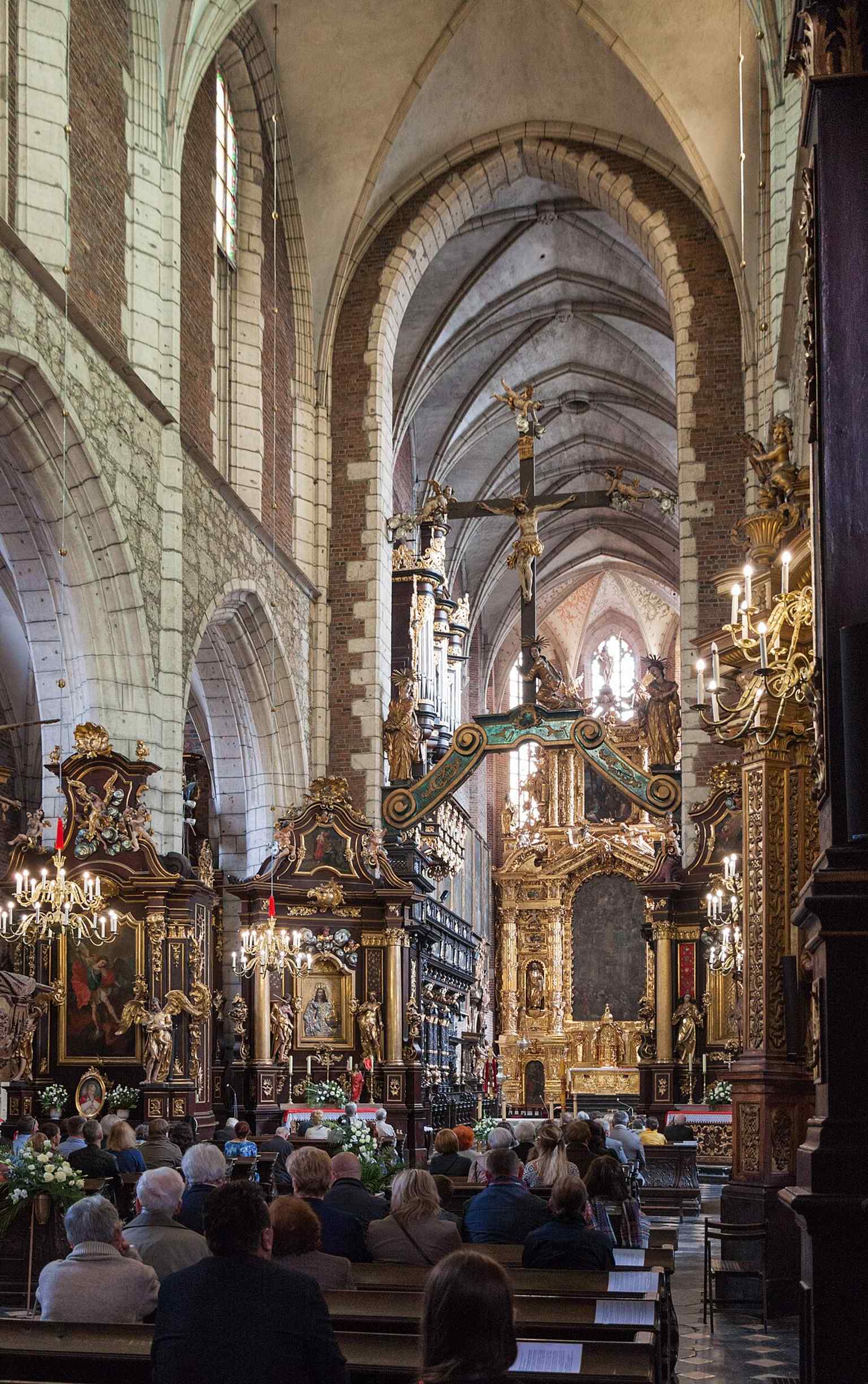
Another interior angle showing the layered church space where monks once lived and worshipped beside the basilica.Photo: Marcin Konsek, Wikimedia Commons, CC BY-SA 4.0. Cropped & resized. 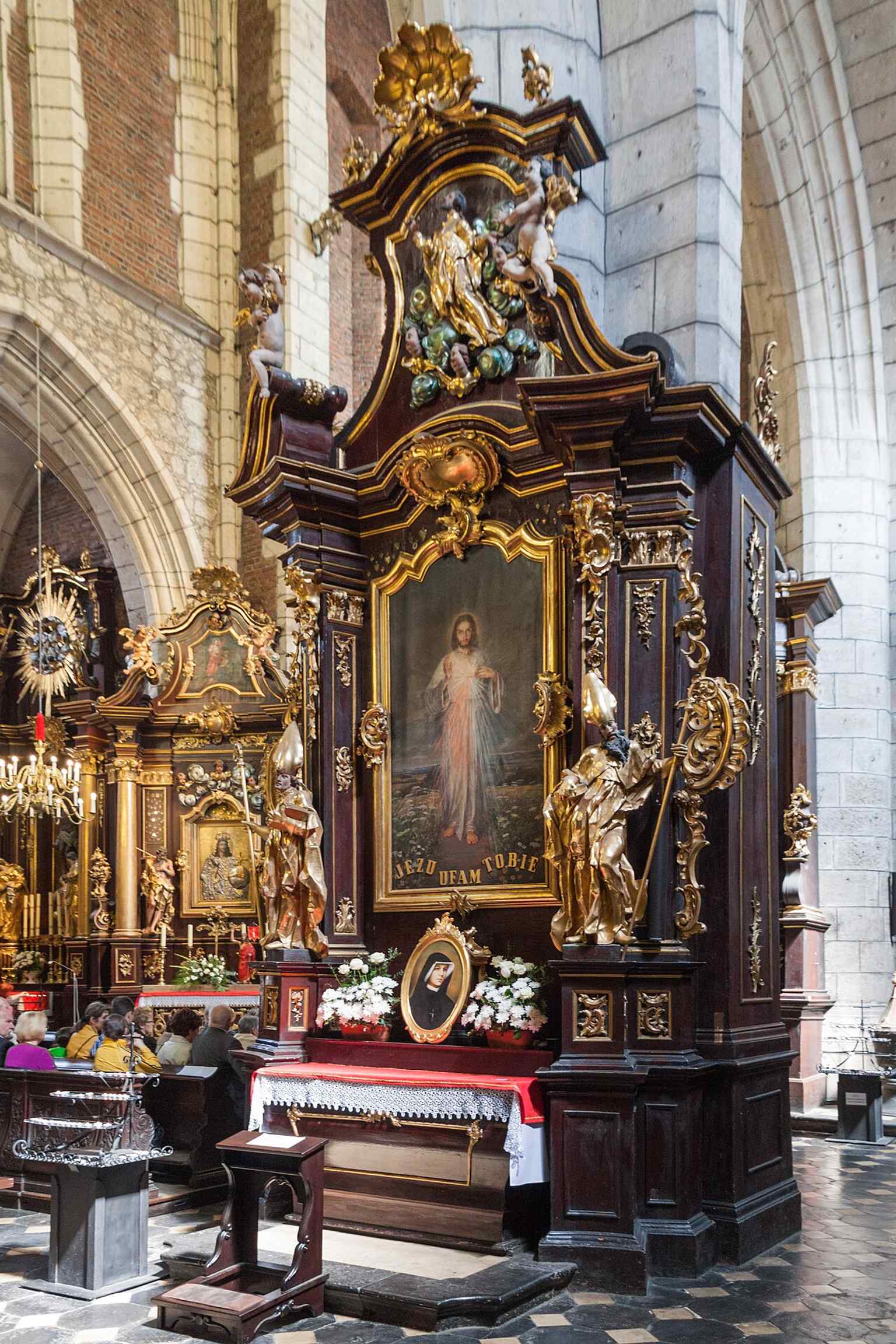
A closer interior detail that helps capture the church’s ornate post-17th-century Baroque character.Photo: Marcin Konsek, Wikimedia Commons, CC BY-SA 4.0. Cropped & resized. 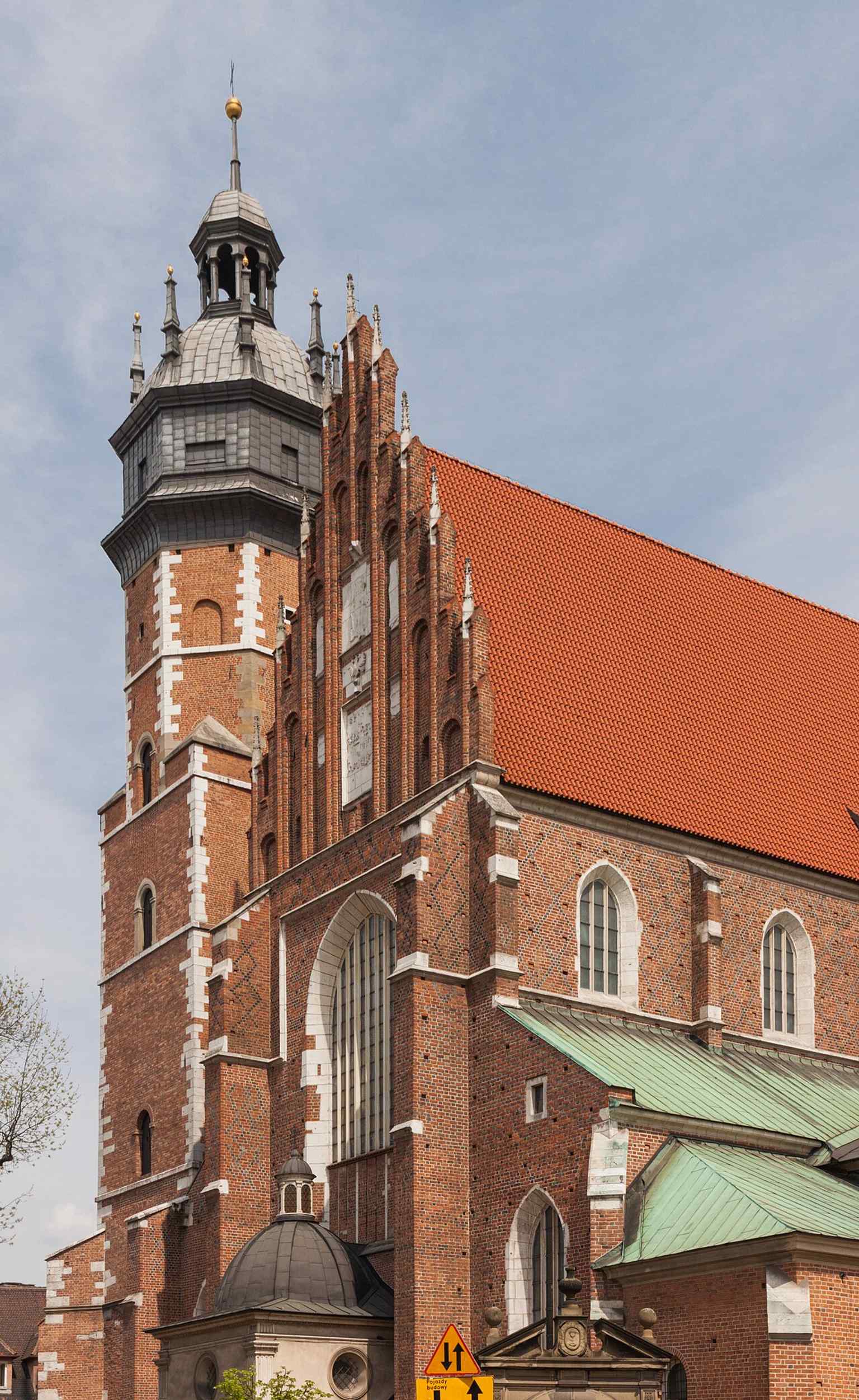
A side view of the basilica’s brick massing, useful for showing how the church’s façade and nave were completed after centuries of building.Photo: Marcin Konsek, Wikimedia Commons, CC BY-SA 4.0. Cropped & resized. 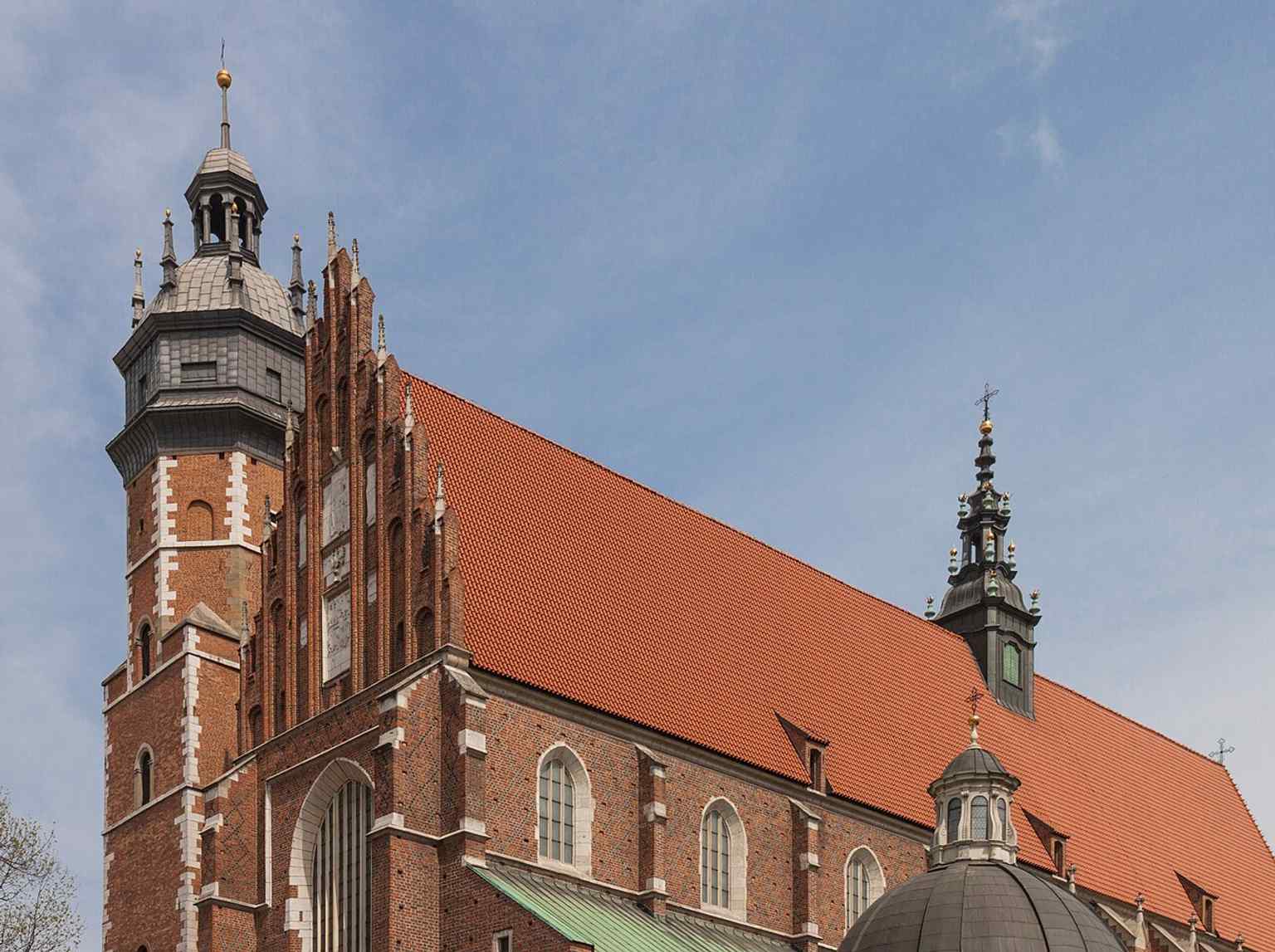
A strong exterior perspective highlighting the church’s tall brick silhouette in Kazimierz, where royal patronage and monastic life met.Photo: Marcin Konsek, Wikimedia Commons, CC BY-SA 4.0. Cropped & resized. 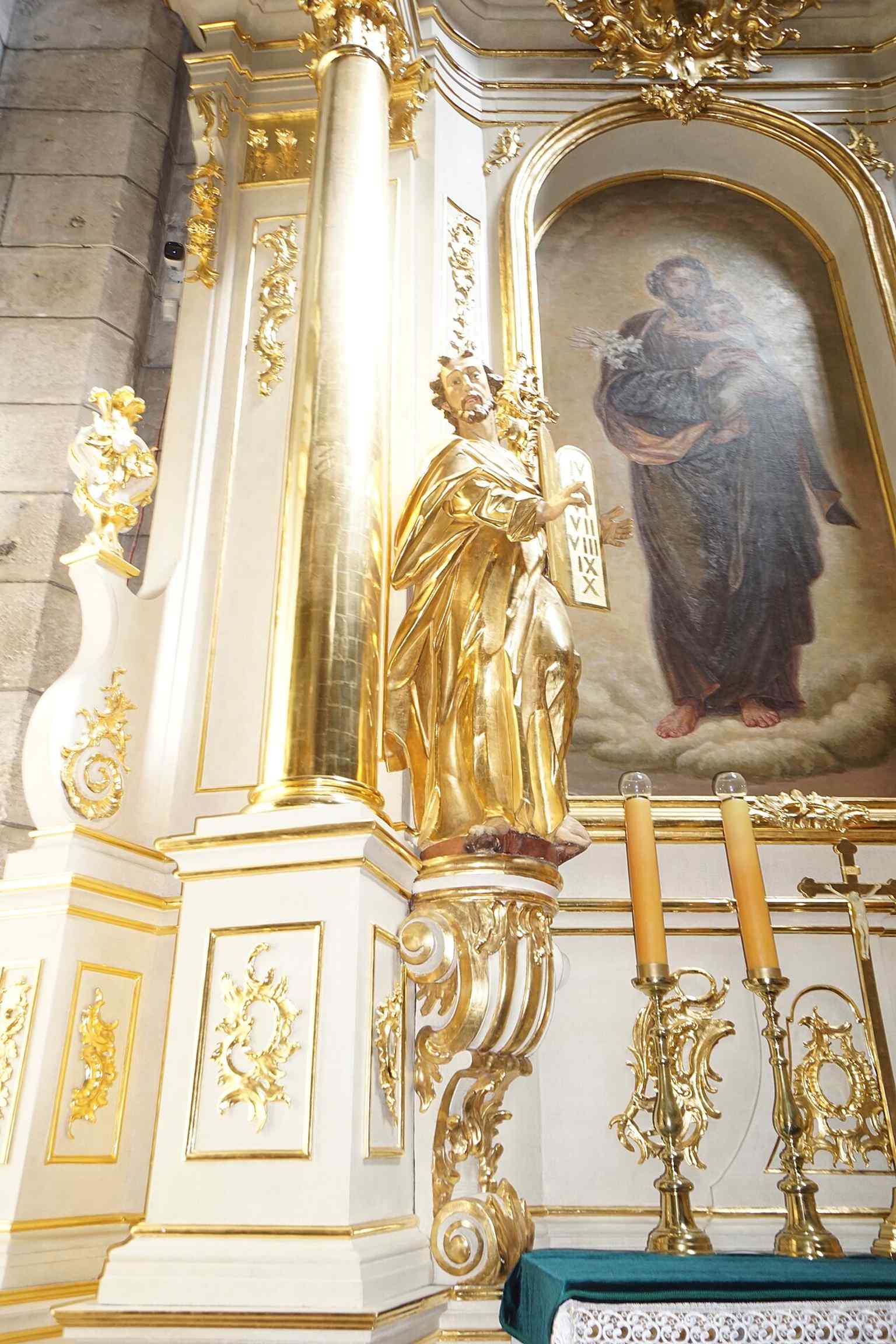
A recent high-resolution view of the basilica at its modern address, linking the living parish to its medieval foundation.Photo: Igor123121, Wikimedia Commons, CC BY 4.0. Cropped & resized. 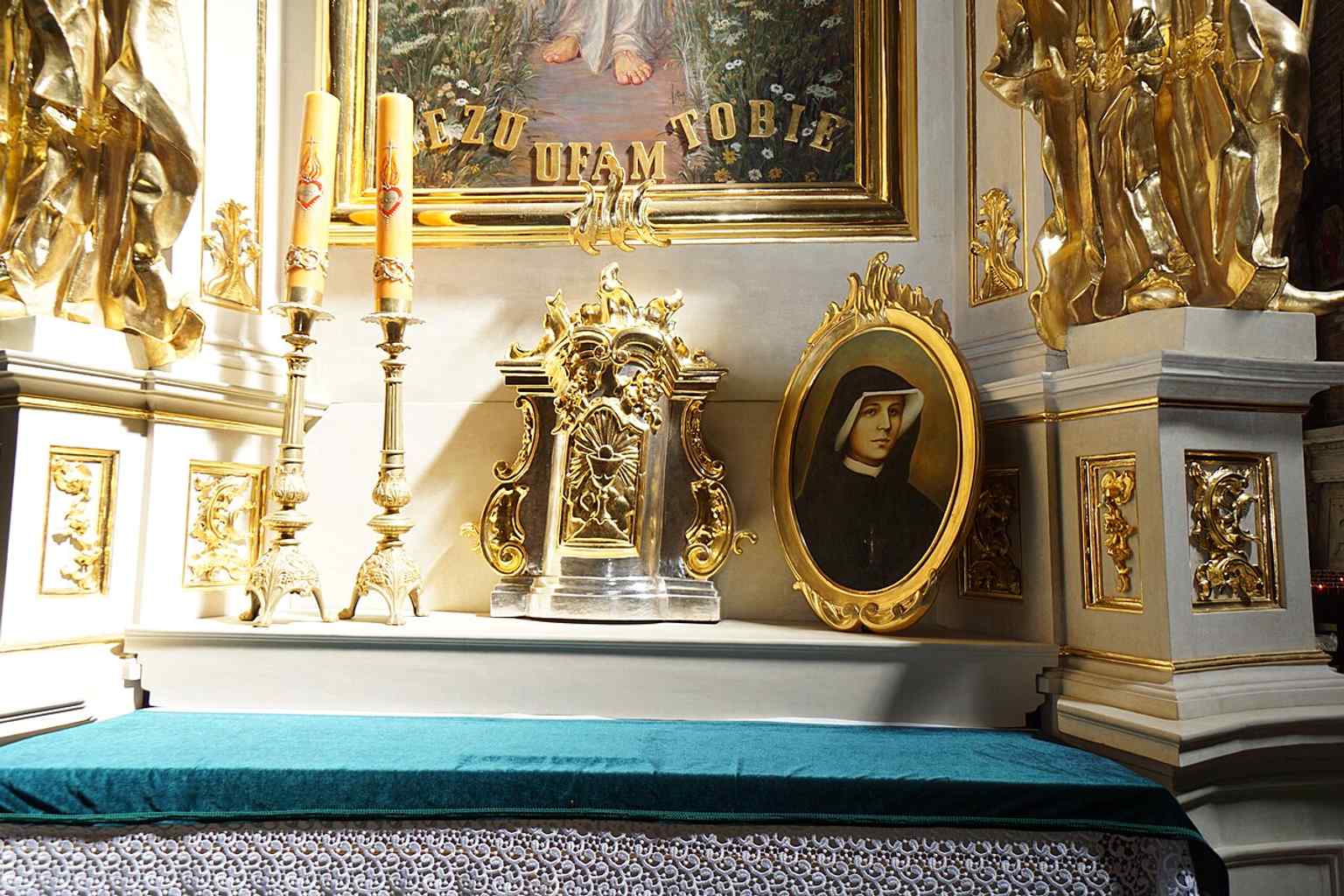
An architectural detail from the basilica complex, part of the cloistered setting that once included cells, treasury, and oratory.Photo: Igor123121, Wikimedia Commons, CC BY 4.0. Cropped & resized. 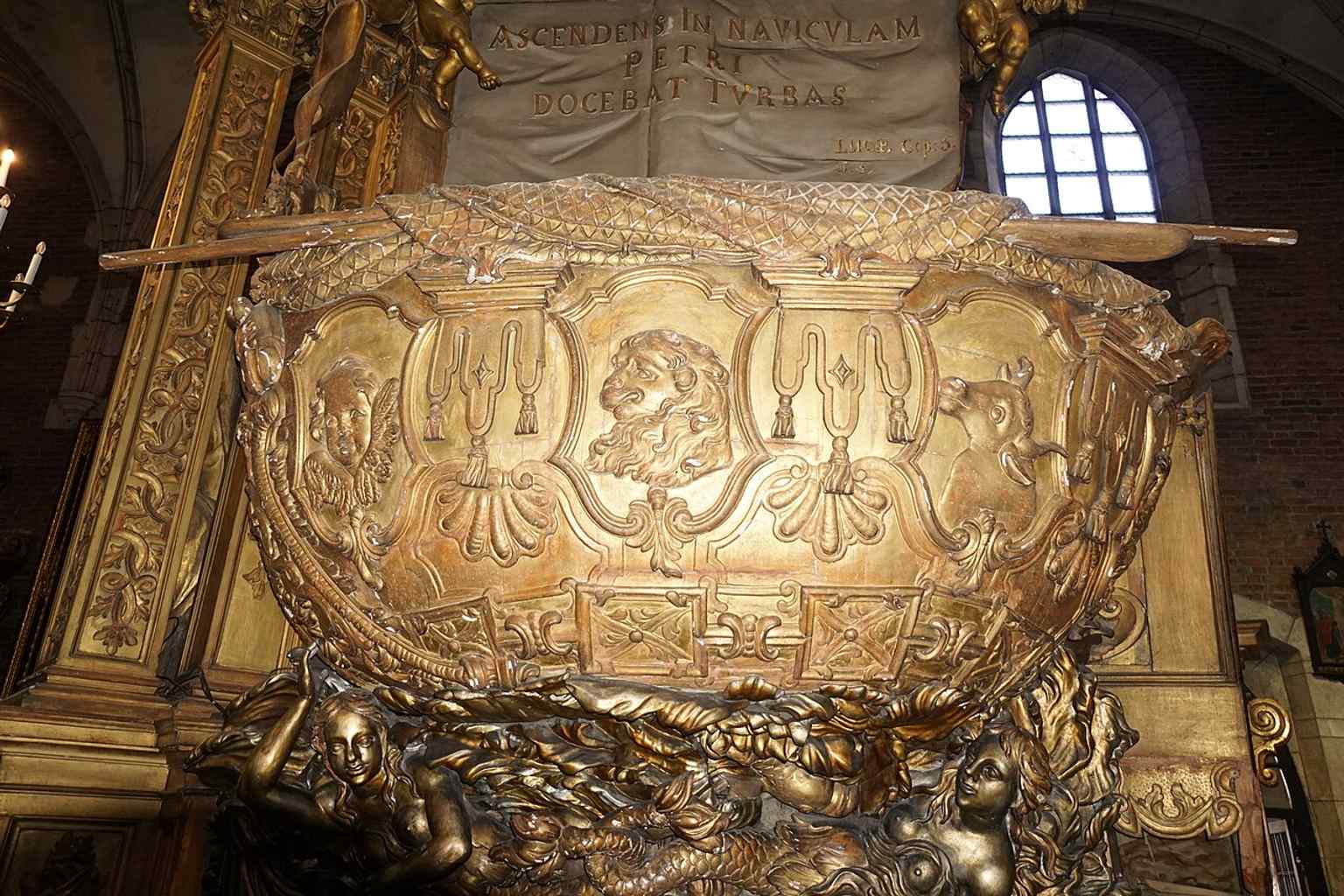
A close look at the church fabric and historic brickwork, echoing the building campaigns that stretched from the 14th century onward.Photo: Igor123121, Wikimedia Commons, CC BY 4.0. Cropped & resized. 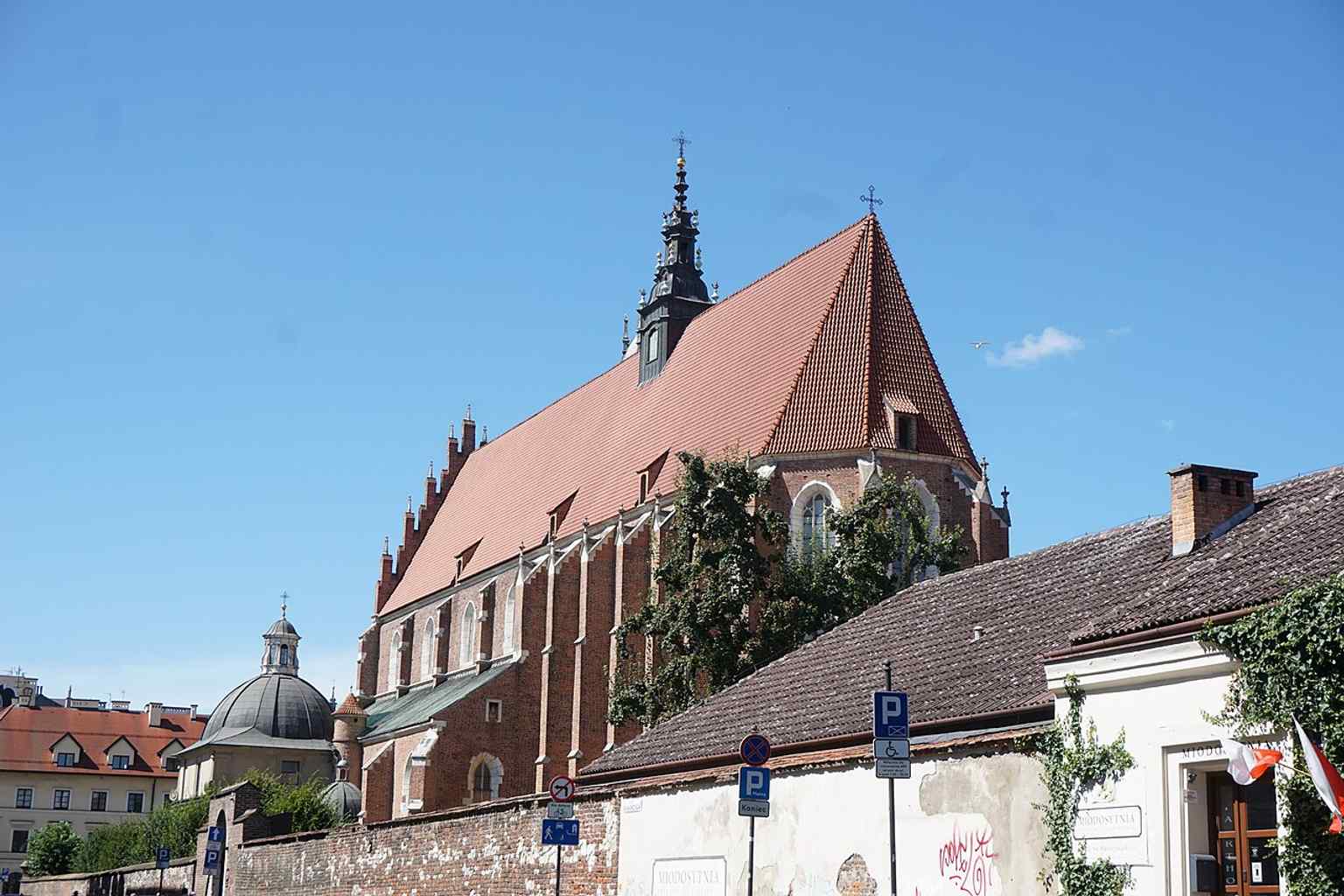
A clear modern exterior view of Corpus Christi Basilica, the best starting point for introducing the landmark itself.Photo: Igor123121, Wikimedia Commons, CC BY 4.0. Cropped & resized. 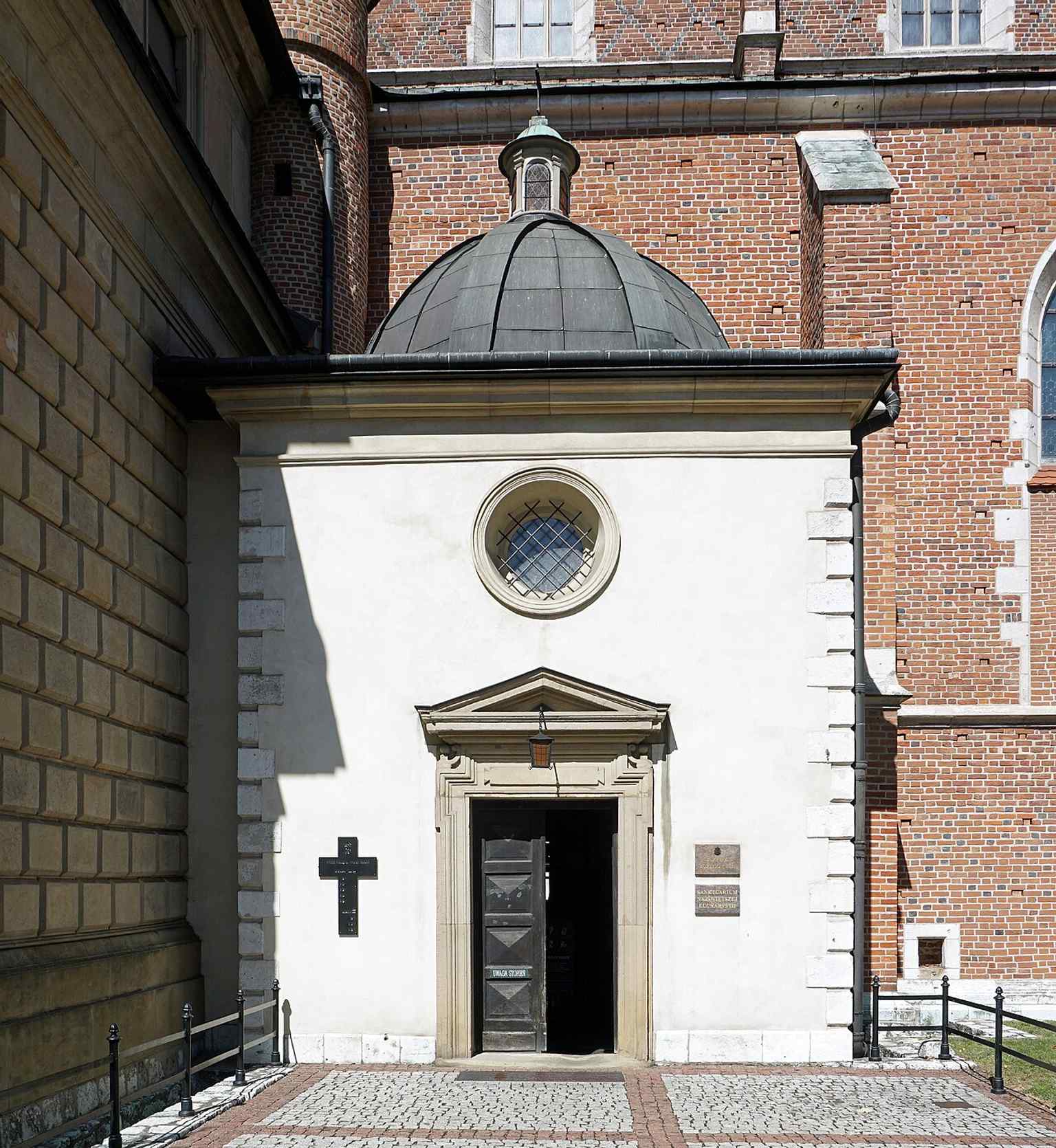
A detailed close-up that helps convey the basilica’s preserved historic shell after later restorations.Photo: Igor123121, Wikimedia Commons, CC BY 4.0. Cropped & resized. Look for a broad weave of stucco-and-stone townhouses, straight street lines, and the rising towers and synagogue rooflines that make Kazimierz feel less like one building than a…Read moreShow less
Open dedicated page →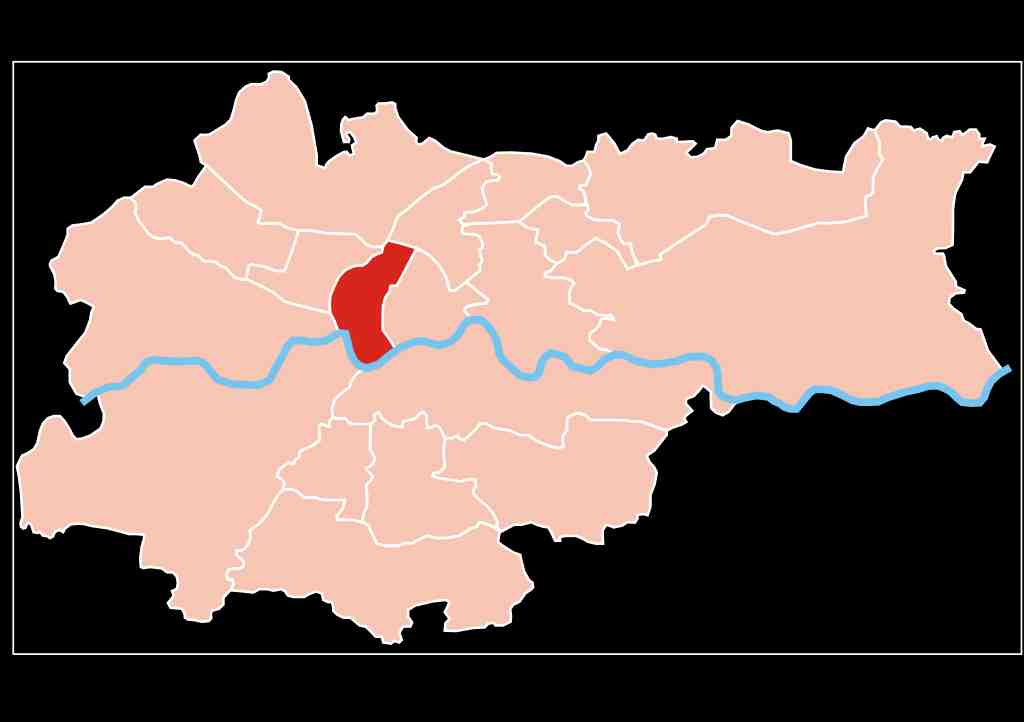
KazimierzPhoto: Wikimedia Commons contributor, Wikimedia Commons, CC BY-SA 3.0. Cropped & resized. Look for a broad weave of stucco-and-stone townhouses, straight street lines, and the rising towers and synagogue rooflines that make Kazimierz feel less like one building than a whole old city preserved in place.
Kazimierz is the rare place that still behaves like a former town, even after the map insists it belongs to somewhere larger. In thirteen thirty-five, King Casimir the Great looked south of Kraków and founded a new royal city here, naming it after himself. He gave it self-rule under Magdeburg Law, a German system of urban law, ordered walls in the thirteen sixties, and set in motion something larger than a suburb. This was meant to be a proper urban organism: market square, churches, trade routes, defenses, authority.
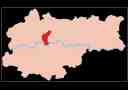
If you glance at the map in the app, you can see the secret that explains the whole district. Kazimierz once sat apart from Kraków, divided by a branch of the Vistula called the Old Vistula River. That green line now known as Józef Dietl Street is not just an avenue; it is a buried riverbed. Locals know that when you cross it, you are really crossing an old piece of geography that used to decide who belonged to which city. That separation helped Kazimierz become two things at once. Its Christian heart grew around Wolnica Square, Corpus Christi, and Skałka. Its northeastern quarter became the Oppidum Judaeorum, the Jewish City, dense behind its own internal walls, only a fifth of Kazimierz in area but nearly half its population. The turning point came after the great fire of fourteen ninety-four. In fourteen ninety-five, King Jan Olbracht forced Jews out of Kraków’s Old Town and into Kazimierz. Brutal as that was, it also began the concentrated Jewish Kazimierz whose synagogues, schools, and courts made this district a spiritual centre of Polish Jewry.
One man helps fix that world in memory: Rabbi Moses Isserles, the Remuh. His grave, his synagogue, and the cemetery we began with turned Kazimierz into a destination for study and devotion, not merely residence. Around him lived scholars, craftsmen, physicians, and merchants. Prayer filled courtyards; law and learning travelled from house to house.
Then the district changed again. Emperor Joseph the Second dissolved the Jewish communal government in seventeen eighty-two. Austria absorbed Kraków after the partitions. In eighteen twenty-two, workers tore down the old walls. And yet the old patterns clung on. Sabbath law kept many Jewish families close to the synagogues, so memory remained anchored to streets even after administration moved on.
Another image in the app shows the old town hall at Wolnica Square. It matters because it reminds you that Kazimierz did not begin as a theme, or a quarter, or an afterthought. It began as a city with its own civic spine. The twentieth century tried to silence all of this. In nineteen forty-one, the Germans forced Kraków’s Jews across the river into the ghetto in Podgórze, and many did not survive. After the war came violence again, neglect after that, and long years of ruin. But Kazimierz refused to stay empty. Museums, restoration, a living Remuh congregation, and the Jewish Culture Festival have brought sound back into streets once hollowed out. Even Spielberg’s Schindler’s List helped the world look again.
So here, at the end, perhaps the truest picture is this: a district shaped by a vanished river, scarred by removals, and still full of return. In Kazimierz, stones, street names, cemeteries, sanctuaries, and ordinary facades keep speaking across the breaks. If you listen carefully, this place does not tell you only who was lost. It tells you who still, stubbornly, belongs.
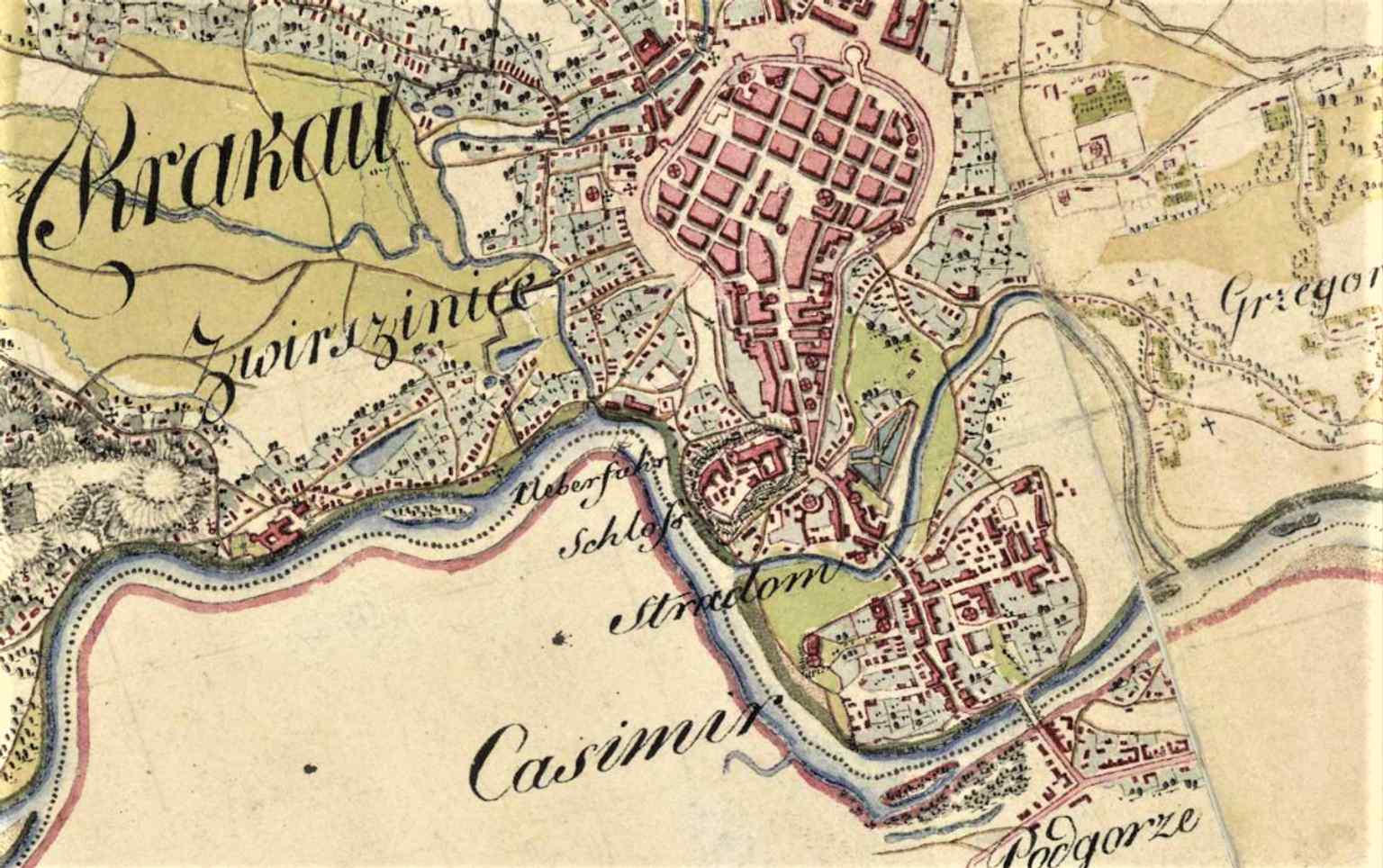
Early 19th-century map of Kazimierz, when it was still a distinct town before incorporation into Kraków.Photo: Josephinische Landesaufnahme, Wikimedia Commons, Public domain. Cropped & resized.
Frequently asked questions
How do I start the tour?
After purchase, download the AudaTours app and enter your redemption code. The tour will be ready to start immediately - just tap play and follow the GPS-guided route.
Do I need internet during the tour?
No! Download the tour before you start and enjoy it fully offline. Only the chat feature requires internet. We recommend downloading on WiFi to save mobile data.
Is this a guided group tour?
No - this is a self-guided audio tour. You explore independently at your own pace, with audio narration playing through your phone. No tour guide, no group, no schedule.
How long does the tour take?
Most tours take 60–90 minutes to complete, but you control the pace entirely. Pause, skip stops, or take breaks whenever you want.
What if I can't finish the tour today?
No problem! Tours have lifetime access. Pause and resume whenever you like - tomorrow, next week, or next year. Your progress is saved.
What languages are available?
All tours are available in 50+ languages. Select your preferred language when redeeming your code. Note: language cannot be changed after tour generation.
Where do I access the tour after purchase?
Download the free AudaTours app from the App Store or Google Play. Enter your redemption code (sent via email) and the tour will appear in your library, ready to download and start.
If you don't enjoy the tour, we'll refund your purchase. Contact us at [email protected]
Checkout securely with 






%20Synagogue%2C%2038%20J%C3%B3zefa%20street%2C%20Kazimierz%2C%20Krak%C3%B3w%2C%20Poland.jpg)


.jpg)

.jpg)


.jpg)


.jpg)
.jpg)


.jpg)


.jpg)
.jpg)
.jpg)
.jpg)
.jpg)
%20%2C%20Josephinische%20Landesaufnahme%20(cropped).png)