
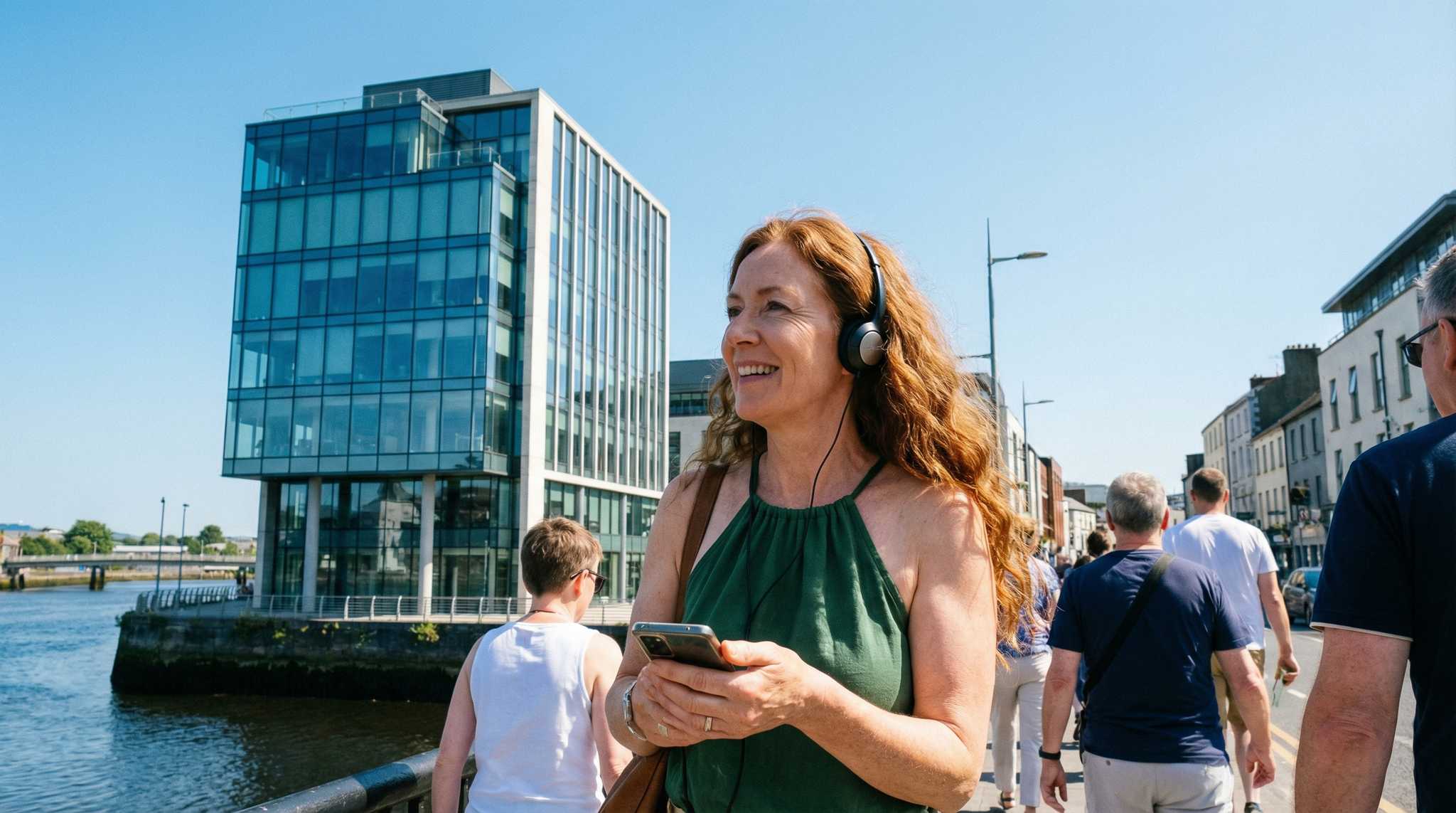
Limerick Audio Tour: Stories & Streets of Prior’s-Land Revealed
A statue in the heart of Limerick stands with silent defiance—but history here is anything but quiet. This self-guided audio tour unlocks a hidden city beneath your feet, weaving down O'Connell Street, past Riverpoint’s soaring glass, through Ormston House’s artistic shadows and beyond. Hunt the stories that most visitors miss. Why did an ordinary evening on Prior’s-Land explode in political chaos? What secret is buried beneath Riverpoint’s foundations and why was it never spoken aloud? Who vanished from Ormston House without a trace—and why does nobody speak their name? Trace power struggles and turbulent rebellions. Stand at the sites of scandal and forgotten moments. Pass sculptures and bridges pulsing with untold mysteries as you move from one landmark to the next, seeing Limerick transformed in every step. See the city others overlook. Press play and dive into Limerick’s greatest secrets.
Tour preview
About this tour
- scheduleDuration 80–100 minsGo at your own pace
- straighten2.5 km walking routeFollow the guided path
- location_on
- wifi_offWorks offlineDownload once, use anywhere
- all_inclusiveLifetime accessReplay anytime, forever
- location_onStarts at People's Park, Limerick
Stops on this tour
lock_open 3 free previews · 11 unlock with purchase
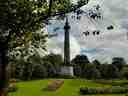
Look for the park’s black iron railings, its straight formal paths, and the tall stone Spring Rice column rising above the trees. People’s Park feels generous now, but it began…Read moreShow less
Open dedicated page →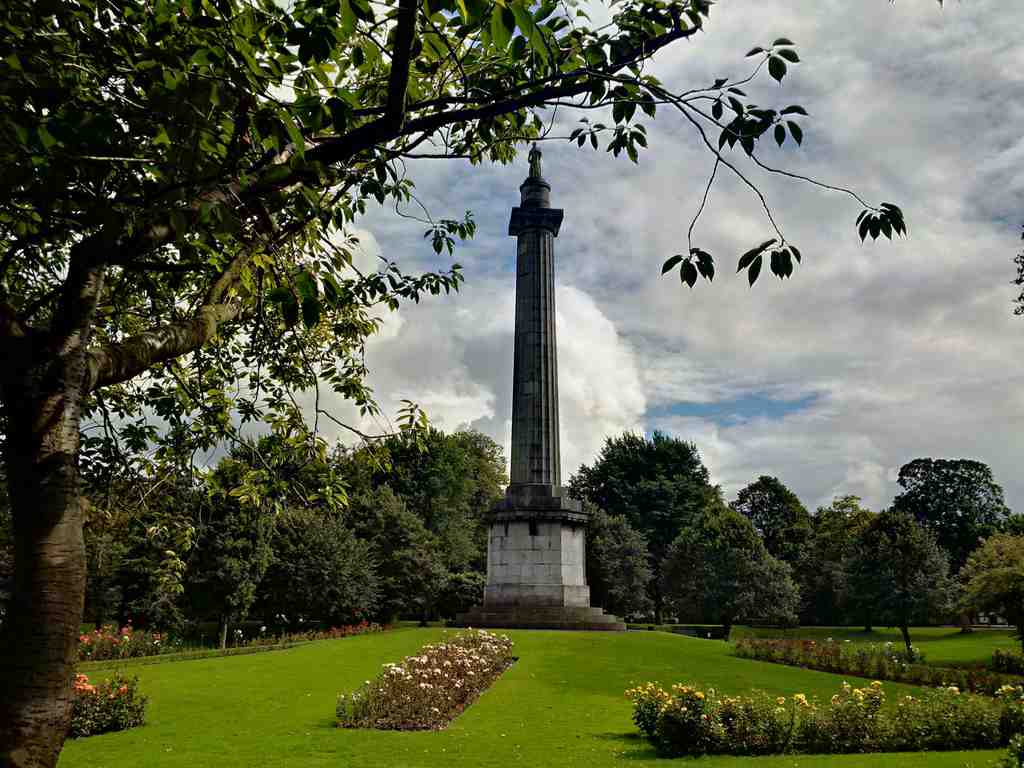
People's Park, LimerickPhoto: GilPe, Wikimedia Commons, CC BY-SA 4.0. Cropped & resized. Look for the park’s black iron railings, its straight formal paths, and the tall stone Spring Rice column rising above the trees.
People’s Park feels generous now, but it began with a locked gate in mind. In eighteen thirty-five, this ground formed part of the Newtown Pery expansion, Limerick’s great planned extension beyond the older city: a district of measured streets, elegant terraces, and a central square in the Georgian manner, that orderly style of urban design favoured in the eighteenth and early nineteenth centuries. The idea was simple enough. Build respectable houses for the affluent, place a private green at the centre, and let access itself become a badge of status.
So this “people’s” park first belonged to keyholders, not the public. Pery Square was meant to wrap neatly around it, rather like the grand squares in Dublin, though on a more modest scale. But history has a habit of spoiling clean geometry. The economy faltered, the Great Famine darkened Ireland, funds ran out, and only one terrace of the square reached completion. What had been planned as an enclosed statement of privilege slowly changed purpose.
Take a moment and look around the edges, the ordered planting, the memorials, the sense that even the greenery has been carefully arranged. For all its calm, this is designed landscape, almost a drawing in stone and grass.
If you glance at the image on your screen, you can see an earlier view of the park before later additions softened and expanded it. One detail locals sometimes pass without comment is the tall memorial column. It honours Thomas Spring Rice, Limerick’s M-P from eighteen twenty to eighteen thirty-two. Later, as Lord Monteagle, he denounced British famine policy in the House of Lords. That column did more than remember a man; it first signalled elite influence in a private square, and then survived into a public park, carrying its old message into a completely different civic life. The place officially opened to the people of Limerick in eighteen seventy-seven, in honour of Richard Russell, a prominent local businessman. Even then, the Earl of Limerick’s five-hundred-year lease came with conditions: no political or religious meetings, and no bands on a Sunday. Public, yes, but still supervised. Around you, Victorian features such as the bandstand, the ornate Richard Russell drinking fountain, and the gazebos show how the city kept adapting the park rather than abandoning it. At the northern edge, the art gallery began life as Andrew Carnegie’s Free Library and Museum; when he laid the foundation stone in October nineteen oh-three, builders sealed newspapers, coins, and a parchment record inside like a message to the future.
Walk on to Pery Square, about three minutes away. There, the polished face of this district begins to reveal the money, ambition, and unease that shaped it. If you return later, the park is generally open daily from eight in the morning until nine in the evening.
Ahead of you is a long terrace of red-brick Georgian houses, laid out in a strict crescent-like line, with tall sash windows and fanlit doorways, all terminated to the south by…Read moreShow less
Open dedicated page →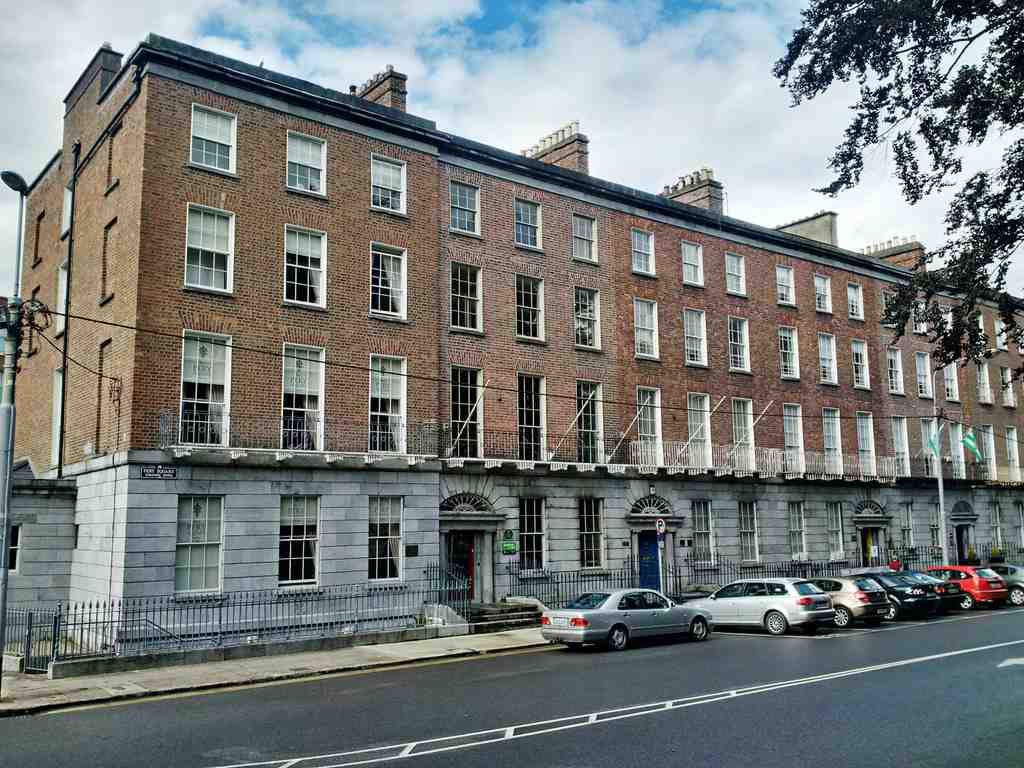
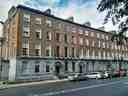
Pery SquarePhoto: GilPe, Wikimedia Commons, CC BY-SA 4.0. Cropped & resized. Ahead of you is a long terrace of red-brick Georgian houses, laid out in a strict crescent-like line, with tall sash windows and fanlit doorways, all terminated to the south by the pointed Gothic mass of Saint Michael’s Church.
Pery Square is one of Limerick’s grandest displays of composure, but its calm face hides a rather unnerving bargain. The terrace rose between eighteen thirty-five and eighteen thirty-eight, when the Pery Square Tontine Company set out to create a polished address in Newtown Pery, naming it for the politician Edmund Sexton Pery. James Pain supervised the work, and a contractor from Ennis, Pierse Creagh, carried it into being. By eighteen thirty-eight, tenants had already moved in.
If you glance at the image on your screen, you can see the effect they were after: brick, symmetry, restraint, and status. This was late Georgian architecture at full stretch, one of the finest examples in Limerick, and indeed in Ireland. Yet the money behind it came from what locals called the “Life and Death Lottery.” A tontine is a shared investment where returns grow as other nominees die. The clever, chilling twist here was that each investor bought a share and attached it to a named “life” - often a child, sometimes a public figure. As those lives ended, their shares died with them, and the value concentrated in fewer and fewer hands.
There were eighty-nine original shares. Among the nominated lives were Prince Albert and Princess Augusta, granddaughter of George the Third. The scheme dragged on for more than seventy years, ending only in nineteen thirteen, when six lives remained. And then comes the story people remember: Sophia Vanderkiste, a widow in her seventies, discovered that her father had nominated her as a child without telling her. One morning she woke to find she now owned numbers one, two, and three Pery Square, having simply outlived almost everyone else.
That polished row across from the green also tells another story about who a city belongs to. The square’s central garden began as a private enclosure for wealthy key-holders. By eighteen seventy-seven, it had become a public park in Richard Russell’s name. The fountain in the park came from the contributions of workers at Russell’s Flour Mills, a rare tribute from employees to an employer. So the old private privilege became, in part, a public gift.
Even now, the terrace keeps changing. Number one survives as a boutique hotel; number two, restored by Limerick Civic Trust, serves as a Georgian museum. A handsome place, certainly. But like much in this city, its beauty sits on terms somebody else had to live through. When you’re ready, continue to The Crescent, about four minutes away.
Look for the pale Georgian terraces sweeping in an oval of brick and stucco, with a stone monument to Daniel O'Connell standing at the centre like a fixed point in the curve. The…Read moreShow less
Open dedicated page →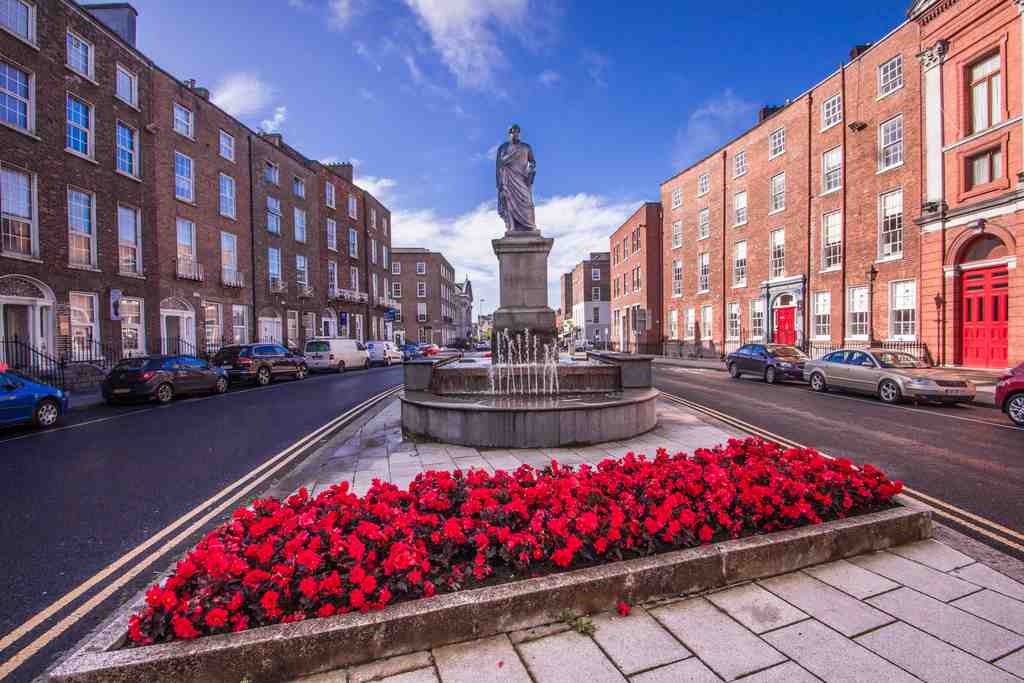
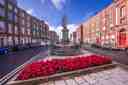
The Crescent, LimerickPhoto: Stevesphotography, Wikimedia Commons, CC BY-SA 4.0. Cropped & resized. Look for the pale Georgian terraces sweeping in an oval of brick and stucco, with a stone monument to Daniel O'Connell standing at the centre like a fixed point in the curve.
The Crescent is one of the set pieces of Georgian Limerick, and it knows it. The paired terraces bend into that distinctive oval, giving the street its present name, though it began as Richmond Place, after Charles Lennox, the fourth Duke of Richmond. Then, in eighteen fifty-seven, the city placed Daniel O'Connell here. John Hogan sculpted the monument, and local memory still prizes it as the first outdoor statue ever raised to O'Connell. That matters. A statue does not merely remember a man; it claims ground for him. From this point onward, O'Connell’s campaign for Catholic Emancipation did not live only in speeches and newspapers. It stood in stone at the centre of a fashionable address. If you glance at your screen, you can see the monument’s assured stance more clearly.
But prestige streets rarely keep a single purpose. On the west side, the Church of the Sacred Heart entered the scene in the eighteen sixties for the Jesuits, with William Edward Corbett generally taking the credit, though later Byrne gave it a new front in nineteen hundred, one that sits slightly out of tune with the Georgian terrace beside it. Next door, the Jesuits took Crescent House in eighteen sixty-two, expanded their college, and, at Bishop George Butler’s request, opened a free school for poorer boys in eighteen sixty-four. One elegant curve, two very different ideas of who a city should serve.
Then the ground shifted. The Jesuits closed the church in two thousand and six, and after that John O’Dolan bought it for a reported four million euros and floated an astonishing plan: Roman Baths, with a twenty-metre swimming pool in the nave, the church’s main central hall. The scheme reached pre-planning talks and went no further. In two thousand and twelve, Canon Wulfran Lebocq and the Institute of Christ the King Sovereign Priest bought the building for seven hundred thousand euros and began hauling it back toward worship. Volunteers scrubbed the long-shut interior, the organ from nineteen twenty-four sounded again, and restoration continued stone by stone, donation by donation. The older photograph on your phone shows the church and college before that uncertain afterlife began.
So here is the question The Crescent leaves hanging: when a building outlives the purpose that first justified it, should a city preserve it, reinvent it, or let it fade rather than choose? We will carry that thought on to Belltable, about two minutes away. If you are using this stop practically, businesses around The Crescent generally trade from half past nine until six, stay open later on Thursday and Friday, and open from noon on Sunday.
Show 11 more stopsShow fewer stopsexpand_moreexpand_less
On your right, look for the broad red-brick frontage with its rectangular face, a glass entrance at street level, and the Belltable name set across the front. Belltable tells you…Read moreShow less
Open dedicated page →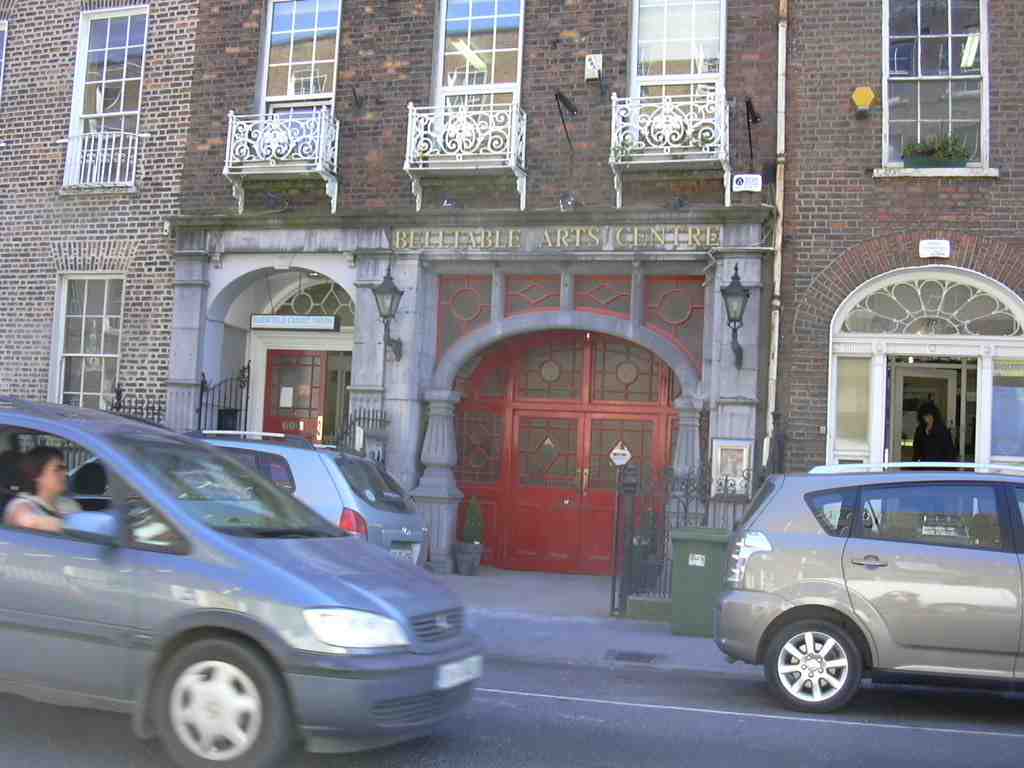
BelltablePhoto: A bit iffy, Wikimedia Commons, Public domain. Cropped & resized. On your right, look for the broad red-brick frontage with its rectangular face, a glass entrance at street level, and the Belltable name set across the front.
Belltable tells you something central about Limerick: this city has long loved a crowd gathering in one room to watch something unfold. Cinema, theatre, concerts, public talks, odd little experiments that might delight you or leave you baffled - all of that belongs to Limerick’s character. A city does not only perform in its streets; sometimes it performs in the dark, with everyone facing the same stage.
This building has changed costume more than once. Before Belltable, it lived as the Coliseum Cinema and, in another chapter, as the Redemptorist Confraternity Hall. Locals still enjoy the small irony that “Belltable” was itself a compromise: when the arts centre opened in nineteen eighty-one, one side wanted to keep the grand old Coliseum name, while the Confraternity Credit Union wanted to honour its own heritage, so they settled on Henry Hubert Belltable, the Belgian army officer who founded the Holy Confraternity here. Even the name above the door is a negotiated peace between nostalgia and ownership.
The show began in nineteen seventeen, when local merchant Michael Gough opened the Coliseum. His daughter Lena, a trained opera singer, used to perform arias between film screenings, which is wonderfully Limerick: not content with cinema alone, the place added live voice as well. In nineteen twenty-eight, the building screened Limerick’s first talking picture, The Jazz Singer. If you glance at the image in the app, you’ll see how restrained the exterior seems; all the drama happened once you crossed the threshold.
Then the glamour frayed. By the nineteen fifties, locals called it a flea-pit, and after a bitter strike in nineteen fifty-one to nineteen fifty-two, it closed. In one of those turns cities specialise in, the silent auditorium became a shirt factory in nineteen fifty-three, with sewing machines rattling where audiences had once waited for the lights to drop.
Its modern life has been just as dramatic. Inside are a two hundred and twenty-seat theatre-cinema, gallery, rehearsal rooms and workspaces for artists. Mike Finn premiered Pigtown here in nineteen ninety-nine, then returned years later and called the place a hothouse for Limerick talent. Even in rougher periods, Belltable Unfringed kept the spirit alive with gloriously unruly work, including a vegetable circus called Cirque de Légume. Then came the collapse in twenty thirteen: a one million euro refurbishment ran over by three hundred thousand euro, creditors met in an angry room, and Joanne Beirne dryly dubbed the new seating arrangement “Vatican Two theatre” because actors had to look up at the audience. The theatre reopened in twenty sixteen, proving that some buildings never stop auditioning for their next role.
From here, the city’s performance shifts outward - away from stage lights and toward the river, where newer glass and steel make their own statement at Riverpoint. If you want to come back, Belltable generally opens from noon to five thirty on Monday, from nine to five thirty Tuesday to Friday, and closes on Saturday and Sunday.
Riverpoint is a blue-green glass tower with a broad curved facade, a squared roofline, and a slimmer companion block rising just behind it on the quay. What you are looking at is…Read moreShow less
Open dedicated page →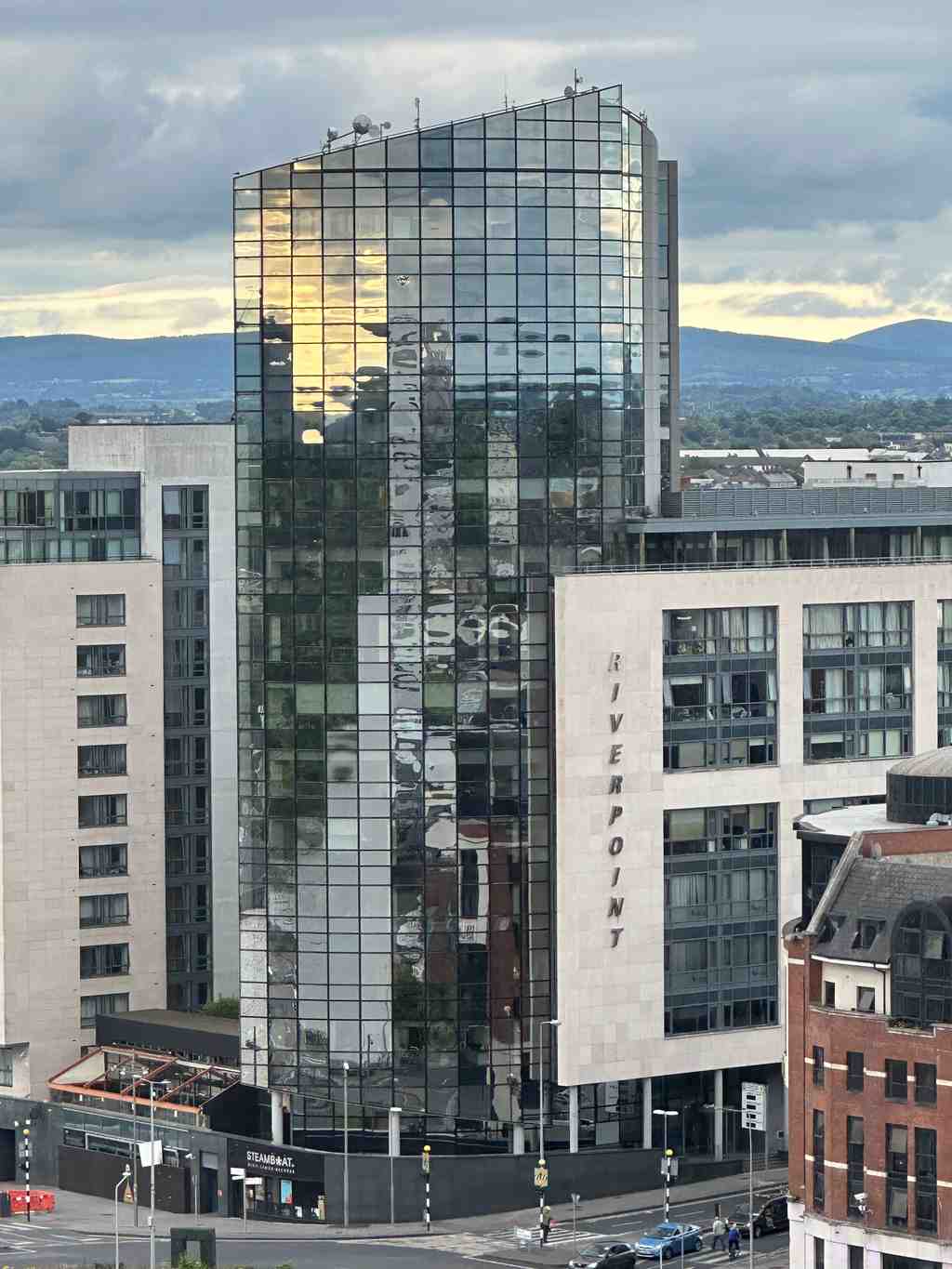
RiverpointPhoto: Kindlefire112, Wikimedia Commons, CC0. Cropped & resized. Riverpoint is a blue-green glass tower with a broad curved facade, a squared roofline, and a slimmer companion block rising just behind it on the quay.
What you are looking at is Limerick trying, very deliberately, to look ahead. People here spoke about turning the city back toward the Shannon, and Riverpoint became one of the clearest statements of that intention: not a shy building, but a glittering marker at the bridge approach, facing the river as if the city had decided to meet its own front door properly at last.
Jim Barrett, the architect so often credited with pushing that riverside ambition, spent years arguing that Limerick should stop presenting its back to the water. Later profiles called him the city architect, even a mover-and-shaker, and this complex is one of the places where his argument took physical form. If you glance at the image on your screen, you can see Riverpoint near the start of that transformation, when the old site was still fresh in memory.
And memory matters here, because Riverpoint did not rise on neutral ground. Before this stood St Munchin’s House, a late nineteen-sixties office block so disliked that people called it one of the ugliest buildings in Limerick. It faced the Shannon with a blank concrete gable, a dead wall where a riverfront ought to have had some grace. The Department of Agriculture worked there, then moved into Riverpoint, a quiet but telling change: the state itself stepped out of an old embarrassment and into a glass tower.
At fifty-eight point five two metres, Riverpoint still makes its point rather well. It is one of the taller storeyed buildings in the country and a striking marker on the skyline. The scheme promised a complete urban package: thirteen floors of offices, one hundred and thirty-seven apartments across the two towers, a restaurant, a fitness centre, and an underground car park.
But Limerick’s grand resets rarely stay pure for long. Developer Michael Daly tied Riverpoint to boom-time confidence, then to the crash, when Anglo Irish Bank won an eighty-six point five million euro judgment against him in twenty ten. And the contrast sharpened again in December twenty fourteen, when residents told reporters that homeless people were sleeping in penthouse-floor corridors. That is the uncomfortable truth standing inside the polished glass: aspiration above, hardship close by.
If you want a cleaner modern view, the app has one as well. Yet even this sleek frontage cannot quite erase what stood here before, or the uneasy questions that followed after. Riverfront renewal is only one chapter in a city that keeps trying to improve, impress, and recover. When you are ready, continue to Henry Street, about a two minute walk from here.
Look for a long, straight street framed by brick and stone facades, with the broad glazed frontage of Dunnes Stores as its most modern marker and the heavier ecclesiastical mass…Read moreShow less
Open dedicated page →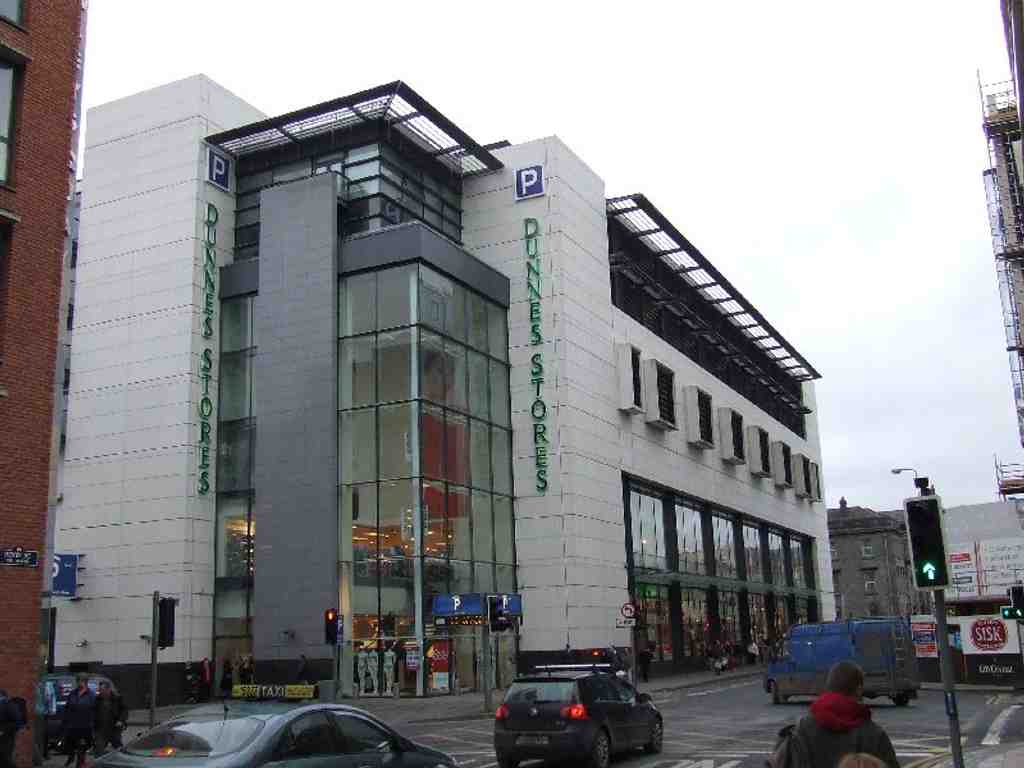
Henry Street, LimerickPhoto: FreeBird, Wikimedia Commons, Public domain. Cropped & resized. Look for a long, straight street framed by brick and stone facades, with the broad glazed frontage of Dunnes Stores as its most modern marker and the heavier ecclesiastical mass of the Franciscan church further along.
Henry Street may seem like a commercial corridor, but it has a habit of turning into a stage, then a ruin, then a stage again. In eighteen forty-eight, Joseph Fogerty fitted up a new theatre here for a Masonic ball. Later accounts claimed men tried to set it alight. That uneasy rhythm returned on the twenty-third of January, nineteen twenty-two, when the Theatre Royal on this street burned down.
And yet Henry Street kept performing. The Savoy opened here on the nineteenth of December, nineteen thirty-five. Fire tore through it in October nineteen forty-one. Then, improbably, it entered what many locals remember as a golden age under Tom English, who took charge in nineteen fifty-four at just twenty-two years old and ran the house for eight years. A street can teach you a city’s character that way: applause in one decade, ash in the next, then a queue forming all over again.
If you glance at the image on your screen, you can see one of Henry Street’s later acts of self-reinvention: the glazed Dunnes frontage that replaced the old Spaights site in two thousand and one. People had mocked Spaights as shabby and tacky; its replacement became a small declaration that the city intended to smarten its cuffs and carry on.
But Henry Street does not keep only commercial memory. It also keeps political memory at pavement level. A plaque marks the birthplace of Seán South, born here and later active in Clann na Poblachta, Sinn Féin, the Gaelic League and the Legion of Mary. So here, on one ordinary street, cinema glamour, fire, retail ambition and ideology all occupy the same address book.
Walk on toward O’Connell Street. There, these local dramas broaden into the city’s main public performance.
Look for the broad, straight avenue framed by red-brick and stucco Georgian terraces, their tall sash windows stacked in tidy rows, with Daniel O’Connell’s monument marking the…Read moreShow less
Open dedicated page →Look for the broad, straight avenue framed by red-brick and stucco Georgian terraces, their tall sash windows stacked in tidy rows, with Daniel O’Connell’s monument marking the far end at the Crescent.
This is the street where Limerick presents itself to the world. O’Connell Street is the city’s main thoroughfare, running almost a mile in a long, confident line, parallel to the Shannon, and cutting through the centre as the showpiece of Newtown Pery. In seventeen sixty-five, Edmund Sexton Pery asked the engineer Davis Ducart to design a new district on his southern lands, and this street became its centrepiece. That was a bold move: the city’s wealthier residents began leaving the older medieval quarters of Englishtown and Irishtown for these broader, grander addresses.
Its name tells its own little drama. For years it was George’s Street, honouring King George the Third. Later, Limerick gave the same central artery to Daniel O’Connell instead. The city did not simply raise O’Connell on a monument at the Crescent; it let his name run the full length of its civic spine. That is what a main street often does. It reveals who a city wishes to honour, and how confidently it wishes to be seen.
Commerce arrived early and held on stubbornly. Around eighteen fourteen, a drapery business traded on the Cannock’s site. Then, in eighteen fifty, George Cannock and John Arnott bought the shop at number one hundred and thirty-four George Street and built it into one of Limerick’s best-known retail names. For many locals, Cannock’s became part of family ritual, especially the famous Christmas windows. Then came the wound. In the early nineteen sixties, builders replaced the old façade and landmark clock tower in a rebuild that former staff and historians later called a “philistine exercise” - in plain terms, a crude act of redevelopment that stripped away much of the building’s character. When Cannock’s closed in nineteen eighty, people mourned more than a shop. They mourned a familiar face of the street.
If you fancy it, have a look at the before-and-after image in the app; the bones of George Street remain recognisable even after the façades and traffic systems changed.
That tension between pride and vulnerability still hangs here. O’Connell Street remains the city’s retail and financial centre, lined with banks, department stores, bookshops and hotels. Yet a study in twenty twelve found that sixteen percent of its retail units stood vacant, the weakest figure for a main city street in Ireland at the time. A grand address, then, but not an invincible one.
And that is why Belltable matters so much here. Earlier, you met it at number sixty-nine: a two hundred and fifty-seat theatre-cinema, a smaller studio, a gallery, and a place for poetry and performance. On a street so often judged by tills, rents and footfall, Belltable quietly insists that a city’s main street must also make room for thought, experiment and risk.
From here, the story narrows and becomes more social. Bedford Row, about four minutes away, developed with a different sort of energy - less official, less ceremonial, and more rooted in everyday gathering. Head there when you’re ready.
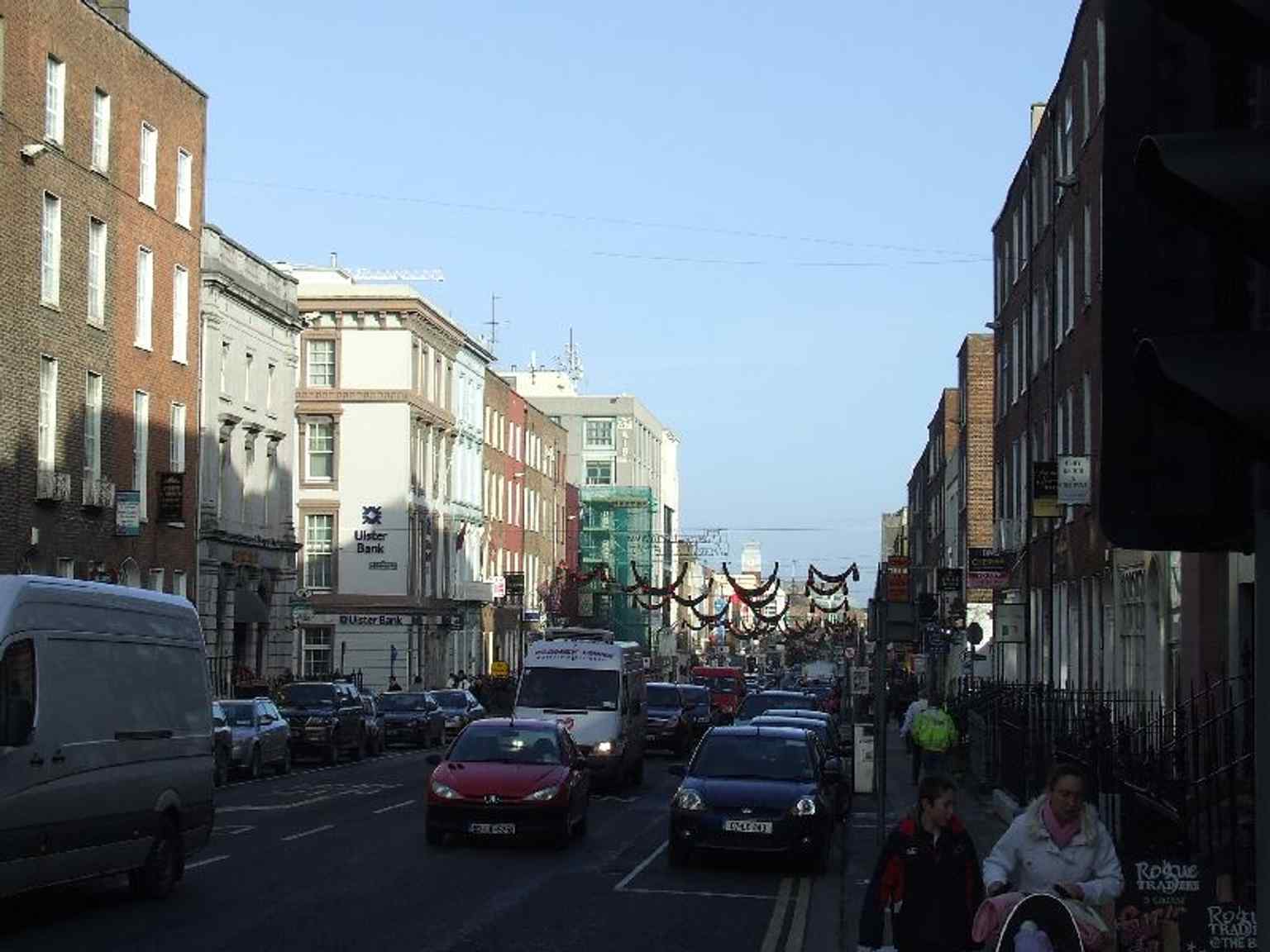
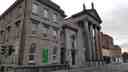
A modern view of O'Connell Street, Limerick’s main thoroughfare, showing the Georgian-era city centre street that was later renamed for Daniel O’Connell.Photo: Roland Czaczyk FreeBird 03:33, 14 January 2007 (UTC), Wikimedia Commons, Public domain. Cropped & resized. Look for the pale stone former friary, with its plain rectangular frontage, rows of sash windows, and the larger church building folded into the same historic complex. This is…Read moreShow less
Open dedicated page →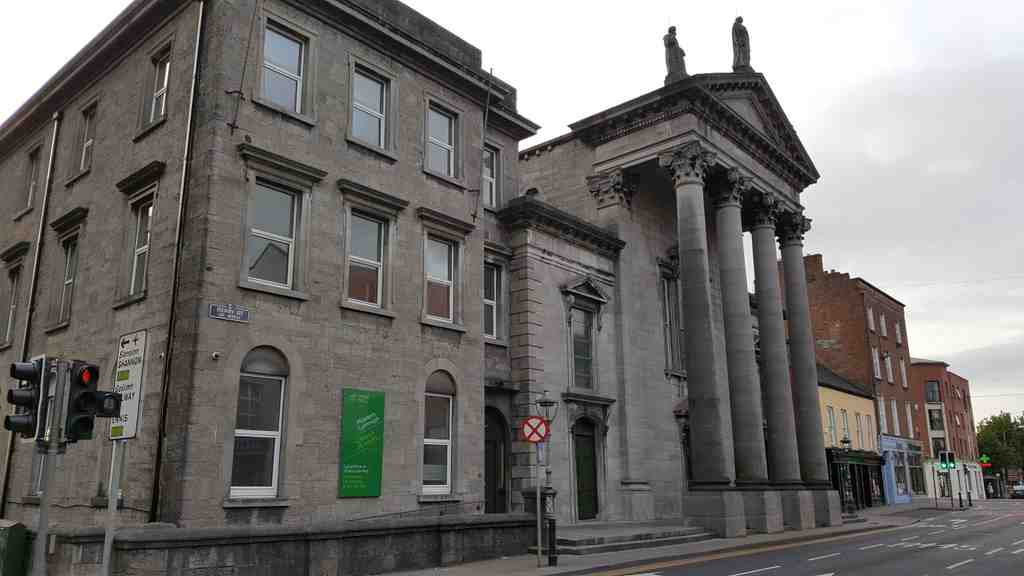
Limerick MuseumPhoto: PinkHolly, Wikimedia Commons, CC BY-SA 4.0. Cropped & resized. Look for the pale stone former friary, with its plain rectangular frontage, rows of sash windows, and the larger church building folded into the same historic complex.
This is Limerick Museum, and there is a quiet irony here. A museum is the city’s official memory machine: Limerick City and County Council gathers fragments, labels them, protects them, and decides which pieces of the past become part of the shared story. Yet this keeper of memory has led a wandering life of its own. It began in nineteen oh seven in Andrew Carnegie’s library and museum on Pery Square, opened to the public in nineteen sixteen, shifted to restored houses in John Square in nineteen seventy-nine, moved again to Castle Lane in nineteen ninety-eight, then to temporary rooms on Merchant’s Quay in twenty twelve, and only in May of twenty seventeen settled here in the old Franciscan friary. If you glance at the picture on your screen, you can see that latest chapter for yourself: not a purpose-built museum, but an older religious building given a fresh civic duty.
That rather changes the question, does it not? A city does not simply inherit memory. It edits it, rehousing it when necessary, and decides what deserves careful keeping. Which stories usually make it into museums: civic triumphs, ordinary work, political struggle, or buildings that vanished before anyone thought to love them? And which ones quietly miss the shelf?
Inside are more than sixty-two thousand objects, collected through donation, purchase, and long-term loan. Some are grand: the city charter signed by King Charles the Second, a civic sword associated with Queen Elizabeth the First, and a scabbard said to have been used by Lord Edward Fitzgerald at his arrest in seventeen ninety-eight. Some are intimate: Limerick lace, eighteenth- and nineteenth-century silver, even a gentleman’s suit from around seventeen oh six. And some are gloriously strange: Ireton’s Cat, mummified on Nicholas Street, a fragment of the largest meteorite ever to fall in Ireland, and two Second World War gas masks that, thankfully, never had to do their work.
The museum’s modern name honours Jim Kemmy, a Labour politician and twice Mayor of Limerick. That matters. Naming a museum after him ties medieval relics and revolutionary papers to a man who argued about the city in living memory. The institution has done the same in its exhibitions: Soviets and strikes, the War of Independence with one hundred and thirty county fatalities, and the First Dáil, the first revolutionary Irish parliament. Since two thousand and four, it has even catalogued its collection online, becoming the first local authority museum in the state to do so.
In a moment, continue to Sarsfield Street, about a minute away, where history steps out of the display case and back into trade, closure, and redevelopment. If you fancy coming inside later, the museum generally opens from ten to five on weekdays, with shorter Saturday hours, and it closes on Sunday.
Look for a broad, straight street framed by multi-storey stone and concrete commercial blocks, running from the solid span of Sarsfield Bridge toward the junction at O’Connell…Read moreShow less
Open dedicated page →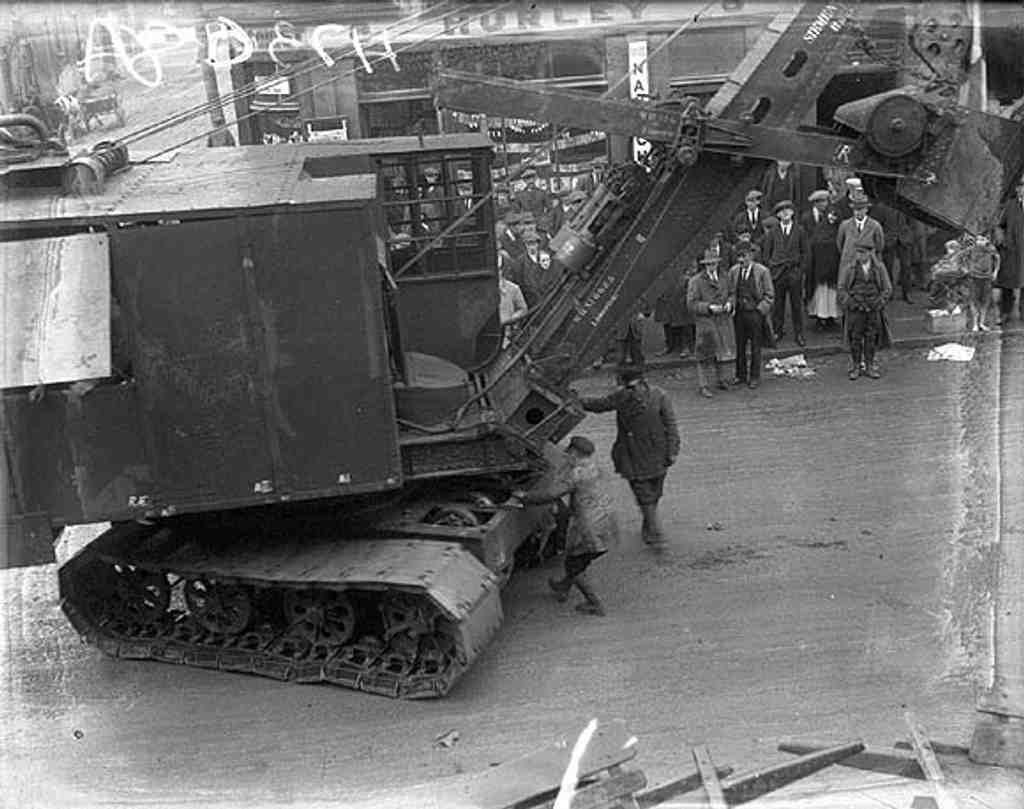
Sarsfield Street, LimerickPhoto: National Library of Ireland on The Commons, Wikimedia Commons, No restrictions. Cropped & resized. Look for a broad, straight street framed by multi-storey stone and concrete commercial blocks, running from the solid span of Sarsfield Bridge toward the junction at O’Connell Street.
Sarsfield Street is one of those places whose identity has been revised in public, and more than once. It began as Brunswick Street, then in the early twentieth century the city gave it a different patron: Patrick Sarsfield, first Earl of Lucan, the Jacobite commander who fought for King James the Second during the Siege of Limerick in sixteen ninety, and then helped arrange the Treaty of Limerick. Even the name tells you this street does not stand still. It gets relabelled to suit the story a city wants to tell about itself.
But the harder story here is commercial. Before the ring road and newer bridges diverted the flow, this was the start of the main road toward Galway, a proper working artery through the city. In eighteen twenty-nine, John Spillane opened a tobacco factory here, later remembered as the House of Garryowen. By nineteen twenty-nine, it was among the last large tobacco factories left in Limerick. And William Spillane, who owned it later, also served as mayor. That is how tightly business and civic power could fit together on one street.
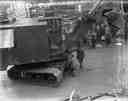
Locals know something most visitors miss: the tobacco handled here did not simply come from nearby fields. Limerick traders brought leaf from the United States, Egypt, and Turkey as well as from Irish growers. So this apparently ordinary city street sat inside a supply chain that stretched across oceans. If you glance at the image on your phone, the steam shovel passing Hurley’s Tobacconists in nineteen twenty-eight catches that mood exactly: commerce first, sentiment later. Then came the familiar urban turn. Roches Stores bought premises here in nineteen thirty-seven, suffered a fire in nineteen forty-seven, and reopened on O’Connell Street in nineteen fifty-one. Decades later, Dunnes Stores shut its large complex here in two thousand and eight and moved to Henry Street. Debenhams, formerly Roches Stores, closed in two thousand and twenty when the company collapsed in Ireland. What looked like a single retail loss was really the latest round in a long habit of opening, burning, moving, closing, and starting again.
The street’s fragility showed itself brutally in Storm Darwin in February two thousand and fourteen. Part of a building collapsed outside Sullivan’s pharmacy. The boathouse next door lost its roof. Fire crews evacuated a University of Limerick student after the door blew off her fourth-floor apartment. Part of the old Dunnes frontage also came down onto a car at the lights.
And yet, even that shell found a second use. In two thousand and nineteen, the University of Limerick bought the former Dunnes building for eight million euros, then turned it into a city-centre campus and Fab Lab, a workshop for design and digital making. In two thousand and twenty-three, the rezoning made it official: this street would not simply wait for the next shop tenant.
From here, walk about four minutes to Ormston House, where another kind of reinvention waits.
Frequently asked questions
How do I start the tour?
After purchase, download the AudaTours app and enter your redemption code. The tour will be ready to start immediately - just tap play and follow the GPS-guided route.
Do I need internet during the tour?
No! Download the tour before you start and enjoy it fully offline. Only the chat feature requires internet. We recommend downloading on WiFi to save mobile data.
Is this a guided group tour?
No - this is a self-guided audio tour. You explore independently at your own pace, with audio narration playing through your phone. No tour guide, no group, no schedule.
How long does the tour take?
Most tours take 60–90 minutes to complete, but you control the pace entirely. Pause, skip stops, or take breaks whenever you want.
What if I can't finish the tour today?
No problem! Tours have lifetime access. Pause and resume whenever you like - tomorrow, next week, or next year. Your progress is saved.
What languages are available?
All tours are available in 50+ languages. Select your preferred language when redeeming your code. Note: language cannot be changed after tour generation.
Where do I access the tour after purchase?
Download the free AudaTours app from the App Store or Google Play. Enter your redemption code (sent via email) and the tour will appear in your library, ready to download and start.
If you don't enjoy the tour, we'll refund your purchase. Contact us at [email protected]
Checkout securely with 





