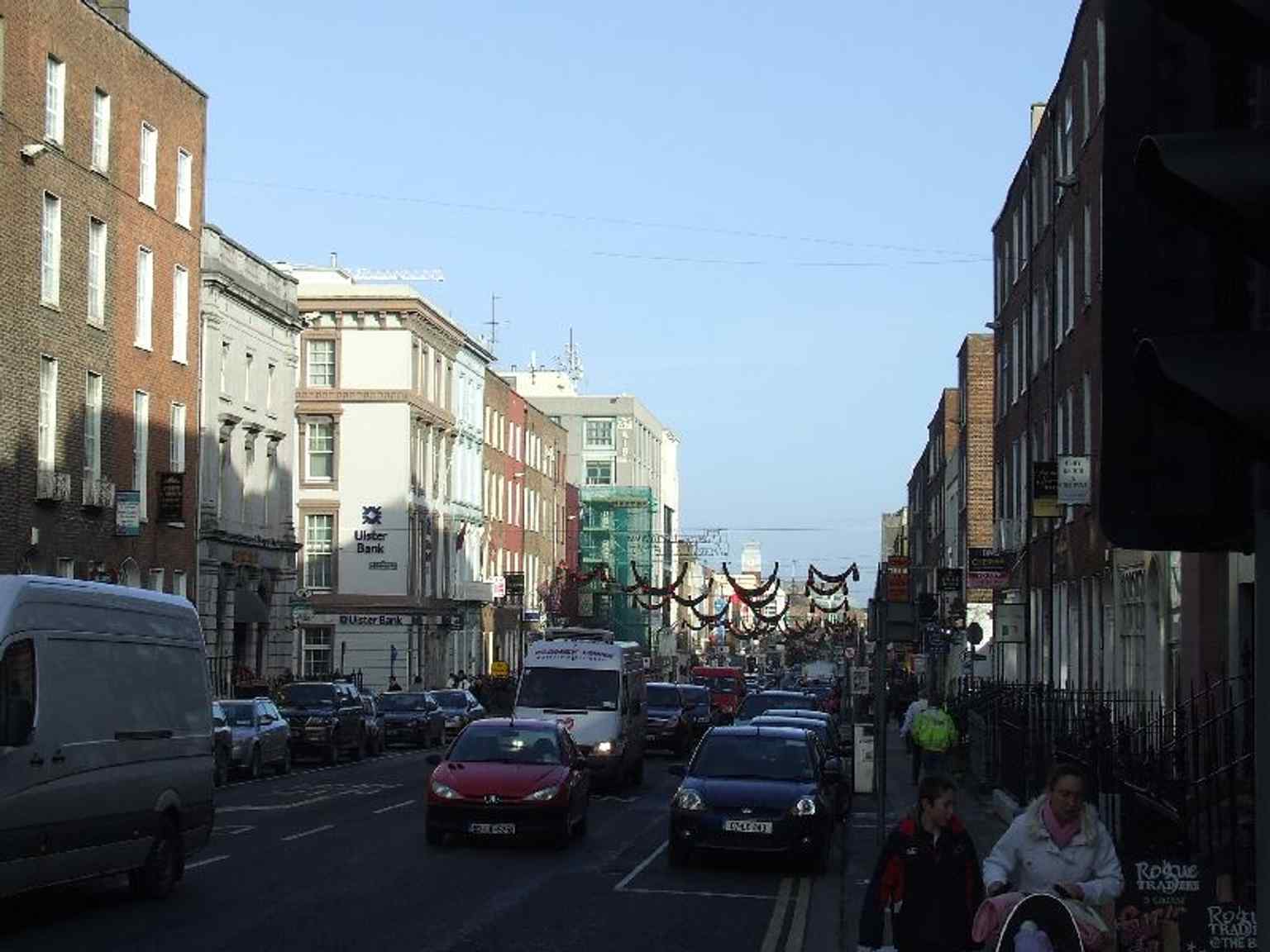
Look for the broad, straight avenue framed by red-brick and stucco Georgian terraces, their tall sash windows stacked in tidy rows, with Daniel O’Connell’s monument marking the far end at the Crescent.
This is the street where Limerick presents itself to the world. O’Connell Street is the city’s main thoroughfare, running almost a mile in a long, confident line, parallel to the Shannon, and cutting through the centre as the showpiece of Newtown Pery. In seventeen sixty-five, Edmund Sexton Pery asked the engineer Davis Ducart to design a new district on his southern lands, and this street became its centrepiece. That was a bold move: the city’s wealthier residents began leaving the older medieval quarters of Englishtown and Irishtown for these broader, grander addresses.
Its name tells its own little drama. For years it was George’s Street, honouring King George the Third. Later, Limerick gave the same central artery to Daniel O’Connell instead. The city did not simply raise O’Connell on a monument at the Crescent; it let his name run the full length of its civic spine. That is what a main street often does. It reveals who a city wishes to honour, and how confidently it wishes to be seen.
Commerce arrived early and held on stubbornly. Around eighteen fourteen, a drapery business traded on the Cannock’s site. Then, in eighteen fifty, George Cannock and John Arnott bought the shop at number one hundred and thirty-four George Street and built it into one of Limerick’s best-known retail names. For many locals, Cannock’s became part of family ritual, especially the famous Christmas windows. Then came the wound. In the early nineteen sixties, builders replaced the old façade and landmark clock tower in a rebuild that former staff and historians later called a “philistine exercise” - in plain terms, a crude act of redevelopment that stripped away much of the building’s character. When Cannock’s closed in nineteen eighty, people mourned more than a shop. They mourned a familiar face of the street.
If you fancy it, have a look at the before-and-after image in the app; the bones of George Street remain recognisable even after the façades and traffic systems changed.
That tension between pride and vulnerability still hangs here. O’Connell Street remains the city’s retail and financial centre, lined with banks, department stores, bookshops and hotels. Yet a study in twenty twelve found that sixteen percent of its retail units stood vacant, the weakest figure for a main city street in Ireland at the time. A grand address, then, but not an invincible one.
And that is why Belltable matters so much here. Earlier, you met it at number sixty-nine: a two hundred and fifty-seat theatre-cinema, a smaller studio, a gallery, and a place for poetry and performance. On a street so often judged by tills, rents and footfall, Belltable quietly insists that a city’s main street must also make room for thought, experiment and risk.
From here, the story narrows and becomes more social. Bedford Row, about four minutes away, developed with a different sort of energy - less official, less ceremonial, and more rooted in everyday gathering. Head there when you’re ready.