
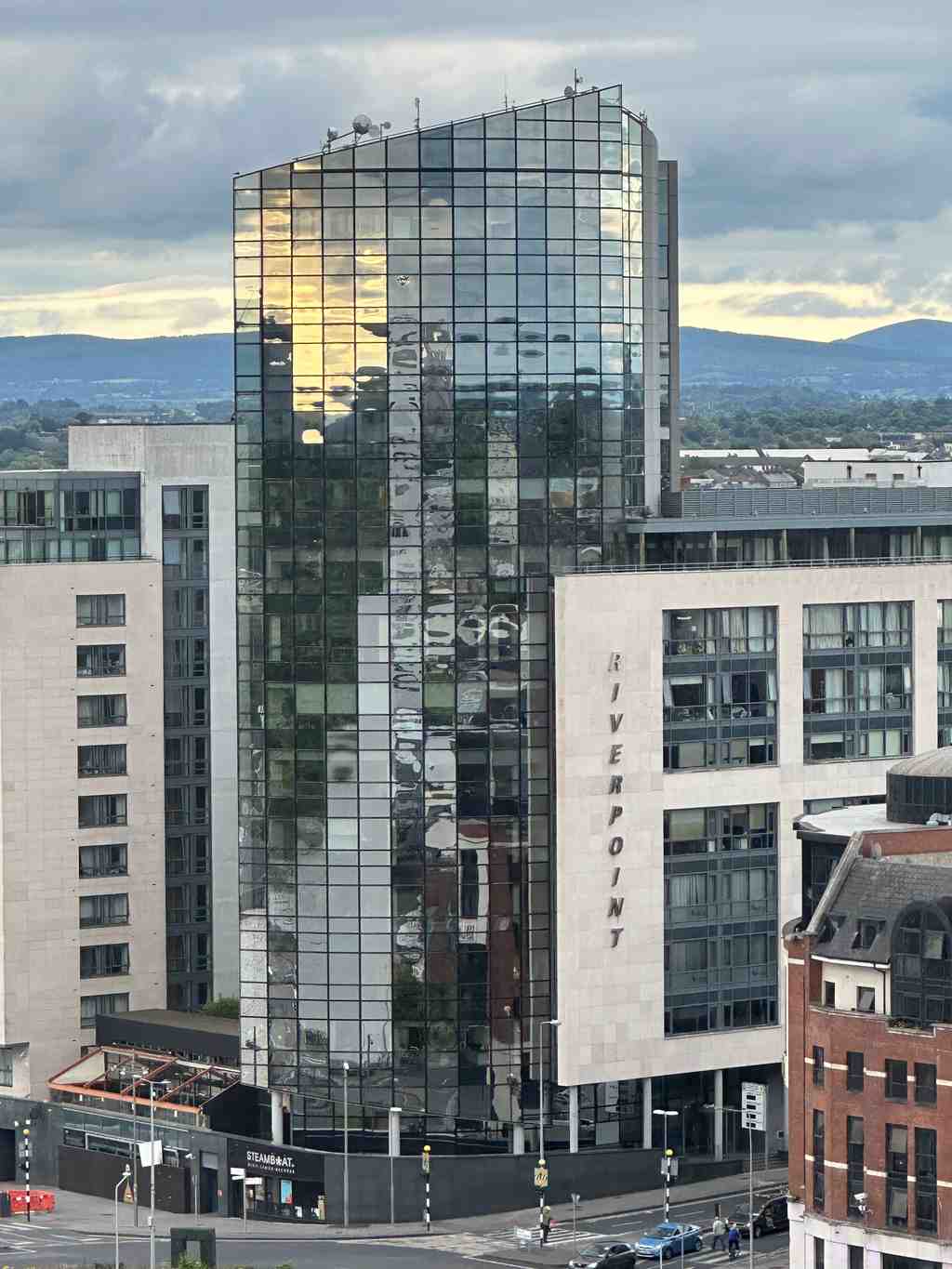
Riverpoint is a blue-green glass tower with a broad curved facade, a squared roofline, and a slimmer companion block rising just behind it on the quay.
What you are looking at is Limerick trying, very deliberately, to look ahead. People here spoke about turning the city back toward the Shannon, and Riverpoint became one of the clearest statements of that intention: not a shy building, but a glittering marker at the bridge approach, facing the river as if the city had decided to meet its own front door properly at last.
Jim Barrett, the architect so often credited with pushing that riverside ambition, spent years arguing that Limerick should stop presenting its back to the water. Later profiles called him the city architect, even a mover-and-shaker, and this complex is one of the places where his argument took physical form. If you glance at the image on your screen, you can see Riverpoint near the start of that transformation, when the old site was still fresh in memory.
And memory matters here, because Riverpoint did not rise on neutral ground. Before this stood St Munchin’s House, a late nineteen-sixties office block so disliked that people called it one of the ugliest buildings in Limerick. It faced the Shannon with a blank concrete gable, a dead wall where a riverfront ought to have had some grace. The Department of Agriculture worked there, then moved into Riverpoint, a quiet but telling change: the state itself stepped out of an old embarrassment and into a glass tower.
At fifty-eight point five two metres, Riverpoint still makes its point rather well. It is one of the taller storeyed buildings in the country and a striking marker on the skyline. The scheme promised a complete urban package: thirteen floors of offices, one hundred and thirty-seven apartments across the two towers, a restaurant, a fitness centre, and an underground car park.
But Limerick’s grand resets rarely stay pure for long. Developer Michael Daly tied Riverpoint to boom-time confidence, then to the crash, when Anglo Irish Bank won an eighty-six point five million euro judgment against him in twenty ten. And the contrast sharpened again in December twenty fourteen, when residents told reporters that homeless people were sleeping in penthouse-floor corridors. That is the uncomfortable truth standing inside the polished glass: aspiration above, hardship close by.
If you want a cleaner modern view, the app has one as well. Yet even this sleek frontage cannot quite erase what stood here before, or the uneasy questions that followed after. Riverfront renewal is only one chapter in a city that keeps trying to improve, impress, and recover. When you are ready, continue to Henry Street, about a two minute walk from here.




