
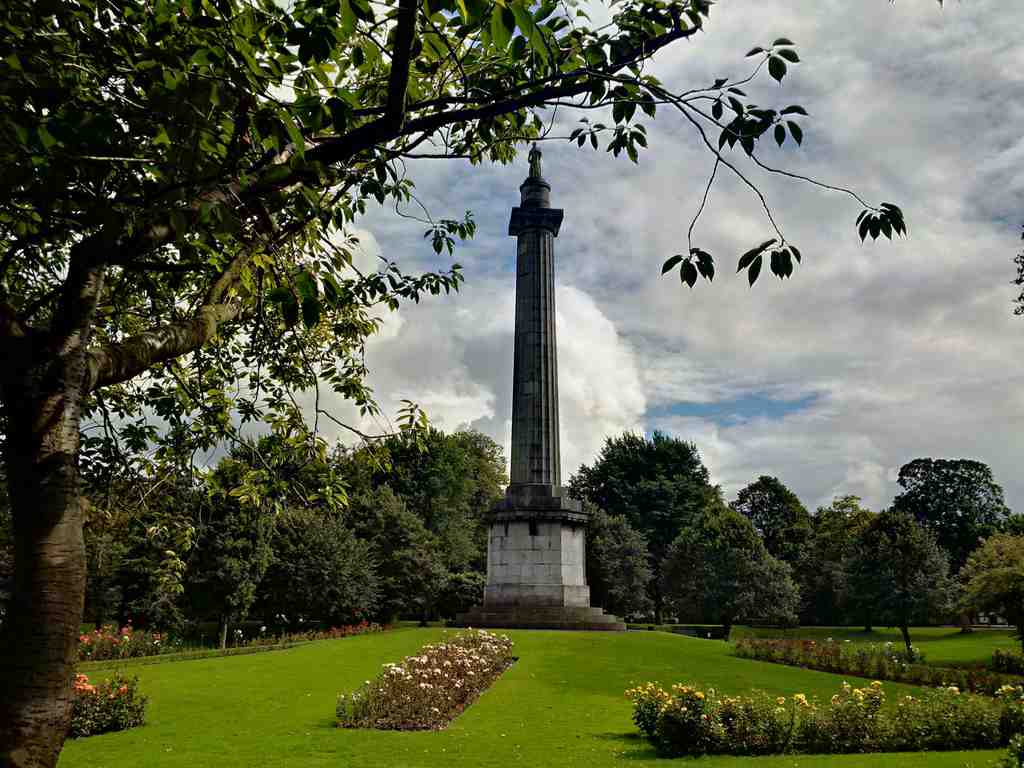
Look for the park’s black iron railings, its straight formal paths, and the tall stone Spring Rice column rising above the trees.
People’s Park feels generous now, but it began with a locked gate in mind. In eighteen thirty-five, this ground formed part of the Newtown Pery expansion, Limerick’s great planned extension beyond the older city: a district of measured streets, elegant terraces, and a central square in the Georgian manner, that orderly style of urban design favoured in the eighteenth and early nineteenth centuries. The idea was simple enough. Build respectable houses for the affluent, place a private green at the centre, and let access itself become a badge of status.
So this “people’s” park first belonged to keyholders, not the public. Pery Square was meant to wrap neatly around it, rather like the grand squares in Dublin, though on a more modest scale. But history has a habit of spoiling clean geometry. The economy faltered, the Great Famine darkened Ireland, funds ran out, and only one terrace of the square reached completion. What had been planned as an enclosed statement of privilege slowly changed purpose.
Take a moment and look around the edges, the ordered planting, the memorials, the sense that even the greenery has been carefully arranged. For all its calm, this is designed landscape, almost a drawing in stone and grass.
If you glance at the image on your screen, you can see an earlier view of the park before later additions softened and expanded it. One detail locals sometimes pass without comment is the tall memorial column. It honours Thomas Spring Rice, Limerick’s M-P from eighteen twenty to eighteen thirty-two. Later, as Lord Monteagle, he denounced British famine policy in the House of Lords. That column did more than remember a man; it first signalled elite influence in a private square, and then survived into a public park, carrying its old message into a completely different civic life. The place officially opened to the people of Limerick in eighteen seventy-seven, in honour of Richard Russell, a prominent local businessman. Even then, the Earl of Limerick’s five-hundred-year lease came with conditions: no political or religious meetings, and no bands on a Sunday. Public, yes, but still supervised. Around you, Victorian features such as the bandstand, the ornate Richard Russell drinking fountain, and the gazebos show how the city kept adapting the park rather than abandoning it. At the northern edge, the art gallery began life as Andrew Carnegie’s Free Library and Museum; when he laid the foundation stone in October nineteen oh-three, builders sealed newspapers, coins, and a parchment record inside like a message to the future.
Walk on to Pery Square, about three minutes away. There, the polished face of this district begins to reveal the money, ambition, and unease that shaped it. If you return later, the park is generally open daily from eight in the morning until nine in the evening.




