
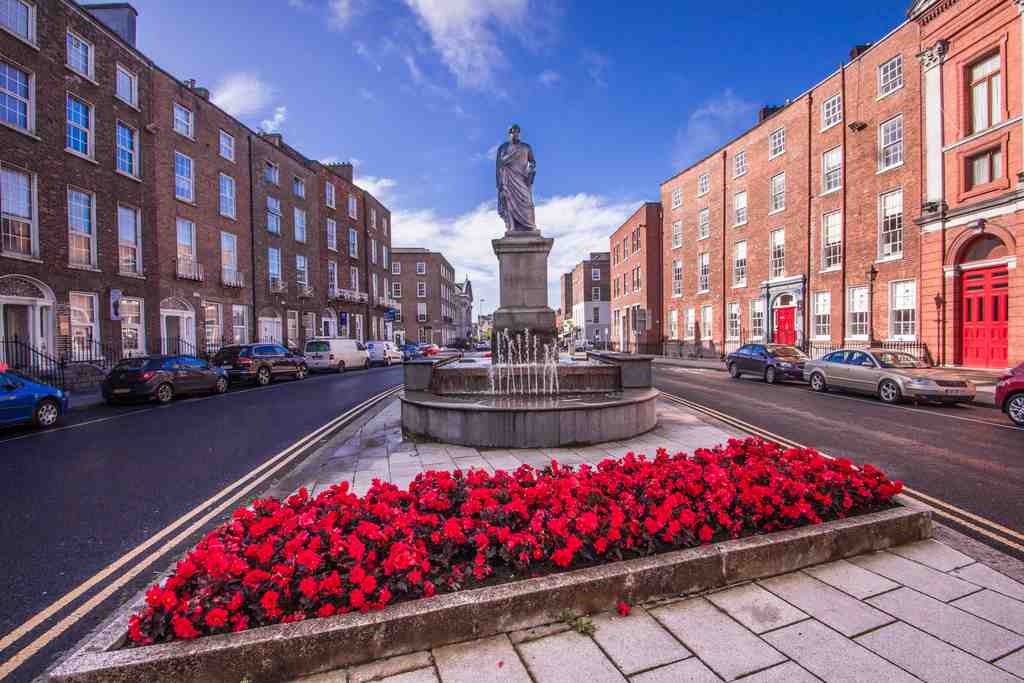
Look for the pale Georgian terraces sweeping in an oval of brick and stucco, with a stone monument to Daniel O'Connell standing at the centre like a fixed point in the curve.
The Crescent is one of the set pieces of Georgian Limerick, and it knows it. The paired terraces bend into that distinctive oval, giving the street its present name, though it began as Richmond Place, after Charles Lennox, the fourth Duke of Richmond. Then, in eighteen fifty-seven, the city placed Daniel O'Connell here. John Hogan sculpted the monument, and local memory still prizes it as the first outdoor statue ever raised to O'Connell. That matters. A statue does not merely remember a man; it claims ground for him. From this point onward, O'Connell’s campaign for Catholic Emancipation did not live only in speeches and newspapers. It stood in stone at the centre of a fashionable address. If you glance at your screen, you can see the monument’s assured stance more clearly.
But prestige streets rarely keep a single purpose. On the west side, the Church of the Sacred Heart entered the scene in the eighteen sixties for the Jesuits, with William Edward Corbett generally taking the credit, though later Byrne gave it a new front in nineteen hundred, one that sits slightly out of tune with the Georgian terrace beside it. Next door, the Jesuits took Crescent House in eighteen sixty-two, expanded their college, and, at Bishop George Butler’s request, opened a free school for poorer boys in eighteen sixty-four. One elegant curve, two very different ideas of who a city should serve.
Then the ground shifted. The Jesuits closed the church in two thousand and six, and after that John O’Dolan bought it for a reported four million euros and floated an astonishing plan: Roman Baths, with a twenty-metre swimming pool in the nave, the church’s main central hall. The scheme reached pre-planning talks and went no further. In two thousand and twelve, Canon Wulfran Lebocq and the Institute of Christ the King Sovereign Priest bought the building for seven hundred thousand euros and began hauling it back toward worship. Volunteers scrubbed the long-shut interior, the organ from nineteen twenty-four sounded again, and restoration continued stone by stone, donation by donation. The older photograph on your phone shows the church and college before that uncertain afterlife began.
So here is the question The Crescent leaves hanging: when a building outlives the purpose that first justified it, should a city preserve it, reinvent it, or let it fade rather than choose? We will carry that thought on to Belltable, about two minutes away. If you are using this stop practically, businesses around The Crescent generally trade from half past nine until six, stay open later on Thursday and Friday, and open from noon on Sunday.




