
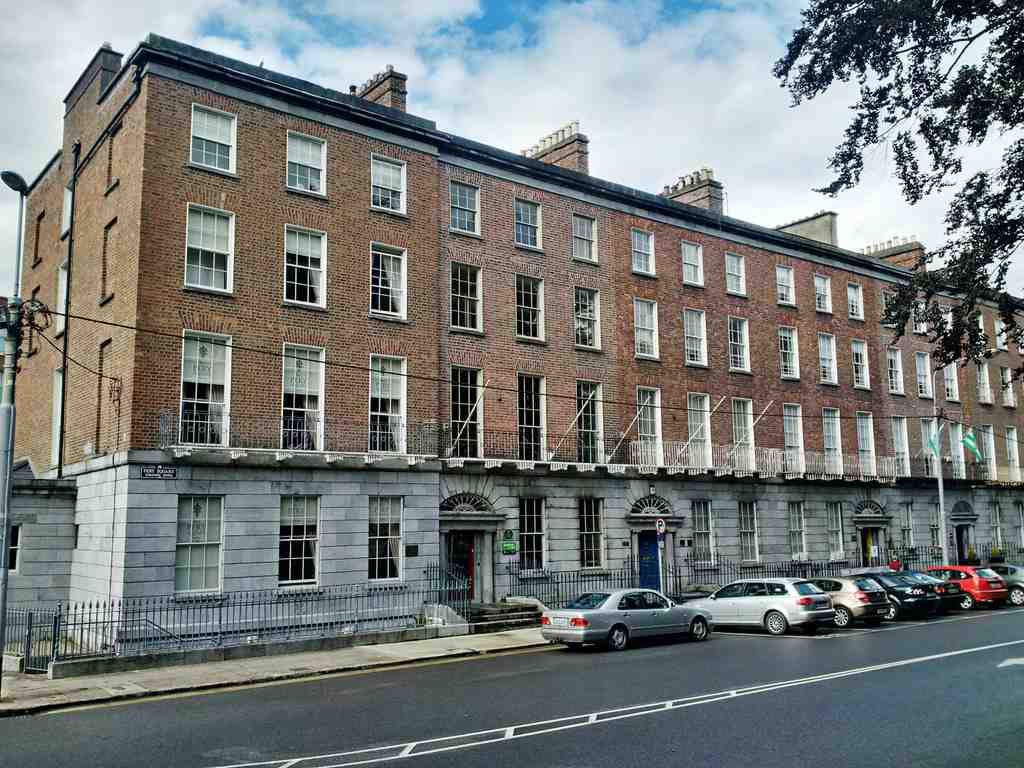
Ahead of you is a long terrace of red-brick Georgian houses, laid out in a strict crescent-like line, with tall sash windows and fanlit doorways, all terminated to the south by the pointed Gothic mass of Saint Michael’s Church.
Pery Square is one of Limerick’s grandest displays of composure, but its calm face hides a rather unnerving bargain. The terrace rose between eighteen thirty-five and eighteen thirty-eight, when the Pery Square Tontine Company set out to create a polished address in Newtown Pery, naming it for the politician Edmund Sexton Pery. James Pain supervised the work, and a contractor from Ennis, Pierse Creagh, carried it into being. By eighteen thirty-eight, tenants had already moved in.
If you glance at the image on your screen, you can see the effect they were after: brick, symmetry, restraint, and status. This was late Georgian architecture at full stretch, one of the finest examples in Limerick, and indeed in Ireland. Yet the money behind it came from what locals called the “Life and Death Lottery.” A tontine is a shared investment where returns grow as other nominees die. The clever, chilling twist here was that each investor bought a share and attached it to a named “life” - often a child, sometimes a public figure. As those lives ended, their shares died with them, and the value concentrated in fewer and fewer hands.
There were eighty-nine original shares. Among the nominated lives were Prince Albert and Princess Augusta, granddaughter of George the Third. The scheme dragged on for more than seventy years, ending only in nineteen thirteen, when six lives remained. And then comes the story people remember: Sophia Vanderkiste, a widow in her seventies, discovered that her father had nominated her as a child without telling her. One morning she woke to find she now owned numbers one, two, and three Pery Square, having simply outlived almost everyone else.
That polished row across from the green also tells another story about who a city belongs to. The square’s central garden began as a private enclosure for wealthy key-holders. By eighteen seventy-seven, it had become a public park in Richard Russell’s name. The fountain in the park came from the contributions of workers at Russell’s Flour Mills, a rare tribute from employees to an employer. So the old private privilege became, in part, a public gift.
Even now, the terrace keeps changing. Number one survives as a boutique hotel; number two, restored by Limerick Civic Trust, serves as a Georgian museum. A handsome place, certainly. But like much in this city, its beauty sits on terms somebody else had to live through. When you’re ready, continue to The Crescent, about four minutes away.




