
Aarhus Highlights Audio Tour: Essential Cultural Treasures
Aarhus breathes through layers of fire, blood, and brilliance. Beneath the polished glass of the rainbow panorama lies a medieval city that has survived Viking raids, religious rebellions, and shadows that refused to leave the cobblestones. Unlock these secrets with this self-guided audio tour. Wander beyond the postcard facade to uncover hidden narratives and forgotten scandals that defined this restless harbor city. Why did a desperate secret lie buried for centuries beneath the floorboards of the Church of Our Lady? What dark omen drove the residents of The Old Town to flee in the dead of night? And exactly which royal decree caused a riot over a single loaf of bread? Trace the pulse of history through shifting streets and cinematic vistas. Turn every corner into a revelation. Elevate your perspective and master the secrets of Aarhus. Put on your headphones and begin your descent into the truth.
Tour preview
About this tour
- scheduleDuration 100–120 minsGo at your own pace
- straighten4.4 km walking routeFollow the guided path
- location_on
- wifi_offWorks offlineDownload once, use anywhere
- all_inclusiveLifetime accessReplay anytime, forever
- location_onStarts at Concert Hall Aarhus
Stops on this tour
lock_open 3 free previews · 10 unlock with purchase
Look for a wide modern building of glass and pale stone, shaped in clean horizontal blocks, with a long transparent facade that opens toward the park. This is Musikhuset Aarhus,…Read moreShow less
Open dedicated page →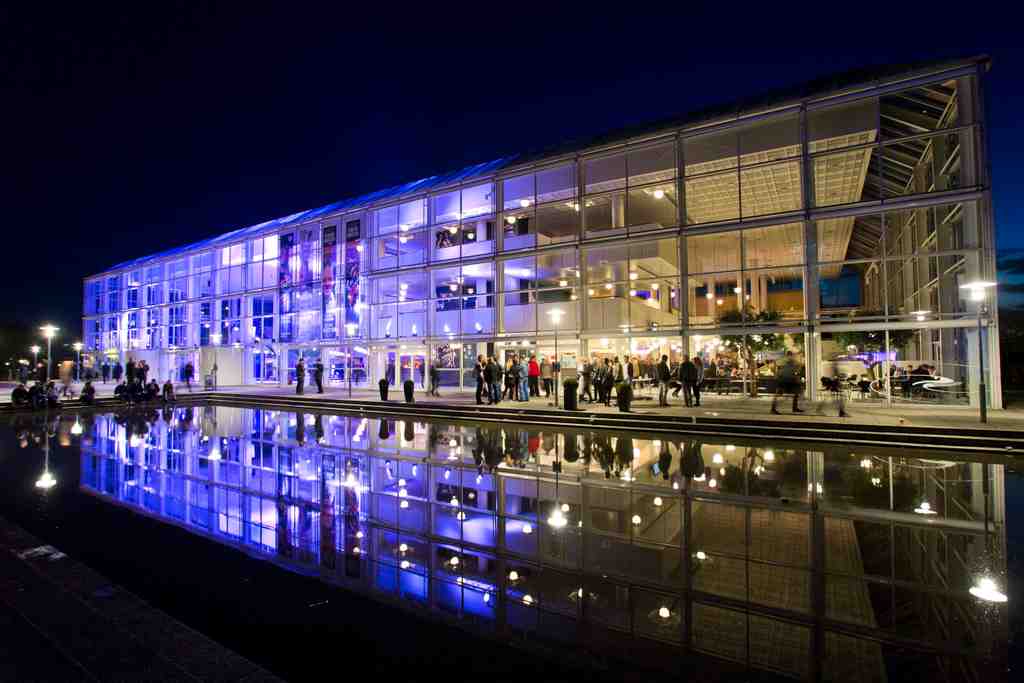
Concert Hall AarhusPhoto: Musikhuset Aarhus, Wikimedia Commons, CC BY-SA 4.0. Cropped & resized. Look for a wide modern building of glass and pale stone, shaped in clean horizontal blocks, with a long transparent facade that opens toward the park.
This is Musikhuset Aarhus, the city’s concert hall... and not in a modest way. It opened on the twenty-seventh of August, nineteen eighty-two, after architects Kjær and Richter won the design competition. Aarhus Municipality paid the bill: one hundred and fifteen million kroner. Since then, this place has grown from an ambitious cultural house into one of the largest music houses in the Nordic region, now covering thirty-five thousand square meters and around five hundred rooms.
That scale matters because this is not just one concert hall. It holds six halls and nine stages, and it hosts about fifteen hundred events every year: concerts, opera, dance, theater, musicals, comedy, the whole lot. Around six hundred and fifty thousand people pass through annually. So yes... it is one of those buildings that claims to do everything, and rather annoyingly, seems to manage it.
Inside, the foyer - the grand entrance hall - became even larger in two thousand and four, when engineers moved the glass facade eight point six four meters outward toward the park. That added six hundred square meters on the ground floor, and about one thousand when you count the balconies. If you check the photo on your screen, you can get a feel for that broad glass front and the building’s confident scale.
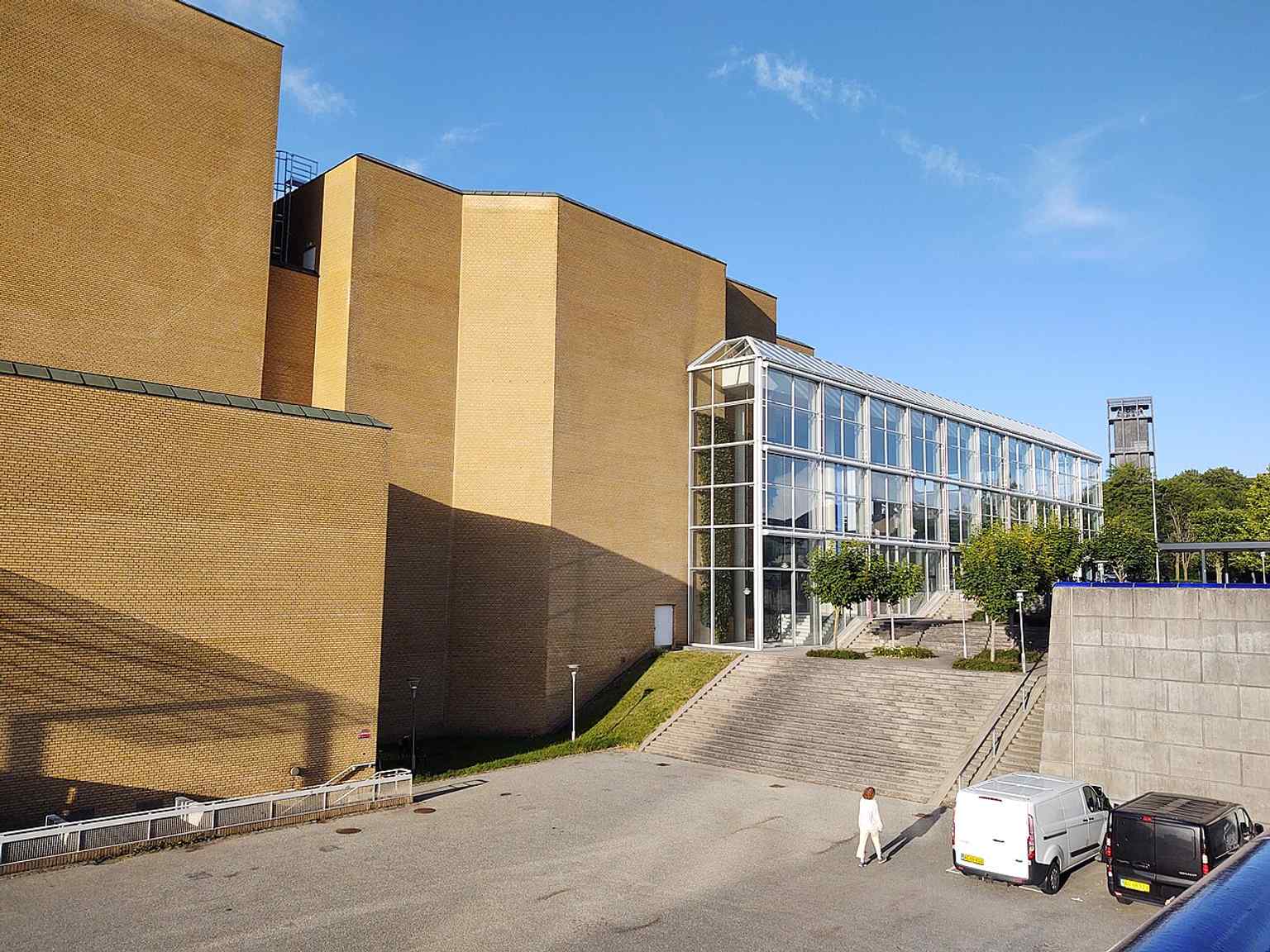
Musikhuset Aarhus in Skovgaardsgade, the Nordic music house that hosts around 1,500 performances a year and opened in 1982.Photo: Fugit hora, Wikimedia Commons, CC BY-SA 4.0. Cropped & resized. The expansion in two thousand and seven, designed by C-F Møller, added the Symphonic Hall, the Rhythmic Hall, and a chamber music hall, along with teaching spaces for the Royal Academy of Music and facilities for Aarhus Symphony Orchestra. Big names have performed here too: Bob Dylan, Tina Turner, Leonard Cohen, Ray Charles, even the Bolshoi Theatre. In twenty seventeen, Aarhus opened its year as European Capital of Culture here, with the queen in attendance. Not bad for a building that began with a single groundbreaking in nineteen seventy-nine.
Musikhuset tells you something important about Aarhus: this city takes culture seriously, but never solemnly.
When you’re ready, continue toward the old freight railway, where industry takes the next verse.
On your right, look for the long red-brick station building with its low industrial shape and the newer angular addition beside it, topped by a walkable roof. This began as…Read moreShow less
Open dedicated page →
The freight railway (Aarhus)Photo: RhinoMind, Wikimedia Commons, CC BY-SA 4.0. Cropped & resized. On your right, look for the long red-brick station building with its low industrial shape and the newer angular addition beside it, topped by a walkable roof.
This began as Aarhus’s freight station, the place where goods arrived, paused, and got sorted before moving on. In two thousand and three, the city decided the old station deserved a second career, and after a major rebuild, Aarhus Municipality and Realdania opened Godsbanen here on the thirtieth of March, twenty twelve.
Now it works as a cultural production center rather than a cargo depot... which is a much better use of a railway building unless you are personally very devoted to pallets. Inside are ten thousand five hundred square meters of workshops, project rooms, rehearsal rooms, exhibition spaces, guest housing, and venues for more than four hundred events each year. There’s even a black box called Åbne Scene, or Open Stage - a plain, flexible performance room that artists can reshape for theater, dance, readings, and whatever else they dare try. Teater Katapult, Radar, Spiselauget, Aarhus Billedkunstcenter, and Aarhus Litteraturcenter all make their home here.
Take a glance at the image on your screen and you’ll see the rooftop path, one of the clever touches from the renovation, letting visitors look across the old station and the new extension in one sweep. And yes, a few tracks still belong to Banedanmark and serve D-S-B, plus one platform said to be reserved for the royal family... because even the scruffiest creative district keeps a respectable handshake with the state.
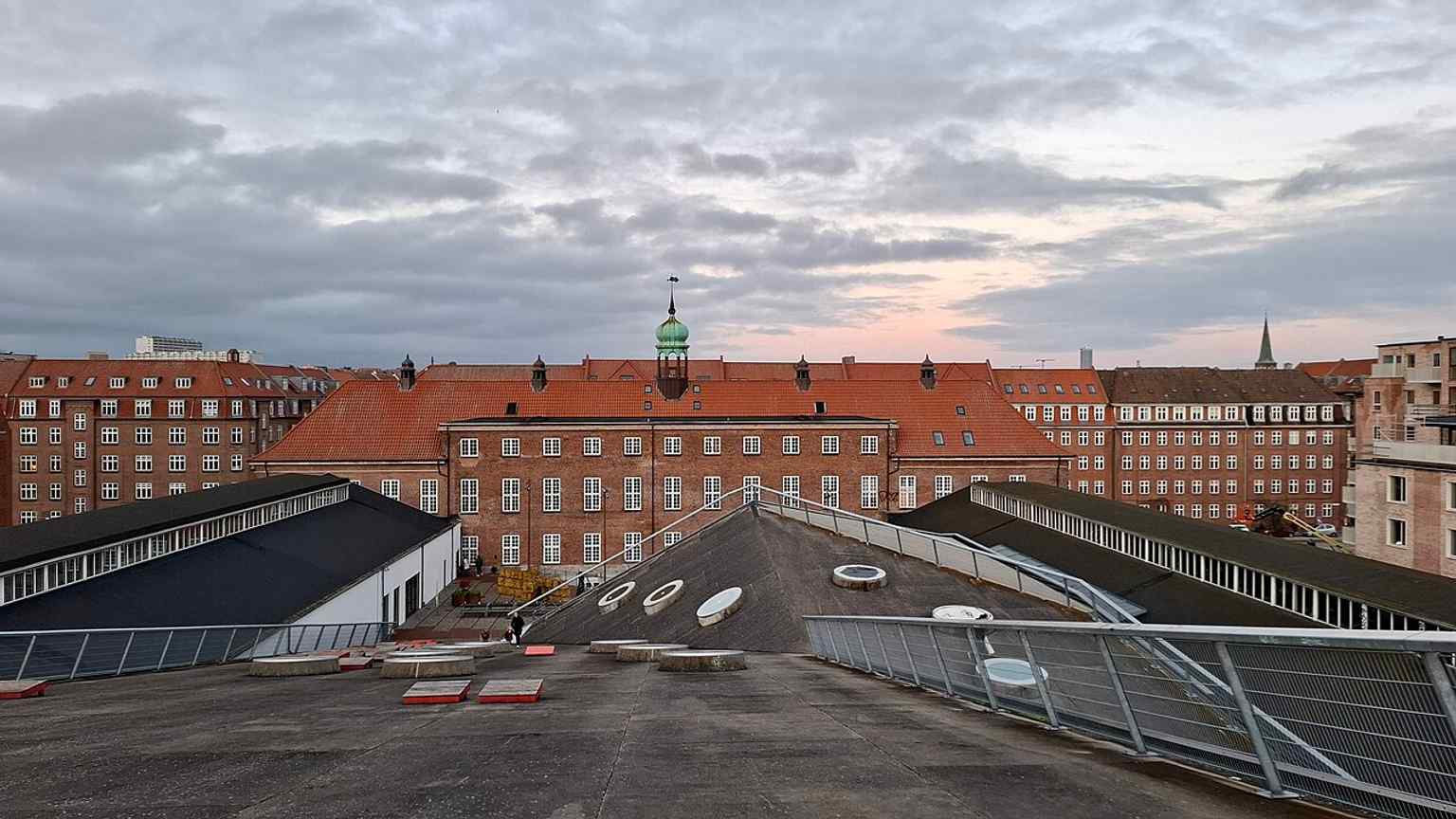
The rooftop walkway above Godsbanen, where visitors can explore the renovated site and look out over the old freight-railway complex.Photo: Ciara Ní Riain, Wikimedia Commons, CC BY-SA 4.0. Cropped & resized. This old freight yard now ships ideas instead of cargo.
When you’re ready, continue on and let Aarhus unfold a little further.
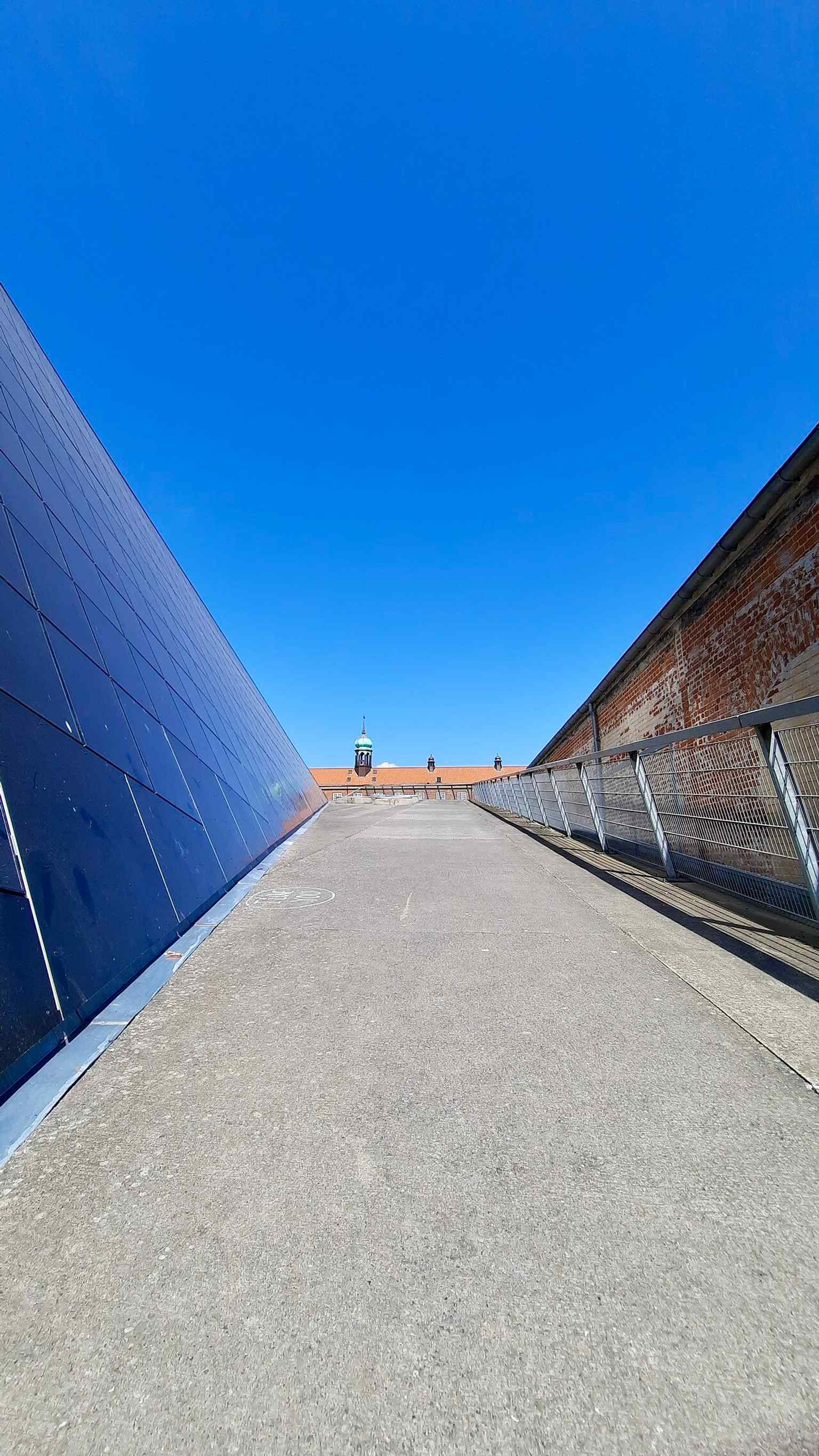
A clear rooftop view of the historic redbrick freight station, now part of Godsbanen’s transformation into a cultural production center.Photo: Ciara Ní Riain, Wikimedia Commons, CC BY-SA 4.0. Cropped & resized. 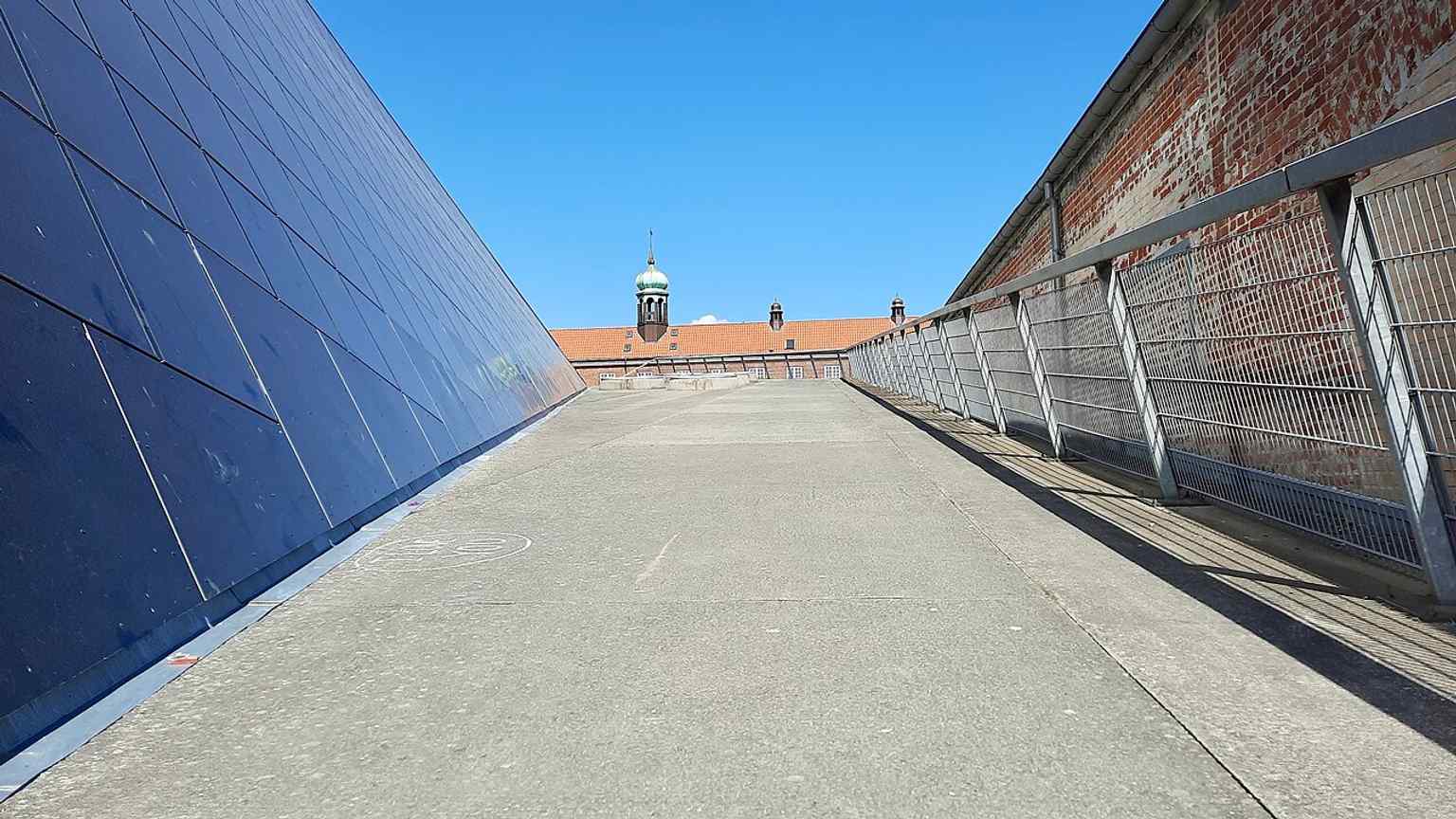
Another view from the roof with the ornate turret of Århus Godsbanegård, highlighting the preserved station building beside the new cultural quarter.Photo: Ciara Ní Riain, Wikimedia Commons, CC BY-SA 4.0. Cropped & resized. 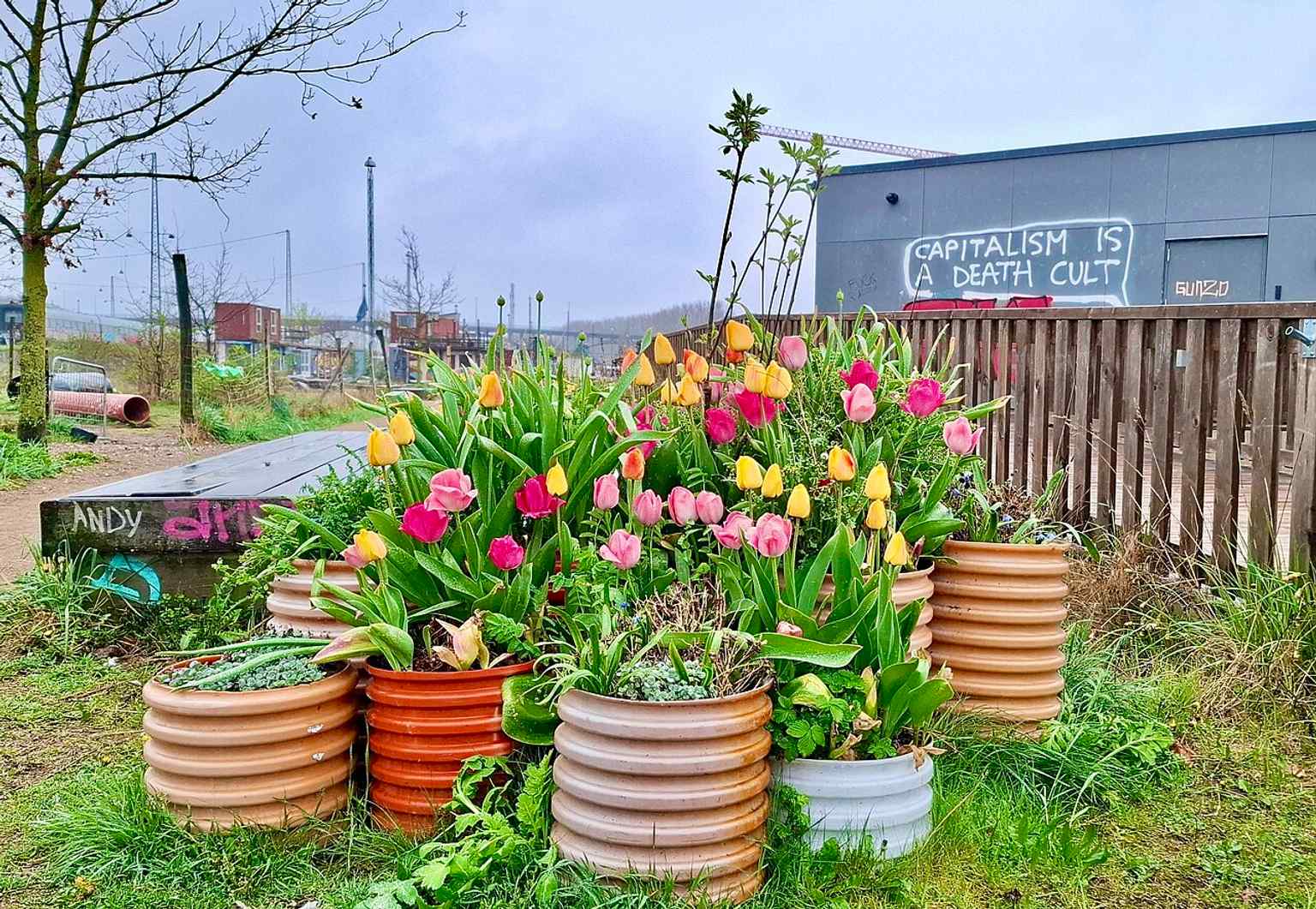
Repurposed railway huts and site details in the Godsbanen grounds, reflecting the area’s ongoing reuse and redevelopment into Aarhus K.Photo: Ciara Ní Riain, Wikimedia Commons, CC BY-SA 4.0. Cropped & resized.
Show 10 more stopsShow fewer stopsexpand_moreexpand_less
Look for tall stone gateposts, open iron gates, and the garden’s name set at the entrance to a broad landscaped park. This is Aarhus Botanical Garden... or, to be precise, a…Read moreShow less
Open dedicated page →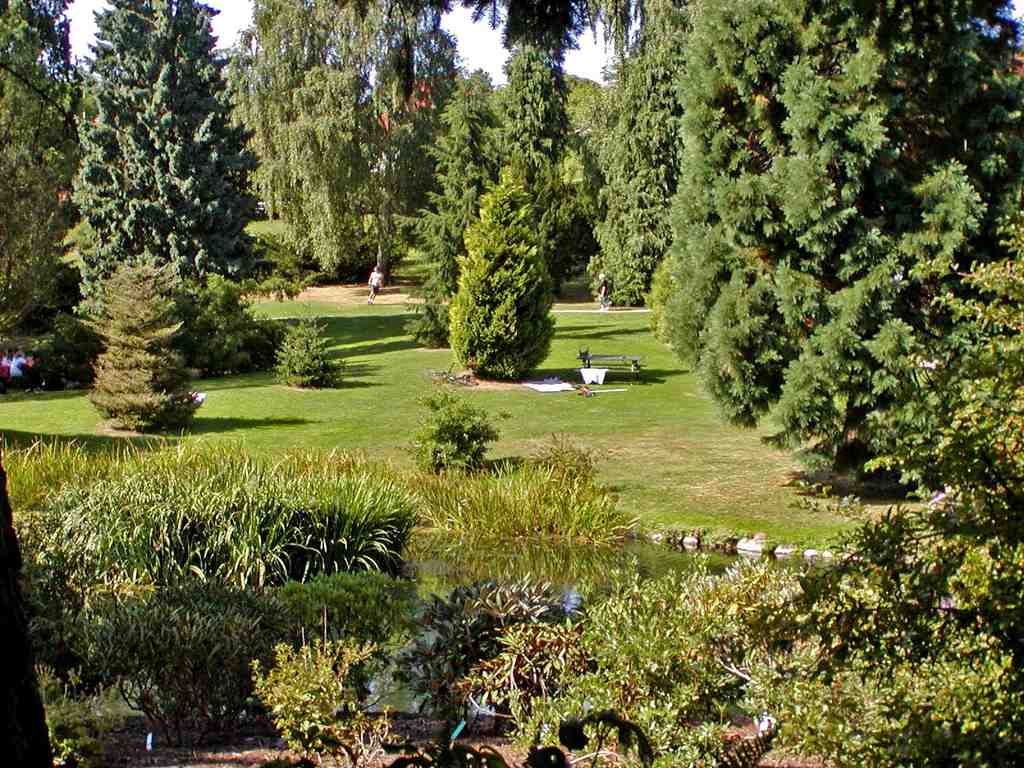
Botanical Garden (Aarhus)Photo: Stan Shebs, Wikimedia Commons, CC BY-SA 3.0. Cropped & resized. Look for tall stone gateposts, open iron gates, and the garden’s name set at the entrance to a broad landscaped park.
This is Aarhus Botanical Garden... or, to be precise, a park that began life as a botanical garden. The city leased this land in eighteen seventy-three to a new gardening society, later called Det Jydske Haveselskab, and the place first went by the modest name Haven ved Vesterbro. Since then, it has grown into about twenty-one and a half hectares, right beside Den Gamle By, with five hectares of that area now folded into the Old Town museum next door. Gardens and museums make friendly neighbors, though both have a habit of expanding.
Inside, the garden spreads into themed sections: Flower Valley, stone beds, climbing plants, rhododendrons, a beech wood, and an arboretum, which simply means a collection of trees. The arboretum is the largest part, with species from temperate regions and wide lawns meant less for strict science and more for human beings to sit, wander, and briefly pretend they have no emails.
The greenhouses gave the place a new chapter. In nineteen seventy, architect C-F Møller designed the original complex. Then, between twenty eleven and twenty fourteen, the garden got a major renovation: a new tropical house arrived, and the old tropical house became a café, shop, and meeting space. If you glance at your screen, you can peek inside that glass world of different climate zones here.
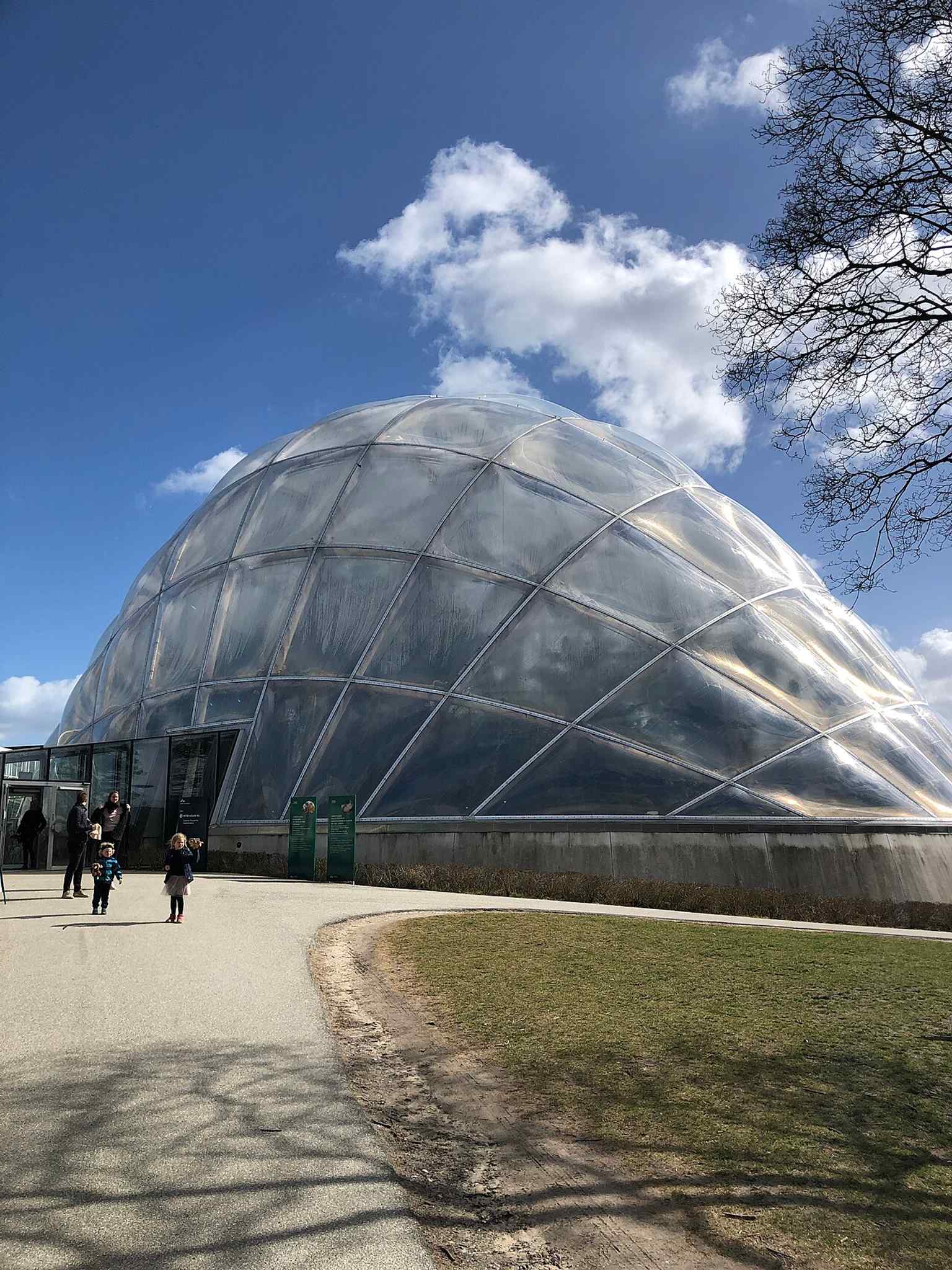
Inside the modern glasshouses of Aarhus Botanical Garden, which reopened after the 2011–14 renovation and now include a tropical house.Photo: Peterleth, Wikimedia Commons, CC BY-SA 4.0. Cropped & resized. Not every change pleased everyone. When the city chose in twenty twelve to remove several labor-intensive beds, including many rose beds in Flower Valley, local volunteers formed Friends of the Botanical Garden and still maintain them without pay. The park also won legal protection in twenty fifteen, confirmed in twenty seventeen, to preserve the land itself and its biodiversity, even if the old scientific botanical mission has largely given way to education and recreation with free access.
If you want to visit the indoor areas, they generally open from nine to four on weekdays and from ten to four on weekends.
This place is Aarhus at its best: cultivated, public, and a little stubborn.
When you’re ready, keep going and let the next stop add another layer to the story.
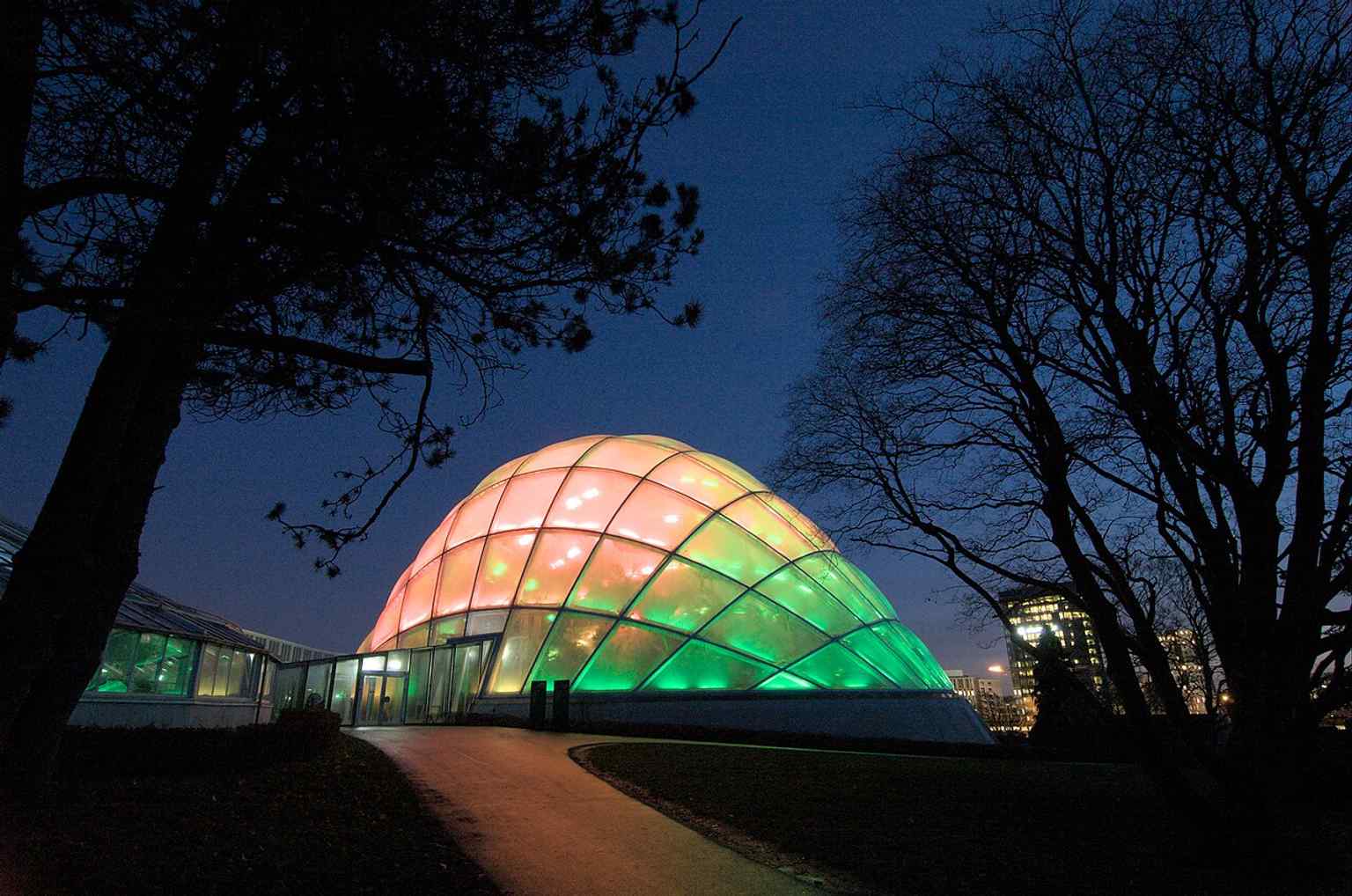
The illuminated conservatory in 2017, showing the greenhouse complex that brings together plants from different climate zones.Photo: Mikkel Houmøller, Wikimedia Commons, CC BY-SA 4.0. Cropped & resized. 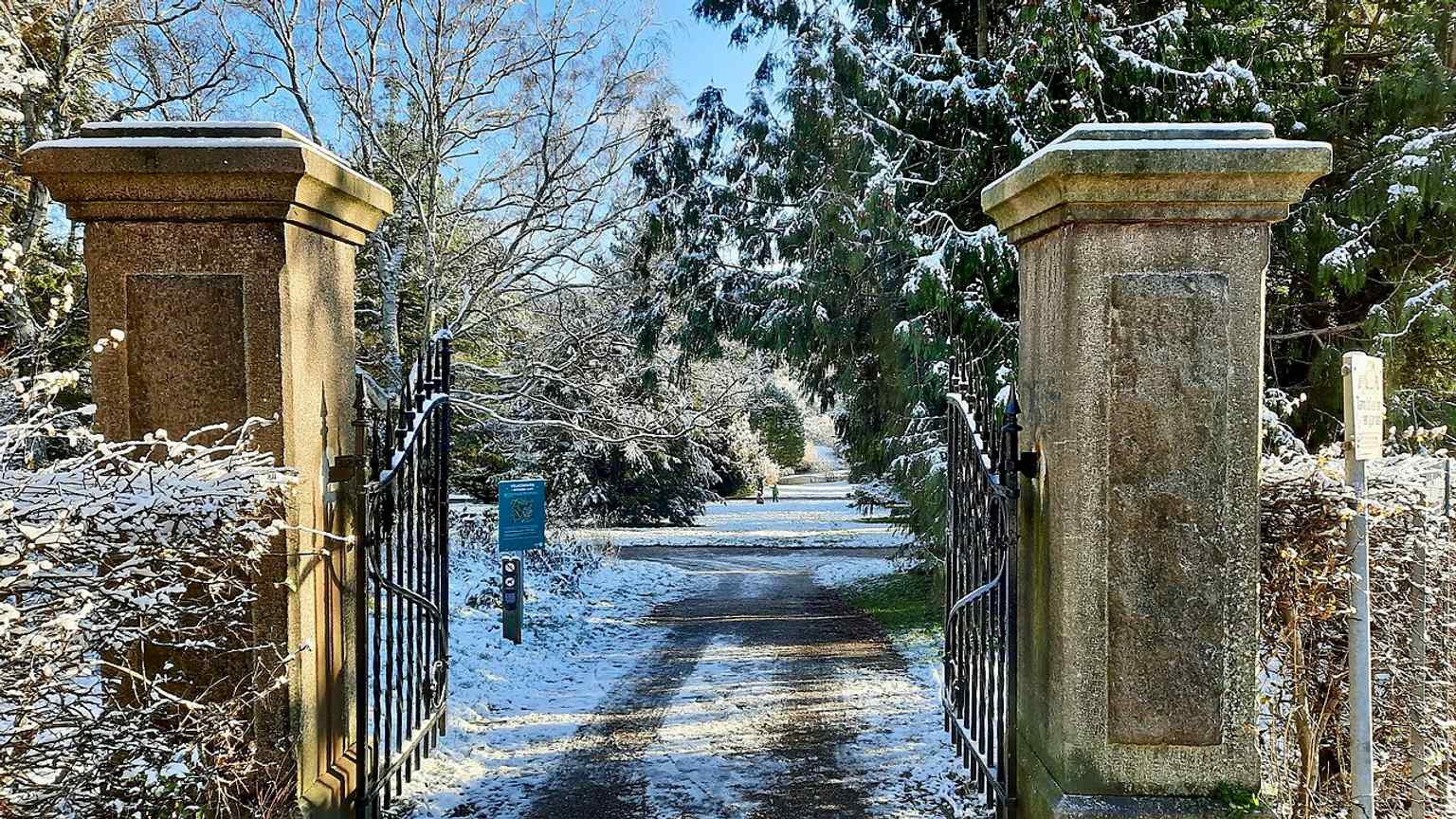
The main entrance on Eugen Warmings Vej, with old stone pillars and open gates leading into the park that borders Den Gamle By.Photo: Ciara Ní Riain, Wikimedia Commons, CC BY-SA 4.0. Cropped & resized. 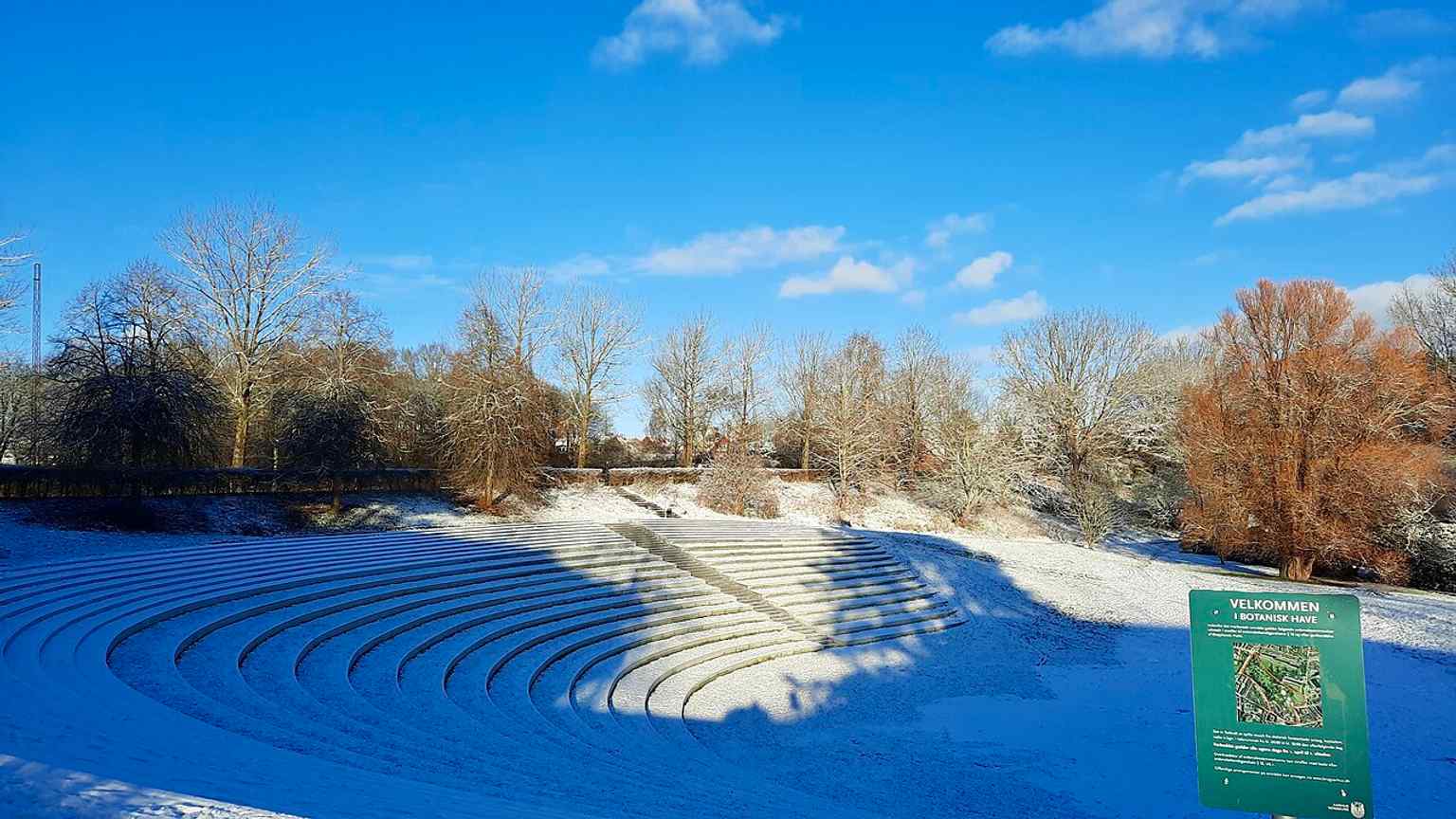
A snowy winter view with the garden sign visible, capturing the park’s free-access recreational character as well as its landscaped grounds.Photo: Ciara Ní Riain, Wikimedia Commons, CC BY-SA 4.0. Cropped & resized. On your right, look for the red-brick building with a simple rectangular front, broad window openings, and the Dansk Plakatmuseum sign marking the entrance. This is Denmark’s…Read moreShow less
Open dedicated page →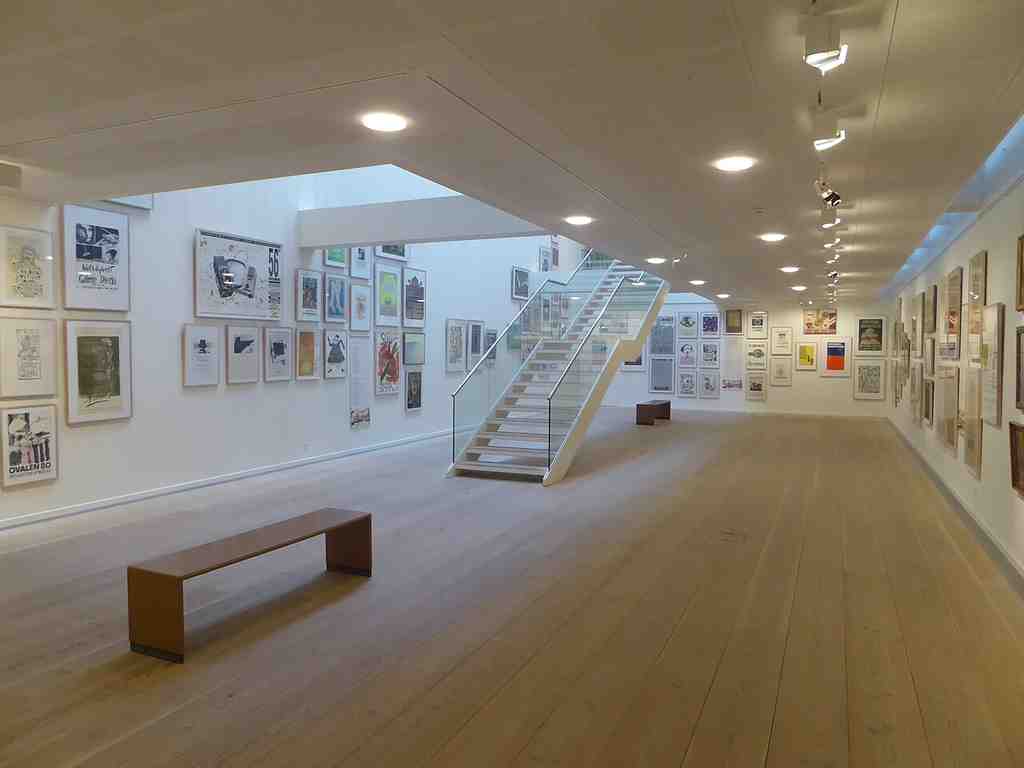
Danish Poster MuseumPhoto: Leif Jørgensen, Wikimedia Commons, CC BY-SA 4.0. Cropped & resized. On your right, look for the red-brick building with a simple rectangular front, broad window openings, and the Dansk Plakatmuseum sign marking the entrance.
This is Denmark’s only museum devoted entirely to posters... which is wonderfully specific, and also a reminder that paper can outlast speeches. Artist Peder Stougaard started it all after years of collecting posters himself and arguing, persistently, with the authorities until Aarhus finally agreed to create the museum in nineteen ninety-three, with Stougaard as its first leader. Since two thousand and six, it has belonged to Den Gamle By, and this purpose-built exhibition building opened on the first of November, two thousand and nine.
Inside and in storage, the museum holds nearly four hundred thousand posters from around the world: political, commercial, and educational, by famous names like Henry Heerup, Aage Sikker Hansen, and Bjørn Wiinblad, as well as artists history forgot. Most stay in storage, so the museum rotates a handful of special exhibitions each year. Take a quick look at the exterior on your screen if you like.
Posters are fleeting by design, but this place treats them like witnesses. If you want to return later, it opens daily from ten A-M to four P-M; when you’re ready, continue to the next stop.
On your right, Den Gamle By looks like a compact little town of half-timbered houses with white plaster walls, steep red-tile roofs, and a gateway leading into a street that seems…Read moreShow less
Open dedicated page →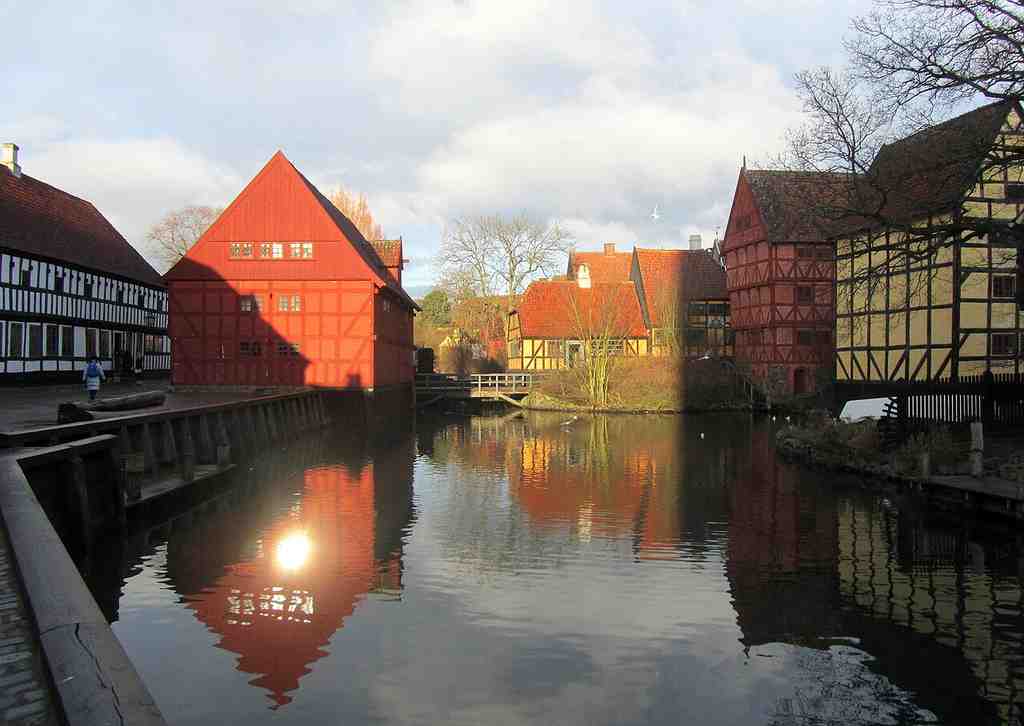
The Old TownPhoto: Nico-dk, Wikimedia Commons, CC BY-SA 3.0. Cropped & resized. On your right, Den Gamle By looks like a compact little town of half-timbered houses with white plaster walls, steep red-tile roofs, and a gateway leading into a street that seems to have misplaced a few centuries.
This is not just an old building... it is an old city, assembled piece by piece. Den Gamle By opened in nineteen fourteen and is often described as the world’s first open-air museum devoted to urban culture, meaning the life of a Danish market town, a town officially allowed to trade and hold markets. That idea sounds obvious now. At the time, it was downright radical.
The whole thing started because a schoolteacher and local historian named Peter Holm noticed that a merchant’s house called the old Mayor’s House, standing in central Aarhus, faced demolition. Holm did not shrug and mutter about progress. He fought to save it, had it rebuilt for the national exhibition here in nineteen oh nine, and then kept pushing until Aarhus gave land in what had been the horticultural society’s garden, now the Botanical Garden. On the twenty-third of July, nineteen fourteen, the museum opened with just three buildings. Modest beginning... slightly absurd ambition. Perfect combination, really.
Holm ran the museum for thirty-one years and rescued around fifty historic buildings from destruction. Today the place holds seventy-five historic houses, workshops, and shops, gathered from towns across Denmark, with buildings dating from the sixteen hundreds through the nineteen hundreds. If you glance at the image on your screen, you can see how it spreads out like a real town rather than a neat museum campus.
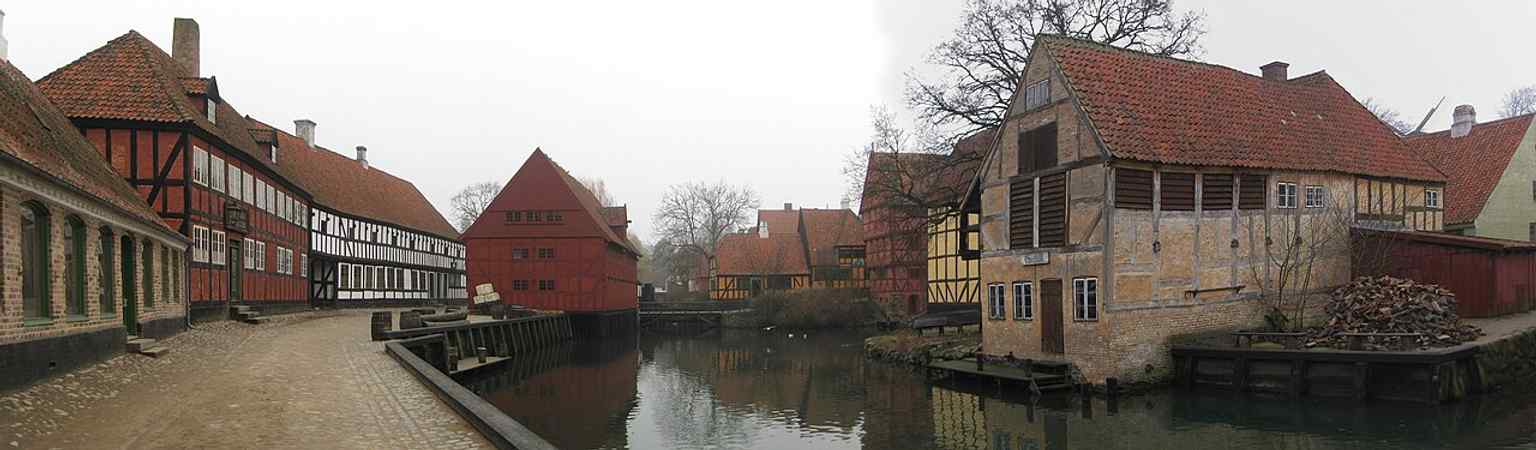
A sweeping panorama of Den Gamle By, the world’s first open-air museum for urban culture, showing the museum town spread out like a historic Danish market city.Photo: Thorsten Hartmann, Wikimedia Commons, CC BY-SA 3.0. Cropped & resized. And that is the trick here: this place does not display history in a line. It lets history behave like a neighborhood. Inside are around twenty-seven furnished rooms and kitchens, thirty-four workshops, ten shops, five historic gardens, plus a post office, customs house, school, and even Helsingør Theater, rebuilt here in nineteen sixty-one. Staff often work in character as grocers, blacksmiths, and townspeople, which helps the illusion along nicely. Museums usually ask you not to touch the past. This one practically offers it a job.
One of the cleverest additions is Møntmestergården, a grand seventeenth-century Copenhagen house from Borgergade. For years the museum reserved a spot in the square for an old town hall, but no market town wanted to give one up. Fair enough. So the museum rebuilt Møntmestergården instead, after it had sat dismantled in storage since nineteen forty-four, and finished its interior reconstruction in two thousand nine. Problem solved with style.
If you look at the street scene on your phone, you’ll catch the museum’s real magic: not one monument, but an entire everyday world of shopfronts, doors, windows, and corners where ordinary life once unfolded. That living approach inspired similar museums later in Bergen and Åbo, now Turku, so Aarhus quietly started a whole movement.
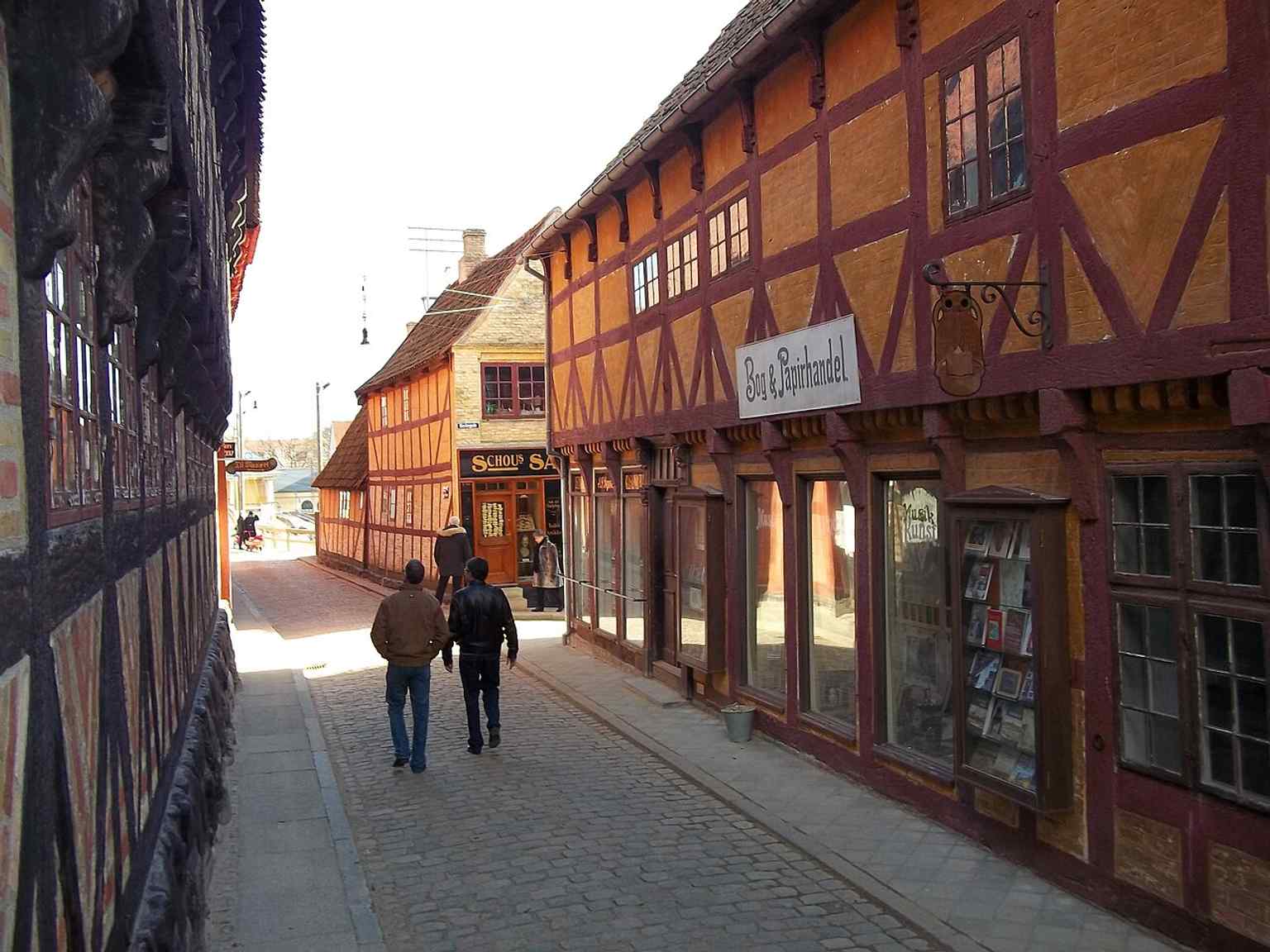
A street view inside the museum town, where historic houses and shopfronts recreate the life of a Danish market town across the last 300 years.Photo: Simon Burchell, Wikimedia Commons, CC BY-SA 4.0. Cropped & resized. If you want to go inside later, Den Gamle By is open every day from ten in the morning to five in the afternoon.
This place proves that preserving history can be an act of imagination, not just storage.
When you’re ready, continue on toward A-Ro-S, where another kind of time machine is waiting.
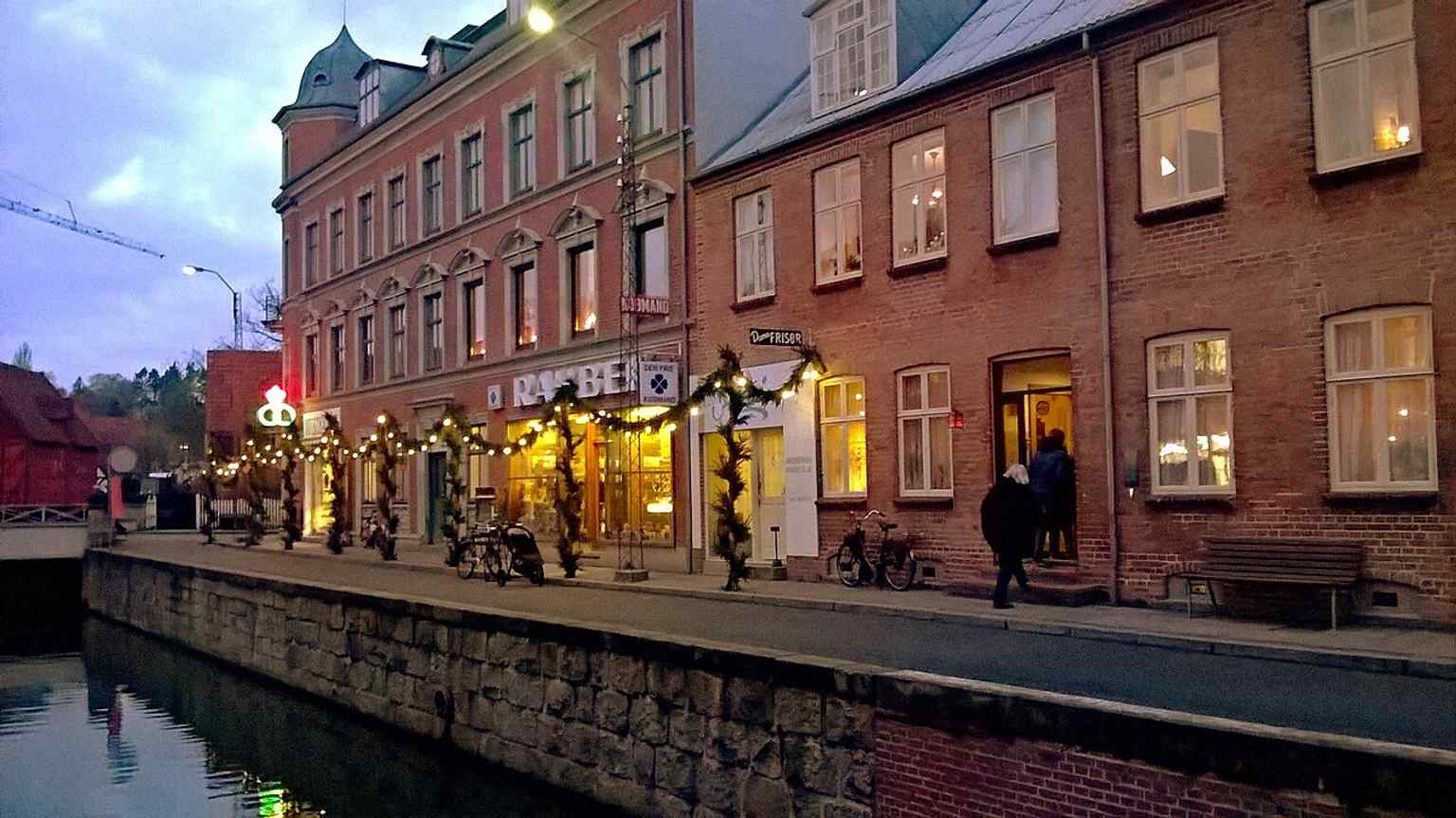
The Havnekvarter area adds the 1900s layer to Den Gamle By, reflecting how the museum expanded beyond its early 18th- and 19th-century buildings.Photo: Kenny Arne Lang Antonsen, Wikimedia Commons, CC BY-SA 4.0. Cropped & resized. 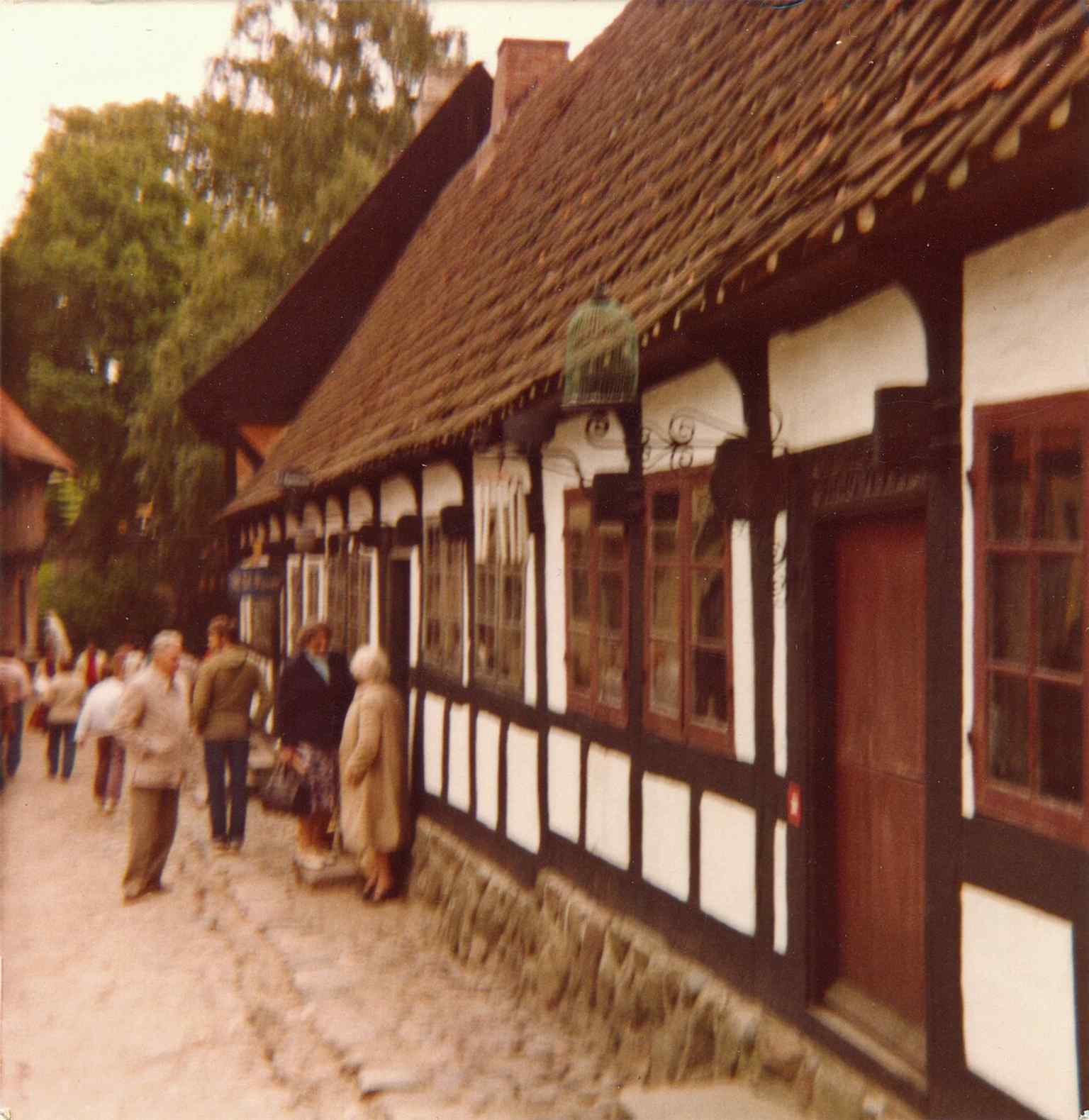
An early view of Den Gamle By from 1981, useful for showing how the museum has grown over time from a small collection into a full townscape.Photo: Thomas Dahlstrøm Nielsen, Wikimedia Commons, CC BY-SA 4.0. Cropped & resized. 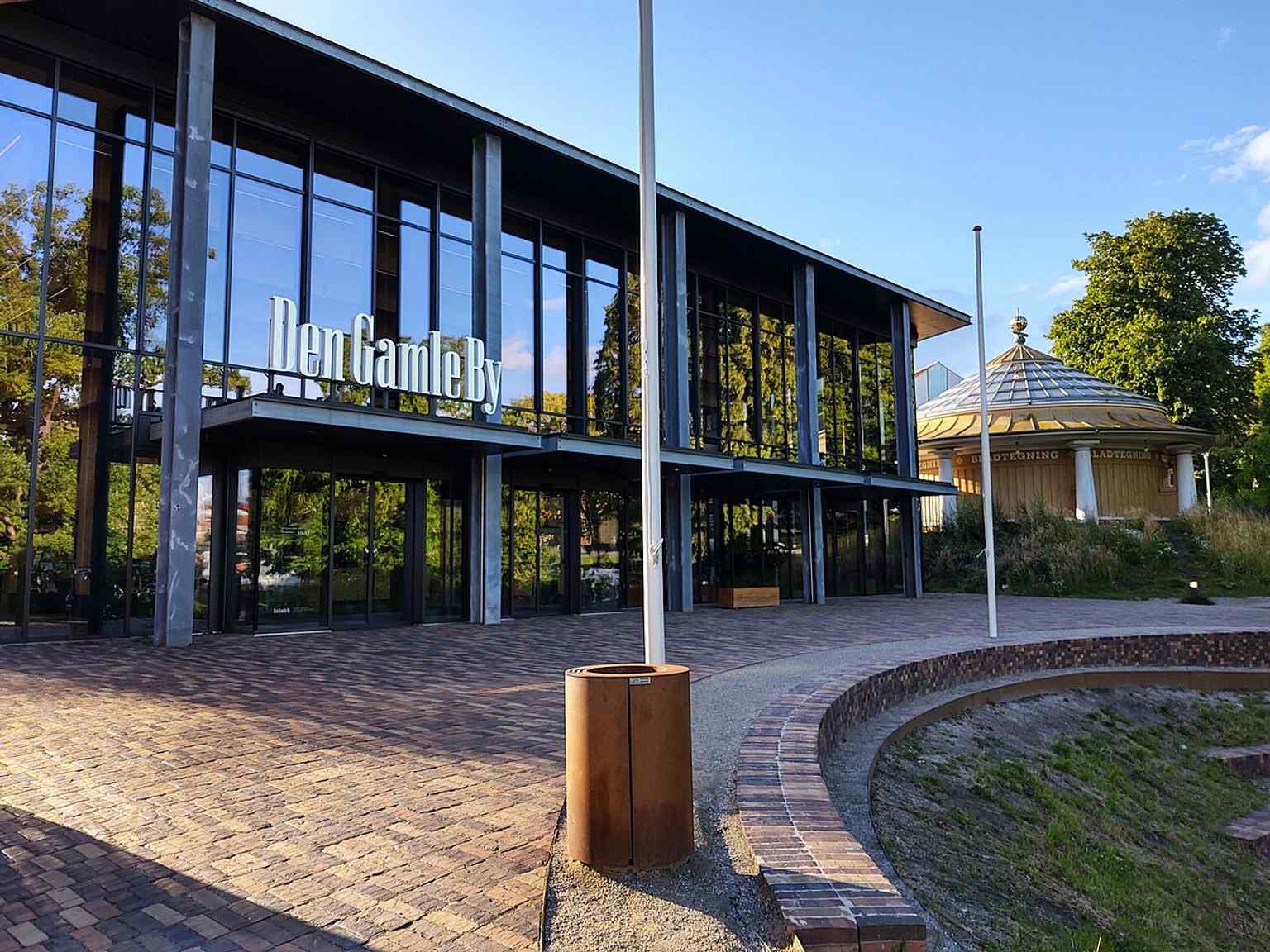
The main entrance to Den Gamle By in Aarhus, the gateway to the open-air museum founded in 1914 and now home to dozens of historic buildings.Photo: Fugit hora, Wikimedia Commons, CC BY-SA 4.0. Cropped & resized. On your right stands a massive reddish-brick cube, sharply squared and almost fortress-like, topped by a circular ring of colored glass that hovers above the roof. This is ARoS…Read moreShow less
Open dedicated page →On your right stands a massive reddish-brick cube, sharply squared and almost fortress-like, topped by a circular ring of colored glass that hovers above the roof.
This is ARoS Aarhus Art Museum - pronounced A-ros - and modesty has never really been its thing. With ten floors and about twenty thousand seven hundred square meters inside, it ranks among the biggest art museums in northern Europe. But the story starts much smaller: in eighteen fifty-nine, Aarhus opened the first public art collection outside Copenhagen, after a local art society led by Emmerik Høegh-Guldberg worked to, as they put it, spread a more common feeling for art and its creations. That is a very nineteenth-century sentence, but the ambition still holds up.
The museum spent time in a town hall attic near the cathedral, then outgrew that and moved again and again, because art collections behave a bit like book lovers... they never stop expanding. After a home near Mølleparken and another in Vennelystparken, the city finally gave the museum this central site on Vester Allé, on what used to be called Poorhouse Hill. Schmidt Hammer Lassen designed the current building, and it opened on the seventh of April, two thousand and four.
The design has a little literary swagger. The cube measures fifty-two by fifty-two meters and rises to about fifty meters high. Its layout nods to Dante’s Divine Comedy, the medieval poem about a journey through the afterlife: the basement stands for hell, and the roof stands for heaven. So yes, even the floor plan aims high.
Inside, the collection stretches from the Danish Golden Age to international contemporary art. There are more than eight thousand works, and some date back to seventeen seventy. You’ll find Danish artists like Eckersberg, Købke, Per Kirkeby, and Bjørn Nørgaard, along with international names such as Bill Viola, Pipilotti Rist, Mona Hatoum, James Turrell, and Ron Mueck. One of the museum’s best-known works is Mueck’s Boy, a four-and-a-half-meter-tall sculpture of a crouching child in underpants... unsettling, tender, and impossible to ignore.
Then came the crown. In twenty eleven, Olafur Eliasson’s Your rainbow panorama opened on the roof: a fifty-two-meter-wide circular walkway, lifted on slim columns, wrapped entirely in colored glass. It turned the museum from admired building into city icon. If you want a quick visual of that transformation, the before-and-after image in the app shows ARoS just before the rainbow ring arrived. If you look at the interior photo on your screen, you can see how that glass turns the city into a slow-moving band of color.
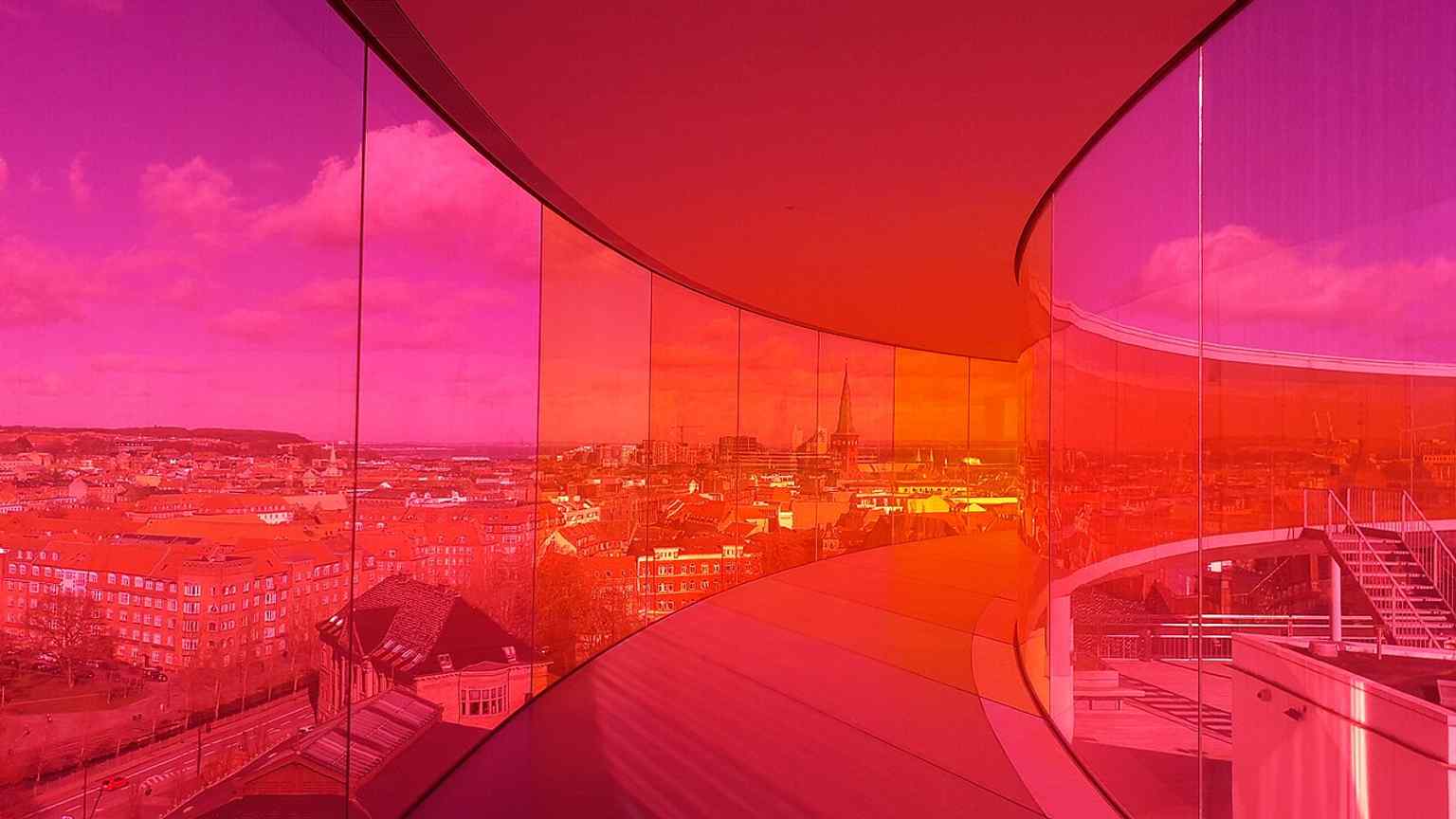
A vivid interior view inside Olafur Eliasson’s rainbow walkway, showing the 360-degree city panorama that made the rooftop artwork famous.Photo: Ciara Ní Riain, Wikimedia Commons, CC BY 4.0. Cropped & resized. ARoS keeps changing, too. An underground expansion called The Next Level is on the way, centered on James Turrell’s The Dome, a Skyspace - that means a room designed so light and the framed sky become the artwork itself - planned for completion in June twenty twenty-six. In twenty twenty-three, about six hundred twenty-four thousand people came here, including visitors to the galleries, shop, café, and orangery. Art may inspire the soul, but a museum café never hurts.
ARoS feels like Aarhus deciding that public art should be generous, ambitious, and just a little theatrical.
If you want to go inside, it’s open daily from nine A-M to eight P-M on weekdays, and from nine A-M to five P-M on Saturdays and Sundays.
When you’re ready, continue toward the Business Archives for a very different kind of collection.
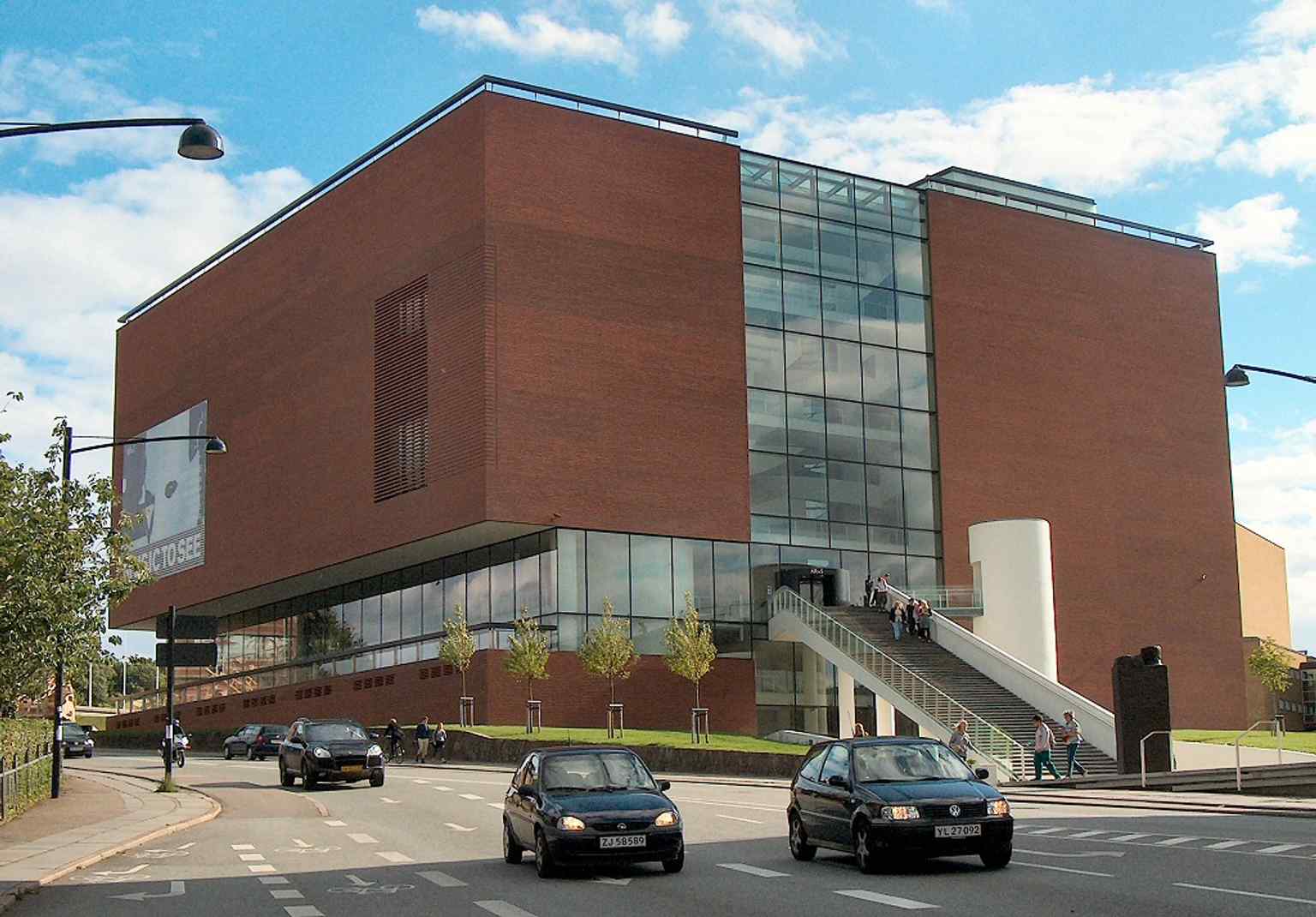
A clear street-level view of ARoS’s cube-like building, useful for introducing the museum’s modern 2004 home on Vester Allé.Photo: Villy Fink Isaksen at Danish Wikipedia, Wikimedia Commons, Public domain. Cropped & resized. 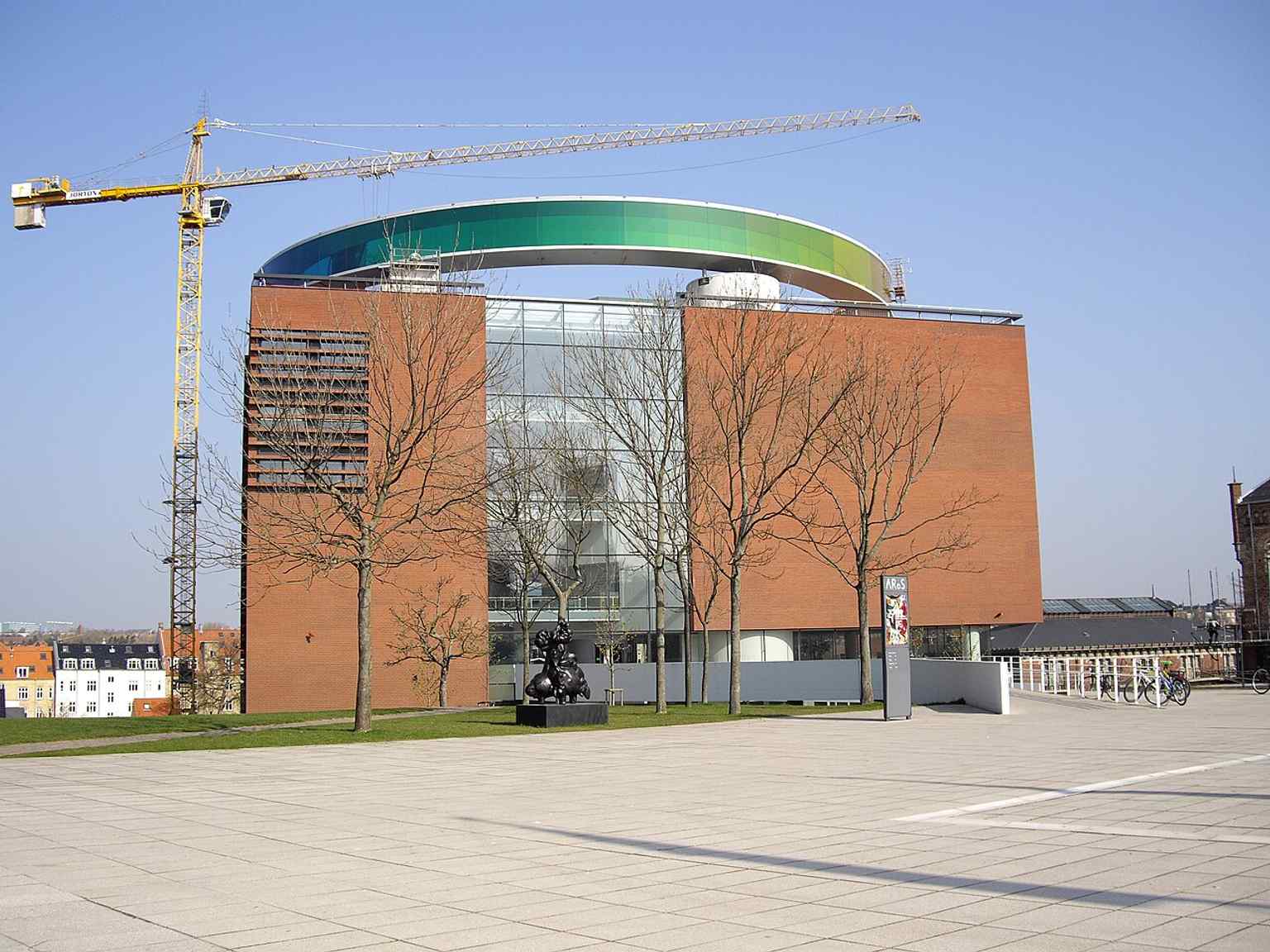
ARoS with Your Rainbow Panorama under construction — a rare behind-the-scenes glimpse of the rooftop work that later became one of Aarhus’s best-known landmarks.Photo: Jon Wickmann, Wikimedia Commons, CC BY 3.0. Cropped & resized. 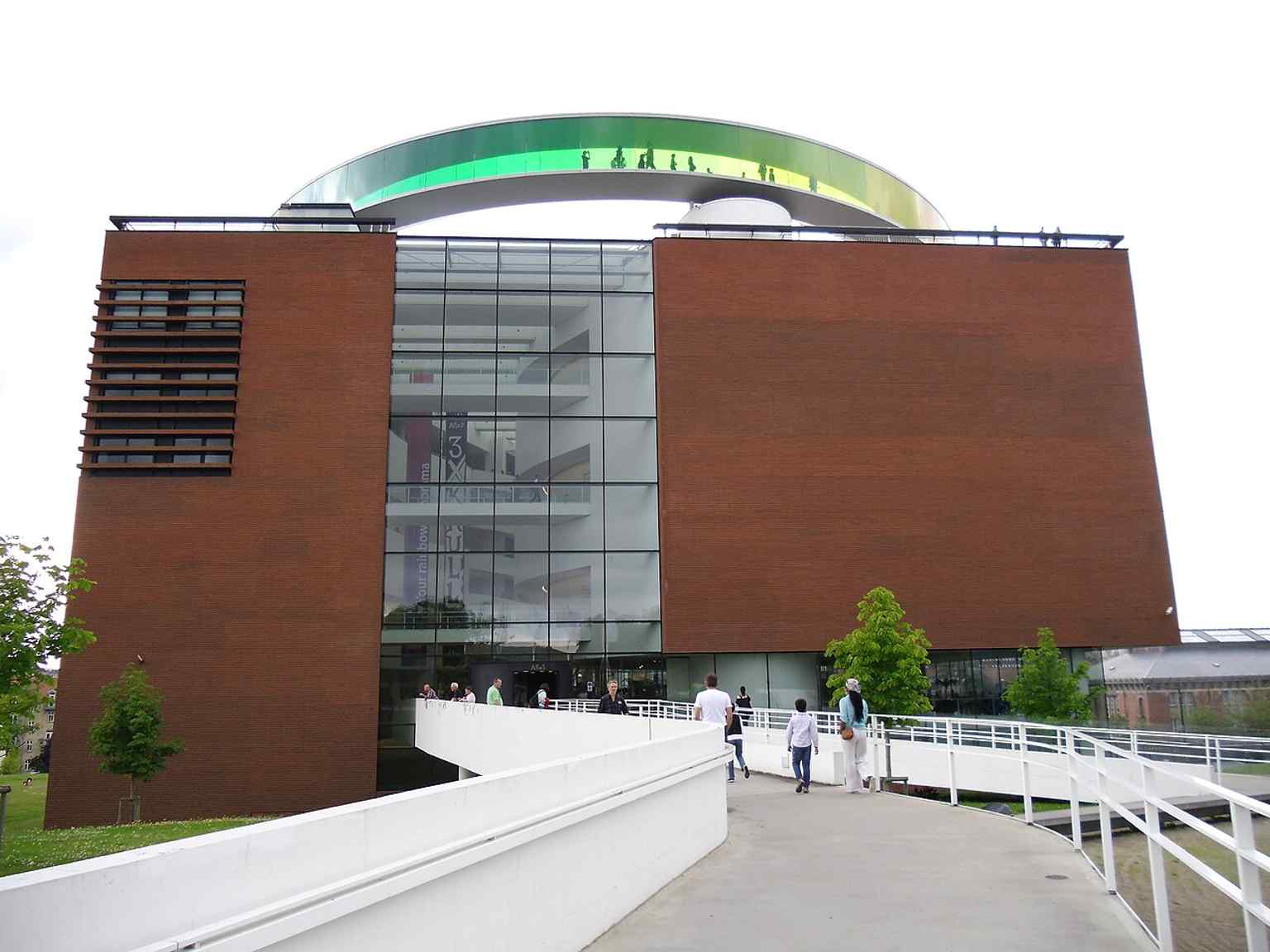
The museum façade with Olafur Eliasson’s rainbow ring on top, showing the iconic combination of ARoS’s architecture and rooftop artwork.Photo: Cristianrodenas, Wikimedia Commons, CC BY-SA 3.0. Cropped & resized. 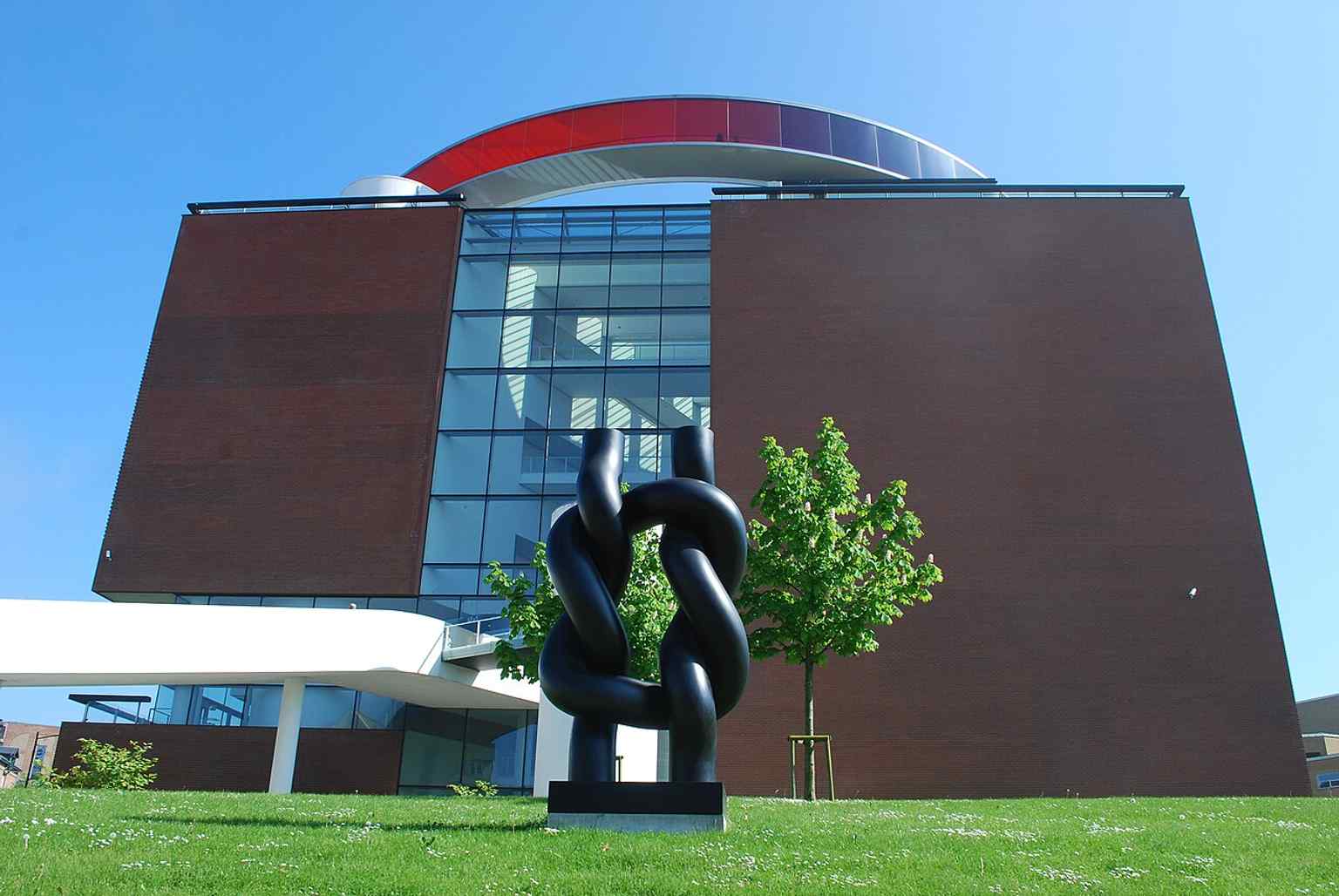
A crisp modern exterior shot of ARoS, a good image for the museum’s current identity and central downtown location.Photo: Erik Christensen, Wikimedia Commons, CC BY-SA 3.0. Cropped & resized. 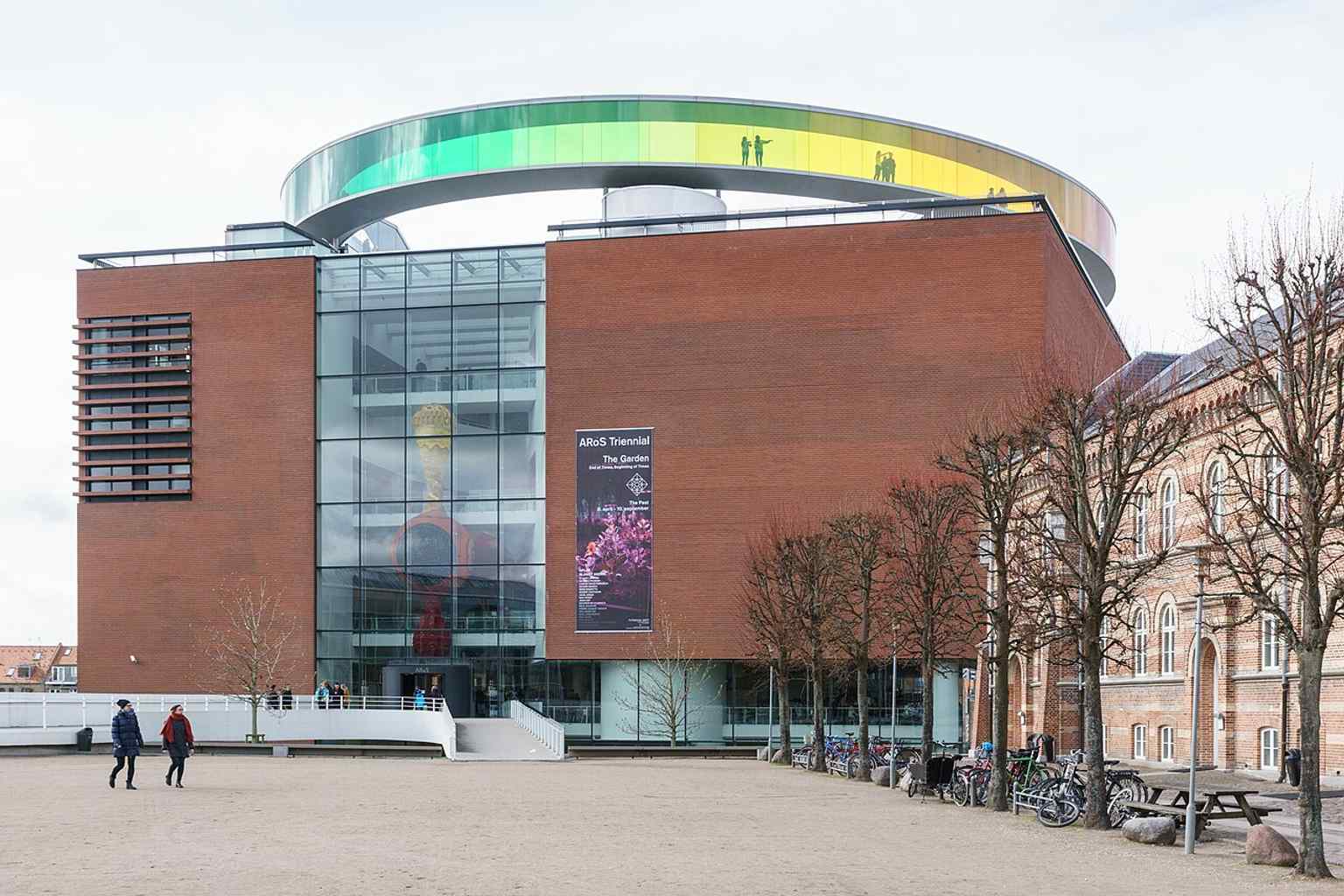
ARoS seen in 2017, highlighting the landmark’s bold form and the rooftop rainbow installation that draws visitors from across the city.Photo: Colin, Wikimedia Commons, CC BY-SA 4.0. Cropped & resized. 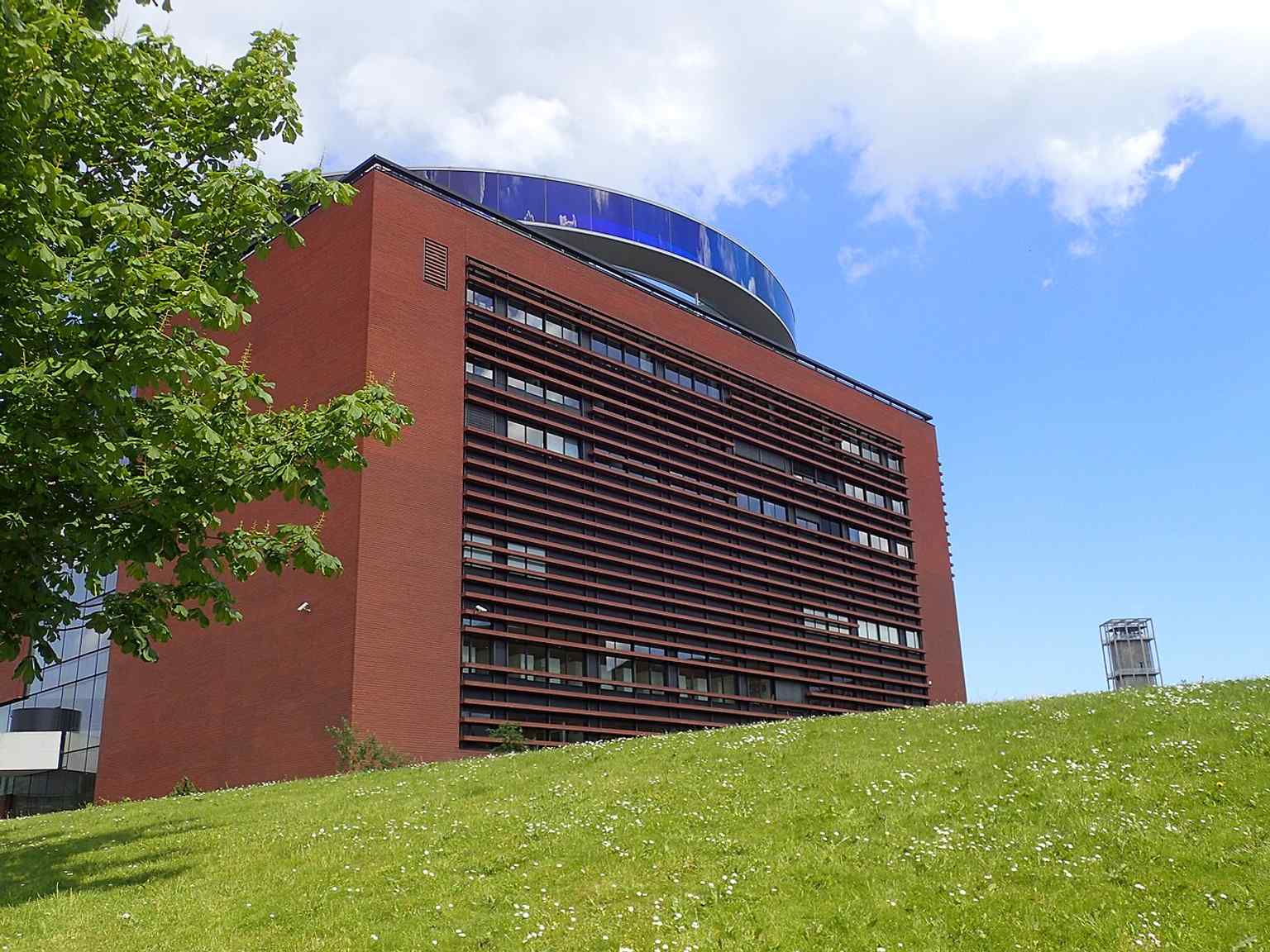
Seen from Musikhushaven, this angle shows how ARoS sits beside Aarhus’s cultural quarter and urban park landscape.Photo: RhinoMind, Wikimedia Commons, CC BY-SA 4.0. Cropped & resized. 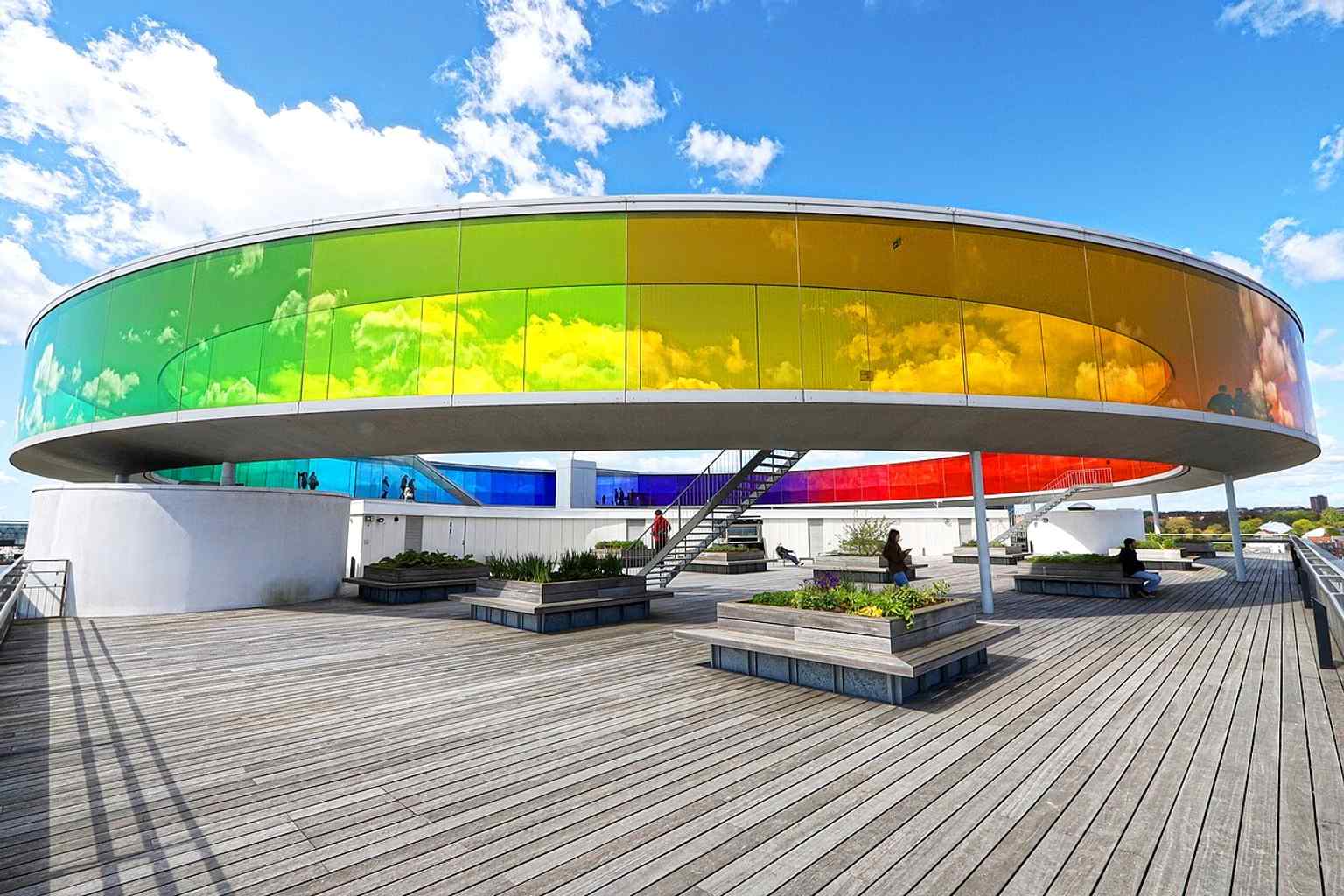
Inside Your Rainbow Panorama, where the colored glass turns the city view into an immersive walk above Aarhus.Photo: ThomasLendt, Wikimedia Commons, CC BY-SA 4.0. Cropped & resized. 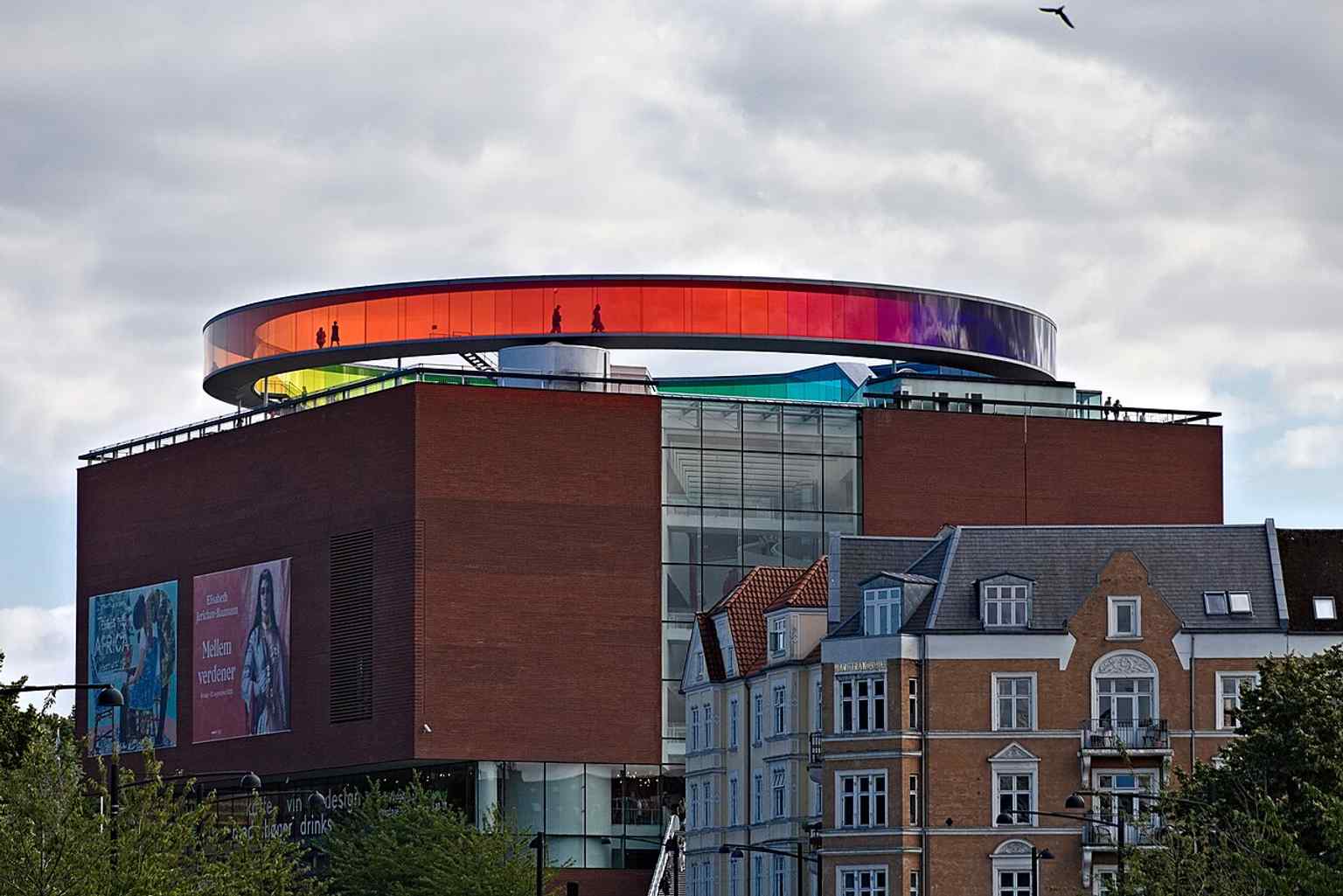
A clear rooftop view of ARoS with Your Rainbow Panorama, ideal for explaining the museum’s instantly recognizable silhouette.Photo: Mozzihh, Wikimedia Commons, CC BY-SA 4.0. Cropped & resized. 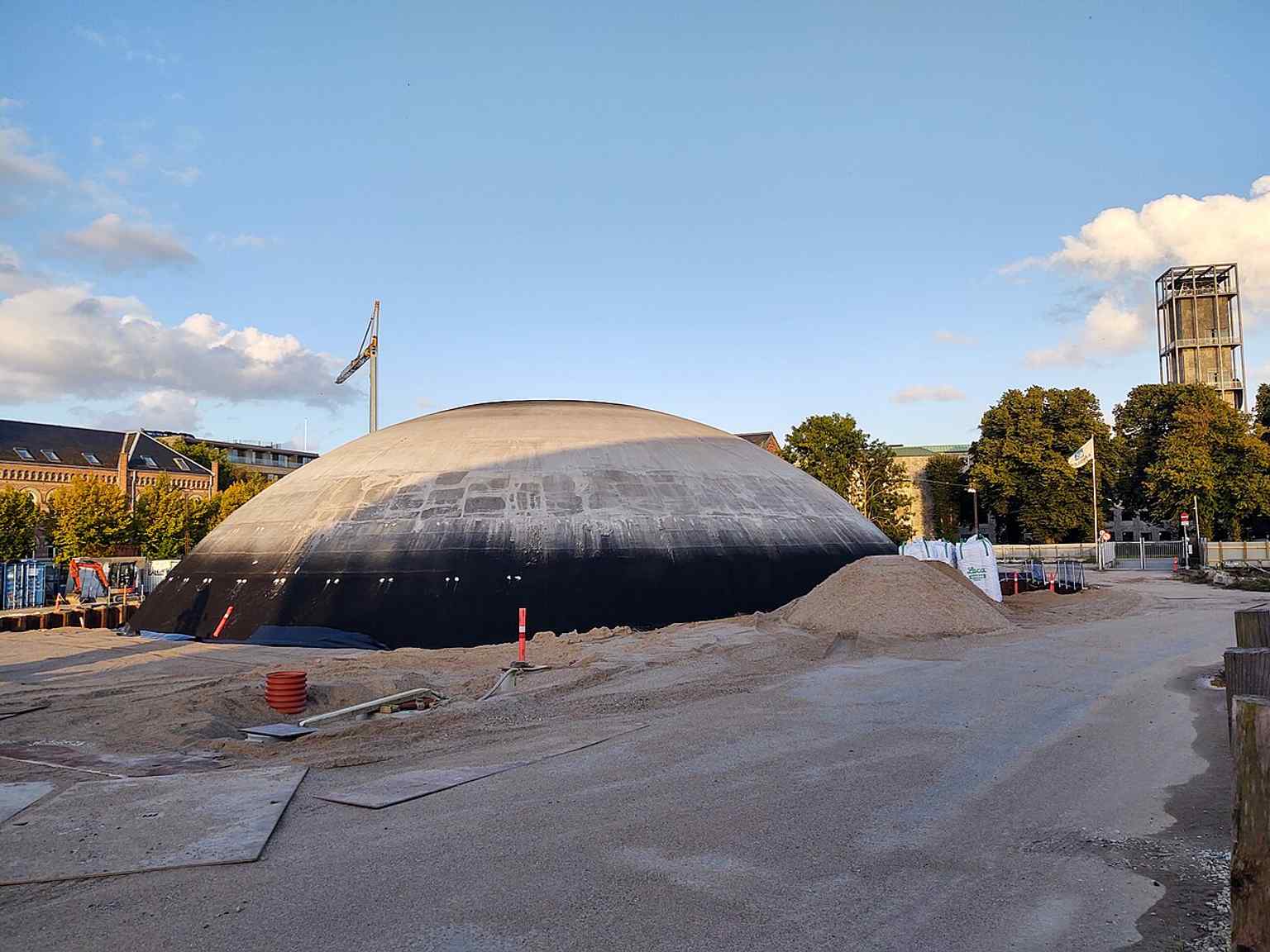
Construction of The Dome for The Next Level expansion, reflecting ARoS’s major underground growth project planned for completion in 2026.Photo: Fugit hora, Wikimedia Commons, CC BY-SA 4.0. Cropped & resized. On your right is a compact red-brick building with a symmetrical front, tall arched windows, and finely worked stone details that give it a formal, almost jewel-box look. This…Read moreShow less
Open dedicated page →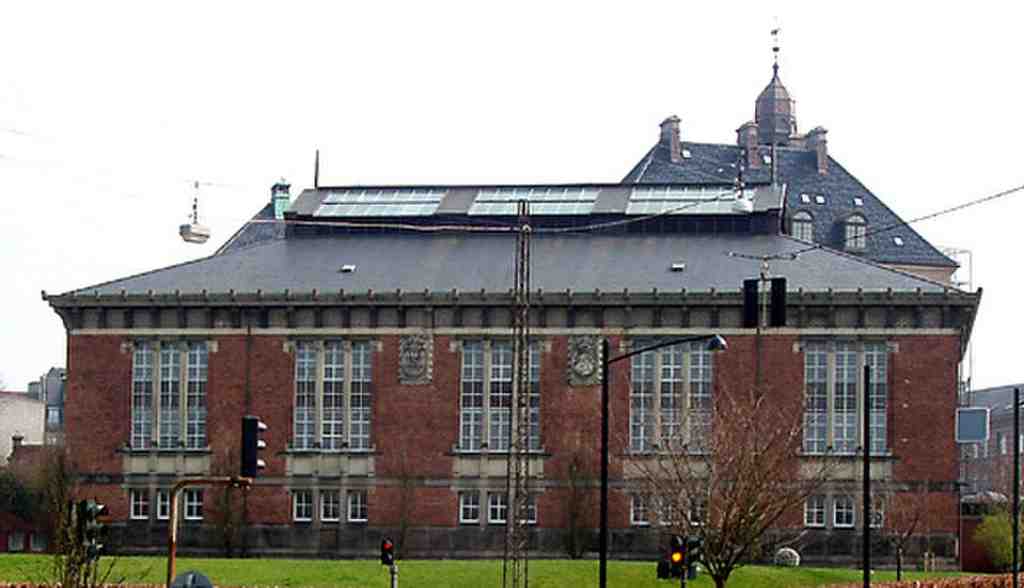
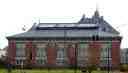
The Business ArchivesPhoto: Foto N.N Jepsen (Nico-DK), Wikimedia Commons, CC BY-SA 3.0. Cropped & resized. On your right is a compact red-brick building with a symmetrical front, tall arched windows, and finely worked stone details that give it a formal, almost jewel-box look.
This is Erhvervsarkivet, the Business Archives of Aarhus... though the building itself is older than the archive by quite a stretch. Architect Hack Kampmann designed it in eighteen ninety-eight for the State Library, and locals later nicknamed it Smykkeskrinet, meaning “the Jewel Box.” Not every archive gets to live in a place with that kind of nickname.
The archive opened in nineteen forty-eight as an independent institution, and it moved around before settling here in nineteen sixty-three. First it worked out of the basement under Aarhus City Hall, then the basement of the main university building, then the former Aarhus-Hammel Railway station on Carl Blochs Gade. Finally it arrived here, at Vester Allé twelve, in a building handsome enough to make paperwork feel important.
And paperwork really was the point. Private companies in Denmark did not have to hand over their records to the state, so archivists had to persuade them, one agreement at a time. That patient work built a collection of around seven thousand business archives, with material ranging from the sixteen hundreds back to the fifteen hundreds, though most came from the years between eighteen fifty and nineteen fifty. The archive also cared for Aarhus municipal records until the city founded its own municipal archive in twenty fourteen.
The move away from Aarhus caused real debate. In twenty fourteen, the national archive service announced that the storage magazines - the secure archive vaults - were no longer suitable, so the collections would move to Viborg. The public reading room, the study hall where researchers handled the material, closed on the eighteenth of December, twenty fifteen, with farewell speeches from a user and a reading-room guard. Since twenty twenty-one, Aarhus Court has used the building.
If you want to go inside, it is generally open Tuesday through Thursday from nine in the morning to four in the afternoon, and closed the rest of the week.
So this little jewel box held the paper trail of how Danish business actually worked. When you are ready, continue on toward Møllestien for a very different kind of Aarhus story.
On your right, look for a long red-brick church with a tall square tower, a steep tiled roof, and pale stone framing its arched windows and doors. This church plays a very old…Read moreShow less
Open dedicated page →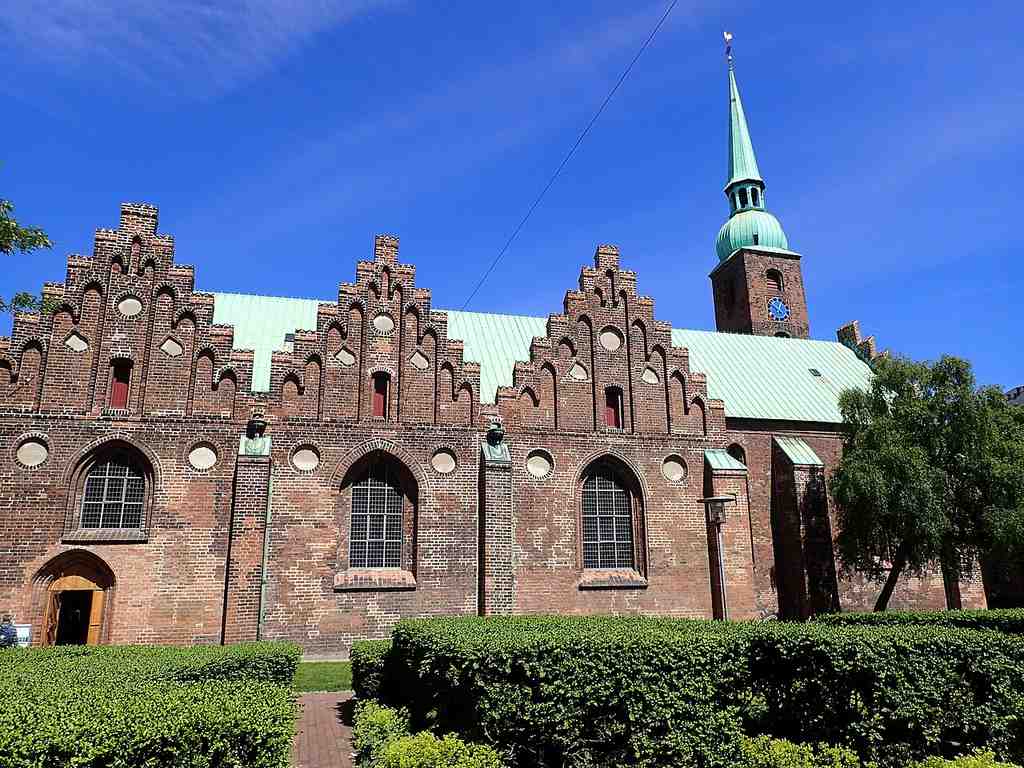
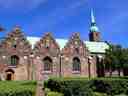
Church of Our Lady (Aarhus)Photo: RhinoMind, Wikimedia Commons, CC BY-SA 4.0. Cropped & resized. On your right, look for a long red-brick church with a tall square tower, a steep tiled roof, and pale stone framing its arched windows and doors.
This church plays a very old trick on the eye... it looks medieval, because it is, but the deepest part of its story sits under your feet. The first church here reached completion around ten sixty. Only its stone crypt remains now, an underground chapel, and that makes it the oldest surviving stone church in Scandinavia. Not bad for a place that spent centuries forgotten as a storage room.
That earliest church rose after an older wooden one burned during an assault on the town. In the same year, King Svend Estridsen split Denmark into eight bishoprics, and Christian became the first bishop of Aarhus. Building a church here also helped loosen the grip of Adalbert, the powerful archbishop in Hamburg-Bremen, over Danish church affairs. Medieval politics, always happy to dress up as piety.
Around ten eighty, people built a larger church here and named it Saint Nicholas. By eleven eighty, sources mention it as Aarhus's first cathedral. Then the Dominicans arrived around twelve forty and set up a priory, a religious community for friars, with this church forming its southern wing. If you glance at the picture on your screen, you can get a clean sense of that sturdy medieval massing still visible today.
Between the mid-thirteenth century and fifteen hundred, builders kept enlarging the church, including the big tower. After the Reformation, King Christian the Third renamed it the Church of Our Lady and ordered the surrounding priory buildings to serve as a hospital and poor house. In the nineteen fifties, workers rediscovered the crypt during renovations. The National Museum found two graves there, one child and one adult, plus twenty-three fourteenth-century coins... five from Lübeck, the rest from Hamburg. Even buried pockets can tell on a city.
If you want to visit inside, it usually opens Monday through Friday from ten to four, Saturday from ten to two, and stays closed on Sunday.
This church holds Aarhus in layers: bishopric, priory, hospital, parish, memory.
When you're ready, make your way toward Main Square.
On your right, look for a broad stone-paved square framed by old facades, with the long brick flank of Aarhus Cathedral beside it and the curling bronze fountain locals call the…Read moreShow less
Open dedicated page →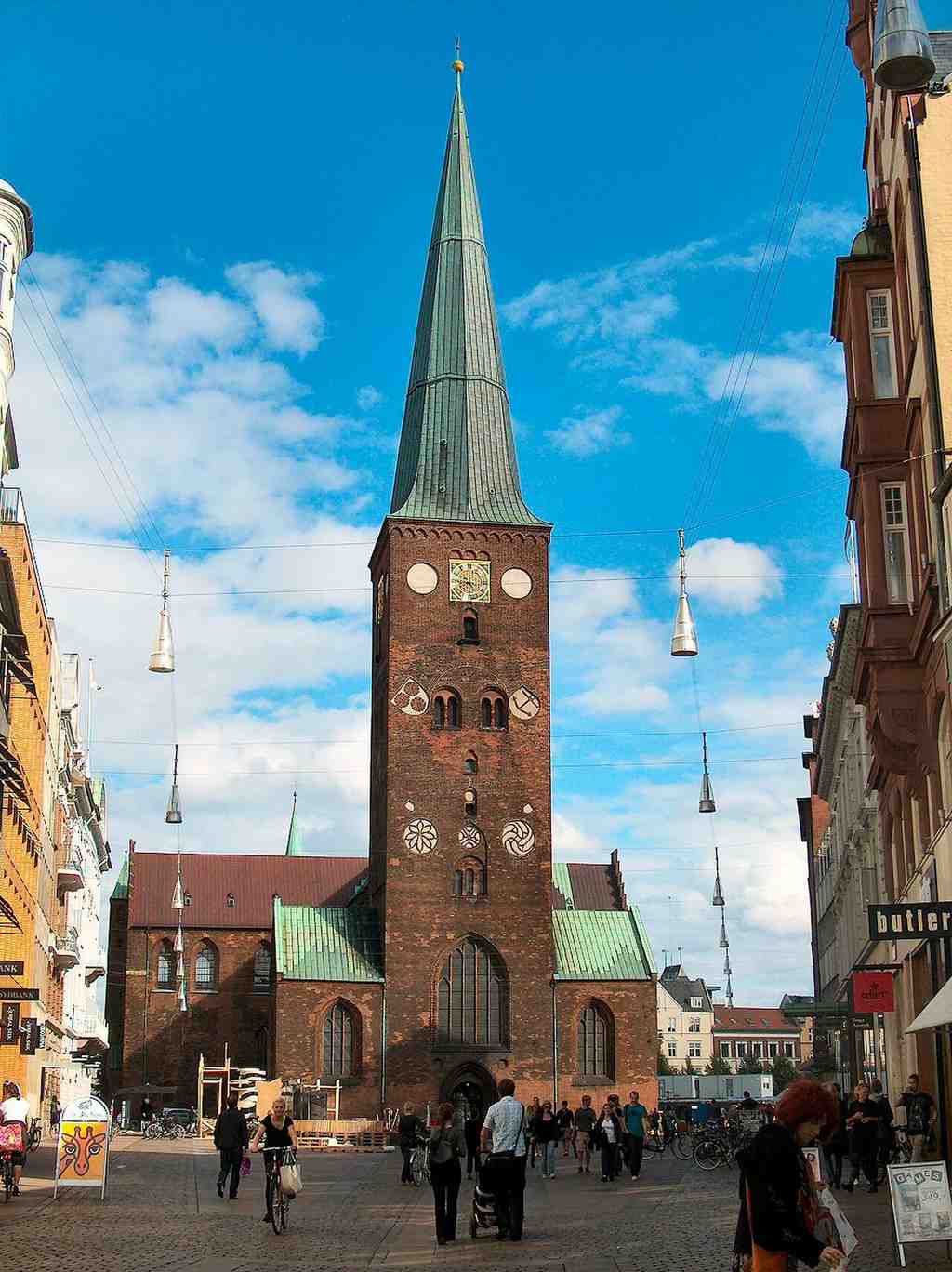
Main SquarePhoto: Villy Fink Isaksen, Wikimedia Commons, Public domain. Cropped & resized. On your right, look for a broad stone-paved square framed by old facades, with the long brick flank of Aarhus Cathedral beside it and the curling bronze fountain locals call the Water Dragon.
This is Store Torv, the Main Square... though for its first centuries it was less a grand plaza and more a practical passage. Around the year twelve hundred, as builders raised the cathedral, this space took shape between Lille Torv and the church. Back then people called it Torvegaden, a route running from Immervad toward the cathedral, while nearby Lille Torv did the real work as the city’s center.
What you see now opened up only after a demolition job with excellent timing. A gate called Borgporten once split Store Torv from Lille Torv. It had a medieval tower, and the city watchmen used it as their base. In sixteen eighty-five, the town tore it down because it blocked traffic. Even then, Aarhus had opinions about congestion.
For centuries this square handled nearly everything a town could throw at it. Markets filled it from the Middle Ages onward. The king set the rules: trade could begin only when the church bells rang. First came local shoppers, then the middlemen and visitors from outside town. Butchers stood with butchers, bakers with bakers, shoemakers with shoemakers... a tidy little system meant to keep competition lively and arguments efficient.
And yes, justice happened here too. Opposite the old gate stood the town hall until eighteen fifty-nine, pressed so close to the cathedral entrance that only a narrow passage separated them. Inside were council rooms, courtrooms, and jail cells in the cellar. Outside, the city court often met in the open air until around seventeen hundred. If a sentence involved whipping, the stocks, or hanging, the condemned had a very short walk from the basement to the square. Convenient for officials... less so for everyone else.
The place could be festive as well. That same town hall hosted weddings and citizens’ balls in its large hall. Around seventeen hundred, after a major renovation, the building also carried Aarhus’s first streetlights: two oil lanterns. Military parades marched here for royal birthdays, the citizen militia showed off in uniform, and the fire brigade tested its pumps here too. Nothing says civic pride quite like rehearsing for disaster in public.
Store Torv also had a strong relationship with mess. Cows passed through daily, loose pigs annoyed residents, and by eighteen sixty-five people complained that the gutter smelled foul enough to earn its own legal case. Later came horse trams, electric trams, cars, taxis, and buses, until the city finally made the square car-free in nineteen ninety. In two thousand and three, Elisabeth Toubro added the fountain installation called Torvenes Brøndsløjfe... better known as Vanddragen, the Water Dragon.
The app lists hours here as daily from ten to eight, though the square itself has clearly ignored opening times for about eight hundred years.
Store Torv is Aarhus in miniature: trade, ceremony, punishment, traffic, and a stubborn gift for reinvention.
When you’re ready, continue toward the Viking Museum, where the city drops a few centuries and gets even more interesting.
On your right, look for a modest glass-and-concrete entrance dropping below street level, with straight stairs and the Viking Museum sign marking the descent. This place hides…Read moreShow less
Open dedicated page →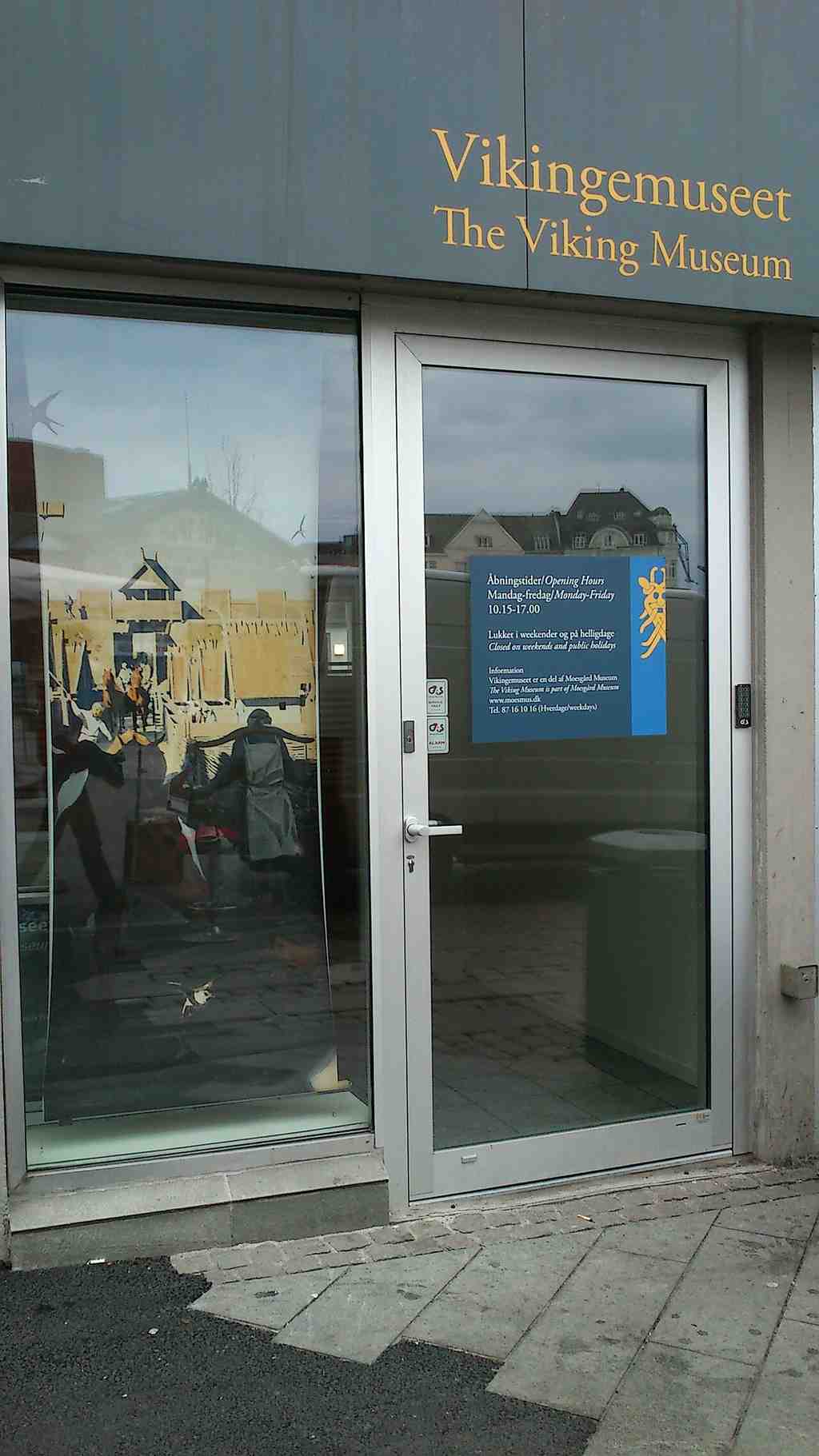
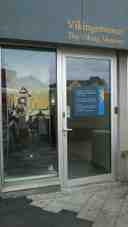
Viking MuseumPhoto: RhinoMind, Wikimedia Commons, CC BY-SA 3.0. Cropped & resized. On your right, look for a modest glass-and-concrete entrance dropping below street level, with straight stairs and the Viking Museum sign marking the descent.
This place hides one of Aarhus’s best tricks... the city above sits on another city below. In nineteen sixty-three and nineteen sixty-four, archaeologists from Moesgaard Museum, down in the Marselisborg woods south of town, came here because builders wanted an office block. Three meters under the street, they uncovered part of Viking Age Aarhus, still in situ, which means exactly where it originally stood. They found remains of houses, fences, wells, street routes, tools, pottery, and even part of the old defensive rampart. That discovery led to this museum in nineteen sixty-eight. A classic archaeological plot twist: start with paperwork, end with Vikings. A renovation in two thousand and eight drew a rush of visitors, and since late twenty eleven the museum has had its own entrance instead of borrowing Nordea’s. If you want to go in, it usually opens from ten fifteen to six on weekdays and to five on weekends. Beneath this square, Aarhus keeps its oldest address. When you’re ready, continue on toward Dokk One.
On your left, Dokk One looks like a giant seven-sided metal disc resting on a transparent glass base, all lifted above broad concrete stairways at the waterfront. Dokk One is…Read moreShow less
Open dedicated page →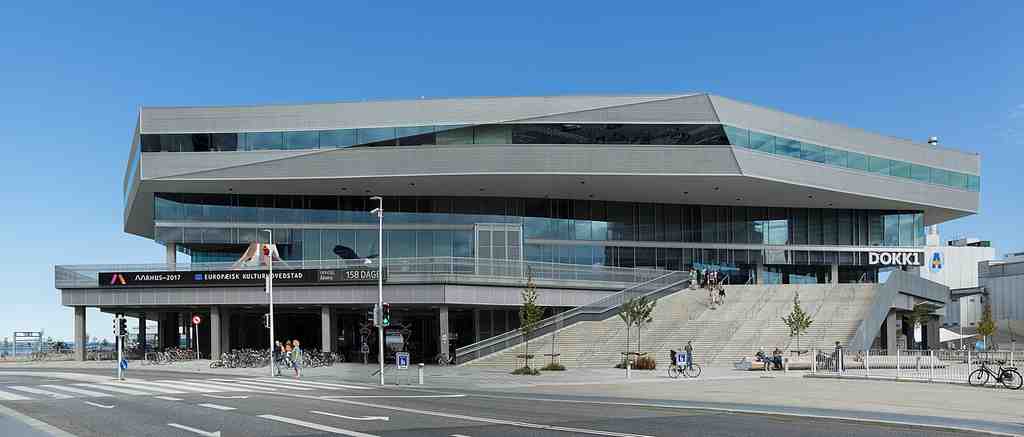
Dokk1Photo: Wikimedia Commons contributor, Wikimedia Commons, CC BY-SA 4.0. Cropped & resized. On your left, Dokk One looks like a giant seven-sided metal disc resting on a transparent glass base, all lifted above broad concrete stairways at the waterfront.
Dokk One is what happens when a city decides its old harbor should stop being merely industrial and start being public. You’re standing at the edge of a huge remake of Aarhus’s waterfront, part of the Urban Mediaspace project, where former dockland turned into civic space instead of fading into rust and nostalgia. Aarhus Municipality and Realdania put in two point one billion Danish kroner, Schmidt Hammer Lassen Architects and landscape architect Kristine Jensen shaped the design, and NCC managed the construction. Work began on the eighth of June, twenty eleven, and the building opened on the twentieth of June, twenty fifteen.
The name came from a public contest in the autumn of twenty twelve. People say it as “Dokken,” “Dok-Et,” or “Dok-Een,” but the meaning stays the same: Dock One. Simple, direct, and very tied to this patch of former industrial harbor.
Architecturally, it’s a neat trick. The upper volume is a heptagon - that just means seven-sided - clad in metal, while the lower part is a glass prism meant to show the life inside. Instead of hiding a library behind solemn walls, the architects let the place advertise itself. If you glance at the app, the interior image shows that idea perfectly: open reading spaces, clear sightlines, and activity visible right through the glass.
And this is not only a library. Dokk One packs in the Aarhus Main Library, municipal citizen services, theater and event spaces, business offices, and an automated underground garage with twenty lifts and room for one thousand cars. Because apparently even the parking here has career ambitions. The library alone covers seventeen thousand five hundred square meters, and it is one of the largest public libraries in Scandinavia.
The building also plugs straight into the light rail. Trains run through and under it, with a station right by the lower entrance. On your screen, you can see how deliberately the whole place was designed around public transport, not just around cars. That matters, because Dokk One tried to be a model of urban convenience: elevators, ramps, inclines, adaptable counters, hearing loops, and pictogram signs all help make the building usable for as many people as possible.
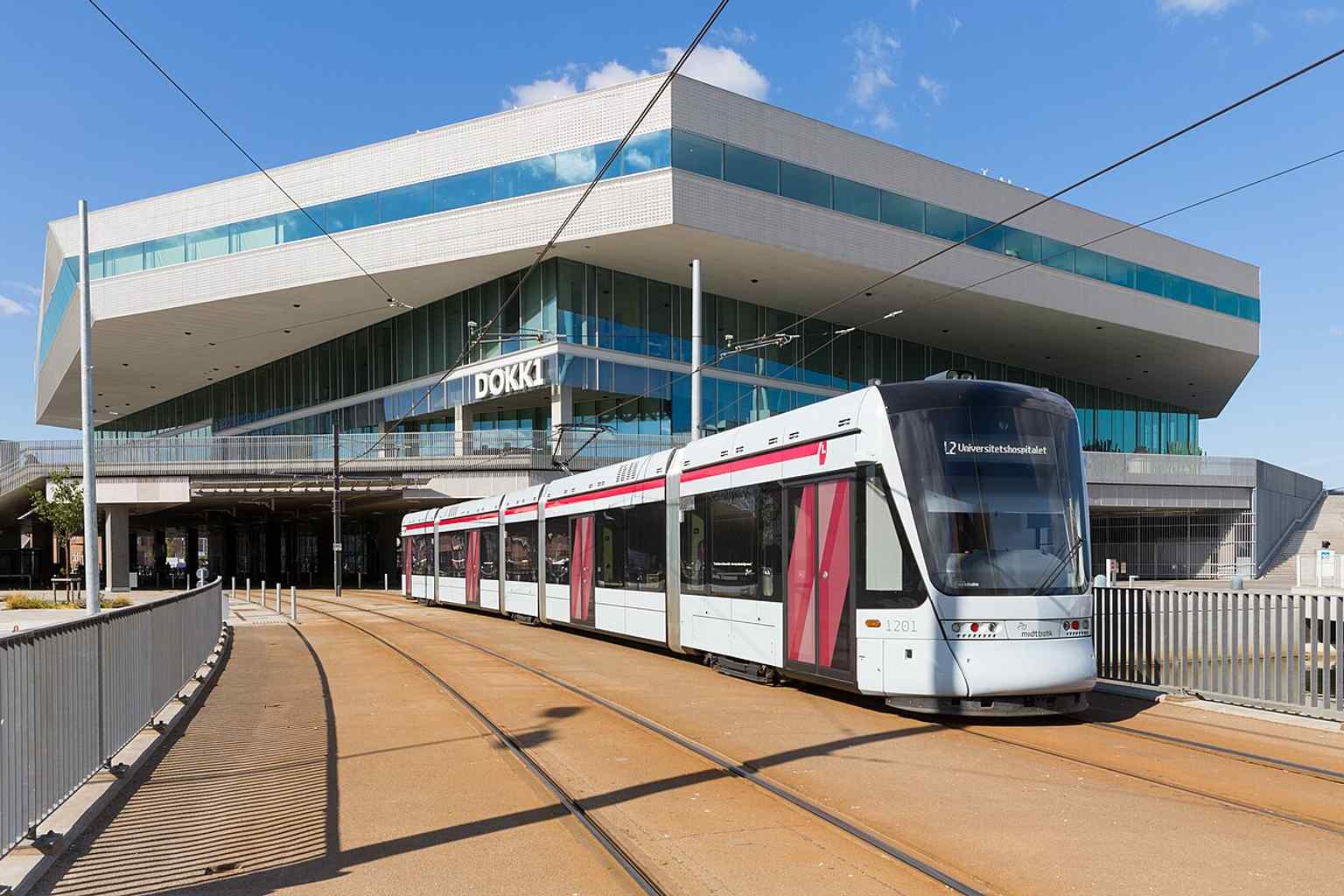
A tram approaching Dokk1 — the light rail connection runs through this landmark building and links it directly to the city.Photo: Liberaler Humanist, Wikimedia Commons, CC BY-SA 3.0. Cropped & resized. Inside hangs one of its most touching details: a bronze pipe bell by Kirstine Roepstorff, about seven and a half meters long, eighty centimeters wide, and close to three tonnes in weight. Parents at Aarhus University Hospital can press a button after a baby is safely born, and the bell sounds here in the library. Not bad for a public building - a place where bureaucracy, books, and brand-new life briefly share the same soundtrack.
Dokk One also aimed for low energy use: solar panels on the roof, seawater for cooling, L-E-D lighting, and durable recyclable materials. Not everything went perfectly; some magnesium oxide wind-barrier boards absorbed water and had to be replaced after opening. Even futuristic buildings, it turns out, still have to deal with boring chemistry.
If you go inside, Dokk One is generally open from eight to ten on weekdays, and from ten to four on weekends.
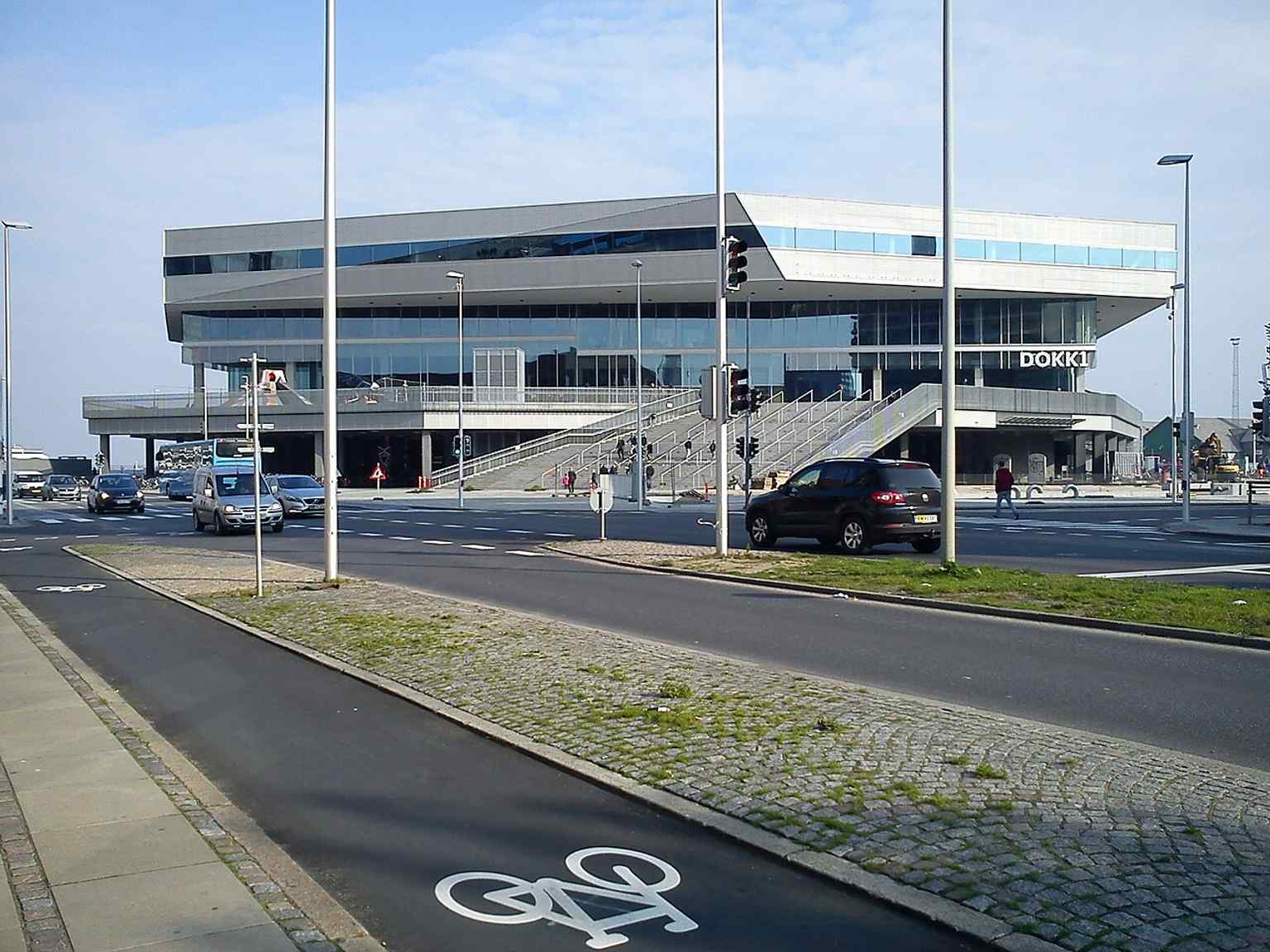
The main Dokk1 frontage with cycle lanes — a good overview of the landmark’s bold waterfront architecture.Photo: RhinoMind, Wikimedia Commons, CC BY-SA 4.0. Cropped & resized.
Frequently asked questions
How do I start the tour?
After purchase, download the AudaTours app and enter your redemption code. The tour will be ready to start immediately - just tap play and follow the GPS-guided route.
Do I need internet during the tour?
No! Download the tour before you start and enjoy it fully offline. Only the chat feature requires internet. We recommend downloading on WiFi to save mobile data.
Is this a guided group tour?
No - this is a self-guided audio tour. You explore independently at your own pace, with audio narration playing through your phone. No tour guide, no group, no schedule.
How long does the tour take?
Most tours take 60–90 minutes to complete, but you control the pace entirely. Pause, skip stops, or take breaks whenever you want.
What if I can't finish the tour today?
No problem! Tours have lifetime access. Pause and resume whenever you like - tomorrow, next week, or next year. Your progress is saved.
What languages are available?
All tours are available in 50+ languages. Select your preferred language when redeeming your code. Note: language cannot be changed after tour generation.
Where do I access the tour after purchase?
Download the free AudaTours app from the App Store or Google Play. Enter your redemption code (sent via email) and the tour will appear in your library, ready to download and start.
If you don't enjoy the tour, we'll refund your purchase. Contact us at [email protected]
Checkout securely with 






.jpg)


