
Visite audio de Barcelone : Les Incontournables Historiques
Sous les boulevards éclatants de Barcelone, un quartier juif médiéval murmure encore dans la pierre, et un opéra garde la chaleur des émeutes entre ses murs. Ceci est une visite audio autoguidée qui s'étend de l'Ancienne Synagogue au Liceu et au Palau Güell de Gaudí, révélant des rébellions, des scandales, des batailles politiques et des coins oubliés devant lesquels la plupart des visiteurs passent sans s'arrêter. Que s'est-il passé lorsque la fureur s'est déversée sur La Rambla et que la ville a exigé du changement juste devant le Liceu ? Quels signes cachés près de l'Ancienne Synagogue pointent vers des vies effacées, mais pas entièrement disparues ? Pourquoi le Palau Güell cache-t-il un détail étrangement spécifique qui n'apparaît qu'à un certain angle et à une certaine heure ? Déplacez-vous à travers des ruelles ombragées vers des salles dorées, passez devant des secrets de ferronnerie et des échos dans les places. Attendez-vous à de la tension, à des découvertes et au sentiment que Barcelone se met enfin en place. Appuyez sur play et laissez la ville parler depuis les profondeurs.
Aperçu du tour
À propos de ce tour
- scheduleDurée 120–140 minsAllez à votre propre rythme
- straightenParcours à pied de 4.9 kmSuivez le sentier guidé
- location_on
- wifi_offFonctionne hors ligneTéléchargez une fois, utilisez n'importe où
- all_inclusiveAccès à vieRéécoutez n'importe quand, pour toujours
- location_onCommence à Plaça de Catalunya
Arrêts de ce tour
lock_open 3 aperçus gratuits · 15 à débloquer à l'achat
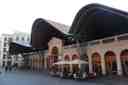
Levez les yeux vers cette grande arche en fer forgé, pointue comme un fronton, bordée de ronds en vitrail jaune et bleu. Au centre, un blason bien chargé annonce clairement la…Lire plusAfficher moins
Ouvrir la page dédiée →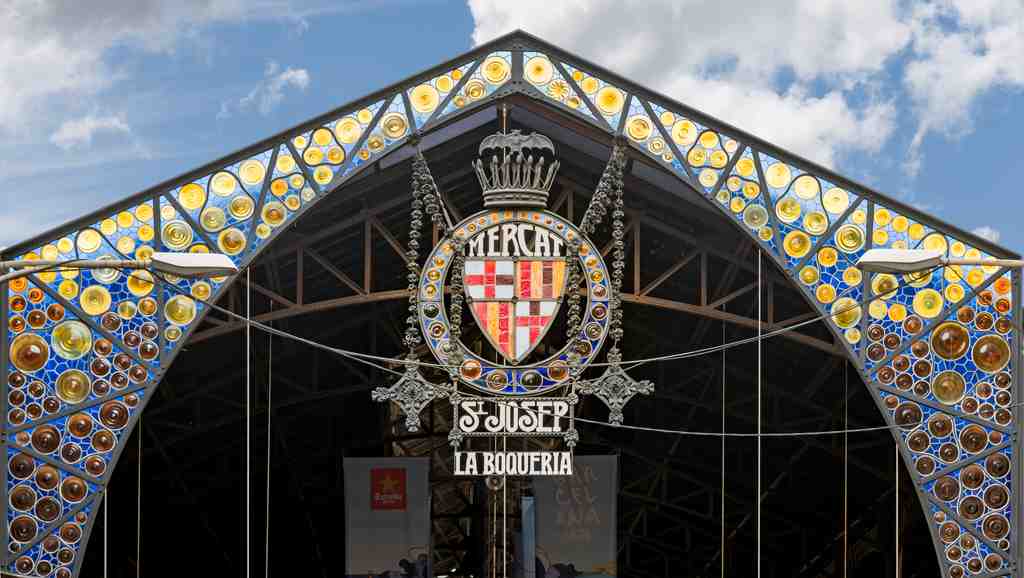
La BoqueriaPhoto: Didier Descouens, Wikimedia Commons, CC BY-SA 4.0. Cropped & resized. Look up at the towering, peaked wrought-iron archway framed by circular panels of yellow and blue stained glass, with a large, ornate crest hanging in the center reading Mercat Sant Josep La Boqueria.
This is Catalonia's largest and most famous market, a massive space offering everything from local goat meat to exotic fruits. But beneath the bright, modern culinary scene lies a rather dark history... one born from sudden violence.
Back in 1835, a convent of Carmelite monks stood right where you are standing. That summer, a notoriously bad bullfight at a nearby arena sparked an unusual chain of events. The bulls were apparently so small and tame that the enraged crowd dragged a dead bull through the streets, and their frustration quickly mutated into a violent anti-clerical riot, an uprising targeting the church's wealth and social influence. The mob surrounded the convent on this exact spot, setting its heavy wooden doors and windows ablaze to flush out the monks inside. The local militia barely managed to rescue the religious men before they were killed, but the building was completely ruined, which allowed the city to confiscate the land and clear away the rubble to build a public market.
You can tap your screen to check out a comparison image showing the transformation of La Boqueria's entrance over a century, evolving from a simpler historic plaza into the grandly roofed marketplace that draws millions of visitors today.
That friction between the shadows of the past and the relentless push of modern commerce is woven right into the fabric of this place. If you look at your screen again, you will see an interior shot of the massive modern operation, which houses over three hundred stalls under the metallic roof added in 1914.
Many of these stalls have been run by the exact same families for over one hundred and fifty years. But even in its golden era of modern gastronomy, the market has never quite shaken its flair for the dramatic. Take Ramón Cabau, a local pharmacist turned dandy, who helped popularize Catalan cuisine. With his impeccable suits and a mustache that practically defied gravity, he was a beloved daily fixture here. Then, one morning in 1987, he casually greeted his favorite vendors, pulled out a glass of water, and committed suicide by swallowing a cyanide pill right in the middle of the crowded aisles. The loss plunged the market into a mourning period that lasted for years.
The market carries on, absorbing every tragedy and triumph into its daily routine. By the way, the stalls are open Monday through Saturday from 8 AM to 8:30 PM, and are closed on Sundays.
Let us keep moving. Head further down the Rambla toward the grand opera house, and we will reconnect at the Liceu.
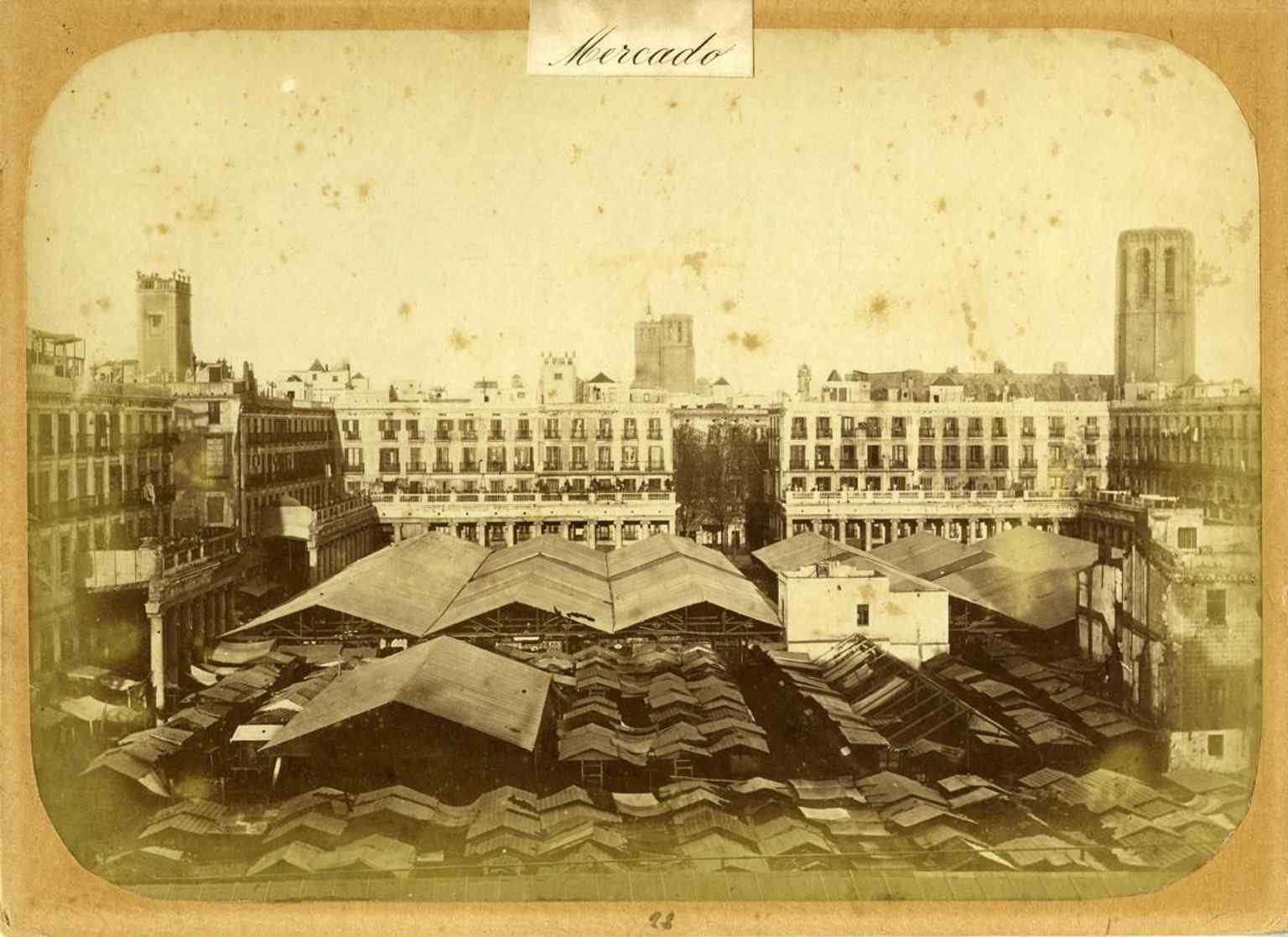
An 1874 view of La Boqueria, which began as an open-air market outside the city walls, helping vendors avoid city taxes.Photo: Joan Martí Centellas, Wikimedia Commons, Public domain. Cropped & resized. 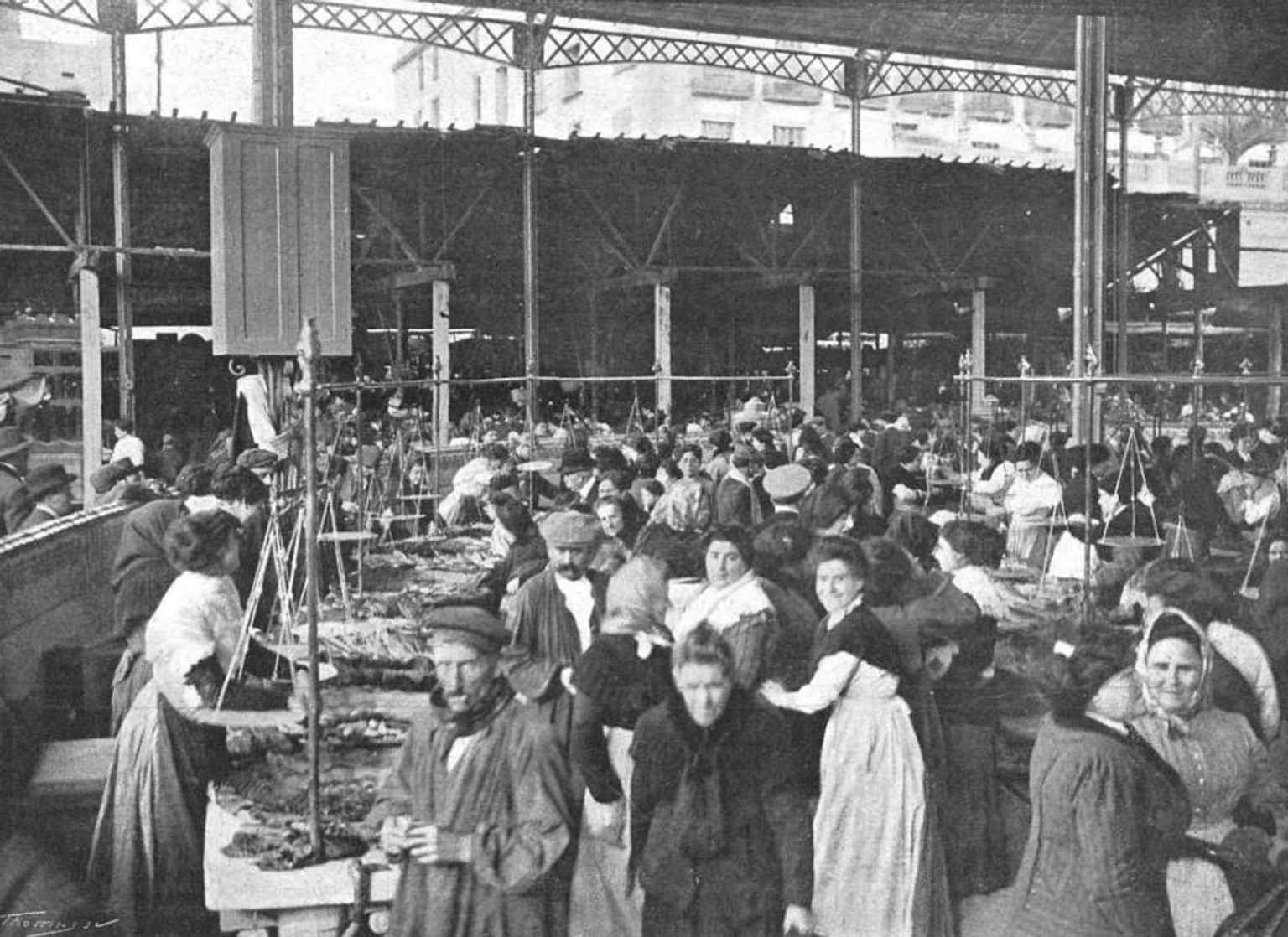
A 1911 glimpse into the fish market section, illustrating the evolution of specialized stalls within La Boqueria's permanent structure.Photo: Frederic Ballell i Maymí, Wikimedia Commons, Public domain. Cropped & resized. 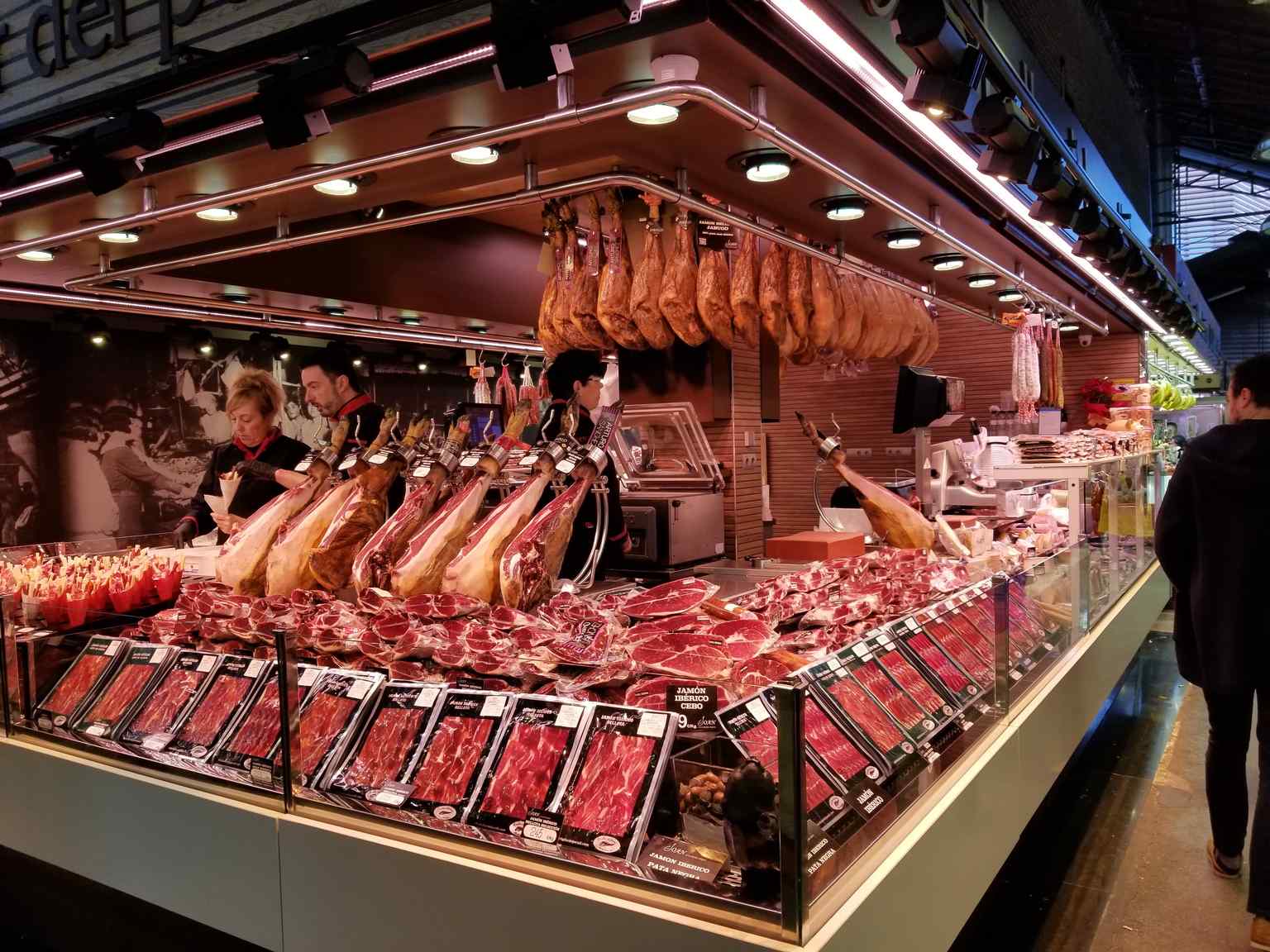
A butcher's stall reminiscent of the market's debated origin name, 'Boquería,' possibly derived from 'boc' (male goat), referring to early sales of goat meat.Photo: DuckWrangler97, Wikimedia Commons, CC BY-SA 4.0. Cropped & resized. 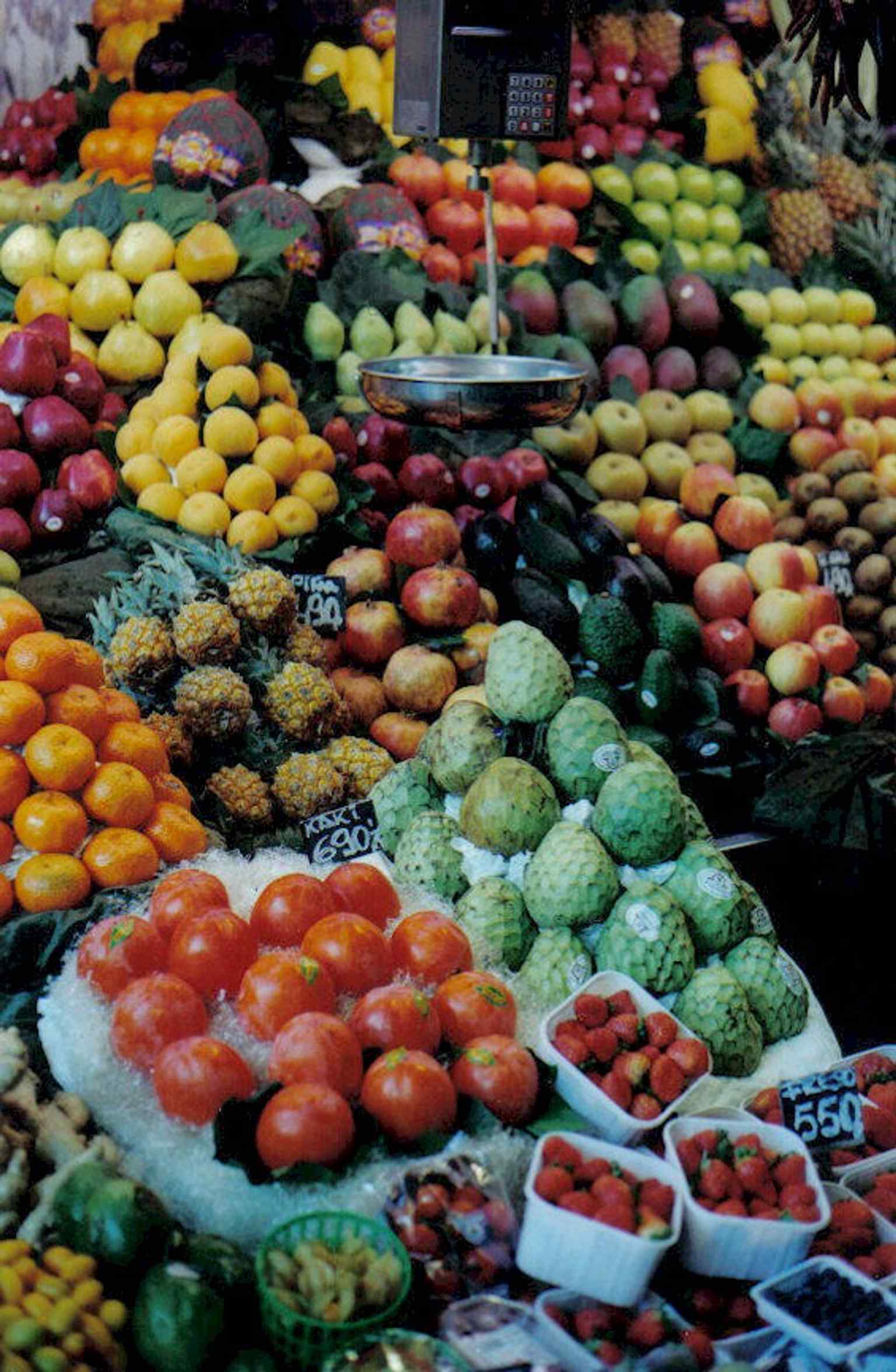
A vibrant greengrocer stall, exemplifying the deep family history of La Boqueria, where some stalls have been passed down through generations for over 150 years.Photo: Jruizalvarez, Wikimedia Commons, CC BY-SA 4.0. Cropped & resized. À gauche, vous repérez un grand bâtiment de pierre claire, avec trois grandes fenêtres en arc au centre, un fronton arrondi surmonté d’une horloge, et ce petit couronnement de…Lire plusAfficher moins
Ouvrir la page dédiée →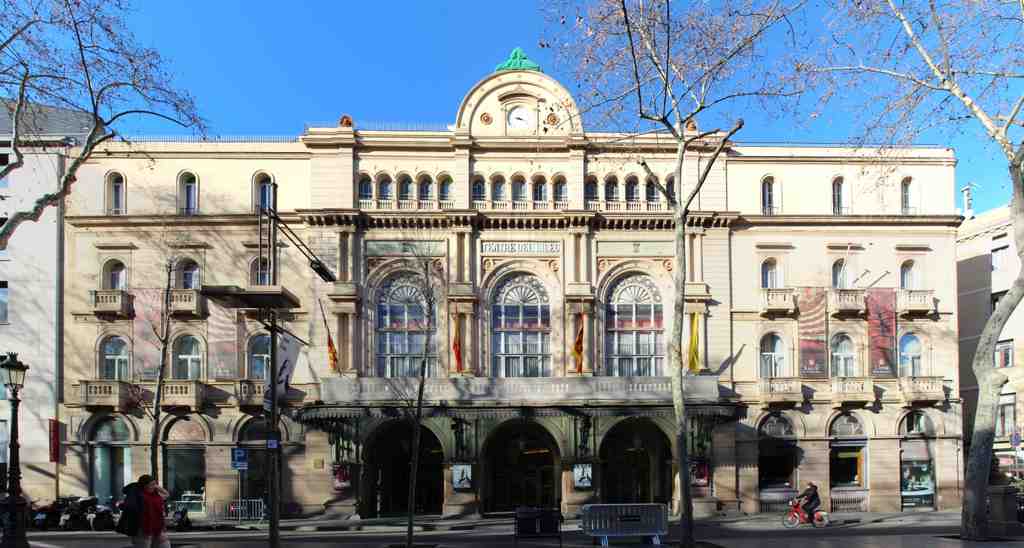
LiceuPhoto: Chabe01, Wikimedia Commons, CC BY-SA 4.0. Cropped & resized. Look to your left and you will spot a grand, tan stone building defined by three prominent arched windows in the center, a rounded clock pediment at the top, and a distinctive green roof ornament crowning the structure. This is the Gran Teatre del Liceu, Barcelona's oldest active theater, and frankly, it is a miracle it is still standing. If buildings have nine lives, this opera house has used up quite a few of them.
When it was built in 1847, it was funded by private citizens rather than a monarchy, which is why you will not find a royal box inside. But they built it right on top of a former convent. According to local lore, the displaced religious figures left behind a curse, dooming the theater to repeatedly burn down. Looking at its history, you might start to believe it.
The first devastating fire hit in 1861, leaving only the facade and a few halls intact. They rebuilt it. Then, during the opening night in 1893, an anarchist threw two bombs from the upper gallery down into the stalls, the main ground floor seating area. Twenty people were killed. The death toll would have been worse, but one bomb miraculously failed to detonate because its fall was broken by a victim. The theater rebuilt again, leaving the seats of the victims conspicuously empty for years as a memorial. Some staff even say they still hear phantom singing and whispers near those private boxes.
But the curse was not finished. In 1994, a workman's blowtorch sparked a fire that raged completely out of control. Huge balls of fire shot into the air, incinerating the instruments in the orchestra pit. Crowds stood weeping in the street, including the famed Catalan soprano Montserrat Caballé, who considered the Liceu her second home.
Yet again, the city refused to let the music die. They rebuilt it, merging the surviving historical architecture with state-of-the-art technology. You can see how the energy outside the theater has evolved over the years in the app's before and after image. Over a century later, La Rambla remains a bustling thoroughfare past the iconic Gran Teatre del Liceu, capturing the shift from early 20th-century pedestrians to modern-day tourists.
My absolute favorite moment of modern resilience happened here in 2020. To mark the end of the strict pandemic lockdown, the Liceu reopened not for humans, but for an audience of 2,292 house plants. A string quartet played Puccini to a sea of green leaves, and afterward, the plants were donated to local healthcare workers. That is the essence of this place, an institution forever caught in a dance between honoring its tragic history and embracing wild, forward-thinking reinvention.
If you want to look inside, the theater is usually open to visitors Monday through Saturday until seven, though it closes at two on Saturdays and is entirely closed on Sundays. For now, we are going to keep moving. Just ahead, look for the narrow street leading off La Rambla, which will take us to our next stop, Palau Güell, about a three-minute walk away.
Afficher 15 arrêts de plusAfficher moins d'arrêtsexpand_moreexpand_less
Repérez ce grand bâtiment de pierre claire, presque monumental… Au rez-de-chaussée, deux énormes arcs en forme de parabole encadrent des grilles en fer forgé très travaillées,…Lire plusAfficher moins
Ouvrir la page dédiée →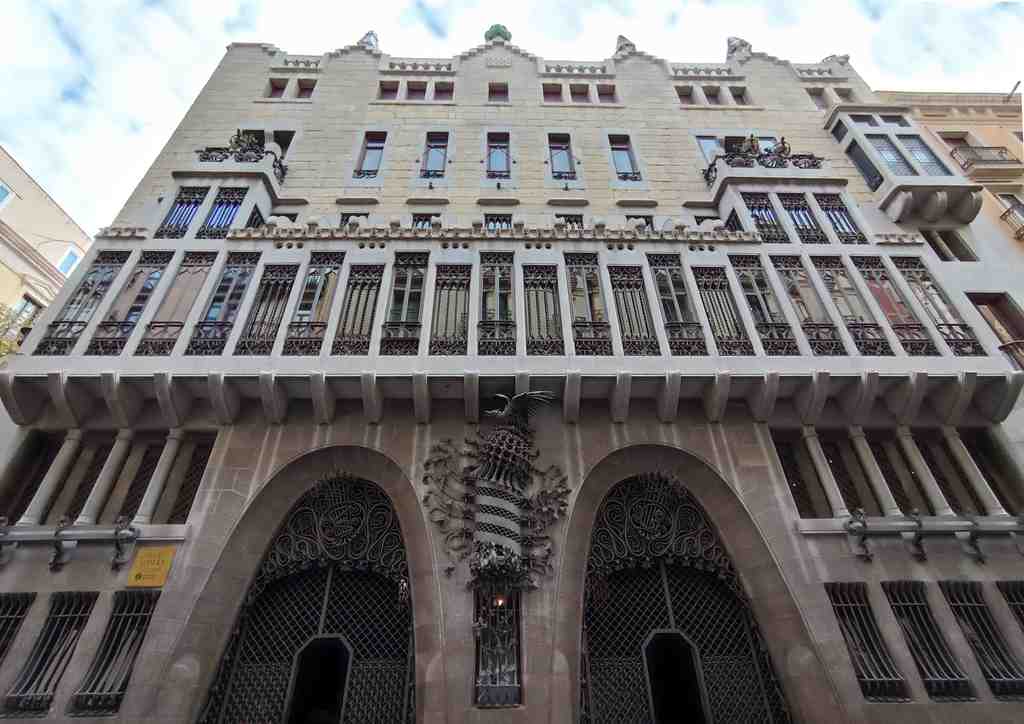
Palais GüellPhoto: Canaan, Wikimedia Commons, CC BY-SA 4.0. Cropped & resized. Look for a monumental pale stone building dominated by two massive parabolic arches on the ground floor, filled with intricate ironwork and separated by a striking wrought-iron crest.
This is Palau Güell. It was the first major commission for a young, relatively unknown architect named Antoni Gaudi.
Built between 1886 and 1890, this palace belongs to Gaudi's orientalist phase, drawing heavy inspiration from the geometric patterns and elaborate tile work of Near Eastern and Islamic art. It marked the dawn of Catalan Modernism, a regional artistic movement that rejected strict, classical architecture in favor of bold, highly decorative, and often nature-inspired designs. Gaudi poured his absolute soul into this project, coming up with twenty-five different solutions just for the facade you see here.
But the immense wealth that paid for this architectural masterpiece had a deeply troubling origin, as the patron's father, Joan Güell, built his initial fortune in Cuba through the illegal transatlantic slave trade. That dark money laid the foundation for the family's massive industrial empire back in Barcelona.
It is a heavy thing to stand before such brilliance and know exactly what bought it. Eusebio Güell, the son who inherited that fortune and commissioned this palace, wanted a home that would project his absolute power. Just look at those immense entrance doors with their iron mesh. They were designed with those towering parabolic shapes, which are tall curves similar to the path of a tossed object, specifically so that high-society guests could ride their horse-drawn carriages straight into the ground floor. If you look closely, the ironwork at the top of the doors cleverly hides two twisting snakes that form the letters E and G, for Eusebio Güell.
The influence of that dark wealth even bent the city's rules. The municipal architect originally rejected Gaudi's design because the solid stone facade violated city ordinances, which strictly required lighter iron and glass structures for these types of viewing galleries. But Güell simply pulled a few political strings in the local government, and the city magically approved the heavy stone construction anyway. The elite truly wrote their own rules, pushing their bold visions of the future forward while standing on the silent ghosts of the past.
The palace is open Tuesday through Sunday from ten in the morning to eight in the evening, if you ever want to explore the stunning central dome and the wildly colorful chimneys on the roof. For now, let us head back toward the heart of the Gothic Quarter, as our next stop, Plaça Reial, is just a short two-minute walk away.
Regardez cette place bien rectangulaire, bordée de façades uniformes en pierre claire. Au rez-de-chaussée, une arcade continue: ce sont ces rangées d’arches qui créent une galerie…Lire plusAfficher moins
Ouvrir la page dédiée →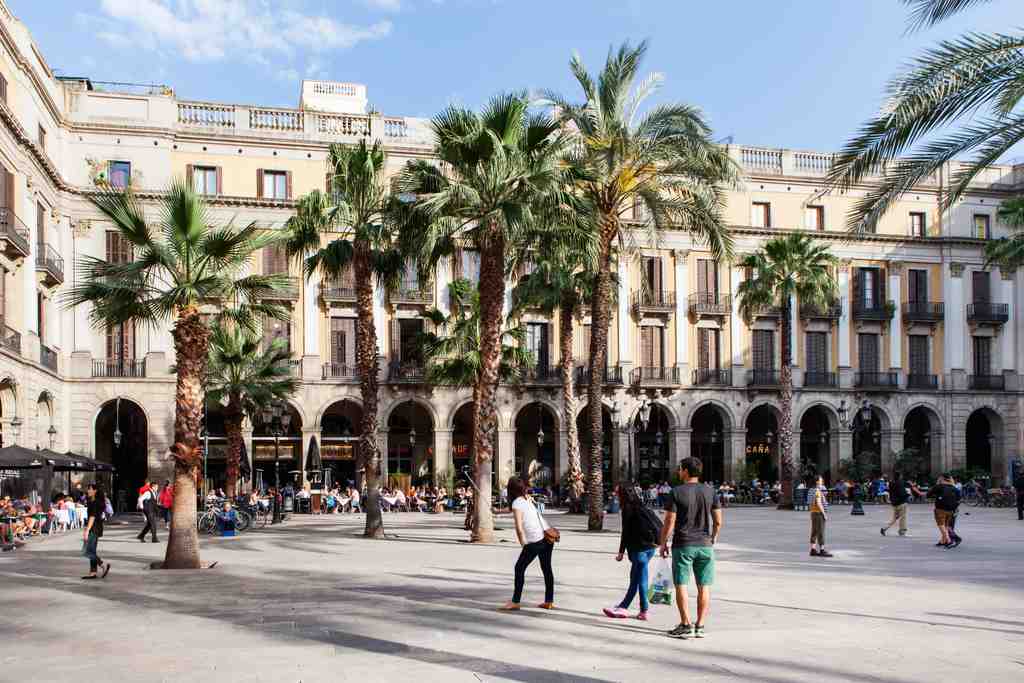
Plaça ReialPhoto: Paux127, Wikimedia Commons, CC BY-SA 4.0. Cropped & resized. Au XXe siècle, le vernis élégant de la place accueillait des personnages délicieusement excentriques. En 1919, une boutique de taxidermie renommée a ouvert ses portes ici, spécialisée dans la préservation et le montage d'animaux. Elle attirait tout le monde, de la star d'Hollywood Ava Gardner au roi Alphonse XIII, qui y fit naturaliser la jambe de son cheval préféré. Naturellement, Salvador Dalí était un adepte. En 1960, le peintre surréaliste posa ici même, au centre de la place, sur le dos d'un rhinocéros de Java empaillé, payant vingt duros aux déménageurs, soit environ cinquante dollars d'aujourd'hui, pour leur peine. Apparemment, il repartit aussi avec un squelette de gorille qu'il ne paya jamais.
Avant de partir, remarquez les lampadaires en fer élaborés. Regardez de près les serpents entrelacés et le casque ailé de Mercure. Ce fut l'une des toutes premières commandes municipales confiées à un jeune Antoni Gaudí en 1879.
Malgré toutes ses tentatives de dignité royale, la Plaça Reial a toujours favorisé les rebelles, les artistes et les marginaux qui se l'ont appropriée. Dirigeons-nous plus profondément dans les rues labyrinthiques du quartier gothique, en nous dirigeant vers les grands murs médiévaux de Santa Maria del Pi.
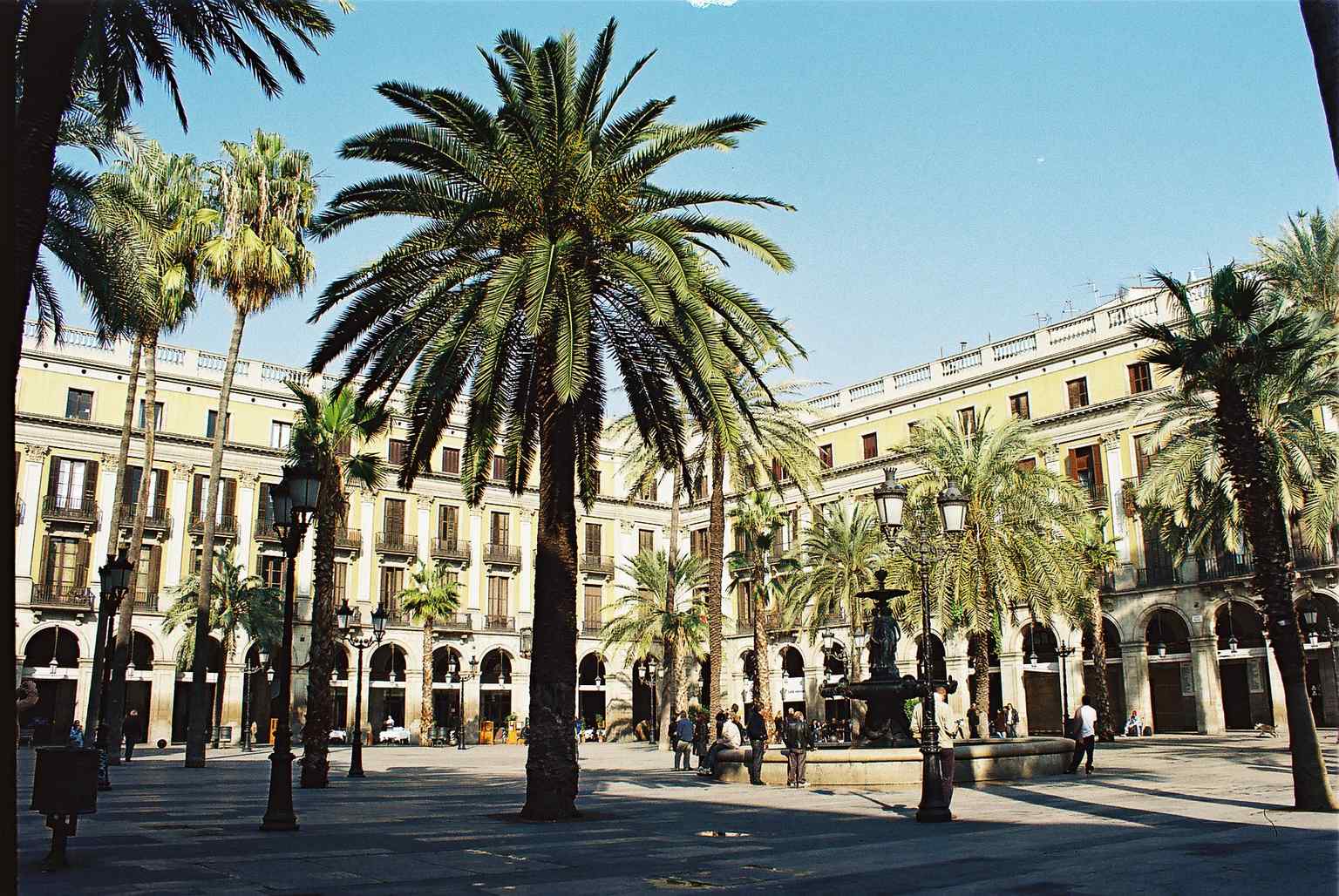
Observez l'architecture néoclassique des bâtiments de la Plaça Reial, conçus par Francisco Daniel Molina, présentant des galeries à portiques au rez-de-chaussée et des pilastres corinthiens aux étages supérieurs.Photo: Ralf Roletschek, Wikimedia Commons, CC BY-SA 3.0. Cropped & resized. null
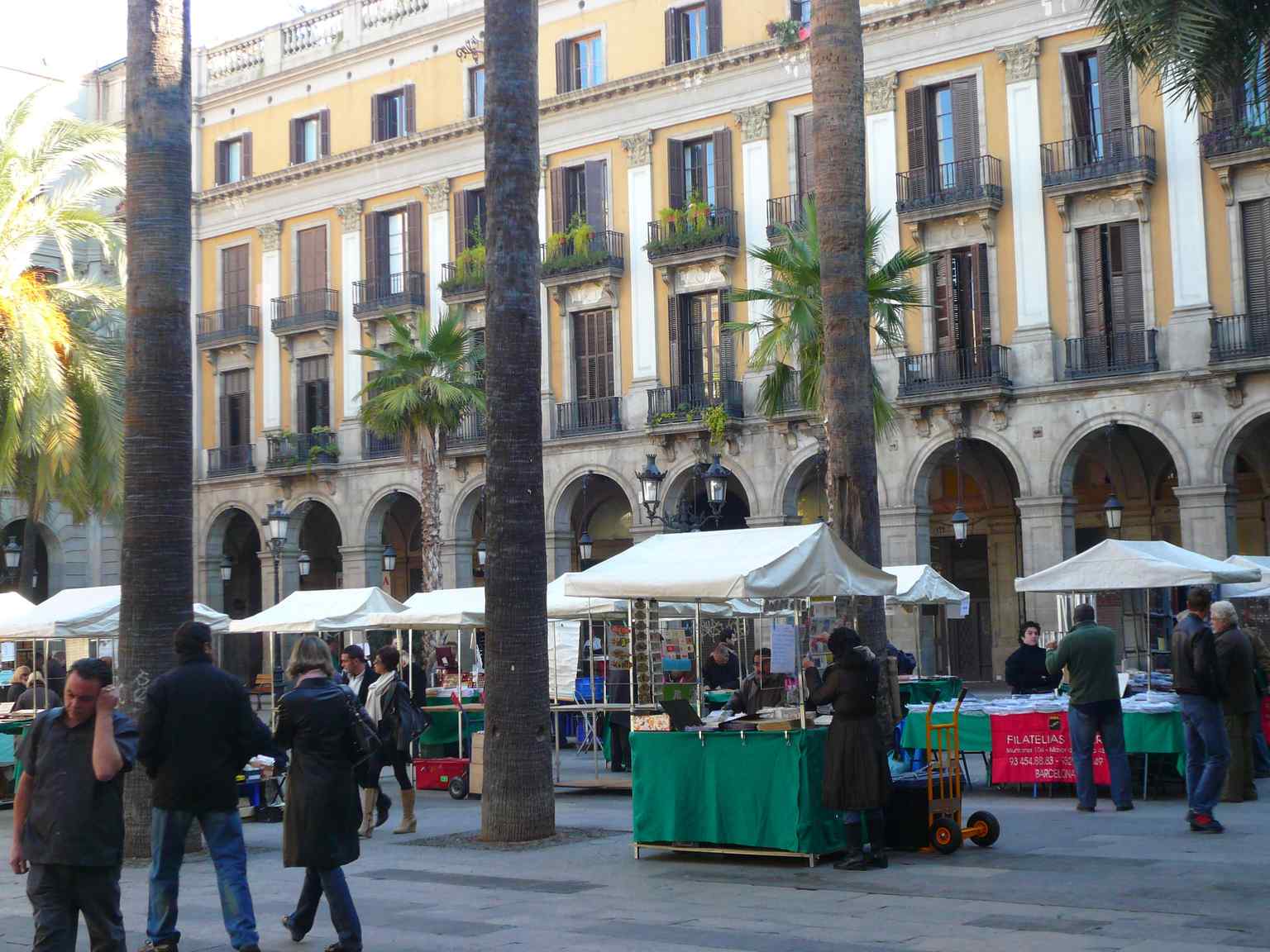
Observe the neoclassical architecture of the Plaça Reial's buildings, designed by Francisco Daniel Molina, featuring ground-floor porticoed galleries and Corinthian pilasters on the upper levels.Photo: Pere prlpz, Wikimedia Commons, CC BY-SA 3.0. Cropped & resized. 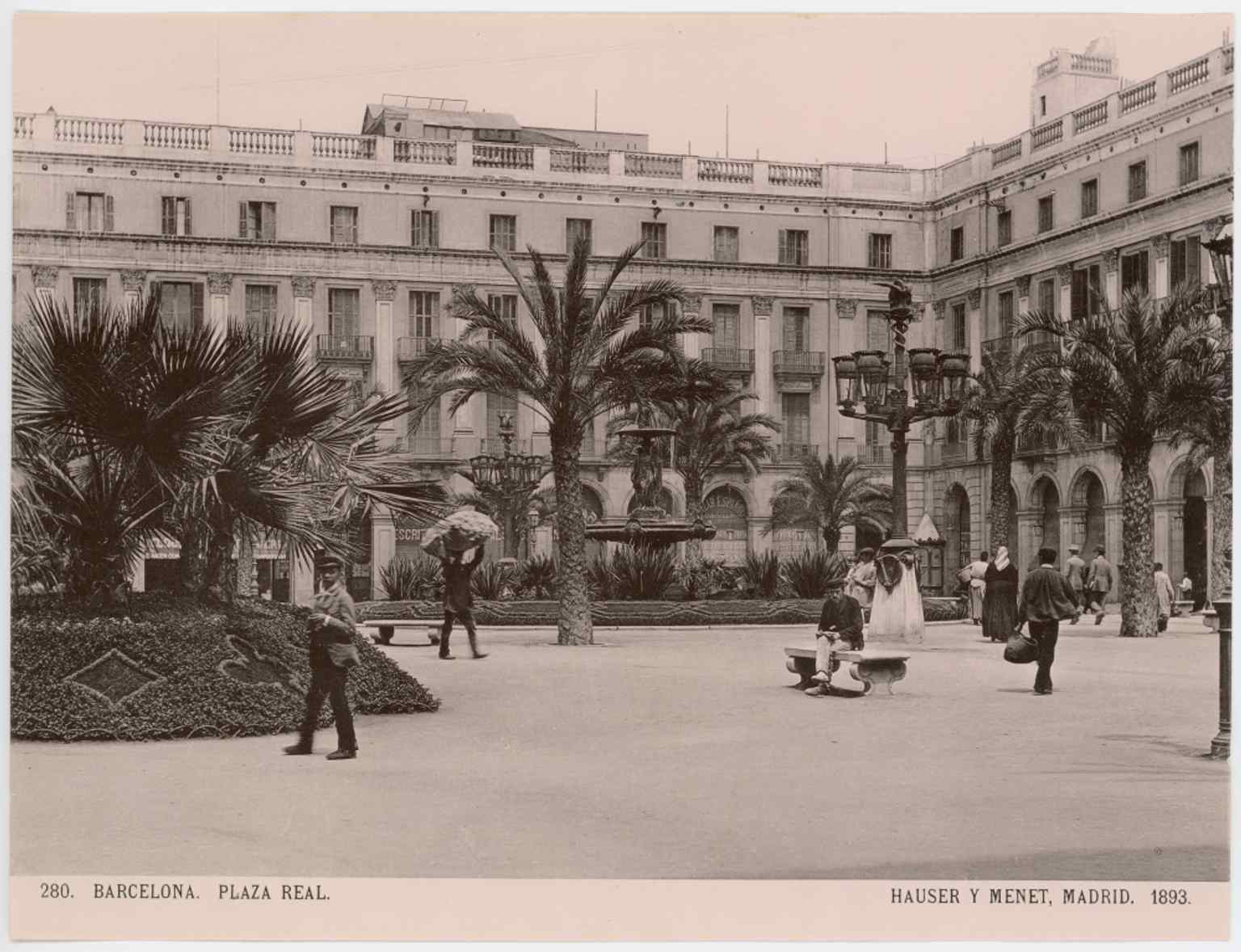
A view of Plaça Reial from 1893, capturing the square decades after its construction and around the time of the late 19th-century political unrest, including an anarchist bombing in 1892.Photo: SMU Libraries Digital Collections, Wikimedia Commons, No restrictions. Cropped & resized. Sur votre gauche, voilà Santa Maria del Pi: une façade massive en pierre bien plane, presque austère… jusqu’à ce que le regard tombe sur l’immense rosace circulaire à douze « bras…Lire plusAfficher moins
Ouvrir la page dédiée →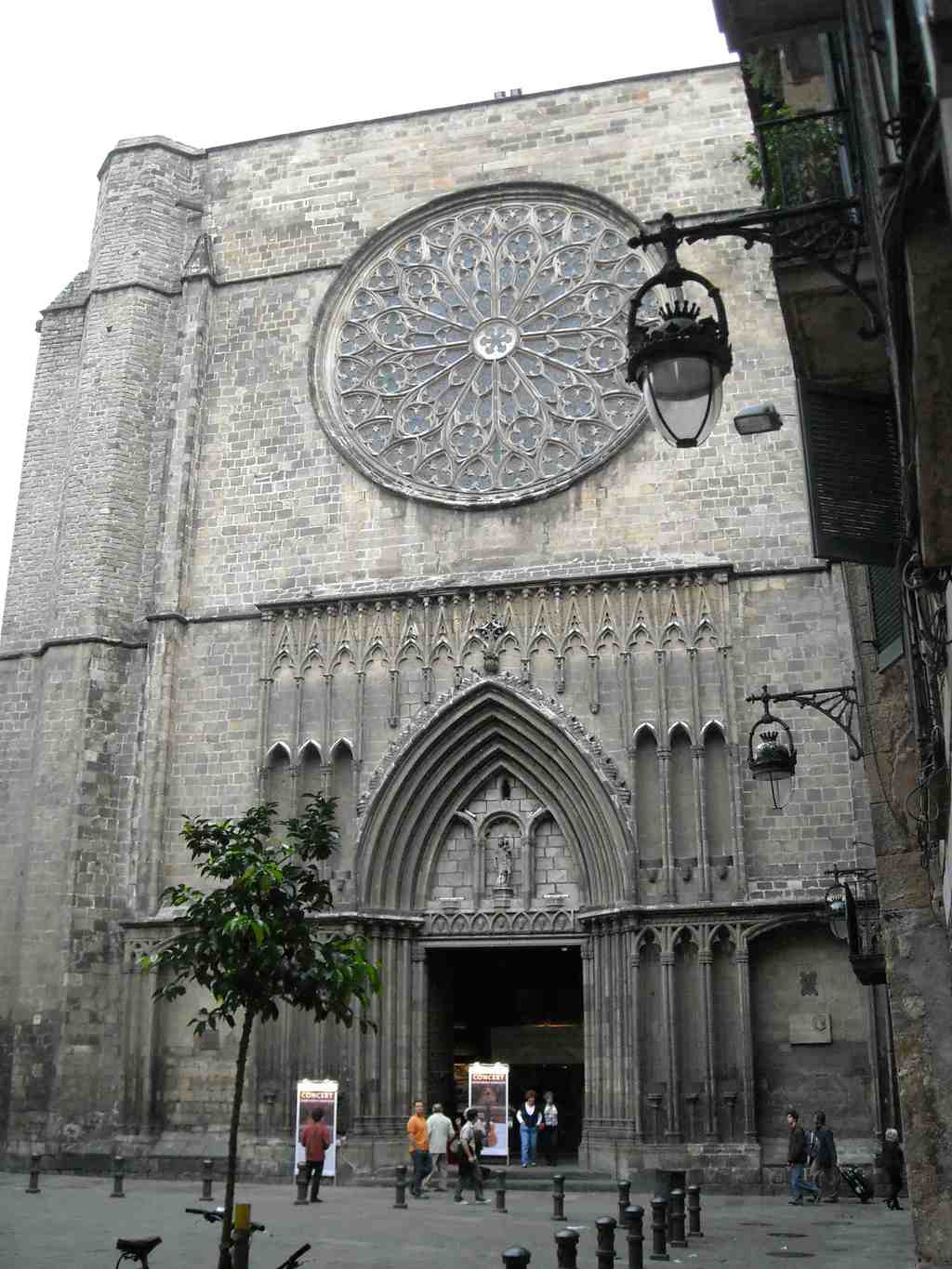
Sainte-Marie-du-PinPhoto: Cruccone, Wikimedia Commons, CC BY-SA 3.0 ES. Cropped & resized. Notice Santa Maria del Pi on your left, with its massive facade of flat stone defined by its enormous, twelve-armed circular rose window sitting squarely above a pointed, deeply recessed archway.
The name translates to Saint Mary of the Pine. According to local lore, a wooden image of the Virgin Mary was once found hidden deep inside the heart of a pine tree. To honor this, the community planted a pine right out front. It became a living anchor, a piece of ancient earth holding its ground as the stone city built up and expanded around it.
In the year fifteen sixty-eight, a specific pine was planted that grew as tall as the surrounding rooftops. It survived centuries of urban expansion, only to meet its end in eighteen oh two when a soldier inexplicably stabbed its trunk with his bayonet. The tree died, but the locals simply planted another. They have kept replanting it ever since. That insistence on keeping a green, living monument in a paved square is a quiet rebellion, ensuring old traditions survive even as the modern world encroaches.
The basilica itself knows all about survival. In nineteen thirty-six, at the dawn of the Spanish Civil War, anti-clerical militias set the building on fire. The heat was so intense it collapsed the vaulted ceilings, the curved stone arches supporting the roof, and shattered that magnificent rose window, sending thousands of glass shards raining down onto the square. Yet, as the political forces of tomorrow threatened to completely erase the past, ordinary neighbors rushed into the smoke. They ignored the valuable metals, instead grabbing the parish archives. They hid twelfth-century paper documents in their own homes, protecting the historical memory of their community from the fires of upheaval.
There are older, darker memories woven into these stones, too. Look up toward the top of that towering, eight-sided bell tower. Its construction in the fifteenth century was such a monumental challenge that rumors naturally blamed the supernatural. Legend says the master builder struck a deal with the devil, promising his soul in exchange for completing the tower. The devil would collect his due the moment the architect set foot on the one-hundredth step of the spiral staircase. The architect simply outsmarted him by stopping his work on the stairs at step ninety-nine, focusing on the rest of the church until he died peacefully of old age. When his successor finally added the hundredth step, the devil was so enraged at being cheated that he stomped his foot, leaving a deep hoofprint in the stone. It drew so many curious onlookers that nineteenth-century church authorities eventually had to patch it with cement just to stop the spectacle.
This basilica is a quiet sanctuary where old mysticism still pushes back against a purely rational world. If you want to step inside, the church is open daily, though Sunday hours are a bit shorter. For now, let us head just around the corner to seek out an aristocratic residence, making the short walk over to Palau Maldà.
Regardez le bâtiment en pierre sur votre gauche: une façade bien plate et rectangulaire, des rangées de balcons en fer forgé bien sages, et surtout ce grand portail en arc,…Lire plusAfficher moins
Ouvrir la page dédiée →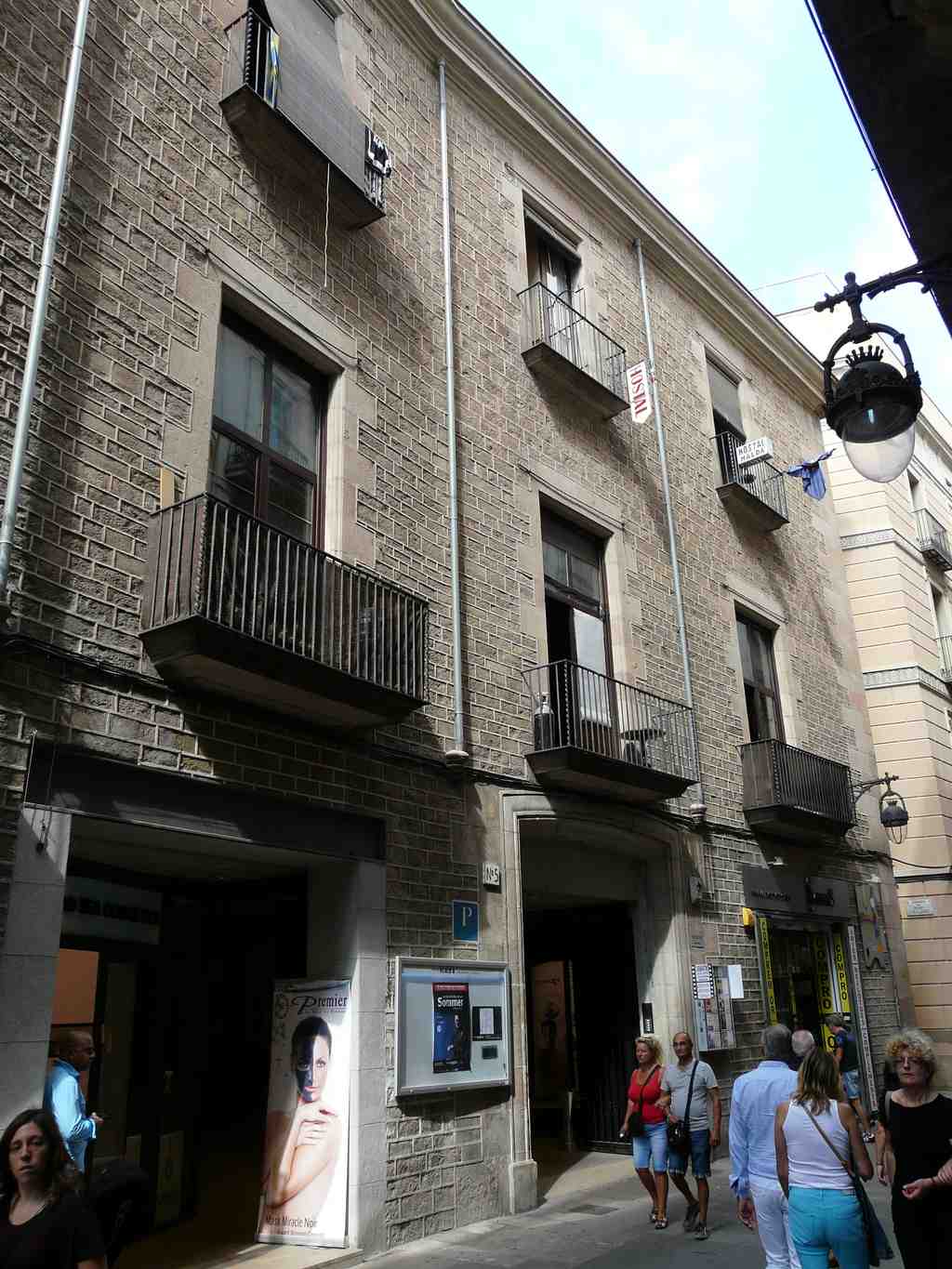
Palau MaldàPhoto: pere prlpz, Wikimedia Commons, CC BY-SA 3.0. Cropped & resized. Au XVIIIe siècle, ce palais appartenait à Rafael de Amat, le premier baron de Maldà. Rafael était un aristocrate excentrique dont l'œuvre majeure fut un journal personnel en cinquante volumes. Il était obsédé par ce qu'il appelait la douce oisiveté de sa vie. Loin d'être un grand intellectuel, le baron écrivait uniquement pour son propre plaisir, remplissant ses pages de récits détaillés, presque obsessifs, de ses repas extravagants. Il défendait farouchement son droit de simplement bien manger et mieux boire, et refusait catégoriquement d'écrire en castillan, qu'il considérait comme la langue du percepteur d'impôts.
Mais cette bulle aristocratique confortable et frivole éclata en 1808. Lorsque les Français envahirent le pays pendant la guerre d'Indépendance, le baron terrifié fut contraint de fuir son palais bien-aimé. Il passa ses dernières années en tant que fugitif fortuné, errant de ville en ville, écrivant avec fureur dans son journal à quel point sa vie douillette ici lui manquait.
Depuis lors, ce bâtiment a constamment tenté de s'inventer un nouvel avenir, pour être finalement rattrapé par son histoire. En 1942, la famille avait déménagé, et le rez-de-chaussée ainsi que les jardins furent transformés en Galerías Maldà. Il s'agissait de galeries marchandes couvertes de verre, calquées sur les passages parisiens. Elles connurent un succès massif. Elles abritèrent même pendant plus de soixante-dix ans un hôpital pour poupées très apprécié, où des chirurgiens du jouet réparaient des yeux en porcelaine et recousaient des membres en tissu.
À l'étage, les anciennes salles de concert privées du baron devinrent finalement un théâtre. Regardez la deuxième image sur votre application pour voir l'escalier intérieur menant à cet espace de spectacle. Mais ces murs recèlent un secret plus profond. Pendant la guerre civile espagnole, dans les années 1930, alors que les églises de la ville étaient attaquées, l'une des petites salles de théâtre du palais fonctionnait secrètement comme une chapelle catholique basque. Elle resta ouverte au culte en toute sécurité, au vu et au su de tous. Des décennies plus tard, lors de la rénovation du cinéma du bâtiment en 2006, des ouvriers firent une découverte surprenante. Cachée directement derrière l'écran de cinéma se trouvait une grande hornacina, une niche décorative encastrée dans le mur, qui abritait autrefois des figures religieuses pour cette congrégation secrète du temps de guerre.
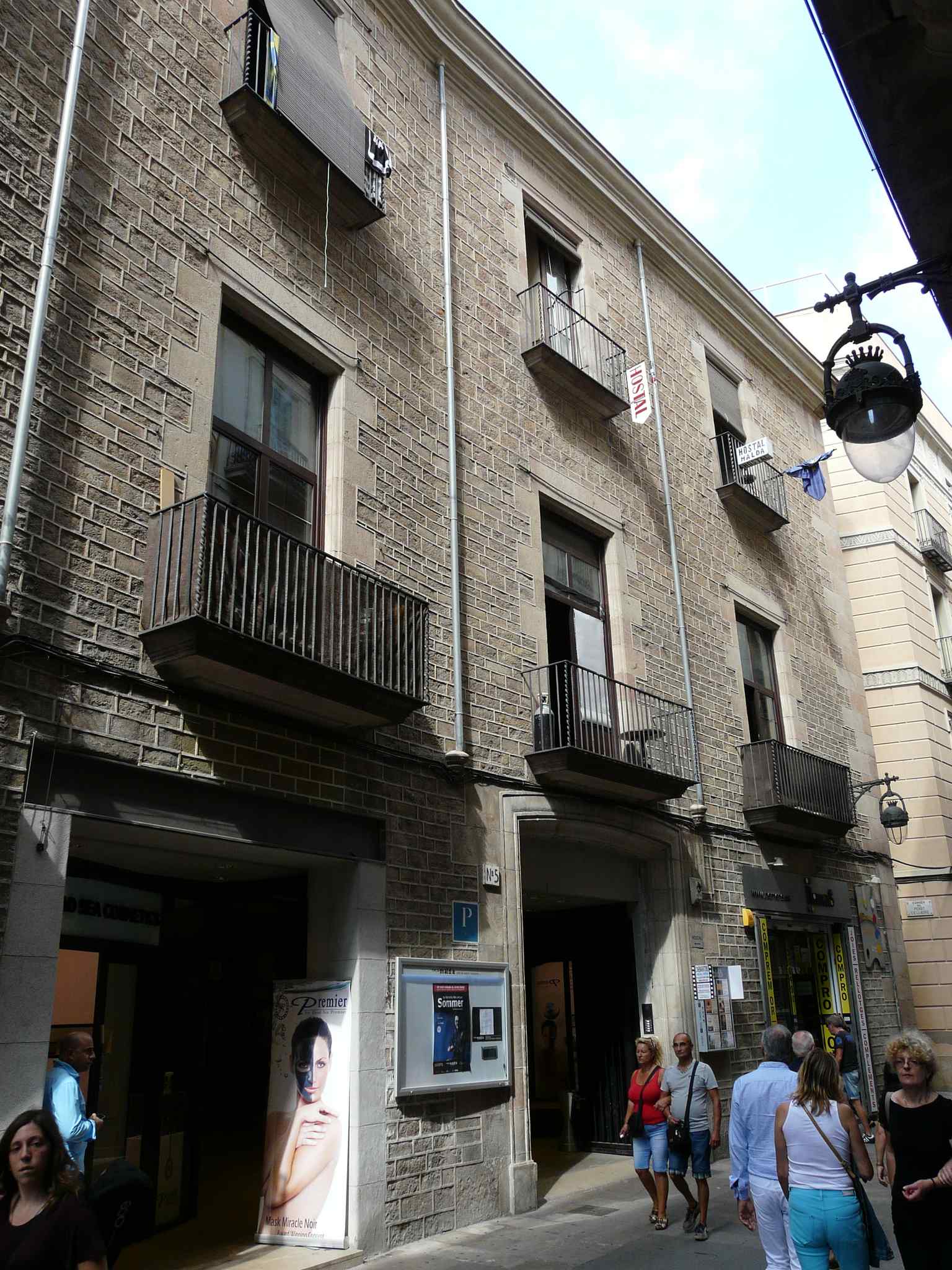
L'escalier menant au Teatre Maldà, un espace au sein du palais autrefois utilisé pour des concerts privés par le baron de Maldà et officiellement inauguré comme théâtre en 1996.Photo: pere prlpz, Wikimedia Commons, CC BY-SA 3.0. Cropped & resized. Back in the eighteenth century, this palace belonged to Rafael de Amat, the first Baron of Maldà. Rafael was an eccentric aristocrat whose main life's work was a fifty-volume personal diary. He was obsessed with what he called the sweet idleness of his life. Far from being a grand intellectual, the Baron wrote entirely for his own amusement, filling his pages with detailed, almost obsessive accounts of his extravagant meals. He fiercely defended his right to just eat well and drink better, and he absolutely refused to write in Castilian Spanish, which he dismissed as the language of the tax collector.
But that comfortable, frivolous aristocratic bubble popped in 1808. When the French invaded during the War of Independence, the terrified Baron was forced to flee his beloved palace. He spent his final years as a wealthy fugitive, wandering from town to town, furiously writing in his diary about how much he missed his cozy life back here.
Since then, this building has constantly tried to invent a new future for itself, only to be pulled back by its history. By 1942, the family had moved out, and the ground floor and gardens were transformed into the Galerías Maldà. These were glass-covered shopping corridors modeled after Parisian arcades. They were a massive hit. They even housed a beloved doll hospital for over seventy years, where toy surgeons would repair porcelain eyes and stitch up cloth limbs.
Upstairs, the Baron's former private concert halls eventually became a theater. Take a look at the second image on your app to see the interior staircase leading up to that very performance space. But those walls hold a deeper secret. During the Spanish Civil War in the 1930s, while churches across the city were being attacked, one of the palace's small theater rooms secretly functioned as a Basque Catholic chapel. It remained safely open for worship right under everyone's noses. Decades later, when the building's cinema was being renovated in 2006, workers made a surprising discovery. Hidden directly behind the movie screen was a large hornacina, a decorative recessed niche in the wall, that once held religious figures for that secret wartime congregation.
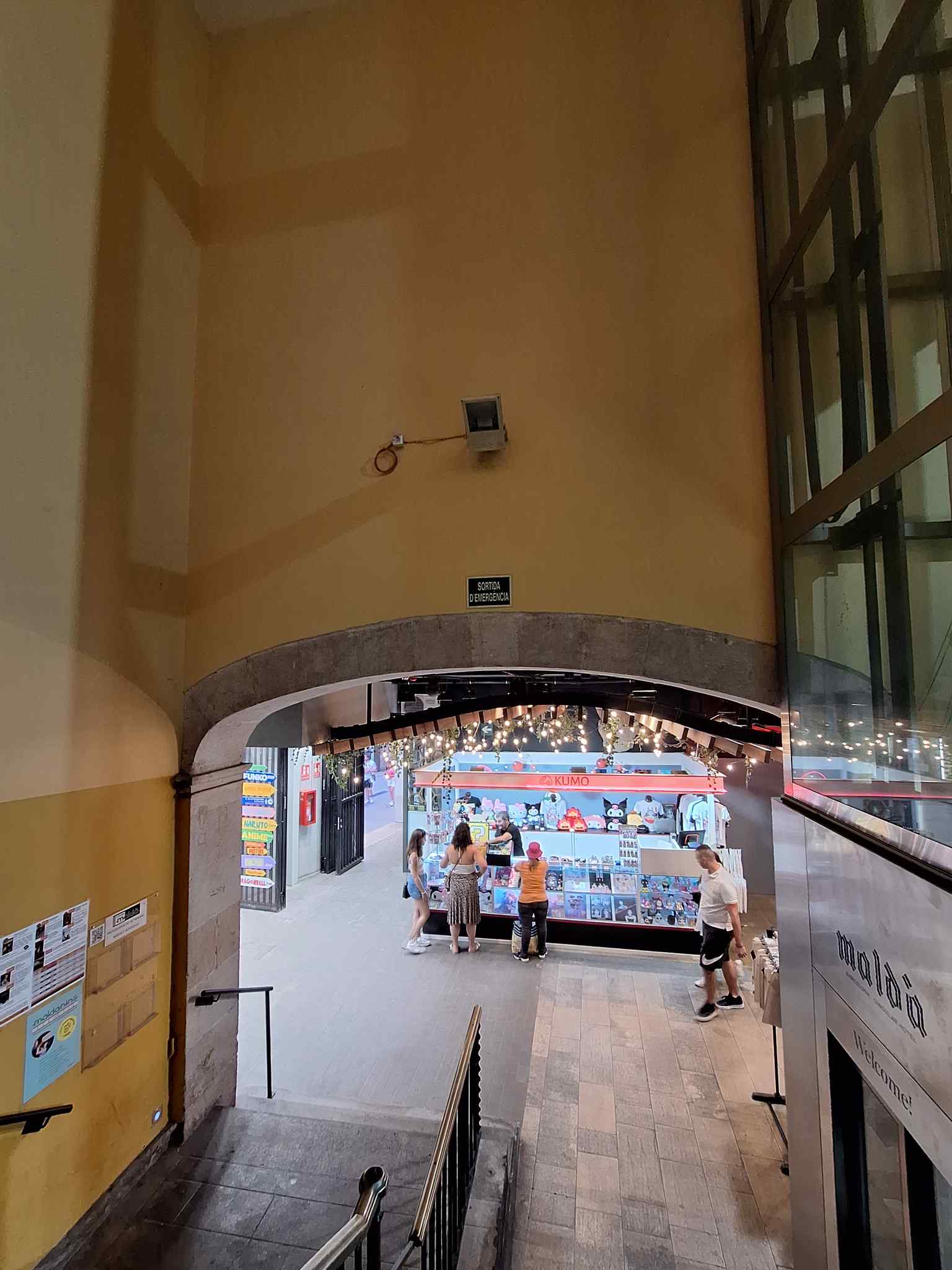
The staircase leading to the Teatre Maldà, a space within the palace once used for private concerts by the Baron of Maldá and officially inaugurated as a theater in 1996.Photo: Pere López Brosa, Wikimedia Commons, CC BY-SA 4.0. Cropped & resized. As for the shopping galleries below, they slowly turned into a ghost town by the 1980s. A sudden burst of modern progress arrived in 2017 when a massive Harry Potter store opened, briefly transforming the crumbling corridors into a booming hub for fantasy and pop culture fans. But the magic did not last. By late 2024, almost all the new themed shops abruptly closed their doors, leaving the historic corridors mostly empty once again.
It seems this palace is always caught in a tug of war between its grand visions of the future and the quiet echoes of its past. Let us leave this fading aristocratic playground behind and head toward an entirely different kind of survival. We are taking a five-minute walk over to our next stop, the Ancient Synagogue.
Tournez-vous vers la gauche: devant vous, une façade rectangulaire assez imposante, en grands blocs de pierre beige bien lisse. Au centre, une grande porte en arc… et juste…Lire plusAfficher moins
Ouvrir la page dédiée →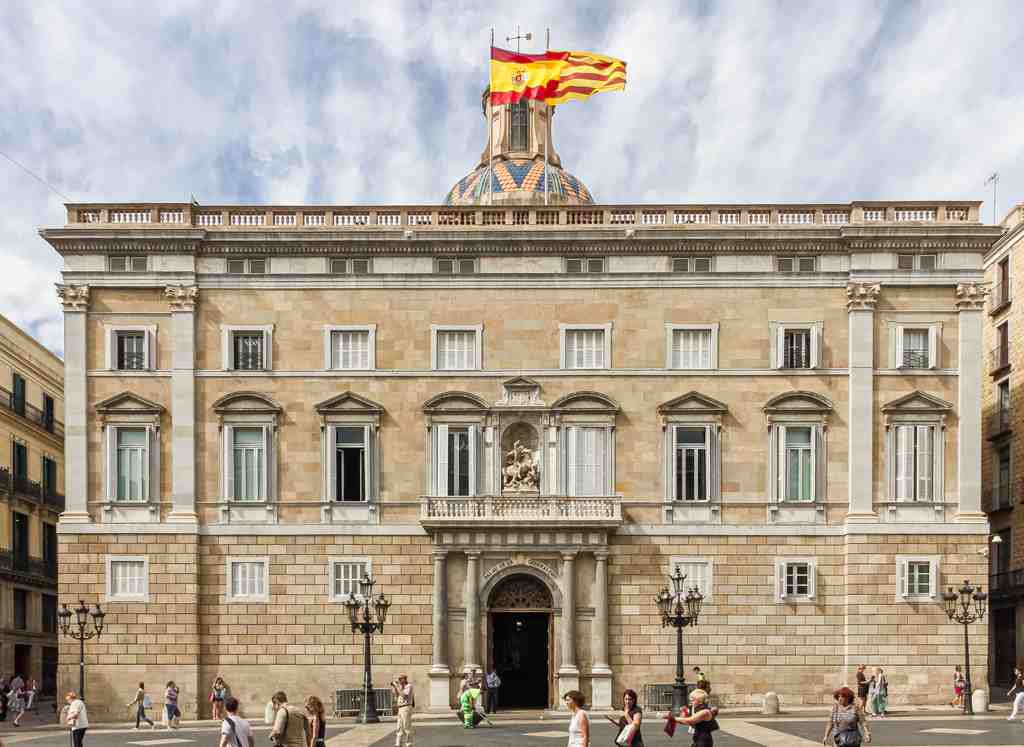
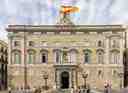
Palais de la GénéralitéPhoto: AndriySadivskyy, Wikimedia Commons, CC BY-SA 3.0 ES. Cropped & resized. Turn your attention left to the imposing rectangular facade built from smooth, tan stone blocks, anchored by a large central arched doorway and a prominent balcony right above it. Notice the sculpted statue of a knight on horseback nestled into the niche above that balcony.
That knight is Saint George, the patron saint of Catalonia, watching over the Palace of the Generalitat. This is the historic seat of the Catalan government. It is actually one of the very few medieval buildings in Europe that still serves as the headquarters for the exact same institution that built it.
The roots of this government stretch deep into the Middle Ages. Back in 1282, the Catalan courts formed, and by 1359, they created a permanent commission to collect taxes. That humble tax board eventually evolved into the Generalitat, essentially taking on the role of an executive branch of government.
But this palace did not spring up from empty land. It was built directly over a tragic piece of the buried ancient city we explored earlier. These properties originally belonged to the prosperous Jewish Quarter. In 1391, a brutal pogrom... a targeted, violent riot... wiped out the neighborhood. Nine years later, the government purchased the vacant houses, paving over the lost community to build a new center of power.
Take a close look at the four plain stone columns flanking the main entrance door. When the architect designed this Renaissance facade in 1596, he did not carve those columns. He imported them. They are actually almost two thousand years old, carved from granite near the legendary city of Troy. The Romans originally brought them to Spain to build a massive temple. Centuries later, they were salvaged and shipped here to frame this doorway. It is a perfect metaphor for this place. Ancient foundations propping up new political ambitions.
Now, direct your attention to the balcony right above the door. Over the last century, that small ledge has been the stage for profound triumph and devastating tragedy. In 1931, Francesc Macià stepped onto it to boldly declare a Catalan Republic. Three years later, his successor, Lluís Companys, proclaimed a Catalan State from that exact spot. That second declaration provoked a furious response from the central government in Madrid. Artillery shells bombarded this very palace. Following a night of heavy fighting, the Catalan government surrendered, waving a white flag from the balcony. Companys was arrested, and later became the only democratically elected president in European history to be executed in office by the Franco dictatorship.
Yet, the institution survived its ghosts. In 1977, after thirty eight years in exile and the fall of the dictatorship, President Josep Tarradellas returned to Barcelona. He stepped out onto that same balcony, looked down at a massive, euphoric crowd, and shouted... Citizens of Catalonia, I am here.
The Generalitat remains a powerful symbol of endurance. Now, turn your back to the palace and look directly across the plaza. We are heading to its royal counterpart, the Royal Palace, which is just a three minute walk away.
Sur votre droite, vous voyez un vaste ensemble de murs en pierre claire. Un large escalier de pierre monte en éventail vers des portes en arc, et au-dessus, une grande masse…Lire plusAfficher moins
Ouvrir la page dédiée →Ces pierres ont connu leur part de sang. En décembre 1492, le roi Ferdinand le Catholique descendait les marches extérieures quand un paysan l'attaqua par derrière avec une épée. Le roi ne fut sauvé que par l'épaisse chaîne d'or d'un ordre honorifique autour de son cou, qui dévia la lame juste assez pour transformer un coup fatal en une profonde blessure à l'épaule. L'agresseur prétendit que le Saint-Esprit lui avait dit de frapper, et son châtiment fut absolu. Il fut exhibé nu à travers la ville dans une charrette, torturé et démembré vivant par le bourreau et la foule furieuse.
À cause de cette blessure, Ferdinand était encore en convalescence dans un monastère tranquille à l'extérieur de la ville lorsque Christophe Colomb revint des Amériques. Ainsi, malgré les célèbres peintures romantiques montrant Colomb présentant de l'or et des perroquets aux monarques dans la grande salle gothique de ce palais, la rencontre légendaire a en réalité eu lieu à des kilomètres de là. L'histoire préfère toujours les scènes les plus grandioses.
Alors que le pouvoir royal finit par s'éloigner de Barcelone, des chapitres plus sombres s'y installèrent. L'Inquisition espagnole emménagea, transformant les jardins luxuriants des lions en sombres cellules de détention. Plus tard, au XVIIIe siècle, un couvent de religieuses prit possession de la grande salle médiévale. Pour moderniser l'espace, elles construisirent une église baroque entièrement neuve à l'intérieur même des murs gothiques, recouvrant le passé de plâtre.
Il en resta ainsi jusqu'en 1936. Pendant les bouleversements de la guerre civile espagnole, des ouvriers commencèrent à démanteler l'église et firent une découverte stupéfiante. Derrière le plâtre et la brique, les majestueuses arches en pierre du XIVe siècle de la salle médiévale étaient parfaitement intactes. La cité antique ensevelie s'était cachée à la vue de tous, protégée accidentellement pendant deux siècles par les murs mêmes censés la remplacer.
Aujourd'hui, une partie de cet ancien jardin de l'Inquisition a été transformée en un foyer fascinant pour une immense collection d'objets historiques excentriques. Le complexe est ouvert la plupart des jours de 10h00 à 20h00, bien qu'il soit fermé le dimanche. Dirigeons-nous à une minute de marche vers l'insolite musée Frederic Marès.
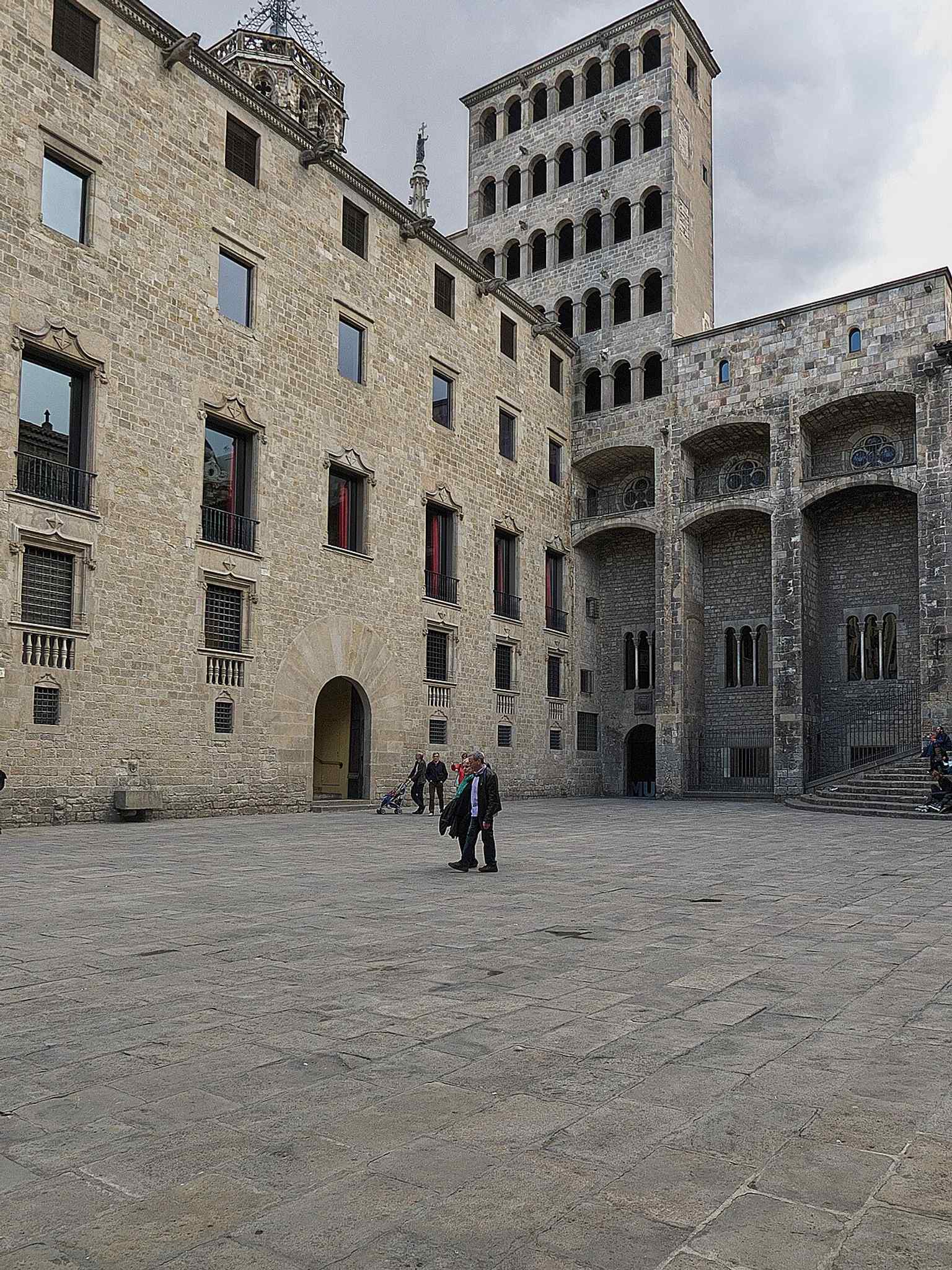
The King Martin's Watchtower, added in 1555, was the last major addition to the Royal Palace, originally serving defensive, observation, and ostentatious purposes.Photo: José Luis Filpo Cabana, Wikimedia Commons, CC BY 3.0. Cropped & resized. These stones have witnessed their share of blood. In December 1492, King Ferdinand the Catholic was walking down the very steps outside when a peasant attacked him from behind with a broadsword. The king was saved only by the thick gold chain of an honorary order around his neck, which deflected the blade just enough to turn a fatal blow into a deep shoulder wound. The attacker claimed the Holy Spirit told him to strike, and his punishment was absolute. He was paraded naked through the city in a cart, tortured, and dismantled alive by the executioner and the furious crowd.
Because of that wound, Ferdinand was still recovering in a quiet monastery outside the city when Christopher Columbus returned from the Americas. So despite the famous romantic paintings showing Columbus presenting gold and parrots to the monarchs in the grand gothic hall of this palace, the legendary meeting actually happened miles away. History always prefers the grander stage.
As royal power eventually shifted away from Barcelona, darker chapters took hold. The Spanish Inquisition moved in, turning the lush lion gardens into grim holding cells. Later, in the seventeen hundreds, a convent of nuns took over the grand medieval hall. To modernize the space, they built a completely new Baroque church right inside the gothic walls, plastering over the past.
It remained that way until 1936. During the upheaval of the Spanish Civil War, workers began dismantling the church and made a stunning discovery. Behind the plaster and brick, the majestic fourteenth century stone arches of the medieval hall were perfectly intact. The buried ancient city had been hiding in plain sight, accidentally protected for two centuries by the very walls meant to replace it.
Today, a piece of that historic Inquisition garden space has been transformed into a fascinating home for a massive collection of eccentric historical objects. The complex is open most days from 10 AM to 8 PM, though it closes on Sundays. Let us take a short walk just a minute away to the quirky Frederic Marès Museum.
Sur votre droite, vous voyez un grand bâtiment de pierre, plutôt massif, avec une entrée très “à l’ancienne”: deux colonnes qui portent un fronton triangulaire, et dessous, une…Lire plusAfficher moins
Ouvrir la page dédiée →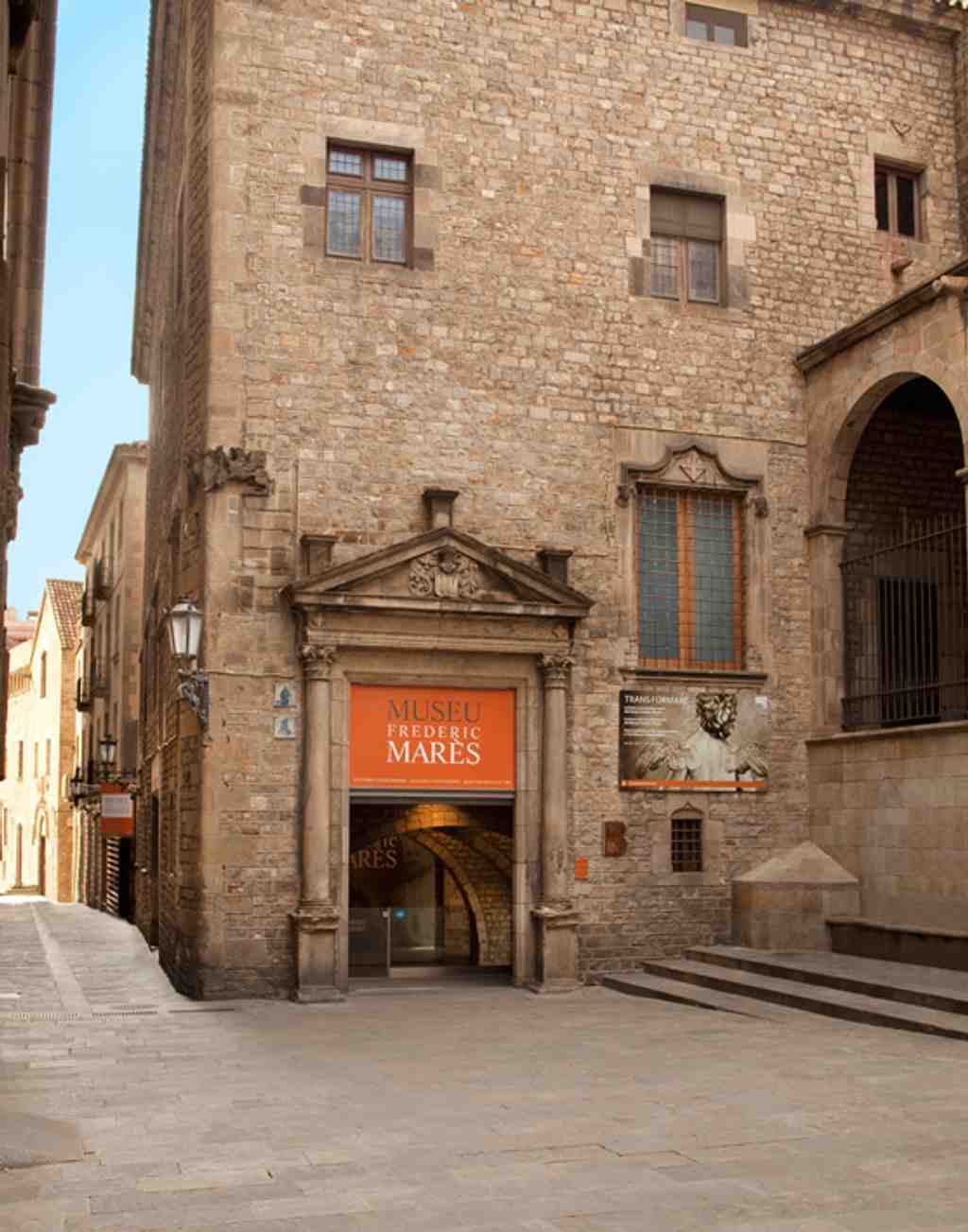
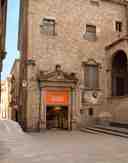
Musée Frederic MarèsPhoto: Foto:Guillem F-H, Wikimedia Commons, CC BY-SA 3.0. Cropped & resized. Ahead on the right sits a tall, blocky stone building featuring a classical doorway where two stone columns support a triangular pediment over an arched entrance.
This is the Frederic Marès Museum. Meet Frederic Marès... a sculptor by trade, but an obsessive accumulator of history by nature. His drive to anchor the fleeting past in physical objects started when he was just four years old, carefully saving chocolate wrappers and colorful bits of paper. By the time he was an old man, that childhood habit had ballooned into an astonishing hoard of over fifty thousand items. Before this museum existed, his own house on Mallorca Street had become a chaotic labyrinth where priceless medieval carvings were stacked alongside early printed books and ticking clocks.
Inside, the Collector's Cabinet reveals a deeply intimate, eccentric catalog of human existence. It holds thousands of everyday artifacts... pipes, walking sticks, pocket watches. But the female room contains something a bit more unusual. You will find intricate jewelry and decorative pictures woven entirely out of human hair. This was a nineteenth century mourning tradition, crafting keepsakes from the locks of deceased loved ones. Step into the photography room, and you will find an unsettling collection of post-mortem portraits. Families would dress their recently deceased relatives, posing them as if they were merely sleeping, desperate for one final visual memory. It shows just how fiercely people fought to hold onto what was slipping away as the modern era marched forward.
Marès himself was a complex figure navigating a shifting society. During the Spanish Civil War, he actively rescued religious art from churches being looted or burned by revolutionary committees. He saw himself as a cultural savior. Yet, critical historians point out that the turbulent post-war era allowed wealthy collectors like him to acquire displaced masterpieces for almost nothing, sparking modern legal battles over the rightful ownership of these stolen treasures.
Even his own art was subjected to the push and pull of changing political tides. During the Republic, Marès sculpted a nude female figure called Victory. After the war, the new Franco regime decided to repurpose his statue to celebrate their own triumph. However, the strict national-catholic dictatorship found the statue's bare chest entirely too scandalous. They actually forced Marès to alter his own sculpture to cover her up.
Ironically, despite complying with the conservative dictatorship, Marès earned the nickname the hippie in his later years, simply because he wore his hair unusually long for an eighty year old man in that era.
If you want to explore his vast collections, the museum is open Tuesday through Saturday from 10 AM to 7 PM, and Sundays from 11 AM to 8 PM, remaining closed on Mondays. For now, let your eyes drift toward the towering structure nearby, and we will take a short walk over to the Barcelona Cathedral.
Levez les yeux vers cette façade de pierre claire, toute en verticalité: une flèche centrale qui file vers le ciel, des arcs pointus finement découpés, et une vraie armée de…Lire plusAfficher moins
Ouvrir la page dédiée →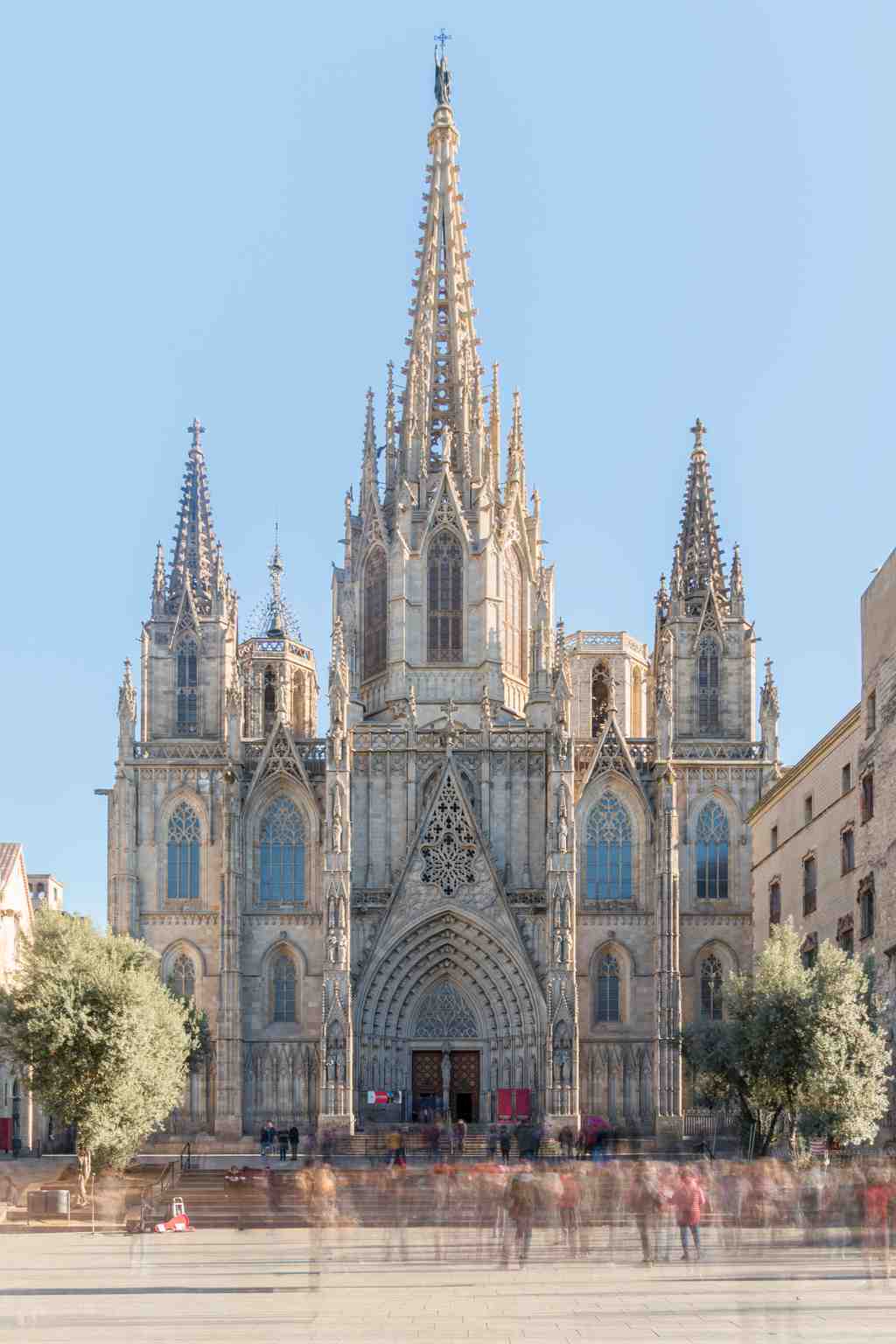
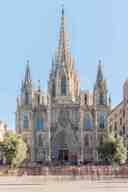
Cathédrale de BarcelonePhoto: Fernando, Wikimedia Commons, CC BY-SA 4.0. Cropped & resized. Levez les yeux vers l'imposante façade en pierre pâle, définie par sa flèche centrale élancée, ses arches brisées complexes et une multitude de statues montant la garde le long de ses lignes verticales.
Il est facile de supposer que vous regardez une relique intacte du Moyen Âge. Mais la vérité est bien plus complexe. Ce grand visage de pierre est en réalité un ajout néo-gothique de la fin du XIXe et du début du XXe siècle, financé par un banquier local pour donner au bâtiment un profil plus spectaculaire. Vous pouvez voir exactement à quel point cette silhouette a changé en consultant l'image historique avant/après sur votre téléphone.
Ce bâtiment est une leçon magistrale sur la façon dont les nouvelles générations se superposent aux anciennes. La cathédrale actuelle repose sur les fondations d'une église romane, elle-même construite sur une église wisigothique, qui trônait elle-même sur une basilique paléochrétienne. Chaque époque a enterré le passé pour construire sa propre vision du futur.
Mais en creusant jusqu'à la roche mère de ce site, vous découvrirez l'histoire de Sainte Eulalie. C'était une jeune fille de treize ans à l'époque romaine qui a courageusement protesté contre la persécution des chrétiens. Le gouverneur local a répondu par une cruauté impensable, lui infligeant treize tortures différentes, une pour chaque année de sa vie. Elle fut jetée dans un tonneau tapissé de verre brisé et de clous, dévalée d'une colline, et finalement crucifiée sur une croix en forme de X, qui est aujourd'hui l'emblème du diocèse. Sa crypte repose sous l'autel principal encore aujourd'hui.
Si vous prenez un moment pour regarder de près le cloître, la cour ouverte attenante à la cathédrale, essayez de repérer les oies blanches qui errent sur le terrain. Il y a toujours exactement treize oies gardées ici en l'honneur de l'âge d'Eulalie. Au-delà de leur symbolisme spirituel, ces oiseaux très territoriaux servaient en fait un but très pratique, agissant comme un système d'alarme bruyant et criard contre les intrus nocturnes.
Le choc de l'histoire et du progrès est tout aussi frappant à l'intérieur. L'intérieur présente une nef vertigineuse, le hall central principal de l'église, où les bas-côtés sont presque aussi hauts que le centre, créant une vaste caverne résonnante. Vous pouvez avoir une idée de cette échelle intérieure massive en regardant l'image sur votre écran.
Pendant la guerre civile espagnole en 1936, toute cette structure ancienne a failli disparaître en cendres. Des anarchistes armés sont arrivés pour l'incendier, mais un poète anarchiste a convaincu la foule que l'architecture appartenait au peuple. Cet appel aux idéaux modernes, combiné à une rumeur folle selon laquelle cinq mille prêtres lourdement armés se cachaient dans les cryptes labyrinthiques, a sauvé le bâtiment.
La cathédrale est ouverte tous les jours pour les visites, bien que les horaires soient légèrement plus courts les dimanches après-midi. Quittons maintenant cette majesté gothique pour nous diriger vers les étals vibrants du marché de Santa Caterina, à environ cinq minutes de marche.
Regardez sur votre droite: une rangée d’arches en pierre blanche, très classique… et au-dessus, un toit moderne immense, tout en vagues, porté par des piliers métalliques qui se…Lire plusAfficher moins
Ouvrir la page dédiée →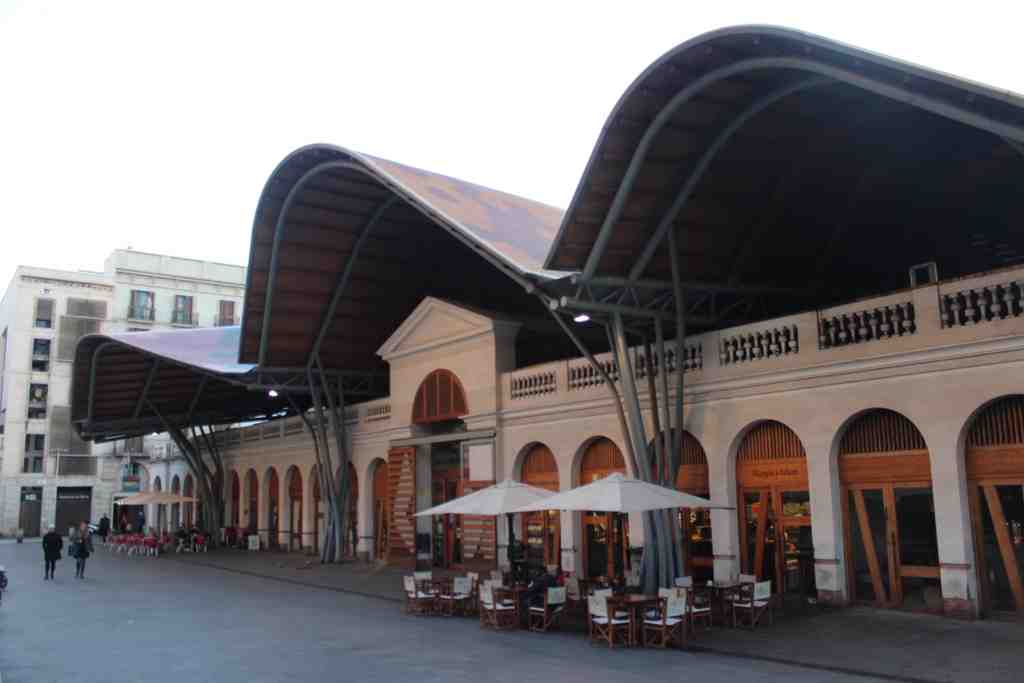
Marché Santa CaterinaPhoto: Albert Prat, Wikimedia Commons, CC BY-SA 4.0. Cropped & resized. Notice the building on your right, where a row of traditional white stone arches is dramatically overshadowed by a massive modern wavy roof supported by twisting metal pillars.
This is the Santa Caterina Market, the oldest covered market in the city. But to understand this place, we have to look past that striking roof and dig into the ashes underneath it. You see, this spot was originally a thirteenth-century Dominican convent. That came to a violent end during the same wave of anti-clerical riots in 1835 that we heard about earlier. An angry mob stormed the convent and set it ablaze. The monks fled for their lives as centuries of history, including a massive library, went up in smoke. The city government, practicing a policy of state confiscation, decided not to rebuild. Instead, they cleared the ruined cloisters and built the neoclassical market you see the bones of today.
For a long time, this place was the gritty heart of neighborhood survival. During the harsh years following the Spanish Civil War, marked by extreme rationing, these stalls and the narrow alleys around them became an epicenter for the black market. Underneath the counters, desperate locals and cunning smugglers traded basic food items at astronomical prices, just trying to outlast the economic collapse.
Fast forward to 1997, and the city decided it was time for an upgrade. They brought in a husband and wife architectural team, Enric Miralles and Benedetta Tagliabue, who designed that incredible undulating roof. It is covered in a massive mosaic of over four thousand square meters, using a technique called trencadis, where broken ceramic shards are pieced together to form patterns. The colors represent the vibrant fruits and vegetables sold inside. But it is not just pretty. Those complex parabolic curves act as a natural ventilation system, pulling hot air up and out so the market stays cool without heavy air conditioning.
But pushing into the future is rarely simple, especially when the foundations of your new vision are built on literal ruins. When the construction crews started digging, they hit a massive archaeological jackpot... uncovering the medieval convent foundations, a Roman necropolis, and a Bronze Age settlement. Four thousand years of history were sitting right under the produce aisle. The city mandated that the ruins be preserved, which triggered a logistical nightmare and delayed the grand opening by four long years. The stall owners had to survive in a temporary tent outside, and sadly, many family businesses did not make it.
The project also suffered a profound personal tragedy. In the year 2000, Enric Miralles was diagnosed with a brain tumor and passed away at just forty-five. His wife, Benedetta, had to finish the monumental task alone. When she finally opened the doors in 2005, the market became not just a marvel of modern urban life, but a vibrant tribute to her late husband.
Feel free to step inside if they are open... the market operates Monday through Saturday, though it is closed on Sundays. Next, we are heading toward a true jewel of Catalan music, the Palau de la Musica Catalana, which is just a five-minute walk away.
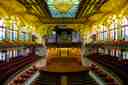
Regardez bien votre écran: vous allez voir le cœur du Palau… de grands arcs couverts de céramique, un orgue monumental qui encadre la scène en bois, et surtout une coupole de…Lire plusAfficher moins
Ouvrir la page dédiée →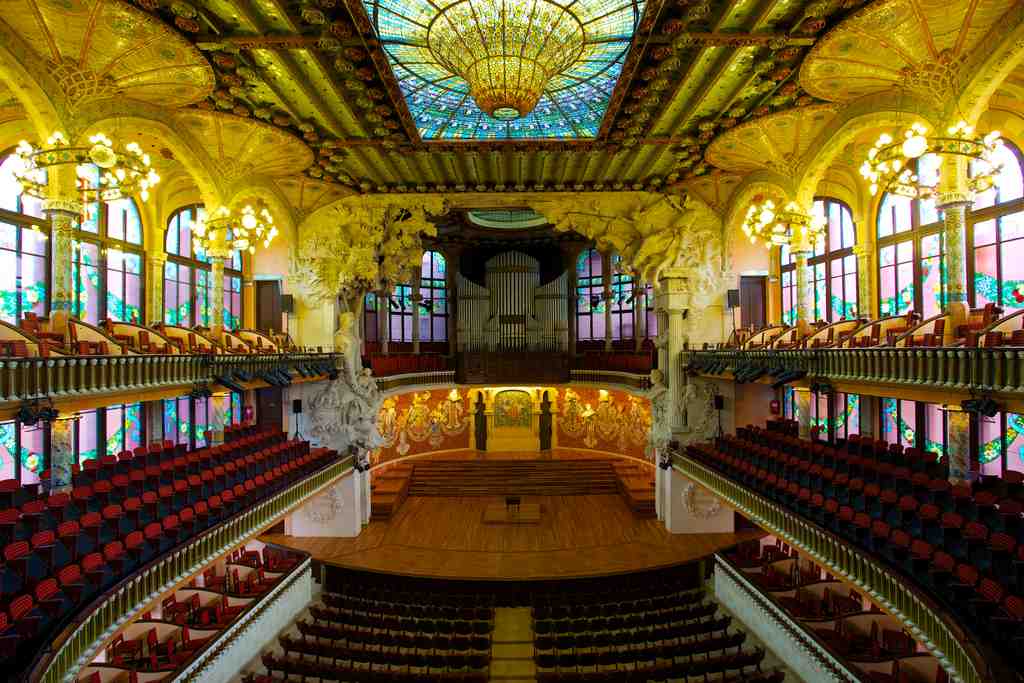
Palais de la musique catalanePhoto: Jiuguang Wang, Wikimedia Commons, CC BY-SA 3.0 ES. Cropped & resized. Look closely at your screen to picture the heart of this landmark, a breathtaking space defined by sweeping ceramic-tiled arches, a majestic pipe organ framing the wooden stage, and a spectacular inverted stained-glass dome radiating from the ceiling.
You are standing outside the Palau de la Música Catalana, an absolute masterpiece of Catalan Modernism. Designed by the visionary architect Lluís Domènech i Montaner and built between 1905 and 1908, this building was conceived as the headquarters for a beloved local choral society.
Domènech i Montaner was famously stubborn about his art. He wanted to build a gleaming beacon for his culture, refusing to cut corners even on a side of the building that faced a narrow, hidden alley. He insisted on premium red brick and intricately sculpted pillars where barely anyone would see them. This uncompromising dedication caused the budget to balloon from 450,000 pesetas to over 900,000, an amount roughly equivalent to around four million dollars today. The choral society struggled deeply to cover the costs, but their sacrifice gave the city a crown jewel.
The interior is so overwhelmingly beautiful that visitors sometimes suffer from Stendhal syndrome. That is a genuine psychological condition where exposure to intense, magnificent art causes rapid heartbeat and dizziness. The massive stained-glass skylight weighs several tons and drops down like a glowing, multicolored sun... bathing the audience in an explosion of light.
This grand hall has often served as a battleground between the heavy shadows of history and a fierce desire for cultural survival. In 1960, during a brutal dictatorship, authorities banned the singing of a traditional Catalan anthem here. But when the concert began, the audience boldly rose to their feet and sang it anyway. A young doctor was arrested and tortured simply for his role in the protest, yet that defiant song echoed far beyond these walls, sparking a political awakening in the region.
Decades later, the building faced a very different kind of threat. In 2009, a massive corruption scandal was exposed. Corrupt managers had siphoned millions of euros from the institution, even using public funds to throw lavish private weddings right inside the historic concert hall. It was an audacious betrayal.
Yet the community refused to let their beloved sanctuary fall to ruin. When the majestic pipe organ fell silent after decades of decay, everyday citizens and local businesses banded together to sponsor individual pipes, fully funding its intricate restoration. No matter what dark moments have tested this place, the music, and the people's vision for a brighter future, have always pushed forward into the light.
Let us keep that enduring spirit in mind as we move onward toward a true monument of resistance, the Rafael Casanova Monument, which is just a seven minute walk away.
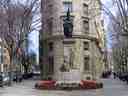
Repérez sur votre gauche ce grand socle de pierre, bien massif, décoré de figures féminines sculptées… et, tout en haut, cette statue en bronze sombre: un homme qui serre un…Lire plusAfficher moins
Ouvrir la page dédiée →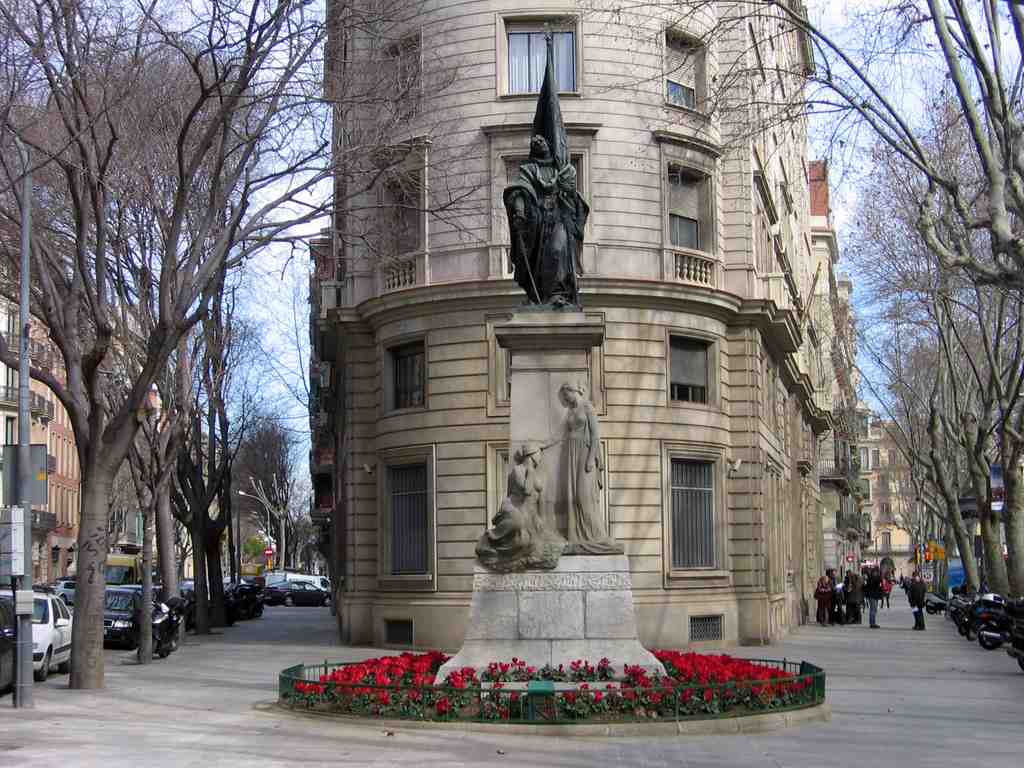
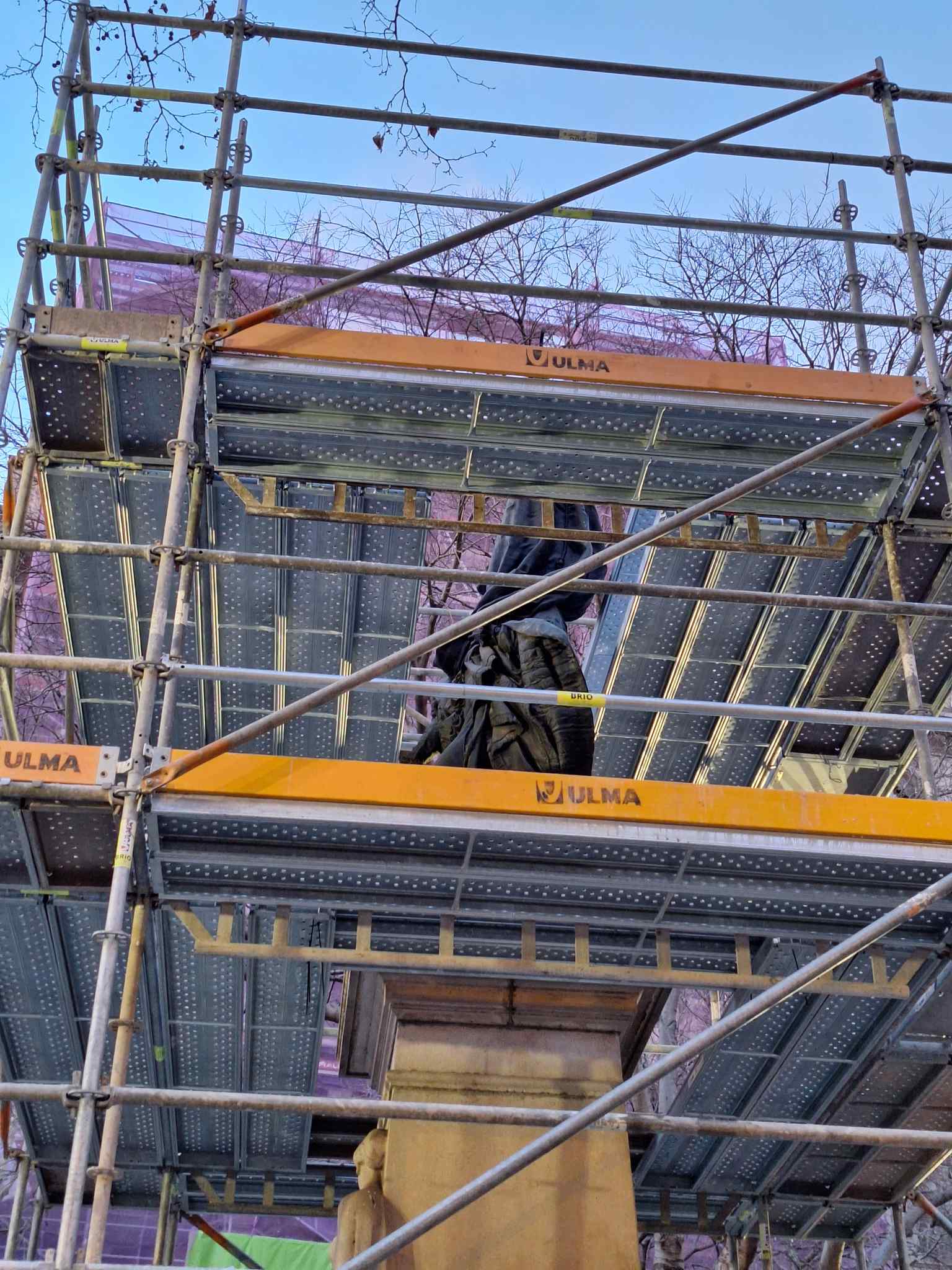
Monument à Rafael CasanovaPhoto: Canaan, Wikimedia Commons, CC BY-SA 3.0. Cropped & resized. Casanova a en réalité survécu. Il a été transporté clandestinement dans un hôpital, s'est déguisé en frère et a vécu ses derniers jours sous un faux nom jusqu'à ce qu'il soit discrètement gracié des années plus tard. Mais le souvenir de sa résistance est devenu un fantôme puissant que les autorités ultérieures ont désespérément tenté d'effacer.
En 1939, le nouveau régime autoritaire a ordonné que cette statue soit fondue en bronze brut pour faire table rase du passé. Mais dans un acte de rébellion silencieux, le maire de la ville a secrètement ignoré l'ordre. Il a fait démonter soigneusement la figure de bronze et l'a cachée dans un entrepôt poussiéreux de la rue Wellington.
Pendant près de quarante ans, ce héros déchu est resté dans l'ombre, relique d'un passé douloureux attendant que le cours de l'histoire s'inverse, tandis que les visions d'une ville modernisée prenaient forme au-dessus de lui. Il a finalement été ramené à la lumière en 1977, lors de la transition de l'Espagne vers la démocratie. Si vous voulez voir comment cet espace a évolué au cours du siècle, consultez le curseur avant/après sur votre écran. Il montre un rassemblement commémoratif massif ici même en 1908, comparé aux récents efforts de restauration minutieux. C'est un témoignage de la manière dont les blessures les plus profondes de l'histoire perdurent, luttant silencieusement contre l'élan vers l'avenir.
En le regardant, demandez-vous ce que vous feriez si votre ville était encerclée et sur le point de tomber... Tiendriez-vous bon?
Puisqu'il s'agit d'un espace public, ce monument est ouvert vingt-quatre heures sur vingt-quatre. Maintenant, marchons vers la grande entrée de l'ère moderne, en nous dirigeant vers l'Arc de Triomphe.
Cette image de 1908 tirée de "La Ilustració Catalana" montre un hommage précoce lors de la Diada de Cataluña, illustrant comment les offrandes florales au monument sont devenues un symbole puissant de l'identité catalane.Photo: Pere López Brosa, Wikimedia Commons, CC BY-SA 4.0. Cropped & resized. Casanova actually survived. He was smuggled into a hospital, disguised himself as a friar, and lived out his days under a fake name until he was quietly pardoned years later. But the memory of his stand became a powerful phantom that later authorities tried desperately to erase.
In 1939, the new authoritarian regime ordered this statue to be melted down into raw bronze to wipe the slate clean. But in a quiet act of rebellion, the city's own mayor secretly ignored the order. He had the bronze figure carefully dismantled and hidden away in a dusty warehouse on Wellington Street.
For nearly forty years, this fallen hero sat in the dark, a relic of a painful past waiting out the tide of history while visions of a modernized city took shape above him. He was finally brought back into the light in 1977 during Spain's transition to democracy. If you want to see how this space has evolved over the century, check out the before and after slider on your screen. It shows a massive memorial gathering right here in 1908, compared to recent careful restoration efforts. It is a testament to how the deepest wounds of history are carried forward, quietly wrestling with the push toward tomorrow.
As you look up at him, consider what you would do if your city was surrounded and falling... Would you stand your ground?
Since it is a public space, this monument is open twenty-four hours a day. Now, let's walk toward the grand entryway of the modern era, as we make our way to the Arc de Triomf.
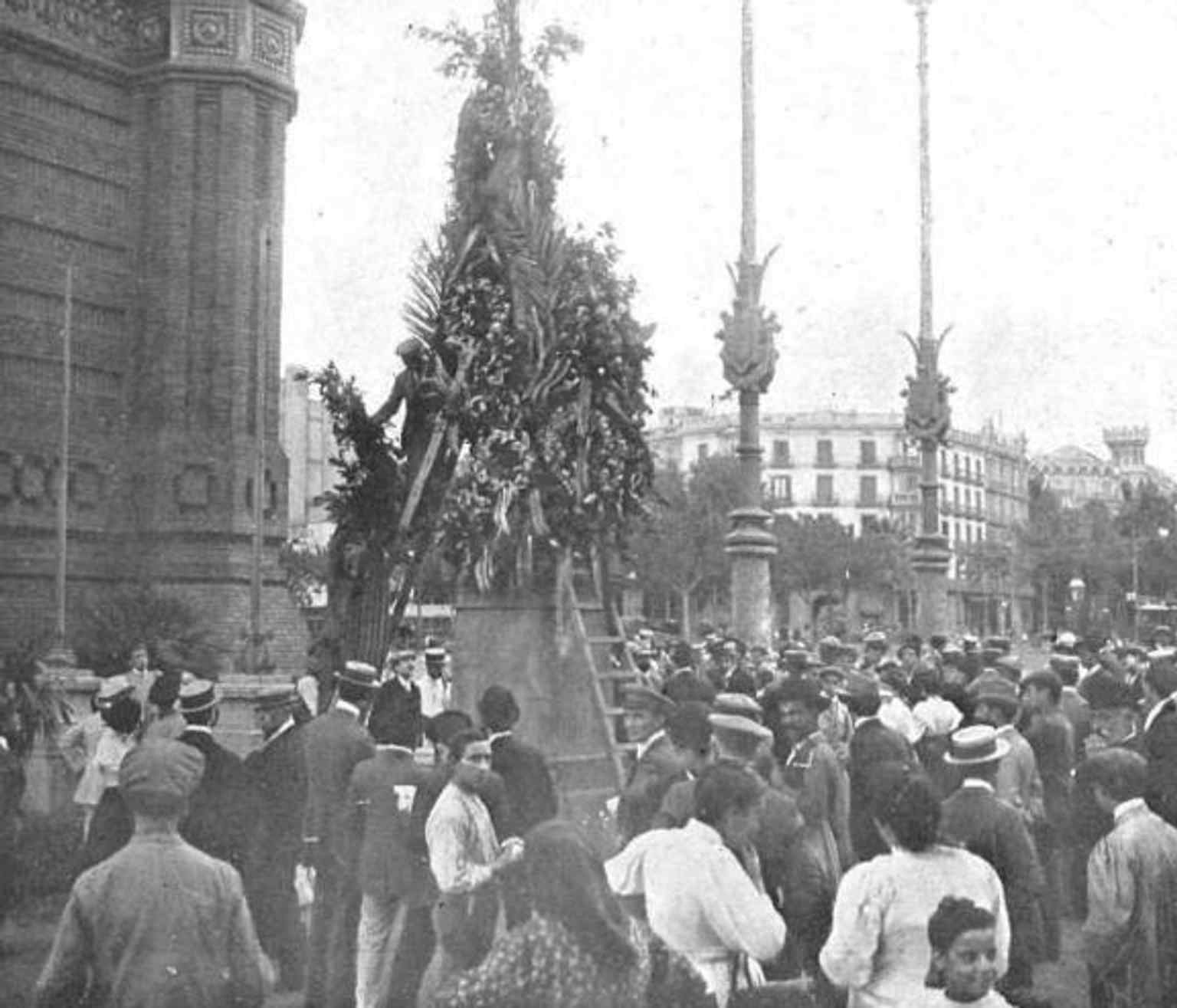
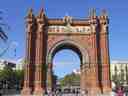
This 1908 image from "La Ilustració Catalana" shows an early Diada de Cataluña tribute, illustrating how floral offerings at the monument became a potent symbol of Catalan identity.Photo: Frederic Ballell i Maymí, Wikimedia Commons, Public domain. Cropped & resized. Devant vous, un arc monumental en brique rouge, franchement spectaculaire, surmonté de frises en pierre blanche finement sculptées… et encadré par de hautes tourelles décoratives…Lire plusAfficher moins
Ouvrir la page dédiée →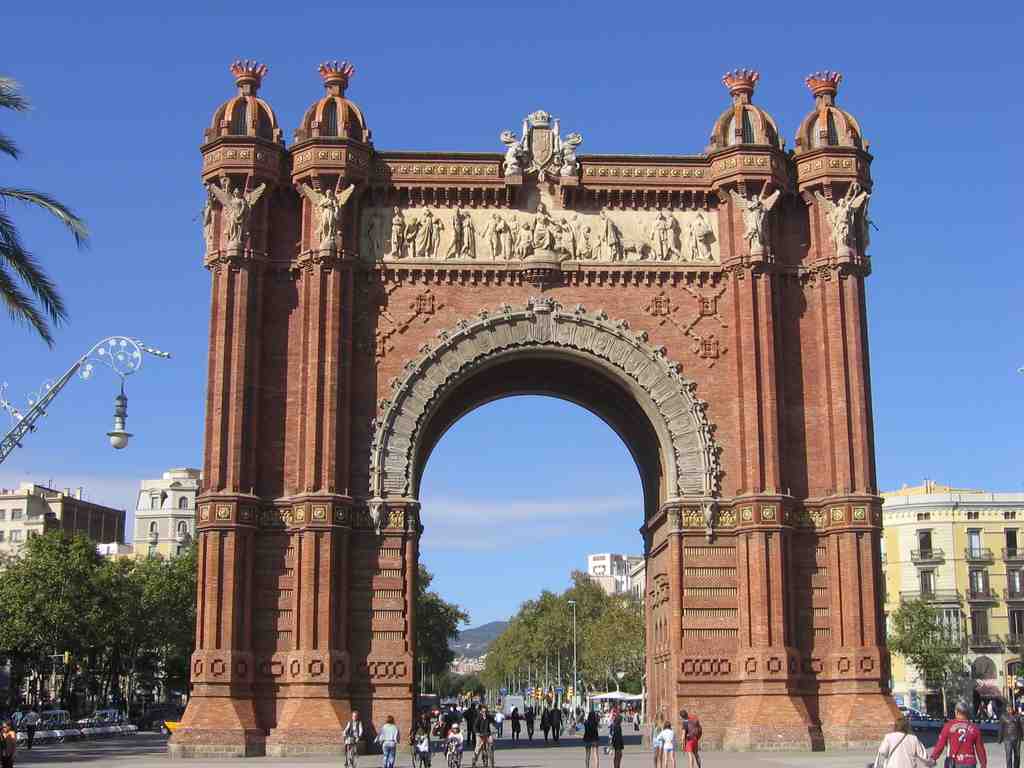
Arc de TriomfPhoto: Canaan, Wikimedia Commons, CC BY-SA 3.0. Cropped & resized. Straight ahead stands a massive arch made of striking red brick, crowned with intricate white stone friezes and flanked by tall, decorative corner towers.
Unlike the cold marble monuments scattered across Europe that were built to celebrate military conquests and bloody battlefield victories, this gateway was designed to honor a purely civic triumph. It was built as the grand, welcoming entrance for the 1888 Universal Exposition. The 1888 Universal Exposition was a massive global fair that forced the city to modernize rapidly, serving as a glittering stage to show off Barcelona's soaring industrial might to the rest of the world. It fit perfectly into the progressive spirit of Cerda's Ensanche Plan, which was actively pulling Barcelona out of its cramped medieval history and into a bold, expansive new era.
The design of this arch perfectly captures the friction of that changing world. You might hear a very persistent urban legend that a French engineer named Gustave Eiffel actually pitched his famous iron tower for this exact spot, and the city rejected it for being a monstrous, expensive eyesore. While historians have completely debunked that myth, the story survives because it illustrates the real architectural anxiety of the time. It highlights the cultural tug of war between cold, ultra-modern iron structures and the warm, historically rooted brickwork that ultimately won out here.
The architect, Josep Vilaseca, designed this in the neo-Mudejar style, a revival architectural movement that blended traditional Moorish and European elements. Using exposed red brick instead of noble stone was also a brilliant economic move. The arch cost a mere one hundred and fifty four thousand pesetas to build, which equates to just a few thousand dollars today. But more importantly, the humble material connected this grand monument directly to the local working class and the booming regional brick industry.
If you look closely at the columns, you will spot stone bats carved into the structure. The bat was the emblem of King James the First of Aragon, and became a powerful symbol of good fortune in Catalan design.
Yet, the wide avenue leading up to the arch hides a darker tale of how the past is often forcibly erased by new visions of the future. The promenade used to be lined with eight grand bronze statues of Catalan heroes. During the turbulent years of the Spanish Civil War, most were yanked from their pedestals. Then, in 1950, authorities melted down five of those historic bronzes to forge a giant religious statue of the Virgin Mary for a local basilica. The old secular heroes were quite literally consumed to build the new regime's cultural vision. Luckily, as with the monument to Rafael Casanova, one statue was secretly hidden in a dark warehouse, surviving the ideological purge before finally being rescued.
This magnificent gateway is open twenty four hours a day, standing as a permanent welcome to anyone who wanders by. Let us pass straight through the arch now and follow the wide promenade toward the park, where the Castle of the Three Dragons is just a six minute walk away.
À votre droite, vous avez une forteresse carrée plutôt impressionnante, en brique rouge laissée apparente, avec des créneaux - ces “dents” tout en haut des murs qui servaient à se…Lire plusAfficher moins
Ouvrir la page dédiée →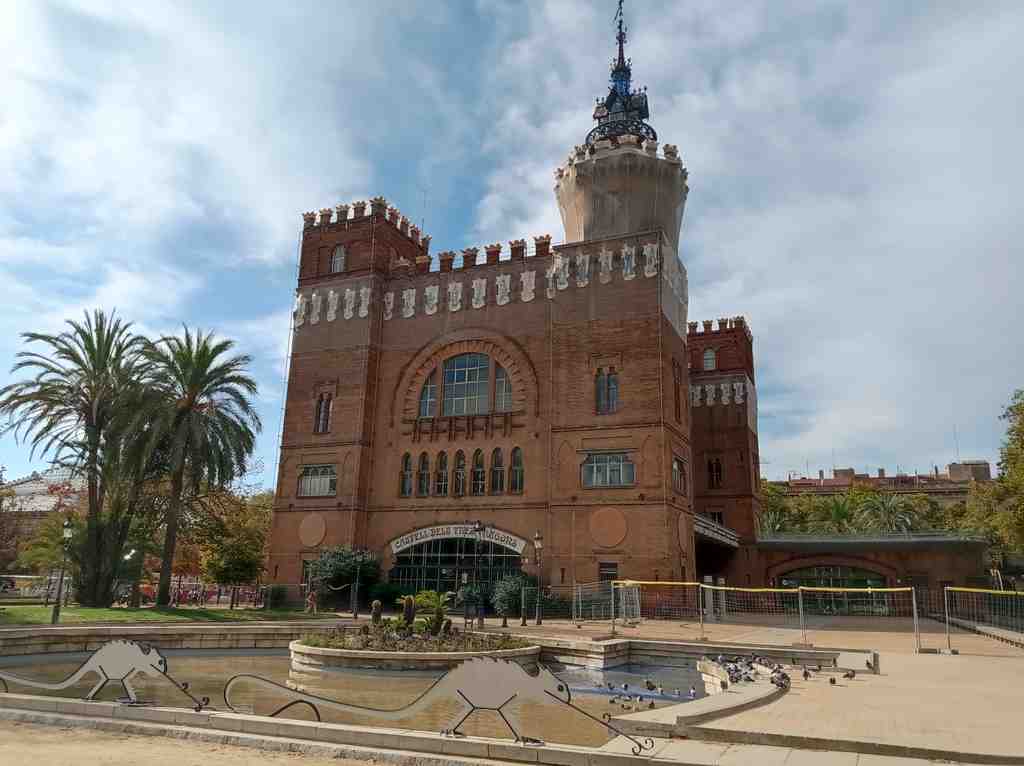
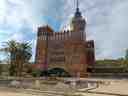
Château des Trois DragonsPhoto: Canaan, Wikimedia Commons, CC BY-SA 4.0. Cropped & resized. Après l'exposition, alors que d'autres pavillons massifs étaient rapidement démolis, ce château a été épargné. L'architecte a fini par revenir à son chef-d'œuvre inachevé et l'a transformé en un atelier bohème et dynamique. Il a réuni des forgerons, des verriers et des mosaïstes pour expérimenter. Ils voulaient extraire de l'histoire des métiers médiévaux oubliés et les confronter à des matériaux industriels modernes comme le fer brut. Cette tension spécifique, consistant à se tourner vers l'artisanat traditionnel pour alimenter un avenir visionnaire, a jeté les bases concrètes du modernisme catalan.
Bien sûr, un bâtiment aussi ancien porte des ombres pesantes. Pendant la guerre civile espagnole, les bombardiers fascistes ont détruit l'immense vitrail du château, un chef-d'œuvre qui inondait autrefois l'intérieur de lumière. Dans les sombres années de l'après-guerre, l'espace a été transformé en réfectoire caritatif. Les pièces immenses et aérées, conçues à l'origine pour que la bourgeoisie internationale puisse siroter des liqueurs fines, étaient soudainement remplies de citoyens démunis faisant la queue pour des rations de survie.
Continuons notre promenade plus profondément sous les arbres. Nous entrerons pleinement dans le parc de la Ciutadella dans quelques minutes seulement.
After the exposition, while other massive pavilions were quickly demolished, this castle was spared. The architect eventually returned to his unfinished masterpiece and transformed it into an energetic, bohemian workshop. He gathered blacksmiths, glassmakers, and mosaicists to experiment. They wanted to pull forgotten medieval crafts out of history and collide them with modern industrial materials like raw iron. That specific tension, looking backward to traditional crafts to fuel a visionary future, laid the practical groundwork for Catalan Modernism.
Of course, a building this old carries some heavy shadows. During the Spanish Civil War, fascist bombers destroyed the castle's colossal stained-glass window, a masterpiece that once flooded the interior with light. In the grim post-war years, the space was turned into a charity dining hall. The massive, airy rooms originally designed for the international bourgeoisie to sip fine liqueurs were suddenly filled with impoverished citizens lining up for survival rations.
Let's continue our walk deeper into the trees. We will transition fully into Ciutadella Park in just a few minutes.
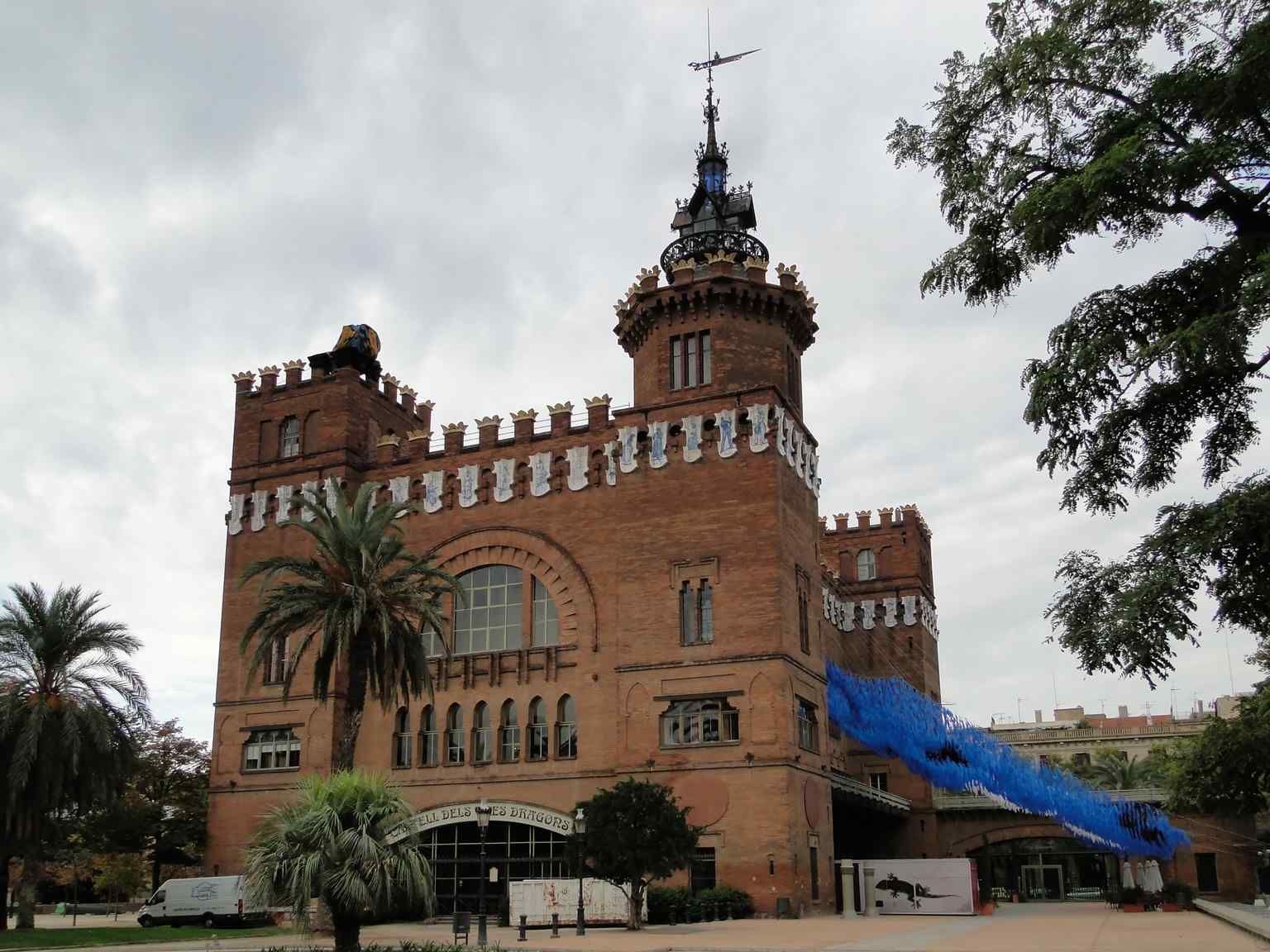
This view captures the striking modernist architecture of the Castle of the Three Dragons, built with visible brick and iron, featuring battlements and a castle-like design.Photo: Bernard Gagnon, Wikimedia Commons, CC BY-SA 3.0. Cropped & resized.
Foire aux questions
Comment commencer le tour ?
Après l'achat, téléchargez l'application AudaTours et entrez votre code de réduction. Le tour sera prêt à commencer immédiatement - il suffit d'appuyer sur lecture et de suivre l'itinéraire guidé par GPS.
Ai-je besoin d'Internet pendant le tour ?
Non ! Téléchargez le tour avant de commencer et profitez-en pleinement hors ligne. Seule la fonction de chat nécessite Internet. Nous recommandons de télécharger en WiFi pour économiser vos données mobiles.
S'agit-il d'une visite de groupe guidée ?
Non - il s'agit d'un audioguide en autonomie. Vous explorez indépendamment à votre propre rythme, avec une narration audio diffusée par votre téléphone. Pas de guide, pas de groupe, pas d'horaire.
Combien de temps dure le tour ?
La plupart des tours durent entre 60 et 90 minutes, mais vous contrôlez totalement le rythme. Faites des pauses, sautez des arrêts ou arrêtez-vous quand vous le voulez.
Et si je ne peux pas finir le tour aujourd'hui ?
Pas de problème ! Les tours disposent d'un accès à vie. Faites une pause et reprenez quand vous le souhaitez - demain, la semaine prochaine ou l'année prochaine. Votre progression est sauvegardée.
Quelles sont les langues disponibles ?
Tous les tours sont disponibles dans plus de 50 langues. Sélectionnez votre langue préférée lors de l'utilisation de votre code. Note : la langue ne peut pas être changée après la génération du tour.
Où accéder au tour après l'achat ?
Téléchargez l'application gratuite AudaTours sur l'App Store ou Google Play. Entrez votre code de réduction (envoyé par e-mail) et le tour apparaîtra dans votre bibliothèque, prêt à être téléchargé et commencé.
Si vous n'appréciez pas le tour, nous vous rembourserons votre achat. Contactez-nous à [email protected]
Paiement sécurisé avec 





.jpg)


