
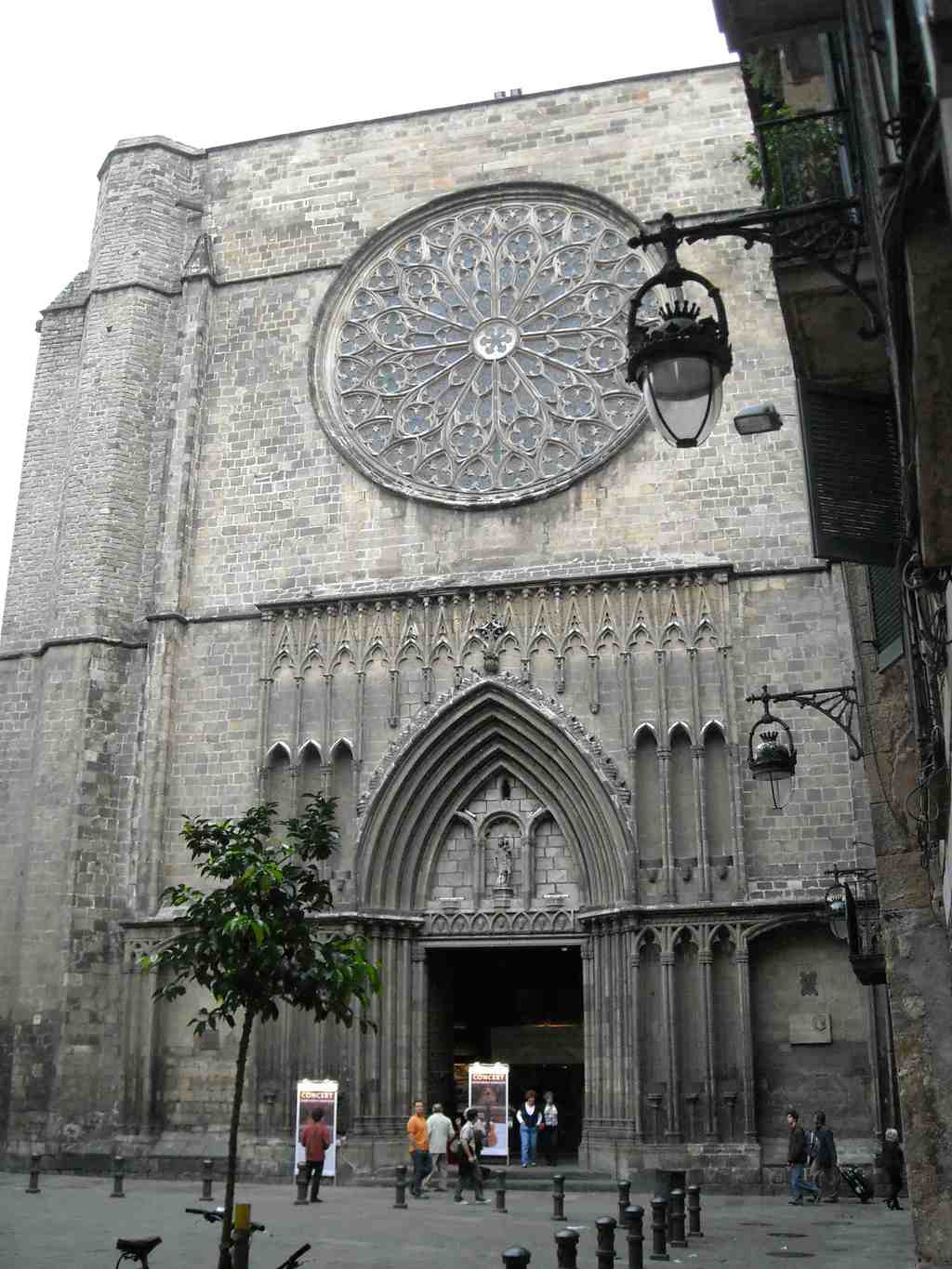
Notice Santa Maria del Pi on your left, with its massive facade of flat stone defined by its enormous, twelve-armed circular rose window sitting squarely above a pointed, deeply recessed archway.
The name translates to Saint Mary of the Pine. According to local lore, a wooden image of the Virgin Mary was once found hidden deep inside the heart of a pine tree. To honor this, the community planted a pine right out front. It became a living anchor, a piece of ancient earth holding its ground as the stone city built up and expanded around it.
In the year fifteen sixty-eight, a specific pine was planted that grew as tall as the surrounding rooftops. It survived centuries of urban expansion, only to meet its end in eighteen oh two when a soldier inexplicably stabbed its trunk with his bayonet. The tree died, but the locals simply planted another. They have kept replanting it ever since. That insistence on keeping a green, living monument in a paved square is a quiet rebellion, ensuring old traditions survive even as the modern world encroaches.
The basilica itself knows all about survival. In nineteen thirty-six, at the dawn of the Spanish Civil War, anti-clerical militias set the building on fire. The heat was so intense it collapsed the vaulted ceilings, the curved stone arches supporting the roof, and shattered that magnificent rose window, sending thousands of glass shards raining down onto the square. Yet, as the political forces of tomorrow threatened to completely erase the past, ordinary neighbors rushed into the smoke. They ignored the valuable metals, instead grabbing the parish archives. They hid twelfth-century paper documents in their own homes, protecting the historical memory of their community from the fires of upheaval.
There are older, darker memories woven into these stones, too. Look up toward the top of that towering, eight-sided bell tower. Its construction in the fifteenth century was such a monumental challenge that rumors naturally blamed the supernatural. Legend says the master builder struck a deal with the devil, promising his soul in exchange for completing the tower. The devil would collect his due the moment the architect set foot on the one-hundredth step of the spiral staircase. The architect simply outsmarted him by stopping his work on the stairs at step ninety-nine, focusing on the rest of the church until he died peacefully of old age. When his successor finally added the hundredth step, the devil was so enraged at being cheated that he stomped his foot, leaving a deep hoofprint in the stone. It drew so many curious onlookers that nineteenth-century church authorities eventually had to patch it with cement just to stop the spectacle.
This basilica is a quiet sanctuary where old mysticism still pushes back against a purely rational world. If you want to step inside, the church is open daily, though Sunday hours are a bit shorter. For now, let us head just around the corner to seek out an aristocratic residence, making the short walk over to Palau Maldà.




